Colombia Visa Guide 2026: Types, Requirements, Fees and How to Apply
By MAS Inspire | Editorial draft: 27 November 2026 (fees and rules re-verified 27 November 2026)
Last verified: 26 November 2026. This guide is educational information for international applicants. Colombia's Ministry of Foreign Affairs (Cancillería) is the authority for visa decisions. Rules, forms, fees and nationality lists can change; confirm the live official portal before paying or travelling.
Introduction
Colombia offers temporary visits, study, employment, family migration, investment and permanent-residence routes through a structured visa system. The central distinction is between a Visitor (V), Migrant (M) and Resident (R) visa. A visitor permission or visa is not a general residence status; a work-authorising visa is not a blanket licence to work for any employer; and a Resident visa is not the same as citizenship.
The governing framework is Resolution 5477 of 22 July 2022, effective from 21 October 2022, as amended. The official consolidated regulation and Cancillería category pages should be treated as controlling sources. In December 2024, Colombia added a Visitor Special category. Resolution 5477 and amendments · Visa types.
Table of contents
- Why visit Colombia
- Visa types
- Visa comparison
- Eligibility
- Documents
- Application procedure
- Fees
- Processing times
- Pakistan and Vietnam
- Student visa
- Work visas
- Family and permanent residence
- Mistakes
- Refusals
- FAQs
- Official websites
- Final checklist
Why People Visit, Study, and Work in Colombia
Visitors come for Colombia's Caribbean and Pacific coasts, historic cities, biodiversity, cultural events and business meetings. International students may pursue university, language, exchange, research or training programs. Employers recruit foreign specialists where a suitable work arrangement and any professional licensing requirements are met. Entrepreneurs and investors may qualify under specific Migrant categories. Retirees with a qualifying lifetime pension may also have a Migrant pathway.
The correct visa depends on the activity, duration, nationality and evidence—not simply on the applicant's preferred label. For example, remote work for an overseas company does not automatically qualify every nationality for a digital-nomad visa.
Types of Colombia Visas
1. Visitor visa (Type V)
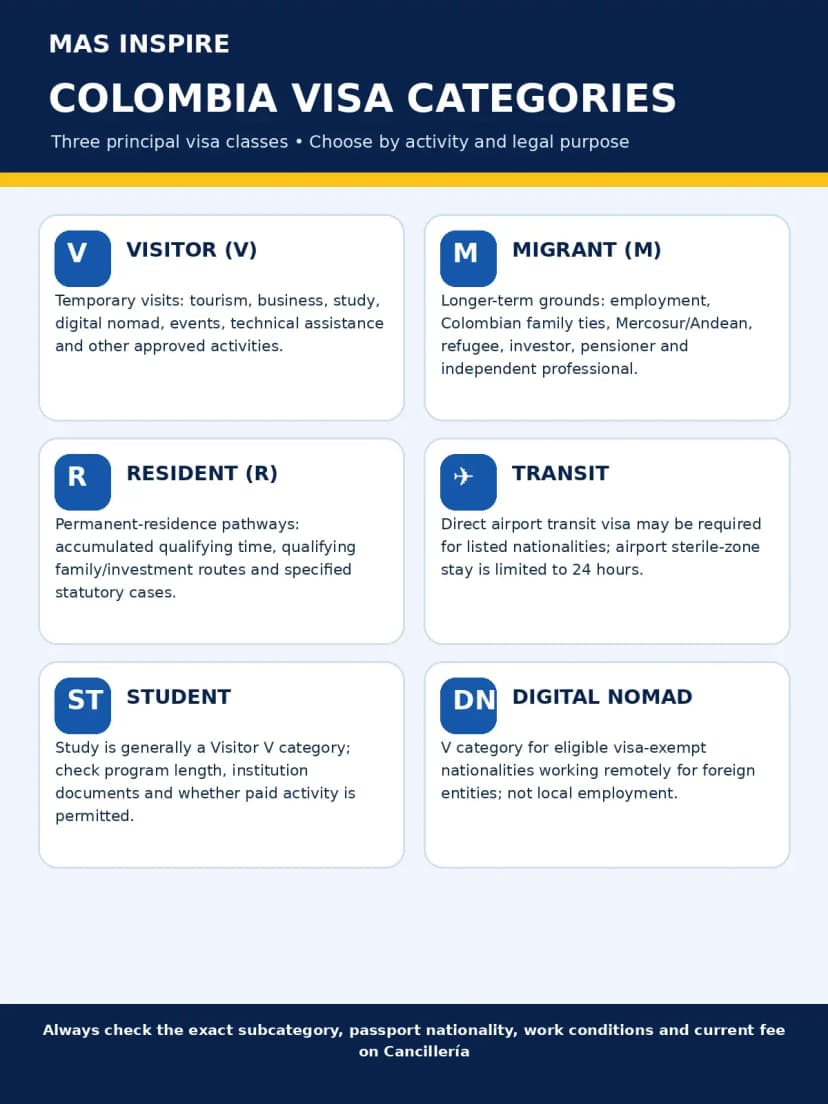
Type V is for temporary activities and does not itself establish temporary or permanent resident status. The official list includes airport transit, tourism, business, study, medical treatment, administrative or judicial procedures, crew, seasonal agricultural work, events, religious activities, volunteering, audiovisual production, journalism, technical assistance, certain treaty business activities, working holidays, internships, service provision, rentista, digital nomad and other defined cases. The Visitor Special category was added by Resolution 12509 of 4 December 2024. Not every V category permits work. Where work is allowed, it is limited to the authorised activity, employer or contractual scope.
Tourism: Applicants whose passports are on Colombia's short-stay visa-exempt lists may generally enter for non-remunerated short visits under an entry permit, subject to border-authority discretion and entry conditions. Other nationalities must obtain the appropriate Visitor visa before travel. A visa-exempt entry permit is not a work permit.
Business: The business visitor category is for permitted commercial activities such as meetings and negotiations, not local employment or salary-generating work in Colombia. Invitation and business-purpose evidence may be required. Check the precise V business conditions before undertaking any paid activity.
Student: The V student category is used for qualifying academic study. The applicant normally needs evidence from the recognised educational institution identifying the program, duration and enrolment or admission. Additional evidence may include proof of funds, insurance and academic records according to the case. Do not assume all study visas allow employment; confirm the conditions printed on the issued visa and the category rules.
Digital nomad: The V digital-nomad visa is for eligible foreign remote workers, independent contractors or digital entrepreneurs working through digital means for foreign businesses or projects. The official requirement includes a passport from a country or territory exempt from short-stay visa requirements, a foreign-company letter or qualifying entrepreneurship explanation, bank statements showing at least three Colombian monthly minimum wages (SMLMV) for each of the preceding three months, and comprehensive health coverage in Colombia. It can be issued for up to two years and does not authorise paid work for a Colombian-domiciled person or entity. This nationality condition is important: a Pakistani ordinary passport holder does not meet the visa-exempt-nationality requirement merely by holding a Vietnamese residence card. Official digital-nomad requirements.
Other V categories: Medical treatment, events, religious work, volunteering, internships, temporary service provision, technical assistance, crew and media activities have distinct evidence and work limitations. Apply under the category matching the actual activity. A category may require an invitation, contract, sponsoring organisation, institutional letter, insurance or proof of qualifications.
2. Migrant visa (Type M)
Type M is for a foreign national seeking to establish themselves in Colombia under a qualifying circumstance but who does not yet qualify for Type R. Main official subcategories include:
- Spouse or permanent partner of a Colombian national: requires evidence of the legally recognised relationship and any prescribed supporting declarations or records.
- Parent of a Colombian child: separate categories exist depending on whether the child is Colombian by birth or adoption; provide civil-status evidence.
- Mercosur or Andean migrant: available only to nationals covered by the relevant regional arrangements and subject to their conditions. It is not a general route for all nationalities.
- Refugee / stateless person: handled under the applicable protection and status rules. An ordinary employment or visitor application is not a substitute for a protection claim.
- Worker: for employment with a Colombian legal entity under an employment contract. The official checklist includes the Ministry's contract-summary format signed by employer and foreign worker, an employer motivation letter explaining the role and the applicant's suitability, and the employer's recent bank evidence showing average monthly income of 100 SMLMV. Professional credentials and licensing evidence may also be required. The visa may be valid for up to three years and work is restricted to the authorised position, entity, profession or activity. Official M worker page.
- Partner / owner, independent professional, pensioner, internationalisation promotion and investor: each has its own legal and documentary test. An investor must meet the applicable registered-investment threshold and documentary formalities; simply owning a small business or transferring funds is not enough.
- Pensioner: requires a lifetime pension certification of at least three SMLMV, properly apostilled/legalised and translated where applicable; police records for countries of residence during the preceding three years; a medical certificate; and health coverage. It can be issued for up to three years and does not permit work. Official pensioner requirements.
A Type M visa's validity depends on the subcategory. The work permission, if any, is category-specific. Beneficiary visas may be available for qualifying dependent spouses/partners and children up to age 25 or dependent children with a disability, but a beneficiary visa does not itself authorise employment.
3. Resident visa (Type R)
Type R is intended for a foreign national seeking permanent establishment in Colombia under a statutory route. The official categories include accumulated qualifying time under specified M categories, certain Colombian-family relationships, qualifying investment, former Colombian nationals who renounced nationality, and specified special statutory pathways. There is no universal job-seeker visa or automatic permanent residence merely because someone has lived in Colombia for a short period.
For accumulated time, the official schedule varies by prior visa category: examples include two years for certain Colombian-parent and Mercosur/Andean categories, three years for a spouse of a Colombian national, and five years for several other M categories, including worker, investor, pensioner and independent professional. The applicant must meet continuity and supporting-document conditions; time spent as a visitor does not automatically count. Official accumulated-time table.
Type R gives broad work permission, subject to professional licensing rules, with the stated exception for pensioners. The holder must transfer/renew the visa document every five years. The R visa automatically loses validity if its holder remains outside Colombia for two consecutive uninterrupted years. Official R visa rules.
4. Categories that do not exist as stand-alone general routes
Colombia does not list a general open-ended job-seeker visa or a generic points-based skilled-worker visa among its principal categories. Skilled professionals may qualify through a specific employer-sponsored M worker route, independent-professional route or another defined category. A startup founder may qualify only if the facts meet an actual V or M category; there is no general guarantee of a startup visa. Humanitarian protection is governed by refugee and other protection procedures, not a routine visitor visa. Transit is a specific V category for nationalities designated by Colombia; it is not required by every traveller.
Visa Comparison Table
| Route | Typical purpose | Work permission | Key qualification | Duration / stay |
|---|---|---|---|---|
| V Tourism | Short visit, leisure | No local employment | Passport nationality / entry-permit rules | As authorised at entry or on visa |
| V Business | Meetings, negotiations | No local employment | Defined business purpose and evidence | Category-specific |
| V Student | Qualifying study | Only if specifically permitted | Institution letter and study evidence | Program/category-specific |
| V Digital nomad | Remote work for foreign business | No Colombian local employment | Eligible visa-exempt nationality, foreign-work proof, 3 SMLMV income and insurance | Up to 2 years |
| V Service / internship / event | Defined temporary activity | Only within authorised scope | Contract, invitation or sponsor documents | Category-specific |
| M Worker | Colombian employment | Yes, limited to approved role/entity | Contract summary, employer letter and employer solvency | Up to 3 years |
| M Pensioner | Lifetime pension income | No | Pension at least 3 SMLMV, police/medical/insurance evidence | Up to 3 years |
| M Family | Family relationship with Colombian | Depends on category/conditions | Civil-status and relationship evidence | Category-specific |
| M Investor / owner | Qualifying investment or ownership | Subject to visa category | Investment/registration and financial proof | Category-specific |
| R Resident | Permanent residence | Generally open, subject to licensing | Qualifying statutory route | R document transfer every 5 years |
Eligibility Requirements
Applicants should check all of the following before starting:
- Nationality: confirm whether the passport is visa-exempt for short stays, requires a Visitor visa, or is on the direct airport-transit visa list.
- Purpose: select the exact subcategory that matches the real activity. Tourism, meetings, paid employment and remote work are not interchangeable.
- Residence and place of application: use the application system and consular office applicable to the country where the applicant is legally resident. Local residence does not change nationality-based visa rules.
- Sponsor or host: determine whether an employer, school, Colombian family member, company, institution or other host must provide documents.
- Financial test: use the exact threshold for the category. Do not rely on generic online balance recommendations.
- Document formalities: foreign public documents may require apostille or legalisation and official Spanish translation. Follow the specific rule for each document and issuing country.
- Regulated professions: a visa does not replace professional recognition, registration, licence or other sectoral authorisation.
Complete Document Checklists
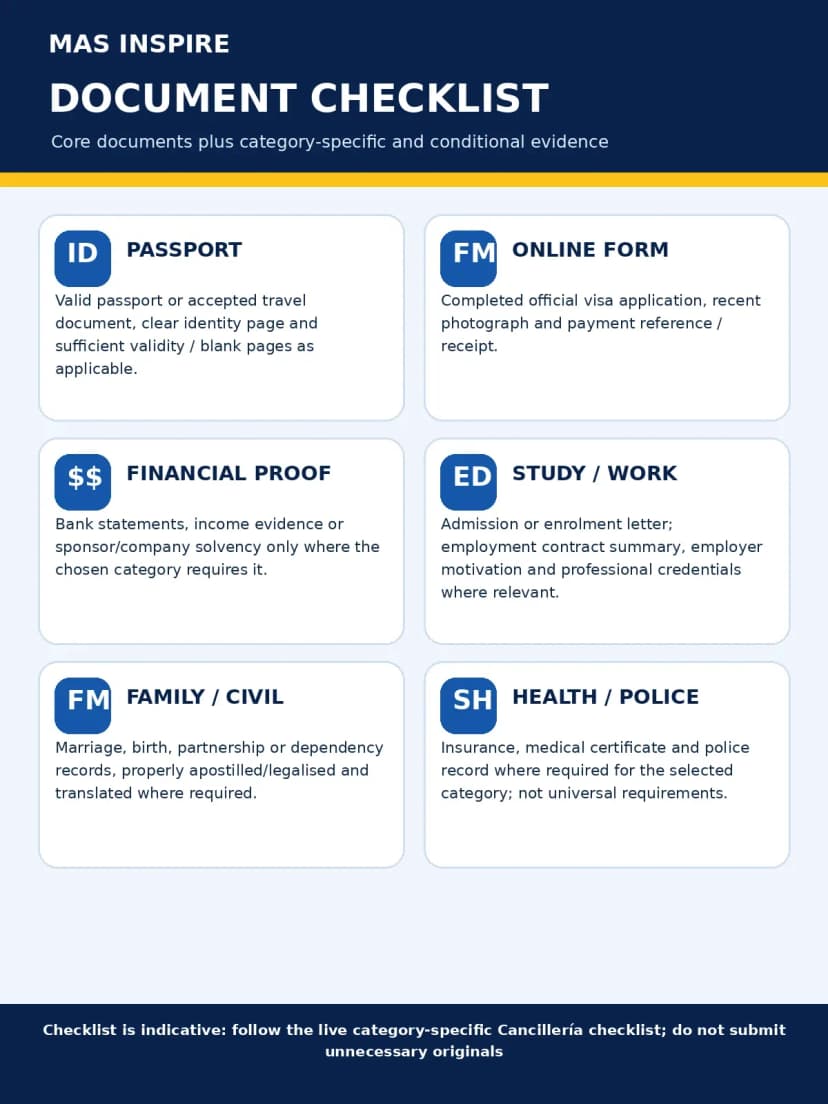
The following are planning checklists, not a claim that every item is mandatory for every applicant. The online system may request further evidence. The category-specific Cancillería checklist prevails.
| Document | General status | Notes |
|---|---|---|
| Passport identity page / travel document | Core | Must be valid and accepted; check passport condition and required validity. |
| Digital application form | Core | Complete the official online form accurately. |
| Recent digital photograph | Core in portal | Follow the current portal's size and background specifications. |
| Payment reference and study-fee receipt | Core | Study fee is non-refundable. |
| Proof of legal residence in Vietnam or another filing country | Conditional | Especially relevant when applying outside nationality country; confirm consular jurisdiction. |
| Bank statements / financial evidence | Conditional | Required thresholds differ by category; avoid assuming a universal minimum. |
| Invitation / admission / employment contract | Conditional | Required where the category is based on host, institution, employer or contract. |
| Employer/company solvency records | Conditional | For M worker, official employer evidence includes the specified four-month period and 100 SMLMV average monthly income test. |
| Marriage / birth / partnership records | Conditional | For family routes and dependants; apostille/legalisation and translation may apply. |
| Police clearance | Conditional | Required for some categories, including the pensioner route; check covered countries and period. |
| Health insurance / medical certificate | Conditional | Expressly required for certain categories, such as digital nomad and pensioner. |
| Education / professional qualifications | Conditional | For study, professional or employment categories; licensing rules may apply. |
| Travel itinerary / accommodation | Supporting where relevant | Not a universal mandatory item; include only when relevant or requested. |
Category-specific evidence
- Tourism: itinerary, accommodation, return/onward travel and funds may support the purpose, but do not treat these as universal legal requirements unless the portal or officer requests them.
- Business: invitation letter, meeting agenda, company details, travel funding and evidence of the overseas business relationship.
- Student: admission/enrolment letter, course/program details, duration, payment or scholarship evidence, funds and any required insurance.
- M Worker: signed contract-summary format; employer motivation letter; employer bank statements for the last four months demonstrating average monthly income of 100 SMLMV; applicant's qualifications or experience; professional licence if the occupation is regulated.
- M Pensioner: lifetime pension certificate for at least three SMLMV, police certificate covering countries lived in over the previous three years, medical certificate and Colombian health coverage or qualifying insurance.
- Digital nomad: passport from a short-stay visa-exempt country; foreign employer/client letter or qualifying foreign-company ownership and remote-work letter; bank statements for the last three months showing at least three SMLMV; comprehensive Colombian health insurance.
- Family: official civil-status documents, evidence of the Colombian relative's status, proof of dependency where applicable and any required declarations.
- Investor: official evidence of the qualifying investment, including registration or property records as the specific route requires, plus health and financial evidence where specified.
How to Apply: Step-by-Step
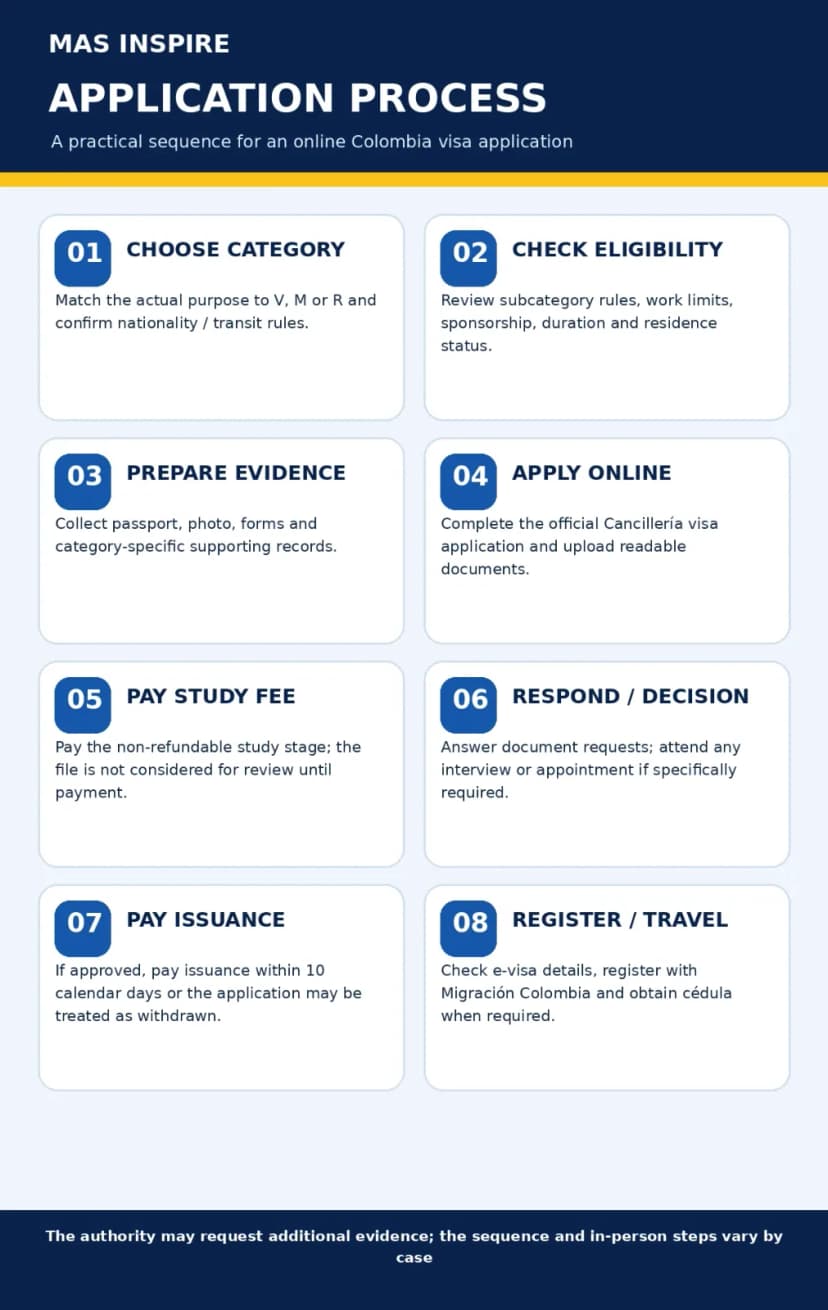
- Choose the correct visa category. Start with the official Cancillería visa categories. Do not select a category solely because its name sounds similar to your purpose.
- Check nationality, residence and eligibility. Review short-stay exemption lists and airport transit requirements. Confirm whether the consulate serving your legal residence can process or support the application.
- Prepare documents. Scan clear, complete copies. Arrange apostilles/legalisation and Spanish translations where required. Keep originals available in case the authority asks for them.
- Open the official online application portal. Use the link from the Cancillería visa page; avoid third-party lookalike websites. Enter personal, passport, travel and sponsor details consistently.
- Complete the correct form. Review spelling, passport numbers, dates, addresses and the selected visa category before submission.
- Upload documents and pay the study fee. The application is considered submitted for study only after the required study payment. The fee is generally non-refundable and does not guarantee approval.
- Attend biometrics or interview if requested. Do not assume every applicant must attend an appointment. Follow the specific email or instructions issued by the visa authority or consulate.
- Submit and monitor the application. Check the portal and email, including spam folders. Respond to requests for missing documents within the stated deadline.
- Receive the decision and pay issuance. If approved, pay the issuance fee within ten calendar days. Failure to pay within that period may be treated as withdrawal.
- Check the visa and post-arrival obligations. Verify the visa details and permitted activities. Where required, register the visa with Migración Colombia and apply for a cédula de extranjería within the applicable period. Confirm entry conditions before travel.
The regulation provides up to 30 calendar days for the authority to issue a decision after a complete application and payment, but additional document requests, case complexity or other circumstances may affect the actual timeline. Regulatory processing rule.
Visa Fees and Financial Requirements
The 2026 general tariff resolution publishes the following standard USD charges for the three main visa classes:
| Visa class | Study fee | Issuance fee | Standard combined amount |
|---|---|---|---|
| V Visitor | USD 56 | USD 138 | USD 194 |
| M Migrant | USD 56 | USD 204 | USD 260 |
| R Resident | USD 56 | USD 183 | USD 239 |
| Visa transfer | USD 56 | USD 56 | USD 112 |
These figures are standard class-level amounts shown in the 2026 tariff schedule. The live cost page may display category-specific or nationality-specific amounts; for example, its digital-nomad selector displays USD 56 for study and USD 183 for issuance. Therefore, applicants should use the live fee calculator for their exact category, location and nationality before payment. Some exemptions and special rates apply. Stamp tax, where applicable, may be additional. 2026 tariff resolution · Official visa cost calculator.
Financial thresholds are category-specific, not a universal bank-balance rule. Examples include three SMLMV in monthly income for the digital-nomad category (for the preceding three months), three SMLMV in lifetime pension for M pensioner, and the employer's 100 SMLMV average monthly income test for M worker. SMLMV is Colombia's statutory monthly minimum wage; the peso value changes by year. Do not convert a past year's threshold into a current requirement without checking the applicable annual wage.
Visa Processing Times
The regulation states that the Visa and Immigration Authority has up to 30 calendar days to issue a decision once the application is complete, all required documents have been supplied and the study fee has been paid. This is a regulatory decision period, not a promise that every application will be decided in 30 days. A request for additional documents, verification, interview or other administrative step can affect the timetable. No fixed universal processing time should be assumed for all categories or consulates.
| Stage | Published rule / practical note |
|---|---|
| Study payment after creating application | Pay within 10 calendar days or application may be treated as withdrawn. |
| Decision after complete submission and payment | Up to 30 calendar days under the regulation. |
| Issuance payment after approval | Pay within 10 calendar days. |
| Appointment / biometrics | Only if specifically required; local consular practice may vary. |
| Passport / e-visa delivery | Follow the decision notice and portal instructions; do not assume a universal collection method. |
Applying from Pakistan or Vietnam
Pakistani passport holders
Pakistani ordinary passport holders should assume that a visa is required for an ordinary tourism visit unless Cancillería's current nationality list expressly provides otherwise. Pakistan is specifically named on Colombia's official list of nationalities that require a direct airport-transit visa for transit through an international airport en route to a third country. The transit permission is limited to the international sterile/transit area for up to 24 hours and does not authorise changing airports or entering Colombia. Check the current list before booking a connection.
A Pakistani national living or working legally in Vietnam remains a Pakistani national for visa-exemption purposes. A Vietnamese temporary residence card, work permit or other local residence document may help establish where the person lawfully resides and which consular office to contact; it does not automatically waive Colombia's visa requirement or guarantee that the Hanoi office will accept every category of application. Obtain written confirmation from the consular section before paying or travelling to an appointment.
Applying while legally resident in Vietnam
Colombia maintains an embassy and consular section in Hanoi:
Embassy of Colombia in Vietnam Cornerstone Building, 14F, 16 Phan Chu Trinh Street, Cua Nam Ward, Hanoi, Vietnam Telephone: +84 24 393 65318 Consular appointments: contact the consular section by email or telephone; the official page lists weekday service by appointment. Official embassy contact page.
A Pakistani applicant in Vietnam should prepare a valid Pakistani passport, Vietnamese residence/work documentation, the selected category's evidence and any required apostilles/translations. Ask the Hanoi consular section whether it handles the requested visa category for residents of Vietnam, whether any in-person step is needed, the payment method and whether additional country-specific documents are expected. The public embassy contact page confirms the office and contact details; it does not publish a special guaranteed pathway for Pakistani residents.
Applying from Pakistan compared with Vietnam
| Issue | Applying from Pakistan | Applying from Vietnam |
|---|---|---|
| Nationality rule | Pakistani passport rules apply | The same Pakistani passport rules apply |
| Residence evidence | Usually evidence of residence in Pakistan | Provide valid Vietnamese residence/work status |
| Consular office | Confirm the Colombian mission responsible for Pakistan | Contact the Colombian Embassy/consular section in Hanoi |
| Application platform | Use official Cancillería portal | Same official portal; confirm local consular arrangements |
| Documents | Pakistani-issued public records may need apostille/legalisation and translation | Vietnamese-issued records may need their own formalities; Pakistani records retain their own issuing-country formalities |
| Eligibility | Determined by visa category and nationality | Vietnamese residence does not create visa-free eligibility |
Do not assume a residence permit in Vietnam is equivalent to permanent residence in a visa-exempt country. This matters particularly for the digital-nomad category, whose published nationality condition requires a passport from a short-stay visa-exempt country.
Student Visa Guide
A prospective student should first obtain admission from a qualifying Colombian educational institution and confirm which V student category applies to the course. The institution's letter should clearly identify the applicant, program, study level, dates and expected duration. Applicants should prepare the passport, online form, photo, admission/enrolment evidence, proof of tuition payment or scholarship if relevant, funds and any insurance or additional documents requested by the authority.
A student visa is not a general employment permit. Do not accept paid work unless the issued visa and applicable rules expressly authorise it. Students in postgraduate programs may have different beneficiary possibilities from other student cases; verify the current beneficiary provisions. Keep enrolment active and notify the authority if the underlying study circumstances change in a way that affects the visa.
Work Visa and Job Opportunities
Foreign nationals who will be employed by a Colombian legal entity should examine the M worker visa. The employer plays a substantial role: the prescribed contract-summary format must be signed by the employer's legal representative and the foreign worker; the employer must explain the role, the applicant's suitability and why the position is not filled by a Colombian citizen; and the company must provide the prescribed recent financial evidence. The official M worker page states an average monthly income threshold of 100 SMLMV across the employer's preceding four months.
The visa's work permission is tied to the authorised role, entity, profession or activity. A change of employer or role may require a new visa or authorisation. Regulated professions may require a separate licence or registration from the relevant professional council. A visa approval does not replace labour-law compliance, social-security obligations or professional recognition.
Colombia does not provide a general job-seeker visa as a substitute for sponsorship. Applicants should secure a qualifying job and employer documentation before applying under the worker category.
Family Immigration and Permanent Residence
Family-based M routes include spouse or permanent partner of a Colombian national and specified parent/child relationships. Civil documents must prove the relationship in the form required by Colombian rules. A marriage certificate, birth record or partnership declaration issued abroad may need apostille/legalisation and official translation. A beneficiary visa may be available to eligible dependent family members of a principal visa holder; beneficiaries generally cannot work unless a separate legal basis authorises it.
Permanent residence through accumulated time is not automatic. Only specified visa categories count, and the minimum period depends on the category. Applicants should preserve copies of every visa and relevant movement record, maintain legal status and check the required continuity. Type R holders must transfer the visa document every five years and avoid a two-consecutive-year absence that would automatically terminate validity.
Common Application Mistakes
- Choosing tourism or business when the real purpose is local employment.
- Assuming a residence permit in a third country changes passport-based visa exemption.
- Applying for a digital-nomad visa without meeting its nationality condition.
- Uploading incomplete, illegible, inconsistent or expired documents.
- Omitting apostille/legalisation or required Spanish translation.
- Using a generic employer letter instead of the prescribed contract-summary format and motivation letter.
- Treating the visa study payment as refundable or as a guarantee of approval.
- Missing the ten-calendar-day payment deadlines.
- Starting work outside the exact scope printed on the visa.
- Assuming a visitor stay automatically counts toward permanent residence.
Reasons for Visa Refusal
A visa may be refused where the applicant does not meet the category's legal conditions, provides incomplete or unreliable information, fails to establish the genuine purpose of travel, lacks required sponsor or financial evidence, submits documents that cannot be authenticated, or raises admissibility or public-order concerns. A decision is discretionary under Colombian law. Never submit altered records, conceal relevant facts or misrepresent the proposed activity. If refused, read the written decision and follow the official procedure for any available review or new application; a fresh application normally requires a new study-fee payment.
Frequently Asked Questions
1. Do all nationalities need a visa to visit Colombia?
No. Colombia maintains short-stay visa-exempt lists and special cases. Travellers not covered by an exemption generally need the relevant Visitor visa. Check the official nationality list before travel.
2. Do Pakistani citizens need a visa for Colombia?
Pakistani ordinary passport holders should check and obtain the required visa before travel. Pakistan is explicitly listed among nationalities requiring a direct airport-transit visa.
3. Can a Pakistani living in Vietnam apply from Hanoi?
The Colombian Embassy in Hanoi has a consular section. The applicant should contact it to confirm acceptance of the category and local procedure. Vietnamese residence does not waive the Pakistani passport's visa requirement.
4. Does a Vietnam work permit make a Pakistani eligible for Colombia's digital-nomad visa?
No, not by itself. The official digital-nomad requirements specify a passport from a short-stay visa-exempt country. A Vietnam work permit is not a substitute for that nationality condition.
5. How much does a Colombia visa cost in 2026?
The 2026 standard class tariff lists USD 56 study plus USD 138 issuance for V, USD 56 plus USD 204 for M, and USD 56 plus USD 183 for R. Check the live category-specific calculator because special category fees and exemptions may differ.
6. How long does a Colombia visa take?
The regulation provides up to 30 calendar days for a decision after a complete application and payment. Additional document requests or other steps can extend the practical timeline.
7. Can I work in Colombia on a tourist visa?
No. Tourism or ordinary business visitor permission does not authorise local employment. Work is permitted only where the specific visa category expressly grants it and within its limits.
8. Can I work for a Colombian company on a digital-nomad visa?
No. The digital-nomad visa does not permit paid work for a person or entity domiciled in Colombia.
9. Is there a Colombia job-seeker visa?
There is no general open-ended job-seeker visa in the principal visa framework. A foreign employee generally needs a qualifying job arrangement and the appropriate work-authorising category.
10. What is the difference between V, M and R visas?
V is for temporary visitor activities; M is for defined migrant circumstances such as employment, family, pension or investment; R is for permanent residence under specified legal pathways.
11. Does a student visa allow employment?
Do not assume so. Work permission depends on the exact category and conditions. Check the current rule and the issued visa before accepting paid work.
12. How long is a digital-nomad visa valid?
The official category page says it may be issued for up to two years, subject to approval and the individual visa conditions.
13. Can a pensioner visa holder work?
The official M pensioner page states that this visa does not permit work in Colombia.
14. How can I qualify for permanent residence?
Possible routes include specified qualifying accumulated time under listed M categories and other statutory pathways. The required period varies; it is not an automatic consequence of any stay.
15. Does a Colombian resident visa expire if I leave the country?
The official rule says an R visa automatically loses validity after two consecutive uninterrupted years outside Colombia. R visa holders must also complete the visa transfer process every five years.
Official Immigration Websites
- Colombian Ministry of Foreign Affairs – Visas
- Visa types and categories
- Do I need a visa? Nationality and transit information
- Visa application guidance / ABC
- Visa costs
- Resolution 5477 of 2022, consolidated
- Migración Colombia
- Colombian Embassy in Vietnam
Final Checklist and Conclusion
Before submitting, confirm the correct V, M or R subcategory; verify nationality and transit requirements; confirm the consular office serving your legal residence; prepare the correct supporting evidence; complete apostilles, legalisation and translations; use the official portal; pay the correct study fee; monitor email and portal messages; pay issuance promptly if approved; and comply with registration, work and entry conditions.
Colombia offers several legitimate routes for visitors, students, workers, family members, investors and retirees, but each route has its own eligibility test. Pakistani nationals living or working in Vietnam should pay particular attention to nationality-based restrictions and obtain confirmation from the Colombian consular section in Hanoi before applying. No guide can guarantee approval. Always rely on the current official instructions and the visa decision issued in your own case.
Disclaimer: This article is for general educational purposes and is not legal advice, immigration representation or a guarantee of visa approval. Rules and fees can change without notice. Confirm all requirements directly with Colombia's Ministry of Foreign Affairs and, where appropriate, a qualified Colombian immigration professional.