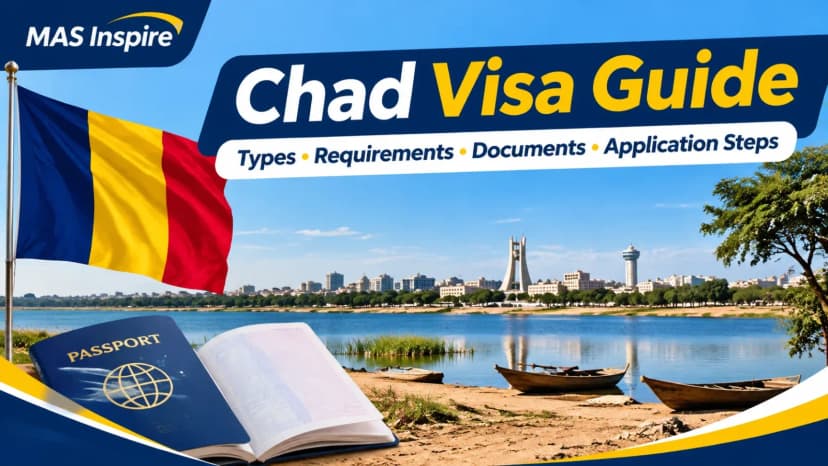
Chad Visa Guide 2026: Types, Requirements, Documents and How to Apply
Research checked: 26 November 2026 Publisher: MAS Inspire Important: This guide is educational information, not legal advice and not an official publication of the Republic of Chad. Immigration rules, fees and procedures can change. The Chadian authorities make the final decision on entry and residence.
Start with the official portal: e-Visa Tchad. Use the government portal rather than an intermediary. The portal describes itself as the official online visa application platform.
Table of contents
- Introduction
- Why visit, study or work in Chad?
- Types of Chad visas
- Visa comparison
- Eligibility requirements
- Document checklists
- How to apply
- Visa fees and financial requirements
- Processing times and validity
- Applying from Pakistan or Vietnam
- Student and work pathways
- Family residence and permanent residence
- Mistakes and refusal risks
- Frequently asked questions
- Official sources
- Final checklist and conclusion
Introduction
Chad is a landlocked country in Central Africa with N'Djamena as its capital. Travellers may visit for tourism, business, official assignments, education, employment, family reasons or transit. The correct entry permission depends on the purpose and length of the visit, the traveller's nationality and any applicable exemption or bilateral arrangement.
For most applicants, the safest first step is to check the live e-Visa Tchad portal. Do not assume that a visa issued by a third-party website is valid. The portal's own instructions and the applicable Chadian rules should be checked immediately before payment and travel.
Why visit, study or work in Chad?
Chad has distinctive natural and cultural attractions, including the Sahara and Ennedi landscapes, the Ounianga Lakes, Zakouma National Park and Lake Chad. N'Djamena is the principal administrative and commercial centre. Business, development, humanitarian, research and education assignments may also bring foreign nationals to the country.
Travel planning should include a separate security and health assessment. Visa approval does not establish that a particular region is safe to visit. Check your own government's current travel advice and obtain suitable medical and evacuation insurance.
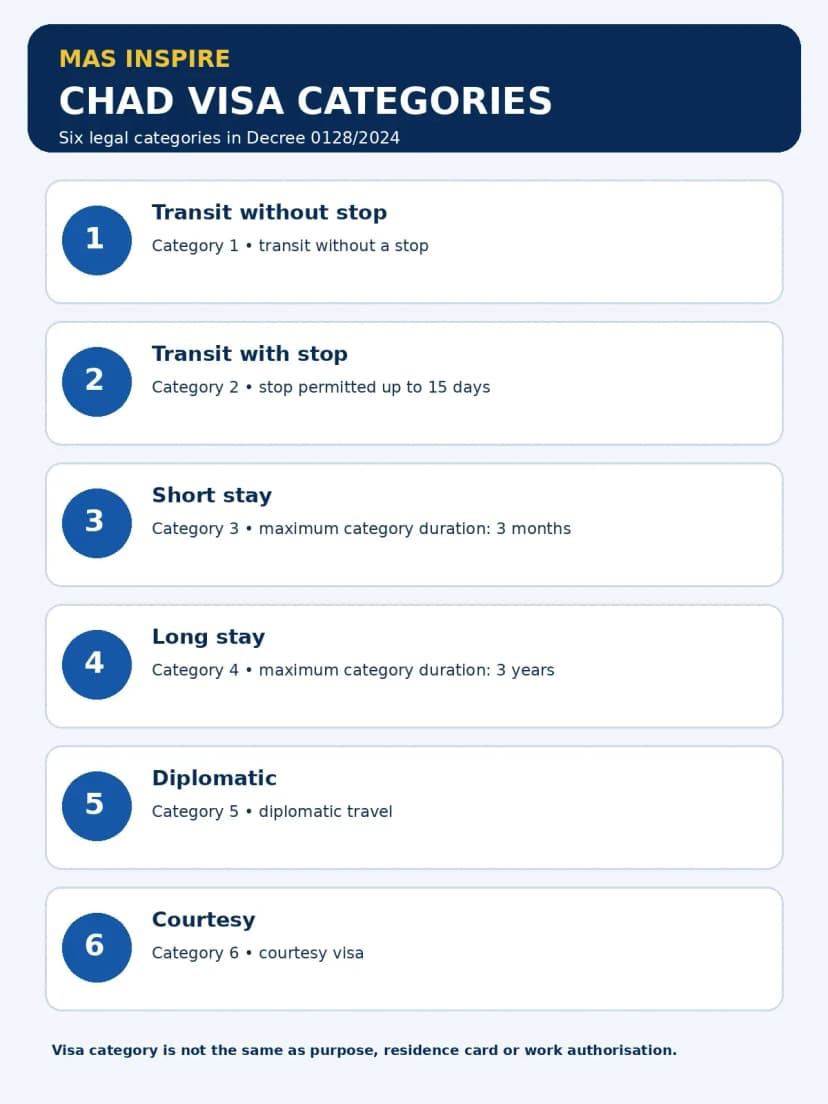
Types of Chad visas
Chad's 2024 decree divides foreign nationals broadly into visitors and residents, according to the purpose and duration of their stay. It describes tourists, business visitors, temporary workers, official mission visitors and medical evacuees as visitor types. Residents include contractual workers, diplomats, members of religious congregations and students enrolled in an eligible higher-education or training institution.
The decree identifies these six legal visa categories:
| Legal category | Meaning in the decree | Key point |
|---|---|---|
| Category 1 | Transit without stop | For transit where no stop is made; confirm routing and eligibility with the authority. |
| Category 2 | Transit with a stop, maximum 15 days | The decree specifies a maximum stop of 15 days. |
| Category 3 | Short-stay visa, not exceeding 3 months | Common framework for short visits; purpose-specific evidence may be requested. |
| Category 4 | Long-stay visa, not exceeding 3 years | Long-stay permission is distinct from the residence card and any work authorisation. |
| Category 5 | Diplomatic visa | For qualifying diplomatic travel. |
| Category 6 | Courtesy visa | Issuance is governed by the relevant official arrangements. |
Tourist and visitor travel
A tourist visits Chad to discover the country and stays in a hotel or private accommodation. Prepare an accommodation record, itinerary, return or onward travel evidence and financial evidence if requested. Tourism does not authorise local employment.
Business visitor
The decree describes a business visitor as a person whose stay is related to economic or financial sectors and who carries out a professional activity for profit in a personal capacity. For meetings, negotiations, conferences or commercial visits, prepare a host invitation, employer letter, trip purpose, itinerary and evidence of accommodation and funding. A business visit should not be used as a substitute for permission to take up local employment.
Temporary worker and contractual employee
The decree distinguishes a temporary worker travelling in connection with professional activity from a resident contractual worker bound by a duly signed employment contract. A foreign employee must obtain the applicable employment and residence authorisations before starting work. The decree's residence-card checklist specifically refers to an employment authorisation from the competent employment-promotion body for company employees.
Student and long-term trainee
A student is defined by reference to regular enrolment at a higher education, vocational or training institution in Chad. A foreign national admitted for studies or a long-term internship must obtain a residence card unless another legal provision applies. Obtain written admission and ask the institution and immigration authority which long-stay/e-Visa route applies to the particular programme.
Diplomatic, courtesy and official mission travel
Diplomatic and courtesy visas are separate legal categories. The decree assigns diplomatic admission matters to the Ministry responsible for Foreign Affairs. Officials and experts on mission should carry an official mission order or accreditation document as well as the required travel and vaccination documents.
Family, medical, research, internship and humanitarian cases
The decree recognises a special residence arrangement for legal spouses of Chadian citizens, medical evacuees among visitor types, and long-term interns in its residence provisions. It does not establish separate public-facing visa products in the sources reviewed for digital nomads, job seekers, start-up founders, general skilled migration or permanent settlement. Applicants in research, exchange, humanitarian or family situations should obtain written category confirmation from the Chadian authorities rather than assume a separate visa class exists.
Visa comparison
| Purpose | Relevant legal route | Work rights | Main evidence to prepare |
|---|---|---|---|
| Tourism/private visit | Usually category 3 short stay | No local employment | Accommodation, itinerary, travel ticket, funds, passport, vaccination record |
| Business meetings | Visitor/business purpose, generally short stay | Meetings only; not local employment | Invitation, employer letter, itinerary, accommodation, funds |
| Transit | Category 1 or 2 | No | Confirmed onward itinerary and destination entry permission if applicable |
| Employment | Category 4/long-stay route plus employment and residence authorisations as applicable | Only after required authorisations | Signed contract, employer documents, employment authorisation, residence application |
| Study/long internship | Long-stay route and residence card | Do not assume work permission | Admission/enrolment, funding, accommodation, passport, police record if requested |
| Diplomatic/courtesy | Category 5 or 6 | Only within official status | Diplomatic/service passport, note verbale or official letter, mission details |
| Family residence | Relevant entry permission plus residence-card procedure | Separate work authorisation required if employed | Marriage/family proof, sponsor details, passport and residence documents |
Eligibility requirements
Eligibility is determined by nationality, travel purpose, intended stay, the documents supplied and any bilateral exemption. Chad's decree provides visa-free or privileged treatment for CEMAC nationals and nationals of countries with relevant exemption agreements. CEMAC nationals may enter, circulate and stay for up to 90 days with one of the accepted valid identity or passport documents specified in the decree. The e-Visa portal separately publishes a live list of visa-exempt nationalities. These are nationality-based rules: holding a residence permit from Vietnam or another third country does not itself create a Chadian visa exemption.
The UK government states that a British visitor's passport should remain valid for at least six months after arrival. Chad's decree requires a passport valid for at least six months before expiry. Travellers should meet the stricter practical standard and confirm any nationality-specific requirement with the portal or mission handling the application.
The decree requires proof of accommodation and an international yellow-fever vaccination certificate for ordinary entry. It specifies that the vaccination should have been administered more than 10 days and less than 10 years before embarkation, and exempts children under one year from presenting the certificate under that decree. Follow any newer public-health directions as well.
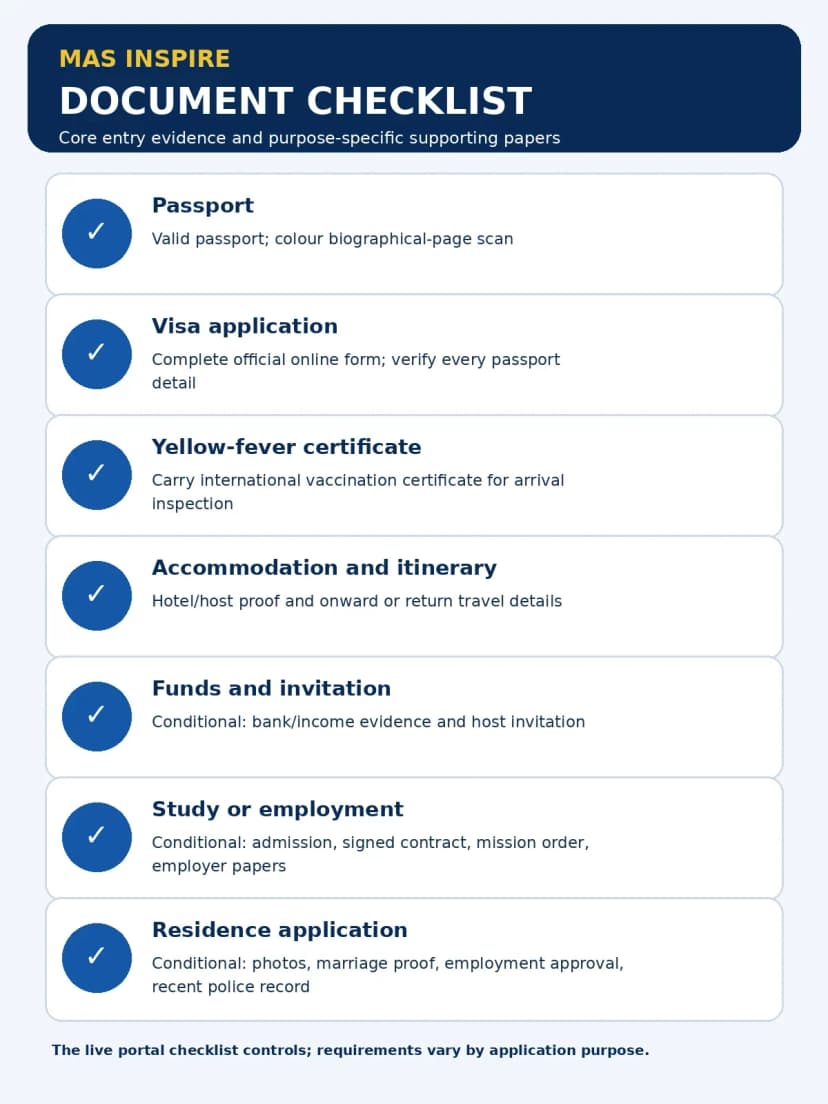
Document checklists
The following separates legal baseline documents from supporting evidence shown on the official portal. The authority may request additional documents depending on the purpose.
| Document | Status / when relevant | Notes |
|---|---|---|
| Valid passport | Core | Decree specifies at least six months remaining before expiry; portal upload asks for the colour biographical page. |
| Official e-Visa application | Core for applicants using the online route | Enter details exactly as shown in the passport. |
| Recent passport photograph | May be requested | Decree's general visa application provision specifies two recent photos; follow current portal specifications. |
| Yellow-fever vaccination certificate | Entry requirement | Carry the original international certificate for inspection. |
| Accommodation proof | Entry requirement in decree | Hotel booking or host accommodation attestation. |
| Flight/transport itinerary | Core/supporting | Portal lists flight tickets and transport evidence. |
| Invitation letter | Conditional | For host, business, NGO or private invitation cases; legalisation may be required where applicable. |
| Proof of funds/income | Conditional | Portal lists bank statements and income evidence; no universal minimum balance was found. |
| Employer letter/contract | Conditional | For business, temporary work or employment-related cases. |
| Assignment order / mission document | Conditional | For official mission, NGO or institutional travel. |
| Host organisation/company records | Conditional | Portal lists administrative and tax documents for organisations/businesses. |
| Admission/enrolment letter | Conditional | For study or long-term training. |
| Marriage/family certificate | Conditional | For spouse/family residence applications. |
| Police clearance | Residence-card application | Decree specifies a criminal-record extract issued less than three months earlier. |
| Employment authorisation | Employment residence | Decree lists this for employees of companies. |
| Residence-country permit | Conditional | Portal lists a residence card of the applicant's host country among possible supporting items. |
| Previous visa | Extension | Portal asks for the latest visa when applying to extend a stay. |
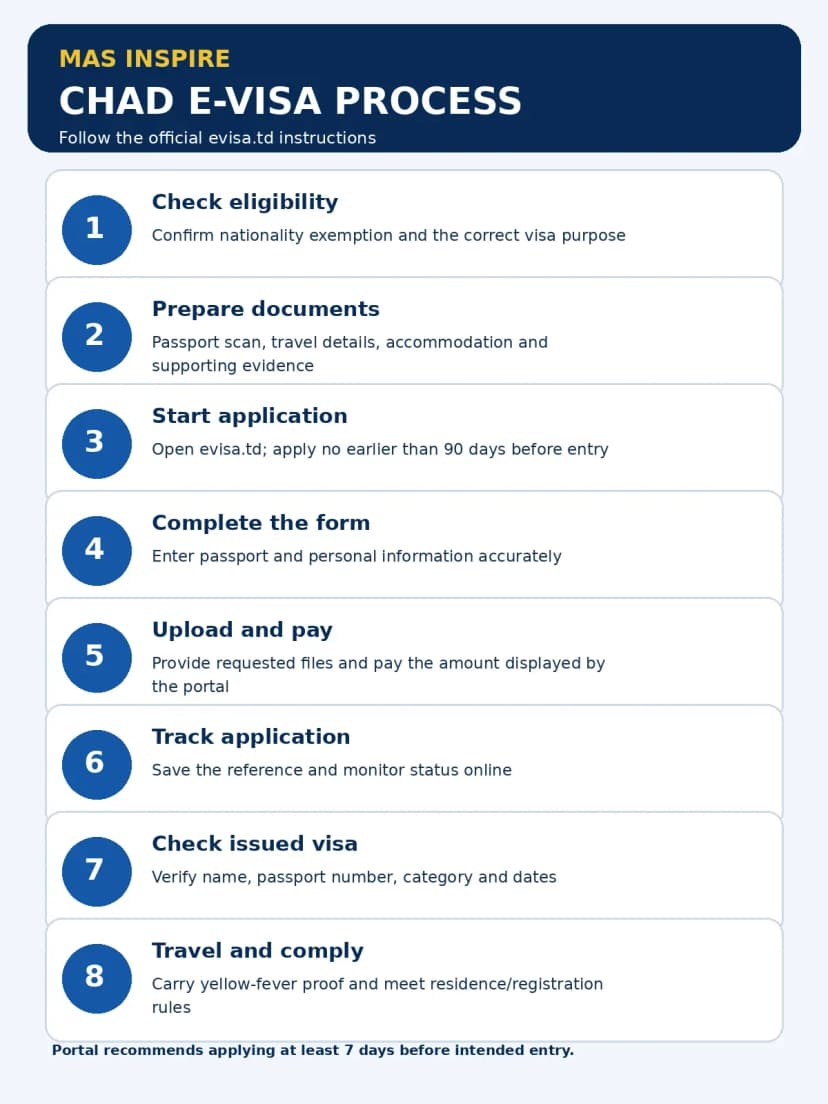
How to apply: step-by-step
- Choose the correct purpose and category. Decide whether the trip is transit, tourism, business, official mission, study, employment or family-related. Match the purpose to the legal categories rather than choosing a label solely because it appears convenient.
- Check nationality and residence. Use the official exempt-country list and verify whether a bilateral agreement or CEMAC rule applies. A residence permit in Vietnam is not a nationality exemption.
- Prepare documents. Scan the passport biographical page in colour. Gather accommodation, travel, invitation, financial, employer, school or mission evidence as appropriate. Keep the yellow-fever certificate ready for travel.
- Open the official portal. Go to evisa.td. The portal's stated process begins with initiating the application, entering the form details, paying and tracking the request.
- Complete the application carefully. Use the exact passport spelling, number and expiry date. Check all information before submitting: the portal says an issued e-Visa cannot be modified.
- Upload the requested evidence. Follow the live checklist and file-format instructions. The portal's application-start section asks for the passport biographical page; its further checklist lists additional supporting evidence depending on the file.
- Pay only through the official process. Check the amount and payment method shown in the portal at the time of application. The portal states that payments are non-refundable.
- Attend any additional step if directed. The public portal pages reviewed describe an online process and do not publish a universal biometrics or interview requirement. Follow any individual instruction from immigration.
- Track the application. Use the portal's application-tracking function and keep the reference number and payment confirmation.
- Check the issued permission before travel. Confirm the name, passport number, entry dates, category and permitted stay. Carry accommodation evidence and the yellow-fever certificate. If staying more than 72 hours, UK travel advice says visitors must register with the police; confirm the current local procedure on arrival.
Not every application follows ten identical steps. Diplomatic and courtesy cases, and long-stay/residence procedures, may involve other government offices and supporting documents.
Visa fees and financial requirements
No current universal fee amount could be verified from the readable official tariff material. The e-Visa homepage carries a 11 May 2026 notice titled “Nouvelles tarifications des visas en République du Tchad,” but the accessible page did not expose the actual amounts in readable text. Do not rely on old embassy fee tables or third-party fee aggregators as current e-Visa prices.
The official portal lists proof of funds or income, such as bank statements, among documents that may be required. No universal minimum bank balance was published in the material reviewed. Ask the authority whether the amount is assessed by trip length, sponsorship and applicant circumstances.
| Fee / financial item | Verified position |
|---|---|
| e-Visa application fee | Check the amount displayed in the official portal before payment; readable current amount not verified |
| Transit fee | Not independently verified |
| Short-stay fee | Not independently verified |
| Long-stay fee | Not independently verified |
| Residence-card fee | Decree refers to a bank deposit slip; amount not stated in the decree text reviewed |
| Minimum bank balance | Not officially published in sources reviewed |
Processing times and validity
The e-Visa portal recommends applying at least seven days before entry, but this is a recommendation for when to submit, not a guaranteed processing time. The portal does not publish a universal processing-time promise on the pages reviewed. Apply early and do not buy non-refundable travel based on an assumed decision date.
The legal decree defines category 2 transit as no more than 15 days, category 3 short stay as no more than three months and category 4 long stay as no more than three years. These are category ceilings, not a promise that every applicant will receive the maximum duration. The residence card is valid for one year and renewable. Visa validity and the period authorised for a particular stay are not necessarily the same thing; follow the dates and conditions on the issued document.
Applying from Pakistan or Vietnam
Pakistani passport holders legally living or working in Vietnam
A Pakistani passport holder should assess the application by Pakistani nationality, not by Vietnamese residence. Pakistan is not among the visa-exempt countries visible in the official portal list reviewed. A Vietnamese residence permit does not automatically exempt a Pakistani national from a Chadian visa or guarantee that a local Chadian mission will accept a paper application.
The e-Visa platform is the clearest first channel because it accepts applications from non-exempt foreign nationals online. Its supporting-document list includes a residence card from the applicant's country of residence, so a Pakistani applicant living in Vietnam should be ready to upload a valid Vietnamese temporary or permanent residence document if the form requests it. Also prepare a passport scan, travel purpose evidence, accommodation, itinerary, funding and invitation/employer/school papers where relevant.
The public sources reviewed did not establish a Chadian embassy or consulate in Vietnam, nor confirm a separate local filing arrangement for Pakistani residents. Before paying, contact the official e-Visa helpdesk at contact@evisa.td or +235 68 00 11 45 and ask whether any additional nationality-specific document or in-person step applies. If the portal directs you to a mission, request the correct mission responsible for Vietnam in writing.
Applying from Pakistan
A Pakistani applicant applying while resident in Pakistan should use the same official portal and provide their true place of residence and application details. If the system or immigration authority requires a consular route, ask the Chadian Ministry/mission to identify the responsible office. Do not assume that a third-country embassy will accept the case without jurisdiction confirmation.
Applying while resident in Vietnam: practical comparison
| Issue | Applying from Pakistan | Pakistani citizen resident in Vietnam |
|---|---|---|
| Nationality assessment | Pakistani passport | Pakistani passport; Vietnam residence does not change nationality |
| Starting channel | Official e-Visa portal | Official e-Visa portal |
| Residence evidence | Pakistan address/residence evidence if requested | Valid Vietnam residence card/permit if requested |
| Local mission | Confirm with Chadian authorities | No Vietnam-based Chadian mission confirmed in sources reviewed; ask e-Visa helpdesk |
| Additional documents | Purpose-specific invitation, employer/school and funds | Same, plus proof of lawful Vietnam residence if requested |
| Guarantee of local acceptance | No | No; residence does not guarantee consular jurisdiction |
Student and work pathways
Student visa and residence
Secure admission before applying. Ask the institution to confirm its legal status, programme dates, attendance requirements and the immigration paperwork it supports. Decree 0128/2024 defines a student as a person regularly enrolled at a higher-education, vocational or training institution. It says a foreign national admitted for studies or a long-term internship must obtain a residence card unless another rule applies. Prepare the admission letter, passport, entry permission, accommodation, proof of funding and any additional documents requested by immigration. The reviewed sources do not establish a separate public student visa fee or a universal student work right.
Work visa, employment and permits
Do not travel on a tourist visa intending to start a job. Obtain a genuine employment offer and ask the employer to coordinate the correct long-stay, employment authorisation and residence-card process. Decree 0128/2024 lists an employment authorisation from the competent employment-promotion authority among the residence-card documents for company employees. It also states that foreigners exercising a profession, whether remunerated or not, must hold a residence card and comply with the labour code; employers must not employ a foreigner without the required residence card or an appropriately endorsed employment contract.
The public legal text reviewed does not provide a complete online work-permit application checklist, fee or processing time. The employer should confirm current requirements with the competent employment and immigration authorities before the employee begins work.
Family residence and permanent residence
The 2024 decree says legal spouses of Chadian citizens benefit from a derogatory/special regime for entry and residence, with implementation details to be set by ministerial order. It does not mean every spouse automatically receives permanent residence. For a residence-card application, the decree lists a marriage certificate for spouses, a handwritten application stating the reason, a valid passport bearing a valid entry visa, a bank deposit slip, two colour identity photos and a criminal-record extract issued less than three months earlier. Additional requirements may apply.
The sources reviewed establish a renewable one-year residence card, not a general permanent-residence or settlement pathway. Do not describe a renewable residence card as permanent residence or citizenship. Dependants should ask immigration whether each family member needs a separate entry permission and residence card. A dependant who intends to work should obtain the required separate authorisation.
Common application mistakes
- Using an unofficial visa website instead of evisa.td.
- Applying more than 90 days before intended entry or leaving the application until the last minute.
- Entering passport details incorrectly or uploading an unreadable scan.
- Assuming that an issued e-Visa can be amended; the portal says it cannot.
- Assuming an old embassy fee schedule is still current.
- Failing to provide accommodation or purpose-specific invitation evidence.
- Treating a business visit as permission to take up employment.
- Assuming a Vietnam residence permit creates visa-free access or guarantees local consular jurisdiction.
- Arriving without the required yellow-fever certificate or failing to check current health rules.
- Staying beyond the authorised period without contacting the Directorate of Emigration and Immigration.
Reasons for visa refusal or entry denial
The decree authorises refusal where an applicant is subject to criminal proceedings, has been convicted of a crime, is associated with persons or organisations involved in criminal activity, or is considered likely to disturb public order. Incomplete or inconsistent evidence, an unclear purpose, missing accommodation proof, invalid travel documents or failure to meet the category requirements can also undermine an application. The embassy in the United States warns that incomplete applications submitted through its consular process may be rejected; current e-Visa applicants should follow the online portal's checklist.
Never submit false documents or conceal material facts. A visa does not guarantee admission: border authorities retain the power to examine documents and decide whether entry conditions are met.
Frequently asked questions
1. Do Pakistani citizens need a visa for Chad?
Pakistani nationals are not among the visa-exempt nationalities visible in the official portal list reviewed. Check the live list and apply through the official portal unless the authorities confirm an applicable exemption.
2. Can a Pakistani citizen apply for a Chad visa from Vietnam?
The official e-Visa portal is the appropriate starting point for non-exempt foreign nationals. Upload Vietnam residence evidence if requested and ask the helpdesk about any nationality-specific or local requirements. A Vietnam residence permit does not guarantee consular acceptance.
3. What is the official Chad visa website?
The government platform is https://evisa.td/.
4. How early should I apply?
The portal recommends applying at least seven days before entry and does not allow an application more than 90 days before the intended entry date.
5. How much does a Chad visa cost in 2026?
The live portal publishes a notice about new tariffs, but the readable material reviewed did not show the actual amounts. Check the amount displayed in the official application before paying.
6. Is there a visa on arrival?
Do not assume that you can board or arrive without prior permission. The official portal says the entry visa is now issued online. Confirm any exceptional arrangement directly with Chadian immigration before travel.
7. What are Chad's visa categories?
The 2024 decree identifies six: transit without stop, transit with a stop of up to 15 days, short stay up to three months, long stay up to three years, diplomatic and courtesy.
8. Is a tourist visa valid for work?
No. A tourist or visitor permission should not be treated as employment authorisation. Foreign workers must meet the applicable labour and residence requirements.
9. Do students need a residence card?
The decree says foreign nationals admitted for studies or a long-term internship must obtain a residence card unless another provision applies.
10. How long can I stay in Chad?
It depends on the visa issued. The decree sets category ceilings, including three months for category 3 and three years for category 4. The issued document controls the actual authorised stay.
11. Is yellow fever vaccination required?
The decree requires an international yellow-fever vaccination certificate for entry, subject to its stated exemption for children under one year. The portal also tells applicants to carry the certificate for inspection on arrival. Check current health instructions before departure.
12. Must I register with the police after arrival?
The UK government's entry advice says visitors staying more than 72 hours must register with the police. The Chadian decree separately requires certain first-time arrivals through non-computerised border posts to register with immigration within three days. Follow the instructions given by border officials and confirm the applicable procedure.
13. Can I extend my stay?
The e-Visa portal says that if the e-Visa expires during the stay, the traveller should contact the Directorate of Emigration and Immigration for an extension. Start before expiry and do not overstay while waiting.
14. Is permanent residence available?
The sources reviewed describe a renewable one-year residence card but do not establish a general permanent-residence pathway. Obtain written legal confirmation before relying on a settlement route.
15. Can my family work if I hold a residence card?
Do not assume that dependants have automatic work rights. A family member intending to work should obtain the relevant separate employment and residence authorisations.
Official immigration websites
- Republic of Chad e-Visa portal — applications, tracking, FAQs, contact and visa-exempt list.
- Decree No. 0128/PR/PM/MSPI/2024 (PDF) — entry, visa categories and residence rules.
- UK government: Chad entry requirements — independent travel-document, police-registration and health-entry guidance for British travellers.
- Chad Embassy in the United States — consular information; its fee schedule may not reflect the current online tariff regime.
- Chad Embassy in South Africa visa form (PDF) — mission-specific historical/consular instructions; confirm whether still applicable under the online system.
Final checklist and conclusion
Before travelling, confirm that you have selected the right purpose and visa category; checked the current exemption list; applied through the official portal within its 90-day window; uploaded a valid passport scan and all requested supporting evidence; paid the current amount shown by the portal; received and checked the issued e-Visa; arranged accommodation; carried the yellow-fever certificate; and understood any police-registration or residence-card obligation. Workers and students should secure the relevant authorisations before starting employment or long-term study.
Chad's rules distinguish short visits from long-term residence and regulated employment. Use the official portal, rely on the issued conditions rather than assumptions, and obtain written confirmation from immigration where your nationality, residence country or purpose creates uncertainty.
Educational disclaimer: MAS Inspire provides general educational information, not immigration, legal or consular advice. Requirements, fees, forms and processing practices can change. Confirm your individual case with the Republic of Chad's competent authorities before making travel or financial commitments.