Cambodia Visa Guide 2026: Types, Requirements, Fees and How to Apply
Table of contents
- Introduction
- Why visit, study or work in Cambodia?
- Types of Cambodia visas
- Visa comparison table
- Eligibility requirements
- Complete document checklists
- How to apply
- Visa fees and financial requirements
- Visa processing times
- Applying from Pakistan or Vietnam
- Student visa guide
- Work visa and job opportunities
- Family immigration and permanent residence
- Common mistakes and refusal risks
- Frequently asked questions
- Official immigration websites
Introduction
Cambodia welcomes international visitors for tourism, business, education, employment and other purposes. Before travelling, however, it is essential to choose the correct visa class. A short holiday generally calls for a Tourist (T) visa. A visitor intending to establish a longer stay for business, study or employment-related purposes should investigate the Ordinary (E) visa and the relevant extension category.
The initial visa is not the whole immigration process. An E-class visa does not itself grant unrestricted work rights, and an employer-sponsored job does not remove the need to comply with labour and immigration rules. Foreign employees must address both their immigration status and their MLVT work permit and employment card.
Why visit, study or work in Cambodia?
Cambodia offers internationally known heritage destinations, including Angkor Wat, a growing urban economy centred on Phnom Penh, and education and employment opportunities in sectors such as tourism, hospitality, education, construction, manufacturing and services. The appropriate immigration route depends on the real purpose of the stay. Tourism, paid employment, formal study and business activity should not be treated as interchangeable purposes.
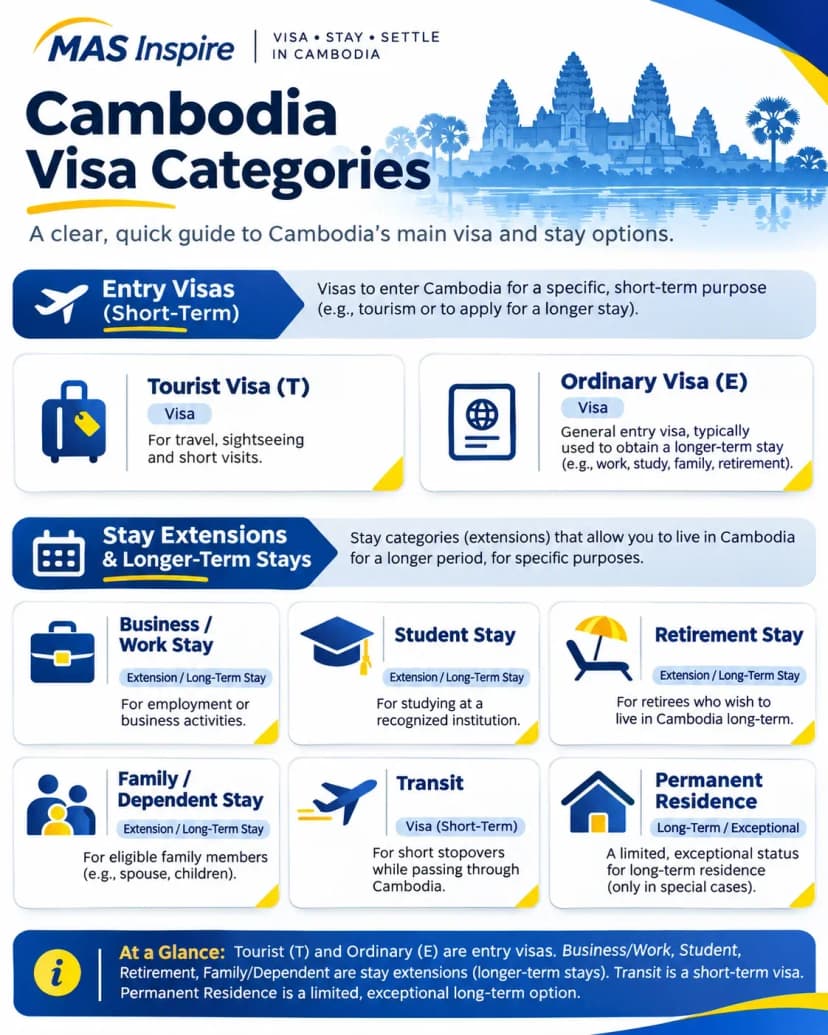
Types of Cambodia visas
1. Tourist visa — T class
The T visa is for visitors whose purpose is tourism. The published standard is a single-entry visa allowing a stay of up to 30 days. The visa has a stated pre-entry validity period; check the actual grant and entry deadline on the digital visa issued to you. A tourist visa may be extended once for up to one month, according to the published Cambodia visa information. It is not a work authorization and should not be used as a substitute for the appropriate long-stay status.
2. Ordinary visa — E class
The E-class Ordinary visa is the usual starting category for many non-tourist stays, including business-related, employment-related and study-related purposes. The initial entry permission is generally 30 days. After arrival, an applicant may seek an extension in the category appropriate to their circumstances. The extension is not automatic; the GDI may request supporting evidence and decide the period granted.
3. Business/employment extension — EB
The EB extension is commonly associated with business activity and foreign employment. Applicants may be asked for an employer letter, employment contract, company documents, business registration evidence or other proof relevant to their claimed purpose. A person who performs work in Cambodia must separately comply with MLVT work-permit and employment-card requirements. A business visa or EB extension alone is not a work permit.
4. Student extension — ES
The ES extension is used by foreign students pursuing studies at Cambodian educational institutions. Applicants should obtain an enrolment or acceptance letter and supporting records from the institution before applying. The exact current financial, attendance, insurance and course-document requirements should be confirmed with the GDI and the school. Study permission does not automatically authorize paid employment or an internship.
5. Retirement extension — ER
The ER category is identified in the Council for the Development of Cambodia handbook as a retirement extension. Applicants should be prepared to document their retirement circumstances, identity and ability to support themselves. The handbook does not provide a current, authoritative universal age threshold or minimum bank balance. Confirm the current criteria with GDI before relying on this route.
6. General extension — EG
The EG category is described in the CDC handbook as a general extension category. It is sometimes associated with people seeking work or needing a short period to regularize their plans. Do not treat it as a guaranteed job-seeker visa, a skilled-worker immigration route or an entitlement to work. Ask GDI which extension category applies to the applicant's exact circumstances and what evidence is required.
7. Diplomatic (A), Official (B) and Courtesy (C) visas
These are special-purpose categories rather than ordinary visitor routes. The Cambodian diplomatic visa service describes A-class visas for diplomatic passport holders and B-class visas for official passport holders. C-class courtesy visas are restricted to eligible courtesy cases, including certain international NGO personnel covered by an appropriate arrangement. Applicants should apply through the relevant diplomatic or government channel; ordinary travellers should not select these categories.
8. Khmer (K) visa
The K visa is for Cambodian nationals who travel using a foreign passport and can provide documentary evidence of Cambodian nationality or heritage. The Cambodia visa information page gives evidence such as proof that a parent was Cambodian as an example. It is not a general family-reunion visa for foreign spouses.
9. Transit, exchange, internship and research
The 2017 MFAIC service-fee schedule lists a D-class transit visa, but current eligibility, availability and fee should be reconfirmed directly with MFAIC or a Cambodian mission. Cambodia's public-facing sources reviewed do not establish separate, generally available digital-nomad, job-seeker, skilled-worker, startup, researcher or exchange visa classes. Applicants in those situations should identify the correct underlying immigration category with GDI and confirm any additional labour, institutional or sponsor approvals. Do not assume that a programme invitation creates a separate visa class.
10. Family members and humanitarian cases
The CDC handbook describes spouses and children of qualifying EB holders among the people associated with EB extensions, but this should not be interpreted as an automatic family-reunification entitlement. Each dependent's status and supporting documents must be confirmed with immigration. Humanitarian protection and refugee matters are distinct from ordinary visitor visas and require case-specific contact with the competent Cambodian authorities and, where appropriate, UNHCR. No general humanitarian visa application route or fee schedule was verified in the public sources reviewed.
Visa comparison table
| Category | Main purpose | Initial stay / extension | Work rights | Published fee |
|---|---|---|---|---|
| T tourist | Tourism and visits | 30 days; one extension up to one month | No general work authorization | US$30 |
| E ordinary | Non-tourist purposes; basis for extensions | 30 days initially; extensions depend on category | Not by itself; separate work permit required | US$35 |
| EB extension | Business/employment-related longer stay | Period granted by GDI; published options historically include 1, 3, 6 or 12 months | Work permit and employment card required for work | Extension fee varies; verify |
| ES extension | Study | Depends on course and GDI approval | No automatic work right | Verify with GDI |
| ER extension | Retirement | Depends on GDI approval | Not a work route | Verify with GDI |
| EG extension | General/other temporary purpose | Depends on GDI approval | No automatic work right | Verify with GDI |
| A/B/C | Diplomatic, official or eligible courtesy purpose | Depends on status and MFAIC | Not ordinary employment permission | Special/official; confirm |
| K | Cambodian national using foreign passport | As issued | Not applicable as a foreign-worker route | Published as free |
| D transit | Transit | Current conditions to be confirmed | No | Historical schedule lists US$15; reconfirm |
Eligibility requirements
Most applicants need a passport accepted by Cambodian authorities, with sufficient remaining validity. Cambodia's published tourist information specifies at least six months' passport validity and a recent passport photograph for visa-on-arrival processing. For a consular application, follow the mission's current requirements, which may include the original passport, application form, photo and fee.
Eligibility also depends on nationality. Cambodia's visa information page identifies a group of nationalities required to obtain a visa in advance, including Pakistani citizens. Other travellers may be eligible for e-Visa or visa on arrival, subject to current nationality and port-of-entry rules. Visa-exempt arrangements apply to certain nationalities, including Vietnamese passport holders, but a Pakistani passport holder living in Vietnam remains a Pakistani national for visa assessment.
For a longer stay, the applicant must show that the requested extension category matches the actual purpose. A student should have a genuine enrolment relationship; a worker should have a legitimate employment arrangement and comply with labour rules; and a retiree should be able to substantiate the retirement basis requested by immigration. No universal minimum bank balance for all Cambodia visas was identified in the official material reviewed.
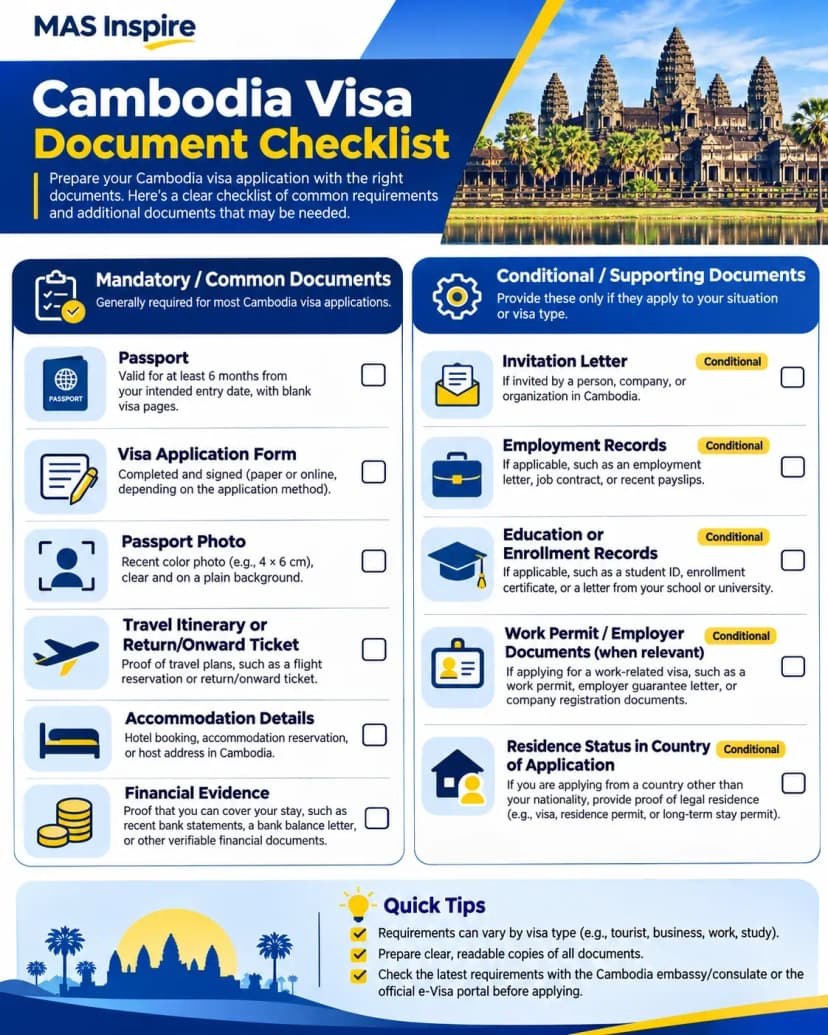
Complete document checklists
The following tables separate baseline documents from purpose-specific or conditional evidence. The receiving authority may request additional documents.
General visitor / T visa
| Document | Status | Notes |
|---|---|---|
| Valid passport | Mandatory | Published entry guidance says at least six months' validity |
| Completed application / online form | Mandatory where applicable | Use the official portal or mission form |
| Recent passport photograph | Required where requested | Follow current photo specifications |
| Visa fee | Mandatory | Published T visa fee US$30 |
| Accommodation details | Supporting / may be requested | Hotel booking or host address |
| Return/onward travel details | Supporting / may be requested | Keep itinerary consistent with stay |
| Evidence of funds | Conditional | No universal published minimum verified |
| Travel insurance | Recommended / may be requested | Check carrier and personal requirements |
Ordinary E visa and extensions
| Document | Status | Notes |
|---|---|---|
| Passport and current Cambodian status | Mandatory | Include entry/visa record as directed |
| Application form and photograph | Mandatory where requested | Requirements depend on application channel |
| E visa fee | Mandatory for initial visa | Published fee US$35 |
| Employer letter / contract | Conditional for EB | Use genuine employer information |
| Company or business documents | Conditional for business case | Relevant registration or business evidence |
| School acceptance / enrolment letter | Conditional for ES | Obtain from recognized institution |
| Retirement evidence | Conditional for ER | Confirm what GDI accepts |
| Financial evidence | Conditional | Requirements vary; no universal amount verified |
| Dependent relationship records | Conditional | Marriage/birth certificates and translations if requested |
Work permit and employment card
| Document / approval | Status | Notes |
|---|---|---|
| Valid passport and appropriate immigration status | Mandatory | Foreign worker must have legally entered and hold valid passport |
| Employer foreign-worker quota approval | Employer-side requirement | MLVT quota rules apply |
| Employment contract / employer details | Normally required | Confirm current FWCMS checklist |
| Health / fitness documentation | May be required | Labour law refers to fitness and communicable-disease requirements |
| Work permit and employment card application | Mandatory | FWCMS: https://fwcms.mlvt.gov.kh/ |
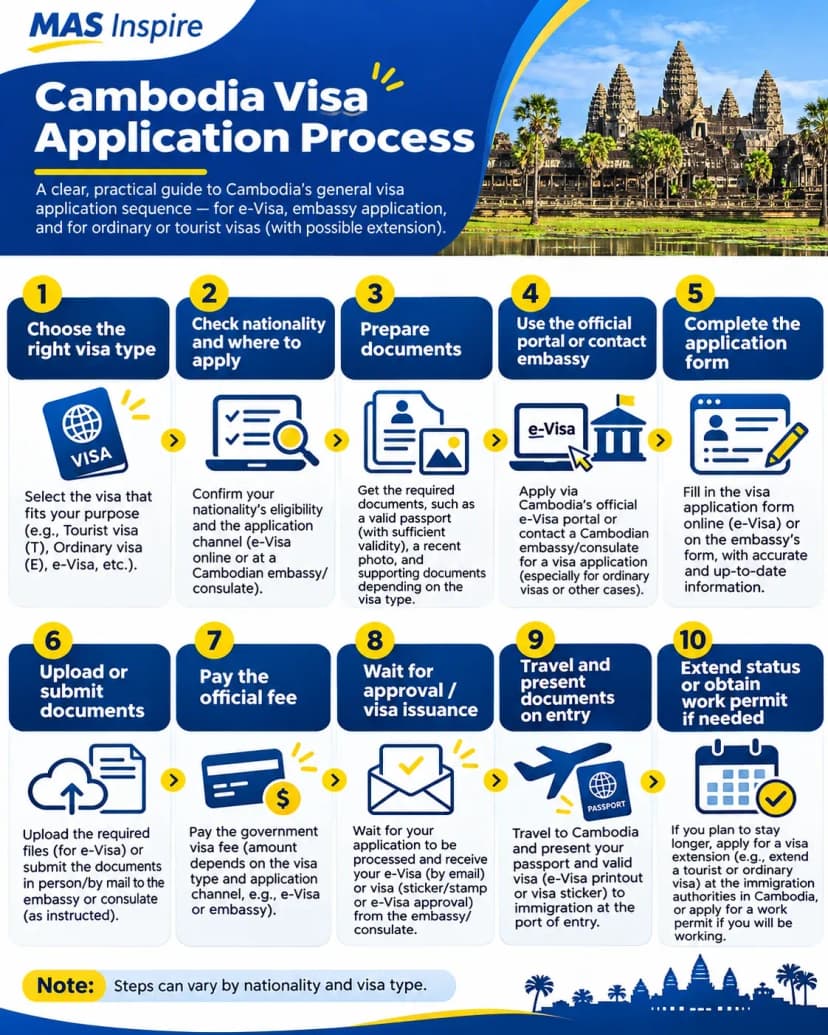
How to apply: step-by-step
- Choose the correct category. Decide whether the trip is tourism, business, study, employment, retirement, official duty or transit. Do not use a tourist visa for work.
- Check nationality rules. Confirm visa exemption, e-Visa eligibility, visa-on-arrival access and advance-visa requirements for the passport you will use. Pakistani citizens are listed as requiring advance visa arrangements.
- Confirm where to apply. Use the official e-Visa system only if your nationality and entry route qualify. Otherwise contact the Cambodian embassy or consulate responsible for your place of residence.
- Prepare documents. Ensure the passport, photographs, form and purpose-specific evidence are accurate and consistent. Arrange translations or certifications if the mission requests them.
- Complete the correct form. Use the official government e-Visa website or the form supplied by the Cambodian mission. Avoid third-party lookalike sites.
- Pay the official fee. Confirm the amount, currency, accepted payment method and refund policy before submitting. Save the receipt.
- Attend any required appointment. Biometrics or an interview are not established as universal steps for every Cambodian visa. Follow the issuing authority's instructions.
- Submit the application. For consular applications, ask whether the original passport must be lodged and how it will be returned. From 3 October 2026, the tourism portal reports digital visa issuance rather than physical stickers across categories; confirm the mission's current process.
- Track the application. Use the tracking mechanism provided by the official portal or mission. Published general processing estimates are not a guarantee.
- Check the grant before travel. Verify name, passport number, category, validity, permitted stay, entries and port-of-entry conditions. Complete the free e-Arrival declaration when required for air arrival, using https://arrival.gov.kh/ and the current submission window.
Not every application uses all ten steps. For example, a visa-on-arrival process differs from an embassy application, while work-permit procedures are separate from visa issuance.
Visa fees and financial requirements
The Cambodia Tourism visa page publishes these standard initial visa fees:
| Visa | Published fee | Initial stay |
|---|---|---|
| Tourist T | US$30 | 30 days |
| Ordinary E | US$35 | 30 days |
| K Khmer | Free, subject to proof of Cambodian nationality/heritage | As issued |
| D transit | US$15 in an older MFAIC fee schedule; current fee must be reconfirmed | Historical schedule says 7 days |
Extension fees are not stated as a single reliable current schedule in the official sources reviewed. They vary by category and duration and should be checked with GDI or the authorized service channel before payment. No universal minimum bank balance was verified for tourist, student, business or retirement applicants. Do not rely on unofficial figures as legal thresholds.
The Cambodia visa information page also states an overstay fine of US$10 per day. Overstaying can create additional immigration consequences; never assume payment of a daily fine guarantees a simple exit or future entry.
Visa processing times
The public information reviewed does not establish a current, guaranteed processing time for every visa class or extension. An older MFAIC fee schedule lists a three-day service period for certain visa issuance services, but that historical schedule should not be treated as a current service guarantee. Processing may depend on nationality, application channel, additional checks, completeness and the issuing authority. Apply well before travel and obtain a current estimate from the actual mission or portal.
Applying from Pakistan or Vietnam
Pakistani passport holders
Cambodia's published visa page lists Pakistan among nationalities required to obtain a visa in advance at a Cambodian embassy. The Tourism Cambodia diplomatic directory groups Pakistan under the Cambodian Embassy in New Delhi, India, and gives the email camemb.ind@mfa.gov.kh and telephone +91-11-2921 4436 / 4435. Applicants in Pakistan should contact that mission to confirm the current process, jurisdiction, appointment rules, documents, fees and digital issuance procedure before travelling to submit an application.
Pakistani citizens legally living or working in Vietnam
The Cambodia Tourism directory identifies the Royal Embassy of Cambodia in Hanoi at 71A Tran Hung Dao Street, Hanoi, email camemb.vnm@mfa.gov.kh, and the Royal Consulate General in Ho Chi Minh City at 41 Phung Khac Khoan Street, email camcg.hcm@mfa.gov.kh. These are useful official contact points, but the directory does not conclusively establish that either mission must accept a Pakistani applicant who is resident in Vietnam.
Before applying locally, send the mission a concise enquiry including nationality, Vietnamese residence status and expiry date, intended Cambodian visa category, travel dates and place of residence. Ask whether it accepts Pakistani applications from Vietnam, whether an appointment or original passport is required, and which documents prove lawful residence. A Vietnamese work permit, temporary residence card or visa does not convert the applicant into a Vietnamese national and does not itself establish consular jurisdiction.
Typical additional evidence for a local application
A mission may request a Vietnamese residence card or visa, Vietnamese work permit, employer confirmation, local address, bank evidence, Cambodian invitation or accommodation details. These are examples of supporting evidence to ask about, not a verified universal checklist. Do not submit fabricated bookings, employment letters or financial records.
Pakistan versus Vietnam application
| Issue | Applying from Pakistan | Applying from Vietnam |
|---|---|---|
| Nationality rule | Pakistani passport requires advance visa per published Cambodia guidance | Same Pakistani nationality rule applies |
| Mission listed | Cambodian Embassy in New Delhi is listed for Pakistan | Cambodia Embassy Hanoi / Consulate General HCMC are listed in Vietnam |
| Residence evidence | Pakistan residence/address may be requested | Vietnamese lawful-residence evidence may be requested |
| Acceptance | Confirm with New Delhi | Confirm directly with Hanoi/HCMC; acceptance is not guaranteed by residence status |
| Visa route | Mission-directed application | Mission-directed application; do not assume e-Visa or visa-on-arrival access |
Student visa guide
International students should first obtain admission from a Cambodian education provider and ask the institution's international office which immigration documents it supplies for an ES extension. The usual planning sequence is: secure admission, confirm the initial entry visa with the Cambodian mission, enter Cambodia lawfully, and apply for the appropriate student extension before the current permission expires.
Prepare a valid passport, current visa/entry record, acceptance or enrolment letter, course dates and any financial or accommodation evidence requested by immigration. The exact current ES extension checklist, fee, processing time and required proof of funds were not fully established by the public official sources reviewed. Ask the school and GDI for written instructions. An ES extension is not an automatic work authorization; confirm separately whether any internship or paid work is permitted and whether a work permit is required.
Work visa and job opportunities
Cambodia does not provide a stand-alone general “work visa” that replaces the ordinary visa and labour compliance process. Foreign workers commonly use an E-class visa and a relevant extension, but must also hold the work permit and employment card required by the Labour Law.
The MFAIC work-procedure document states that foreign nationals cannot work without an MLVT work permit and employment card. It describes employer foreign-worker quota approval, normally capped at 10% of the workforce unless an exception is approved, and online applications through FWCMS. It also says foreign employees, independent contractors and volunteers are covered by the requirement when performing work in Cambodia. Employers should check current quota application windows and any updated MLVT notifications.
A practical employee checklist includes a genuine job offer or contract, employer details, valid passport, lawful entry and stay, quota approval where applicable, and FWCMS application records. The employer should clarify who handles the quota and permit filings, fees and renewal dates. Do not begin work on the assumption that an E visa alone is sufficient.
Cambodia does not have a verified dedicated digital-nomad visa in the official material reviewed. Remote work performed while physically in Cambodia can raise immigration and labour questions; seek advice from GDI and MLVT rather than assuming overseas clients create an exemption.
Family immigration and permanent residence
The sources reviewed do not establish a general foreign spouse/family-reunification visa equivalent to systems in some other countries, nor a routine permanent-residence route for ordinary foreign residents. The CDC handbook indicates that spouses and children may be included in certain EB-related extension arrangements, but eligibility and documentation must be confirmed for each family member. Prepare marriage and birth certificates, passports, evidence of the principal applicant's status and any translations or legalization requested.
Cambodian heritage applicants may qualify for the K visa if they can prove Cambodian nationality or qualifying ancestry. This is distinct from a foreign spouse pathway. Permanent residence, naturalization and exceptional settlement matters require case-specific legal advice and confirmation from the Cambodian authorities; no universal fee, points system or guaranteed pathway is stated here.
Common application mistakes
- Applying for a tourist visa when the real purpose is employment or long-term study.
- Assuming every nationality can obtain a visa on arrival or use the e-Visa portal.
- Pakistani applicants travelling without an advance visa arranged through a Cambodian mission.
- Assuming Vietnamese residence automatically gives a Pakistani applicant a right to apply at a Cambodian mission in Vietnam.
- Treating an E visa or EB extension as a substitute for a work permit and employment card.
- Using inconsistent travel dates, employer details or course dates.
- Relying on outdated fee charts or unofficial processing promises.
- Letting a visa or extension expire while waiting for an appointment.
- Failing to check entry count, validity and permitted stay on the actual digital visa.
- Using unofficial websites that imitate government portals.
Reasons for visa refusal or entry problems
The sources reviewed do not publish a comprehensive official list of refusal grounds. Common risk factors include incomplete forms, invalid or insufficiently valid passports, unsupported travel purpose, inconsistent documents, failure to meet nationality-specific advance-visa rules, concerns about the genuineness of an invitation or employment, and failure to satisfy the relevant extension requirements. Border officials may also assess admissibility at arrival. Provide truthful information, disclose relevant facts and answer requests promptly. A visa approval does not remove the need to meet entry conditions.
Frequently asked questions
1. Do Pakistani citizens need a visa for Cambodia?
Yes. The Cambodia visa information page lists Pakistan among nationalities required to obtain a visa in advance through a Cambodian embassy. Confirm the current procedure with the responsible mission before travel.
2. Can a Pakistani citizen apply for a Cambodia visa in Vietnam?
The Cambodian Embassy in Hanoi and Consulate General in Ho Chi Minh City are listed official missions. Contact them to confirm whether they accept applications from Pakistani residents of Vietnam and what proof of Vietnamese residence is required.
3. Does a Vietnamese residence card guarantee local application eligibility?
No. It may support a request to apply locally, but it does not guarantee that a Cambodian mission in Vietnam will accept the application.
4. How much does a Cambodia tourist visa cost?
The published fee is US$30 for a single-entry T visa allowing an initial stay of 30 days. Confirm the amount and payment method before applying.
5. How much does an ordinary E visa cost?
The published initial fee is US$35 for a single-entry E visa with an initial 30-day stay.
6. Can I work in Cambodia with an E visa?
Not on the visa alone. Foreign workers must comply with MLVT work-permit and employment-card requirements.
7. What is an EB extension?
EB is an extension category commonly associated with business and employment-related longer stays. The applicant must meet immigration requirements and separately obtain work authorization where working.
8. Is there a student visa for Cambodia?
Students generally use the E-class ordinary visa framework and seek an ES student extension, supported by an education institution's enrolment documentation. Confirm current requirements with the school and GDI.
9. Is there a Cambodia digital nomad visa?
No dedicated digital-nomad category was verified in the official sources reviewed. Seek clarification on immigration and labour rules before working remotely from Cambodia.
10. Can a tourist visa be extended?
The published guidance says a T visa can be extended once for up to one month. Confirm the process and fee before expiry.
11. How long can an ordinary E visa be extended?
The extension period depends on the category and approval. Historical government investment guidance lists 1-, 3-, 6- and 12-month options for some extensions; confirm current options and evidence with GDI.
12. Is there a minimum bank balance requirement?
No universal minimum balance was verified in the official sources reviewed. Immigration may request financial evidence depending on the category and circumstances.
13. Do I need an e-Arrival card?
Cambodia's e-Arrival system is used for arrival declarations. Check the official https://arrival.gov.kh/ portal for current rules, submission timing and applicable entry points.
14. Does Cambodia issue physical visa stickers in 2026?
The Cambodia visa information page reports that physical visa stickers were discontinued from 3 October 2026 and digital issuance applies across categories. Confirm the actual delivery and verification process with the issuing mission.
15. What happens if I overstay?
The published visa page lists an overstay fine of US$10 per day. Overstay can also lead to additional immigration consequences. Contact GDI promptly if your status is at risk of expiring.
Official immigration websites
- Cambodia e-Visa: https://www.evisa.gov.kh/
- Cambodia e-Arrival: https://arrival.gov.kh/
- Ministry of Foreign Affairs and International Cooperation: https://www.mfaic.gov.kh/
- General Department of Immigration: https://www.immigration.gov.kh/ (confirm current official access and service details)
- Ministry of Labour and Vocational Training: https://www.mlvt.gov.kh/
- Foreign Workers Centralized Management System: https://fwcms.mlvt.gov.kh/
- Council for the Development of Cambodia: https://cdc.gov.kh/
- Cambodia Tourism visa information: https://www.tourismcambodia.com/tripplanner/essential-information/visa-passport.htm
Final checklist and conclusion
Before departure, confirm that you have selected the correct category, checked the rules for your passport nationality, applied through the correct embassy or official portal, paid the current official fee, received the visa grant, checked its validity and permitted stay, and completed the e-Arrival declaration if applicable. Students should coordinate with their institution; employees should coordinate with their employer on quota and work-permit compliance; Pakistani applicants in Vietnam should obtain confirmation from the Cambodian mission before making travel arrangements.
Cambodia offers several routes for visitors and longer-term residents, but the correct route depends on the purpose of travel and the applicant's nationality. A careful application based on current official instructions is safer than relying on generic visa summaries or third-party promises.
Educational information only; not legal advice. Immigration rules and fees may change. Verify requirements directly with Cambodian authorities before applying. No visa approval is guaranteed.