


By MAS Inspire | Last reviewed: 27 November 2026 (key figures re-verified 27 November 2026)
On this page
- Introduction
- Why visit, study and work
- Visa types
- Visa comparison
- Eligibility
- Document checklists
- Application steps
- Fees and finances
- Processing times
- Pakistan and Vietnam
- Student guide
- Work and jobs
- Family and residence
- Mistakes and refusals
- FAQs
- Official websites
- Final checklist
Introduction
Romania is a member of the European Union. It joined the Schengen area for air and sea borders on 31 March 2024, and land border controls were lifted on 1 January 2025, making it a full Schengen member. (Muse correction, verified 25 Nov 2026.) That change is important for visitors: Romania now issues Schengen short-stay visas, rather than a separate national short-stay visa for ordinary tourism and business visits. A uniform Schengen visa issued by Romania can generally be used throughout the Schengen area, subject to its territorial validity, number of entries and the 90-days-in-any-180-days limit.
Romania still issues national long-stay visas, known as Type D visas, for purposes such as employment, studies, family reunification, economic activities, professional activities, religious activities and other specific grounds. A Type D visa normally allows entry and an initial stay of 90 days. A foreign national who intends to remain longer must apply to the General Inspectorate for Immigration (IGI) for the appropriate residence extension and residence permit.
The most important starting point is to identify the real purpose of travel. Tourism, a business meeting, local employment, full-time study and joining a family member are not interchangeable purposes. Applying under the wrong category or presenting documents that do not support the declared purpose can lead to refusal.
Official starting points: Romanian Ministry of Foreign Affairs e-Visa, visa types, supporting documents, and IGI.
Why People Visit, Study, and Work in Romania
Visitors travel to Bucharest, Brasov, Sibiu, Cluj-Napoca, Timisoara, the Carpathian Mountains and the Black Sea coast. Short-stay visas also cover eligible business meetings, conferences, cultural events, sports, medical visits and visits to relatives or friends. These purposes remain temporary and do not authorize ordinary employment in Romania.
International students may enrol at accredited Romanian institutions in undergraduate, postgraduate, doctoral and other eligible programmes. Study applicants generally need official acceptance and evidence of tuition payment and maintenance funds unless an exemption applies. Romania also admits qualifying foreign workers through employer-led work authorization routes.
Romania is not a general job-seeker-visa destination: do not assume that a visitor can enter and look for work or begin employment. Most ordinary employment routes require a Romanian employer to obtain the relevant employment authorization before the worker applies for the D/AM visa.

Types of Romania Visas
1. Short-stay Schengen visa (Type C)
Type C covers tourism, visiting relatives or friends, business, cultural and sporting events, official visits, medical treatment, short study or training and other permitted temporary purposes. It normally allows a maximum of 90 days in any rolling 180-day period across the Schengen area. The visa sticker's validity dates and number of entries do not increase the 90/180-day allowance. It does not authorize ordinary paid work.
Pakistani passport warning: Pakistan appears on the EU visa-required list and is marked with an asterisk on Romania's official short-stay list. The asterisk means Pakistani nationals must present an invitation endorsed by IGI for the relevant short-stay invitation-based route. Pakistan is also marked as requiring an airport transit visa. Applicants must check the precise purpose-specific rules: this invitation endorsement is not a generic document that can be substituted by a hotel booking or an ordinary letter from a friend.
2. Business visitor
A business visitor normally applies for Type C under the business purpose where the activities are temporary meetings, negotiations, conferences or similar permitted visits. The Romanian host or business partner may need to provide an invitation and supporting company details. A business visitor visa is not a work permit and does not authorize taking up a Romanian job, providing ordinary local labour or being paid for work in Romania. Pakistani nationals must check the endorsed-invitation requirement before applying.
3. Long-stay employment visa (Type D/AM)
The employment route is employer-led. A Romanian employer normally applies for the relevant employment/secondment notice or authorization through the applicable government process. Once the authorization is issued, the worker applies for the long-stay employment visa at a Romanian diplomatic mission or consular post. April 2026 reform (Muse correction, verified 25 Nov 2026): Government Emergency Ordinance 32/2026 abolished the work permit (aviz de angajare) and its EUR 100 fee (EUR 25 seasonal) from 27 April 2026. The employer now files a free single application (cererea unică) on WorkinRomania.gov.ro — D/AM1 for the employer route, D/AM2 for shortage occupations. The EUR 300 D visa is paid by the worker unless the firm job offer states the employer bears it. After arrival the worker applies for the single residence permit (EUR 120 in lei + RON 265 for the card, at first issue and each renewal). GEO 32/2026 also requires the employer to post a EUR 1,000 financial guarantee per worker (State Treasury deposit or bank guarantee; returned if not called) to cover return costs. For D/AM2 the gross salary must be at least the national gross minimum wage — RON 4,325/month from 1 July 2026 (RON 4,582 in construction). Single applications filed on the platform produce full legal effects from 8 August 2026, and the 2026 quota for newly admitted foreign workers is 90,000 (Government Decision 1169/2025) — the quota applies to the D/AM2 route. IGI describes categories including permanent, seasonal, highly qualified, trainee, posted, cross-border, ICT and au pair workers. The exact authorization and visa subcategory depend on the job and legal basis.
The D visa is normally issued for an initial 90-day period. After arrival, the worker applies to IGI for a residence permit before the visa stay expires. A standard employment permit is generally tied to the employer and role stated in the authorization. Do not change employer or job without checking the required new authorization.
4. Student visa (Type D/SD)
The student route is for third-country nationals accepted into qualifying full-time studies at an accredited or legally authorized Romanian institution. Typical requirements include Ministry of Education acceptance, tuition payment for at least one academic year, proof of maintenance at least equal to the national minimum gross wage per month for the period covered by the visa (RON 4,325/month from 1 July 2026), criminal-record documentation and medical insurance. Scholarship holders and certain exempt groups may have different evidence requirements.
After arrival, the student must obtain a residence permit from IGI. Students with a valid study residence right may work without a separate work permit only under the applicable part-time limit: IGI states no more than six hours per day under an individual employment contract. (Muse correction, verified 25 Nov 2026 — IGI Studies page.) Check the current legal conditions before accepting work.
5. Digital nomad (Type D/AS - other purposes)
Romania has a specific long-stay route for digital nomads who work remotely using information and communications technology while earning income from an employer or business established outside Romania. IGI states that the applicant must show income from the qualifying remote activity of at least three times Romania's average gross monthly salary for each of the six months before the application and for the entire visa period. This is a formula, not a permanently fixed RON amount; calculate it using the official salary figure in force when applying. Using the 2026 reference average of RON 9,192/month (Law 44/2026, in force from 30 March 2026), the threshold is RON 27,576/month (roughly EUR 5,160–5,400) — but the exact figure consulates apply is disputed (budget-law average vs the statistics institute's monthly average), so recalculate from the current official figure at filing and aim above the lowest published figure. (Muse enhancement, verified 25 Nov 2026.)
A digital nomad visa is not a general authorization to take a Romanian local job. Evidence should establish the foreign employer or foreign-registered business, the remote nature of the activity, income and the qualifying six-month history. Confirm the current supporting-document list and whether any dependants have a separate route.
6. Family reunification and spouse routes
A non-EU/EEA foreign resident may in qualifying circumstances sponsor a spouse and unmarried minor children, subject to the sponsor's status and IGI approval. IGI identifies eligible sponsors such as holders of qualifying residence permits valid for at least one year, EU Blue Cards, ICT permits, long-term residence permits and beneficiaries of refugee or subsidiary protection. Special rules apply to researchers and certain permit holders.
The sponsor normally first obtains a favourable IGI opinion. The family member then applies for the appropriate D visa. Family members of Romanian citizens have a distinct route and should follow the specific MAE/IGI checklist rather than assuming the ordinary third-country sponsor procedure applies.
7. Economic, commercial and professional activities
Romania provides national long-stay categories for certain regulated economic, commercial and professional activities. These are not generic investor visas that automatically grant residence in return for purchasing property or making an arbitrary investment. Applicants must meet the legal criteria for the specific activity and provide the relevant approvals, corporate evidence, professional recognition or other statutory documentation.
IGI's other-purposes guidance describes, for example, a company administrator route with specific corporate and capital/technology conditions. The official e-Visa portal also lists D/AE (economic), D/AP (professional) and D/AC (commercial) categories. Obtain case-specific advice from IGI or the competent mission before committing funds.
8. Research, internship, training and exchange
Researchers may qualify under a dedicated long-stay research route based on a hosting agreement with an eligible research organization. Trainees and interns may qualify under the applicable employment or other-purpose provisions, depending on whether the placement is paid, unpaid, educational or employment-based. Unpaid vocational training requires a qualifying training agreement, an eligible host and proof of maintenance and accommodation. Student exchange has its own documentary route.
Do not use a tourist visa for a placement that is legally an internship or employment. Ask the host institution to identify the correct Romanian legal category and provide the official agreement or authorization.
9. Religious activities, volunteering, au pair and medical treatment
IGI recognizes additional D visa grounds for qualifying religious activities, volunteering, au pair placements, long-term medical treatment and certain other lawful purposes. Religious workers may need approval from the State Secretariat for Religious Affairs and evidence of support and accommodation. Volunteers need a contract with a qualifying non-profit or public host, with the host undertaking specified support obligations. Au pair rules include age and host-family conditions. Long-term medical treatment requires acceptance from a Romanian medical institution and details of treatment.
10. Transit visa (Type A)
Type A is an airport transit visa. It allows an eligible traveller to remain in the international transit area while changing flights; it does not authorize entry into Romania or leaving the airport transit zone. Pakistan is specifically marked as a nationality subject to the airport-transit-visa requirement. Whether an exemption applies depends on the traveller's residence status, visas and travel document; verify with the airline and consulate.
There is no current Type B Romanian transit visa. Since full implementation of Schengen rules, Romania states that transit across Schengen territory is covered by the relevant uniform Schengen visa, not a national Type B category.
11. Humanitarian protection and asylum
Asylum, refugee status, subsidiary protection and temporary protection are protection procedures/statuses, not ordinary visitor or work visas. People seeking protection should contact the Romanian authorities and use the official asylum procedure. Eligibility is assessed individually under national and international protection law. Do not treat asylum as an immigration shortcut or make a claim without a genuine protection basis.
Visa Comparison Table
| Route | Main purpose | Initial stay / validity | Work rights | Fee |
|---|---|---|---|---|
| Type A | Airport transit only | Transit through international zone; multiple-entry validity may be limited | No | EUR 90 |
| Type C | Tourism, visit, business, event, medical, short study | Up to 90 days in any 180 days | No ordinary employment | EUR 90 |
| Type D/AM | Employment | Normally 90 days initially; then residence permit | As authorized | EUR 300 visa fee; employer work-authorization fee may also apply |
| Type D/SD | Full-time study | Normally 90 days initially; then residence permit | Limited student work rights | EUR 300 visa fee |
| Type D/AS | Digital nomad and other specific purposes | Normally 90 days initially; then qualifying residence permit | Remote foreign activity; not a local job authorization | EUR 300 visa fee |
| D family route | Join eligible family member | Normally 90 days initially; then residence permit | Depends on permit/status | EUR 300, subject to exemptions |
| D/AE, D/AP, D/AC | Economic, professional, commercial | Normally 90 days initially; then residence permit | Only within authorized activity | EUR 300 |
The MAE fee page states EUR 90 for Type A and C and EUR 300 for Type D applications submitted through e-Visa from 27 April 2026. Certain exemptions apply. The fee is collected in EUR, USD or local currency according to the applicable exchange calculation and local mission arrangements. Fees are non-refundable in ordinary cases unless the authority's rules provide otherwise.
Eligibility Requirements
All applicants should establish identity, a valid travel document, a genuine purpose of travel and compliance with the chosen category. For a Schengen Type C application, the passport should generally have been issued within the previous ten years, remain valid for at least three months after the intended departure from the Schengen area and contain at least two blank pages. The applicant must provide the harmonized form, photograph, fingerprints where required, travel medical insurance, evidence of means, purpose and accommodation, return/ onward travel evidence and fee payment.
For Type D, the central eligibility test is the legal basis for the intended long stay. Examples include an employer's authorization, an official study acceptance, an IGI family-reunification approval or evidence satisfying the digital-nomad rules. A bank statement alone cannot replace the underlying legal basis.
Nationality can add requirements. Pakistani nationals are visa-required and are marked for airport transit visas. For short-stay invitation-based applications, Pakistan is also marked with an asterisk requiring an invitation endorsed by IGI. This requirement should be checked for the exact application purpose and route.

Complete Document Checklists
The following are planning checklists, not a promise that every listed item is mandatory in every case. The live portal generates category-specific requirements. The mission may request further evidence. Submit originals and copies where instructed; documents should be legible and translated into Romanian or English as required.
General Type C checklist
| Document | Status | Notes |
|---|---|---|
| Completed and signed Schengen application form | Mandatory | Individual application; minors require proper parental/guardian signature |
| Valid passport/travel document | Mandatory | Issued within 10 years; 2 blank pages; validity at least 3 months after planned Schengen exit |
| Recent colour photograph | Mandatory | Must meet current photo specifications |
| Fingerprints/biometrics | Conditional | In-person collection where no valid prior record or older than 59 months; exemptions may apply |
| Travel medical insurance | Mandatory | Must meet Schengen coverage and territorial requirements |
| Proof of accommodation and itinerary | Purpose-specific | Hotel booking, host accommodation or itinerary |
| Proof of funds | Mandatory | Statements, sponsor evidence or other accepted proof |
| Return/onward travel and intention to leave | Mandatory | Evidence appropriate to the circumstances; do not buy non-refundable travel solely to apply |
| Proof of employment/study/business ties | Supporting | Helps explain circumstances and intention to leave |
| Invitation/host documents | Conditional | Required for the relevant visit or business route; Pakistani applicants must check IGI endorsement rule |
| Visa fee receipt | Mandatory | Unless an exemption applies |
Student D/SD checklist
| Document | Status | Notes |
|---|---|---|
| Ministry of Education acceptance for full-time study | Mandatory | For the applicable student route |
| Proof of tuition paid for at least one academic year | Usually mandatory | Exceptions for scholarship/exempt categories |
| Proof of maintenance | Mandatory unless exempt | At least national minimum gross wage per month for the period on the visa, per IGI guidance (RON 4,325/month from 1 July 2026) |
| Criminal record certificate | Mandatory | From relevant authority; translation/legalization may be needed |
| Medical insurance | Mandatory | Cover visa period |
| Passport and application form | Mandatory | Follow mission checklist |
| Accommodation evidence | As required | University housing or other proof; confirm current list |
| Parental consent | Conditional | If applicant is a minor |
| Scholarship award | Conditional | If relying on scholarship exemption |
Employment D/AM checklist
| Document | Status | Notes |
|---|---|---|
| Romanian employment/secondment authorization | Core prerequisite | Usually obtained by employer/beneficiary before visa |
| Employment contract/offer and job details | Mandatory/route-specific | Must match authorization |
| Passport and visa application | Mandatory | Apply through competent mission |
| Criminal record evidence | Usually required | As listed by the mission and category |
| Medical/travel insurance | Required | Confirm required coverage and duration |
| Qualifications and experience | Conditional | For regulated, skilled or specialized roles |
| Accommodation and means evidence | As requested | Category-specific |
Digital nomad checklist
| Document | Status | Notes |
|---|---|---|
| Proof of foreign employer or foreign-registered business | Core prerequisite | Must show qualifying activity outside Romania |
| Remote-work evidence | Core prerequisite | Contract, company documents and role description |
| Income evidence for preceding six months | Core prerequisite | Must meet 3x average gross monthly salary formula for each month |
| Evidence of income for intended stay | Core prerequisite | Must continue to meet threshold during visa period |
| Passport and application | Mandatory | Current e-Visa instructions |
| Medical insurance and criminal record | As required | Follow the exact D/AS list |
| Accommodation and other supporting evidence | As required | Check portal/mission |
Family reunification checklist
| Document | Status | Notes |
|---|---|---|
| IGI favourable opinion for family reunification | Core prerequisite for applicable route | Sponsor applies first |
| Marriage/birth/kinship certificate | Mandatory where relevant | Translated and legalized/apostilled as applicable |
| Sponsor's residence document | Mandatory | Must be an eligible status |
| Proof of suitable accommodation | Mandatory | IGI assesses accommodation |
| Proof of means of support | Mandatory | Subject to statutory exceptions |
| Health insurance evidence | Mandatory | As required by IGI |
| Passport and visa application | Mandatory | Family member applies for D visa |
| Custody/other-parent consent | Conditional | For minor children where applicable |
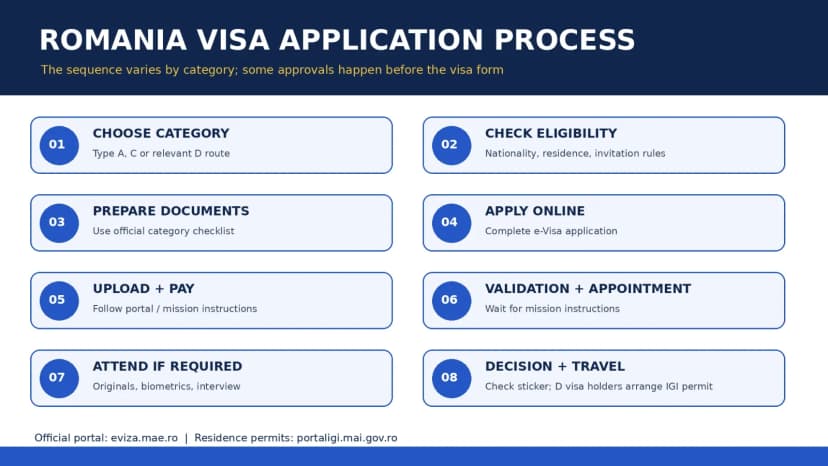
How to Apply: Step-by-Step
- Choose the correct category. Decide whether the trip is a short Schengen visit, airport transit or a long-stay purpose such as work, study, family or remote foreign employment.
- Check nationality and place-of-application rules. Use the official visa checker and verify whether your passport requires a visa, airport transit visa or an endorsed invitation. Confirm the mission's jurisdiction.
- Prepare the documents. Use the exact category checklist on the official e-Visa portal. Arrange translations, apostilles/legalization and originals early.
- Create or access an e-Visa application. Use only https://eviza.mae.ro/. The portal supports uploading supporting documents and saving an incomplete file temporarily.
- Complete the correct form. Answer consistently and accurately. Each traveller, including a child travelling on a parent's travel document, needs an individual application.
- Upload documents and follow payment instructions. File formats, size limits and payment arrangements are specified by the portal and mission. Do not pay an intermediary claiming to guarantee approval.
- Wait for validation and appointment instructions. After online validation, the mission arranges an interview/appointment. Some cases need review or prior approval from IGI or the National Visa Centre.
- Attend in person when required. Bring passport, originals and copies. Biometrics are required where applicable. A previous fingerprint record may be reused if it is within the permitted period.
- Track the application. Use the e-Visa portal and the official notification email. Do not rely on unofficial tracking sites.
- Review the decision and entry conditions. Check the visa sticker's validity, entries, duration and territorial scope. Carry supporting travel documents. Border officers make the final admission decision. For Type D, arrange the IGI residence-permit process promptly after arrival.
Not every application follows all ten steps in the same order. Work authorization and family reunification approvals may need to be secured before the visa application; a Type C visitor does not normally apply for a Romanian residence permit after a short visit.
Visa Fees and Financial Requirements
| Fee / financial item | Amount | Who pays / qualification |
|---|---|---|
| Type A airport transit visa | EUR 90 | Standard published fee |
| Type C Schengen visa | EUR 90 | Standard published fee |
| Type A/C child fee (ages 6-12) | EUR 45 | Where applicable |
| Type D long-stay visa | EUR 300 | For e-Visa submissions from 27 April 2026 |
| Employer work authorization (aviz de angajare) | ABOLISHED 27 April 2026 | GEO 32/2026 repealed the work permit and its EUR 100 / EUR 25 (seasonal) fee; the employer now files a free single application on WorkinRomania.gov.ro (Muse correction, verified 25 Nov 2026) |
| Single residence permit (extension of right of residence) | EUR 120 (in lei) + RON 265 card | Worker pays at first issue and each renewal (Muse enhancement, verified 25 Nov 2026) |
| Student maintenance | At least national minimum gross wage per month (RON 4,325 from 1 July 2026) | For the visa period, subject to exemptions |
| Digital nomad income | At least 3x Romanian average gross monthly salary | Each of previous six months and during visa period |
The MAE states that visa fees may be collected in EUR, USD or the currency of the country of residence, based on the previous month's average exchange rate. Confirm the amount and payment method with the mission. The work authorization fee is separate from the D visa fee and is normally paid by the employer. Financial thresholds expressed as a multiple of a national salary change when the reference salary changes; do not copy an old RON figure from a blog.
Visa Processing Times
Romania's MAE does not promise one universal processing time for all applications. The duration depends on mission workload, document completeness, the purpose of travel and whether IGI or the National Visa Centre must issue a prior opinion. MAE advises that short-stay applications may be submitted at least three weeks before intended travel and no earlier than three months in advance. Schengen Type C decisions are normally made within 15 calendar days, extendable to 45 in individual cases (Visa Code). (Muse enhancement, verified 25 Nov 2026.) For long-stay applications, it advises applying at least 45 days before travel and no more than 90 days in advance. These are planning recommendations, not guaranteed decision deadlines.
IGI publishes category-specific periods for some preliminary approvals and residence matters. For example, its student guidance describes a 30-day IGI opinion period, extendable by up to 15 days, and its residence-permit guidance contains separate timelines. Do not treat these as the total visa processing time: mission appointment, document validation and final visa issuance are additional stages.
Applying from Pakistan or Vietnam
Pakistani passport holders applying from Pakistan
Pakistani ordinary passport holders are on the visa-required list. The official Romanian list also marks Pakistan for airport transit visa requirements and, with an asterisk, the endorsed-invitation requirement for short-stay applications. Applicants should confirm whether the planned short-stay purpose requires an invitation approved by IGI before lodging the application. A hotel reservation, informal invitation or agent's letter is not a substitute for the required official endorsement.
Apply through the Romanian diplomatic mission with jurisdiction over the applicant's place of legal residence. Use the MAE directory to identify the responsible mission and confirm its current appointment, payment and document rules. Do not assume that the Pakistani embassy or a visa agent issues Romanian visas.
Pakistani passport holders legally living or working in Vietnam
Romania's e-Visa rules allow third-country nationals who reside in the country where a Romanian mission is located and can prove their legal status there to apply at that mission. They also describe certain applicants who are temporarily and legally present in that country. This creates a possible route for a Pakistani national who holds a valid Vietnamese temporary residence card, work permit or other accepted evidence of lawful stay.
However, legal residence in Vietnam does not automatically guarantee that the Romanian Embassy in Hanoi will accept every application. The applicant must confirm consular jurisdiction and acceptance before preparing an application. Ask the mission whether it accepts the particular category from a Pakistani national residing in Vietnam, whether it requires proof of Vietnamese residence for a minimum period, and how to book an appointment. Use the Romanian MFA diplomatic-mission directory for the current contact details; do not rely on outdated third-party addresses.
Prepare, as relevant, the Pakistani passport, Vietnamese residence card and work permit, evidence of current legal status, Vietnamese employment letter, leave approval, salary evidence, bank statements, accommodation and travel itinerary, plus the category-specific Romanian documents. If documents are issued in Vietnamese or Urdu, ask the mission whether certified translation into English or Romanian and legalization are required.
For a short-stay invitation-based application, the Pakistan-specific IGI-endorsed invitation requirement remains relevant even if the applicant lives in Vietnam. Residence in Vietnam does not remove nationality-based visa rules. For Type D work or study, use the relevant employer or education route rather than the short-stay invitation procedure.
Applying from Vietnam versus Pakistan
The legal eligibility for the underlying visa category does not change merely because the application is lodged in Vietnam. The main differences are the competent mission, proof of legal residence, appointment availability, local document translation/legalization and payment currency. A person who is only visiting Vietnam may not be accepted by the Romanian mission there unless the exceptional legal-presence criteria are met. Obtain written confirmation before travel to Hanoi or any other mission location.
Student Visa Guide
The first step is admission, not the visa form. Applicants should apply to a Romanian institution that is accredited or authorized for the relevant programme and obtain the official acceptance document required by the Ministry of Education. The student visa checklist then includes proof of tuition payment for at least one academic year, maintenance funds at the specified minimum-gross-wage formula (RON 4,325/month from 1 July 2026), criminal record evidence and insurance. Scholarship holders may benefit from exemptions, but the applicant must document the scholarship and follow the appropriate route.
After arrival, apply for the student residence permit through IGI, ideally well before the initial 90-day visa stay expires. IGI says the application should be submitted at least 30 days before expiry. Maintain enrolment and meet renewal conditions. Study residence may be extended for the duration of eligible studies. A limited post-study extension may be available for specified graduation and job-search formalities; verify the current rule with IGI. Student work is restricted and should not be treated as unrestricted full-time employment.
Official guide: IGI student long-stay visa.
Work Visa and Job Opportunities
A foreign national normally needs a Romanian employer willing to sponsor the legal employment process. The employer submits the employment/secondment authorization application to IGI and pays the applicable authorization fee. After approval, the worker applies for the D/AM visa at the competent Romanian mission. The work authorization system includes permanent, seasonal, highly qualified, trainee, posted, ICT and other defined categories. The employer must meet legal conditions, including genuine business activity, inability to fill the vacancy from the specified domestic/EU labour pool where required, compliance with tax and employment obligations, and the annual quota.
The D/AM visa allows entry for the authorized employment purpose. After arrival, the worker obtains the appropriate residence permit. Check the permit's employer, occupation and validity conditions. Changing employers or duties may require a new authorization. A job offer alone is not the same as a work permit, and a tourist visa does not authorize work.
Official guides: IGI employment and posting and Work in Romania.
Family Immigration and Permanent Residence
For family reunification with a non-EU/EEA sponsor, the sponsor generally must hold an eligible residence status. IGI's published rules include a temporary residence permit valid for one year, EU Blue Card, ICT permit, Mobile ICT permit, long-term residence permit or international-protection status. The sponsor applies first for an IGI favourable opinion and provides evidence of relationship, legal residence, accommodation, means and health insurance. The family member then applies for the relevant visa.
Long-term residence is a separate status. IGI generally describes a five-year continuous lawful residence requirement, with absence limits and exclusions. Student residence is counted at half for this calculation. Some categories, including seasonal workers and au pairs, cannot use their time in that category to qualify under the general long-term residence rule. Short-stay residence does not count. The applicant must also satisfy other conditions and submit proof of accommodation, insurance, means (where required), Romanian criminal record and civil-status documents. The resulting long-term residence permit is generally valid for five years, or ten years for a family member of a Romanian citizen, according to IGI guidance.
Do not assume that five calendar years in Romania automatically qualify: the type of residence and permitted absences matter. Obtain an individual assessment from IGI before relying on a settlement timeline.
Common Application Mistakes and Reasons for Refusal
Frequent problems include choosing the wrong category, applying to the wrong Schengen state, incomplete or inconsistent forms, a passport that fails the validity rules, insufficient proof of funds, unclear accommodation, weak evidence of the visit's purpose, missing insurance, missing translations, unverified invitation documents and failure to disclose relevant travel or immigration history. For Pakistani short-stay applicants, overlooking the IGI-endorsed invitation requirement can be particularly serious.
A work applicant may be refused or delayed if the employer has not obtained the correct authorization, the role does not match the permit or the employer does not meet statutory conditions. A student may encounter problems if the acceptance is not from an eligible institution, tuition evidence is missing or funds do not meet the applicable formula. A digital nomad application can fail if the applicant cannot prove foreign remote activity or the required six-month income.
Authorities may refuse a visa where the purpose and conditions of stay are not established, documents are unreliable, there are reasonable doubts about the intention to leave before the visa expires, the applicant lacks sufficient means or there are security, public-policy or immigration-history concerns. Never submit altered bank statements, fake employment letters, fabricated bookings or misleading declarations. A refusal notice should explain the applicable review or appeal procedure and deadline; seek qualified legal advice promptly if challenging a decision.
Frequently Asked Questions
1. Is Romania part of the Schengen Area?
Yes. Romania fully applies the Schengen rules from 31 March 2024. A Romanian uniform short-stay visa is generally a Schengen visa, subject to its validity and territorial limits.
2. How much is a Romanian visa in 2026?
The published standard fee is EUR 90 for Type A and Type C, and EUR 300 for Type D applications submitted through e-Visa from 27 April 2026. Children aged 6-12 pay EUR 45 for eligible A/C applications. Exemptions and local payment arrangements may apply.
3. Can I work in Romania on a tourist visa?
No. A Type C tourist or business visitor visa does not authorize ordinary employment. Use the relevant work authorization and D/AM route.
4. Can Pakistani citizens apply for a Romanian visa?
Yes, but Pakistani ordinary passport holders are visa-required. The official list also marks Pakistan for airport transit visas and an endorsed-invitation requirement for short-stay applications. Check the exact route.
5. Can a Pakistani living in Vietnam apply in Hanoi?
Potentially. Romanian rules allow applications by third-country nationals legally resident in the country where the mission is located. The applicant must prove Vietnamese legal status and confirm that the Romanian mission accepts the particular category and application.
6. Does a Vietnamese residence card guarantee acceptance in Vietnam?
No. It is evidence of legal residence, not a guarantee of consular jurisdiction or acceptance. Confirm directly with the mission.
7. How long can I stay in Romania on a Type C visa?
Up to 90 days in any 180-day period across the Schengen area, subject to the visa's validity and entries.
8. How long is a Romanian long-stay visa valid?
The D visa normally grants an initial 90-day stay. Applicants who need to remain longer must obtain the relevant IGI residence permit.
9. Can international students work in Romania?
IGI states that holders of study residence may work without a separate work permit on a part-time individual employment contract of no more than six hours per day, subject to current law.
10. Does Romania have a digital nomad visa?
Yes. The long-stay route requires remote ICT-based work for a foreign employer or foreign-registered business and income of at least three times the Romanian average gross monthly salary for each of the six preceding months and the visa period.
11. Is there a Romanian job-seeker visa?
There is no general-purpose job-seeker visa identified in the official visa categories covered here. Most employment routes require an employer-led authorization before the D/AM visa.
12. Can I obtain permanent residence after five years?
Potentially, if the residence type, continuity, absences and other statutory conditions qualify. Study time counts at half, while some categories are excluded. Check with IGI.
13. Do I need an airport transit visa if I do not leave the airport?
Some nationalities do. Pakistan is marked as subject to the airport transit visa requirement. Exemptions may depend on residence permits, visas and travel documents.
14. Can I apply online without visiting the embassy?
The e-Visa portal supports online forms and document uploads, but applicants should expect to attend the competent mission when instructed. Biometrics and originals may be required.
15. Does a visa guarantee entry?
No. The visa allows the holder to present at the border. Border authorities may still check purpose, funds, accommodation, onward travel and other entry conditions.
Official Immigration Websites
- Romanian Ministry of Foreign Affairs e-Visa portal
- Visa types and purposes
- Visa fees
- Supporting documents
- Nationality and visa requirement list
- MAE visa FAQ
- General Inspectorate for Immigration
- Student long-stay visa
- Employment and posting
- Family reunification
- Long-term residence
- Romanian Border Police
- Work in Romania
Final Checklist and Conclusion
Before submitting, confirm the correct visa type, nationality rules, the competent mission, passport validity, the official checklist, translations and legalization, funds and insurance, invitation or prior approval requirements, fee and appointment instructions. Keep copies of everything submitted and check the visa sticker immediately after collection. Type D applicants should plan the residence-permit process before their initial 90-day stay expires.
Romania offers several legitimate routes for visitors, students, employees, family members, researchers and qualifying remote workers. The safest application is one that matches the applicant's real purpose and is supported by authentic, consistent documents. Use the official MAE and IGI sources for final decisions, and seek qualified legal advice for complex cases.
Disclaimer: This guide is general educational information, not legal advice or a guarantee of visa approval. Immigration rules, fees, forms, quotas and consular practices can change. The official Romanian authorities decide applications and entry. MAS Inspire should conduct an administrator/legal review immediately before publication and periodically thereafter.


