

By MAS Inspire | Last reviewed: 27 November 2026 (key figures re-verified 27 November 2026)
Introduction
Poland offers international visitors, students, skilled professionals and entrepreneurs opportunities to travel, study, work and establish businesses within the European Union.
However, immigration requirements depend on your nationality, intended activities, country of residence and proposed duration of stay.
This Poland visa guide explains the principal immigration pathways, application procedures, supporting documents, financial requirements and important considerations before travelling.
On this page
- Why people visit, study and work
- Visa types
- Visa comparison
- Eligibility
- Document checklists
- Application steps
- Fees and finances
- Processing times
- Pakistan and Vietnam
- Student guide
- Work and jobs
- Family and residence
- Mistakes
- Refusals
- FAQs
- Official websites
- Final checklist
Why People Visit, Study, and Work in Poland
Poland is an attractive destination for international applicants because of its universities, historic cities, European business connections and diverse employment market.
Popular reasons for travelling include:
- Undergraduate, postgraduate and doctoral education.
- Tourism and cultural experiences.
- Engineering, manufacturing, technology and logistics employment.
- International business meetings and conferences.
- Scientific research and academic collaboration.
- Family reunification.
- Long-term professional development.
Applicants should choose a legal immigration route that accurately reflects their intended activities.

Types of Poland Visas
1. Tourist and visitor visas
International travellers who require a visa for short visits generally apply for a Schengen C visa.
This visa may permit tourism, sightseeing, visiting friends and attending cultural events.
The maximum short-stay allowance is 90 days in any rolling 180-day period across the Schengen Area, subject to the conditions printed on the visa.
A tourist visa does not normally authorize employment.
Applicants should demonstrate sufficient funds, accommodation, travel medical insurance and a credible travel purpose.
Official source: European Commission — Applying for a Schengen visa.
2. Business visitor visa
Business visitors may use the appropriate Schengen visa to attend conferences, negotiate contracts, meet commercial partners and participate in authorized business events.
A business invitation should explain the purpose and duration of the visit and, where applicable, who will cover the expenses.
Business visitor status must not be confused with permission to undertake regular paid employment in Poland.
3. Student and language-study visas
Non-EU applicants planning to undertake long-term higher education normally require a national D visa issued for the appropriate educational purpose.
Applications may require:
- An official university admission certificate.
- Academic qualifications.
- Recognition of foreign qualifications, where applicable.
- Evidence of language proficiency.
- Financial resources.
- Tuition payment or scholarship documentation.
- Accommodation and health insurance.
Language courses and other training programmes may fall under different educational purposes. Their immigration and employment rights are not necessarily equivalent to those of full-time university students.
Official source: Study in Poland — Foreign applicant requirements.
4. Work and employer-sponsored visas
Foreign workers generally need both a lawful basis for residing in Poland and appropriate employment authorization, unless a statutory exemption applies.
Employers may need to obtain authorization before their prospective employee applies for a visa.
A job offer alone is not sufficient evidence that the individual can legally begin employment.
After arrival, eligible workers may apply for a temporary residence and work permit through the relevant immigration procedure.
5. Job seeker residence permit
Poland has a targeted post-study pathway for qualifying graduates of Polish universities.
This temporary residence permit allows eligible graduates to seek employment or prepare to establish a business.
It is granted once for nine months.
It should not be confused with an unrestricted job seeker visa available to all overseas applicants.
Official source: Office for Foreigners — Graduate residence permit.
6. Skilled-worker immigration and EU Blue Card
The EU Blue Card is intended for qualifying non-EU professionals undertaking highly skilled employment.
Applicants generally need suitable professional qualifications, eligible employment and remuneration satisfying the applicable legal threshold.
It combines residence and employment authorization and provides certain additional EU mobility benefits.
For applications filed in 2026 the salary threshold is PLN 13,355.34 gross per month (PLN 160,264.08 per year) — 150% of the 2025 national average wage of PLN 8,903.56 (GUS communiqué, 9 February 2026). For shortage occupations the reduced threshold is PLN 8,903.56 gross per month. The threshold is reset every February, so applications filed in 2027 need a fresh check. The employment contract must run at least six months.
Official source: Polish EU Blue Card information.
7. Digital nomad visa
No dedicated Polish digital nomad visa was identified in the official immigration sources reviewed.
Remote workers should not assume that employment by an overseas company permits them to reside and work remotely in Poland under visitor status.
Applicable immigration, employment and taxation requirements should be checked independently.
8. Entrepreneur, startup and investor immigration
Foreign nationals intending to operate businesses may qualify for a temporary residence permit based on business activity.
Company registration alone does not create a right of residence.
The authorities may examine business performance, financial resources, employment creation and evidence that the enterprise satisfies the relevant economic conditions.
No dedicated passive-investment golden visa was identified in the official sources reviewed.
9. Family reunion and spouse immigration
Eligible family members of Polish citizens, EU citizens and qualifying foreign residents may have access to family-based immigration routes.
The requirements differ according to the sponsor's citizenship, residence status and relationship to the applicant.
Marriage certificates, birth certificates and documentation confirming the sponsor's lawful status may be required.
Work rights depend on the specific residence basis.
10. Permanent residence and settlement
Poland provides permanent residence and EU long-term resident status through distinct legal pathways.
Permanent residence is available to applicants satisfying specific statutory conditions, including certain family, ancestry and protection-related circumstances.
EU long-term residence generally requires a qualifying period of lawful residence, appropriate income, insurance and other statutory conditions.
Not every period spent in Poland counts equally toward settlement.
11. Airport transit visas
The airport transit visa, also known as a Type A visa, is intended for certain travellers connecting through an international airport transit zone.
It does not authorize entry into the Schengen Area.
Pakistani passport holders should check airport transit requirements and exemptions carefully, especially where a connection requires passing through immigration control.
12. Exchange, internship and training visas
Students, trainees and exchange participants may qualify for visas or residence permissions corresponding to their programme and intended stay.
Documentation may include an exchange agreement, training contract, host institution letter, insurance and financial support.
Paid internships may also require employment authorization.
13. Researcher and academic immigration
Researchers may qualify for national visas or temporary residence permits based on scientific research.
The relevant academic institution may need to provide a hosting agreement and other documents confirming the nature and funding of the research.
14. Humanitarian protection
Poland operates procedures for international protection, including refugee status and subsidiary protection.
These are distinct from ordinary tourism, education and employment migration routes.
Individuals seeking protection should consult the Office for Foreigners.
15. Other immigration pathways
Additional immigration arrangements may apply to seasonal workers, intra-corporate transferees, qualifying people of Polish origin and holders of the Pole’s Card.
Applicants should consult the official immigration portal for their particular circumstances.
Poland Visa Comparison Table
| Category | Main purpose | Duration | Employment rights |
|---|---|---|---|
| Type A | Airport transit | Authorized connection | No |
| Type C tourist | Tourism and visits | Up to 90/180 days | Normally no |
| Type C business | Business visits | Up to 90/180 days | Restricted |
| Type D student | Higher education | Up to one year | Eligible students |
| Type D employment | Employment | Up to one year | Subject to authorization |
| Graduate permit | Job search or business preparation | Nine months | Depends on legal entitlement |
| EU Blue Card | Highly skilled employment | Permit-specific | Authorized skilled work |
| Business residence | Business activity | Permit-specific | Subject to conditions |
| Family residence | Family reunification | Permit-specific | Depends on status |
| Research permit | Scientific research | Permit-specific | Subject to conditions |
| Permanent residence | Settlement | Indefinite status | Generally permitted |
| EU long-term residence | Long-term settlement | Indefinite status | Generally permitted |
| Digital nomad visa | Remote employment | No dedicated route identified | Not applicable |
Important: Visa validity, permitted stay, number of entries and employment authorization are separate matters.
Poland Visa Eligibility Requirements
The Polish authorities assess whether an applicant's proposed journey is consistent with the immigration category selected.
General considerations include a valid passport, genuine travel purpose, sufficient financial resources, appropriate insurance, reliable documentation and eligibility to apply within the selected consular district.
Additional criteria depend on the purpose of travel.
For example, a student needs evidence of academic admission, while a worker needs documentation establishing the legal basis for employment.
Even when an applicant meets the published requirements, approval is not guaranteed.

Complete Document Checklists
General visa documents
| Document | Requirement |
|---|---|
| Valid passport | Mandatory |
| Signed visa application | Mandatory |
| Recent visa photograph | Mandatory |
| Visa application fee | Mandatory unless exempt |
| Travel medical insurance | Required for relevant visa applications |
| Evidence of travel purpose | Mandatory |
| Accommodation details | Generally required |
| Financial evidence | Generally required |
| Legal residence in application country | Required where applicable |
| Previous passports | Mission-specific |
| Travel reservations | Mission-specific |
| Certified translations | Conditional |
| Civil-status certificates | Conditional |
For national visa applicants, the embassy instructions should be checked for passport validity, blank-page requirements, accepted insurers and photograph specifications.
Student document checklist
| Document | Status |
|---|---|
| University admission certificate | Required |
| Academic diplomas and certificates | Required as applicable |
| NAWA recognition statement | Conditional |
| Accepted language certificate | Required where applicable |
| Tuition payment or funding evidence | Required as applicable |
| Scholarship award | Conditional |
| Financial resources | Required |
| Accommodation confirmation | Generally required |
| Health insurance | Required |
| Sponsor documentation | Conditional |
| Entrance examination evidence | Conditional |
Employment document checklist
| Document | Status |
|---|---|
| Work permit or exemption evidence | Required as applicable |
| Polish employer letter | Mission-specific requirement |
| Employment contract or offer | Purpose-specific |
| Qualifications | Conditional |
| Professional experience certificates | Mission-specific |
| Accommodation evidence | Generally required |
| Financial documentation | Mission-specific |
| Previous employer records | Conditional |
Family reunion document checklist
| Document | Status |
|---|---|
| Marriage or birth certificate | Relationship-specific |
| Sponsor identification | Required |
| Sponsor residence status | Required where applicable |
| Accommodation evidence | Route-dependent |
| Income evidence | Route-dependent |
| Certified translation | Conditional |
| Legalization or apostille | Conditional |
Applicants should download the relevant mission's current checklist rather than relying on a fixed universal number of documents.
How to Apply for a Poland Visa: Step-by-Step
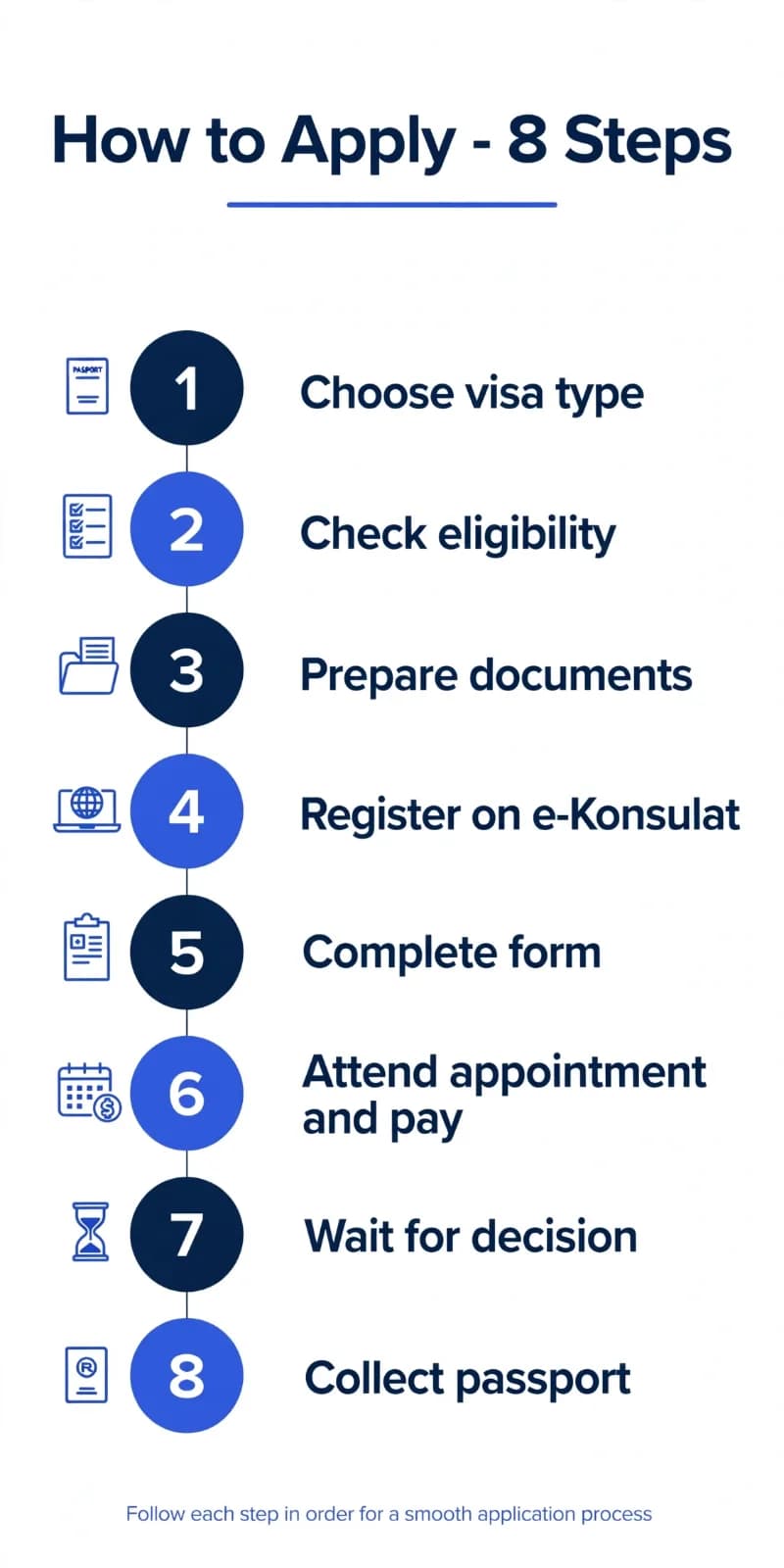
Step 1: Select the correct category
Identify whether your proposed stay is short-term or long-term and determine its primary purpose.
Step 2: Confirm application eligibility
Check whether your nationality requires a visa and which consulate is authorized to process your application.
Step 3: Prepare the documentation
Gather the general application documents together with category-specific evidence. Arrange translations and qualification recognition sufficiently early.
Step 4: Access the official registration portal
Visit e-Konsulat. Select the appropriate Polish diplomatic mission and visa service.
Step 5: Complete the application form
Enter accurate information matching your passport and other supporting documents. Print and sign the form as instructed.
Step 6: Arrange the appointment
Follow the mission's appointment procedure. Employment visa applicants may be subject to electronic appointment draws.
Step 7: Attend in person and pay the fee
Submit the application and supporting documents at the authorized location. Provide fingerprints where required and attend an interview if requested.
Step 8: Respond to additional enquiries
The consulate may request clarification or additional evidence. Respond within the specified deadline.
Step 9: Check the decision
Follow the collection and status instructions published by the relevant consular mission. There is no universal tracking procedure applicable to every Polish consulate.
Step 10: Collect the passport and prepare for travel
Check the visa's dates, authorized entries, permitted duration and purpose. Travellers must still satisfy border-entry requirements.
Applying for residence after arrival
From 27 April 2026, applications for Polish temporary residence, permanent residence and EU long-term residence permits must be submitted electronically through MOS.
Applicants create an account, complete the appropriate form and submit supporting documents electronically. Subsequent personal attendance and biometric requirements may still apply.
The residence permit system is different from the overseas consular visa application procedure.
Poland Visa Fees and Financial Requirements 2026
| Application | Published charge in original draft |
|---|---|
| Schengen adult visa | €90 |
| Schengen child visa, ages 6–11 | €45 |
| National visa in Pakistan | PKR 65,771 |
| National visa in Vietnam | VND 2,490,000 |
| Graduate residence permit | PLN 340 |
| Residence permit stamp duty | Generally PLN 340–640, depending on category |
| Residence card issuance | PLN 100 |
Official fee sources: Pakistan consular tariff, Vietnam consular tariff and MOS information.
Financial requirements
Applicants must demonstrate that they can fund their intended stay and, where required, return travel.
The original draft reported the following figures from the Polish Embassy in Pakistan for student visa applicants:
| Expense | Published requirement reported in draft |
|---|---|
| Student living expenses | PLN 1,010 per month (single-person household; PLN 823 per family member) |
| Return travel | PLN 2,500 |
| Accommodation | Additional actual costs |
| Tuition | Additional applicable costs |
| Travel medical insurance coverage | Generally at least €30,000 |
The figure above is the current minimum in force from 1 January 2025 (single-person household PLN 1,010/month; PLN 823/month per person in a family household). Some older consular and voivodeship pages still show the pre-2025 figure of PLN 776/month — do not use that figure. The amount must not be treated as a universal threshold for every student visa, residence permit or diplomatic mission; reconfirm with the responsible mission before relying on it.
Illustrative student financial calculator
Using the current figure, 12 months of living expenses at PLN 1,010, accommodation at PLN 1,000 per month, tuition of PLN 15,000 and return travel of PLN 2,500 produce an illustrative total of PLN 41,620. This excludes visa fees, insurance and other expenses and is not an official determination of eligibility.
Poland Visa Processing Times
| Application | Published timeframe reported in draft |
|---|---|
| Schengen visa | Normally 15 days |
| Extended Schengen examination | Up to 45 days |
| National visa in Hanoi | Normally 15 days |
| Extended national examination in Hanoi | Up to 30 days in justified cases; further consultation may affect timing |
| Employment visa appointment | Depends on appointment availability |
| Residence permit | Route-specific statutory timeframe |
| Permanent residence | Check current immigration procedure |
Appointment waiting periods must be distinguished from processing times after submission.
Applicants should avoid making irreversible travel arrangements before receiving a decision.
Applying from Pakistan or Vietnam
Applying from Pakistan
Pakistani nationals residing in Pakistan should normally follow the procedures published by the Polish Embassy in Islamabad.
The Islamabad mission requires prior registration through e-Konsulat and personal submission.
For employment visa applications, preliminary registration includes details of the applicant's employment authorization. Applicants receiving a link to complete the full application must follow the stated 48-hour deadline.
Family Registration Certificates issued by NADRA, previous passports, financial records and employment or educational documents may be required depending on the category.
Official source: Poland in Pakistan — National visas.
Applying from Vietnam as a Pakistani passport holder
This section is particularly important for Pakistani professionals, workers, students and business owners legally residing in Vietnam.
Living in Vietnam does not automatically make a Pakistani citizen eligible to submit every Polish visa category in Hanoi.
The Polish Embassy's Polish-language national visa instructions identify its jurisdiction as covering Vietnamese citizens and other nationals legally residing in Vietnam on a permanent basis.
Therefore, holders of temporary residence cards, work permits or other Vietnamese immigration permissions should obtain confirmation of jurisdiction before proceeding.
Potential documents include:
| Evidence | Purpose |
|---|---|
| Pakistani passport | Nationality and identity |
| Vietnamese residence card | Evidence of local residence |
| Vietnamese visa or immigration permission | Additional legal-status evidence |
| Vietnamese work permit | Employment status, if relevant |
| Local employment contract | Supporting evidence of residence |
| Address or residence registration | Supporting evidence |
| Polish university or employer documents | Purpose of travel |
| Financial evidence | Ability to support intended stay |
These are potential jurisdiction and supporting documents, not a verified mandatory checklist applicable to every Pakistani applicant in Vietnam.
The Polish Embassy in Hanoi is the identified visa application location. Applicants living in Ho Chi Minh City should not assume a local honorary consulate processes visa applications.
Hanoi's official instructions also require Vietnamese-language documents to be translated into Polish or English.
Official source: Polish Embassy in Vietnam — National visa instructions.
Pakistan versus Vietnam application comparison
| Consideration | Pakistan | Vietnam |
|---|---|---|
| Mission | Islamabad | Hanoi |
| Registration | e-Konsulat | e-Konsulat |
| Personal attendance | Required | Required |
| National visa fee | PKR 65,771 | VND 2,490,000 |
| Employment appointment draw | Applicable | Applicable |
| Local residence evidence | Relevant identity/residence evidence | Confirm qualifying legal residence |
| Pakistani NADRA records | Listed for relevant categories | Confirm acceptance and requirements |
| Approval guarantee | None | None |
Poland Student Visa Guide 2026
Poland offers bachelor's degrees, master's programmes, doctoral education and other academic opportunities to international students.
Choosing a university
Applicants should verify that their institution and programme meet the applicable requirements for admitting international students.
They should also check accreditation, tuition costs, teaching language and refund policies.
Recognition of academic qualifications
Foreign certificates may require official recognition or confirmation from the Polish National Agency for Academic Exchange, known as NAWA.
Applicants whose qualifications fall under recognized exemptions may follow different procedures.
Official source: NAWA qualification recognition.
Language proficiency
International applicants should prepare accepted evidence demonstrating the required level of proficiency in their programme's teaching language.
B2-level proficiency is an important requirement in relevant admissions and visa procedures.
Applicants should confirm that their specific language certificate is accepted before paying examination or tuition fees.
Working while studying
Eligible full-time university students with the appropriate legal immigration status may benefit from exemption from the ordinary work-permit requirement.
This exemption should not be assumed to cover every part-time programme, language course or training visa.
Students must continue satisfying the conditions of their educational residence status.
Official source: European Commission — Student in Poland.
Staying after graduation
Qualifying graduates can apply for the nine-month graduate residence permit.
Before that permit expires, they must establish another lawful residence basis if they wish to remain in Poland.
Poland Work Visa and Job Opportunities
International professionals may explore employment opportunities in information technology, engineering, manufacturing, construction, logistics, hospitality and other industries.
Job availability depends on qualifications, language skills, experience and employer demand.
Before accepting employment, applicants should verify the employer's legal identity, written employment conditions, salary, working hours and responsibility for obtaining the necessary employment authorization.
Applicants should be cautious about recruitment intermediaries promising guaranteed visas or charging substantial fees for unverified employment offers.
Official European employment services are available through EURES.
Changing employers
An employment permit or residence and work permit may contain conditions relating to an employer or employment arrangement.
Changing jobs may require notification, amendment or a new authorization.
Workers should consult MOS before starting employment under changed circumstances.
Family Immigration and Permanent Residence
Family reunification can provide a pathway for qualifying relatives to join a person legally residing in Poland.
Applicants must first determine whether their sponsor is a Polish citizen, another EU citizen or a non-EU resident because the applicable legal rules may differ.
Permanent residence is not automatically obtained after completing a degree, working for several years or purchasing property.
Long-term residents should maintain records of lawful residence, travel absences, employment, income, insurance and family circumstances.
Some settlement routes also require evidence of Polish language proficiency.
Official information: Office for Foreigners and MOS.
Common Poland Visa Application Mistakes
Applicants can avoid unnecessary difficulties by checking their documents carefully.
Common mistakes include submitting an application to the wrong consulate, choosing an incorrect visa purpose, providing incomplete university documents, relying on unverified work permits, failing to disclose previous visa refusals, using unacceptable insurance, misunderstanding financial requirements and submitting inconsistent personal information.
Other risks include assuming that a Vietnamese residence card automatically establishes Polish consular jurisdiction or that a Schengen visitor visa permits regular employment.
Always obtain official confirmation when eligibility is uncertain.
Reasons for Poland Visa Refusal
A visa application may be refused when the applicant fails to establish a genuine travel purpose, financial capacity, valid insurance or compliance with immigration requirements.
False or altered documents can result in refusal and potentially additional legal consequences.
For short-stay visas, doubts regarding the applicant's intention to depart before the authorized stay expires may also be relevant.
Applicants receiving a refusal should read the written decision and follow the applicable review or appeal procedure.
The Hanoi mission states a 14-day deadline for requesting reconsideration of a national visa decision.
Frequently Asked Questions
1. Do Pakistani citizens need a visa for Poland?
Generally, yes. Pakistani ordinary passport holders must obtain the appropriate visa unless a specific exemption or qualifying immigration permission applies.
2. Can a Pakistani citizen apply for a Poland visa from Vietnam?
Potentially, if the Polish Embassy accepts the applicant's local residence status and consular jurisdiction. Confirmation should be obtained before applying.
3. Can Vietnamese citizens travel to Poland without a visa?
Vietnamese ordinary passport holders generally require a visa unless an applicable exemption exists.
4. What is the difference between Type C and Type D visas?
Type C covers authorized short stays. Type D is a Polish national visa used for longer stays.
5. How much does a Polish Schengen visa cost?
The standard adult application fee is €90, subject to exemptions and applicable local payment arrangements.
6. Can international students work in Poland?
Eligible full-time students may work without a separate work permit when the relevant statutory conditions are satisfied.
7. Does Poland have a digital nomad visa?
No dedicated digital nomad visa was identified in the official sources reviewed.
8. Can I get a job seeker visa after graduation?
Eligible graduates of Polish universities may apply for a nine-month temporary residence permit for employment search or business preparation.
9. Is a Polish work permit the same as a visa?
No. Employment authorization and legal permission to enter or reside in Poland serve different functions.
10. Does a Poland visa allow travel to Germany or France?
A qualifying Polish visa generally permits short visits within the Schengen Area, subject to applicable conditions. It does not automatically authorize employment in those countries.
11. Can I apply for a residence permit online?
Yes. From 27 April 2026, the relevant Polish residence permit applications must be submitted electronically through MOS.
12. Is NAWA recognition compulsory for every international student?
No. Requirements depend on the qualification, educational route and applicable exemptions.
13. How long does a Polish visa take to process?
Schengen applications normally take 15 days after submission, although extended examinations can take longer. National visa timelines depend on the applicable procedure.
14. Is Poland visa approval guaranteed after paying university tuition?
No. University admission and tuition payment do not guarantee a positive immigration decision.
15. Can I obtain permanent residence simply by purchasing property?
Purchasing property does not by itself establish eligibility for permanent residence.
Official Immigration Websites
| Authority | Official link |
|---|---|
| Polish Ministry of Foreign Affairs | Visa information |
| Polish Office for Foreigners | Immigration information |
| MOS | Residence permit portal |
| e-Konsulat | Consular registration |
| Polish Embassy in Pakistan | National visa applications |
| Polish Embassy in Vietnam | National visa applications |
| NAWA | Academic recognition |
| Study in Poland | Study information |
| European Commission | Schengen visa requirements |
| EURES | European employment resources |
Final Checklist and Conclusion
- [ ] Select the correct visa or residence category.
- [ ] Confirm passport validity and nationality requirements.
- [ ] Verify consular jurisdiction.
- [ ] Obtain genuine university, employer or sponsor documents.
- [ ] Arrange qualification recognition if applicable.
- [ ] Prepare sufficient financial evidence.
- [ ] Purchase acceptable insurance.
- [ ] Check current visa fees.
- [ ] Register through the official application portal.
- [ ] Attend appointments and provide required biometrics.
- [ ] Review the immigration decision and travel conditions.
Poland provides several legitimate immigration opportunities for international students, workers, families and visitors. Successful preparation begins with selecting the correct immigration route and understanding the requirements of the responsible authority.
Pakistani applicants residing in Vietnam should pay particular attention to consular jurisdiction. International students should prioritize qualification recognition, accepted language evidence and genuine university admission.
Always consult official government sources before paying fees or making travel commitments.
Disclaimer: MAS Inspire provides educational information and is not a government immigration authority. This article does not constitute individual legal advice or guarantee visa approval. Immigration requirements, fees and procedures may change.


