

By MAS Inspire | Last reviewed: 27 November 2026 (key figures re-verified 27 November 2026)
Introduction
The Philippines welcomes visitors for holidays, business meetings, education, employment, family life and investment. The correct immigration permission depends on your nationality, reason for travel, length of stay and whether you will receive compensation or work for a Philippine organization.
The main temporary visitor category is the 9(a) visa. Students pursuing qualifying degree programmes generally need a 9(f) student visa, while eligible short-course or under-18 students may need a Special Study Permit. Foreign nationals taking up local employment usually need a 9(g) pre-arranged employment visa, supported by the employer and the relevant labour authorization. Family members and people seeking long-term residence may qualify for specific immigrant or resident categories.
This guide summarizes the official framework checked on 25 November 2026. Philippine authorities can change rules, fees and forms. Always use the linked government pages for the final decision and do not book non-refundable travel until the required visa has been issued.
On this page
- Why people visit, study and work
- Visa types
- Visa comparison
- Eligibility
- Document checklists
- Application steps
- Fees and finances
- Processing times
- Pakistan and Vietnam
- Student guide
- Work and jobs
- Family and residence
- Mistakes
- Refusals
- FAQs
- Official websites
- Final checklist
Why People Visit, Study, and Work in the Philippines
The country attracts travellers with its islands, beaches, diving, historic cities and family connections. Manila and other urban centres also host regional offices, business events, universities, language programmes and international employers. Foreign nationals may come for short commercial visits, formal study, employment, family reunification or qualifying investment.
The purpose matters. Attending a conference or meeting a prospective business partner can fall within a visitor category; performing paid work for a Philippine employer generally does not. Likewise, a visitor visa is not a substitute for a student or employment visa simply because the proposed stay is initially short.

Types of Philippines Visas
The BI classifies visas into non-immigrant, immigrant and special visa categories. The list below focuses on pathways likely to matter to international applicants. Not every category is open to every nationality.
1. Tourist and visitor visa — 9(a)
The 9(a) Temporary Visitor Visa covers tourism/leisure and a range of temporary purposes, including business visits, medical treatment, training, conferences and meetings. Applicants must show a genuine temporary purpose, a valid passport, the prescribed application form and return/onward travel. The official eVisaPH policy page provides the minimum baseline and additional requirements for subcategories.
A visa-required national must apply through an authorized Philippine Foreign Service Post or an online channel only if the portal confirms that nationality and visa type are eligible. A visa's validity is not necessarily the same as the authorized stay stamped or recorded at entry. The immigration officer at the port of entry determines admission and permitted stay.
Work rights: A 9(a) visitor must not take up ordinary paid employment in the Philippines. Business visitors must remain within permitted visitor activities and must not receive Philippine-source compensation for services rendered locally where that would create an employment relationship.
2. Business visitor — 9(a-1)
This is a visitor subcategory for temporary scientific, commercial, industrial, professional and business purposes, where the visitor will not be paid by a Philippine company/entity for services rendered in the country. Typical evidence includes an invitation from the Philippine host, employer letter, itinerary, proof of the overseas business and accommodation. Business-owner and employee checklists differ; use the official eVisaPH 9(a) policy.
3. Student visa — 9(f)
The 9(f) visa is intended for foreign nationals aged at least 18 who are admitted to qualifying degree-level programmes at an accredited Philippine university, college or seminary. The BI conversion process involves the student and petitioning school, document screening, payment, biometrics/ACR I-Card processing and visa implementation after approval. The 2025 BI Citizen’s Charter gives the current procedural framework. The school should confirm its accreditation and explain its role in filing.
A 9(f) visa is not a general work permit. Do not assume that it grants unrestricted employment. Ask BI and the school about any proposed internship, practicum or paid activity before starting it.
4. Special Study Permit (SSP)
A foreign national who does not qualify for a 9(f) visa may be eligible for an SSP, including certain minors, non-degree students and short-course participants. The school must be appropriately authorized, and BI approval is required. The BI service page describes the process but still labels its fee schedule as updated in 2014; therefore, the listed amount is not a reliable 2026 quotation.
5. Work visa — 9(g) pre-arranged employment
The 9(g) visa is for a foreign national entering or changing status to engage in lawful employment. A Philippine-based employer petitions for the worker. The employer generally coordinates the DOLE AEP (or applicable exemption) and BI visa process. DOLE’s Department Order 248-25 governs current rules for employing foreign nationals; the exact labour permit route depends on the job, employer and any exemption.
BI’s FAQ says that a 9(g) commercial visa is normally processed in about 40 days, depending on workload and complete documentation. Treat this only as a published indicative estimate, not a guaranteed deadline. BI's fee page contains old 2014 figures, so obtain a current assessment before paying.
6. Special Work Permit and Provisional Work Permit
BI separately lists Special Work Permits (including commercial and artists/athletes) and Provisional Work Permits. These are special permissions for defined circumstances and are not interchangeable with a full 9(g) visa. A short engagement may fit a special permit only if BI confirms the conditions. Do not begin work while an application is pending unless the relevant authority has expressly authorized it.
7. Treaty trader or investor — 9(d)
The 9(d) category is a treaty-based route. BI identifies nationals of the United States, Japan and Germany for treaty-trader eligibility under the applicable commerce and navigation treaties, subject to the statutory conditions. The BI page also describes qualifying enterprise-development/investment circumstances. It is not a general investor visa for every nationality. Pakistani applicants should not assume eligibility under 9(d); seek BI confirmation on nationality and treaty basis.
8. Family, spouse and immigrant visas
- 13(a) non-quota immigrant visa by marriage: A foreign national validly married to a Philippine citizen may qualify if the statutory and BI requirements are met. The BI process includes a probationary stage and later amendment to permanent status where approved.
- Temporary Resident Visa (TRV): A specific route may be available to a foreign spouse where the applicant's country does not have the relevant reciprocity agreement. BI's published page describes a one-year TRV route under Law Instruction No. 33 for eligible cases. The exact nationality rules need individual confirmation.
- 13(g): Returning former natural-born Filipino citizens may qualify under the applicable rules.
- 13(e): Returning resident category for eligible former residents, subject to BI conditions.
- Quota immigrant visa (13): Available only within the statutory quota and reciprocity framework; BI states no more than 50 applicants of any one nationality in a calendar year.
- Other 13-series categories: The BI directory includes immigrant categories for certain children born abroad and other specified circumstances. These are fact-specific, not general settlement routes.
A marriage alone does not automatically confer permanent residence or Philippine citizenship. Applicants must provide civil-status evidence and satisfy BI screening.
9. Transit — 9(b)
A transit visa may be required for a visa-required traveller who enters the Philippines en route to another country. BI's transit guidelines distinguish airside transfer within the same airport from landside transfer that requires admission. Transit passengers should hold confirmed onward tickets, meet the 72-hour framework in the circular where applicable, and hold permission to enter the final destination. Airline terminal changes, separate tickets, baggage collection or overnight stays can affect whether the passenger must pass immigration. Confirm with the airline and Philippine consular post before travel.
10. Research, internship, exchange and training
There is no single universal “research visa” or “intern visa” that covers every placement. Depending on the activity, duration, host and compensation, the appropriate route may be 9(a), 9(f), 9(g), SSP, Special Work Permit or another institutional/special category. Academic visitors should obtain a host institution letter and ask the Philippine Embassy/BI to classify the activity before travel.
11. Job-seeker, skilled-worker and digital-nomad routes
The BI's published visa list does not establish a general job-seeker visa or points-based skilled-migration programme comparable to systems in some other countries. The normal local employment route is employer-led 9(g), with the relevant labour authorization. No general digital-nomad visa appears in the BI visa categories reviewed for this guide. A foreign remote-work arrangement does not automatically make a 9(a) stay lawful; seek written advice from BI/DFA on the exact facts and avoid representing a visitor trip as something it is not.
12. Humanitarian protection
The Philippines has legal mechanisms for refugees, stateless persons and other protection-related cases under national law and international commitments. These are protection procedures, not ordinary travel visas or a route to be selected for convenience. People seeking protection should contact the Philippine government authorities and UNHCR through official channels and obtain qualified legal assistance.
Visa Comparison Table
| Category | Main purpose | Sponsor/host | Work rights | Stay/validity | Fee status (2026) |
|---|---|---|---|---|---|
| 9(a) visitor | Tourism, short business, medical, meetings | Usually no employer sponsor; evidence of host/purpose may be needed | No ordinary local employment | Entry-authorized stay; extensions subject to BI rules | USD 40 single / USD 80 6-mo multiple / USD 120 1-yr multiple (visa-required nationals); e-Visa +USD 25 — confirm with post |
| 9(a-1) business visitor | Unpaid business activity/meetings | Philippine invitation often required | No local paid services | Temporary visit | Check official post |
| 9(f) student | Qualifying degree study | Accredited school petitions/supports | No unrestricted work right | Study period; extensions required | BI page lists stale 2014 fees; verify current assessment |
| SSP | Eligible short/non-degree study or minors | Authorized school | No general employment right | Permit/course-specific | Verify with BI; published page has stale fee note |
| 9(g) work | Local employment | Philippine employer petitions | Work for approved employer/role subject to conditions | Often 1–3 years initially per BI FAQ, tied to contract | Verify; published BI fee schedule says 2014 |
| SWP/PWP | Defined short-term/provisional work | Host/employer and relevant authority | Only the approved activity | Permit-specific | Check BI current schedule |
| 9(d) | Treaty trader/investor | Treaty/business evidence | Business activity within visa terms | Visa-specific | Check BI; published page says 2014 fee update |
| 13(a)/TRV | Spouse/family residence | Philippine spouse | Rights depend on status and applicable rules | Probationary/temporary then permanent where eligible | Check BI; published page says 2014 fee update |
| Quota 13 | Immigrant residence under quota/reciprocity | No ordinary employer sponsor | Not a work permit by itself | Immigrant status if approved | Check BI |
| 9(b) transit | Transit to another country | Confirmed onward travel | No | Transit framework | Check consular post |
Eligibility Requirements
Most applicants should be ready to demonstrate:
- A passport acceptable for Philippine visa processing. The eVisaPH portal requires six months' validity beyond departure from the Philippines and accepts electronic or machine-readable passports for visa applications.
- A genuine, consistent purpose that matches the selected category.
- Legal residence in the place where the application is lodged, where required by the consular post.
- Sufficient financial capacity or a credible sponsor where relevant.
- Return/onward travel for visitor applications, unless the consular officer directs otherwise.
- No disqualifying immigration, security or public-health issue.
- For study: admission to an eligible school/course and school documentation.
- For employment: a real Philippine employer/petitioner and the applicable DOLE authorization.
- For marriage/family: valid civil records and proof of the qualifying relationship.
There is no single published minimum bank balance that applies to every Philippine visa applicant. Do not rely on internet claims of a fixed amount. Provide credible evidence proportionate to the trip or application and follow the specific consular checklist.
Complete Document Checklists
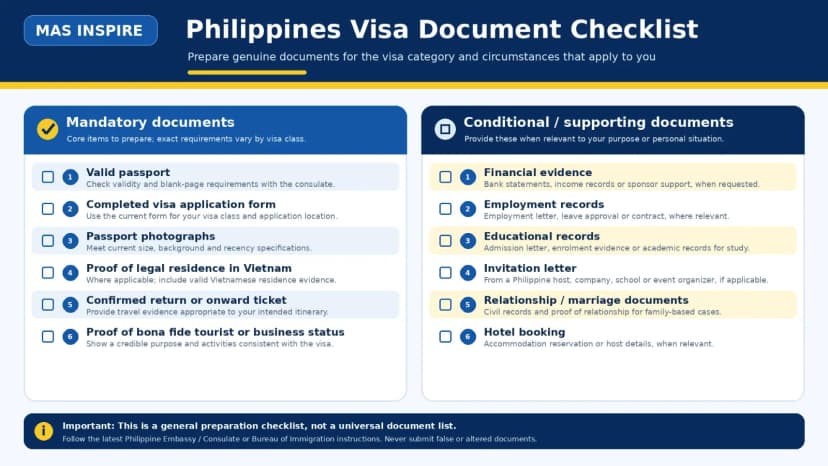
The lists below separate the common baseline from category-specific evidence. The embassy or BI may request additional documents. This is not a claim that every applicant must submit every item.
Visitor and business application
| Document | Status | Notes |
|---|---|---|
| Passport and bio-data copy | Mandatory baseline | Machine-readable/e-passport; validity per eVisaPH guidance |
| Completed visa application form | Mandatory baseline | Use the current form issued by the post/portal |
| Recent photograph | Commonly required | Follow post's exact dimensions/background |
| Return/onward ticket or reservation | Mandatory baseline in eVisaPH visitor list | Avoid non-refundable purchase before decision unless required |
| Proof of bona fide visitor status/purpose | Mandatory baseline | Itinerary, hotel, event details or explanation |
| Bank statements/income evidence | Conditional/supporting | Amount not standardized publicly for all cases |
| Employer letter/business registration | Conditional | Especially for business travellers |
| Philippine invitation letter | Conditional | Include host identity, purpose, dates and relationship |
| Legal residence permit in Vietnam | Required by Hanoi post for locally lodged applications | Pakistani applicant should confirm acceptance first |
| Police/security clearance | Embassy-specific/conditional | Islamabad checklist asks for authenticated police clearance |
| Medical/treatment letter | Conditional for medical visit | Philippine provider acceptance/appointment and medical evidence |
Student 9(f) / SSP
| Document | Status | Notes |
|---|---|---|
| Passport and copies | Mandatory | Follow BI checklist and validity rules |
| Current BI application form/CGAF | Mandatory | Download only from BI or obtain from school/BI |
| School admission/acceptance and enrolment evidence | Mandatory | School must meet applicable accreditation rules |
| School petition/endorsement and supporting school papers | Mandatory/conditional | School coordinates its part of process |
| Birth certificate/identity records | Conditional | May be required for identity/age verification |
| Proof of financial support | Conditional/supporting | Sponsor documents where applicable |
| Medical/police records | Conditional | If required by the current checklist or consular officer |
| ACR I-Card biometrics documents | Required where applicable | BI process includes image/fingerprint capture |
Work 9(g)
| Document | Status | Notes |
|---|---|---|
| Passport, current immigration status and application form | Mandatory | BI's current checklist controls |
| Joint request/letter from applicant and petitioner | Commonly required | Employer participates in petition |
| Employment contract/appointment and job description | Mandatory/supporting | Role, compensation, term and work location |
| Employer corporate registration and business records | Mandatory/supporting | Exact documents depend on employer |
| DOLE AEP or applicable exemption | Generally prerequisite | DOLE rules and any exemption apply |
| Certification of foreign and Filipino employees | BI checklist item in commercial cases | Notarization may be required |
| Credentials/licences | Conditional | Especially regulated professions |
| ACR I-Card/biometrics requirements | Required where applicable | BI process |
Marriage/family 13(a), TRV or other immigrant application
| Document | Status | Notes |
|---|---|---|
| Passport and BI application form | Mandatory | Current checklist |
| Philippine spouse's proof of citizenship/identity | Mandatory | Government-issued records |
| Marriage certificate | Mandatory | PSA/recognized foreign record and authentication/registration as applicable |
| Birth certificates of dependants | Conditional | For children/dependants |
| Proof of genuine relationship/cohabitation | Supporting/conditional | If requested; truthful records only |
| Police/security clearances | Conditional/commonly requested | Check BI list and nationality-specific requirements |
| Medical certificate | Conditional | BI may require health evidence |
| Proof of financial capacity/support | Eligibility evidence | No universal public minimum stated for all cases |
| ACR I-Card/biometrics | Required where applicable | BI will advise on process |
How to Apply: Step-by-Step
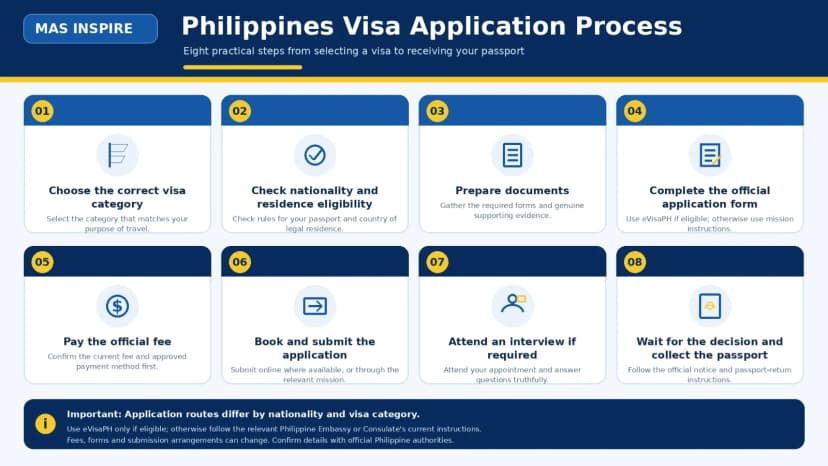
The exact route varies. An overseas visitor visa is normally handled by a Philippine Foreign Service Post/DFA; in-country status conversion and many residence/work/student processes are handled by BI. Use only the steps that apply to the chosen category.
- Choose the correct category. Match the real activity to 9(a), 9(f), SSP, 9(g), 9(d), 13(a), 9(b) or another official route.
- Check nationality and place-of-application rules. Confirm whether your passport is visa-required, whether your intended post accepts applications from legal residents, and whether the category is available to you.
- Prepare documents. Use the current embassy or BI checklist. Arrange certified translations, apostilles or authentication only where required.
- Create an online account if applicable. Use eVisaPH only if the portal explicitly offers the route to your nationality and case. Not every category is an online application.
- Complete the correct form. Do not use a generic form from an unofficial website. BI in-country conversions commonly use the Consolidated General Application Form (CGAF).
- Submit documents and pay the assessed fee. Pay only through the official channel and keep the official receipt. Ask for the current amount before paying because some BI pages show 2014 prices.
- Attend biometrics/interview if instructed. BI student, work and immigrant procedures may include hearings and fingerprint/photo capture. Embassy applicants may be asked to appear in person.
- Submit/complete the application. Keep copies and proof of submission. Do not start work or study activities requiring a permit before approval.
- Track the case. Use the official portal, BI status page or the consular post's instructions. Avoid unofficial agents claiming guaranteed approval.
- Review the decision and entry conditions. Check visa validity, number of entries, authorized stay, permitted activity, passport return and any BI registration obligations. A visa does not guarantee admission at the border. Complete the free eTravel registration (etravel.gov.ph) within 72 hours before arrival.
Visa Fees and Financial Requirements
| Application | Officially verifiable fee position as at 25 Nov 2026 | Financial evidence |
|---|---|---|
| 9(a) overseas visitor | Standard consular schedule (e.g. Washington embassy, updated Aug 2026; Islamabad USD 40 for Pakistani applicants): USD 40 single-entry (3 months) / USD 80 six-month multiple / USD 120 one-year multiple for visa-required nationals (visa-free nationals USD 30/60/90; Chinese nationals USD 25/50/100); e-Visa adds a USD 25 convenience fee. The Hanoi post's local-currency amount must still be confirmed with the Embassy. (Muse enhancement, verified 25 Nov 2026.) | No single universal minimum balance published |
| eVisa | Portal-specific amount shown during eligible application; nationality/category availability must be checked | Depends on visit and portal checklist |
| 9(f) student | BI webpage displays PHP 9,720 total and additional USD 50 ACR fee but explicitly dates the schedule to 06 Mar 2014; not a 2026 quote. Dated note (Muse, 25 Nov 2026): the BI 2026 Citizen's Charter lists conversion at PHP 11,250 + USD 50 ACR at the Main Office (extension PHP 10,560 + USD 50) — higher than the PHP 9,720 / PHP 4,020 web-page figures. Quote the Charter figure and confirm on the Order of Payment Slip. | Sponsor/financial support evidence may be requested; no universal amount verified |
| SSP | BI page displays PHP 5,240 plus USD 50 ACR fee, marked 06 Mar 2014; not a 2026 quote | Course/sponsor evidence as required |
| 9(g) work | BI page displays legacy amounts by validity/employer type, marked 06 Mar 2014; not a 2026 quote | Employer-sponsored; contract and employer records |
| 13(a)/TRV/13 quota | BI pages display legacy PHP amounts and 2014 update notes; not 2026 quotes | 13(a) includes sufficient capacity to support family; no single general minimum verified |
| ACR I-Card | BI page shows USD 50 + PHP 500, marked 2014; the same USD 50 + PHP 500 figure is still listed on BI's current ACR pages (2026 guides, checked Oct–Nov 2026) — confirm on the Order of Payment Slip. (Muse enhancement, verified 25 Nov 2026.) | Not applicable |
SRRV (Special Resident Retiree's Visa, Philippine Retirement Authority): Classic deposit — age 50+ pensioner USD 15,000 / non-pensioner USD 30,000; age 40–49 pensioner USD 25,000 / non-pensioner USD 50,000; Courtesy (foreign nationals) USD 1,500 (50+) or USD 3,000 pensioner / USD 6,000 non-pensioner (40–49); application fee USD 1,500 (principal) + USD 300 per dependent; annual PRA fee USD 360 (Classic). Minimum age 40. (Muse enhancement, verified 25 Nov 2026 against PRA's revised Sep 2025 service standard.)
Practical fee advice: Request the current itemized assessment from the Philippine Embassy/Consulate or BI office responsible for your case. Budget separately for authentication, translations, courier, medical checks, ACR I-Card, express-lane charges and travel. These may be additional and case-dependent.
Visa Processing Times
| Category | Published processing information | Planning advice |
|---|---|---|
| Overseas 9(a) | Not consistently published as a universal service time | Ask the post handling your application; allow extra time for security checks/additional documents |
| 9(g) commercial | BI FAQ says usually 40 days, depending on workload and complete documents | Start well before intended employment date |
| 9(f) / SSP | Varies by school, BI office, completeness and biometrics | Obtain a current estimate from the school's international office and BI |
| 13(a), TRV, quota 13 | No universal current timeframe verified | Plan for hearings, document authentication and possible probationary stage |
| Transit | Consular decision time varies | Do not book a tight connection until visa/transfer requirements are confirmed |
Applying from Pakistan or Vietnam
Pakistani passport holders
Pakistan is not included in the official eVisaPH visa-free list reviewed for this guide. Pakistani ordinary-passport holders should therefore apply for the correct Philippine visa before travel. The Philippine Embassy in Islamabad publishes a general temporary visitor checklist that includes:
- Personal appearance at the Embassy;
- Passport valid at least six months beyond the stay;
- Completed visa application form and two recent colour photos;
- Evidence of visit purpose, such as an employer endorsement or Philippine invitation;
- Apostilled proof of financial capacity, such as bank statements, payslips or pension evidence;
- Authenticated police/security clearance;
- Flight and hotel booking; and
- Visa fee payment.
This Islamabad checklist is specific to the Embassy's process and may be amended. Check its current page before submitting. The Embassy may require additional documents based on the applicant's profile and visa subtype.
Pakistani citizens legally living or working in Vietnam
The Philippine Embassy in Hanoi's published requirements document (21 November 2024) instructs applicants to request a consular appointment at hanoipe.visa@dfa.gov.ph and submit the visa form, recent colour photo, proof of bona fide tourist/business status, proof of legal residence and confirmed return/onward tickets. Additional documents may be requested after the initial email.
For a Pakistani applicant, the practical approach is:
- Email the Embassy before booking an appointment. State that you hold a Pakistani passport, identify the visa category, and explain your lawful status in Vietnam.
- Attach a clear scan of the passport bio page and Vietnam residence card/visa or other proof of lawful residence, if the Embassy requests it. Do not send sensitive documents to an unverified address.
- Ask whether the Embassy accepts Pakistani nationals for that category and whether an in-person interview, police clearance, bank evidence or authentication is required.
- Ask for the current application form, appointment process, fee, payment method, processing estimate and whether the original passport must be retained.
- Follow the Embassy's written instructions. Do not assume that legal residence in Vietnam guarantees that the Embassy will accept or approve the application.
Dated note (27 November 2026): In May 2026 the Philippines was reported to have extended eVisa access to people legally residing in any of 45 countries — including Vietnam — regardless of passport nationality. If that extension is in force for your case, a Pakistani national legally resident in Vietnam may be able to apply for a 9(a) visa online through eVisaPH instead of applying in person in Hanoi. This is reported by a secondary source and was not confirmed on the official eVisaPH policy page during this review — check the portal directly (evisa.gov.ph) and confirm your eligibility before relying on it.
Pakistan versus Vietnam: Applying in Pakistan means following the Islamabad Embassy's personal-appearance and document-authentication checklist. Applying in Vietnam means proving legal residence in Vietnam and obtaining confirmation from the Embassy in Hanoi that it will accept the case. The visa eligibility itself is based principally on nationality and visa category, not simply the country where the applicant happens to live.
Student Visa Guide
International students should first secure admission to an institution authorized to enrol foreign students. A degree student aged 18 or older may qualify for a 9(f) visa. The school normally provides institutional documentation and guides the student through petitioning and filing. Applicants should confirm whether the programme is degree-level and whether the school is accredited for the 9(f) process.
For minors, short courses and non-degree study, an SSP may be appropriate instead. The distinction is important: an SSP is a permit for defined study, not a general student residence visa and not permission to work.
Student preparation checklist: admission letter; school petition/endorsement; passport; BI form; identity and civil documents if requested; proof of financial support; translations/authentication where required; biometrics and ACR I-Card application if applicable. The BI 2025 Citizen’s Charter states that extensions should be filed at least one month before the 9(f) visa expires; late filing may attract penalties.
Do not assume international students can work unlimited hours. The official sources reviewed do not establish a broad automatic part-time work allowance comparable to some other study destinations. Obtain written BI/school advice and the necessary work authorization before accepting paid work or an internship.
Work Visa and Job Opportunities
A foreign national seeking ordinary employment should secure a genuine job offer from a Philippine employer prepared to petition for the 9(g) visa. The employer must assess whether an AEP is required or whether a specific exemption applies under DOLE rules. DOLE's Department Order 248-25 sets out rules for AEP applications, filing and employment of foreign nationals. Certain regulated professions may require additional professional authorization.
The AEP and 9(g) visa serve different functions. An AEP is a labour authorization; it is not by itself an immigration visa. A Special Work Permit or Provisional Work Permit may cover limited situations, but only when the activity and conditions meet BI rules. Never begin work on a tourist entry or while an application is pending unless the relevant authorities have expressly authorized it.
The Philippines does not operate a general job-seeker visa in the BI list reviewed. Job applicants generally need an employer willing to complete the required process.
Family Immigration and Permanent Residence
A foreign spouse of a Philippine citizen may qualify for a 13(a) non-quota immigrant visa if the marriage is valid and recognized under Philippine law and the applicant meets the other requirements. BI identifies factors including good immigration/security standing, health and sufficient financial capacity. A probationary one-year period may precede conversion to permanent non-quota status. Applicants whose nationality does not meet the relevant reciprocity basis may need to ask BI about a TRV route or other applicable category.
The quota 13 visa is subject to reciprocity and an annual nationality cap. Returning former natural-born Filipinos may qualify for 13(g), and returning residents may be considered under 13(e). These routes are not generic options for any foreign national who wishes to settle. Permanent residence should not be confused with citizenship; naturalization is a separate legal process.
Common Application Mistakes
- Choosing a visitor visa for work, long-term study or another activity that requires a different status.
- Assuming a Vietnam residence card changes Pakistani nationality-based visa requirements.
- Applying at an embassy without confirming that it accepts the applicant's nationality and category.
- Relying on outdated fee tables or unofficial websites.
- Submitting inconsistent travel dates, employment details, funding evidence or invitation letters.
- Providing unverified, altered or misleading bank statements, bookings or civil records.
- Forgetting required translations, apostilles or authentication.
- Treating visa validity as the authorized period of stay.
- Starting employment, an internship or paid services before the required authorization is issued.
- Overlooking ACR I-Card, extension or annual-report obligations where applicable.
Reasons for Visa Refusal
A visa may be refused or entry denied if the officer is not satisfied about the purpose of travel, funds, sponsorship, ties and intention to comply with the visa conditions. Other risks include incomplete or unauthenticated records, inconsistent information, suspected misrepresentation, inadmissibility, prior immigration violations, security concerns or an application under the wrong category. No agent or school can guarantee approval. Provide truthful evidence and answer questions directly.
Frequently Asked Questions
1. Do Pakistani citizens need a visa for the Philippines?
Yes. Pakistan is not included in the official 30-day visa-free nationality list reviewed. Pakistani ordinary-passport holders should obtain the appropriate visa before travel and confirm the current application channel with a Philippine Embassy/Consulate.
2. Can a Pakistani citizen apply for a Philippine visa in Vietnam?
The Philippine Embassy in Hanoi publishes a process requiring proof of legal residence in Vietnam. Pakistani applicants should email the Embassy first to confirm that it will accept their nationality and visa category. Vietnamese residence does not guarantee local acceptance or visa approval.
3. What is the Philippine 9(a) visa?
It is the temporary visitor visa for tourism and other permitted temporary purposes such as business visits, medical treatment, training and meetings. It does not authorize ordinary local employment.
4. Can I work in the Philippines on a tourist visa?
No. A visitor visa is not a general work authorization. Local employment normally requires the appropriate work permission, commonly a 9(g) visa supported by an employer and applicable DOLE authorization.
5. What is the 9(g) visa?
It is the pre-arranged employment visa for foreign nationals hired by a Philippine-based employer that petitions for the worker. The employer coordinates the immigration and labour requirements.
6. How long does a 9(g) visa take?
BI's FAQ gives an indicative estimate of about 40 days for a commercial 9(g) application when documents are complete. Actual processing varies with workload and case circumstances.
7. What is the 9(f) student visa?
It is the student visa for qualifying foreign nationals aged 18 or older enrolled in eligible degree-level programmes at an appropriately accredited institution.
8. Is a language course eligible for a 9(f) visa?
Not automatically. Short or non-degree study may require a Special Study Permit. The school and BI should confirm the correct route for the exact course and duration.
9. Is there a Philippine digital nomad visa?
No general digital-nomad visa appears in the BI visa categories reviewed for this guide. Do not assume remote work is permitted under visitor status; seek written advice for your circumstances.
10. Is there a job-seeker visa?
The BI visa list reviewed does not show a general job-seeker visa. The ordinary employment route is employer-sponsored 9(g), subject to labour and immigration rules.
11. What is the 13(a) visa?
It is a non-quota immigrant visa route for a foreign national validly married to a Philippine citizen, subject to statutory eligibility and BI approval.
12. Does a 13(a) visa immediately give permanent residence?
The BI process commonly begins with probationary status. Applicants may apply for amendment to permanent status after meeting the requirements. Check the current BI procedure for the individual case.
13. How much money must I show for a tourist visa?
The official sources reviewed do not set one universal minimum bank balance for every visitor. Provide credible financial evidence proportionate to the trip and follow the consular post's instructions.
14. What happens if I stay more than 59 days?
BI states that many foreign nationals, including temporary visitors, who stay more than 59 days must apply for an ACR I-Card. Check current exemptions, extension rules and fees with BI.
15. Does an issued Philippine visa guarantee entry?
No. The eVisaPH portal expressly states that a visa does not guarantee automatic admission. Border immigration officers determine admissibility and authorized stay.
Official Immigration Websites
- Philippine Bureau of Immigration
- BI visa categories
- Philippine Visa Online Portal (eVisaPH)
- Department of Foreign Affairs
- Philippine Embassy in Hanoi
- Philippine Embassy in Islamabad
- Department of Labor and Employment
- eTravel registration
Final Checklist and Conclusion
Before submitting, confirm that the category matches the real purpose; the passport and residence status meet the rules; the correct embassy/BI office accepts the case; the form and checklist are current; documents are complete and authentic; the fee is confirmed in writing or on the official assessment; biometrics/interview arrangements are understood; and the final visa conditions permit the intended activities.
The Philippines offers several pathways for visitors, students, employees and eligible family members, but there is no universal visa. Pakistani nationals living in Vietnam should pay particular attention to nationality-based visa requirements and obtain written confirmation from the Philippine Embassy in Hanoi before applying locally. Use official sources, avoid outdated fee quotations, and never assume approval is guaranteed.
Educational information disclaimer: This guide is general information, not legal advice or a guarantee of visa approval. Immigration rules, fees, forms and processing times can change without notice. Confirm your individual case with the Philippine Department of Foreign Affairs, Bureau of Immigration, DOLE or a qualified Philippine immigration lawyer. MAS Inspire is an independent educational publisher and is not a Philippine government agency or visa-issuing authority.


