Panama Visa Guide 2026: Types, Requirements, Documents and Application Steps
Last checked: 28 November 2026. This guide is for Pakistani passport holders living in Vietnam. Visa rules change without notice — always confirm the live rules with the Embassy of Panama in Hanoi or the Consulate-General in Ho Chi Minh City and with Panama's National Immigration Service (SNM) before paying any fee or booking a non-refundable ticket.
Introduction
The honest news is that there are two completely different ways in, and which one applies to you decides the whole trip. If you hold a valid visa or residence permit from the United States, Canada, the United Kingdom, an EU country, Australia, Japan, South Korea or Singapore, Executive Decree 196 of 28 October 2024 lets you enter Panama as a tourist without a Panamanian visa at all — that is the single most valuable fact in this guide, and it is worth checking before you spend a dollar on an application. If you do not hold one of those visas, you need an Authorized Visa (Visa Autorizada): a permit that must be approved in Panama City by the National Immigration Service and the National Council of Public Safety and National Defense before any consulate can stamp it into your passport, with the file due 60 days before travel. There is no e-visa for Panama and no visa on arrival for Pakistani passports, so neither shortcut exists for you.
Do Pakistani Passport Holders Need a Visa for Panama?
Yes, unless you hold one of the qualifying foreign visas or residence permits described in the next two sections. Panama's National Immigration Service (SNM) lists Pakistan among the countries whose ordinary passport holders need a visa. There is no e-visa and no visa on arrival for Pakistanis — a Pakistan-focused guide that checked the SNM rules on 7 November 2026 states both points explicitly. The rule follows your passport, not where you live: holding a Vietnamese temporary residence card (TRC) or a Gulf residence visa does not remove the visa requirement. Gulf residence (UAE, Saudi Arabia and others) is expressly not on Panama's exemption list.
Pakistan is not on Panama's visa-free list at all. The visa-free group covers the United States and Canada (up to 180 days) and most other exempt nationalities — including the United Kingdom, the EU states, Australia, Japan, South Korea and Singapore — for up to 90 days. A second group needs only a stamped visa from a Panamanian consulate before travel. Pakistan sits in the third and smallest group: the restricted nationalities that need prior authorisation from Panama itself.
The Authorized Visa: Panama's Restricted-Nationality Route
The Authorized Visa (Visa Autorizada) is the entry permit Panama requires from citizens of certain restricted nations before they travel as tourists. A Panama City immigration law firm, Kraemer & Kraemer, which publishes the fullest public account of the route, states that citizens of 65 countries need this permit, set for health or security reasons, including India, Pakistan and the People's Republic of China alongside mainly African and Middle Eastern states. Each file reaches the National Council of Public Safety and National Defense and the National Immigration Service 60 days before the trip, and those two bodies decide whether to grant it. They have full discretion to grant or refuse, so even a complete file carries no guarantee.
The 60-day lead time is the single most important planning fact in this guide. The file must reach Panama 60 days in advance so the National Council can verify it. A Pakistan-focused commercial guide puts standard processing at 20 to 30 days because of the Panama City authorisation step, but that figure conflicts with the 60-day filing rule and with a transit-visa guide that puts authorised-visa processing at up to 60 business days (about three months). This guide treats the 60-day filing rule as controlling and tells you to apply at least three months before travel.
What the file contains. According to Kraemer & Kraemer, the Authorized Visa file needs a completed form; a passport valid for at least six months; four colour passport photographs; two colour photocopies of the passport including every page, even blank ones; two colour copies of the national ID or residence card (your Vietnamese TRC) and of a second identification; a pre-booked round-trip airfare reservation; proof of economic solvency of at least USD 500; proof of income such as an employment letter; a hotel reservation or an invitation letter from the person or company responsible for the visit; and copies of any previously approved Panamanian permits. Every document must be translated into Spanish and apostilled or notarised. If you apply through a lawyer in Panama, a power of attorney is added.
The invitation letter. The invitation replaces the hotel reservation and comes from whoever is responsible for the visit. A natural person must add ID, a utility bill proving their address, a bank reference letter and an employment letter stating their salary. A company must add a letter of responsibility from its legal representative, a utility bill, proof of financial solvency, and for private companies a Public Registry certificate and commercial licence (Aviso de Operaciones). Start this early: a slow invitation letter is the usual delay in an authorised-visa file.
How long you can stay. Here the sources conflict, and the conflict matters. A Pakistan-focused guide says tourist visas run up to 90 days, which is also the maximum tourist stay in Panama's immigration law (Decree Law 3 of 22 February 2008). Kraemer & Kraemer's visit guide, however, says the Panama visit visa that a consulate stamps usually allows 30 days at a time, and that approval for a restricted country brings one month. This guide reports both figures and tells you to plan on 30 days: the stamp the officer puts in your passport on arrival sets your deadline, so check it before you walk away from the desk.
The Shortcut: Entering with a US, UK, EU or Other Qualifying Visa
Before you start an Authorized Visa file, check whether you already hold the shortcut. Under Executive Decree 521 of 6 August 2018, as amended by Executive Decree 196 of 28 October 2024, Panama removes the visa requirement for every nationality that needs one if the traveller holds a valid visa or residence permit of Canada, the United States, Australia, South Korea, Japan, the United Kingdom, Singapore or any European Union member state. A Schengen visa issued by an EU country counts, and a valid US permanent resident card (green card) is expressly recognised in the same way. This is the exemption the UrduPoint guide summarises as "no Panama visa needed with a valid US, Canada, UK, EU, Australia, Japan, South Korea or Singapore visa or residence", confirmed by Kraemer & Kraemer, AlwaysPacked and the visa-policy summary.
The conditions are disputed — and the dispute is about the 2024 change. Older material, including the visa-policy summary and one Panama relocation guide, states three conditions on the qualifying visa: it must be multiple-entry, it must have been used at least once to enter the issuing country, and it must have at least six months of remaining validity at the time of travel to Panama. But two 2026 guides that track the decree itself — Roafly (checked 30 September 2026) and LegalClarity — state that Executive Decree 196 of 28 October 2024 stripped away exactly those extra conditions, and that the revised provision requires only a valid visa from one of the named countries when entering Panama. This guide reports both positions: the decree text as described by the 2026 guides is the newer reading, but airlines at check-in have been reported to ask that the visa be multiple-entry and already used, so carry proof of earlier travel on that visa and, if your visa is single-entry or unused, confirm with the Panamanian mission and your airline before you rely on the exemption. Do not assume the newest reading is the one the check-in desk will apply.
How long the exemption lets you stay is also not settled. AlwaysPacked and the visa-policy summary put it at up to 30 days; the UrduPoint guide says the SNM page states only that the visa or residence must be valid and does not state the number of days, so it tells readers to ask the consulate. This guide adopts 30 days as the planning figure — confirm it with the mission. The exemption applies to tourism only, not to residency, work or investment visas.
What does not qualify. Gulf residence is not on the list, so a UAE or Saudi residence visa does not exempt you. A Vietnamese residence card does not exempt you either — it proves where you live, not a qualifying visa. A valid visa from a country outside the eight named sources (for example, a Turkish, Russian or Chinese visa) does not exempt you. If none of the eight applies to you, the Authorized Visa in the previous section is your route.
Types of Panama Visas for Pakistani Passport Holders
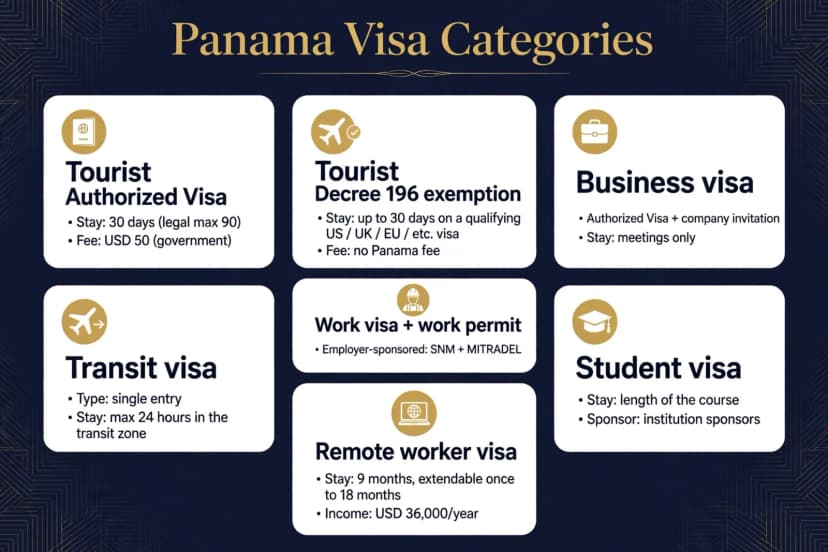
Panama's immigration system, built on Decree Law 3 of 22 February 2008 and Executive Decree 320 of 8 August 2008, sorts foreigners into non-resident, temporary-resident and permanent-resident categories. The types below are the ones a Pakistani passport holder living in Vietnam is realistically likely to use. Which of them you can obtain depends on whether the Decree 196 exemption applies to you: if it does, you enter as a tourist on your qualifying visa; if it does not, the tourist, business and transit routes below all run through the Authorized Visa process, and the work, study and residence routes run through the National Immigration Service in Panama City with a Panamanian lawyer.
Tourist visa (Authorized Visa route)
The standard short-stay visa for sightseeing and visiting friends and family. For a Pakistani passport holder without a qualifying foreign visa, this is the Authorized Visa described above: prior approval in Panama City, then a stamp from the consulate. Plan on a 30-day stay, with a legal maximum tourist stay of 90 days. A tourist visa does not allow paid work of any kind.
Tourist entry on a qualifying foreign visa (Decree 196 exemption)
Not a visa at all, but the route most readers of this guide should check first: if you hold a valid visa or residence permit from the US, Canada, the UK, an EU state, Australia, Japan, South Korea or Singapore, you enter as a tourist without a Panamanian visa, for up to 30 days on the most-cited reading. No application, no fee, no waiting — but carry the qualifying visa, proof of earlier travel on it if you have it, your return ticket and your proof of funds, because the airline and the officer will both want to see them.
Business visa
For meetings, conferences, prospecting and contacts with Panamanian companies. For a Pakistani national this is also processed as an Authorized Visa, with an added company invitation letter and the inviting company's registration and licence documents. A business visa is for prospecting and meetings, not for taking up a job: a separate work permit is required before any employment begins.
Transit visa (Visa de Tránsito)
For passing through Tocumen International Airport on a connecting flight without formally entering Panama. Most nationalities can connect airside for under 12 hours without one, but restricted nationalities — including Pakistan — are treated differently (see the transit section below). The transit visa falls under the authorised-visa category, so it needs the same prior approval in Panama and the same long lead time.
Work visa and work permit
Panama requires two separate documents before a foreigner can legally hold a job: a visa or residence permit from the National Immigration Service and a work permit from the Ministry of Labour and Workforce Development (MITRADEL). The employer sponsors both, a Panamanian lawyer files them, and the process can take four to six months. Many professions are reserved by law for Panamanian citizens, and foreign-worker quotas cap how many foreigners any company can employ. The full sequence is in the work section below.
Student visa
For studies at a Panamanian institution. The institution sponsors the application, filed with the SNM through a lawyer, and you need the acceptance letter, proof of funds for the course and living costs, and the usual police and medical certificates. There is no published student-visa fee for this guide to quote — the mission's or the SNM's figure is the one that counts.
Short Stay Visa for Remote Workers (digital nomad visa)
Panama's visa for people who work remotely for a foreign employer or foreign clients while living in Panama. It lasts nine months, extendable once to 18 months, requires foreign-source income of at least USD 36,000 a year (USD 3,000 a month) and health insurance covering you in Panama, and is filed inside Panama through a lawyer — not at a consulate abroad. It is a temporary permit, not residence. Full details are in the work section below.
Friendly Nations Visa
Panama's best-known residence route, giving permanent residence after a two-year provisional period to citizens of about 50 "friendly" countries who show employment with a Panamanian company, property worth at least USD 200,000, or a fixed-term bank deposit of at least USD 200,000. Pakistan is not on the friendly-nations list, so this route is closed to you on a Pakistani passport — do not pay any agent who offers it to you.
Residence and investor visas
Panama offers temporary and permanent residence permits — pensioner (pensionado), investor, reforestation investor and others — filed in Panama through a lawyer, not visit visas. The Qualified Investor Visa is the only one that also solves the restricted-nationality entry problem: its entry permission is processed at the same time as the residence request, so no separate Authorized Visa is needed. If you are considering one, take advice from a licensed Panamanian immigration lawyer first.
| Visa type | Typical stay | Where to apply | Work allowed? |
|---|---|---|---|
| Tourist — Authorized Visa | Plan on 30 days; legal max 90 days | Panamanian mission; approval in Panama City | No |
| Tourist — Decree 196 exemption | Up to 30 days (most-cited figure) | No application — enter on a qualifying US/UK/EU/etc. visa or residence | No |
| Business visa | As stamped (plan on 30 days) | Panamanian mission, as an Authorized Visa + company invitation | No — meetings only |
| Transit visa | Single entry; max 24 hours in the transit zone | Panamanian mission, as an authorised visa | No |
| Work visa + work permit | As issued; tied to the employer | SNM + MITRADEL in Panama, via employer and lawyer | Yes, for that employer only |
| Student visa | Length of the course | SNM via the institution and a lawyer | No (unless separately authorised) |
| Remote worker visa | 9 months, extendable once to 18 months | SNM in Panama, through a lawyer | Remote work for foreign clients only |
| Friendly Nations Visa | Permanent residence after 2 years provisional | Not available to Pakistani nationals | Yes, if eligible (not Pakistan) |
Fees and Processing Times
The fee picture for Panama is the weakest part of the public record. The one figure that appears in more than one place is the Authorized Visa government fee of USD 50 per applicant, stated by Kraemer & Kraemer as the government cost (legal fees separate, notarisation and authentication extra), and repeated as "approximately USD 50" by the Pakistan-focused Travel Visa Stack guide. It is consistent with a third source: a 2026 entry-requirements page that quotes the SNM's own tourist-visa requirements as setting the migration-services fee at 50 balboas — the balboa trades at par with the US dollar — payable when the application is presented to the Service. Against that, the UrduPoint guide, which checked the SNM rules on 7 November 2026, states plainly that it could not confirm the visa fee or the processing time from an official page, and tells readers to ask the Panamanian consulate. This guide therefore treats USD 50 as the best-supported figure for the Authorized Visa fee, not as a verified official figure — get the fee in writing from the mission that takes your file before you pay.
| Item | Figure reported | Source |
|---|---|---|
| Authorized Visa — government fee | USD 50 per applicant | Kraemer & Kraemer (government costs); Travel Visa Stack ("approx. USD 50") |
| Tourist visa — SNM migration-services fee | 50 balboas (B/.50, about USD 50) | SNM tourist-visa requirements, as reported by travelrequirements.info (Aug 2026) |
| Authorized Visa — total estimated cost | USD 70–100 (fee + courier/agent handling USD 20–40) | Travel Visa Stack (commercial estimate) |
| Authorized Visa — fee / processing time | Not verifiable from an official page | UrduPoint (checked 7 Nov 2026): "ask the Panamanian consulate" |
| Transit visa — consulate cost | USD 140 (two money orders) | LegalClarity (single commercial source, unverified) |
| Remote worker visa — SNM application | USD 250 + USD 50 for the visa card | SNM checklist via IGoPanama (Nov 2026); ProPanamá lists USD 250 |
| Overstay fine | USD 50 per month or part of a month | SNM FAQ via ExpatDen; Smithsonian Tropical Research Institute |
| Overstay fine — married to a Panamanian / Panamanian child | USD 100 per month | SNM FAQ via ExpatDen; capped at USD 1,000 per IGoPanama |
| Airport departure tax | USD 40, usually included in the ticket | UK FCDO |
| Sea arrival (non-cruise vessel) | USD 100 + USD 5 registration per passenger | UK FCDO |
| Entry funds proof | At least USD 500 (FCDO: USD 1,000 or a credit card) | SNM / US State Department / FCDO (see conflict below) |
Processing time. The filing rule is 60 days before the trip: the file must reach Panama 60 days in advance so the National Council of Public Safety and National Defense can verify it. Travel Visa Stack reports 20 to 30 days "due to the Panama City authorization requirement", and a transit-visa guide reports up to 60 business days for authorised-visa processing. Those three figures cannot all describe the same step: apply at least three months before travel and treat the 60-day filing rule as the hard deadline. Legal fees, translations, apostilles and notarisation are charged separately, and no source found for this guide publishes a fee list for the Hanoi embassy or the Ho Chi Minh City consulate — ask the mission that takes your file.
Two money warnings. First, the Decree 196 exemption route costs nothing for a visa: if you hold a qualifying foreign visa, there is no Panamanian fee to pay at all. Second, visa fees are generally non-refundable, including if your application is refused — confirm the fee and the exemption position in writing before you pay. Never pay a Panama visa fee through a lookalike website: Panama has no e-visa portal, so any site offering you a Panama e-visa is not official.
The funds conflict. The SNM, the US State Department and Panama's tourism authority all put the entry funds minimum at USD 500, provable by cash, credit card, bank statement, employment letter or traveller's cheques. The UK FCDO, however, says border officers may ask British visitors to prove at least USD 1,000 or a credit card. The USD 500 figure is the Panamanian official minimum; the FCDO's USD 1,000 is the safer amount to carry, and this guide recommends carrying USD 1,000 or a credit card so both standards are covered. Children under 18 do not need to show money, according to the UrduPoint guide.
Complete Document Checklists
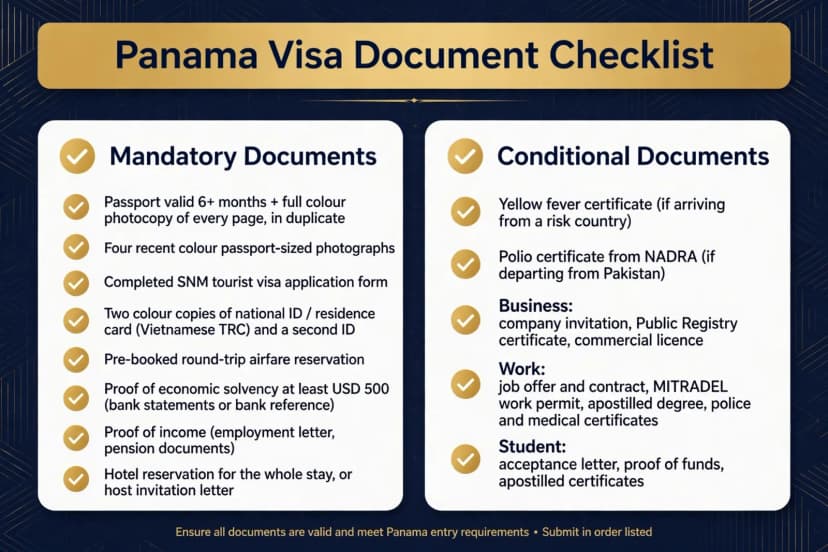
No single official document list for Pakistani applicants was published on a page found for this guide, so the checklists below combine what Kraemer & Kraemer lists for the Authorized Visa, what the SNM lists for tourist entry, and what the FCDO and the US State Department say border officers check on arrival. The mission that takes your file may ask for more or less — its list governs your application, so confirm it before you travel there. Prepare originals and clean copies; every Authorized Visa document must be translated into Spanish and apostilled or notarised.
Authorized Visa (tourist) — the main route
- Pakistani passport valid at least six months (the SNM general minimum is three months — see the passport conflict below), with a full colour photocopy of every page, even blank ones, in duplicate
- Four recent colour passport-sized photographs
- Completed SNM tourist visa application form
- Two colour copies of your national ID or residence card (your Vietnamese TRC) and of a second identification document
- Pre-booked round-trip airfare reservation
- Proof of economic solvency of at least USD 500 — bank statements or a bank reference letter
- Proof of income — employment letter stating your salary, pension documents, or equivalent
- Hotel reservation for the whole stay, or an invitation letter from your host in Panama with the sponsor documents listed above
- Copies of any previously approved Panamanian immigration permits
- Yellow fever certificate if arriving from a risk country (see the health section); polio certificate from NADRA if departing from Pakistan
Tourist entry on a qualifying foreign visa (Decree 196 exemption)
- Pakistani passport valid at least three months beyond arrival (six months recommended — see the passport conflict below), with at least one blank page
- Your valid qualifying visa or residence permit — US, Canada, UK, EU state, Australia, Japan, South Korea or Singapore — in the passport or as a residence card
- Proof that the qualifying visa has been used before, if you have it (earlier entry stamps), in case the airline applies the older conditions
- Confirmed return or onward ticket within your allowed stay
- Proof of at least USD 500 (USD 1,000 or a credit card is safer)
- Hotel booking or the address in Panama where you will stay, with a contact telephone number
- Completed entry and exit card, supplied by the airline
Business visa — Authorized Visa route
- Everything in the Authorized Visa checklist above, plus:
- Invitation letter from the Panamanian company, with a letter of responsibility from its legal representative
- The company's Public Registry certificate and commercial licence (Aviso de Operaciones), utility bill and proof of financial solvency
- Your employer's letter confirming your job, salary and the purpose of the trip
Work visa and work permit — employer-sponsored
- Everything in the Authorized Visa checklist above, plus:
- A job offer and signed contract from a Panamanian employer, filed through a Panamanian lawyer
- Work permit application to MITRADEL, with the employer's company documents and proof it meets the foreign-worker quota
- University degree and professional certificates, apostilled, with validation at the University of Panama if required
- Police clearance / criminal record certificate, apostilled, and a medical certificate
- Proof that your profession is not reserved for Panamanian citizens
Student visa
- Everything in the Authorized Visa checklist above, plus:
- Acceptance or enrolment letter from the Panamanian institution
- Proof of funds for tuition and living costs for the course
- Academic certificates and transcripts, apostilled and translated into Spanish
- Police clearance certificate and medical certificate if the mission or the SNM asks for them
Remote worker visa
- Passport copy and three passport photographs
- Proof of foreign-source income of at least USD 36,000 a year, with an employer letter stating at least USD 3,000 a month (or your foreign-registered company papers if self-employed)
- Health insurance covering you in Panama for the whole stay
- Apostilled criminal record certificate and a health certificate
- Sworn statement that you will not accept work offers in Panama
- Notarised power of attorney for the Panamanian lawyer who files the application with the SNM
Children travelling with you
- Each child needs their own passport and their own visa or exemption document — children under 18 do not need to show funds
- Birth certificate proving the relationship to the accompanying parent(s)
- If a child travels with one parent only, or with neither parent, carry a notarised parental consent letter
- Yellow fever certificate for children aged one year and older if arriving from a risk country
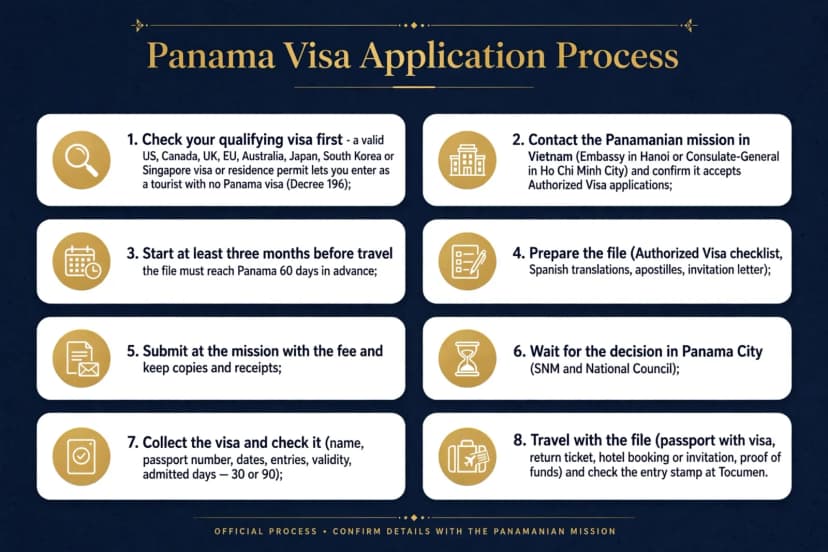
How to Apply: Step-by-Step
Route A — entering on a qualifying foreign visa (check this first)
Step 1 — Check your qualifying visa. Do you hold a valid visa or residence permit from the US, Canada, the UK, an EU member state, Australia, Japan, South Korea or Singapore? If yes, you do not need a Panama visa. If it is multiple-entry and already used, you meet even the older, stricter reading of the rule. If it is single-entry or unused, contact the Panamanian mission in Vietnam and your airline before relying on the exemption, because the conditions are disputed (see the exemption section).
Step 2 — Assemble the arrival file. Passport, qualifying visa, return or onward ticket, proof of at least USD 500 (USD 1,000 or a credit card is safer), hotel booking or host address with a telephone number, and the completed entry and exit card from your airline.
Step 3 — Travel and enter. Present the file at check-in in Ho Chi Minh City and at immigration at Tocumen. Make sure the officer stamps your passport and check the stamp before you walk away — the stamp sets your deadline, and the most-cited stay under this route is 30 days.
Route B — Authorized Visa, step by step
Step 1 — Contact the Panamanian mission in Vietnam. Telephone or email the Embassy of Panama in Hanoi or the Consulate-General of Panama in Ho Chi Minh City (details in the next section) and confirm, in writing if you can, that the mission accepts Authorized Visa applications from Pakistani nationals resident in Vietnam, what its current form, fee and document list are, and whether you need an appointment. Do not start the 60-day clock until you have this confirmation.
Step 2 — Start at least three months before travel. The file must reach Panama 60 days before the trip. Translations, apostilles, the invitation letter from Panama and the National Council's decision all take time. Three months is the planning figure in this guide; two months is the legal minimum and leaves no room for a correction.
Step 3 — Prepare the file. Assemble the Authorized Visa checklist above, with originals and copies. Get every document translated into Spanish and apostilled or notarised. Ask your host or employer in Panama for the invitation letter early, because a slow letter is the usual delay.
Step 4 — Submit at the mission. Attend the mission with your file and the fee in the form the mission accepts. Keep copies and receipts of everything you submit and pay. The mission forwards your file to the SNM and the National Council in Panama City.
Step 5 — Wait for the decision in Panama. The two bodies have full discretion to grant or refuse. If they ask for a correction or an extra document, supply it immediately.
Step 6 — Collect the visa and check it. When the visa is issued, check the name, passport number, dates, number of entries and validity on the sticker before you leave the mission. Ask the mission to confirm in writing how many days you are admitted for — 30 or 90 — because the sources conflict on this point.
Step 7 — Travel with the file. Carry the passport with the visa, your return ticket, your hotel booking or invitation, and your proof of funds in your hand luggage for the arrival check at Tocumen. Make sure the officer stamps your passport and check the stamp before you leave the desk.
Applying from Vietnam — the Embassy in Hanoi and the Consulate in Ho Chi Minh City
The brief for this guide assumed Panama has no mission in Vietnam. That assumption is wrong, and correcting it is the best news in this guide: Panama has an embassy in Hanoi and a Consulate-General in Ho Chi Minh City, confirmed by the current list of diplomatic missions of Panama, by embassy directories and by a Panama–Viet Nam Business Forum held in Hanoi on 7 October 2026 under the Embassy of Panama in Vietnam. For a reader in Ho Chi Minh City, the consulate is in your own city — but whether it processes Authorized Visas for Pakistani nationals, or only handles maritime and consular work, could not be verified from any published source for this guide, so contact both missions before you decide where to file.
Embassy of Panama, Hanoi. The address is disputed between listings, and this guide reports both. One current directory gives 191 Ba Trieu Street, Vincom City Towers, Tower A/B, Floor 17, Suite 17-04, Hanoi, with email empanviet@yahoo.com. Older listings give the Hanoi Central Office Building, 9th Floor, Suite 9-04, 44B Ly Thuong Kiet, Hoan Kiem District, Hanoi, telephone +84 24 3936 5213, emails embapanavietnam@gmail.com and empanviet@yahoo.com. A 2026 Hanoi embassy list still shows the 44B Ly Thuong Kiet address. Telephone first and confirm which address is current before you travel to Hanoi.
Consulate-General of Panama, Ho Chi Minh City. The listings give 7A Le Thanh Ton Street, Ben Nghe Ward, District 1, Ho Chi Minh City, telephone +84 28 3825 0334, fax +84 28 3823 6447. The head of mission is listed as Consul General Servio S. Samudio B. Panama's consulates in Vietnam exist largely because Panama is a major flag state for shipping, so the consulate's day-to-day work is heavily maritime — confirm in advance that it accepts an Authorized Visa application from a Pakistani resident, rather than assuming it does.
Three cautions belong here. First, no published fee list, opening-hours page or visa-application form for either mission was found for this guide — telephone or email the mission and confirm everything before you go. Second, the mission's ability to issue an Authorized Visa to a Pakistani national resident in Vietnam is the exact question to put to it: a written confirmation from the mission is worth more than any statement in this guide. Third, if neither mission in Vietnam can take your file, the fallback missions are the Embassy of Panama in Bangkok (1168/37 Lumpini Tower Building, 16th Floor, Rama IV Road, Bangkok; email consular@panathai.com; telephone +66 2 679 7988) and the Embassy of Panama in Singapore (16 Raffles Quay, #41-06 Hong Leong Building, Singapore; email general@panamaemb.org.sg). The Consulate-General in Mumbai is listed as a fallback in older guides, but a check on 30 September 2026 found its visa services temporarily suspended, so do not plan on Mumbai. There is no Panamanian embassy in Pakistan — a Pakistani applying from Pakistan itself would also have to use a mission abroad.
Also useful from Vietnam: the Embassy of Pakistan in Hanoi is your own mission if anything goes wrong while you are applying or travelling. Keep your Vietnamese temporary residence card valid for the whole trip and carry it with your passport, because it is your proof of the right to return to Vietnam, and airlines and immigration officers on the way home will ask for it. If your TRC is close to expiry, renew it before you travel.
| Mission | Address | Contact | Note |
|---|---|---|---|
| Embassy of Panama, Hanoi (nearest embassy) | 191 Ba Trieu St, Vincom City Towers, Tower A/B, Fl 17, Suite 17-04, Hanoi — or 44B Ly Thuong Kiet, 9th Fl, Hanoi Central Office Building, Suite 9-04 (listings conflict) | +84 24 3936 5213; empanviet@yahoo.com | Confirm the current address and that it accepts Authorized Visa applications from Pakistanis in Vietnam |
| Consulate-General of Panama, Ho Chi Minh City (in your city) | 7A Le Thanh Ton St, Ben Nghe Ward, District 1, Ho Chi Minh City | +84 28 3825 0334; fax +84 28 3823 6447 | Confirm it processes Authorized Visas — much of its work is maritime |
| Embassy of Panama, Bangkok (fallback) | 1168/37 Lumpini Tower Building, 16th Fl, Rama IV Rd, Bangkok 10120 | +66 2 679 7988 / 7989; consular@panathai.com | Visa applications in person; confirm it accepts Vietnamese residents |
| Embassy of Panama, Singapore (fallback) | 16 Raffles Quay, #41-06 Hong Leong Building, Singapore | general@panamaemb.org.sg | Confirm it accepts Vietnamese residents |
| Consulate-General of Panama, Mumbai | Mumbai, India | Confirm before travel | Visa services reported suspended (checked 30 Sep 2026) |
Transit at Tocumen Airport: the 12-Hour Rule and the Pakistani Exception
The general rule. The visa-policy summary, citing Timatic, states that travellers other than citizens of Cuba and Haiti may transit in Panama without a visa for 12 hours if they have a confirmed onward ticket. Citizens of Cuba and Haiti require a visa at all times, including for transit. On that reading, a Pakistani passport holder with a confirmed onward ticket and a layover under 12 hours, staying airside, needs no transit visa.
The restricted-nationality rule. Against that, three 2026 sources say restricted nationalities are treated differently. Roafly (checked 30 September 2026) states that the restricted-nationality rules include passports from India, Pakistan, Bangladesh, Nigeria and Egypt, and that qualifying circumstances can include a Panamanian visa or residence, certain foreign residence permits or multiple-entry visas, or a visa, residence or nationality for the final destination; the Mumbai consulate describes a maximum 12-hour transit allowance for the listed nationalities when the required conditions are met. LegalClarity states that citizens of countries the SNM designates as higher migratory risk must obtain a transit visa even for layovers under 12 hours, that the transit visa falls under the authorised-visa category with processing of up to 60 business days, and that the consulate cost is USD 140 in two money orders. A Copa connections guide states the same shape: some nationalities can transit Panama only if they hold a visa or residence card from Panama, Canada, the US, Australia, Korea, Japan, the UK, Singapore or an EU member state, or are travelling onward to a country where they hold a visa or residence permit.
What this guide tells you to do. Treat the general 12-hour rule as unproven for a Pakistani passport. If you hold a qualifying foreign visa or residence (the Decree 196 list), or a visa or residence for your final destination, you meet the conditions the restricted-nationality sources describe, and a sub-12-hour airside transit should be possible — confirm it with Copa or your airline in writing before you book. If you hold none of those, do not book a connection through Tocumen at all: apply for a transit visa from the Panamanian mission in Vietnam well in advance (the authorised-visa lead time applies), or route around Panama entirely — via Doha, Dubai, Istanbul or Frankfurt. A transit visa permits a single entry and a maximum stay of 24 hours inside Tocumen's international transit zone, according to LegalClarity; the USD 140 cost comes from that single commercial source and could not be verified against an official page, so confirm it with the mission. Leaving the transit area to visit Panama City or sleep in a hotel always requires eligibility to enter Panama. Note also that Tocumen has two terminals with an airside shuttle between them (5:00 a.m. to 9:00 p.m.); a connection outside those hours may force you through immigration.
Extending Your Stay and Overstay Rules
Extension. A tourist can ask the National Immigration Service for an extension (prórroga or extensión de turista) before the permitted period expires — but it only helps if the officer gave you fewer days than the maximum. The extension tops you up to the 90-day legal maximum; it cannot take you past 90 days, and if you were stamped in for the full 90 days there is nothing to extend. The SNM's requirements list asks for a full passport copy with at least three months' validity, a paid electronic ticket, a hotel reservation where that applies, a written justification, and proof of funds of at least USD 500; the SNM form says the process takes 48 hours. The FCDO adds that you cannot normally extend your stay unless you apply to change your immigration status within the three months. The extension fee is not published on the SNM checklist found for this guide. File before your stay expires: an expired stay cannot be extended, only fined. A separate route exists for tourists who decide to apply for residence: an extension to change category costs USD 250 plus a USD 500 deposit and gives up to 60 extra days to finish the paperwork, according to IGoPanama.
Overstay. Overstaying is a sanctionable violation, but it is also a solvable one if you handle it promptly. The SNM's own FAQ page, as reported by ExpatDen and confirmed by the Smithsonian Tropical Research Institute, sets the fine at USD 50 (B/.50.00) for each month expired, or fraction of a month — one day over costs the same as 29 days over. If you are married to a Panamanian or have a Panamanian child, the fine is USD 100 per month, capped at USD 1,000 according to IGoPanama. Pay the fine at the National Immigration Service before departure — without the paid receipt you will not board your flight — and note that once it is processed you have seven working days to leave the country. The procedure at the main office involves a ticket at reception, two carnet-size photos, a copy of your passport information page and entry stamp, and a USD 5 passport registration fee, according to one 2026 guide. Expired immigration documentation can also mean detention and possible expulsion, and IGoPanama reports that the SNM tracks entries and exits to spot serial "visa runs": leaving for a neighbouring country and returning for a fresh stamp is not a renewal method, and enforcement has visibly tightened in 2026. Do not overstay, even by a day; if your departure is delayed, go to the SNM office before your stay expires, not after, and keep every document proving the delay was outside your control.
Work, Study and Remote-Work Routes
Work. Panama's work route is employer-led, lawyer-filed and slow, and it has two separate documents that must both be in place before you start: a visa or residence permit from the SNM and a work permit from MITRADEL. Your Panamanian employer sponsors both, a Panamanian lawyer files them, and the process can take four to six months. Foreign-worker quotas cap how many foreigners any company can employ, and many professions are reserved by law for Panamanian citizens — law, medicine, dentistry, nursing, pharmacy, accounting, engineering, veterinary medicine, psychology, economics, social work, surveying and others. If your profession is on the reserved list, you cannot be hired for it in Panama at all. Short-term work permits exist for stays of up to 15 days or for three or nine months, sponsored by a Panama-based licensed business, and for restricted nationalities the visa application must also be reviewed by the National Security Council. Working without authorisation is fined USD 1,000 for a first offence and USD 5,000 for a repeat, and employers are fined too, according to IGoPanama. Never travel on a tourist or business visa intending to start work: a tourist visa does not convert into a work permit on arrival.
Remote work (digital nomad visa). This is the most realistic Panama route for a Pakistani who earns online, because it does not depend on a Panamanian employer or on the Friendly Nations list. The Short Stay Visa for Remote Workers (Visa de corta estancia como trabajador remoto), created by Executive Decree 198 of 7 May 2021, covers employees of a foreign company and self-employed people whose work takes effect abroad. The SNM checklist asks for foreign-source income of at least USD 36,000 a year, with an employer letter stating at least USD 3,000 a month; health insurance covering you in Panama; an apostilled criminal record certificate; a health certificate; and a sworn statement that you will not accept work offers in Panama. The government payments are USD 250 to the SNM plus USD 50 for the visa card. The visa lasts nine months, extendable once to 18 months. It is filed inside Panama through a Panamanian lawyer under a notarised power of attorney — not at a consulate abroad — so the practical route is to enter Panama first (on an Authorized Visa or the Decree 196 exemption) and file from inside. It is a temporary permit, not residence, and it ends after 18 months at most. Note the income threshold: USD 3,000 a month is far above many online teaching incomes, so check your last twelve months of foreign income before you plan on this route.
Study. Get accepted by a Panamanian institution, which sponsors the student visa; apply through the SNM via a lawyer with the acceptance letter, proof of funds for tuition and living costs, and your academic records apostilled and translated into Spanish. There is no published student-visa fee for this guide to quote. A student visa is a study permit, not a work permit, and working without authorisation carries the fines above.
Flights, Transit Routings and Money: Practical Notes
Flights. There is no direct flight from Vietnam to Panama, and none from Pakistan either. The realistic corridors from Ho Chi Minh City are Turkish Airlines via Istanbul, Qatar Airways via Doha, Emirates via Dubai, and routings via Taipei, Frankfurt or Paris — all connecting onward to Tocumen without a US visa. Avoid routings through the United States unless you hold a US visa: a US transit needs a US visa, and a missed US connection can strand you. Copa Airlines operates the onward network from Tocumen across Latin America and the Caribbean. Book the whole journey on one ticket where you can, so a missed connection is the airline's problem, and leave a generous connection time at Tocumen: the two-terminal shuttle stops at 9:00 p.m., and a night connection outside its hours may force you through immigration.
Money. Panama uses the balboa (PAB), which trades at par with the US dollar, and US dollar notes and coins circulate as everyday money — you can plan the whole trip in dollars. The entry funds minimum is USD 500 (the FCDO says USD 1,000 or a credit card, and carrying USD 1,000 covers both). The US State Department lists a cash limit of USD 10,000 in and USD 10,000 out: declare cash above that. The airport departure tax is USD 40 and is usually included in the price of your ticket (FCDO). ATMs and card payments are easy in Panama City and harder outside it; carry cash for the islands and the highlands, and keep your proof of funds with your passport rather than in checked luggage.
Safety, Health and Arrival Checks
Security. The US State Department rates Panama Level 2: Exercise Increased Caution (advisory dated 20 August 2026), because of crime including armed robbery and muggings, with parts of the Darién region and the Mosquito Gulf coast rated Level 4: Do Not Travel. Do not travel to Darién: it is the roadless jungle border with Colombia, not a tourist destination. Panama City, the Canal, Casco Antiguo, Boquete, Bocas del Toro and the San Blas islands sit well outside the Level 4 areas, but read the current State Department and FCDO pages in the week before you travel. Panama sits in an active earthquake zone: on 9 October 2026 a magnitude 7.7 earthquake struck the Azuero Peninsula region. Register your trip with the Embassy of Pakistan in Hanoi.
Health. The yellow-fever rule is genuinely disputed, and this guide reports both positions. The US State Department and the FCDO both state that a yellow fever vaccination certificate is required if you are arriving from a country with endemic yellow fever, and the World Health Organization lists Panama as requiring proof from travellers aged one year and over arriving from risk countries. Panama's own tourism authority, however, states that under updated Ministry of Health (MINSA) rules an international vaccination certificate is no longer required as an entry requirement, while still advising travellers from risk countries to carry a card showing vaccination at least 10 days prior. Neither Pakistan nor Vietnam is a yellow-fever risk country, so a direct routing from Ho Chi Minh City via Istanbul, Doha or Dubai should not need the certificate — but a routing via Bogotá, Colombia, which is a risk country, makes this a live question, so ask the mission or your airline before you book that routing, and if there is any doubt, get vaccinated in Vietnam before you travel and carry the yellow card with your passport. The CDC also recommends (not requires) the vaccine for travellers going to mainland areas east of the Canal, including Darién. If you are departing from Pakistan rather than Vietnam, carry your polio vaccination certificate from NADRA: it is needed to leave Pakistan, according to the UrduPoint guide. Malaria prophylaxis is advised for Darién, Guna Yala, Bocas del Toro and Chiriquí; Panama City and the Canal area are free of malaria transmission. Dengue is the main mosquito concern, so repellent matters. Travel insurance is not listed as a required visa document, but medical evacuation is expensive — buy a policy that covers it before you travel.
Arrival checks. At Tocumen, expect to show your passport with the visa (or your qualifying foreign visa), your return or onward ticket, your hotel booking or invitation letter, and your proof of funds. The immigration officer makes the final decision, whatever document you hold. Make sure the officer stamps your passport and check the stamp before you walk away — the stamp is your proof of entry date and length of stay, and the document the SNM will ask for if you apply for an extension. Complete the entry and exit card supplied by your airline. If you arrive by sea on a vessel that is not a cruise ship, you must have a visa and pay USD 100 plus USD 5 registration per passenger (FCDO); cruise passengers transiting the Canal need no visa unless staying more than three months.
Frequently Asked Questions
1. Do Pakistani citizens need a visa for Panama?
Yes, unless you hold a valid visa or residence permit from the US, Canada, the UK, an EU country, Australia, Japan, South Korea or Singapore — in which case Executive Decree 196 of 2024 lets you enter as a tourist without a Panamanian visa. Without one of those, you need an Authorized Visa approved in Panama City before a consulate can stamp it. There is no e-visa and no visa on arrival for Pakistani passports.
2. What is the Authorized Visa, and why do Pakistanis need it?
The Authorized Visa (Visa Autorizada) is the permit Panama requires from citizens of 65 restricted nations, including Pakistan, India and China, before they travel as tourists. Your file goes to the National Council of Public Safety and National Defense and the National Immigration Service in Panama City, which have full discretion to grant or refuse it. The file must reach Panama 60 days before the trip.
3. How much does the Panama Authorized Visa cost?
The best-supported figure is USD 50 per applicant in government costs (Kraemer & Kraemer; Travel Visa Stack says "approximately USD 50"), consistent with the SNM's 50-balboa migration-services fee. But UrduPoint states it could not confirm the fee from an official page, so treat USD 50 as reported, not verified, and get the fee in writing from the mission that takes your file. Legal fees, translations and apostilles are extra. Entering on a qualifying foreign visa costs nothing for a visa.
4. How long does the Authorized Visa take?
The file must reach Panama 60 days before travel. One commercial guide reports 20 to 30 days and another up to 60 business days — those figures conflict, so apply at least three months before travel and treat the 60-day filing rule as the hard deadline.
5. Can I enter Panama with a US, UK or Schengen visa?
Yes, if it is valid and issued by the US, Canada, the UK, an EU member state, Australia, Japan, South Korea or Singapore. A Schengen visa issued by an EU country counts. Older sources add three conditions — multiple-entry, already used, six months' validity remaining — but 2026 guides state that Decree 196 of 2024 removed them. Airlines have been reported to apply the older conditions, so carry proof of earlier travel on that visa and confirm with the mission and your airline if your visa is single-entry or unused.
6. How long can I stay in Panama?
Plan on 30 days. Panama's immigration law sets the maximum tourist stay at 90 days, and some guides say tourist visas run up to 90 days, but Kraemer & Kraemer's visit guide says a consulate stamp usually allows 30 days at a time and approval for a restricted country brings one month. Under the Decree 196 exemption the most-cited stay is also 30 days. The stamp in your passport on arrival is the deadline that counts.
7. Is there a Panamanian embassy in Vietnam?
Yes — Panama has an embassy in Hanoi and a Consulate-General in Ho Chi Minh City. The Hanoi address is disputed between listings (191 Ba Trieu Street, Vincom City Towers, Suite 17-04, versus 44B Ly Thuong Kiet, Suite 9-04; telephone +84 24 3936 5213). The Ho Chi Minh City consulate is at 7A Le Thanh Ton Street, District 1, telephone +84 28 3825 0334. Confirm in advance that the mission accepts Authorized Visa applications from Pakistani residents, and confirm the current Hanoi address before travelling there.
8. What documents do I need for a Panama visa?
A passport valid at least six months for the Authorized Visa (the SNM general minimum is three months); four passport photographs; the completed SNM form; colour copies of your passport (every page) and of your Vietnamese residence card and a second ID; a round-trip ticket reservation; proof of at least USD 500 and proof of income; and a hotel booking or an invitation letter with sponsor documents. Every document must be translated into Spanish and apostilled or notarised. The full checklists are in the document section above.
9. Do I need a transit visa to connect through Tocumen Airport?
Probably, unless you hold a qualifying foreign visa or a visa for your final destination. The general rule is 12 hours' transit without a visa on a confirmed onward ticket, but 2026 sources say restricted nationalities including Pakistan need a transit visa even for a layover under 12 hours. If you hold none of those, do not book through Tocumen — apply for a transit visa well in advance or route via Doha, Dubai, Istanbul or Frankfurt instead.
10. Can I work in Panama on a tourist or business visa?
No. A tourist or business visa does not give the right to work. A work visa needs a job offer from a Panamanian employer, a work permit from MITRADEL and a visa from the SNM, filed through a lawyer — a process that can take four to six months. Many professions are reserved for Panamanian citizens, and working without authorisation is fined USD 1,000 for a first offence. The Friendly Nations Visa is closed to Pakistani nationals.
11. Is there a digital nomad visa for Panama?
Yes: the Short Stay Visa for Remote Workers, created by Executive Decree 198 of 2021. It lasts nine months, extendable once to 18 months, and requires foreign-source income of at least USD 36,000 a year (USD 3,000 a month) plus health insurance covering you in Panama. Government payments are USD 250 to the SNM plus USD 50 for the visa card. It is filed inside Panama through a lawyer.
12. What happens if I overstay my Panama visa?
You will be fined USD 50 for each month expired, or part of a month — one day over costs the same as 29 days over — and USD 100 a month if you are married to a Panamanian or have a Panamanian child. Pay at the National Immigration Service before departure; without the paid receipt you will not board, and once processed you have seven working days to leave. Long overstays can mean detention and expulsion, and "visa runs" to a neighbouring country do not renew a stay.
13. Do I need a yellow fever certificate for Panama?
Only if you arrive from a country with yellow-fever transmission risk — and the rule itself is disputed: the US State Department and the FCDO say a certificate is required from risk countries, while Panama's tourism authority says MINSA no longer requires it as an entry requirement. Neither Pakistan nor Vietnam is a risk country, so a routing via Istanbul, Doha or Dubai should not need it; a routing via Bogotá makes it a live question. If in doubt, get vaccinated in Vietnam and carry the yellow card.
14. Are there direct flights from Vietnam or Pakistan to Panama?
No. The realistic corridors from Ho Chi Minh City are via Istanbul (Turkish Airlines), Doha (Qatar Airways), Dubai (Emirates), or via Taipei, Frankfurt or Paris. Avoid routings through the United States unless you hold a US visa. Copa Airlines connects Tocumen onward across Latin America and the Caribbean.
15. What is the passport validity rule for Panama?
It is disputed: the SNM and the US State Department set the minimum at three months beyond arrival, with at least one blank page, while the FCDO recommends six months after the day you plan to leave Panama. The Authorized Visa file itself requires six months. Use six months as your planning standard — it satisfies every source — and renew your passport before you apply if it is anywhere near the limit.
Official Immigration Websites
| Website | What it is | Link |
|---|---|---|
| Panama National Immigration Service (SNM) | Official immigration authority — restricted list, visa requirements, fees (Spanish) | migracion.gob.pa |
| Panama Ministry of Foreign Affairs (MIRE) | Consular services and the diplomatic network | mire.gob.pa |
| US Department of State — Panama Travel Advisory | Entry requirements and Level 2 advisory of 20 August 2026 | travel.state.gov |
| UK FCDO — Panama travel advice, entry requirements | Passport validity, funds, departure tax, sea-arrival fee, yellow fever | gov.uk |
| Panama Tourism Authority — travel requirements | Official entry summary, updated November 2026 | tourismpanama.com |
| Kraemer & Kraemer — Authorized Visa for Restricted Countries | Panama City law firm: 65-country list, 60-day rule, document list, USD 50 fee, Decree 196 exemption | kraemerlaw.com |
| Kraemer & Kraemer — Visit Panama: Entry Requirements | Entry rules; 30-day stamp, one-month restricted-country approval | kraemerlaw.com |
| UrduPoint — Panama Visa for Pakistanis 2026 | Pakistan-focused guide (checked 7 Nov 2026): no e-visa or visa on arrival; fee and time unverifiable | urdupoint.com |
| Travel Visa Stack — Panama Visa for Pakistan Citizens 2026 | Pakistan-focused guide: Authorized Visa, approx. USD 50 fee, 20–30 days' processing | travelvisastack.com |
| AlwaysPacked — Panama Entry Rules | November 2026 explainer: three entry groups, Decree 196 exemption | alwayspacked.com |
| Roafly — Panama Entry Requirements: Visas, Passports & Transit | Checked 30 Sep 2026: Decree 196 conditions removed; transit rules; Mumbai suspension | roafly.com |
| Wikipedia — Visa policy of Panama | Visa exemption, Decree 196 rule, 12-hour transit rule | en.wikipedia.org |
| LegalClarity — Panama Transit Visa | Transit-visa rules for restricted nationalities, USD 140 cost | legalclarity.org |
| ExpatDen — Panama Visa Overstay Fine | USD 50 per month overstay fine; extension rules | expatden.com |
| Smithsonian Tropical Research Institute — Visas, Extensions and Driver's Licences | USD 50 per month overstay fine; extension procedure | stri.si.edu |
| Nomad Capitalist — Panama Work Visa 2026 | Work visa and permit, Friendly Nations list, remote worker visa, restricted professions | nomadcapitalist.com |
| IGoPanama — Panama Digital Nomad / Remote Worker Visa | SNM checklist: USD 36,000 a year, USD 250 + USD 50, 9 + 9 months | igopanama.com |
| IGoPanama — Tourist Entry vs Residence in Panama | Extension to 90 days, change-of-category costs, work fines | igopanama.com |
| Wikipedia — List of diplomatic missions of Panama | Embassy in Hanoi and Consulate-General in Ho Chi Minh City | en.wikipedia.org |
| Panama Relocation Firm — Countries That Need a Visa to Enter Panama (2026) | Authorized Visa country list; Decree 196 exemption, older conditions | panamarelocationfirm.com |
This guide was checked on 28 November 2026. Visa rules change without notice. Always confirm the live rules with the Embassy of Panama in Hanoi or the Consulate-General in Ho Chi Minh City and with Panama's National Immigration Service before paying any fee or booking a non-refundable ticket. Nothing in this guide is immigration advice; the Panamanian authorities set and enforce the entry rules, and the immigration officer at Tocumen makes the final decision.