North Korea Visa Guide 2026: Types, Requirements, Documents and Application Steps
Last checked: 27 November 2026. This guide is for Pakistani passport holders living in Vietnam. Read the warning first: as of 27 November 2026 North Korea is closed to general tourism. Only Russian passport holders are currently admitted as tourists, and no reopening date has been announced. Everything in this guide therefore describes the system as it works when tours run, and the checks you must make before paying any deposit. Visa rules change without notice — always confirm the live position with a licensed tour operator and the Embassy of the Democratic People's Republic of Korea (DPRK) in Hanoi before paying any fee or booking a non-refundable ticket.
Table of Contents
- Introduction
- Do Pakistani Passport Holders Need a Visa for North Korea?
- Is North Korea Open to Tourists in 2026?
- Types of North Korea Visas for Pakistani Passport Holders
- Visa Fees and Tour Costs
- Processing Times
- Complete Document Checklists
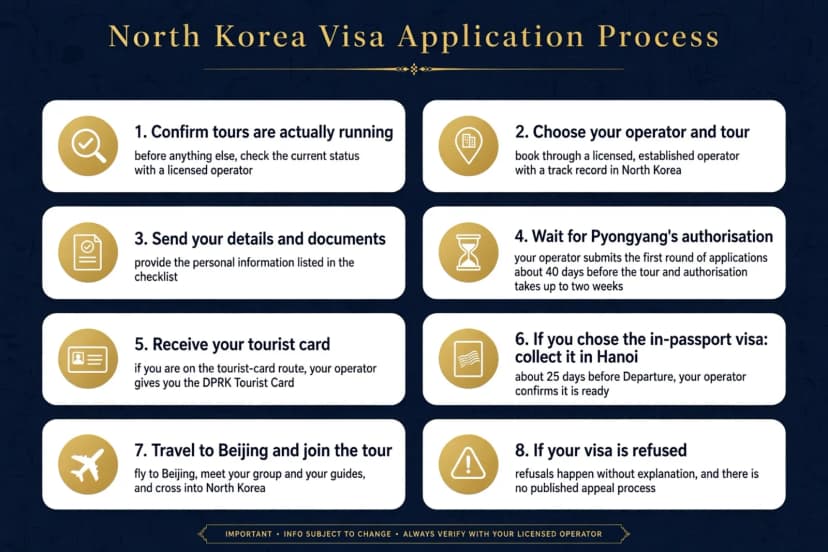
- How to Apply: Step-by-Step
- Applying from Vietnam — the DPRK Embassy in Hanoi
- Entry Points, China Transit and Getting There
- Extending Your Stay and Overstay Rules
- Work and Study Routes
- Flights, Money and Practical Notes
- Safety, Health and the Rules Inside North Korea
- Frequently Asked Questions
- Official Immigration Websites
Introduction
North Korea — officially the Democratic People's Republic of Korea, or DPRK — is the most restricted travel destination in the world, and this guide is written differently from every other guide in this series because of that fact. For most countries, a visa guide is a practical manual: choose a category, gather documents, file, wait, fly. For North Korea, the honest starting point is that you probably cannot go at all right now, and that no document you prepare changes that. The country shut its borders in January 2020, at the start of the COVID-19 pandemic. Since then it has reopened only selectively: Russian tour groups have been admitted since February 2024, Western tourists were let into the far north-eastern Rason zone for a few weeks in early 2025 before the door closed again, and transport links to China and Russia have quietly resumed in 2026 without any resumption of general tourist visas. As of 27 November 2026, the two longest-established Western tour operators, Koryo Tours and Young Pioneer Tours, both state that North Korea remains closed to international tourism for every nationality except Russians, with no opening date, no reopening criteria and no confirmed news of any kind.
That does not make this guide useless. It makes the order of operations different. The first thing a Pakistani passport holder living in Vietnam needs is the current status, the second is the system that applies when tours do run, and the third is the set of warnings that protect your money and your safety in the meantime. The system itself, when it operates, is unusual: there is no independent tourist visa, no e-visa portal, no visa on arrival and no embassy counter where you can simply apply. You book an organised tour with a licensed operator, the operator arranges your visa with the authorities in Pyongyang, and you travel with government-assigned guides for the whole trip. Your passport is usually never even stamped — the visa is a separate paper tourist card, handed to you just before departure and taken from you when you leave. The fee is small (about EUR 60, according to Koryo Tours), but it is folded into a tour costing roughly USD 1,000 or more for four or five days, and the real cost of a mistake is a non-refundable deposit paid for a departure that never happens.
This guide is written for a Pakistani passport holder who lives in Vietnam, because that combination creates its own questions: which DPRK embassy has jurisdiction over you, whether your Vietnamese residence helps, what Chinese visa you need to get to the departure point, and what happens if something goes wrong in a country where Pakistan has no functioning embassy. Every figure in this guide is labelled with its source, and where sources disagree — on the fee, on passport validity, on the Hanoi embassy's address — the disagreement is stated openly and the controlling source is named. Where a figure could not be verified at all, this guide says so plainly instead of inventing one. North Korea publishes almost nothing about its own visa rules, so this guide leans on the operators who run the tours, on the US State Department and the UK Foreign, Commonwealth and Development Office (FCDO), and on the DPRK's own tourism authority where its statements could be checked — and it names, at every point where it matters, which of those is speaking.
Do Pakistani Passport Holders Need a Visa for North Korea?
Yes. Every holder of an ordinary Pakistani passport needs a visa before travelling to North Korea. No nationality is exempt from needing a North Korea visa for tourism: Koryo Tours states this flatly — "no country is exempt from needing a North Korea visa if the purpose of travel is tourism" — and the visa-policy summaries agree that zero of 198 nationalities can enter without a visa issued in advance. Pakistan is listed as "visa required" in every passport index checked for this guide, including the Henley Passport Index data and the Wikipedia-derived summaries. There is no visa-free entry, no e-visa, no electronic travel authorisation and no visa on arrival for tourists. The only narrow exceptions reported anywhere concern Chinese tourists visiting the border areas of Sinuiju for a day trip or Tongnim County for two days, and holders of diplomatic or service passports travelling on official business — neither of which applies to a Pakistani tourist.
The rule follows your passport, not where you live. Living in Vietnam, holding a Vietnamese temporary residence card (TRC), holding a US, UK or Schengen visa, or having lived in the Gulf does not remove the visa requirement, and no simplified regime for Vietnamese residents of Pakistani nationality was found. If a travel agent tells you that a Gulf residence visa or a Western visa makes North Korea visa-free for you, ask them to show the official rule: none was found. The visa also follows a second rule that matters more than the first: even with a visa, you cannot enter independently. Tourist entry requires prior authorisation from a travel company registered with the DPRK State General Bureau of Tourist Guidance, and in practice that means a licensed tour operator sponsors your visit, submits your details to Pyongyang, and arranges guides who stay with you for the entire trip.
Two nationalities are barred outright, and the contrast is instructive. South Korean passport holders cannot apply for a North Korea visa through travel agents at all; permission must come from the South Korean Ministry of Unification and its northern counterpart, and in practice South Korean tourists are not admitted. US passport holders are barred by their own government: US passports have been invalid for travel to, in or through North Korea since September 2017 unless specially validated by the US Secretary of State, and that restriction has been renewed every year, most recently extended through 31 August 2027. Young Pioneer Tours adds that, according to its partners, North Korea itself now refuses Americans holding a second nationality, whichever passport they travel on. Pakistani passport holders are in neither barred group — but that is a narrow comfort, because as of late November 2026 no non-Russian nationality is getting tourist visas at all. Malaysia is also reported as refused entry in some 2026 visa summaries, a legacy of the 2017 diplomatic rupture after the killing of Kim Jong-nam; that report comes from secondary visa databases rather than an official DPRK statement, so this guide flags it rather than asserting it.
On passport validity the sources disagree, and the disagreement is worth seeing in full. The FCDO says your passport should be valid for the proposed duration of your stay. The German government is reported as requiring three months' validity from arrival, and the Canadian government six months after departure. The safest reading — the one this guide recommends — is six months' validity beyond your planned departure from North Korea, with at least two blank pages, because the Chinese visa you will also need is itself subject to a six-month rule, and a passport that fails China's test stops the trip in Beijing before North Korea is even reached. Renew your Pakistani passport in Vietnam or Pakistan before you apply if it is anywhere near the limit.
Is North Korea Open to Tourists in 2026?
No — not to general tourism, and not to a Pakistani passport holder, as of 27 November 2026. This is the single most important section of the guide, and it is stated first so that nothing else in it is mistaken for a bookable trip. North Korea shut its borders in January 2020. Since then the only tourist openings have been narrow and short-lived, and every one of them has closed again or stayed limited to Russians.
The timeline is short enough to set out in full. In February 2024, Russian tour groups were admitted again, and they have continued on a restricted basis since — visiting fewer places than pre-2020 tourists did. On 16 January 2025, North Korea announced it would reopen the Rason Special Economic Zone, in the far north-east near the Chinese and Russian borders, to foreign tour groups of nearly all nationalities except Americans and South Koreans. The first groups arrived in mid-February 2025 — the first non-Russian foreign tourism since the 2020 closure — and Young Pioneer Tours became the first Western operator to lead groups there. On 5 March 2025, about three weeks later, DPRK authorities halted Rason arrivals without public explanation, and reporting through March and May 2026 confirms that general foreign tourist access to Rason had still not been restored more than a year later; the only visitors getting in were small numbers of Russians entering via the Vladivostok–Tumen River crossing. The Wonsan-Kalma coastal resort opened in mid-2025, but its confirmed foreign visitors have been Russians only. The Pyongyang International Marathon, which sold out in under five hours in December 2025, was cancelled by North Korea weeks before the 5 April 2026 race with no reason given; Koryo Tours, the marathon's official travel partner, said on 23 November 2026 that there will be no race in April 2027 either, and that October 2027 is the earliest realistic prospect.
Against that record, 2026 has produced transport news that looks like reopening but is not. The Beijing–Pyongyang passenger train resumed on 12 March 2026 after about six years, alongside a Dandong–Pyongyang service, and Air China restarted Beijing–Pyongyang flights on 30 March 2026, one weekly flight (CA121 outbound, CA122 return). But ticket agents told reporters that a valid North Korean visa was required to buy a train seat — and that North Korea was not yet issuing tourist visas for the route. The resumed links are transport between North Korea and China, not a resumption of foreign tourist visas. A Tourism Expo held in Pyongyang in April 2026 signalled interest in reopening, likely starting with Chinese tour groups, but gave no confirmed date, and nothing changed on the ground afterwards. In early July 2026 Russia's foreign ministry said a regular bus route between Vladivostok and the Rason zone, operated by Vostok Intur, was planned to launch by the end of the year — again, a Russian-facing link.
What to do with this information. Do not pay a deposit for a fixed-date North Korea departure on the strength of a social-media post or an agent's assurance that the country "has reopened". Claims on social media that the country has reopened to everyone are wrong, according to the operators who run the tours, and a waiting list or a proposed programme is not evidence of a visa. If you want to go when the door opens, the practical move is to join a licensed operator's mailing list (Koryo Tours and Young Pioneer Tours both publish status updates), keep your passport validity well ahead of the six-month rule, and hold your money until an operator confirms in writing that tourist visas are being issued to Pakistani passport holders for a specific departure. The rest of this guide describes the system as it worked before 2020 and as it is described by the operators today, so that you are ready when — and only when — that confirmation arrives.
Types of North Korea Visas for Pakistani Passport Holders
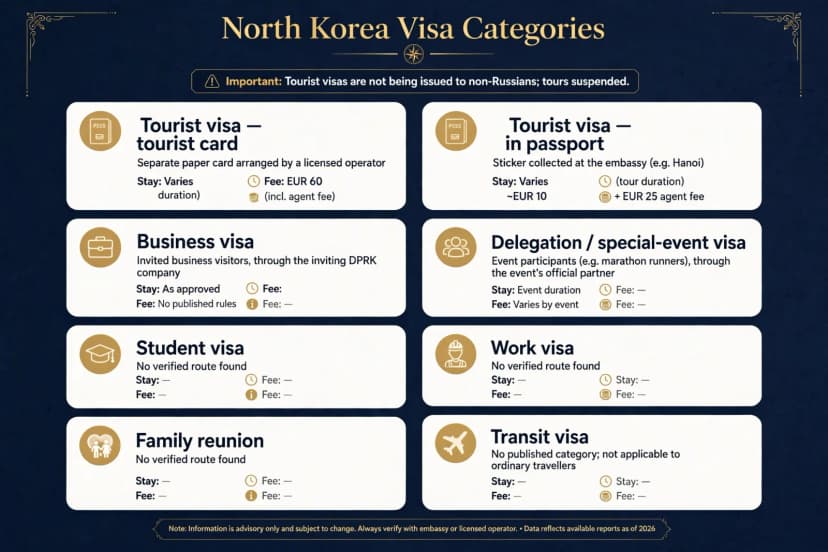
North Korea does not publish a visa-category list the way most countries do, and there is no official portal where the categories can be checked. The categories below are the ones the licensed operators describe and the ones that exist in practice. If a category is not listed here, treat it as unavailable rather than assuming it exists: there is no digital-nomad visa, no job-seeker visa, no retirement visa and no permanent-residence route for a foreign tourist, and no source found for this guide describes one.
Tourist visa (tourist card)
The standard entry permission for sightseeing as part of an organised tour. It is normally issued as a separate paper document — the DPRK Tourist Card — rather than a stamp or sticker in your passport, and it is taken from you by immigration when you leave, so you will not keep it as a souvenir. It covers only the itinerary your operator has arranged and the ports of entry and exit written on it; Pyongyang and Sinuiju are the default ports, with Hoechang and Tumangang added for exits to Rason and onward to Russia, and Heochang and Wonjong for Rason and onward to China. You travel with two North Korean guides at all times, stay in state-assigned hotels, and move only on the approved itinerary. The visa is valid for the tour only — there is no published validity period separate from the tour dates, and no published rule on how many days a tourist visa can cover, because the tour defines the stay. A South Korean stamp or visa already in your passport is not a problem, according to Koryo Tours.
Tourist visa issued in your passport
An alternative form of the same tourist visa, available only in limited cases: if your country of citizenship or residence has a DPRK embassy and you are not based in mainland China, you can ask for the visa to be issued as a sticker in your passport instead of a separate tourist card. For a Pakistani living in Vietnam this is in principle the Hanoi route, because the DPRK has an embassy in Hanoi. You tell your tour manager you want this option, the operator sends the first round of applications to Pyongyang about 40 days before the tour, and about 25 days before departure you should receive an email telling you the visa is ready for collection. You then make an appointment at the embassy, bring your passport and a copy, two passport photos (3 x 4 cm), the completed visa pick-up form the operator sends you, the fee (to be confirmed with the embassy) and a pen, and the visa is stuck into your passport on the spot — you do not leave your passport with the embassy and you need only one visit. Koryo Tours notes, from customer experience, that in some European countries the consul will have a friendly chat with you, and that this is only a chat, not part of the visa decision.
Business visa
Business visas exist, and Koryo Tours reports that there have been visitors, mostly from China, entering on them in recent months. You need to be invited by a company or organisation authorised to invite foreigners, and one that expects to do actual business with you. There is no published fee, no published processing time and no published document list for a business visa, and no source found for this guide describes a Pakistani national obtaining one. Do not confuse a business visa with a work permit: it covers a business visit, not employment in North Korea, and it is arranged through the inviting organisation, not through a tour operator's standard booking flow. If someone offers you a North Korean "work visa" without a named inviting company, treat the offer as suspect.
Delegation and special-event visas
North Korea issues delegation visas for special events — the clearest recent example is the Pyongyang International Marathon, whose foreign amateur runners entered in 2025 on a marathon delegation visa issued by the Sports Ministry rather than the standard tourist visa processed through the National Travel Authority or the Korea International Travel Company. Delegation visas are event-specific, arranged by the event's official partner, and not a route you can apply for on your own. The 2026 marathon was cancelled and there will be no April 2027 race, so this route is closed for now.
Student, work and family visas
No verified route exists for a Pakistani passport holder to study, work or join family in North Korea. No university admission route for foreign fee-paying students is described by any operator or government source found for this guide, no employer-sponsored work-permit system is published, and there is no family-reunion category. A small number of diplomats, aid workers and business representatives from a handful of countries live in Pyongyang, but that is not a visa category open to applications. This guide states the absence plainly rather than inventing requirements for categories that do not exist. If your purpose is study or work, North Korea is not a realistic destination, and the rest of this guide will not help you get there.
Transit
There is no published transit-visa category for North Korea, and in practice the question does not arise: you cannot transit North Korea to a third country as an ordinary traveller, and the only people crossing the border are tour groups, delegations and business visitors whose entry permission already covers their route. The transit question that does matter for you is the Chinese one, covered in the entry-points section: you will almost certainly travel through Beijing, and that needs its own Chinese visa.
| Visa type | Who it is for | How it is issued | Current status (27 Nov 2026) |
|---|---|---|---|
| Tourist visa — tourist card | Organised-tour travellers | Separate paper card, arranged by licensed operator | Not being issued to non-Russians; tours suspended |
| Tourist visa — in passport | Tour travellers resident where a DPRK embassy exists | Sticker in passport, collected at the embassy (e.g. Hanoi) | Not being issued to non-Russians; tours suspended |
| Business visa | Invited business visitors | Through the inviting DPRK company or organisation | Reported in use for visitors, mostly from China; no published rules |
| Delegation / special-event visa | Event participants (e.g. marathon runners) | Through the event's official partner | No qualifying event running; 2026 marathon cancelled |
| Student visa | — | — | No verified route found |
| Work visa | — | — | No verified route found; do not trust offers without a named inviter |
| Family reunion | — | — | No verified route found |
| Transit visa | — | — | No published category; not applicable to ordinary travellers |
Visa Fees and Tour Costs
There is no published official DPRK fee schedule for visas, and that absence shapes everything in this section. The figures below come from the tour operators, not from a government price list, and they are old: Koryo Tours' visa page, which carries the EUR 60 figure, is undated and its content predates the 2020 closure, and the operators have not been issuing tourist visas to non-Russians since. Treat every figure as the best available operator report, not as a current official price, and get the figure in writing from your operator before you pay.
| Item | Figure reported | Source |
|---|---|---|
| Tourist card issued in China | EUR 60 (including agent fee) | Koryo Tours visa page |
| Visa issued at a DPRK embassy outside China | About EUR 10, plus EUR 25 Koryo Tours agent fee | Koryo Tours visa page |
| Tourist visa (operator quote) | EUR 50 | Rocky Road Travel visa page |
| Typical 4–5 day tour from Beijing | About USD 1,000–1,500 | 2026 operator and travel-guide reports |
| Typical introductory tour (pre-2020) | EUR 600–1,500 per person | Koryo Tours FAQ, pre-2020 pricing |
| Embassy-issued visa fee (Hanoi) | Not published — to be confirmed with the embassy | No source found; Koryo Tours says the fee is confirmed with the mission |
| Chinese visa (double or multiple entry) | Set by the Chinese embassy in Vietnam; check the current fee there | Chinese embassy/consulate in Vietnam — not covered by any DPRK source |
The fee conflict. Koryo Tours quotes EUR 60 for a tourist card issued in China, while Rocky Road Travel quotes EUR 50 for the visa — a EUR 10 difference between two operators for what is described as the same document. The difference is small and is best explained as different agent fees bundled into the headline figure, not as two different government fees. The controlling figure is the one your own operator quotes you in writing for your specific departure, and if the visa is issued at an embassy (the Hanoi route), Koryo Tours says the fee is confirmed with that embassy at the time — which means no figure in this guide can substitute for asking the mission. A separate warning from the marathon context: for the 2025 marathon, the DPRK visa fee was not included in the tour cost and participants paid it separately, so always ask whether your quoted tour price includes the visa or not.
The tour is the real cost. The visa fee is the smallest part of the money. A four-to-five-day tour from Beijing is reported at about USD 1,000 or more in 2026 guides, and Koryo Tours' pre-2020 FAQ put introductory tours at EUR 600–1,500 per person depending on departure point, tour length, group size, accommodation and transport. Those two ranges overlap but are not the same, and the older range is not a 2026 price — it is included here only because it is the only operator-published range available, and because it shows the order of magnitude. On top of the tour price, budget for your flights to Beijing, your Chinese visa, travel insurance that covers North Korea (many standard policies exclude it or are invalidated by travelling against FCDO advice), and cash in euros, US dollars or Chinese yuan for spending inside the country, where foreign cards do not work. Visa fees are generally non-refundable, and tour deposits are the figure that matters most: ask your operator, before paying, exactly what is refunded if Pyongyang cancels the departure — as it did with the 2026 marathon, weeks before the race, with no reason given.
What is not published. No minimum bank balance, no proof-of-funds threshold and no financial requirement of any kind has been published for a North Korea tourist visa. The operators do not ask for bank statements; they ask for passport details, occupation and personal background. Do not let any agent sell you a "bank statement package" for North Korea. Equally, no official fee exists for an e-visa or a visa on arrival, because neither exists.
Processing Times
Processing time for a North Korea visa is measured in weeks, not days, and it is set by Pyongyang's approval chain rather than by any published service standard. The figures below come from the operators, and they describe the system when it was running; none of them is a guarantee for a future departure.
Koryo Tours sends the first round of visa applications to Pyongyang 40 days before a tour, and visa authorisation takes up to two weeks. That is why the operator asks you to book early and to have your details submitted well ahead of departure: the 40-day lead time is the operator's own planning rule, built around Pyongyang's two-week authorisation window. For a visa issued in your passport, the collection email should arrive about 25 days before the trip. Rocky Road Travel, a smaller operator, reports that 99.9% of its tourist visas were processed without issue in less than two weeks. Other 2026 guides put the operator-handled process at four to eight weeks minimum and warn that it varies with political circumstances, nationality and time of year. The German government is reported as advising travellers to allow at least four weeks, and the Canadian government describes the process as extremely slow.
Planning rule. Start at least eight weeks before your intended departure — earlier if you can — and treat the operator's 40-day submission deadline as a hard floor, not a target. Do not book non-refundable flights to Beijing until your operator confirms in writing that your visa authorisation has been received. The DPRK's own tourism authority states that a tourist visa should be applied for through a DPRK travel company at least 15 days before departure, but that is a minimum for the application, not a planning horizon: the operator's 40-day rule and the four-to-eight-week reports are the figures to plan around. Remember also that authorisation can be refused without explanation, and that operators routinely screen out journalists, media workers and people working on North Korea — if that describes you, ask the operator about your specific situation before paying anything.
Complete Document Checklists
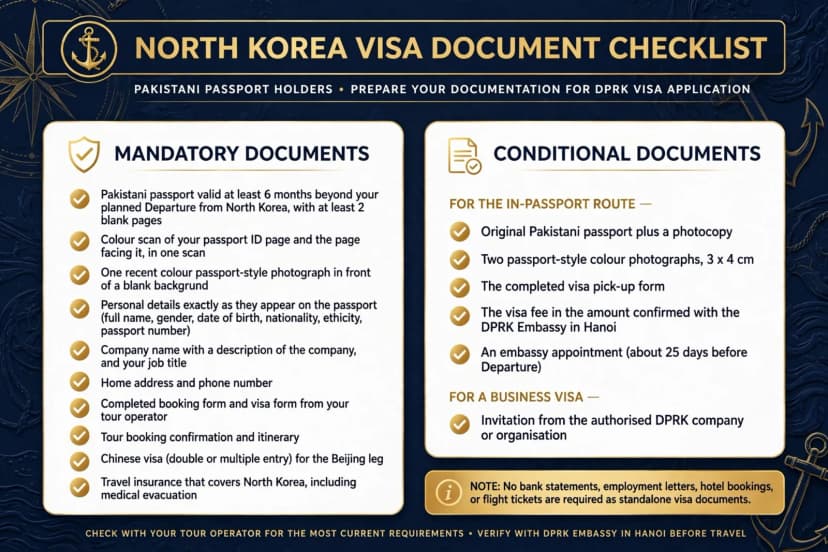
No single official document list for Pakistani applicants is published by the DPRK, so the checklists below combine what the licensed operators ask for, what the DPRK tourism authority states, and what the FCDO says border officers check. The operator's list is the one that governs your application, because the operator is the one who files it — confirm it with your tour manager before you send anything.
Tourist visa — tourist card route (the default)
- Pakistani passport, valid at least six months beyond your planned departure from North Korea, with at least two blank pages
- Colour scan of your passport ID page and the page facing it, in one scan
- One recent colour passport-style photograph of you in front of a blank background (digital file for the operator)
- Personal details exactly as they appear on the passport: full name, gender, date of birth, nationality and ethnicity, passport number
- Company name with a description of the company, and your job title
- Home address and phone number — the operator notes that your address and phone number must be based in the same country
- Completed booking form and visa form from your tour operator
- Your tour booking confirmation and itinerary
- Chinese visa (double or multiple entry) for the Beijing leg — applied for separately at the Chinese embassy or consulate in Vietnam
- Travel insurance that covers North Korea, including medical evacuation
Tourist visa — issued in your passport (Hanoi embassy route)
- Everything in the tourist-card checklist above, submitted to your operator first
- Original Pakistani passport, plus a photocopy of it
- Two passport-style colour photographs, 3 x 4 cm
- The completed visa pick-up form your operator sends you with the collection email
- The visa fee, in the amount confirmed with the DPRK Embassy in Hanoi
- A pen — the operator lists it, only half jokingly, because you may need to sign at the counter
- An appointment at the embassy, made after your operator's email tells you the visa is ready (about 25 days before departure)
Business visa
- Invitation from the authorised DPRK company or organisation you will do business with
- Passport and photographs as above
- Details of the business purpose, the inviting organisation and your role — no published document list exists, so the inviter's instructions govern
Documents that are not required — and documents that are banned
There is no published requirement for bank statements, employment letters, hotel bookings or flight tickets as standalone visa documents for North Korea, because the operator arranges the hotels, the transport and the itinerary as part of the tour. Do not pay anyone to prepare these for a DPRK visa. What matters far more is what you must not bring: GPS devices must be left with North Korean customs on arrival and collected when you leave; foreign mobile phones may be brought in but must be registered at the border; and religious or political material, including Bibles and literature deemed subversive, is prohibited or heavily restricted. Journalists, photographers and media workers cannot use a tourist visa at all without special arrangements: Koryo Tours states it is not permitted to arrange DPRK tourist visas for them, though with additional paperwork — a media agreement, a signed letter stating the visit is solely for tourism, and a supporting letter from the employer confirming the trip is personal and not a work assignment — bookings can sometimes be accepted. If you work in media, declare it honestly to your operator before booking; being discovered inside the country is far worse than being refused before it.
How to Apply: Step-by-Step
There is no online form, no embassy walk-in application and no self-service route for a North Korea tourist visa. The entire application runs through your tour operator. The steps below describe the tourist-card route, which is the default; the in-passport route differs only at steps 6 and 7.
Step 1 — Confirm tours are actually running. Before anything else, check the current status with a licensed operator (Koryo Tours, Young Pioneer Tours, Uri Tours or Lupine Travel). As of 27 November 2026 the answer for a Pakistani passport holder is no. Join the operator's mailing list and wait for written confirmation that tourist visas are being issued to your nationality for a specific departure. Do not pay a deposit before that confirmation.
Step 2 — Choose your operator and tour. Book through a licensed, established operator with a track record in North Korea. Compare what the tour price includes (visa or not, Beijing–Pyongyang transport, accommodation, meals, guides), the refund terms if Pyongyang cancels, and the operator's policy on single supplements. Read the operator's terms on behaviour rules inside the country before you commit.
Step 3 — Send your details and documents. Provide the personal information listed in the checklist — name as in the passport, gender, date of birth, nationality and ethnicity, passport number, company and job title, home address and phone number — plus a colour scan of your passport ID page and the facing page, and a recent colour passport-style photo against a blank background. Your operator will not need your physical passport at any point in the tourist-card process.
Step 4 — Wait for Pyongyang's authorisation. Your operator submits the first round of applications about 40 days before the tour, and authorisation takes up to two weeks. Use this time to apply for your Chinese visa (double or multiple entry, so you can return through Beijing), buy travel insurance that covers North Korea, and sort your flights to Beijing. Do not book non-refundable onward travel until authorisation is confirmed.
Step 5 — Receive your tourist card. If you are on the tourist-card route, your operator gives you the DPRK Tourist Card just before departure — typically at the pre-tour meeting in Beijing. Check that the name, dates and ports of entry and exit on it match your passport and itinerary before you travel to the border.
Step 6 — If you chose the in-passport visa: collect it in Hanoi. About 25 days before departure, your operator emails you that the visa is ready. Make an appointment at the DPRK Embassy in Hanoi, take your passport and a copy, two 3 x 4 cm photos, the completed pick-up form and the fee, and have the visa stuck into your passport on the spot. You do not leave your passport with the embassy.
Step 7 — Travel to Beijing and join the tour. Fly to Beijing, meet your group and your guides, and cross into North Korea by the arranged route — Air Koryo flight or train to Pyongyang, or rail via Sinuiju. Your guides handle registration with the authorities (required within 24 hours) and hold your itinerary. Keep your tourist card with your passport at all times; immigration takes the card when you leave.
Step 8 — If your visa is refused. Refusals happen without explanation, and there is no published appeal process. Your operator is your only channel: ask what, if anything, can be re-submitted, and check your refund terms. Do not attempt to reapply through a different operator with different personal details, and do not attempt to enter without a visa — there is no visa on arrival and no way to fix a refusal at the border.
Applying from Vietnam — the DPRK Embassy in Hanoi
For a Pakistani passport holder living in Vietnam, the DPRK Embassy in Hanoi is the nearest DPRK mission, and it is the reason this guide can offer a concrete local route at all. The embassy exists — it is listed in the DPRK's diplomatic-missions records, it hosted the 75th-anniversary banquet for Vietnam–DPRK diplomatic relations in February 2025, and Kim Jong-un himself visited it during the February 2019 Hanoi summit. Vietnam and North Korea have held diplomatic relations since 31 January 1950, and Vietnam maintains its own embassy in Pyongyang (7 Munsu Street, Munsu-dong, Taedonggang District).
The address conflict. Two different Hanoi addresses circulate for the DPRK Embassy, and this guide states both rather than picking one silently. Most embassy listings, including the Wikipedia mission lists, give 25 Cao Ba Quat Street, Ba Dinh District, Hanoi. A Vietnamese news report from the February 2019 summit, however, gives the address as 48/2 Giang Vo Street, Giang Vo Ward, Hanoi, with telephone +84 24 3736 6491 and fax +84 24 3736 6490. These may be two entrances or buildings of the same compound, an old and a new address, or a reporting error — no source found for this guide resolves the difference, and there is no official DPRK embassy website to check. Do not travel to either address unannounced. Telephone first, confirm which address is current, and confirm the appointment procedure, the fee and the opening hours. No published email address, fee list or opening hours for the Hanoi embassy were found for this guide.
What the Hanoi embassy can and cannot do for you. The embassy's practical role in the tourist process is narrow: it is the collection point for a visa issued in your passport, once your operator has secured authorisation from Pyongyang. It is not a place where you can walk in and apply for a tourist visa on your own, because tourist visas are arranged through the operator and authorised in Pyongyang first. Contact the embassy through your operator rather than cold: your tour manager knows the appointment procedure and will tell you when the visa is ready for collection. For a business visa, the embassy is the mission to ask about the invitation and filing route — but again, only after an authorised DPRK organisation has invited you.
Applying from Vietnam versus applying from Pakistan. There is no DPRK embassy in Pakistan, and Pakistani applicants are typically routed through the DPRK Embassy in Beijing, in coordination with their tour operator. Living in Vietnam therefore gives you a real advantage: a DPRK mission in your country of residence, and the in-passport visa option that comes with it. Your Vietnamese temporary residence card does not change the visa requirement, and no source suggests the Hanoi embassy gives Vietnamese residents simplified treatment — but you can collect a visa without flying to Beijing first. Carry your TRC and proof of address in Vietnam to the appointment as evidence of where you live, even though no published rule requires them.
The consular gap. The other side of the Vietnam–DPRK picture is the absence of help if things go wrong inside North Korea. Pakistan's diplomatic mission in Pyongyang is listed as closed on the Pakistan Foreign Office's own website, according to reporting from September 2026, and there is no functioning Pakistani embassy in the country. Vietnam's embassy in Pyongyang exists, but it is Vietnam's mission, not yours, and it has no obligation to assist a Pakistani national. If you are detained, fall ill or lose your passport inside North Korea, there is effectively no Pakistani consular assistance available. That fact, more than any fee or form, is the reason the travel advisories in this guide are written as strongly as they are. Register your trip with the Pakistan Foreign Office before you travel, leave a full copy of your itinerary and your operator's emergency contacts with family in Vietnam or Pakistan, and make sure someone outside the country knows exactly when you are expected back.
Entry Points, China Transit and Getting There
There are no direct flights from Vietnam — or from Pakistan — to North Korea, and no way to enter North Korea directly from Vietnam. Every realistic route goes through China, and that makes the Chinese visa the second visa in your trip, not an afterthought.
The Beijing route. The standard way in is to fly to Beijing, join your tour group there, and continue by Air Koryo flight to Pyongyang or by train to Pyongyang via Sinuiju, the border city across the Yalu River from Dandong. The Beijing–Pyongyang passenger train resumed on 12 March 2026 after about six years, and Air China restarted Beijing–Pyongyang flights on 30 March 2026 (one weekly flight, CA121/CA122). Both links are operating as transport, but as noted above, North Korea was not issuing tourist visas for the train route when it resumed, so the existence of the train does not mean you can ride it as a tourist. Your operator books the Beijing–Pyongyang leg as part of the tour; Air Koryo tickets to Pyongyang can only be booked through agents.
The Chinese visa. Pakistani passport holders need a visa for China, and for this trip it must be a double-entry or multiple-entry visa — you need to re-enter China on the way back, and a single-entry visa will not cover the return. Koryo Tours states this explicitly for its marathon travellers, and the same logic applies to any tour that starts and ends in Beijing. Apply at the Chinese embassy or consulate in Vietnam well before departure, and allow for the possibility that the Chinese visa takes longer than the DPRK authorisation. Check the Chinese visa fee at the mission; no figure is given here because it is set by China, not by North Korea, and it changes.
The Rason route. The Rason Special Economic Zone, in the far north-east where North Korea meets China and Russia, has its own crossings: Tumangang from Russia and Wonjong/Namyang from China. It was the only place Western tourists were admitted in early 2025, and it is the route Russian groups still use, including the planned Vladivostok–Rason bus service. For a Pakistani traveller it is not currently a usable route: Rason closed to non-Russians on 5 March 2025 and has not reopened to them since, and your visa would in any case need to list the Rason ports of entry and exit. Do not plan a trip around Rason until an operator confirms it is open to your nationality.
What you cannot do. You cannot cross between North and South Korea, and you must not attempt any unauthorised crossing: the Canadian government warns that foreigners have been detained, hurt or killed at unauthorised crossing points. You cannot enter North Korea from South Korea as a tourist, and the DMZ tours run from Seoul stay on the southern side — they are a way to see North Korea, not to enter it.
Extending Your Stay and Overstay Rules
There is no published procedure for extending a North Korea tourist visa, and no source found for this guide describes a tourist extending a stay. Your visa covers your tour, and your tour has fixed dates, fixed hotels and fixed exit arrangements. If you want a longer trip, book a longer tour before you travel; do not assume you can add days once you are inside the country. Overstaying is not a matter of paying a fine at the airport, as it is in some countries: North Korea's legal system offers visitors few protections, offences considered trivial elsewhere can incur very severe penalties, and your guides control your movements and your exit. The practical rule is simple — leave on the date your tour leaves, with your group, through the port of exit written on your visa. If illness or a transport disruption prevents that, your operator and your guides are your only channel to the authorities; contact them immediately and do nothing on your own initiative.
Work and Study Routes
There is no work visa, student visa or job-seeker route to North Korea for a Pakistani passport holder, and this section is short because inventing requirements for categories that do not exist would be worse than useless. No employer-sponsored work-permit system is published, no university admission route for foreign fee-paying students is described by any operator or government source found for this guide, and there is no digital-nomad visa, no entrepreneur visa and no permanent-residence pathway. The only foreigners working in North Korea are diplomats, a small number of aid workers and business representatives, and invited Chinese business visitors. If an agent offers you a North Korean work permit or teaching job — particularly for a fee paid in advance — treat it as a scam unless they can name the inviting DPRK organisation and a licensed operator confirms the arrangement. There are no employment opportunities for Pakistani nationals in North Korea. If your goal is work abroad, the Gulf and online teaching are realistic; North Korea is not.
Flights, Money and Practical Notes
Flights. Fly from Ho Chi Minh City or Hanoi to Beijing, join your tour there, and continue to Pyongyang by Air Koryo or by train. There are no direct flights from Vietnam to Pyongyang, and no direct flights from Pakistan either. Book your Vietnam–Beijing flights only after your operator confirms your DPRK authorisation, and keep them changeable: Pyongyang has cancelled departures with a few weeks' notice before, and a non-refundable ticket is the most expensive part of a cancelled trip.
Money. North Korea runs on cash for foreign visitors: euros, US dollars and Chinese yuan are the usable currencies, and foreign bank cards do not work. There is no published minimum bank balance for the visa, because the operators do not ask for proof of funds — but carry enough cash for the whole tour plus a reserve, since there is no ATM you can use and no way to receive a wire transfer inside the country. Your operator will explain which currencies and payment methods work on your itinerary; ask before departure, not at the border. Keep your cash secure and split between bags, and keep receipts for anything you buy, since customs may ask about purchases on exit.
Phones and internet. There is no normal connectivity inside North Korea. You may bring a foreign mobile phone, but it must be registered at the border, and it will not connect to any network. GPS devices must be left with customs on arrival and are returned when you leave. Do not expect to message family during the trip; tell them in advance that you will be unreachable for the duration, and agree a check-in time after your return to Beijing.
Food and religion. Halal food is essentially unavailable in North Korea, there are no mosques for public use, and religious practice is heavily restricted. Meals are set by the tour, you cannot reliably source halal food, and religious literature is prohibited or heavily restricted at the border. Discuss dietary needs with your operator before booking — and weigh this seriously in the decision whether to go at all.
Safety, Health and the Rules Inside North Korea
Travel advisories — read these before anything else in this guide. The US State Department rates North Korea Level 4: Do Not Travel, its highest level, and says: "Do not travel to the Democratic People's Republic of Korea for any reason," citing the continuing serious risk of arrest, long-term detention and wrongful detention. Its advisory was reissued on 11 August 2025, and in August 2026 the Department confirmed the Level 4 rating and the extension of the passport restriction through 31 August 2027. The UK FCDO advises against all but essential travel to North Korea, updated 10 December 2025, warns that your travel insurance could be invalidated if you travel against its advice, and notes that the British Embassy in Pyongyang is closed, so consular support is severely limited. The Canadian government advises travellers to avoid all travel to North Korea, citing the risk of arbitrary detention. Australia advises "Do Not Travel". These advisories are written for their own nationals, but the risks they describe — arbitrary detention, no consular help, a legal system with few protections for visitors — apply to a Pakistani traveller at least as strongly, because Pakistan has no functioning embassy in Pyongyang at all. No specific published travel advisory from Pakistan's Foreign Office for North Korea was found for this guide; that absence is itself a gap, and it means there is no Pakistani government guidance to fall back on.
The rules inside the country. Your guides stay with you at all times, decide where you go, and approve every photograph before you take it. Bow when your group bows at statues of the leaders. Never approach locals independently, never leave your hotel alone, never photograph military personnel, construction sites or anything your guide has not cleared, and never bring in or display religious or political material. Offences considered trivial elsewhere can incur very severe penalties, and there are well-documented cases of foreigners being detained for actions they considered minor. The case most often cited is Otto Warmbier, a US student detained for 17 months after being accused of taking a propaganda poster from a hotel, who died shortly after his release in 2017 — the event that led to the US passport restriction. Follow your guides exactly, with no exceptions.
Health. Medical facilities inside North Korea are minimal, and outside Pyongyang they are basic at best. Get hepatitis A and typhoid vaccinations before you go, as standard travel-health advice for the region recommends, and consult a travel clinic at least eight weeks before departure. A yellow fever vaccination certificate is required if you are coming from a country listed as a transmission risk, according to the FCDO — Vietnam and Pakistan are not on the usual risk lists, but confirm this with your operator and your clinic, because the requirement follows your travel history, not just your passport. Buy travel insurance that explicitly covers North Korea and includes medical evacuation, and check the policy wording: many standard policies exclude North Korea, and travelling against FCDO advice can invalidate others. Carry any regular medication in its original packaging with a prescription, and carry more than you need for the trip, because pharmacies inside the country cannot be relied on.
Frequently Asked Questions
1. Can a Pakistani passport holder visit North Korea in 2026?
Not as a tourist right now. As of 27 November 2026 North Korea is closed to general tourism for every nationality except Russians. Pakistani passport holders need a visa, and tourist visas are not currently being issued to non-Russians. The system described in this guide applies when tours resume; until an operator confirms in writing that tourist visas are being issued to Pakistanis for a specific departure, do not pay for a trip.
2. Do Pakistanis need a visa for North Korea?
Yes. Every holder of an ordinary Pakistani passport needs a visa before travelling. No nationality is exempt for tourism, there is no visa-free entry, no e-visa and no visa on arrival. Living in Vietnam does not remove the requirement.
3. How do I apply for a North Korea visa?
Through a licensed tour operator only. Book a tour, send the operator your passport details, a passport scan and a photo, and the operator arranges the visa with the authorities in Pyongyang. There is no online application, no e-visa portal and no walk-in embassy application for tourists.
4. How much does a North Korea visa cost?
Koryo Tours quotes EUR 60 for a tourist card issued in China (including the agent fee), and about EUR 10 plus a EUR 25 agent fee for a visa issued at a DPRK embassy outside China. Rocky Road Travel quotes EUR 50. These are operator-reported figures from pages that predate the 2020 closure; there is no published official DPRK fee schedule, so the figure your own operator quotes in writing is the controlling one.
5. How long does the visa take?
Allow at least eight weeks. Operators submit applications to Pyongyang about 40 days before a tour, and authorisation takes up to two weeks; other reports put the process at four to eight weeks. The DPRK tourism authority's own minimum is 15 days before departure, but that is a minimum, not a planning horizon.
6. Can I travel to North Korea independently?
No. Independent travel is not permitted for foreign visitors. You must travel on an organised tour with a licensed operator and government-assigned guides who stay with you for the entire trip. Independent travellers would need a sponsor and permission from the Ministry of Foreign Affairs, which in practice is only available for business visitors.
7. Is there a North Korean embassy in Pakistan?
No. There is no DPRK embassy in Pakistan, and Pakistani applicants are typically routed through the DPRK Embassy in Beijing. If you live in Vietnam, the DPRK Embassy in Hanoi is your nearest mission and the collection point for a visa issued in your passport.
8. Where is the North Korean embassy in Hanoi?
Most listings give 25 Cao Ba Quat Street, Ba Dinh District, Hanoi. A Vietnamese news report from 2019 gives 48/2 Giang Vo Street, with telephone +84 24 3736 6491. The two addresses conflict and no official embassy website exists to resolve it, so telephone first and confirm which address is current before travelling there. No published email address or fee list was found.
9. Do I need a Chinese visa to visit North Korea?
Yes, if you travel via Beijing, which almost every tour does. Pakistani passport holders need a visa for China, and it must be a double-entry or multiple-entry visa so you can re-enter China on the way back. A single-entry Chinese visa will not cover the return.
10. Will my passport be stamped?
Usually not. The tourist visa is normally a separate paper tourist card, not a stamp in your passport, and immigration takes the card from you when you leave — you will not keep it as a souvenir. Rason is one place where entry and exit stamps have been given. If you want the visa in your passport, you can ask for that option through the Hanoi embassy.
11. Can journalists or media workers visit North Korea as tourists?
Not on a standard tourist visa. Operators state they are not permitted to arrange DPRK tourist visas for journalists, photographers and media workers. With additional paperwork — a media agreement, a signed letter stating the visit is solely for tourism, and an employer letter confirming it is a personal trip — bookings can sometimes be accepted. Declare media work honestly before booking.
12. Is North Korea safe to visit?
Governments say no, in unusually strong terms. The US rates it Level 4: Do Not Travel, citing arrest, long-term detention and wrongful detention. The UK advises against all but essential travel and warns insurance may be invalidated. Canada says avoid all travel. Pakistan has no functioning embassy in Pyongyang, so there is effectively no Pakistani consular help inside the country. Read the advisories in full before deciding.
13. Can I work or study in North Korea?
No verified route exists. There is no published work-visa or student-visa system for Pakistani passport holders, no job-seeker or digital-nomad visa, and no family-reunion category. Business visas exist for invited visitors, mostly from China. Treat any offer of a North Korean work permit for an upfront fee as a scam unless a named DPRK organisation and a licensed operator both confirm it.
14. What happens if my visa is refused?
Refusals happen without explanation and there is no published appeal process. Your operator is your only channel. Do not reapply through another operator with different details, and do not attempt to enter without a visa — there is no visa on arrival and nothing can be fixed at the border. Check your tour deposit refund terms before you pay.
15. When will North Korea reopen to tourists?
Nobody knows. Koryo Tours and Young Pioneer Tours both state there is no opening date, no reopening criteria and no confirmed news as of November 2026, and the answer could be anywhere from tomorrow to 2027 or beyond. The best indicator is the operators' own status pages and mailing lists — not social media, where claims of a general reopening have repeatedly proved wrong.
Official Immigration Websites
North Korea publishes almost no visa information itself, so this table mixes the few official sources that exist with the operator and government-advisory sources that carry the real weight for this destination. The operators are the controlling source for whether tours are running and what a visa costs; the US State Department and the FCDO are the controlling sources for safety advice; the Hanoi embassy is the controlling source for the in-passport collection route.
| Website | What it is | Link |
|---|---|---|
| DPRK State General Bureau of Tourist Guidance | North Korea's official tourism authority — tourist visas applied for through a DPRK travel company at least 15 days before departure, two photos | tourismdprk.gov.kp — tourist visa information |
| US Department of State — North Korea Travel Advisory | Level 4: Do Not Travel; US passport restriction extended through 31 August 2027; advisory reissued 11 August 2025 | travel.state.gov — North Korea Travel Advisory |
| UK FCDO — North Korea travel advice | Advises against all but essential travel; entry requirements, yellow fever, insurance warning; updated 10 December 2025 | gov.uk/foreign-travel-advice/north-korea |
| Government of Canada — North Korea travel advice | Advises avoiding all travel; warns of arbitrary detention and unauthorised-crossing dangers; passport-validity guidance | travel.gc.ca — North Korea destination page |
| Koryo Tours — How to Get a North Korea Visa | Licensed operator's visa guide: tourist card EUR 60, embassy visa about EUR 10 + EUR 25 agent fee, 40-day submission, 2-week authorisation | koryogroup.com — North Korea visa guide |
| Koryo Tours — North Korea Travel Today (2026) | Current status: closed to general tourism; Russians only since February 2024; 2026 marathon cancelled; no April 2027 race | koryogroup.com — North Korea Travel Today |
| Young Pioneer Tours — When Will North Korea Open? | November 2026 update: officially closed to international tourism except Russian nationals; no timeline announced | youngpioneertours.com — North Korea open for tourism |
| Embassy of the DPRK, Hanoi | Nearest mission for residents of Vietnam — 25 Cao Ba Quat Street, Ba Dinh, Hanoi (conflicting address 48/2 Giang Vo also reported; tel +84 24 3736 6491); no published website or email found | No website — telephone first |
| Rocky Road Travel — How to Get a North Korea Visa | Operator visa page: EUR 50 visa, under two weeks' processing, tourist card separate from passport | rockyroadtravel.com — North Korea visa |
| Yonhap — US renews North Korea travel warning (Aug 2026) | State Department confirms Level 4 advisory and passport-ban extension to 31 August 2027 | yna.co.kr — US renews North Korea warning |
| TravelTip — Can you visit North Korea? (Nov 2026) | Status summary as of November 2026: closed to tourists of every nationality except Russians; Rason dates; US passport rules | traveltip.org — Can you visit North Korea? |
| Atlas Guide — North Korea Travel Guide | 2026 guide: selective reopening record, Beijing train resumption 12 March 2026, advisories compared | atlas-guide.com — North Korea Travel Guide |
| Wikipedia — List of diplomatic missions of North Korea | Confirms the DPRK Embassy in Hanoi; lists missions worldwide | en.wikipedia.org — Diplomatic missions of North Korea |
| Wikipedia — North Korea–Vietnam relations | Diplomatic relations since 31 January 1950; embassies in Hanoi and Pyongyang; Kim Jong-un's 2019 embassy visit | en.wikipedia.org — North Korea–Vietnam relations |
| TravelFreedom — North Korea visa policy | Visa required for all ordinary passports including Pakistan; tourist authorisation via registered DPRK travel company | travelfreedom.io — North Korea |
| VisaFromPakistan — North Korea Tourist Visa for Pakistanis | Pakistan-focused commercial guide: no DPRK embassy in Pakistan; Beijing route; fee estimate USD 50 (unverified) | visafrompakistan.com — North Korea tourist visa |
| Pakistan Chronicle — Pakistan–North Korea relations (Sep 2026) | Pakistan's mission in Pyongyang listed as closed on the Foreign Office website; no functioning Pakistani embassy in the DPRK | pakistanchronicle.com — Pakistan–North Korea relations |
| OneTimeLivin — North Korea visa rules for Pakistan passport holders | Quotes the DPRK tourism authority (tourismdprk.gov.kp): apply via a DPRK travel company at least 15 days before departure, two photos | onetimelivin.com — North Korea visa rules for Pakistan |
*This guide was checked on 27 November 2026. Visa rules change without notice, and for North Korea they can change overnight and without explanation. Always confirm the live position with a licensed tour operator and the DPRK Embassy in Hanoi before paying any fee or booking a non-refundable ticket. Nothing in this guide is immigration advice; the North Korean authorities set and enforce the entry rules, and as of this writing they are