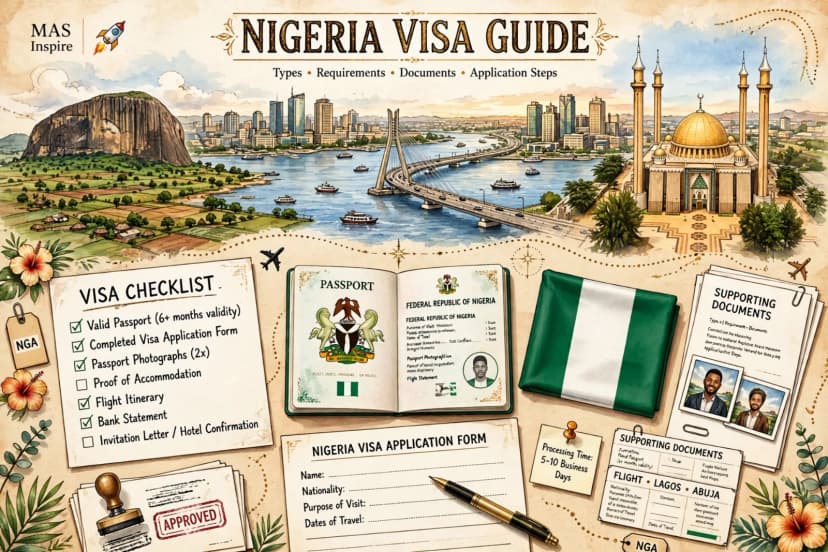
Nigeria Visa Guide 2026: Types, Requirements, Documents and Application Steps
Last checked: 27 November 2026. This guide is for Pakistani passport holders living in Vietnam. Visa rules change without notice — always confirm the live rules on the official e-visa portal (evisa.immigration.gov.ng) and with the Embassy of Nigeria in Hanoi before paying any fee or booking a non-refundable ticket.
Table of Contents
- Introduction
- Do Pakistani Passport Holders Need a Visa for Nigeria?
- The Big Question: Can Pakistanis Use the E-Visa Portal?
- Types of Nigeria Visas for Pakistani Passport Holders
- E-Visa Fees: The Numbers in Dispute
- Processing Times
- Complete Document Checklists
- How to Apply: Step-by-Step
- Applying from Vietnam — the Embassy in Hanoi
- Entry Points, Visa on Arrival and the Landing Card
- Extending Your Stay and Overstay Rules
- Work and Study Routes
- Transit, Flights and Money: Practical Notes
- Safety, Health and Arrival Checks
- Frequently Asked Questions
- Official Immigration Websites
Introduction
Nigeria is Africa's most populous country and its largest economy — more than 200 million people, with Lagos as its commercial capital, Abuja as its federal capital, and an energy, technology, film and music scene that reaches far beyond West Africa. For a Pakistani traveller it is also one of the less obvious destinations: no direct flights from Vietnam or Pakistan, no visa-free access, and an immigration system rebuilt from scratch in 2025. That rebuild is the reason this guide exists in its present form, because the old advice about Nigeria — turn up, buy a visa on arrival, sort the rest out later — is now wrong in every particular, and following it will get you refused boarding in Ho Chi Minh City.
On 1 May 2025 the Nigeria Immigration Service (NIS) switched on a fully digital e-visa system and abolished visa on arrival at the same time; pre-existing visa-on-arrival approvals expired on 30 May 2025. Since then almost every short visit — tourism, family visits, business meetings, conferences, transit, medical treatment, religious travel, sport — has been handled through one of 13 short-visit e-visa classes on a single official portal, evisa.immigration.gov.ng, with the visa certificate sent by email and presented at boarding and on arrival. Longer stays — work, study and residence — still run through the embassy route, with an online form followed by an in-person interview and fingerprint enrolment.
There is one honest complication, and it is better to meet it in the first minute than at the payment page. Whether a Pakistani passport holder can actually use the e-visa portal, and what the fee is if you can, is genuinely disputed between the sources written for Pakistanis. One Pakistan-focused guide, checked on 7 November 2026, says Pakistanis apply online for the e-visa like everyone else. Another, published in September 2025, says there is no e-visa for Pakistani nationals at all and that every application goes through the High Commission in Islamabad, in person, with biometrics and an interview, for a visa fee of USD 68 plus a USD 170 biometrics fee. The fee figures disagree just as sharply: USD 160, USD 175 and USD 238 are all quoted for the same single-entry tourist visa. This guide does not pick a side and hide the other: it lays out both positions, names the controlling source for each figure, and tells you exactly how to settle the question for your own passport before you pay anything — and how to apply through the Embassy of Nigeria in Hanoi if the portal route fails you.
Do Pakistani Passport Holders Need a Visa for Nigeria?
Yes. Every holder of an ordinary Pakistani passport needs a visa before travelling to Nigeria. Pakistan is not on any visa-free list for Nigeria, and there is no visa waiver for Pakistani passports. The only nationals who enter Nigeria without a visa are citizens of ECOWAS member states — Benin, Burkina Faso, Cabo Verde, Côte d'Ivoire, The Gambia, Ghana, Guinea, Guinea-Bissau, Liberia, Mali, Niger, Senegal, Sierra Leone and Togo — under the ECOWAS free-movement protocol, for up to 90 days. Burkina Faso, Mali and Niger left ECOWAS in January 2025 and their transitional visa-free entry is not guaranteed long-term; neither point concerns a Pakistani passport.
The rule follows your passport, not where you live. Living in Vietnam, holding a Vietnamese temporary residence card (TRC), holding a US, UK or Schengen visa, or having lived in the Gulf does not remove the visa requirement, and no simplified regime for Vietnamese residents of Pakistani nationality was found for Nigeria.
There are two narrow exceptions. First, if you hold a valid Nigerian residence permit — a CERPAC (Combined Expatriate Residence Permit and Aliens Card) or a Green Card — you do not need a visa to enter Nigeria, according to the UK Foreign, Commonwealth and Development Office (FCDO); that only helps people who already live in Nigeria. Second, transit passengers who stay inside the airport transit area can remain for up to 48 hours without a visa; a transit visa is needed if you leave the airport.
The passport rule is stated identically by the NIS and the FCDO: your passport must have an expiry date at least six months after the date you arrive, and you need at least two blank visa pages. Apply that rule to the whole trip, not just the arrival date, and renew your passport in Vietnam or Pakistan before you apply if it is anywhere near the limit — a visa cannot be issued into a passport that will fail the six-month test on arrival.
The Big Question: Can Pakistanis Use the E-Visa Portal?
This is the single most important section of the guide, because the two answers in circulation lead to completely different plans — and booking a flight on the wrong one could leave you refused boarding in Ho Chi Minh City or refused entry in Lagos.
Position A — Pakistanis can use the e-visa portal. A Pakistan-focused guide that says it checked the official portal on 7 November 2026 states that most short visits by Pakistanis, including tourism, visiting family or friends and business meetings, are now handled through Nigeria's online e-visa, run by the Nigeria Immigration Service. A second Pakistan-focused guide, updated 20 October 2026, says the same: apply at portal.immigration.gov.ng, single-entry fee around USD 160, pre-approval in 2 to 5 working days. A third source, updated in June 2026, also records the entry type for Pakistani passports as e-visa, processing usually 1 to 5 business days. Under this position, you never visit an embassy for a short visit: you register on evisa.immigration.gov.ng, choose the class, upload the documents, pay by card, and receive the visa certificate by email, usually within 48 hours if there is no local objection.
Position B — Pakistanis cannot use the e-visa and must apply at the High Commission in Islamabad. A detailed Pakistan-focused guide published in September 2025 states flatly that there is no e-visa for Pakistani nationals at this time, and that all Nigerian visas for Pakistanis are processed through the Nigeria High Commission in Islamabad (Diplomatic Enclave, Ispahani Road, G-5/4, Islamabad), in person, because biometric verification (fingerprints and photograph) and an interview are mandatory and no agent can bypass that step. Under this position the standard document is an embassy sticker visa, usually single entry: visa fee USD 68, separate biometrics fee USD 170, total USD 238, no cash payments, processing 5 to 10 working days, apply 3 to 4 weeks ahead. The same guide adds a police character certificate as mandatory — a requirement absent from the NIS e-visa lists — and says the High Commission takes submissions on specific days (Mondays and Wednesdays, 9 to 11 a.m., as an example) and contacts applicants to schedule the interview.
How to settle it for your own passport. Do not take either position on trust, including this guide. The controlling test takes five minutes and costs nothing: open evisa.immigration.gov.ng, register, select Pakistan as your nationality and tourism (F5A) as your purpose, and see whether the system offers you an application and shows you a fee at checkout, or refuses you. If the portal accepts a Pakistani nationality and shows a fee, Position A is right for you and the fee on that checkout screen is the only fee that counts. If the portal refuses Pakistan, or if it accepts the application but the approval never comes, Position B is your route — and for a Pakistani living in Vietnam, that means the Embassy of Nigeria in Hanoi, not Islamabad, is the mission to contact first (see the Vietnam section below). Do this test before you pay anything, before you book any flight, and before you believe any agent who quotes you a fee. Keep a screenshot of whatever the portal shows you: it is the document that proves to an agent or an airline why you hold the visa you hold.
Why the two positions may both be partly right. The September 2025 guide was written four months after the e-visa launch, when the new system was still bedding in and many missions were still issuing sticker visas; the November 2026 guides describe the system as it works now for most nationalities. No official NIS page found for this guide publishes a list of nationalities eligible for the e-visa, or a list excluded from it. The NIS describes the system as covering 177 eligible countries, with 25 nations outside the online route who must use embassy channels, but no source found for this guide names those 25 countries, so Pakistan's place on either list could not be verified against an official page. This guide's recommendation is to plan on the e-visa test first, and to have the embassy route ready as the fallback — not the other way round.
What the dispute does not change. Whichever route applies to you, the underlying requirements are the same shape: a passport valid for six months with two blank pages, a return or onward ticket, proof of accommodation or an invitation, proof of sufficient funds (Nigeria asks for a 180-day bank statement, which is longer than most countries), a yellow fever certificate, and a completed application with a photograph. The dispute is about where you file, what you pay and whether you give fingerprints — not about whether you need a visa at all. One point is agreed by every source on both sides: never travel to Nigeria without any visa document and hope to buy one at the airport. Visa on arrival was abolished on 1 May 2025.

Types of Nigeria Visas for Pakistani Passport Holders
Nigeria's visa system has three layers: short-visit e-visas (13 classes, applied for online), temporary-residence visas (work, study and similar, applied for through an embassy), and residence permits (CERPAC and the Green Card, obtained inside Nigeria after arrival). The classes below are the ones a Pakistani passport holder living in Vietnam is realistically likely to use. Nigeria has no digital nomad visa and no job seeker visa: the NIS visa page lists no remote-work class.
Tourist visa — F5A
The standard short-stay visa for sightseeing and holidays. The NIS describes it as a single-entry visa for non-ECOWAS nationals visiting Nigeria for tourism. It is valid for 90 days from issue, allows one stay of up to 30 days, cannot be extended, and does not permit work. It is applied for online on the e-visa portal (if the portal accepts your nationality) or through an embassy. Do not confuse the 90-day validity with the 30-day stay: the visa must be used within 90 days of issue, and once you enter you have 30 days.
Visiting visa — F6A (single entry) and F6B (multiple entry)
For social visits to family and friends in Nigeria. F6A is the single-entry version: 30 days within 90 days of issue, not extendable, no work. It needs everything the tourist visa needs, plus an invitation letter from your host in Nigeria accepting immigration responsibility, and a copy of the host's Nigerian passport — or their residence permit if the host is not Nigerian. F6B is the multiple-entry visiting visa; it is one of the classes that is not handled on the e-visa portal and must be applied for through the embassy route (online form on visa.immigration.gov.ng, then interview and fingerprints at the mission), with a service target of about 10 days from enrolment.
Business visa — F4A (single entry) and F4B (multiple entry)
For short-term business activities: meetings, conferences, seminars, training, contract negotiations, marketing, sales, procurement, trade fairs and job interviews. F4A is single entry, one stay of up to 30 days within 90 days of issue, not extendable, and does not permit employment. It needs an invitation letter from the Nigerian company and the inviting company's Corporate Affairs Commission (CAC) registration certificate. F4B is the multiple-entry business visa for repeated short business trips; its validity and stay depend on nationality reciprocity and the approval granted, so the portal or the mission sets the terms for your case. A business visa is for prospecting and meetings, not for taking up a job: starting paid work on a business visa is a refusal and removal risk, not a shortcut.
Transit visa — F3B
For passing through Nigeria to a third country. Passengers who stay inside the airport transit area can remain for up to 48 hours without a visa; a transit visa is needed to leave the airport, and accommodation details are required if you stay overnight. Group applications of up to 10 people are allowed for transit. It cannot be extended and does not permit employment. In practice, most Pakistani travellers from Vietnam will not need a Nigerian transit visa at all, because the realistic routings to Lagos transit through Addis Ababa, Doha, Dubai or Istanbul rather than through Nigeria itself.
Other short-visit e-visa classes
The remaining e-visa classes cover narrower purposes, and each is applied for on the same portal with its own document list: journalist visa (F7A), cleric visa (F7B), medical tourism visa (F7C, for treatment in Nigeria, with a stay of up to 180 days reported for this class), religious tourism visa (F7D), sports visa (F7E, for participation in or attendance at sporting activities or competitions), and study tour visa (F7G, for short academic trips of up to 30 days, single entry). None permits paid work, and none substitutes for the student or work routes below. Choose the exact class for your purpose: a mismatch between class and purpose is a common refusal reason.
Classes not on the e-visa portal
Some classes are applied for online and then submitted at a mission, rather than decided entirely online. The clearest examples are the multiple-entry visiting visa (F6B), the student visa (R7A) and the Subject to Regularization visa for employment (STR, class R2A). For these, the sequence is: complete the form on the embassy portal (visa.immigration.gov.ng), upload the documents, pay the fee, then attend the mission for an interview and fingerprint enrolment, with a service target of about 10 days from enrolment. The 25 nations reported to be outside the online route entirely must use embassy channels for everything; as noted above, no source found for this guide names those 25 countries.
| Visa type | Class | Stay | Validity | Where to apply | Extendable? |
|---|---|---|---|---|---|
| Tourist | F5A | 30 days, single entry | 90 days from issue | E-visa portal (if it accepts Pakistanis); otherwise embassy | No |
| Visiting family/friends | F6A | 30 days, single entry | 90 days from issue | E-visa portal; otherwise embassy | No |
| Visiting (multiple entry) | F6B | As issued | As issued | Embassy route | Ask the mission |
| Business | F4A | 30 days, single entry | 90 days from issue | E-visa portal; otherwise embassy | No |
| Business (multiple entry) | F4B | As issued | As issued | E-visa portal; otherwise embassy | No |
| Transit | F3B | Up to 48 hours airside without a visa | As issued | E-visa portal | No |
| Journalist / Cleric / Medical / Religious / Sports / Study tour | F7A–F7G | 30 days (medical up to 180 days reported) | As issued | E-visa portal | No |
| Student | R7A | 90-day entry, then 2-year renewable permit | 90 days from issue | Embassy route | By regularization, not extension |
| Employment (STR) | R2A | 90-day entry, then CERPAC | 90 days from issue | Embassy route, after Expatriate Quota | By regularization, not extension |
| Temporary Work Permit | R10 / R11 | 30 days (R10) or up to 6 months (R11) | As issued | Embassy route, with pre-approval | Ask the mission |
E-Visa Fees: The Numbers in Dispute
The fee picture is the second area where sources disagree, and the disagreement is large enough that you need to see all the numbers before you pay anyone. Nigeria sets visa fees by nationality on a reciprocal basis, so there is no single price — and the Nigeria Immigration Service does not publish e-visa fees on its visa information pages. Its Service Level Agreement (revised April 2026) contains two fee tables in US dollars that list the same countries at different figures, without saying which table applies to e-visas or whether a service charge is added. The table below gives the figures as reported, with the source of each, and the text underneath explains which figure this guide treats as controlling.
| Item | Figure reported | Source |
|---|---|---|
| Single-entry visa, Pakistani passport | USD 175 | April 2026 NIS fee schedule as reported by two 2026 guides (Varioline Traveller; Visa360) |
| Single-entry tourist/business e-visa, Pakistani passport | About USD 160 | Pakistan-focused guide, Oct 2026 (Travel Visa Stack) |
| Single-entry tourist visa, Pakistani passport | USD 100–160 | Pakistan-focused fee page (Himal to Horizon), citing a passport-index dataset, not an official source |
| Tourist visa (F5A), Islamabad embassy route | USD 68 visa fee + USD 170 biometrics fee = USD 238 | Pakistan-focused guide, September 2025 (IWESS); cash payments not permitted |
| Single-entry visa, US passport | USD 160 (single or multiple) | NIS fee schedule, April 2026, via two 2026 fee guides |
| Single-entry visa, US passport, all-in | USD 180 (USD 160 + USD 20 bank processing fee) | VisaVerge e-visa guide, 2026 |
| Single-entry visa, UK passport | USD 193 (Table 8) vs USD 144 (Table 9) | NIS Service Level Agreement, April 2026 — the same document lists both figures |
| Multiple-entry visa, UK passport | USD 458 (Table 8) vs USD 472 / 944 / 2,360 for 1 / 2 / 5 years (Table 9) | NIS Service Level Agreement, April 2026 — the same document lists both figures |
| Single-entry visa, Indian passport | USD 253 | NIS Service Level Agreement fee schedule, April 2026, as reported by two 2026 fee guides |
| Single-entry visa, Canadian passport | USD 75 (single) / USD 150 (multiple) | NIS Service Level Agreement fee schedule, April 2026, as reported by two 2026 fee guides |
| Multiple-entry business e-visa, Pakistani passport | About USD 200 | Pakistan-focused guide, updated 20 October 2026 (Travel Visa Stack) |
| Student visa (R7A) | Varies by nationality; about USD 144 (UK) / USD 160 (US) reported | VisaCross student page, Jun 2026; not on the NIS R7A page |
The controlling figure is the one the portal shows you at checkout. For a Pakistani passport, the best-supported published figure for a single-entry e-visa is USD 175, because two independent 2026 guides both say they are reporting the April 2026 NIS fee schedule and both give the same number for Pakistan. But USD 160 is also in circulation from a Pakistan-focused guide updated in October 2026, and the USD 100–160 range on another page is explicitly not checked against an official source. The USD 238 total (USD 68 + USD 170) belongs to a different route — the Islamabad embassy sticker visa with in-person biometrics — and is not comparable to the online fee. The UK example shows why no printed figure can be trusted blindly: the NIS Service Level Agreement itself lists USD 193 and USD 144 for the same single-entry UK visa in two different tables. Add the USD 20 bank processing fee reported for US applicants, and the total you pay may exceed the headline visa fee. Budget USD 175 for a single-entry e-visa, keep USD 238 in mind for the embassy route, and treat the figure the portal shows before you pay — including any service fee — as the only one that counts.
Embassy fees are set by the mission. If you apply through an embassy or high commission, the fee is whatever that mission charges for your visa type on the day you apply.No published fee list for the Embassy of Nigeria in Hanoi was found — get the fee in writing from the mission before you travel there. The only published embassy-route figures are the Islamabad ones above (USD 68 + USD 170): a visa fee plus a separate biometrics fee, paid online, no cash — not what Hanoi will charge you.
Three practical warnings about money. First, apply only on evisa.immigration.gov.ng, typing the address yourself, and never through a lookalike site: on 6 May 2025 the NIS issued a public notice warning that www.nigeria-e-visa.com is fake, that the e-visa system is only available on the NIS portal, and that third-party sites and agents claiming to process Nigerian e-visas risk fraud, identity theft and financial loss. Second, visa fees are generally non-refundable, including if your application is refused — the NIS FAQ says fees are often non-refundable after a refusal — another reason to run the nationality test and confirm the embassy fee before you pay. Third, there is no published minimum bank balance for the tourist visa: the NIS asks for a 180-day bank statement but publishes no figure, so carry statements that plainly cover the trip.
Processing Times
Processing time is the third disputed figure, and the honest answer is a range with a planning rule. The NIS Service Level Agreement (April 2026) gives a 48-hour standard for the tourism e-visa, qualified by the words "if no local objection" — a condition the document does not define. The NIS FAQ says the same: e-visas are approved within 48 hours, high-volume seasons or incomplete documentation can delay approval, and applicants should apply at least 2 to 4 weeks before travel. The Pakistan-focused guides give longer figures: 2 to 5 working days for online pre-approval (Travel Visa Stack), and 1 to 5 business days (Pakistan-to-Nigeria guide, June 2026).
For the embassy route, the timeline is longer. The Pakistan-focused guide checked on 7 November 2026 puts embassy-route visas at about 10 days from enrolment — that is, from the interview and fingerprint appointment. The Islamabad guide puts processing at 5 to 10 working days after submission, and advises applying at least 3 to 4 weeks before travel. For the student visa (R7A), the NIS Service Level Agreement sets a 10-day service target from enrolment. The work route is slower still, because the employer's Expatriate Quota must be approved before you can apply for the STR visa.
Planning rule. For a short-visit e-visa, plan on 48 hours as the target and two weeks as the safety margin: apply at least 2 to 4 weeks before travel, as the NIS itself advises, so a rejected scan, a name mismatch or a request for a further document can be corrected without losing the trip. For the embassy route, apply at least 4 weeks before travel, longer for work or study. A tourist e-visa is valid for 90 days from issue, so do not apply absurdly early either: check the dates on the approval letter against your flights the moment it arrives.
Complete Document Checklists
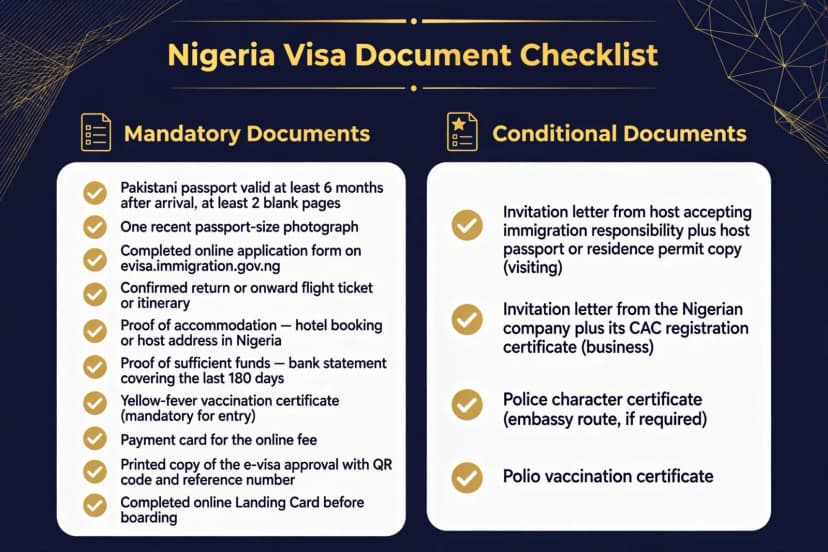
No single official document list for Pakistani applicants was published on a page found for this guide, so the checklists below combine what the NIS publishes for each visa class, what the Pakistan-focused guides report missions asking for, and what the FCDO says border officers check on arrival. The mission that takes your application may ask for more or less — its list governs, so confirm it before you travel. Prepare originals and clean scans; a blurry passport scan is the commonest reason an online application stalls.
Tourist e-visa (F5A) — online route
- Pakistani passport valid at least six months after your arrival date, with at least two blank visa pages; a clear scan of the bio-data page
- One recent passport-size photograph (the portal's size and format as specified on the upload page)
- Completed online application form on evisa.immigration.gov.ng, with your name exactly as it appears on the passport
- Confirmed return or onward flight ticket or itinerary
- Proof of accommodation — hotel booking for the whole stay, or your host's address in Nigeria
- Proof of sufficient funds — a bank statement covering the last 180 days; no official minimum balance has been published
- Yellow fever vaccination certificate (mandatory for entry — see the health section)
- Payment card for the online fee
- Printed copy of the e-visa approval (with its QR code and reference number) to present at boarding and on arrival
- Completed online Landing Card (lecard.immigration.gov.ng) before boarding
Visiting (F6A) or business (F4A) e-visa — online route
- Everything in the tourist checklist above, plus:
- For visiting: an invitation letter from your host in Nigeria accepting immigration responsibility, and a copy of the host's Nigerian passport — or their residence permit if the host is not Nigerian
- For business: an invitation letter from the Nigerian company, and the inviting company's Corporate Affairs Commission (CAC) registration certificate
Embassy route (Hanoi or Islamabad) — short-visit sticker visa
- Original Pakistani passport, valid at least six months from the date you enter Nigeria, with blank visa pages
- Completed online visa application form (printed), with the payment slip and acknowledgement slip
- Two recent passport-size colour photographs (white background)
- Confirmed return or onward flight ticket or itinerary
- Proof of accommodation — hotel booking, or an invitation letter from your host in Nigeria (the Islamabad guide says invitation letters for family or business visits must be notarised and include the host's full contact details)
- Copy of the host's Nigerian identity card or residence permit, if you are staying with a friend or host
- Proof of sufficient funds — recent bank statements (the Islamabad guide recommends 3 to 6 months)
- Police character certificate — listed as mandatory by the Islamabad guide but absent from the NIS e-visa lists; confirm whether Hanoi requires it
- Yellow fever vaccination certificate, and a polio vaccination certificate from NADRA (needed to leave Pakistan — see the health section)
- Any fee the mission charges, in the form it accepts — confirm in advance; the Islamabad route takes no cash
- A covering note explaining your itinerary, and a copy of everything you submit
Student visa (R7A) — embassy route
- Everything in the embassy checklist above, plus:
- Admission letter from an accredited Nigerian educational institution
- Proof of payment of the required minimum tuition fee, by you or your sponsor
- A formal letter from the institution accepting immigration responsibility for you — the institution must also submit a formal R7A application to the Comptroller-General of Immigration on your behalf
- Evidence of funds to sustain yourself (6-month bank statement) or proof of sponsorship
- Academic certificates and transcripts for your previous studies
Work visa (STR, R2A) — embassy route, employer-sponsored
- Everything in the embassy checklist above, plus:
- Expatriate Quota approval letter from the Ministry of Interior, obtained by your Nigerian employer before you apply
- Signed offer letter of employment, and your signed letter of acceptance of the employment
- Your credentials, certificates and CV, vetted by a mission official (certified English translation where applicable)
- The visa application form completed in quadruplicate, with four recent passport photographs
- NIS visa payment receipt and visa acknowledgement receipt
- Yellow fever vaccination certificate and an HIV test report
Children travelling with you
- Each child needs their own passport, valid six months, with two blank pages, and their own visa
- Birth certificate, and a parental consent letter if the child travels with one parent only or with neither parent — the NIS lists both documents for minors under 18 on the tourist and visiting visa pages
- For the F9B class (accompanied under-18s of Nigerian parents travelling on a foreign passport): the child's birth certificate showing the parents' full names, the Nigerian parent's valid passport, proof of Nigerian parentage, a valid ticket, passport-size photos of the child and the accompanying parent or guardian, a consent letter if a guardian accompanies the child, and an application letter from the parent or guardian
How to Apply: Step-by-Step
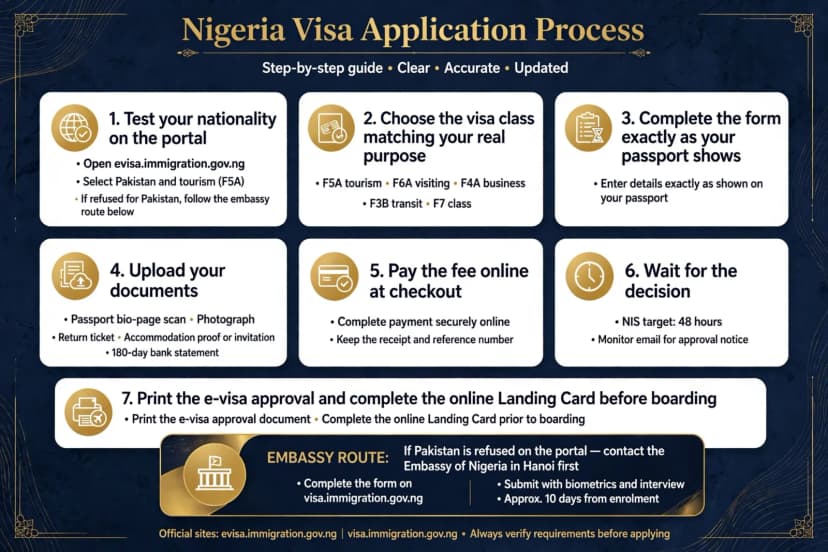
There are two sequences in this guide, because there are two possible routes. Run the portal test first; it decides which sequence you follow.
E-visa — step by step
Step 1 — Test your nationality on the portal. Open evisa.immigration.gov.ng and create an account. Select Pakistan as your nationality and tourism (F5A) as your purpose. If the system offers you an e-visa application and shows a fee at checkout, proceed. If it refuses Pakistan or directs you to an embassy, stop here and follow the embassy sequence below — do not try to force the application through with a different nationality or a different purpose.
Step 2 — Choose the visa class. Select the class that matches your real purpose: F5A tourism, F6A visiting, F4A business, F3B transit, or one of the F7 classes. A mismatch between the class and the purpose is a common refusal reason. Remember that a tourist e-visa is single entry, 30 days, valid 90 days from issue, not extendable, and does not allow work.
Step 3 — Complete the form. Fill in your personal details exactly as they appear on your passport, including the passport number, dates and place of birth. Enter your travel dates, your accommodation address or host's address in Nigeria, and your contact details in Vietnam. A name mismatch between the form and the passport is one of the commonest reasons for delay. Group applications of up to 10 people can be filed under one profile; the fee applies to each applicant.
Step 4 — Upload your documents. Upload the passport bio-page scan, your photograph, your return ticket or itinerary, your accommodation proof or invitation, and your 180-day bank statement. Check each scan is legible before you submit; the portal will return an illegible document and the clock restarts.
Step 5 — Pay the fee online. Pay the amount the portal shows at checkout — that figure, not any figure in this guide or on any other website, is the fee you owe. Keep the payment receipt and the application reference number. Fees are generally non-refundable if the application is refused.
Step 6 — Wait for the decision. The NIS target is 48 hours if there is no local objection. The approval arrives by email as a visa certificate with a QR code and reference number, and in your portal account. If the portal asks for a correction, make it immediately; the review clock may restart.
Step 7 — Complete the Landing Card and print everything. Before boarding, complete the online Landing Card at lecard.immigration.gov.ng. Print the e-visa approval, your return ticket, your hotel booking or invitation, your proof of funds and your Landing Card, and carry them in your hand luggage. Airlines have been told not to carry passengers who lack a valid visa or Landing Card, and immigration officers at Lagos or Abuja may ask for the supporting documents again.
Embassy sticker visa — step by step
Step 1 — Contact the mission. For a Pakistani living in Vietnam, telephone the Embassy of Nigeria in Hanoi (+84 24 3726 3610) and confirm, in writing if you can, that the mission accepts applications from Pakistani nationals resident in Vietnam, its current form, fee and document list, whether you need an appointment, and whether biometrics and an interview are required. Do not travel to Hanoi until you have this confirmation. If you are in Pakistan, the equivalent mission is the High Commission in Islamabad.
Step 2 — Complete the online form. Fill in the visa application on the embassy portal (visa.immigration.gov.ng), pay the fee online, and print the completed form with the payment slip and acknowledgement slip. Keep both a printed and a digital copy of the payment slip; staff may ask for it at several stages.
Step 3 — Prepare the file. Assemble the embassy checklist above, with originals and photocopies. Get your police character certificate, if required, and your yellow fever and polio certificates, while they are still valid. Ask your host or employer in Nigeria for the invitation or sponsorship letter early, because a slow letter is the usual delay.
Step 4 — Submit at the mission, with biometrics and interview. Attend the mission with your file. Expect fingerprint enrolment and a live photograph, and an in-person interview — the Islamabad guide says the interview is mandatory for all applicants, even repeat visitors. Keep a copy of everything you submit and a receipt for everything you pay.
Step 5 — Wait for the decision. The service target is about 10 days from enrolment; the Islamabad guide reports 5 to 10 working days after submission. Apply at least 4 weeks before travel.
Step 6 — Collect the visa and check it. When the visa is issued, check the name, passport number, dates, number of entries and validity on the sticker before you leave the mission. Remember a tourist visa must be used within 90 days of issue, so confirm your travel date still falls inside that window.
Step 7 — Travel with the file. Carry the passport with the visa, your return ticket, your accommodation proof or invitation, your proof of funds, your yellow fever certificate and your Landing Card in your hand luggage for the arrival check.
Applying from Vietnam — the Embassy in Hanoi
For a Pakistani living in Vietnam, the most useful fact in this guide is that Nigeria has a resident embassy in Hanoi — and it is active. Multiple sources confirm it, including the list of diplomatic missions of Nigeria, the lists of embassies in Hanoi, and the mission's own website, nigeriaembassy.org.vn. Its address is Villa No. 44/1, Van Bao Street, Van Phuc Diplomatic Compound, Ba Dinh District, Hanoi, with telephone +84 24 3726 3610 and fax +84 24 3726 3615. Its Instagram account (@nigeriahanoi) posted as recently as September and November 2026, including a formal meeting on 9 November 2026 and a greeting for Vietnam's Independence Day — the mission is plainly open and staffed. That puts a Nigerian mission a short domestic flight from Ho Chi Minh City, instead of the Islamabad or New Delhi missions that a Pakistani in Vietnam might otherwise have to consider.
Three cautions belong here. First, no published email address, fee list, opening-hours page or visa-requirements page for the Hanoi embassy was found — one directory reports Monday to Friday, 8:30 a.m. to 4:30 p.m., with submissions 10:00 a.m. to 1:00 p.m., but that is a directory listing, not the mission's own publication, so telephone the mission and confirm everything before you travel to Hanoi. Second, the embassy's ability to issue a visa to a Pakistani national resident in Vietnam, as opposed to a Vietnamese national, is the exact question to put to the mission: it is the mission that decides, and a written confirmation from it is worth more than any statement in this guide. Third, if the Hanoi mission directs short-visit applications to the e-visa portal, follow its direction — the portal test in this guide is the same test the mission will point you to.
If you are in Pakistan rather than Vietnam, the equivalent mission is the Nigeria High Commission in Islamabad: Plot No. 132–135, Diplomatic Enclave, Ispahani Road, G-5/4, Islamabad; telephone +92 51 283 2194 / 2195 / 2196; email nigeriahc_islamabad@yahoo.com and visa@nigeriahcislamabad.com; website nigeriahcislamabad.com. That is the mission the September 2025 guide describes as the only route for Pakistanis, with in-person biometrics, an interview and the USD 68 + USD 170 fee split. Whether Hanoi follows the same practice for a Pakistani resident of Vietnam is exactly what to confirm by telephone before you travel there.
The Embassy of Pakistan in Hanoi is your own mission if anything goes wrong while applying or travelling. Keep your Vietnamese temporary residence card valid for the whole trip and carry it with your passport — it is your proof of the right to return to Vietnam. If your TRC is close to expiry, renew it before you travel.
| Mission | Address | Telephone | Note |
|---|---|---|---|
| Embassy of Nigeria, Hanoi (nearest to you) | Villa No. 44/1, Van Bao Street, Van Phuc Diplomatic Compound, Ba Dinh District, Hanoi | +84 24 3726 3610 (fax +84 24 3726 3615) | Website nigeriaembassy.org.vn; no published email or fee list found; confirm fee, form, biometrics and appointment by phone first |
| High Commission of Nigeria, Islamabad | Plot No. 132–135, Diplomatic Enclave, Ispahani Road, G-5/4, Islamabad, Pakistan | +92 51 283 2194 / 2195 / 2196 | visa@nigeriahcislamabad.com; nigeriahcislamabad.com; in-person biometrics and interview reported; USD 68 + USD 170 fee split reported |
| Embassy of Pakistan, Hanoi (your own mission) | Hanoi, Vietnam | Confirm before travel | Your consular help if anything goes wrong while applying or travelling |
Entry Points, Visa on Arrival and the Landing Card
Lagos (Murtala Muhammed International Airport, LOS) and Abuja (Nnamdi Azikiwe International Airport, ABV) are the main gateways to Nigeria, and they are where almost every Pakistani traveller from Vietnam will arrive. Port Harcourt, Kano and Enugu also handle international flights. Land borders with Benin, Niger, Chad and Cameroon have immigration posts, but they are not practical entry points for a first-time visitor from Vietnam — plan your entry through Lagos or Abuja unless you have confirmed otherwise in writing.
Visa on arrival is abolished — do not build a trip around it. On 1 May 2025 the e-visa system replaced visa on arrival entirely, across the short-visit categories, and the FCDO confirms that visa on arrival is no longer available and that all visa applications must now be submitted through the online portal before travel. Pre-existing visa-on-arrival approvals expired on 30 May 2025. Many older pages still describe a visa on arrival for Nigeria — some quoting USD 20 to USD 80 — and several Pakistan-focused guides written in 2026 still call the e-visa a "visa on arrival (e-visa)" and describe the visa being stamped at the airport. That language is a leftover from the old system: what you receive now is an e-visa certificate by email, approved before you board, and the stamp or biometric capture at the airport is the entry record, not the visa decision. Do not fly to Lagos with no visa document and a plan to buy one at the airport.
The Landing Card and Exit Card are now part of the journey. Since 1 May 2025, foreign travellers must complete an online Landing Card before boarding (at lecard.immigration.gov.ng) and an Exit Card before departure. One 2026 guide says the Landing Card should be completed within 72 hours before travel; the NIS itself describes the cards as mandatory for foreign nationals other than Nigerians. Present the e-visa approval (printed or digital), the original passport used for the application, and the Landing Card at the airport — those are the three things the NIS FAQ lists for the arrival check. The Exit Card is linked to the overstay penalties described below, so complete it before you leave, not after.
Biometrics on arrival. The Pakistan-focused guides report that fingerprints and a photograph are captured at the port of entry for e-visa holders, rather than before travel — the opposite of the embassy route. Present the same passport you applied with: the NIS FAQ warns travellers must present the original passport used for the application.
Extending Your Stay and Overstay Rules
A short-visit e-visa cannot be extended inside Nigeria — that is the position in the NIS press release of 2 May 2025, in the NIS FAQ, and on the NIS visa classes page. Plan your trip inside the 30 days the visa allows, and leave on time. One wrinkle is worth naming: the NIS pages for classes F9A and F9B (Nigerians by birth travelling on a foreign passport, and their accompanied under-18 children) state "Extendable: Yes", and the April 2026 Service Level Agreement says the same. No document explains the difference. Since F9A and F9B do not apply to a Pakistani passport holder with no Nigerian parentage, the safe reading for you is the general rule: no extension. A longer trip means a different visa class (student, work or residence), applied for before you travel.
Overstay is punished with a published tariff. The NIS press release of May 2025 sets an overstay penalty for foreigners of USD 15 per day, with a 5-year entry ban for overstays of 3 months and above, and blacklisting — a permanent entry ban — for overstays of 1 year and above. That is an official NIS figure, not a third-party estimate, and it is why the Exit Card matters: the card is linked to the overstay record. Do not overstay, even by a day. If your departure is delayed by a cancelled flight or an emergency, go to an NIS office before your visa expires, not after, and keep every document that proves the delay was outside your control.
Work and Study Routes
Nigeria's work route is employer-led and has three steps that must happen in the right order: the quota first, the visa second, and the residence permit third.
Step one — Expatriate Quota. Your Nigerian employer must hold an approved Expatriate Quota from the Ministry of Interior for your position, and the company must be incorporated in Nigeria with at least ₦10 million authorised share capital (a company incorporated directly by a foreigner needs ₦100 million). Quotas are usually granted for three years in the first instance and are renewable. Without a quota position there is no work visa, and no CERPAC afterwards.
Step two — the STR visa (R2A). With the quota approval, a signed offer letter and your acceptance letter, you apply for a Subject to Regularization (STR) visa at a Nigerian embassy or high commission abroad. The file is paper-heavy: the form in quadruplicate with four recent passport photographs, copies of the quota approval, your credentials and CV vetted by a mission official, the offer and acceptance letters, the NIS payment and acknowledgement receipts, a yellow fever certificate and an HIV test report. The STR visa is a single-entry visa valid for 90 days, and it is an entry document only: it does not itself authorise work.
Step three — CERPAC. After arrival you must regularize your stay with the NIS and obtain a Combined Expatriate Residence Permit and Aliens Card (CERPAC), which is the document that legally allows you to live and work. A CERPAC is required for any expatriate who plans to live or work in Nigeria for more than 56 days, it is usually valid for one to two years and renewable, and it also serves as your official identification document in Nigeria. The employer sponsors this step too. Working without it, or working for a different employer than the one on your visa, can lead to fines, deportation and a ban.
For short specialist assignments there is a lighter route: the Temporary Work Permit (TWP), classes R10 (30-day single entry) and R11 (up to 6 months), which needs pre-approval from the Comptroller-General of Immigration.
For study, the route is the student visa (R7A), a temporary-residence visa applied for through the embassy. You need admission to an accredited Nigerian institution, proof that the required minimum tuition has been paid, a formal letter from the institution accepting immigration responsibility for you (the institution must also file its own R7A application with the Comptroller-General), and evidence of funds (a 6-month bank statement) or sponsorship. The entry visa is valid for 90 days; after arrival you regularize to a CERPAC residence permit valid for up to 2 years, renewable for the duration of the programme. The NIS describes employment on a student visa as permitted only subject to approval. One US-focused guide reports a student CERPAC fee of USD 600, against USD 2,000 for workers, but that figure was not verified against an NIS publication for this guide.
A tourist or business e-visa does not give the right to work, and a business visa is for meetings and prospecting — not for taking up a job. There is no route from a short-visit e-visa into a work permit inside Nigeria: the STR visa must be obtained abroad before you travel.
Transit, Flights and Money: Practical Notes
Flights. There is no direct flight from Vietnam to Nigeria, and none from Pakistan either. The practical corridors from Ho Chi Minh City are Ethiopian Airlines via Addis Ababa, Qatar Airways via Doha, Emirates via Dubai and Turkish Airlines via Istanbul, all connecting onward to Lagos and Abuja. Book the whole journey on one ticket where you can, so a missed connection is the airline's problem, and leave a generous connection time. Check the transit-visa rules for your connection point too — an overnight stop outside the airport transit area can need a visa of its own.
Money. The currency is the Nigerian naira (NGN). There is no published minimum bank balance for the tourist visa, but the NIS asks for a 180-day bank statement, so carry statements that plainly cover the trip. Carry a payment card that works internationally and some US dollars in cash: card acceptance and ATMs outside Lagos and Abuja can be unreliable, and the e-visa fee is paid online by card before travel. Keep your receipts and bank statements with your passport, not in checked luggage.
Where to stay and what it costs. Lagos and Abuja have hotels at every level, from budget guesthouses to business hotels, and a week in Lagos is the largest single cost of most trips after the flight. Book the accommodation you will show at immigration before you apply, because the booking is part of the visa file. A local SIM is easy to arrange in Lagos and Abuja; buy one at the airport so you can contact your hotel and host if anything goes wrong on arrival.
Safety, Health and Arrival Checks
Security. Nigeria's security picture varies sharply by region, and the FCDO advice is the controlling source: it advises against all travel to Borno, Yobe, Adamawa, Gombe, Katsina and Zamfara states and to the riverine areas of Delta, Bayelsa, Rivers, Akwa Ibom and Cross River states, and against all but essential travel to 17 more states, including Kano, Kaduna, Kebbi, Bauchi, Niger, Plateau, Benue, Anambra and Imo. It describes kidnapping as widespread and as something that could occur anywhere, and notes that British nationals of Nigerian origin visiting family are seen as targets because they are assumed to have access to funds. Lagos and Abuja are not on the "advise against all travel" list, but read the current FCDO page for every state on your itinerary, register your trip with the Embassy of Pakistan in Hanoi, and do not travel to the north-east or the riverine south without a specific reason and a sponsor who can vouch for security.
Health. A yellow fever vaccination certificate is a mandatory entry requirement for Nigeria — not a recommendation. The FCDO states that to enter Nigeria you must have a certificate proving you have had a yellow fever vaccination; infants aged 8 months or younger and adults aged 61 or older are exempt. Get vaccinated in Vietnam well before travel (the FCDO advises checking vaccine requirements at least 8 weeks ahead) and carry the yellow card with your passport. Separately, the Pakistan-focused guides report that a polio vaccination certificate from NADRA is needed to leave Pakistan — relevant if you travel via Pakistan, or if you are asked for it at departure. Malaria is a risk all year round: take prophylaxis as your doctor in Ho Chi Minh City advises, use repellent and a net, and drink bottled water. In October 2026 Nigeria confirmed its first imported Ebola case, in the Federal Capital Territory, and extra screening is in place at borders: travellers from countries with Ebola transmission must complete an online Nigeria Health Declaration Form before travel and may face temperature screening and a travel-history check on arrival. Travel insurance is not listed as a required visa document, but medical facilities outside Lagos and Abuja are basic and evacuation is expensive — buy a policy that covers medical evacuation.
Arrival checks. At Lagos or Abuja airport, expect to show your passport with the e-visa approval, your return or onward ticket, your hotel booking or invitation letter, your proof of funds and your Landing Card, and to have fingerprints and a photograph taken. The immigration officer makes the final decision, whatever document you hold. Check the stamp in your passport before you walk away from the desk — it is your proof of entry date and length of stay.
Frequently Asked Questions
1. Do Pakistani citizens need a visa for Nigeria?
Yes. Ordinary Pakistani passports need a visa before travel. Pakistan is not visa-free for Nigeria, and the only visa-free nationals are ECOWAS citizens. Living in Vietnam or holding a Western visa does not remove the requirement.
2. Can Pakistanis apply for a Nigeria e-visa online?
This is disputed, and it is the most important question in this guide. Guides checked in November 2026 say yes, on evisa.immigration.gov.ng. A September 2025 Pakistan-focused guide says there is no e-visa for Pakistani nationals and every application goes through the High Commission in Islamabad in person. Settle it on the portal itself: select Pakistan as your nationality and see whether it offers you an application or directs you to an embassy.
3. How much does the Nigeria e-visa cost for a Pakistani passport?
There is no single verified figure. Two 2026 guides reporting the April 2026 NIS fee schedule say USD 175 for a single entry; a Pakistan-focused guide updated in October 2026 says about USD 160; the Islamabad embassy route is reported as USD 68 plus a USD 170 biometrics fee (USD 238). The figure the portal shows at checkout is the only one that counts.
4. How long does the Nigeria e-visa take?
The NIS target is 48 hours if there is no local objection, and it advises applying at least 2 to 4 weeks before travel. Pakistan-focused guides report 2 to 5 working days online. Embassy-route visas take about 10 days from enrolment.
5. How long can I stay in Nigeria on a tourist e-visa?
One stay of up to 30 days, on a visa valid for 90 days from issue. Short-visit e-visas cannot be extended inside Nigeria, according to the NIS press release, FAQ and visa classes page — although the F9A and F9B pages say those two classes are extendable.
6. Is visa on arrival still available in Nigeria?
No. Visa on arrival was abolished on 1 May 2025, when the e-visa system went live, and pre-existing approvals expired on 30 May 2025. The FCDO confirms all visa applications must now be submitted through the online portal before travel. Older pages that still describe a visa on arrival are out of date.
7. What is the Landing Card, and do I need one?
Yes. Since 1 May 2025 every foreign traveller must complete an online Landing Card before boarding, at lecard.immigration.gov.ng, and an Exit Card before departure. Airlines have been told not to carry passengers who lack a valid visa or Landing Card.
8. Is there a Nigerian embassy in Vietnam?
Yes. The Embassy of Nigeria in Hanoi is at Villa No. 44/1, Van Bao Street, Van Phuc Diplomatic Compound, Ba Dinh District, Hanoi, telephone +84 24 3726 3610, website nigeriaembassy.org.vn. No published email or fee list was found, so telephone the mission first to confirm it accepts applications from Pakistani nationals resident in Vietnam.
9. What documents do I need for a Nigeria visa?
A passport valid at least six months after arrival with two blank pages; a recent passport photograph; a completed application form; a confirmed return or onward ticket; proof of accommodation or an invitation letter; and a bank statement covering the last 180 days. Visiting visas add a host invitation accepting immigration responsibility; business visas add a company invitation and CAC certificate.
10. Do I need a yellow fever or polio certificate for Nigeria?
Yes to yellow fever: a vaccination certificate is a mandatory entry requirement, with exemptions only for infants aged 8 months or younger and adults aged 61 or older. A polio certificate from NADRA is reported as needed to leave Pakistan. Get vaccinated at least 8 weeks before travel and carry both certificates with your passport.
11. Can I work in Nigeria on a tourist or business e-visa?
No. Neither visa permits employment. Work needs an employer with an approved Expatriate Quota, then an STR visa from an embassy, then a CERPAC residence permit after arrival. A short specialist assignment uses the Temporary Work Permit instead.
12. How does the work route (STR and CERPAC) work?
Your Nigerian employer gets an Expatriate Quota from the Ministry of Interior first. You then apply for an STR visa at a mission — form in quadruplicate, four photographs, quota approval, vetted credentials and CV, offer and acceptance letters, payment receipts, yellow fever certificate and HIV test report. The STR visa is valid 90 days; after arrival you regularize to a CERPAC, usually valid one to two years and renewable.
13. What happens if I overstay my Nigeria visa?
The NIS overstay tariff is USD 15 per day, a 5-year entry ban for overstays of 3 months and above, and blacklisting (a permanent entry ban) for overstays of 1 year and above. Complete your Exit Card before departure and leave within the stay your visa allows.
14. Are there direct flights from Vietnam or Pakistan to Nigeria?
No. The practical corridors from Ho Chi Minh City are via Addis Ababa (Ethiopian Airlines), Doha (Qatar Airways), Dubai (Emirates) or Istanbul (Turkish Airlines), connecting to Lagos or Abuja. Book on one ticket where you can and leave a generous connection time.
15. Is there a digital nomad or job seeker visa for Nigeria?
No. Nigeria has no digital nomad or remote-work visa and no job seeker visa: the NIS visa page lists no such class, and multiple 2026 guides confirm it. A tourist e-visa covers 30 days of tourism only. Longer stays need a work, study or residence route.
Official Immigration Websites
Check these sources directly before you apply. The portal is the controlling source for e-visa eligibility and fees; the FCDO is the controlling source for passport validity, health and safety advice; the Hanoi embassy is the controlling source for the embassy route from Vietnam.
| Website | What it is | Link |
|---|---|---|
| Nigeria e-Visa portal (NIS) | Official e-visa platform, live 1 May 2025 — eligibility, applications, fee at checkout | evisa.immigration.gov.ng |
| Nigeria Immigration Service — visa classes | Official NIS pages for each visa class, including F5A tourism, F6A visiting and R7A student | immigration.gov.ng — visa classes |
| Nigeria Immigration Service — Student Visa R7A | Official NIS student-visa requirements, validity and restrictions | immigration.gov.ng — Student Visa R7A |
| UK Foreign, Commonwealth and Development Office — Nigeria travel advice | Entry requirements, passport validity, visa on arrival abolished, yellow fever, Ebola screening, safety advice by state | gov.uk/foreign-travel-advice/nigeria |
| Embassy of Nigeria, Hanoi | Nearest mission for residents of Vietnam — Villa 44/1 Van Bao, Ba Dinh, Hanoi; tel +84 24 3726 3610 | nigeriaembassy.org.vn |
| High Commission of Nigeria, Islamabad | Mission for Pakistanis in Pakistan — Diplomatic Enclave, Ispahani Road, Islamabad; tel +92 51 283 2194 | nigeriahcislamabad.com |
| UrduPoint — Nigeria e-Visa for Pakistanis 2026 | Pakistan-focused guide, checked 7 November 2026 — e-visa route, 48-hour target, 180-day bank statement | urdupoint.com/travel/visa/nigeria |
| Travel Visa Stack — Nigeria Visa for Pakistan Citizens 2026 | Pakistan-focused guide, updated 20 October 2026 — e-visa route, about USD 160, 2–5 working days | travelvisastack.com — Nigeria visa for Pakistan |
| IWESS — A Pakistani's Guide to Nigeria Visa Application | Pakistan-focused guide, September 2025 — embassy-only position, USD 68 + USD 170, biometrics and interview | iwess.org — Nigeria visa for Pakistanis |
| Nigerian Docs UK — Nigeria e-Visa from the UK | October 2026 guide verified against NIS and GOV.UK — 13 e-visa classes, fee-table ambiguity, overstay tariff, fake-site warning | nigeriandocs.co.uk — Nigeria e-visa |
| Legal500 — Work Permit and Visas in Nigeria | Expatriate Quota, STR visa and CERPAC procedure under the Immigration Act 2015 and Regulations 2017 | legal500.com — Nigeria work permits |
| Wikipedia — List of diplomatic missions of Nigeria | Confirms the Embassy of Nigeria in Hanoi and the High Commission in Islamabad | en.wikipedia.org — missions of Nigeria |
This guide was checked on 27 November 2026. Visa rules change without notice. Always confirm the live rules on evisa.immigration.gov.ng and with the Embassy of Nigeria in Hanoi before paying any fee or booking a non-refundable ticket. Nothing in this guide is immigration advice; the Nigerian authorities set and enforce the entry rules, and the immigration officer at Lagos or Abuja makes the final decision.