

By MAS Inspire | Last reviewed: 27 November 2026 (key figures re-verified 27 November 2026)
On this page
- Introduction
- Why people visit, study and work
- Visa types
- Visa comparison
- Eligibility
- Document checklists
- Application steps
- Fees and finances
- Processing times
- Pakistan and Vietnam
- Student guide
- Work and jobs
- Family and residence
- Mistakes
- Refusals
- FAQs
- Official websites
- Final checklist
Introduction
Mexico welcomes international visitors for holidays, business meetings, family visits, study, employment and longer-term residence. The correct route depends on your nationality, the purpose and duration of your stay, and whether you will receive payment for activities in Mexico. A visitor visa, temporary resident visa and work-authorized immigration status are not interchangeable.
This guide explains the principal Mexican visa and residence routes, the documents applicants commonly need, the official process and the special considerations for Pakistani citizens who live or work legally in Vietnam. It is designed to help you prepare; the Mexican Embassy or INM makes the actual decision.
Why People Visit, Study, and Work in Mexico
Mexico offers major cultural and historic destinations, universities, manufacturing and technology sectors, international trade links, research opportunities and family-reunification routes. Travellers may visit for tourism or unpaid business activities, while longer-term visitors may qualify for residence through study, family ties, investment or financial solvency, employment authorization or humanitarian grounds. Each purpose has a different legal basis.

Types of Mexico Visas and Immigration Statuses
1. Visitor without permission to carry out remunerated activities
This is the principal short-stay visitor category. It can cover tourism, visiting friends or relatives, attending meetings, conferences, trade events, short unpaid business activities and airport transit. The stay is generally limited to up to 180 days. The immigration authority at the port of entry decides the period actually granted.
Applicants who require a visa must obtain it before travel. A visa does not authorize employment for a Mexican employer or other paid activity in Mexico. Business visitors should ensure their activities remain within the non-remunerated visitor rules.
2. Visitor with permission to carry out remunerated activities
This route is relevant where a foreign national will work for remuneration in Mexico for a period that fits the visitor classification. It is not a self-sponsored job-search route. A Mexican employer or qualifying hiring entity generally files with INM and obtains authorization (often identified by a NUT/authorization number). The applicant then applies for the visa at a Mexican consulate. The consulate conducts an interview and issues the visa if approved. Confirm the applicable validity and fee with the consulate; a separate immigration charge may apply.
3. Temporary resident visa
Temporary residence is generally appropriate when the intended stay exceeds 180 days and is no longer than four years. Common legal bases include economic solvency, family unity, investment, an invitation for qualifying unpaid activity, or a job offer. Economic solvency thresholds for 2026 (Muse enhancement, verified 25 Nov 2026): the 2026 UMA is MXN 117.31/day — income of more than MXN 79,770.80/month (680 UMA days) after tax for the last 6 months, or an average savings/investment balance of MXN 1,344,372.60 (11,460 UMA days) over the last 12 months; each dependant adds MXN 25,808.20 (220 UMA days). Property route: real estate in Mexico worth more than MXN 10,758,500; investor route: more than MXN 5,378,663.50 in a Mexican company or business assets. Each consulate converts these peso figures into its own currency, so confirm the exact amount with the post where you apply. A temporary resident visa is not automatically a work permit. If you intend to work for remuneration, you must obtain the required INM permission and comply with the conditions attached to your status.
4. Temporary student resident visa
Foreign nationals planning qualifying studies, courses or research at an institution in Mexico for more than 180 days generally need temporary student residence. The applicant needs evidence of admission or acceptance and must satisfy the applicable financial or scholarship requirements. The student status is tied to the approved course and institution. Paid work is restricted; certain higher-education, postgraduate or research students may seek INM authorization for paid activities related to their studies and supported by the institution.
5. Permanent resident visa
Permanent residence permits indefinite residence. Eligibility is based on specific legal grounds, which can include certain family relationships, qualifying pension/retirement circumstances, recognized refugee or humanitarian grounds, or other statutory routes. It is not simply a longer tourist visa. The applicant must document the qualifying basis and follow the consular/INM process applicable to that ground.
6. Family unity and family reunification
A Mexican national or a foreign national holding qualifying Mexican residence may be able to request a visa for eligible relatives through INM. The relationship must be proven with official civil documents. INM's published examples include spouses, children and parents, with specific rules for other relationships, guardianship and dependent children. After INM authorization, the applicant attends a consular interview abroad.
7. Humanitarian visitor or residence routes
Humanitarian routes are limited to circumstances recognized under Mexican law, such as specified risks, emergencies, public-interest cases or other qualifying situations. They are not general alternatives for people who simply prefer to move to Mexico. INM authorization and evidence specific to the circumstances are required. INM states that humanitarian visa authorization procedures are exempt from its application fee in the described route; other costs or later procedures may differ.
8. Transit
Mexico's legal framework does not establish a separate general transit visa category. A traveller who requires a Mexican visa must obtain a visitor visa even if only changing aircraft at a Mexican airport, unless a documented exemption applies. Do not book a connection on the assumption that remaining airside removes the visa requirement.
Categories not identified as standalone Mexican visas
The official framework reviewed does not establish a general job-seeker visa, a dedicated digital-nomad visa, or a generic startup visa. Entrepreneurial or investment-based residence may be possible under existing temporary-residence grounds when the legal and documentary criteria are met. Exchange, internship, researcher and academic activities may fit visitor, student, temporary-resident or INM-authorized routes depending on duration, remuneration and institutional status; they are not necessarily separate visa classes.
Visa Comparison Table
| Route | Main purpose | Typical duration / status | Paid work? | Main authority |
|---|---|---|---|---|
| Visitor, no paid activities | Tourism, unpaid business, transit | Up to 180 days; officer sets stay | No | Mexican consulate + INM at entry |
| Visitor with paid activities | Short-term authorized employment | Visitor classification; authorization-specific | Yes, within authorization | Employer/INM + consulate |
| Temporary resident | Longer stay, qualifying grounds | More than 180 days, generally up to 4 years | Only with required work permission | Consulate + INM |
| Temporary student resident | Long-term study/research | Course duration; renewed as required | Only in qualifying cases with INM permission | School + consulate + INM |
| Permanent resident | Indefinite residence | Indefinite | Yes, subject to status rules | Consulate/INM |
| Humanitarian route | Qualifying humanitarian/public-interest case | Case-specific | Depends on status and authorization | INM + consulate |
Eligibility Requirements
Eligibility is not determined by nationality alone. Check all of the following before applying:
- Nationality: Does your passport require a Mexican visa? Check the current SRE/Embassy list.
- Exemption documents: Certain valid multiple-entry visas issued by the United States, Canada, Japan, the United Kingdom or a Schengen country, and certain permanent-residence cards from listed countries, may exempt a traveller from a Mexican visitor visa for eligible non-paid visits. The underlying document must be valid and meet the official rule.
- Purpose: The activity must fit the category. Tourism and unpaid meetings do not authorize local employment.
- Duration: A short visit and a stay beyond 180 days use different immigration statuses.
- Financial or sponsorship evidence: Provide the evidence required for the specific route. Do not rely on an unofficial universal minimum balance; requirements vary by category and consular post.
- Legal residence where applying: If you apply outside your country of nationality, the consulate may require proof of lawful residence in that country.
- Admissibility: A visa permits you to present yourself at the border; it does not guarantee admission.

Complete Document Checklists
The checklist below is a planning aid. It is not a promise that every listed item is mandatory for every applicant. Follow the precise checklist published by the consulate where you will apply.
| Document | Visitor | Work / job offer | Student | Temporary / permanent residence |
|---|---|---|---|---|
| Completed visa application form | Usually required | Required | Required | Required |
| Valid passport and copy | Required | Required | Required | Required |
| Recent passport photograph | Often required | Consulate-specific | Consulate-specific | Consulate-specific |
| Proof of legal stay in application country | If applying outside nationality country | If applicable | If applicable | If applicable |
| Travel purpose / itinerary / invitation | Required as relevant | Employer offer / INM authorization | School acceptance | Evidence of qualifying ground |
| Financial evidence | As applicable | Employer/sponsor evidence as required | Scholarship or funds | Category-specific solvency / pension / investment evidence |
| Family civil records | If relevant | If relevant | If relevant | Required for family route |
| INM authorization / NUT | Not normally | Usually required for job offer | Only if route requires | For relevant INM-first cases |
| Apostille/legalization + Spanish translation | If requested | If requested | If requested | Often relevant for foreign civil records |
Visitor application documents
The Embassy of Mexico in Vietnam's visitor instructions identify a completed English- or Spanish-language form, original passport and copies, a recent colour photograph, and proof of legal stay in Vietnam for applicants who are not Vietnamese citizens. Applicants must also present supporting evidence under an accepted category, such as financial solvency, employment/property ties, a qualifying invitation, or other applicable grounds. The Embassy also refers to hotel or onward travel arrangements, documents explaining the trip and proof of financial resources. Carry originals and copies as directed.
Work application documents
Expect to need the passport, completed visa form, photograph, proof of legal stay where relevant, INM authorization/NUT, employer's offer and details of the role, and any additional consular documents. INM's job-offer procedure requires the offer to identify the occupation, duration, work location and remuneration, and the employer's updated registration certificate. The employer, not the applicant acting alone, initiates the relevant INM procedure.
Student application documents
Prepare the passport, visa form, photograph, proof of legal stay if applying outside your nationality country, acceptance or invitation from the Mexican educational institution, course details and evidence of financial support or scholarship. The Vietnam Embassy's indexed student requirements show bank statements and a bank letter as one financial-evidence route, but the accessible document extract is incomplete. Obtain the complete current checklist from the Embassy before applying.
Residence and family documents
Depending on the ground, evidence may include bank or investment statements, pension evidence, proof of property or investment, family certificates, employer documentation, or a qualifying invitation. INM's family-unit procedure lists civil-status documents such as birth and marriage certificates and requires documentary proof of the family relationship. Foreign public documents may need apostille or legalization and, where applicable, Spanish translation.
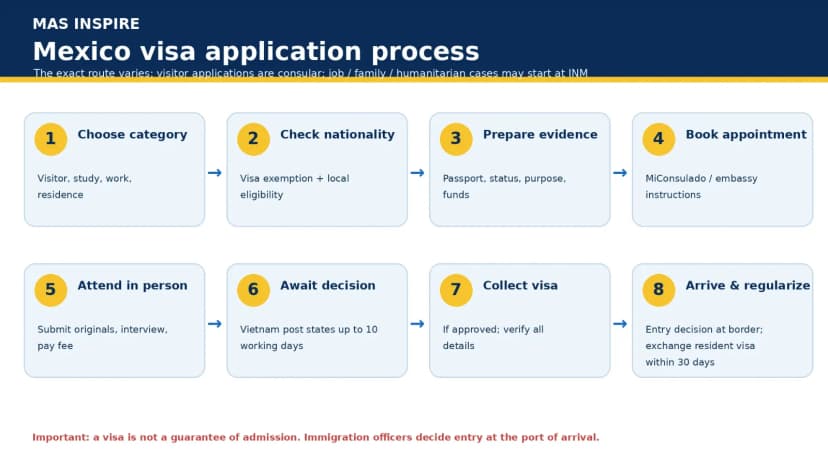
How to Apply: Step-by-Step
- Choose the correct category. Decide whether the trip is a short non-paid visit, authorized employment, study, temporary residence, permanent residence or a humanitarian/family case.
- Check nationality and exemptions. Confirm whether your passport requires a visa and whether you hold a qualifying visa or permanent-residence document that creates an exemption.
- Check where you may apply. If applying outside your country of nationality, confirm the consulate accepts your case and what proof of lawful local stay it requires.
- Prepare the documents. Use the checklist for the exact category and post. Arrange translations and legalization early where required.
- Complete the correct form. Use the form and instructions published by the relevant Mexican Embassy/Consulate or INM procedure. Do not use third-party forms.
- Start with INM if required. Job-offer, family-unity and humanitarian cases may require an INM authorization before the applicant books the consular interview. The INM website explains the applicable filing route.
- Book the consular appointment. Use MiConsulado or the appointment method specified by the post. One appointment may be required per applicant. Do not assume walk-ins or urgent appointments are available.
- Attend in person and pay the fee. Bring originals and copies. Be ready to explain the purpose, funding and itinerary. Pay only by the method confirmed by the consulate; fees may be non-refundable.
- Wait for the decision. The Vietnam Embassy's visitor procedure states a maximum of 10 working days to notify the result after the interview; this is a local published note, not a universal guarantee for every category or exceptional case.
- Collect and check the visa. Verify spelling, passport number, category, validity and entries. If refused, follow the written decision and official review or reapplication instructions; do not assume fees are refunded.
- Travel and complete arrival formalities. Carry supporting evidence and answer immigration questions truthfully. The border officer decides admission and permitted stay. If entering on a resident visa, complete the required INM exchange process within 30 calendar days of arrival to obtain the residence card.
Visa Fees and Financial Requirements
| Fee / financial item | Published amount | Notes |
|---|---|---|
| Ordinary consular visa application (2026) | US$56 | Federal Law on Fees, Article 22; confirm local payment method and exemptions |
| Long-duration visitor visa application (2026) | US$54 | Special fee category in the 2026 schedule; verify that it applies to your case |
| INM family-unit / job-offer filing fee shown on INM page | MXN $248 | INM webpage amount; verify current fee at filing |
| Paid-activity visitor immigration document | Varies by route / post | Some posts publish USD 321 (migration fee); the INM fee for the paid-activity visitor condition is MXN 4,341 in 2026; Vietnam-specific total not independently confirmed |
| Temporary resident card (INM, 2026) | MXN 11,140.74 (1 yr) / 16,693.36 (2 yrs) / 21,142.58 (3 yrs) / 25,057.82 (4 yrs); permanent resident card MXN 13,578.96 | Card fees roughly doubled 1 Jan 2026; 50% discount for family unity / job offer / unpaid invitation cases |
| Work permission (temporary resident) | MXN 4,341 | INM fee, 2026 |
| Visitor permit (FMM / Derecho de No Residente) | MXN 983 | Collected by the airline for air arrivals; land arrivals staying up to 7 days pay nothing |
| Financial solvency threshold | Category- and post-specific | No single universal amount asserted here; check current consular criteria |
Financial solvency — indicative 2026 figures (Muse enhancement, verified 25 Nov 2026): Mexican consulates set their own thresholds. The Orlando consulate lists monthly income of at least USD 1,450 for the previous 3 months, or an average bank balance of at least USD 4,400 over the previous 3 months (students: monthly income of at least USD 850). San Diego lists USD 1,460 income / USD 4,510 balance. These are post-specific examples — Hanoi's own checklist governs for Vietnam applications; confirm the exact figure with the Consular Section before the interview.
Dated note (Muse, 25 Nov 2026): the Federal Fees Law reform published 13 November 2026 raises the ordinary consular visa fee to MXN 1,639.80 from 1 January 2027 (long-duration visitor visa also MXN 1,639.80; visitor DNR fee MXN 983 → MXN 1,158); residence-card fees are unchanged. Confirm the 2027 fee before paying in 2027.
Visa application charges are generally payable even if the application is refused. The Embassy of Mexico in Vietnam's visitor procedure specifies cash payment in US dollars and says the fee is non-refundable. However, the Vietnam page and some linked documents have older fee references. Contact the Consular Section in Hanoi before attending to confirm the exact amount, acceptable banknotes and any category-specific charge. Never rely on a fee quoted by an unrelated consulate without checking whether it applies to Vietnam.
Visa Processing Times
The Vietnam Embassy's visitor application procedure says the Consular Section may take up to 10 working days to notify the applicant of the result after the interview. It does not offer urgent appointments. Appointment availability may add time before the interview, and the stated processing note should not be treated as a guarantee for student, work, residence, INM-first or complex applications. INM authorization stages occur separately and can extend the overall timeline. Apply well ahead of travel and avoid non-refundable bookings before a decision.
Applying from Pakistan or Vietnam: Pakistani Passport Holders
Pakistani ordinary passport holders should plan on needing a Mexican visa for tourism, business or airport transit unless they qualify for a specific exemption. Mexico's visa exemption is not created merely by holding a Vietnamese visa or temporary residence card. The Embassy of Mexico in Vietnam lists qualifying multiple-entry visas from the United States, Canada, Japan, the United Kingdom and Schengen countries, and qualifying permanent-residence cards from specified countries. Vietnam is not among the listed residence-card jurisdictions.
A Pakistani citizen legally living or working in Vietnam may approach the Mexican Embassy in Hanoi, but must distinguish proof of local lawful stay from eligibility to lodge an application there. The Embassy's visitor checklist requires non-Vietnamese applicants to show their legal status in Vietnam (for example a valid visa, temporary residence card or permanent residence card). That is a documentary requirement; it does not amount to a blanket guarantee that every Pakistani applicant or every visa category will be accepted locally. Confirm jurisdiction and appointment availability directly with the Consular Section before travelling to Hanoi.
The Embassy states that all Mexican visa applications are handled exclusively by its Consular Section in Hanoi. The Honorary Consulate in Ho Chi Minh City does not receive or process visa applications. Applicants must submit and collect their passport in person; applications are strictly personal except for limited representation of minors by parents or persons with verified intellectual disabilities. There are no urgent appointments and the Embassy does not pre-review documents before the scheduled appointment.
For a Pakistani applicant applying from Vietnam, prepare a valid Pakistani passport, Vietnam residence/visa evidence, the completed application, photo, evidence of purpose and funding, and any category-specific authorization or invitation. If travelling from Pakistan, also carry the NADRA polio vaccination certificate (required to leave Pakistan). (Muse enhancement, verified 25 Nov 2026.) If applying from Pakistan, use the Mexican Embassy/Consulate with jurisdiction over your residence in Pakistan (the Embassy of Mexico in Tehran holds concurrent jurisdiction over Pakistan; it was reported operating remotely from Azerbaijan after suspending in-person services in 2026 — confirm its current operating status before travelling) and follow that post's current appointment, document, fee and interview rules. Do not assume that the Vietnam Embassy's checklist, fee or processing estimate applies in Pakistan.
If you hold a current multiple-entry US, Canadian, Japanese, UK or Schengen visa, or qualifying permanent residence in one of the listed countries, ask the airline and Mexican authorities to confirm whether the exemption applies to your exact document and journey. Carry the original qualifying document. The exemption applies to eligible non-remunerated visits and does not grant work rights or residence.
Student Visa Guide
For a course or research programme lasting more than 180 days, investigate temporary student residence. Obtain a formal acceptance or invitation from an eligible Mexican educational institution and confirm that the course falls within the relevant educational framework. Prepare proof of funding, such as qualifying personal or family financial records or scholarship evidence, according to the consulate's current criteria. Students may need to renew their status annually while studies continue. Student status does not create unrestricted work rights; seek INM authorization before accepting paid employment. For short courses of 180 days or less, a visitor classification may be appropriate if the activity and nationality rules allow it. Ask the institution and consulate to confirm the correct route before paying tuition.
Work Visa and Job Opportunities
A foreign national planning to work for a Mexican employer should obtain a genuine offer from a legally established employer. The employer generally files the job-offer procedure with INM, including details of the position, duties/occupation, location, duration and remuneration, together with its current employer registration certificate. After INM authorization, the applicant schedules a consular interview and presents the authorization/NUT, passport and supporting documents. After arrival, complete the relevant immigration-card exchange within the required period if the visa grants residence. A visitor visa without paid-work permission is not a substitute for this process.
Family Immigration and Permanent Residence
Family unity may allow eligible relatives of Mexican citizens or qualifying Mexican residents to obtain a visa through an INM-first process. The sponsor must prove their identity and status in Mexico, and the applicant must prove the relationship with official civil records. Rules differ for spouses, children, parents, dependent relatives and guardianship. Permanent residence is available only where the applicant meets a statutory ground. Confirm whether the route begins at INM or at a consulate; do not assume a spouse or relative can simply apply for permanent residence without the required evidence.
Common Application Mistakes
- Choosing a visitor visa for activities that involve paid work in Mexico.
- Assuming a visa-free transit because the traveller will remain in the airport.
- Treating 180 days as guaranteed rather than the maximum possible visitor stay.
- Applying in Vietnam without checking that the Embassy accepts the applicant's case and proof of lawful stay.
- Using a Vietnam TRC as if it were one of the foreign permanent-residence cards that creates Mexico's visitor-visa exemption.
- Submitting incomplete, inconsistent or untranslated civil documents.
- Relying on old financial thresholds, fees or third-party appointment services.
- Buying non-refundable flights before the visa is issued.
- Assuming visa issuance guarantees admission at the Mexican border.
Reasons for Visa Refusal or Entry Problems
A consular officer may refuse an application where the applicant does not establish the purpose of travel, does not meet the category's requirements, provides incomplete or inconsistent evidence, cannot demonstrate the required financial or sponsorship basis, or fails to satisfy applicable legal conditions. False statements or altered documents can create serious immigration consequences. At the border, inconsistent answers, inadequate evidence of the stated visit, or a mismatch between the visa and actual purpose may lead to further questioning or refusal of admission. The specific legal reasons and any review options should be taken from the written decision and official instructions.
Frequently Asked Questions
1. Do Pakistani citizens need a visa for Mexico?
Generally yes, unless they qualify for a recognized exemption based on a qualifying valid multiple-entry visa or permanent-residence document from a listed country.
2. Can a Pakistani citizen apply for a Mexico visa in Vietnam?
The Embassy in Hanoi processes visa applications and requires non-Vietnamese applicants to show lawful stay in Vietnam. Confirm directly that it will accept your particular case; a Vietnam residence permit is not an automatic guarantee of local jurisdiction or approval.
3. Can I apply at the Mexican Honorary Consulate in Ho Chi Minh City?
No. The Embassy states that visa applications are processed exclusively by its Consular Section in Hanoi; the honorary consulate in Ho Chi Minh City does not process them.
4. Is a visa required for airport transit in Mexico?
If your nationality requires a Mexican visa, you generally need the visitor visa even for an airport connection, unless you qualify for an applicable exemption.
5. How long can I stay in Mexico as a tourist?
The visitor category allows up to 180 days, but the immigration officer determines the period authorized at entry. Do not assume every traveller receives 180 days.
6. Can I work in Mexico on a tourist visa?
No. The visitor category discussed here does not permit remunerated activities. A work-related route and the required INM authorization are necessary.
7. Is there a Mexican digital nomad visa?
The official categories reviewed do not identify a standalone digital-nomad visa. Seek individualized advice about the existing residence categories and any tax or work implications before relying on remote-work assumptions.
8. Is there a job-seeker visa for Mexico?
A general job-seeker visa was not identified in the official framework reviewed. A Mexican job offer normally triggers an employer-led INM authorization process.
9. What is the Mexico visa fee in 2026?
The 2026 federal schedule lists US$56 for an ordinary consular visa and US$54 for a special long-duration visitor visa. Confirm which fee applies and how Hanoi accepts payment.
10. How long does a Mexico visa take in Vietnam?
The Embassy's visitor procedure states up to 10 working days to notify the result after interview. Appointment waiting time and other authorization stages are additional; this is not a universal guarantee.
11. Can I study in Mexico on a tourist visa?
Short non-remunerated courses may fit visitor status depending on duration and circumstances. Studies exceeding 180 days generally require temporary student residence.
12. Can a temporary resident work in Mexico?
Not automatically in every case. A temporary resident may need the appropriate INM authorization tied to an employment offer before receiving remuneration in Mexico.
13. Does a Mexican visa guarantee entry?
No. It permits the holder to present at a port of entry and request admission. Mexican immigration authorities decide whether to admit the traveller and for how long.
14. When must I exchange a resident visa for a residence card?
INM states that a person who enters with an authorized temporary or permanent resident visa has 30 calendar days from arrival to complete the exchange process and obtain the residence card.
15. Can I use a Vietnam temporary residence card to enter Mexico visa-free?
No, not on the basis of the exemption list reviewed. The listed permanent-residence cards are from specified countries; Vietnam is not included.
Official Immigration Websites
- Embassy of Mexico in Vietnam — Visa information
- Embassy of Mexico in Vietnam — English visa information
- MiConsulado — appointments
- National Institute of Migration (INM) — immigration procedures
- Secretariat of Foreign Affairs (SRE)
- SRE — airport transit visa announcement
- 2026 Federal Law on Fees extract
Final Checklist and Conclusion
Before applying, confirm your nationality's visa requirement, select the correct category, verify whether an exemption applies, and check that the consulate accepts applications from your place of lawful residence. Prepare the official form, passport, photo, legal-stay evidence, purpose-specific documents and financial or sponsor evidence. Obtain INM authorization first when the route requires it, book the appointment through the official channel, and confirm the current fee and payment method with the responsible consulate. After approval, check the visa details and remember that border admission is a separate decision.
Mexico offers several routes for visitors, students, workers, families and long-term residents, but the requirements differ significantly. Pakistani citizens living or working in Vietnam should pay particular attention to the distinction between a local Vietnamese residence document and Mexico's visa-exemption rules. For the most reliable result, follow the current official checklist from the Mexican Embassy or Consulate handling your application and the INM procedure for your category.


