


Updated: 25 November 2026 | MAS Inspire
Introduction
Malaysia is an attractive destination for international students, tourists, skilled professionals, entrepreneurs and families. Its multicultural society, international universities, established business centres and extensive transport connections make it an accessible destination in Southeast Asia.
However, applicants must understand Malaysia's immigration requirements before making travel arrangements. The appropriate visa or immigration pass depends on nationality, travel purpose, intended duration and sponsorship arrangements.
This Malaysia visa guide explains the principal immigration routes, application procedures, documentation, financial requirements and important restrictions, including guidance for Pakistani passport holders living in Vietnam.
Table of Contents
- Why Visit, Study and Work in Malaysia
- Types of Malaysia Visas
- Visa Comparison Table
- Eligibility Requirements
- Document Checklists
- How to Apply
- Visa Fees and Financial Requirements
- Processing Times
- Applying from Pakistan or Vietnam
- Student Pass Guide
- Work Visas and Job Opportunities
- Family Immigration and Permanent Residence
- Common Mistakes and Refusals
- Frequently Asked Questions
- Official Websites
- Final Checklist
Why Visit, Study and Work in Malaysia
Malaysia offers opportunities across education, tourism, technology, manufacturing, financial services and international business.
International students can explore public universities, private institutions and international university branch campuses. Professionals may find employment opportunities in information technology, engineering, electronics, shared services and other specialist industries.
Popular destinations include Kuala Lumpur, Penang, Langkawi, Melaka, Sabah and Sarawak.
Malaysia also provides specific immigration programmes for qualifying remote professionals and individuals seeking long-term residence.
Nevertheless, visiting Malaysia as a tourist is different from obtaining permission to work or study. Applicants should establish their immigration eligibility before committing to employment, accommodation or educational expenses.

Types of Malaysia Visas
Malaysia issues entry visas and immigration passes for different purposes. A visa allows an eligible traveller to seek entry, while an immigration pass establishes the conditions of an authorised stay.
1. Tourist and Visitor Visa
Foreign nationals travelling for holidays, sightseeing, visiting friends or relatives may require a visa before departure.
Pakistani citizens are subject to visa requirements for ordinary social visits and can use the official eVISA system when eligible.
Common documents include a valid passport, photograph, accommodation evidence, travel itinerary and any additional documents requested by the application system.
Visitors may be asked to demonstrate sufficient funds and an intention to leave Malaysia within their authorised stay.
Tourist status does not permit regular paid employment.
The visa's validity period should not be confused with the duration of stay granted by immigration officers.
Official source: Visa requirements by nationality.
2. Business Visitor Visa
Malaysia's Short-Term Social Visit Pass accommodates certain commercial activities, including attending meetings, conferences, negotiations, exhibitions and investment discussions.
A business visitor may require an entry visa depending on nationality.
Supporting evidence can include an invitation letter from a Malaysian organisation, conference registration, business correspondence and an employer's confirmation letter.
Business visitor status must not be used to undertake ordinary employment, provide services requiring a work pass or operate outside the authorised activities.
Official source: Short-Term Social Visit Pass.
3. Student Pass
International applicants accepted by eligible Malaysian educational institutions generally require a Student Pass.
This route covers appropriate university programmes, school education and approved language or training courses.
Applications commonly involve Education Malaysia Global Services (EMGS), the educational institution and the Immigration Department.
Students should obtain the required approval before travelling and complete any applicable medical screening and pass endorsement procedures.
Employment is restricted and depends on the type of educational institution and immigration approval.
Official source: Malaysia Student Pass.
4. Employment Pass
The Employment Pass is an employer-sponsored route for qualifying expatriates employed in Malaysia.
An eligible Malaysian employer must submit the relevant application and obtain the necessary approvals.
Effective 1 June 2026, Malaysia introduced increased salary thresholds for Employment Pass Categories I, II and III.
The applicant's salary, qualifications, professional experience, job responsibilities and employer eligibility may influence the application.
An Employment Pass is not unrestricted permission to work for any employer. Changing employers generally requires appropriate immigration action and approval.
Official source: Expatriate Services Division.
5. Visit Pass (Temporary Employment)
Malaysia maintains a separate temporary employment system for eligible foreign workers in approved sectors.
This route is distinct from the professional Employment Pass. Recruitment can depend on approved source countries, employer quotas, permitted industries, medical fitness and applicable government policies.
Applicants should not assume that a Malaysian job advertisement establishes eligibility under this programme.
The employer must confirm recruitment approval and complete the appropriate immigration process.
Official source: Malaysia Immigration Department.
6. Professional Visit Pass
The Professional Visit Pass accommodates qualifying short-term professional assignments, specialised services and certain training or academic activities.
A Malaysian sponsoring organisation is generally responsible for submitting the application.
The approved assignment determines the authorised activities. It is not a general employment permit.
The MyGovernment service description identifies a maximum assignment period of approximately 12 months, subject to the approved activity and pass conditions.
Official source: Professional Visit Pass service.
7. Job Seeker and Graduate Pass
Malaysia does not have a broadly available, general-purpose job seeker visa for all foreign applicants.
However, eligible graduates of Malaysian educational institutions may qualify for the Graduate Social Visit Pass.
This pass provides a 12-month period to remain in Malaysia after graduation, explore appropriate opportunities and undertake permitted part-time employment.
Nationality, academic qualifications and other conditions apply. Pakistani applicants should obtain confirmation of nationality eligibility from EMGS before relying on this route.
The Graduate Pass cannot be extended and is not itself a permanent residence route.
Official source: Graduate Pass FAQ.
8. Skilled Professional and Residence Pass-Talent
Skilled workers normally require an appropriate employer-sponsored immigration pass.
Malaysia also operates the Residence Pass-Talent programme for qualifying established expatriate professionals.
This is designed for individuals meeting specific professional, employment and residence criteria rather than newly arriving job seekers.
A Residence Pass-Talent is not equivalent to permanent residence.
Applicants should check current eligibility and application requirements directly with TalentCorp.
Official source: TalentCorp Malaysia.
9. DE Rantau Digital Nomad Pass
Malaysia's DE Rantau programme provides an immigration route for qualifying remote professionals and freelancers.
Applicants must demonstrate eligible professional activities, suitable contracts or remote employment arrangements and the applicable income requirements.
The official programme documentation includes routes for digital professionals and sponsorship arrangements.
Income thresholds, eligible occupations, duration and application charges should be checked against the current MDEC programme requirements before applying. From 1 December 2026 the tech income threshold rises to USD 36,000 a year (non-tech stays USD 60,000) and the pass can be renewed up to four years in total; new applications were paused 1–30 November 2026 and reopen on 1 December 2026 (MDEC announcement, 29 October 2026).
The pass does not provide unrestricted permission to undertake unrelated local employment.
Official source: Malaysia Digital Economy Corporation.
10. Entrepreneur, Startup and Investor Routes
Entrepreneurs and investors may qualify under specialised programmes administered by relevant Malaysian authorities.
Technology entrepreneurs should investigate programmes available through MDEC. Investors may also require an appropriate business immigration pass, depending on their intended activities and responsibilities.
Registering a Malaysian company or purchasing shares does not automatically provide permission to live or work in Malaysia. The Premium Visa Programme (PVIP) offers a 20-year residence pass for applicants with offshore income of at least RM40,000 a month, a RM1,000,000 fixed deposit and a RM200,000 participation fee.
Business founders should confirm which immigration route accommodates their intended role.
Official sources: MDEC and Malaysian Investment Development Authority.
11. Malaysia My Second Home
Malaysia My Second Home, commonly called MM2H, provides renewable long-term immigration arrangements for financially eligible applicants.
Federal programme categories include Silver, Gold, Platinum and designated Special Economic or Special Financial Zone categories.
Eligibility includes age, financial deposits, residential property requirements and other conditions.
Applications must be submitted through appropriately licensed MM2H operators.
MM2H does not automatically lead to permanent residence or Malaysian citizenship. Employment and business permissions depend on the applicable category.
Official source: MM2H official programme.
12. Family and Dependant Passes
Eligible relatives of Malaysian citizens or qualifying foreign pass holders may apply for an appropriate family-related immigration pass.
Possible routes include the Dependant Pass and Long-Term Social Visit Pass.
Applicants normally need evidence of the relationship, sponsor's identity and immigration status.
Family-related passes do not automatically grant employment rights. Where employment is permitted, separate authorisation or endorsement may be necessary.
13. Transit Visa
Transit requirements depend on nationality, airport arrangements, onward flights and whether the passenger must pass through Malaysian immigration.
Travellers with separate flight bookings or baggage collection requirements may need to enter Malaysia formally.
Pakistani passport holders must not assume that every airport connection is visa-free.
Confirm requirements with the airline and Malaysian Immigration before departure.
14. Research, Exchange and Internship Programmes
International researchers, exchange participants, visiting lecturers and interns may need a Student Pass, Professional Visit Pass or Employment Pass.
The correct route depends on the educational or professional arrangement, remuneration, host organisation and duration.
The Malaysian hosting institution should identify the appropriate immigration process before arrival.
15. Humanitarian Protection
Humanitarian protection is separate from Malaysia's ordinary tourism, employment and education immigration system.
Malaysia is not a party to the 1951 Refugee Convention. Applicants seeking international protection should obtain information from the appropriate humanitarian authorities rather than treating an ordinary visitor visa as humanitarian status.
Official humanitarian resource: UNHCR Malaysia.
Visa Comparison Table
| Route | Intended purpose | Duration | Employment |
|---|---|---|---|
| Tourist visa | Tourism and private visits | As authorised | No |
| Business visit | Meetings and commercial discussions | As authorised | No ordinary employment |
| Student Pass | Education | Course-related | Restricted permission |
| Employment Pass | Skilled employment | Approved employment period | Sponsored employment |
| Temporary Employment Pass | Approved foreign worker roles | As approved | Restricted to approved work |
| Professional Visit Pass | Temporary specialist assignment | Generally up to 12 months | Approved activities only |
| Graduate Pass | Eligible recent graduates | 12 months | Permitted part-time work |
| Residence Pass-Talent | Established skilled professionals | Programme-specific | Subject to conditions |
| DE Rantau | Eligible remote professionals | Programme-specific | Approved remote activities |
| Investor/startup route | Qualifying business activities | Varies | Subject to authorisation |
| MM2H | Long-term residence | 5–20 years by category | Category-dependent |
| Family pass | Eligible relatives | Varies | Not automatic |
| Transit visa | Onward travel | As authorised | No |
| Entry Permit | Permanent residence | Permanent status, subject to law | Subject to applicable law |
Eligibility Requirements
Eligibility depends on the category selected.
Most applicants should prepare a valid passport, accurate personal information and evidence that establishes the purpose of their proposed stay.
Additional requirements may include sufficient financial resources, medical fitness, recognised educational qualifications, an approved employer or sponsor, proof of family relationships and security-related documentation.
Some immigration programmes impose nationality restrictions or age requirements.
Applicants must also comply with the immigration conditions of their current country of residence. A valid Vietnamese residence document should not be treated as a substitute for Malaysian immigration approval.
Always obtain category-specific instructions from the authority responsible for your application.

Document Checklists
The following tables are preparation guides. The official application checklist determines the mandatory documents for each individual case.
Visitor and business applications
| Document | Classification |
|---|---|
| Valid passport and biodata copy | Core requirement |
| Application form and photograph | As specified by visa portal |
| Accommodation and travel details | As requested |
| Return or onward travel evidence | As requested |
| Financial statements | If required |
| Business invitation | Business travel, where requested |
| Employment or leave letter | Supporting evidence |
| Vietnam residence documentation | If applicable or requested |
Student Pass applications
| Document | Classification |
|---|---|
| Passport | Core requirement |
| Educational institution offer letter | Core requirement |
| Academic certificates and transcripts | Programme-specific requirement |
| Photograph | Application requirement |
| English proficiency evidence | Where applicable |
| Health declaration and medical screening | As applicable |
| Insurance documentation | As required |
| Personal bond documentation | Where applicable |
| Financial sponsorship evidence | Where requested |
| Certified translations | Where required |
Employment and professional applications
| Document | Classification |
|---|---|
| Passport and photograph | Core documents |
| Employment contract or assignment letter | Route-specific requirement |
| Employer or sponsor submission | Required for sponsored routes |
| Qualifications and professional experience | Where applicable |
| Job description | Where required |
| Government agency approval | Where applicable |
| Company registration records | Employer responsibility |
| Medical screening | Route-dependent |
| Dependant records | Only when applying with family |
Family and long-term residence applications
| Document | Classification |
|---|---|
| Passport | Core requirement |
| Sponsor's identification and pass | Family route, where applicable |
| Marriage or birth certificate | Relationship-specific |
| Bank and financial records | Programme-dependent |
| Fixed deposit evidence | MM2H, at required stage |
| Residential property evidence | Applicable MM2H stage |
| Letter of good conduct | Where required |
| Medical reports and insurance | Programme-dependent |
Never submit altered bank statements, fraudulent employment letters or fabricated accommodation reservations.
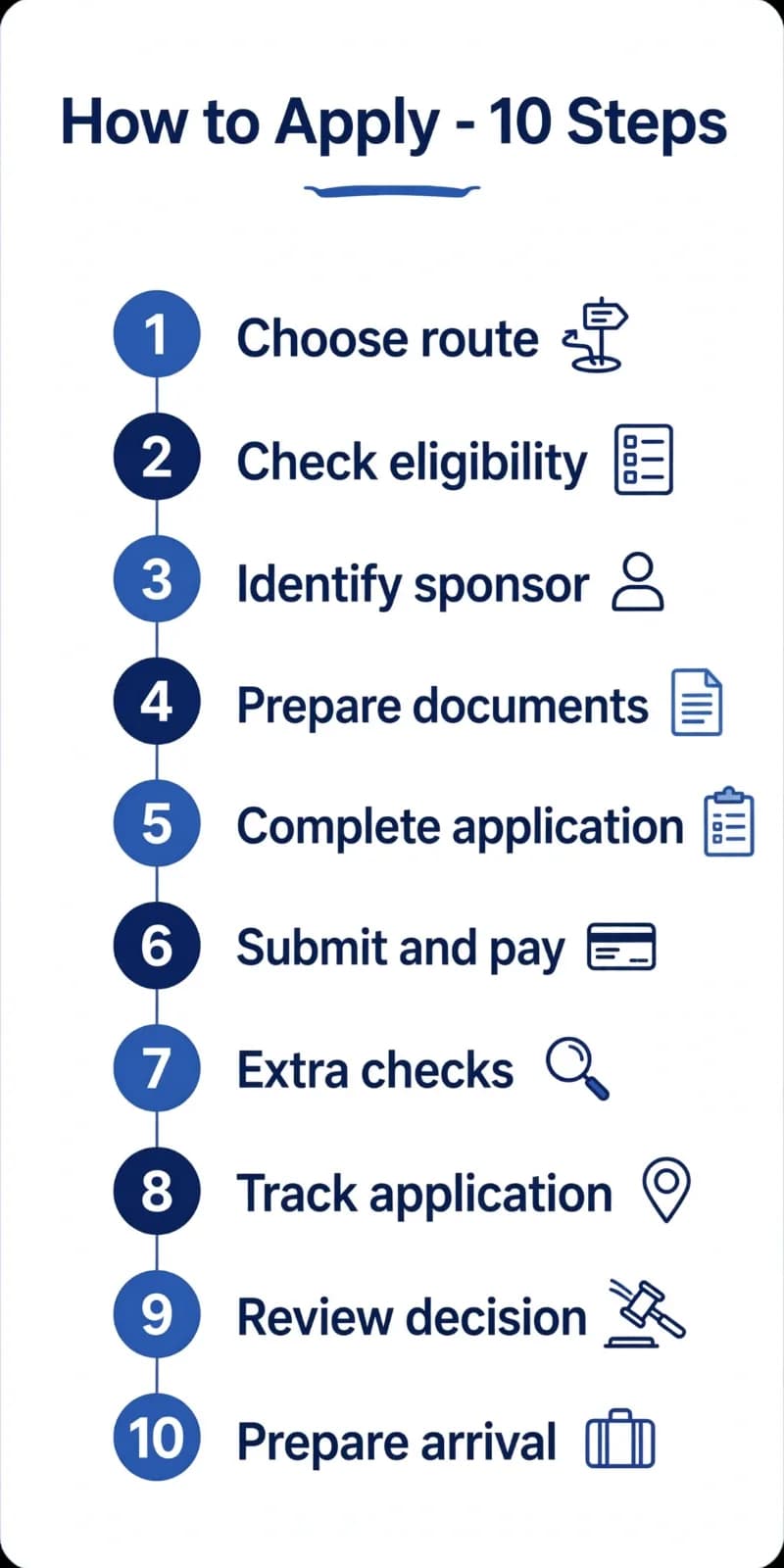
How to Apply
Step 1: Identify the correct route
Decide whether your principal purpose is tourism, business, education, employment, remote work, family reunion or long-term residence.
Step 2: Confirm nationality and eligibility
Check Malaysia's visa requirements by passport nationality. Confirm whether the programme permits applications from your current country of residence.
Step 3: Identify who submits the application
Visitors generally use the relevant visa portal. Employers submit sponsored employment applications, while educational institutions and EMGS coordinate Student Pass procedures.
Step 4: Prepare the documents
Consult the current checklist. Scan documents clearly and obtain certified translations when required.
Step 5: Complete the appropriate application
Use the official system. Enter your passport details exactly as they appear in your travel document.
Step 6: Submit supporting evidence and pay fees
Review the official payment breakdown before paying. Save receipts and your application reference number.
Step 7: Complete additional requirements
Depending on the route, you may need an interview, medical examination, biometrics, institutional verification or sponsor approval.
Do not assume that every applicant must attend an embassy appointment.
Step 8: Track the application
Use the relevant eVISA, EMGS or employer-managed ESD tracking system.
Respond promptly to requests for further information.
Step 9: Review the immigration decision
Check passport details, visa validity, authorised entry conditions and any supporting approval letters.
For sponsored routes, confirm the remaining endorsement procedure with your sponsor.
Step 10: Prepare for arrival
Carry the required documentation. Check whether the Malaysia Digital Arrival Card applies to you and complete it within the prescribed submission window.
Final admission remains subject to immigration checks. Comply with the period and conditions of stay granted at entry.
Visa Fees and Financial Requirements
Malaysia uses different fee structures for entry visas, application processing, endorsements and specialised immigration programmes.
| Application | Published charge |
|---|---|
| Pakistani single/multiple-entry visa base fee | RM20 |
| Pakistani transit visa base fee | RM20 |
| Employment Pass MYXpats service fee | RM2,000 before SST |
| Professional Visit Pass MYXpats service fee | RM1,200 before SST |
| ESD Dependant / Long-Term Social Visit Pass service fee | RM500 before SST |
| Graduate Pass | RM600 plus applicable visa fee |
| Student Pass (new, EMGS) | RM1,728 EMGS processing (RM1,600 + 8% SST) + RM159 eVAL + RM60 Student Pass fee (medical, i-Kad and insurance extra) |
| DE Rantau | Check MDEC |
| MM2H | Category-specific |
The RM20 visa base fee for Pakistani passport holders is not necessarily the complete eVISA application cost. Processing and other applicable charges may increase the amount payable. In practice the eVISA portal adds a processing charge of about RM105, so a Pakistani single-entry eVISA typically totals around RM120–155 before payment-gateway charges.
Employer-sponsored passes can involve both MYXpats service fees and separate immigration endorsement charges.
Employment Pass salary requirements
From 1 June 2026:
| Category | Minimum monthly salary | Maximum policy tenure |
|---|---|---|
| I | RM20,000 | 10 years |
| II | RM10,000 | 10 years |
| III | RM5,000 | 5 years |
Category III has a higher minimum for certain manufacturing activities. The actual pass duration remains subject to approval.
MM2H financial requirements
| Category | Fixed deposit | Minimum property price | Programme term |
|---|---|---|---|
| Silver | USD150,000 | RM600,000 | 5 years |
| Gold | USD500,000 | RM1 million | 15 years |
| Platinum | USD1 million | RM2 million | 20 years |
| SEZ/SFZ, aged 21–49 | USD65,000 | Designated development rules | 10 years |
| SEZ/SFZ, aged 50+ | USD32,000 | Designated development rules | 10 years |
Published participation fees are RM1,000 for Silver and the designated zone categories, RM3,000 for Gold and RM200,000 for Platinum. Separate processing, operator and other applicable charges must be considered.
These requirements concern the federal MM2H programme. State-specific arrangements should be researched separately.
Tourist financial requirements
No universal minimum bank balance has been established in the official materials reviewed for this article.
Applicants should provide credible financial evidence when requested and demonstrate that they can afford their proposed visit.
Do not rely on unofficial claims that a specific bank balance guarantees approval.
Processing Times
Actual processing depends on the category, completeness of the application, nationality, security checks and current demand.
| Route | Published guidance |
|---|---|
| Tourist eVISA | Check current portal estimate |
| Employment Pass | ESD client charter: 5 working days for its approval process |
| Eligible expedited employer categories | Published target of 3 working days |
| Professional Visit Pass | 5 working days in government service guidance |
| Graduate Pass | 14 working days from complete submission to Immigration |
| Student Pass | Check EMGS and institution |
| MM2H | Confirm with programme authority |
| Family and investor passes | Varies |
These are not total end-to-end processing guarantees. Preliminary employer approvals, travel arrangements, requests for extra documents and final endorsement may add time.
Apply sufficiently early and avoid making non-refundable commitments before receiving the necessary approvals.
Applying from Pakistan or Vietnam
Pakistani citizens applying from Pakistan
Pakistani passport holders generally require an entry visa for social visits to Malaysia.
Eligible applicants should use the official eVISA portal and provide the documents specified for their travel purpose.
Consult the High Commission of Malaysia in Islamabad for relevant mission guidance.
For study or employment, obtain the relevant institutional or employer-supported approval before completing any associated entry visa process.
Pakistani citizens legally residing in Vietnam
A Pakistani passport holder living in Vietnam may use Malaysia's eVISA system for an eligible social visit.
Malaysia's official eVISA information permits applications from overseas locations other than specified excluded countries.
The Embassy of Malaysia in Hanoi states that it does not accept entry visa applications at its counter. It directs applicants to the Immigration Department's online visa portals.
Keep copies of your Vietnamese residence documentation, valid visa or Temporary Residence Card available in case the application system requests them.
Depending on your circumstances, supporting documents may include:
- Vietnamese work permit.
- Employment confirmation and approved leave.
- Evidence of your residential address.
- Bank records demonstrating available funds.
- Proof of accommodation in Malaysia.
- Evidence of your intended return or onward travel.
These are conditional supporting documents, not universal mandatory requirements.
Confirm that your Vietnamese immigration documents permit you to return to Vietnam after your trip.
Living in Vietnam does not change your Pakistani nationality or automatically provide the visa exemptions available to Vietnamese passport holders.
Study, work and other sponsored passes remain subject to their respective application procedures.
Official mission: Embassy of Malaysia in Hanoi.
Comparing application locations
| Feature | Applying from Pakistan | Applying from Vietnam |
|---|---|---|
| Passport nationality | Pakistani | Pakistani |
| Social visit visa required | Yes | Yes |
| Online eVISA route | Available when eligible | Available when eligible |
| Vietnam residence evidence | Generally not relevant | May be requested |
| Return travel evidence | Pakistan or onward destination | Vietnam or onward destination |
| Employment sponsorship | Required for Employment Pass | Required for Employment Pass |
Student Pass Guide
Malaysia offers undergraduate, postgraduate and other educational programmes for international students.
Obtaining admission
Select an institution authorised to enrol international students. Review entry requirements, programme recognition, tuition fees, language requirements and accommodation costs.
Obtain a formal offer letter and ask the institution to explain its EMGS application procedure.
Visa approval and arrival
The process generally includes submitting student documentation, obtaining the relevant immigration approval, securing an entry visa when required, travelling to Malaysia and completing outstanding medical and Student Pass requirements.
Do not travel on tourist status intending to begin a full-time course without checking the authorised procedure.
Medical screening and insurance
International students may need pre-arrival health documentation, post-arrival medical screening and suitable medical insurance.
The educational institution and EMGS should confirm the applicable schedule and approved arrangements.
Working while studying
Malaysia Immigration states that eligible students at public universities and private higher-education institutions may obtain permission for part-time work, limited to 20 hours per week.
Authorised locations include specified restaurants, petrol stations, minimarkets, hotels and university or college areas.
Students must obtain the required permission and comply with any academic-calendar limitations and occupational restrictions. Confirm the precise applicable conditions with your institution and Immigration before beginning work.
Students at language centres and certain training institutions are not eligible for this facility.
Do not rely on part-time employment to finance all tuition and living expenses.
After graduation
The Graduate Pass may provide eligible graduates with a further 12 months in Malaysia.
Nationality and other eligibility restrictions apply. Confirm eligibility before making post-graduation plans.
Graduates seeking ordinary full-time employment generally need the appropriate employer-sponsored permission.
Official source: Education Malaysia Global Services.
Work Visas and Job Opportunities
Malaysia's employment market includes multinational businesses, technology companies, industrial employers, educational institutions and professional service providers.
International professionals should focus on positions for which the employer can obtain the necessary expatriate approvals.
A job offer alone does not grant immigration permission.
Before accepting an offer, confirm:
- Whether the employer can sponsor your Employment Pass.
- Whether the salary meets the 2026 threshold.
- Whether the occupation requires additional professional registration.
- Who will handle application charges.
- When employment can legally begin.
- Whether accompanying family members qualify for dependant arrangements.
Employers should use the ESD or other applicable official channel. Skilled expatriate application charges are generally the employer's responsibility under MYXpats guidance.
Avoid recruiters who promise guaranteed work authorisation without identifying a legitimate sponsoring employer.
Sabah and Sarawak can have separate immigration controls. Confirm regional requirements if your employment takes place in either state.
Family Immigration and Permanent Residence
Joining a Malaysian spouse
Foreign spouses of Malaysian citizens may investigate the appropriate Long-Term Social Visit Pass.
Marriage documentation, the Malaysian spouse's identity records and evidence of the relationship are important parts of the application.
Employment may require a specific immigration endorsement.
Joining a foreign professional
Qualifying Employment Pass holders may sponsor eligible dependants, subject to current immigration rules.
The dependant's permission is separate from the principal applicant's authorisation to work.
An accompanying spouse planning to work should confirm the necessary employment permission before accepting a job.
Permanent residence
Permanent residence is granted through Malaysia's Entry Permit framework to qualifying applicants at the discretion of the authorities.
Long residence, investment, marriage or holding a renewable immigration pass should not be interpreted as an automatic entitlement to permanent residence.
Applicants should seek category-specific guidance from the Immigration Department.
Common Mistakes and Refusals
Frequent application problems include choosing an unsuitable visa category, submitting unclear documents, entering inconsistent passport details, failing to demonstrate the purpose of travel and misunderstanding work restrictions.
Other potential concerns include inadequate supporting evidence, previous immigration violations, invalid sponsorship arrangements and failure to meet official programme requirements.
Only the deciding authority can establish the actual reason for an individual refusal.
If your application is unsuccessful, read the instructions provided with the decision. Determine whether the relevant route permits reconsideration, an appeal or a new application.
Do not immediately resubmit the same incomplete application. Address the identified issue and provide truthful supporting information.
Frequently Asked Questions
1. Do Pakistani citizens need a Malaysian visa?
Yes. Ordinary Pakistani passport holders generally need a visa for Malaysian social visits.
2. Can Pakistanis apply for a Malaysia eVISA from Vietnam?
Yes, eligible Pakistani applicants can use the overseas eVISA application system while in Vietnam, subject to the applicable requirements.
3. Can I apply at the Malaysian Embassy in Hanoi?
The embassy states that entry visa applications must be submitted through the official online portals rather than at its counter.
4. How much is a Malaysian visa for Pakistani citizens?
The published base visa fee is RM20. Additional processing and service charges may apply.
5. Can I work in Malaysia on a tourist visa?
No. You need the appropriate permission for your intended work activity.
6. Is there a Malaysia job seeker visa?
There is no broadly available general job seeker visa identified in the official materials reviewed. Eligible Malaysian graduates may qualify for a Graduate Pass.
7. Can international students work part-time?
Eligible higher-education Student Pass holders may request permission for up to 20 hours per week, subject to immigration conditions.
8. What is the Employment Pass minimum salary in 2026?
From June 2026, the general Category III minimum is RM5,000 monthly, with higher requirements for Categories II and I and certain manufacturing positions.
9. Does Malaysia offer a digital nomad visa?
Malaysia operates the DE Rantau programme for qualifying remote professionals and freelancers.
10. Does buying property give me Malaysian permanent residence?
No. Property ownership does not automatically confer permanent residence.
11. Can MM2H lead directly to citizenship?
No. MM2H participation does not itself provide a route to citizenship or permanent residence.
12. Is a Malaysian eVISA a guarantee of entry?
No. Final admission remains subject to immigration checks.
13. Can my family accompany me to Malaysia?
This depends on your immigration pass category, eligibility and the relationship of the proposed dependant.
14. Is there a fixed bank balance guarantee for a tourist visa?
No universal guaranteed approval amount has been identified. Submit genuine financial evidence as required.
15. Can I extend my tourist stay indefinitely?
No. Extensions are discretionary and may be available in exceptional circumstances. You must comply with the authorised stay.
Official Websites
Use these official resources when preparing your application:
- Immigration Department: https://www.imi.gov.my/
- Malaysia eVISA: https://malaysiavisa.imi.gov.my/
- Official visa fees: https://www.imi.gov.my/index.php/en/main-services/visa/visa-fees/
- Student applications: https://visa.educationmalaysia.gov.my/
- Expatriate applications: https://esd.imi.gov.my/
- Employment Pass salary policy: https://esd.imi.gov.my/portal/latest-news/announcement/announcement-266-ep-salary-policy-2026/
- MYXpats fee table: https://esd.imi.gov.my/portal/pdf/payment-table-v13.pdf
- Digital economy programmes: https://mdec.my/
- MM2H: https://www.mm2h.gov.my/
- Investment authority: https://www.mida.gov.my/
- Malaysian Embassy in Hanoi: https://www.kln.gov.my/web/vnm_hanoi/requirement_foreigner
- TalentCorp: https://www.talentcorp.com.my/
Final Checklist
Before submitting your application, confirm that:
- Your passport meets the applicable validity requirements.
- You have selected the correct visa or pass.
- Your nationality is eligible.
- Your sponsor or institution has submitted the necessary applications.
- All supporting documents are genuine.
- Financial and salary requirements are satisfied.
- Your fees have been checked against the official system.
- Additional medical or immigration procedures are completed when required.
- You understand the work and residence conditions.
- You have confirmed your intended return or onward travel arrangements.
Conclusion
Malaysia offers different immigration routes for visitors, international students, skilled employees, remote professionals, entrepreneurs and families.
Successful preparation begins with understanding the difference between an entry visa and the immigration pass required for your actual purpose.
Pakistani citizens living in Vietnam should use the appropriate official application system while maintaining valid Vietnamese immigration status.
Research eligibility carefully, prepare accurate documents and confirm current fees and conditions before making commitments.
Disclaimer: MAS Inspire provides independent educational information and is not a Malaysian government authority. Immigration requirements may change without notice. This guide does not constitute legal advice or guarantee visa approval. Consult the relevant official authority before applying.


