

Types of Jersey Visas and Permissions
By MAS Inspire | Last reviewed: 27 November 2026 (key figures re-verified 27 November 2026)
This guide is educational and is not legal advice. Always follow the latest instructions of the Government of Jersey and the UK Home Office.
Table of contents
- Introduction
- Why visit, study and work in Jersey
- Types of Jersey visas and permissions
- Visa comparison table
- Eligibility requirements
- Complete document checklists
- How to apply
- Visa fees and financial requirements
- Processing times
- Applying from Pakistan or Vietnam
- Student visa guide
- Work permits and employment
- Family immigration and settlement
- Common mistakes and refusal reasons
- Frequently asked questions
- Official immigration websites
- Final checklist and conclusion
Introduction
Jersey is a self-governing Crown Dependency in the Channel Islands. It is not part of the United Kingdom, but it belongs to the Common Travel Area (CTA), and its immigration system is closely aligned with UK immigration rules. The practical consequence is important: many applicants use the UK government’s online visa application process, but Jersey-specific rules and decisions still apply. A UK visa or immigration permission may allow travel to Jersey in certain circumstances, but a Schengen visa does not.
The permission you need depends on your nationality, current immigration status, reason for travel and intended length of stay. Visitors may need a visit visa or Electronic Travel Authorisation (ETA); workers generally need an employer-obtained Jersey work permit as well as the relevant immigration permission; and eligible students and family applicants use routes administered through the UK application system and processed for Jersey.
This guide explains the main routes and highlights the special considerations for Pakistani passport holders who live or work legally in Vietnam. Always recheck the official pages immediately before applying because fees, rules and processing times can change.
Why People Visit, Study, and Work in Jersey
Jersey attracts visitors for its beaches, coastal walks, heritage sites, food and family connections. Its financial and professional services, hospitality, construction, healthcare and other sectors also attract international workers. Students may consider eligible further or higher education and school courses. The island’s compact geography and distinctive constitutional position make it important to distinguish permission to enter from permission to work or live there.

Types of Jersey Visas and Permissions
1. Visitor visa and ETA
A visitor route covers tourism, visiting friends or relatives, and specified short business activities. A standard visit is normally for up to six months. A visitor must be genuine, intend to leave, have sufficient funds, and not use repeated visits to make Jersey their main home. Ordinary employment is not permitted, and a visitor cannot switch into another immigration category while in Jersey.
Visa nationals must obtain a visit visa before travel. Non-visa nationals may need an ETA under the rules introduced for Jersey from 23 April 2026. An ETA is not a visa and does not guarantee admission; it is travel permission for visits of up to six months. It lasts two years or until the passport expires, whichever comes first. A UK, Guernsey or Isle of Man ETA removes the need for a separate Jersey ETA. If an ETA is refused, the visitor may apply for a visa.
Jersey’s visitor rules identify standard visitors, marriage/civil partnership visitors, transit visitors (for transit involving entry into Jersey, generally up to 48 hours), and diplomatic visa arrangement visitors. A marriage visitor must use the correct route rather than an ordinary tourist visit.
2. Business visitors
Business visitors may undertake only activities allowed by the visitor rules, such as qualifying meetings or business-related visits. This is not permission to take up employment, provide ordinary labour or fill a role in Jersey. The applicant should document the purpose, dates, host organisation and who will pay expenses. If the activity is work rather than a permitted business visit, the employer should obtain immigration advice and check the work-permit route.
3. Student permission
A person intending to study may need a Jersey student visa. Government guidance says the applicant must have acceptance on a full-time course at a publicly funded college or university, or a fee-paying school, have enough money for living costs and tuition, and meet Part 2 of the Jersey Immigration Rules. The course and institution must meet the relevant rules; admission alone does not guarantee immigration permission. Apply through the UK government’s student visa process and ensure the application is for study in Jersey.
A short course that qualifies as a permitted visitor activity may not require a student route, but visitors cannot use short-course permission to undertake a course that requires student permission. Check the institution and course with Jersey Customs and Immigration before relying on a visitor exception.
4. Work permits and employer-sponsored work
Anyone who is not British or Irish generally needs a work permit to work in Jersey, subject to specified exemptions. The prospective employer—not the worker—submits the permit application. A permit is issued to the employer for a named employee, role and period. The employee may work only for that employer and in the approved duties. Depending on nationality and permit length, the employee must also obtain a visa before travelling. A non-visa national with a permit of six months or less may not need a separate visa, but must still hold the permit.
Jersey’s January 2026 work permit policy includes a long-term work permit route, temporary routes and specific provisions for sectors and circumstances. Long-term permits can be issued initially for up to three years (with a special longer first period for certain doctors); the employer must satisfy the policy’s occupation and salary criteria. The long-term route has a minimum salary threshold of £30,000, with exceptions considered by business case, and long-term applicants need English at IELTS for UKVI 4.0 overall and in each component. Temporary routes include defined short-term and annual arrangements, student-related work and non-resident business cases. Some temporary routes carry mandatory absence periods and do not lead to settlement. Dependants are generally not permitted for temporary permit holders and may be restricted for long-term permits of 12 months or less.
5. Job-seeker, skilled-worker, digital nomad and startup routes
Jersey does not publish a general job-seeker visa or digital nomad visa. A person cannot arrive as a visitor and simply search for work while undertaking employment. The long-term work permit route is an employer-sponsored route, not an open job-seeker category. The work permit policy includes a long-term route for qualifying occupations, but it should not be confused with an independent points-based skilled migration visa. A general startup visa is not identified as a standalone route in the current official material reviewed. Business establishment and investor provisions exist in the Jersey Immigration Rules, but they have their own criteria and should not be marketed as a generic startup permission.
6. Family visas
Family routes may be available to a spouse or partner, fiancé(e) or proposed civil partner, child under 18, parent or adult dependant relative. Applications are normally made from outside Jersey through the UK visa application process and then sent to Jersey for decision. Applicants must meet relationship, sponsor-status, accommodation and maintenance requirements. The sponsor must demonstrate that the family can be maintained and accommodated without access to public funds. Partner applicants generally need a qualifying relationship and a sponsor with the required British, Irish or settled status. Adult dependant relative cases require evidence of long-term personal care needs and that the necessary care is unavailable or unaffordable in the applicant’s country.
7. Settlement / Indefinite Leave to Remain (ILR)
ILR is permission to live and work without immigration time restrictions. Jersey guidance says applicants generally need five years’ continuous lawful residence in the UK or Channel Islands with valid leave, the Life in the UK Test (including the Jersey supplement) and the English-language requirement. The qualifying route and absences matter. Time on some temporary work routes does not count, and the five-year family partner route has specific conditions. Check the exact route before assuming that time in Jersey automatically leads to settlement.
8. Transit, internship, exchange, research and humanitarian cases
A transit visitor route exists for people entering Jersey while travelling onward outside the CTA. A person merely transiting airside may have different requirements; confirm the itinerary with the carrier and official rules. Internships, placements, exchange programmes and research do not create one universal visa category: the correct route depends on whether the activity is study, employment, permitted visitor activity or a placement covered by a specific policy. Do not begin duties until the correct permission is confirmed. Humanitarian protection, asylum and protection claims are governed by separate legal provisions and are not ordinary visitor or work visas; people needing protection should seek qualified legal assistance and contact the relevant authorities.
Visa Comparison Table
| Route | Main purpose | Who initiates / applies | Typical permission or stay | Work rights |
|---|---|---|---|---|
| Standard visitor | Tourism, family visit, permitted short business | Applicant via GOV.UK if visa required | Usually up to 6 months per visit | No ordinary work |
| ETA | Travel authorisation for eligible non-visa visitors | Traveller via GOV.UK | Up to 6 months per visit; ETA valid 2 years or passport expiry | No work |
| Marriage visitor | Marry/form civil partnership in Jersey, without settlement | Applicant via GOV.UK | Usually up to 6 months | No employment |
| Transit visitor | Enter Jersey while transiting outside CTA | Applicant if required | Generally up to 48 hours | No employment |
| Student | Eligible full-time study | Student via GOV.UK | Course-linked; check grant | Only if expressly permitted |
| Long-term work permit | Employer-sponsored job | Employer applies for permit; worker applies for visa if required | Initially up to 3 years in standard cases | Named employer and role |
| Temporary work permit | Qualifying short-term / sector work | Employer | Route-specific, often up to 9 or 12 months | Named employer and role |
| Family | Join qualifying family member | Applicant outside Jersey | Partner grant commonly 2 years 9 months; fiancé(e) 6 months | Depends on route/conditions |
| ILR | Permanent settlement | Eligible resident applies to Jersey | Indefinite | Work without immigration restrictions |
Eligibility Requirements
Requirements vary by route. A visitor must show a genuine temporary purpose, funds, accommodation and intention to leave. A student needs a qualifying course and institution, sufficient resources and compliance with student rules. A worker needs a genuine eligible job and an employer that obtains the relevant permit. Family applicants need a qualifying relationship, sponsor status and evidence of maintenance and accommodation. ILR applicants need the required qualifying residence and tests.
Pakistani citizens are visa nationals for Jersey/UK entry purposes. A Pakistani passport holder should therefore obtain the appropriate visa before travelling, even if they hold a Vietnamese temporary residence card or work permit. Residence in Vietnam may be relevant to where an application can be lodged, but it does not change nationality-based visa requirements.
Complete Document Checklists
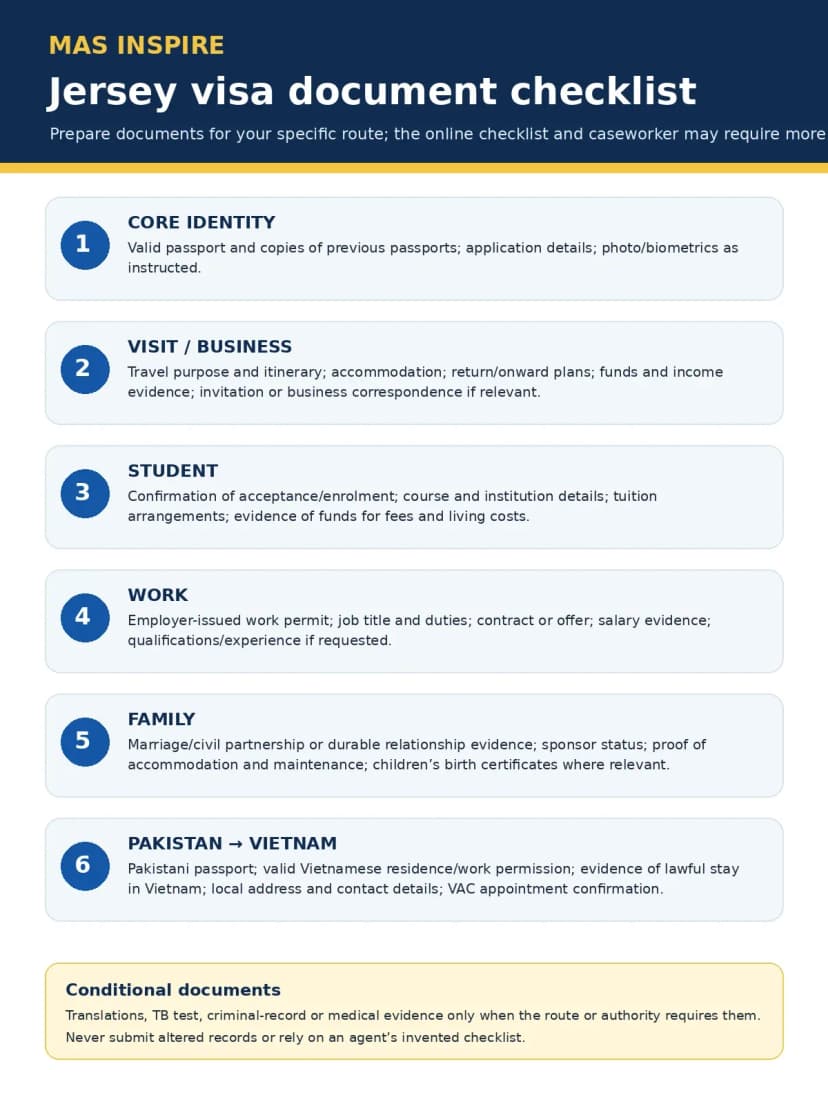
These are planning checklists, not a guaranteed exhaustive list. The online application and the relevant route’s official checklist take precedence.
| Document | Visitor | Student | Work | Family |
|---|---|---|---|---|
| Valid passport and previous travel documents | Required | Required | Required | Required |
| Online application and biometrics | If applying for visa | Yes | If visa required | Yes |
| Purpose / itinerary / accommodation | Required | Course and accommodation details | Job and role details | Sponsor accommodation |
| Funds and income evidence | Required | Tuition and living funds | Salary / employer evidence | Sponsor maintenance evidence |
| Invitation / host details | If relevant | Institution acceptance | Employer permit / contract | Sponsor details |
| Relationship certificates | If relevant | If dependants | If dependants | Required where relevant |
| Vietnam residence / work permission | If applying in Vietnam | If applying in Vietnam | If applying in Vietnam | If applying in Vietnam |
| English / academic evidence | Usually not standard | As course/rules require | As role/rules require | For relevant settlement stages |
Core identity evidence: valid passport, copies of relevant previous passports, personal details and the appointment confirmation. Follow the current biometric instructions.
Visitor supporting evidence: travel purpose, proposed dates, accommodation, return/onward arrangements, employment or study ties, income, bank statements and the source of funds. Business visitors should add a host letter and meeting details. Do not buy non-refundable tickets merely to create evidence.
Student evidence: institution and course acceptance, course dates, tuition arrangements, living-cost evidence, sponsor details if another person pays, and any academic or English evidence required by the institution or immigration route.
Work evidence: the employer’s approved work permit, job offer or contract, role and duties, salary details, qualifications or experience if required, and visa application evidence. The employee cannot substitute a personal job offer for the employer’s permit application.
Family evidence: marriage/civil partnership certificate or evidence of a qualifying durable relationship, birth/adoption certificates for children, sponsor’s immigration status, accommodation details and financial evidence. Adult dependant relative applications require substantial medical and care evidence.
Conditional evidence: certified translations, tuberculosis screening, criminal-record documents, medical evidence, parental consent or additional sponsor records may be required depending on nationality, duration, route and case. Do not assume every applicant needs each item.
How to Apply: Step-by-Step
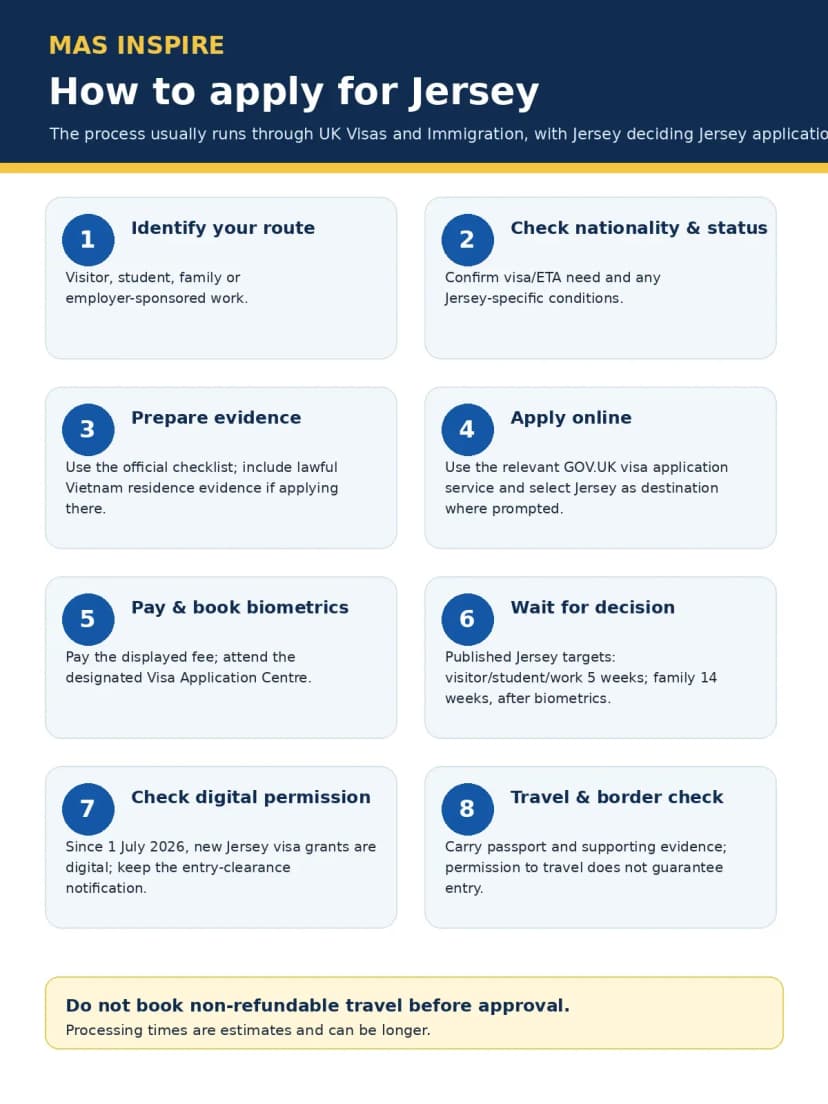
- Choose the correct route. Decide whether the purpose is a visit, study, employment, family reunion or settlement. A visitor route cannot be used for ordinary work.
- Check nationality and residence. Check the UK/Jersey visa-national list, ETA eligibility and any existing UK, Guernsey or Isle of Man permission. A Pakistani passport holder needs a visa; Vietnamese residence does not waive that requirement.
- Confirm the Jersey-specific requirements. Review the Jersey government page and the applicable Jersey Immigration Rules. For work, the employer must check the current work permit policy first.
- Prepare the evidence. Use the official checklist for the selected route. Provide accurate translations and clear evidence of funds, purpose and status.
- Start the official online application. Apply through GOV.UK, selecting Jersey as the destination / relevant jurisdiction where the application asks. Jersey states that applications made through the UK process are sent to Jersey for decision.
- Pay the displayed fee. Fees can include a visa fee, work permit fee and optional service charges. The amount shown at submission is controlling.
- Book and attend biometrics. Attend the Visa Application Centre selected during the application process, unless the instructions say otherwise. Provide fingerprints and a photograph as directed.
- Wait for the decision. Monitor the account and email for requests. Respond by the stated deadline. Do not submit inconsistent or fabricated evidence.
- Check your digital permission. From 1 July 2026, new Jersey visa applications result in digital permission to travel rather than the former physical immigration document. Keep the Notification of Entry Clearance email with your passport.
- Travel with correct documents. Airlines and ferry operators may check digital permission before boarding. A visa or ETA allows travel to the border but does not guarantee entry; the immigration officer may still assess whether the visitor meets the rules.
Visa Fees and Financial Requirements
The official Jersey fee page and UK Home Office fee schedule should both be checked. The following published figures were available on 27 November 2026. Some charges are paid to Jersey (such as work permits and in-country extensions); entry-clearance visa fees are generally collected through the UK application system.
| Fee type | Published amount | Notes |
|---|---|---|
| Standard visit visa, up to 6 months | £135 | UK Home Office fee applicable to Jersey visitor applications |
| Visit visa, 2 years | £506 | Multiple-entry validity; each stay remains subject to visitor rules |
| Visit visa, 5 years | £903 | Each visit subject to permitted stay |
| Visit visa, 10 years | £1,128 | Each visit subject to permitted stay |
| Transit visit visa (landside) | £74.50 | Check whether transit visa is required for itinerary |
| Electronic Travel Authorisation (ETA) | £20 | For eligible non-visa visitors; apply via GOV.UK |
| Student visa, outside UK | £558 | UK Home Office published fee |
| Short-term English study, over 6 and up to 11 months | £228 | Route-specific |
| Family (partner) entry clearance | £2,064 | UK Home Office Route to Settlement fee, collected through the UK application system |
| Work permit, under 1 month | £58 | Jersey employer permit fee |
| Work permit, 1 to 6 months | £85 | Jersey employer permit fee |
| Work permit, over 6 to 9 months | £115 | Jersey employer permit fee |
| Work permit, over 9 to 12 months | £175 | Jersey employer permit fee |
| Work permit, over 1 to 2 years | £290 | Jersey employer permit fee |
| Work permit, over 2 to 3 years | £350 | Jersey employer permit fee |
| Work permit, over 3 to 5 years (medical doctors only) | £580 | Jersey employer permit fee |
| Further leave to remain, student | £558 | Jersey in-country extension fee |
| Further leave to remain, temporary work permit | £340 | Jersey in-country extension fee |
| Further leave to remain, long-term work permit | £943 | Jersey in-country extension fee |
| Indefinite Leave to Remain | £3,226 | Jersey fee page; check before applying |
The Jersey government’s fee page lists additional fees, including family-related extensions and nationality applications. Do not assume that the entry-clearance fee is the only cost. Visa Application Centre optional services, document translation, travel to biometrics, medical tests and other services may add costs. No universal minimum bank balance applies to every route: applicants must meet the financial test for their specific category. Family applications use Jersey’s maintenance and accommodation assessment; work-permit salary thresholds are route- and occupation-specific.
Visa Processing Times
Jersey’s current visa information page publishes the following processing times, counted from the date the applicant attends a Visa Application Centre to provide fingerprints and a photograph:
| Visa type | Published processing time |
|---|---|
| Visitor | 5 weeks |
| Student | 5 weeks |
| Work | 5 weeks |
| Family | 14 weeks |
| British National (Overseas) | 14 weeks |
These are published estimates, not guarantees. Cases may take longer if documents need verification, further evidence or checks are required, application volumes rise or systems experience delays. Jersey advises applicants to apply up to three months before travel and not to book travel until the visa is approved and the decision letter is received.
Applying from Pakistan or Vietnam
Pakistani passport holders
Pakistan appears on the UK visa-national list. Pakistani citizens therefore need the appropriate visa before travelling to Jersey, unless they hold a qualifying immigration status that changes the requirement under the Jersey rules. A Pakistani passport holder should not assume that a UK visitor visa, a Schengen visa, or a Vietnamese residence permit automatically gives permission for every Jersey purpose. Jersey confirms that a visa national needs a visa to enter, visit, work, study or settle.
Pakistani nationals legally living or working in Vietnam
A person lawfully resident in Vietnam may be able to submit an application at a UK Visa Application Centre in Vietnam, subject to the rules for the particular application type and local appointment availability. UK policy generally requires applications for longer-term entry clearance to be made in the country where the applicant lives; short-term visit applications may be made at a visa application centre where the applicant is legally present. The applicant should verify the rule for their specific category and must not assume that a Vietnamese work permit alone proves eligibility to apply there.
A practical Vietnam-based file should include the Pakistani passport, valid Vietnamese temporary residence card or other lawful-stay evidence, Vietnamese work permit if applicable, employer letter or business evidence, proof of Vietnamese address, bank statements and the standard documents for the Jersey route. The residence document should remain valid for the intended application period. If applying for a settlement/family route, check the current country-of-residence application rule before selecting Vietnam as the application location.
Applying from Pakistan instead
An applicant living in Pakistan normally applies through the UK online process and attends the designated Visa Application Centre in Pakistan. A Vietnam-based applicant may have a different biometrics location, local document requirements or travel costs. The substantive Jersey eligibility criteria do not become easier merely because the applicant applies in Vietnam. The correct location depends on lawful residence, visa type and the current VAC arrangements.
Use the official UK visa application centre finder and the GOV.UK information for applicants in Vietnam. Confirm that the selected centre accepts the category you are applying for before booking travel to another city or country.
Student Visa Guide
Start by obtaining a confirmed place on an eligible full-time course at a publicly funded college or university, or a fee-paying school. Ask the institution whether the course qualifies for Jersey student permission and what documents it will provide. Prepare evidence of tuition arrangements and sufficient funds for the course and living expenses. Apply online through GOV.UK for study in Jersey, attend biometrics, and wait for the decision before travelling.
Do not assume that every language school, short course, online course or internship qualifies. Study permission and work rights are separate questions. Any employment during study must be expressly permitted by the conditions attached to the grant. The official Jersey page does not publish one universal maintenance balance for all students; follow the precise financial evidence requirements in the current application process.
Work Permits and Job Opportunities
The employer must first identify the appropriate Jersey work permit category and submit the application. The January 2026 policy describes the long-term work permit route for eligible roles, plus temporary categories with defined sector and duration rules. Employers must check occupation and salary requirements, and the policy in force on the submission date applies. A work permit is employer- and role-specific; the worker cannot freely change employers or duties.
A worker who is a Pakistani national should normally expect to need both an approved work permit and the appropriate visa before travelling. The work permit fee is paid by the employer with the application and is not refunded if refused. The worker should not travel to Jersey to start work until the necessary permission is granted. A visitor cannot switch to work-permit employment while in Jersey.
Family Immigration and Permanent Residence
Family visas are available for specified family relationships, not simply because a relative lives on the island. Applications are made from outside Jersey. A partner application normally requires both partners to be at least 18 and the sponsor to have an eligible status. The relationship must meet the legal definition, and the family must satisfy maintenance and accommodation requirements without recourse to public funds.
Jersey guidance states that a spouse or partner visa is commonly granted for 2 years and 9 months and a fiancé(e) visa for 6 months. A partner may be able to apply for settlement after five years’ continuous residence on the relevant family route. Time spent in the UK under other visa categories or as a fiancé(e) does not necessarily count toward the Jersey family settlement period. Check the current ILR route and tests before applying.
Common Application Mistakes and Reasons for Refusal
- Selecting a UK route without making clear that the intended destination is Jersey.
- Treating a Schengen visa or Vietnamese residence permit as a Jersey entry visa.
- Applying as a visitor while intending to work or undertake non-permitted study.
- Failing to show the source of funds or submitting unexplained deposits.
- Providing inconsistent travel dates, employment details or relationship evidence.
- Assuming a job offer is enough without the employer obtaining the Jersey work permit.
- Applying from Vietnam without proving lawful residence or checking the correct application-location rule.
- Missing biometrics, deadlines or requests for further information.
- Submitting altered documents, false statements or unverifiable invitations.
A refusal may result from failure to meet the route requirements, doubts about a genuine visit, inadequate maintenance/accommodation evidence, incomplete documents, deception or other general grounds for refusal. Read the refusal notice carefully; any review or fresh application option depends on the route and legal basis. Do not submit a duplicate application without understanding the reason for refusal.
Frequently Asked Questions
1. Is Jersey part of the United Kingdom?
No. Jersey is a Crown Dependency, but it is in the Common Travel Area and its immigration rules are closely aligned with UK rules.
2. Do Pakistani citizens need a visa for Jersey?
Yes. Pakistani citizens are visa nationals and should obtain the correct visa before travelling, unless a specific qualifying status changes the requirement.
3. Can I apply for a Jersey visa from Vietnam?
A Pakistani national who lawfully lives in Vietnam may be able to apply through a UK Visa Application Centre there. The application-location rule depends on the visa category and the applicant must prove lawful presence or residence as required.
4. Does a Vietnam residence card replace a Jersey visa?
No. It can evidence lawful residence in Vietnam, but it does not remove Pakistani nationality-based visa requirements for Jersey.
5. Can I use a Schengen visa to enter Jersey?
No. Schengen visas are not valid in Jersey.
6. Can I work in Jersey on a visitor visa?
No ordinary employment is permitted. Only specifically permitted visitor activities are allowed.
7. Who applies for a Jersey work permit?
The prospective employer applies. The employee cannot apply for the employer’s permit personally.
8. Is there a Jersey job-seeker visa?
No general job-seeker visa is identified in the current official Jersey routes reviewed for this guide.
9. Does Jersey offer a digital nomad visa?
No standalone digital nomad visa is identified in the official routes reviewed.
10. How long does a Jersey visitor visa take?
The published processing time is five weeks from biometrics, but cases can take longer.
11. How long does a Jersey family visa take?
The published processing time is 14 weeks from biometrics. The family visa page says decisions are usually within 12 weeks and can take up to 24 weeks; use the latest category-specific page when planning.
12. Can a student work in Jersey?
Only if the student’s immigration permission allows it. Do not assume work rights; check the grant conditions and applicable rules.
13. How long before settlement can I apply?
Many qualifying routes require five years of continuous lawful residence, but route-specific rules, absences, language and Life in the UK Test requirements apply.
14. Is an ETA the same as a visa?
No. An ETA is digital travel authorisation for eligible visitors; it does not guarantee entry and does not permit work.
15. When did Jersey introduce digital visa permissions?
Jersey states that new visa applications from 1 July 2026 receive digital permission to travel rather than a physical immigration document.
Official Immigration Websites
- Government of Jersey — Apply for a visa to visit, work, study or live in Jersey
- Government of Jersey — Travel documents and visa requirements
- Government of Jersey — Electronic Travel Authorisation
- Government of Jersey — Work permit policy (updated January 2026)
- Government of Jersey — Immigration and nationality fees
- Government of Jersey — Family visas
- Government of Jersey — Settlement / ILR
- GOV.UK — UK visa application centre finder
- GOV.UK — Home Office immigration and nationality fees, 8 October 2026
- GOV.UK — UK visa information for Vietnam
Final Checklist and Conclusion
Before submitting, confirm the correct Jersey route, nationality-based visa requirement, application location, current fee, processing estimate, employer or family sponsorship requirements, and the exact documents requested by the official portal. Pakistani applicants living in Vietnam should include valid evidence of their Vietnamese immigration status and confirm that the chosen VAC can process their category. Do not work or study outside the permission granted, and do not travel until the decision and digital permission are available.
Jersey offers routes for visitors, students, employer-sponsored workers, family members and eligible settlement applicants, but there is no universal visa that covers every purpose. The safest approach is to start with the Government of Jersey guidance, use the correct GOV.UK application route and obtain professional immigration advice where a case involves complex family, employment or residence history.
Disclaimer: This article is for general educational information and is not legal advice or a guarantee of visa approval. Immigration rules, fees and processing times can change. Always check the official Jersey and UK government sources before applying.


