

By MAS Inspire | Last reviewed: 27 November 2026 (key figures re-verified 27 November 2026)
Introduction
An India visa application starts with your nationality, actual purpose and place of lawful residence. The right route might be an e-Visa, a visa issued through an Indian mission, a narrowly available Visa on Arrival, or an existing qualifying status such as OCI. These routes have different conditions.
2026 transition: The Ministry of Home Affairs announced a reorganization on 11 November, following an August decision, into nine main visa groups. It said IT implementation would finish by year-end. Live forms, older mission pages and FAQs are not yet consistent. Use the operational form and obtain clarification where instructions conflict; the issued visa or ETA determines your individual permission. Official announcement
Pakistani passport holders: Ordinary visa services were suspended in April 2025. No official general reopening was found during this review. Legal residence in Vietnam does not remove that restriction. Read the dedicated section before paying or planning travel. MHA order
Educational information: MAS Inspire is an independent educational publisher, not an Indian immigration authority. This guide does not guarantee a visa or admission at the border. Fees, eligibility and procedures can change; confirm your circumstances with the responsible authority.
On this page
- Why people visit, study and work
- Visa types
- Visa comparison
- Eligibility
- Document checklists
- Application steps
- Fees and finances
- Processing times
- Pakistan and Vietnam
- Student guide
- Work and jobs
- Family and residence
- Mistakes
- Refusals
- FAQs
- Official websites
- Final checklist
Why People Visit, Study, and Work in India
Travellers come for heritage, family connections, cultural learning and treatment. Students can explore recognized institutions and courses through the government's Study in India programme. Business visitors may meet partners or establish enterprises; qualified professionals may undertake sponsored employment or approved technical assignments.
Choose permission for the activity you will actually perform. A university offer, company registration or invitation supports an application; none substitutes for immigration approval. Plan admission, employment or treatment arrangements and the visa together, with time to resolve inconsistencies before making non-refundable commitments.

Types of India Visas
The announced framework and the labels applicants see
The nine groups are Visitor, Business, Student, Work, Medical, Miscellaneous, Journalist, Diplomatic and Official. Research, internships and exchange study are grouped under Student; NGO and missionary work under Work; family and specified long-term cases under Miscellaneous. Older labels such as Tourist, Employment, Entry, Research, Intern and Film remain on some forms and tariffs. MHA framework
Choose a visa by the purpose of your visit. Confirm the current category and application label before applying.
Tourism, business, treatment and specialist visits
Tourist permission covers eligible leisure and casual family visits. Confirm the category for short language, yoga or cultural courses; formal study needs the education route. A longer visa validity never means unrestricted residence or work. Tourist and other e-Visa instructions
Business permission serves approved commercial activity. Entrepreneurs normally use the relevant Business route; a company does not produce an automatic startup visa. Ordinary salaried employment requires the employment route. For specified industrial assignments, the Indian company can generate a Production Investment Business sponsorship letter through NSWS; the professional must then apply separately for a visa.
Medical and AYUSH treatment have patient and attendant routes. The Indian hospital must substantiate the treatment. Conference applicants need the organizer's invitation and relevant clearances; the organizer should establish whether MHA security clearance applies. Film production and mountaineering require their specialist approvals, even when the application label falls within Business or Visitor. Conference rules · Film requirements · Mountaineering
Routes that are not generally available
No general job-seeker visa, digital-nomad visa or points-based skilled migration programme was identified in the published national framework. Do not treat tourism as permission for remote work, freelancing or job-based residence. Study, employment, investment and family routes each have their own conditions. Published visa framework
Special entry and humanitarian arrangements
Visa on Arrival is limited to Japanese, South Korean and qualifying UAE nationals; UAE applicants must previously have obtained an Indian regular visa or e-Visa. It is not the same as an approved e-Visa. Pakistani-origin exclusions also apply. The published fee is INR2,000 per person, with up to 60 days and double entry, subject to eligibility and approved airports. Confirm the current airport list rather than relying on older six-airport summaries. Central VoA guidance · Updated UAE mission guidance
Humanitarian protection is not a general online visa open to everyone. Specified Long Term Visa cases and Afghan-national arrangements have restricted eligibility. November 2026 exemptions concern defined groups already resident in India; they are not a new visitor route from abroad. Detailed exemption eligibility needs individual legal confirmation. Official government report
Visa Comparison Table
The document and fee tables below complete this comparison. “As granted” means check the actual permission, including entries and each-stay limits.
| Purpose / operational route | Who and permitted activity | Validity or stay; work position |
|---|---|---|
| Tourist / Visitor | Eligible leisure or casual family visitor | e-Tourist cards show 30 days, one year or five years. Longer variants have a 180-day calendar-year ceiling; no ordinary employment. |
| Business | Genuine commercial visitor or enterprise founder | e-Business generally displays one year, multiple entries, visits up to 180 days; not an unrestricted employment permit. |
| Production Investment | Specialist invited for a qualifying industrial assignment | Portal displays six months; only approved activities and sponsorship. |
| Medical / AYUSH / attendant | Patient accepted by an Indian provider; accompanying attendant | Current cards show one year, multiple entries, but legacy FAQs still say 60 days: obtain confirmation; no general work right. |
| Student | Admitted full-time student at a recognized institution | Regular grants may cover course/five years, whichever shorter. e-Student display and announced duration differ; no general work right. |
| Research / exchange / internship | Approved host and defined academic or training purpose | Programme and grant determine duration; internship permission is limited to the approved placement. |
| Employment / Work | Qualified professional engaged by an Indian organization | Contract, role and mission determine grant; work is tied to authorized activity/employer. |
| Entry / family / Miscellaneous | Qualifying Indian/OCI family connection or eligible dependant | As granted, often linked to sponsor; no automatic employment permission. e-Family currently identifies student dependants. |
| Conference / film / mountaineering | Invited delegate, approved production or expedition | Conference e-Visa: 30 days; published Film guidance: up to one year; mountaineering: six months. Specialist approvals remain necessary. |
| Transit | Traveller with confirmed onward journey and destination admission | e-Transit card shows 30-day validity; this does not establish a 30-day permitted stay. Paper transit uses different conditions. |
| Journalist | Eligible media applicant with employer/accreditation evidence | Mission-issued permission; seek advice even when a journalist proposes a private visit. |
| Diplomatic / Official | Entitled official and qualifying dependants | Official assignment and mission determine conditions; fees/timing require mission confirmation. |
Sources: live e-Visa cards, student/research/internship, employment, Entry, film, journalism, official-category framework.
Eligibility Requirements
Check the live nationality list, passport type, ancestry questions and purpose before choosing e-Visa. Residence in an eligible country does not make an ineligible passport eligible. The portal excludes Pakistani passports/Pakistani origin and directs certain other applicants, including specified military/security backgrounds and non-ordinary travel documents, to mission procedures. An alternative procedure is not a promise of eligibility. Official eligibility instructions
Check passport validity for both application and arrival: six months and two blank pages are common published requirements, but follow the selected route's exact wording. Provide truthful identity, nationality, previous-visa and travel information. Establish sufficient resources, a credible purpose and any required onward journey. Official application guidance
A visa/ETA concerns entry and authorized activity. A registration certificate or residential permit records permitted stay where registration applies. OCI is a separate conditional status; it is not Indian citizenship. The e-Arrival Card records arrival information and does not grant a visa. Immigration Rules, 2025
Complete Document Checklists
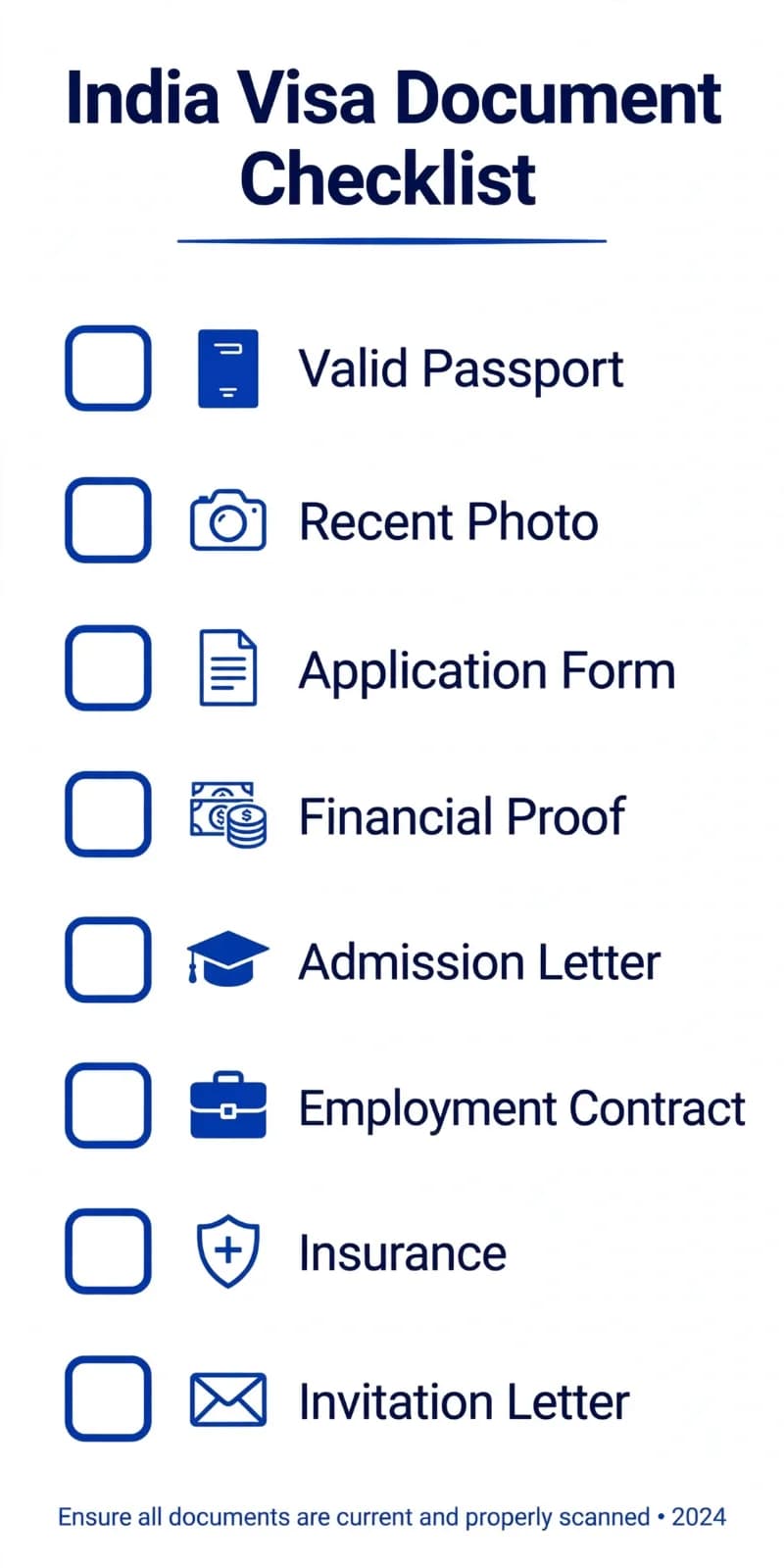
There is no universal fixed document count. Mandatory below means required for the specified route; conditional means required when the stated circumstance applies. The accepting authority may request more evidence.
Core application file
| Item | Status | Preparation |
|---|---|---|
| Individual passport and identity-page copy | Mandatory | Check validity, blanks and exact name/number. |
| Correct official application form | Mandatory | e-Visa is electronic; regular applications usually require a signed printout. |
| Compliant photograph | Mandatory | Follow the current upload or mission specifications; do not use an altered identity photograph. |
| Payment and application reference | Required unless fee-exempt | Keep the receipt and application ID; payment alone is not approval. |
| Vietnam residence/work/entry evidence | Conditional for local mission applications | Establish accepted local residence and jurisdiction, not just physical presence. |
| Translations, minor-consent papers or special clearances | Conditional | Supply when the category or mission requires them. |
Sources: regular application instructions, e-Visa document specifications, Hanoi requirements.
Purpose-specific mandatory evidence and supporting records
| Route | Mandatory for that purpose | Conditional or supporting evidence |
|---|---|---|
| Tourism | Core file; truthful itinerary and eligibility declarations | Bank statements, accommodation and onward-travel evidence; Hanoi requires its published tourist supporting file. |
| Business | Business card or qualifying company invitation for e-Business; mission-specific company letters for paper applications | Company registration, commercial background, travel plan and finances. |
| Student / language study | Recognized admission showing course; SII identification where applicable; prescribed funding evidence | Academic records; medical/paramedical-course Health Ministry NOC; exchange or minor documents. |
| Employment / Work | Contract/engagement, qualifications and employer evidence | CV, company registration, experience, local residence and intra-company transfer letters. |
| Research | Proposal/synopsis, Indian host invitation, home-institution support and funding | Research locations and subject/area clearances. |
| Internship / exchange / training | Host placement letter defining activity and dates | University support, permitted stipend evidence, sector clearances and qualifications. |
| Medical / AYUSH | Indian provider letter identifying patient and planned treatment | Medical history, funding, validated hospital invitation where instructed. |
| Medical attendant | Link to the principal patient/application | Relationship and support evidence requested by the authority. |
| Family / Entry | Applicable marriage/birth and Indian/OCI/sponsor-status evidence | Former Indian passport surrender, sponsor finances, dependant eligibility evidence. |
| Conference | Invitation and MEA political clearance | MHA event/security clearance where applicable; organizer supplies relevant approvals. |
| Production Investment | Digitally generated NSWS sponsor letter | Company/assignment and specialist-expertise evidence. |
| Film / mountaineering | Required production or expedition approval | Script, crew/equipment or expedition details; protected-area permit if applicable. |
| Transit | Confirmed inbound/onward travel; destination visa or other admission entitlement | Evidence supporting the specific connection. |
| Journalist / Diplomatic / Official | Media or official-status documentation, as appropriate | Accreditation, employer authorization, note verbale, assignment/dependant evidence as instructed. |
Sources: student/research/internship, employment, Entry, conference, NSWS, film, journalist, other e-Visa checklists.
Financial documents are not interchangeable. For example, the e-Student checklist specifies parental/guardian support with a bank guarantee or previous six months' statements; Hanoi's regular tourist/business file uses its own requirements. Do not label every optional e-Tourist upload mandatory, or assume admission removes financial-evidence requirements.
There is no universal fixed document count. Follow the current checklist for your route, nationality and accepting mission.
How to Apply: Step-by-Step
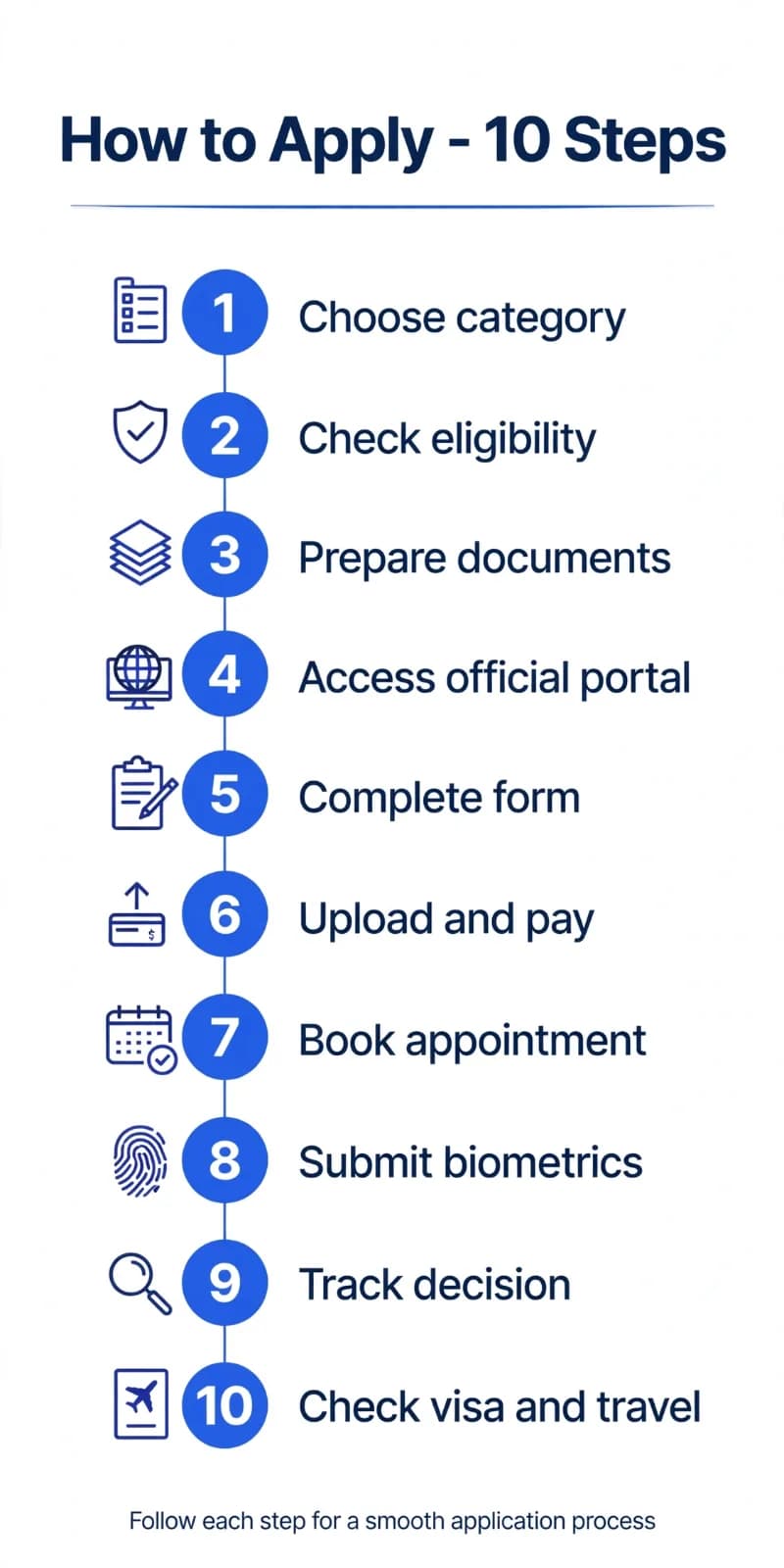
The following sequence branches according to the route. Visa on Arrival and special official procedures do not follow an ordinary advance application in every respect.
- Choose the category. Describe your actual activity, duration and sponsor. Resolve mixed purposes with the mission before selecting a form.
- Check nationality and residence. Confirm passport eligibility, origin restrictions, local mission jurisdiction and any suspension. Pakistani applicants must resolve this gate first.
- Prepare the required evidence. Assemble the core file and category documents. Match dates, names and passport details across every record.
- Use the official service. Start from India Visa Online. e-Visa uses an application reference; do not assume a separate account is required. Students register on Study in India; sponsors may need their own institutional portal.
- Complete the correct form. Use e-Visa or the regular visa form. Select the actual processing mission for a paper application. Review declarations before final submission.
- Upload and pay as instructed. e-Visa applicants upload the photo, passport and relevant evidence, then pay online. Regular-visa payment and document arrangements follow the local mission. Check payment status before retrying a debit.
- Arrange attendance where required. Regular applications may require an appointment, fingerprints and interview. Routine e-Visa applications do not require passport submission at an embassy; e-Visa biometrics are collected at immigration on arrival.
- Complete submission. A saved online paper form is not a complete lodged application. Submit the signed printout, passport and supporting file under mission instructions. Respond promptly to additional-document requests.
- Track the case officially. Use the e-Visa site's status/ETA functions or regular visa status enquiry, using the recorded application details. A receipt or pending status is not travel authorization.
- Check the decision and prepare for arrival. For e-Visa, confirm Granted status and carry the printed ETA with the correct passport. For a mission visa, follow passport-return instructions and inspect the endorsement. Check validity start, entries, permitted stay, purpose, registration and authorized entry point before travel.
Procedure sources: central e-Visa process, regular-visa procedure, Hanoi submission rules.
Complete the e-Arrival Card within 72 hours before arrival. International air passengers must also complete the separate Air Suvidha 2.0 health declaration, available 24 hours before arrival, before boarding. Retain its confirmation; the service is free. These forms do not replace a visa. Arrival-card notice · Air Suvidha instructions · Free-service advisory
After arrival, use e-FRRO if registration or another immigration service is required. The rules contain 14-day registration provisions and exemptions based on stay, age, OCI and visa conditions; some nationalities have special timelines. Registration is not an automatic extension. Check your endorsement promptly with the institution, employer or FRRO. Registration rules
Check eligibility first, then follow the correct application route. Pakistani passport holders should obtain mission confirmation before applying.
Visa Fees and Financial Requirements
Fees depend on passport nationality, category, validity and application channel. A VND mission tariff is not an e-Visa USD tariff. Payment does not establish eligibility, and processing fees generally remain payable even when a visa is refused. Official fee/payment instructions
Published e-Tourist examples
The following USD base fees were checked in the official PDF dated 8 September 2026. Seasonal headings are reproduced as published; use the application to determine the charge for your dates.
| Passport | 30 days: Apr–Jun / Jul–Mar | One year / five years |
|---|---|---|
| Vietnam | USD10 / USD25 | USD40 / USD200 |
| United States | USD10 / USD25 | USD40 / USD160 |
| United Kingdom | USD10 / USD25 | USD40 / USD484 |
The schedule lists additional bank charges; payment-method terms and the displayed checkout total control. Other nationalities may have exemptions or different tariffs. Official tourist fee PDF
ASEAN update: Free tourist e-visas were announced on 17 November 2026, but no operational start date or complete terms were verified. Do not assume a Vietnamese passport currently produces a zero fee; check the official application. Residence in Vietnam is not ASEAN nationality. Official announcement Update (27 Nov 2026): one trade outlet (VisaHQ News, 21 Nov 2026) reports the waiver took effect on 21 November 2026 for all 11 ASEAN nationals, but no official fee-schedule update or portal change was found and several other outlets still describe it as a proposal with no start date — check the fee shown at checkout before paying.
For business, medical and attendant e-Visas, consult the 15 April 2026 nationality tariff and the selected service's payment screen. Fees for newer student, family, transit, specialist and AYUSH selections were not independently established from a complete current public schedule: check the official portal.
Regular-visa examples at Hanoi
These are VND, from the schedule effective 1 April 2026, for Vietnamese/default-tariff applicants. Nationality exceptions apply. A listed duration is a tariff band, not a promised visa grant.
| Published category | Fee band | VND |
|---|---|---|
| Tourist | Up to one year | 2,721,000 |
| Business | Up to one year | 3,250,000 |
| Student | Course/five years, shorter | 2,193,000 |
| Employment | Up to six months / over six months to one year | 3,250,000 / 5,363,000 |
| Entry; Medical; Research; Missionary | Up to six months, each | 2,193,000 |
| Conference; Journalist; Mountaineering | Up to six months, each | 2,193,000 |
| Intern | Up to one year | 2,193,000 |
| Film | Up to one year | 3,250,000 |
| Transit | Up to 15 days | 608,000 |
| Other durations; diplomatic/official; PRS/OCI | Confirm the applicable current tariff | Varies |
Hanoi's complete official fee schedule. Old category names remain in this tariff during the transition. No ordinary fee is quoted as an available Pakistani application route.
Financial evidence
No universal minimum bank balance was verified for every tourist, business or student applicant. Prepare resources appropriate to travel, tuition/living costs or treatment, with a credible source of funds. Published living-cost estimates are not statutory visa thresholds. Study in India financial guidance
Employment and some internships have remuneration criteria; investor PRS has separate investment/job-creation tests, explained below. Neither a salary threshold nor an investment amount should be confused with a visitor's bank balance.
Visa Processing Times
| Route | Published guidance | Practical meaning |
|---|---|---|
| e-Visa | Apply/pay at least four days ahead under portal instructions | Minimum lead time, not a four-day approval guarantee. Check the category's application window. |
| Regular visa, central guidance | Minimum three working days after receipt; nationality dependent, special cases excluded | A lower bound; referrals and incomplete files take longer. |
| Routine Hanoi applications | General page: three working days for Vietnamese nationals/Vietnam residents; five for others | Indicative only; its Business page separately says four–five. |
| Work, research, sensitive-purpose or special-clearance cases | No universal completion time verified | Ask the accepting mission; do not book around another country's estimate. |
| Suspended Pakistani ordinary applications | Not an available standard service | No reliable routine fee or processing promise. |
Sources: e-Visa, central processing guidance, Hanoi indicative times, Hanoi Business instructions.
Applying from Pakistan or Vietnam
Pakistani passport holders legally living or working in Vietnam
The 25 April 2025 MHA order suspended visa services for Pakistani nationals and revoked most existing visas from 27 April. The medical deadline ended on 29 April 2025; it is not a current treatment exception. The order contains LTV and diplomatic/official exceptions, but their scope and acceptance of fresh applications require individual confirmation. No general reopening was found as of this guide's verification date. Signed official order
Pakistani passports and Pakistani-origin cases are excluded from e-Visa eligibility. The ancestry rule also reaches relevant parents/grandparents. A different passport does not erase origin questions, although the e-Visa ancestry exclusion and the suspension specifically affecting Pakistani nationals are distinct rules. Official e-Visa eligibility
Before submitting anything, obtain written confirmation of both an applicable current exception and the mission's authority to accept your case in Vietnam. Explain nationality, origin, purpose, Vietnam residence history and permit validity truthfully. Ask for the actual category, current checklist, clearance process, fee and travel restrictions. An employer invitation or Vietnamese residence card alone is insufficient.
Where to enquire in Vietnam
| Mission | Verified contact | What to confirm |
|---|---|---|
| Embassy of India, Hanoi | Official contacts; pptvisa.hanoi@mea.gov.in | Local eligibility, jurisdiction, exception and appointment. |
| Consulate General of India, Ho Chi Minh City | Official contacts; cons.hcm@mea.gov.in | Current location, jurisdiction and case acceptance. |
Current provincial boundaries and a consistent HCMC street address could not be independently verified; confirm before visiting. Hanoi's foreign-applicant checklist includes residence card, work permit and Vietnam visa/entry records. Its non-Vietnamese Business instructions specify two years of continuous residence and work in Vietnam. Do not generalize that category-specific rule to every visa. Hanoi requirements
If an exceptional case is accepted, additional identity, previous-passport, family or sponsor records may be requested. A Vietnam-specific mandatory CNIC/NICOP or sponsor-certificate list was not verified; obtain the accepting mission's list rather than importing another country's checklist.
Applying in Pakistan versus Vietnam
The nationality restriction is relevant in either location. Applying in Vietnam adds local residence and jurisdiction questions; it does not create an exemption. Current routine submission arrangements in Pakistan were not independently confirmed, so consult the High Commission of India in Islamabad rather than relying on historical fees, agents or processing estimates. Vietnamese passport holders should separately check e-Visa eligibility and the unsettled ASEAN fee announcement.
Student Visa Guide
Choose a recognized institution and course, register through Study in India where required, obtain the admission documentation and apply separately for the appropriate visa. Check tuition, accommodation, refund terms and funding before paying. Institution admission standards, including English evidence, differ; no universal IELTS score or immigration bank balance was verified. Government education FAQ
Validity needs confirmation: The live e-Student card displays one year; the November announcement describes eligible e-S1 grants up to five years or course duration. Do not assume either duration before receiving the actual grant. Live portal · New framework
Research needs a defined project, host, locations and funding. Exchanges and internships require approval for that activity, not merely a tourism booking. Published company-internship guidance specifies at least INR360,000 annual remuneration, with different treatment for educational institutions, NGOs and certain official placements. Graduation-gap rules differ across mission pages, so confirm eligibility rather than adopting a universal number. Study/research/internship requirements
A student visa does not provide a general part-time work allowance. Approved academic activity is distinct from taking an unrelated job, and graduation does not automatically produce a post-study work visa. Plan FRRO registration, insurance and emergency funds with your institution. Student work restrictions · Study in India
Work Visa and Job Opportunities
Ordinary employment normally requires a qualified applicant and a documented engagement with an Indian employer. Published guidance favours skilled or specialist work rather than routine roles readily filled locally. Evaluate actual vacancies and employer credibility; no profession or qualification guarantees sponsorship. Employment guidance
The standard gross annual salary benchmark is INR1,625,000 (16.25 lakh), with specified exceptions. San Francisco's page says “in excess of” the benchmark; Hanoi uses “no less than.” Have the accepting mission resolve a salary exactly at the boundary and any exception. Do not substitute a historic fixed USD25,000 conversion. Update (Muse, 25 Nov 2026): since mid-October 2026, Fragomen and mobility advisers report the floor applied in practice has risen to INR 2,400,000 (₹24 lakh) a year — seen on recently issued FRRO residence permits and confirmed verbally by officials — but no MHA notification had been published as of 11 November 2026. Confirm the live figure with the accepting mission before relying on INR 1,625,000. Employment criteria · Hanoi employment checklist
Obtain the signed contract, duties, salary, qualifications and employer records. Duration depends on assignment and the grant; there is no universal initial term. NGO or missionary work needs the appropriate authorization even when unpaid. Changing employer or taking additional work requires the correct permission. Employment activities and employer restrictions
A specialist installation or production assignment may instead qualify for the purpose-specific NSWS-supported Business facility. The sponsor letter does not approve the visa or create an open work permit. Production Investment procedure
Family Immigration and Permanent Residence
Family visits, Entry permission and dependant residence serve different needs. An eligible Indian/OCI family connection requires relationship and sponsor evidence; longer dependant permission is assessed against the principal's status. The current e-Family checklist specifically addresses student dependants. Marriage itself does not authorize employment or grant citizenship. Entry requirements · e-Family checklist
OCI is available only to qualifying applicants. It is not dual citizenship or a general settlement programme. Pakistani/Bangladeshi citizenship or specified ancestry can disqualify an applicant. Current official guidance provides an initial five-year status for eligible foreign spouses, with renewal conditions; do not describe every OCI grant as unconditional lifetime permission. Apply through OCI Services with the responsible mission's documentary, interview and biometric instructions. Fees vary by mission and service. Current OCI eligibility and spouse rules
India also publishes a narrow Permanent Residency Status for foreign investors policy: at least INR100 million (10 crore) within 18 months, or INR250 million (25 crore) within 36 months, plus employment for at least 20 resident Indians each financial year. The policy provides ten-year status, potentially extendable for another ten years, and excludes Pakistani citizens and third-country nationals of Pakistani origin. Current fees, submission details and operational acceptance require MHA/mission confirmation. It is not automatic citizenship or a property-purchase route. MHA investor policy
Repeated student, visitor or work grants do not establish an automatic general permanent-residence pathway. Confirm any proposed long-term strategy against the specific legal status, rather than counting years of travel as an entitlement.
Common Application Mistakes
- Choosing a familiar visa label without checking the actual activity.
- Treating visa validity as permission to stay continuously.
- Applying under Vietnam's nationality because you live there.
- Relying on obsolete medical, student, transit or fee information.
- Uploading unclear, inconsistent or untranslated records where English is required.
- Mistaking admission, sponsorship, payment or a saved form for visa approval.
- Missing the separate arrival declarations or registration conditions.
Use the official application instructions and the accepting mission's checklist to catch these errors before submission.
Reasons for Visa Refusal
Incomplete or misleading records, an ineligible purpose or nationality, missing sponsor/clearance evidence and adverse security or immigration findings can prevent a grant. Category-specific weaknesses include an unrecognized course, employment that fails applicable criteria, unsupported treatment, an unapproved production, or a conference whose actual purpose differs from the declaration. Conference refusal grounds · Employment criteria · Student criteria
There is no published universal refusal-scoring formula or complete guaranteed appeal process for every route. Read the decision and ask the responsible authority about correction, reconsideration or a fresh application. Never hide a previous refusal or pay someone promising guaranteed approval.
Frequently Asked Questions
1. Is an Indian e-Visa the same as Visa on Arrival?
No. An e-Visa requires advance electronic approval. Visa on Arrival is a separate facility for limited nationalities and conditions. Official entry options
2. Can a Pakistani passport holder apply from Vietnam?
Ordinary services remain subject to suspension; no general reopening was verified. Obtain confirmation of an applicable exception and local acceptance before applying. Vietnam residence alone is insufficient. MHA order
3. Are tourist e-Visas already free for Vietnamese nationals?
A free-visa announcement exists, but its operational start and complete terms were not verified. Check the current application fee. Official ASEAN announcement
4. Does a five-year tourist visa allow five years of residence?
No. Validity and permitted stay are different. The current portal gives a 180-day calendar-year ceiling for one- and five-year e-Tourist visas; obey any further grant conditions. e-Visa rules
5. Is there a fixed minimum bank balance?
No universal amount was verified across all categories. Funding evidence depends on purpose, costs and the authority's checklist. Government student guidance
6. Can international students take a part-time job?
A student visa does not give a general part-time employment allowance. Approved academic internships require the correct permission. Official student conditions
7. Can I use Business permission for a regular salaried job?
Ordinary employment needs the appropriate employment authorization. Specific approved technical Business assignments have their own rules. Employment · Technical sponsorship
8. Does India offer a general digital-nomad or job-seeker visa?
No such general route was identified in the published national framework. Obtain permission appropriate to the actual activity. Official framework
9. Will my application be approved within four days?
No guarantee applies. The e-Visa advance-application requirement is not an approval deadline; regular cases and clearances may take longer. Processing guidance
10. Does an e-Arrival Card replace a visa?
No. It records arrival information. Obtain the visa or other valid entry entitlement separately, and complete the required health declaration for air arrival. Arrival information · Air Suvidha
11. Do all visitors have to register with FRRO?
No. Registration depends on duration, visa conditions, nationality and exemptions. Read the endorsement and applicable rules promptly after arrival. Registration rules
12. Does marriage or graduation guarantee permanent residence?
No. Family, OCI, employment, investor residence and citizenship are separate conditional processes. There is no automatic grant on marriage or graduation. OCI guidance · Study in India
Official Immigration Websites
| Task | Official destination |
|---|---|
| Select application route | India Visa Online |
| e-Visa application and status | e-Visa portal |
| Regular application / tracking | Form · Status |
| Post-arrival services | e-FRRO |
| Laws and policy | MHA Foreigners Division |
| Education / OCI | Study in India · OCI Services |
| Vietnam missions | Hanoi · Ho Chi Minh City |
Some interactive portals blocked automated reading during this review; their official links were corroborated through government instructions. A temporary retrieval failure does not establish that the service is closed. Use the official home page if a deep link changes.
Final Checklist and Conclusion
Before applying, confirm nationality and local eligibility, category, passport, purpose evidence, financial support, current fee and submission method. Before travel, check approval, permitted stay, entry point, arrival declarations and any special restrictions. After arrival, meet registration and activity conditions.
For Pakistani residents of Vietnam, resolve the suspension and mission acceptance first. For every applicant, keep written instructions and copies of the submitted file. During the 2026 transition, a careful comparison of current official guidance and the individual grant is essential to a realistic travel, study or employment plan.


