


By MAS Inspire | Last reviewed: 27 November 2026 (key figures re-verified 27 November 2026)
Important: MAS Inspire is an independent educational information resource, not a Hungarian government body, embassy, immigration authority or visa agent. Immigration law and consular practice change. Confirm the rules for your nationality and individual circumstances with the Hungarian National Directorate-General for Aliens Policing (NDGAP) and the competent Hungarian mission before paying fees or booking travel.
Table of contents
- Introduction
- Why people visit, study and work in Hungary
- Types of Hungary visas and residence permits
- Visa comparison table
- Eligibility requirements
- Complete document checklists
- How to apply
- Visa fees and financial requirements
- Processing times
- Applying from Pakistan or Vietnam
- Student visa guide
- Work visa and job opportunities
- Family immigration and permanent residence
- Common mistakes and refusal reasons
- Frequently asked questions
- Official immigration websites
- Final checklist and conclusion
Introduction
Hungary is a member of the European Union and the Schengen Area. The correct immigration route depends on the purpose and length of the proposed stay, the applicant’s nationality, and (for many long-stay routes) the applicant’s qualifications, sponsor, employment or family circumstances.
A Schengen C visa is generally for a short visit of up to 90 days in any 180-day period. A national D visa is commonly the entry visa associated with an approved long-stay residence application; it is not a general-purpose substitute for a residence permit. A residence permit authorises residence for a specified purpose and period under Hungarian law. A visa sticker does not itself guarantee admission at the border.
Visa-exempt nationals may be able to visit for short stays without a C visa, but visa exemption does not automatically grant the right to work or settle. Third-country nationals planning to remain beyond 90 days generally need an appropriate residence title.
Why people visit, study and work in Hungary
Hungary attracts visitors to Budapest, the Danube Bend, Lake Balaton, historic towns, thermal baths and cultural sites. International students consider Hungarian universities and scholarship opportunities; employers recruit in sectors such as engineering, manufacturing, IT, healthcare and research. These opportunities do not remove immigration requirements: a job offer, university admission or family relationship must fit the legal conditions of the relevant route.

Types of Hungary visas and residence permits
1. Schengen short-stay visa (C)
For tourism, visiting family or friends, business meetings, conferences and other permitted short visits. The total authorised stay is normally no more than 90 days in any rolling 180-day period across the Schengen Area. It does not authorise ordinary employment in Hungary. Applicants normally show the purpose of travel, accommodation, sufficient means, travel medical insurance, and intention and ability to leave the Schengen Area before the authorised stay expires. The standard adult Schengen fee is EUR 90; reduced or waived fees apply in specified cases. The normal decision period is 15 calendar days and may be extended to 45 days.
2. Airport transit (A) and transit
An airport-transit visa, where required by nationality and itinerary, permits transit through the international transit area of an airport; it is not permission to enter Hungary. A traveller who must pass border control or enter the Schengen territory may need a C visa instead. Check the route, airport, nationality and onward destination with the competent consulate.
3. Study and student mobility
A third-country national admitted to an eligible Hungarian educational institution may apply for a residence permit for studies. Evidence generally includes admission, proof of the purpose of study, funds, accommodation, healthcare coverage and a valid travel document. Students holding the relevant study residence title may work up to 30 hours per week during the study period and full-time outside the study period for up to 90 days in a year. A graduate who successfully completes studies may qualify to apply for a permit to seek a job or start a business if the intended job or business matches the level of the completed studies. See the NDGAP student guidance.
4. Employment residence permit
This route is tied to an eligible job and employer and is subject to nationality, occupation and statutory conditions. The applicant generally needs a preliminary employment agreement or employment document, evidence of accommodation, subsistence and healthcare coverage, plus identity and application documents. The permit is not an unrestricted right to change employer or switch to another purpose in Hungary. The NDGAP states that holders of the employment-purpose permit cannot obtain family reunification for family members under the ordinary rules and cannot obtain a national residence card on that basis. Confirm whether the applicant's nationality and specific position qualify before relying on a job offer. June 2026 restriction (Muse enhancement, verified 25 Nov 2026): since Government Decree 92/2026 (effective 6 June 2026), the ordinary employment-purpose residence permit is open only to nationals of Georgia, Armenia and the Philippines (within a 2026 cap of 35,000), plus transitional cases who held a valid employment-purpose permit on 31 December 2024 and stayed continuously employed — a Pakistani national does not qualify for a new employment-purpose permit under the current list. Official employment factsheet.
5. EU Blue Card
A route for highly qualified employment meeting education or professional-experience conditions and a qualifying job offer. Hungary’s published 2026 minimum monthly remuneration is HUF 1,001,048; a lower HUF 800,838 threshold applies to specified healthcare occupations listed by NDGAP. The applicable threshold, eligible profession and evidence must be checked at filing. For 2027 the threshold rises to HUF 1,091,244/month (HUF 872,995 for healthcare occupations) from 1 January 2027 — check the OIF factsheet before signing a contract starting in 2027. (Muse enhancement — 2027 figure confirmed 27 Nov 2026 via Hivatalos Értesítő No. 54 of 2026.) A Blue Card is not simply a general work visa. Official EU Blue Card factsheet.
6. Hungarian Card
A residence permit for specified highly qualified professionals and other eligible employment categories defined by Hungarian rules. Eligibility depends on the recognised professional qualification, job and supporting evidence. Applicants should use the current NDGAP category-specific list rather than assuming that any university degree or skilled job is sufficient. Hungarian Card factsheet.
7. National Card
A special employment residence route available only to nationals specified by Hungarian government rules. The NDGAP's current information identifies Ukrainian and Serbian citizens in its employer guidance. It is not a general route open to Pakistani applicants. National Card factsheet.
8. Guest-worker route — currently unavailable to new applicants
The NDGAP announced that, following the amendment effective 6 June 2026, there are no third countries whose nationals are eligible to apply for a new guest-worker residence permit. Applications already in process under the transitional rule are treated separately. Do not advertise this as an available route for new Pakistani applicants unless the official list and law change. NDGAP notice.
9. Seasonal employment
A seasonal employment permit is limited to specified sectors, including plant production, forestry, animal breeding and fishery. The permit is employer- and job-specific; its validity is limited to a maximum of six months, with extension possible within a 12-month period up to a further six months subject to the rules. It does not provide a general route to settlement or family reunification. Nationality and admissibility must be checked. Official seasonal employment factsheet.
10. Researcher and academic mobility
Researchers may qualify under a research residence route based on a hosting agreement or other prescribed research documentation. Academic visits, funded research, teaching and employment are not interchangeable legal purposes. The host institution should confirm the correct route and provide the required agreement and funding or employment evidence. Researchers who complete an eligible research stay may, in defined circumstances, qualify for a job-seeking or business-starting permit.
11. Traineeship and internship
A traineeship residence permit requires a traineeship contract with an approved host organisation, relevant higher-education status or a degree obtained within the preceding two years, and language ability. The permit is limited to the programme and cannot exceed six months; NDGAP says it cannot be extended. A traineeship is not a general employment route. Official traineeship factsheet.
12. Job-seeking or starting a business after study/research
This is a limited post-study or post-research route, not an open job-seeker visa for any overseas applicant. It is for qualifying holders of a Hungarian study or research residence permit who have completed the relevant programme and can show that the intended job or business matches the level of their studies or research. Official factsheet.
13. White Card — digital nomad residence
The White Card is for qualifying third-country nationals employed by, or owning a share in, a company operating outside Hungary and working remotely from Hungary using digital technology. It does not permit gainful activity for a Hungarian employer or ownership of a Hungarian company. The NDGAP specifies at least EUR 3,000 net monthly income for at least six months before entry, with that income continuing during the stay. It is not a route to family reunification or permanent settlement. Official White Card factsheet.
14. Guest self-employment
This permit may apply to a person carrying out independent remunerated activity or acting as a chief executive of a business organisation. Evidence can include business contracts, tax records, proof of income, accommodation and healthcare cover. A person who performs operational work beyond the executive activity may need a different permit. The permit has restrictions on switching purpose and family reunification during the initial period. Official factsheet.
15. Guest investor
The current programme identifies two qualifying investments: at least EUR 250,000 in a qualifying real-estate fund investment share, held under the statutory conditions for at least five years; or a donation of at least EUR 1,000,000 to an eligible public-interest higher-education institution for specified educational, scientific or artistic purposes. The route has detailed investment, entry and application conditions; it is not a property-purchase visa. NDGAP states that the residence permit may be valid for up to ten years and may be extended for up to another ten years. Official guest-investor factsheet.
16. Family reunification
Eligible family members may apply where the sponsor holds a qualifying Hungarian residence status or is a Hungarian citizen. The usual qualifying relationships include a spouse or registered partner and dependent minor children, subject to the legal definition and sponsor-specific exclusions. Important exclusions apply: sponsors holding employment, guest-worker, White Card, study, training, traineeship and certain other permits generally cannot sponsor family reunification under this route. Evidence includes civil-status documents, sponsor's permit, accommodation, subsistence and healthcare coverage. Official family reunification factsheet.
17. Permanent and long-term residence
Hungary has distinct long-term residence documents, including national residence cards and EU residence cards. The EU residence card may be available after five years of lawful residence in Hungary, or under a qualifying EU Blue Card mobility pathway involving two years in Hungary and five years of qualifying EU residence. Conditions include accommodation, subsistence and healthcare coverage. Not every temporary permit counts in the same way, and some categories are expressly excluded from national residence-card eligibility. A five-year stay should not be described as an automatic grant. NDGAP EU residence card and National residence card.
18. Humanitarian protection and asylum
Asylum, refugee status, subsidiary protection and temporary protection are protection procedures, not ordinary travel visas. Eligibility depends on the relevant international and Hungarian protection law and individual facts. People seeking protection should use official asylum authorities or qualified legal assistance. Do not use a tourist or work visa guide as a substitute for protection advice.
Visa comparison table
| Route | Main purpose | Duration / validity | Work rights | Key restriction |
|---|---|---|---|---|
| Schengen C | Visit / tourism / business | Up to 90/180 days | No ordinary employment | Short stay only |
| Airport transit A | Airside transit | Transit itinerary | No | No entry into territory |
| Study | Education | Course-linked; check permit | Up to 30 hrs/week in term; full-time up to 90 days/year outside term | Institution and study conditions |
| Employment | Job with eligible employer | Permit-specific | Approved employment | Employer / purpose restrictions |
| EU Blue Card | Highly qualified work | Permit-specific | Qualifying highly skilled job | Qualification and salary threshold |
| Hungarian Card | Eligible skilled work | Permit-specific | Approved work | Occupational eligibility |
| National Card | Specified nationalities | Permit-specific | Approved work | Restricted nationality list |
| Seasonal work | Listed seasonal sectors | Max six months; limited extension | Named seasonal job | No general settlement route |
| White Card | Remote work for non-Hungarian business | Generally up to one year; extension rules apply | Remote foreign work only | No Hungarian gainful work |
| Guest self-employment | Independent business activity | Up to three years under rules | Approved self-employment | Purpose and family restrictions |
| Guest investor | Qualifying investment | Up to ten years | Broad work rights | High qualifying investment |
| Family reunification | Join eligible family sponsor | Linked to sponsor and applicant | Depends on single-procedure authorisation | Sponsor category exclusions |
| Research / traineeship | Academic research / structured training | Activity-linked | Only as authorised | Host / agreement requirements |
| Permanent / EU long-term | Long-term residence | Indefinite status; card validity rules | Broad rights subject to law | Residence history and conditions |
Eligibility requirements
Applicants should assess five issues before selecting a form:
- Nationality: Pakistani passport holders require a visa for Schengen short stays. Nationality also affects which Hungarian work routes are available.
- Residence and application location: A person normally applies at the Hungarian mission responsible for their country of legal residence. A residence permit from Vietnam is relevant evidence, but does not itself guarantee acceptance of every application in Vietnam.
- Purpose: The actual planned activity must match the category. A visitor cannot use a C visa to take ordinary employment.
- Sponsor or host: Work, study, research, family and traineeship routes require the relevant employer, institution, host or family evidence.
- Means and accommodation: Applicants must show the resources and housing appropriate to their category. Do not rely on an invented universal bank-balance figure: NDGAP assesses evidence under the relevant permit rules, with a specific published income threshold for the White Card and salary thresholds for the EU Blue Card.

Complete document checklists
The lists below are preparation guides, not a universal mandatory-document count. The official category checklist and the mission's current instructions control.
Short-stay C visa
| Usually central to the application | Conditional / supporting evidence |
|---|---|
| Completed Schengen form; valid passport; photograph; travel medical insurance; purpose and itinerary; accommodation; evidence of funds; evidence of legal residence in the country of application | Invitation, employer letter, school letter, family relationship evidence, prior passports, detailed travel history, proof of ties, additional financial evidence, minor-travel consent |
Residence permit — common evidence
| Usually relevant | Conditional by category |
|---|---|
| Passport; application form; photograph and biometrics; proof of purpose; accommodation; subsistence; healthcare cover; exit/return conditions | Employment agreement, diploma, admission letter, scholarship, hosting agreement, civil-status certificates, business plan/contracts, investment certificates, police record or translations/legalisation if requested |
Pakistani applicants living in Vietnam
| Document / evidence | Why it matters |
|---|---|
| Pakistani passport and copies | Establishes nationality and identity |
| Valid Vietnamese temporary/permanent residence card or other qualifying proof | Supports habitual and lawful residence in Vietnam |
| Vietnam visa / entry record where relevant | Helps establish current lawful stay; a tourist entry alone may not establish habitual residence |
| Employment contract, work permit or employer confirmation in Vietnam, if applicable | Supports residence and ties in Vietnam |
| Hungarian purpose-specific evidence | Invitation, itinerary, admission, job or family documents as relevant |
| Financial, accommodation and insurance evidence | Demonstrates ability to fund the proposed stay |
| Certified translations / legalisation where required | Ensures foreign civil and official records can be assessed |
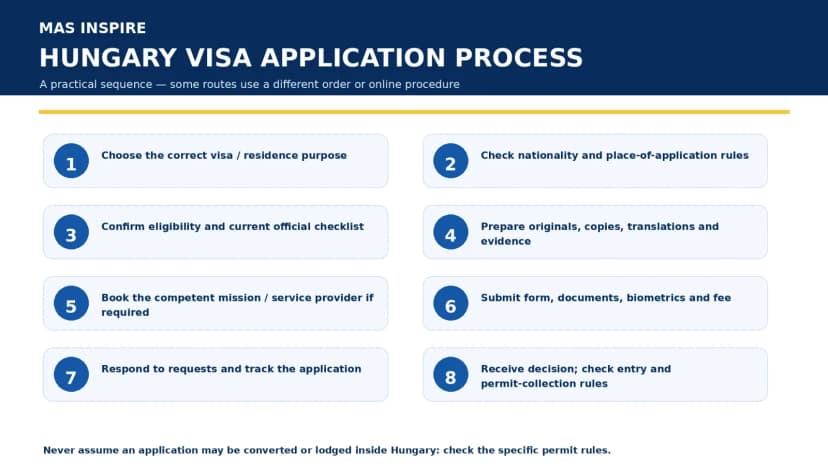
How to apply: step-by-step
- Choose the correct category. Decide whether the trip is a short visit, transit, study, employment, research, family stay, remote work or investment.
- Check nationality and residence rules. Confirm whether a visa is required and which Hungarian mission is competent for the applicant's habitual residence.
- Check the exact eligibility conditions. Review the current NDGAP factsheet for the chosen permit and the consulate's checklist.
- Prepare documents. Obtain originals, copies, translations, legalisation/apostilles where required, financial records and sponsor documents.
- Use the correct official form or portal. Short-stay C applications use the Schengen application process. Many residence applications are lodged at a Hungarian diplomatic mission abroad or through Enter Hungary where the law permits.
- Book an appointment where required. The Hungarian Embassy in Hanoi requires prior appointment booking for its consular-office process. Its page also describes VFS handling for Schengen applications in Hanoi; confirm that the relevant route and location remain current before booking.
- Submit biometrics and pay the fee. Fingerprints and a facial image are generally collected unless an exemption applies. Pay only the amount and method confirmed by the competent mission or official portal.
- Respond to additional requests. The authority may request further documents, an interview or clarification.
- Track and await the decision. Use the official tracking method supplied at submission; do not rely on third-party status pages.
- Follow the decision and entry instructions. If approved for a residence permit from abroad, the applicant may receive a limited single-entry D visa to travel and collect the permit. Check the entry deadline, permitted stay on the D visa and collection instructions carefully.
Visa fees and financial requirements
Fees depend on category, location, age, nationality and application channel. The figures below are official figures identified during research; local mission schedules may use local-currency equivalents and may change.
| Fee / financial figure | Amount | Notes |
|---|---|---|
| Standard Schengen C visa, adult | EUR 90 | EU standard fee; exemptions and reductions may apply |
| Schengen C visa, child aged 6–12 | EUR 45 | Standard EU fee |
| Residence permit application at diplomatic mission | EUR 110 | NDGAP procedural-fee schedule; confirm category and local collection |
| Residence permit application in Hungary, in person | HUF 39,000 | NDGAP schedule |
| Residence permit application via Enter Hungary | HUF 26,000 | NDGAP schedule |
| EU Blue Card minimum monthly remuneration, 2026 | HUF 1,001,048 | Lower HUF 800,838 threshold for listed healthcare occupations |
| White Card minimum net monthly income | EUR 3,000 | At least six months before entry and throughout stay |
| Guest-investor fund investment | EUR 250,000 | Qualifying regulated real-estate fund investment, statutory holding conditions |
| Guest-investor donation | EUR 1,000,000 | Qualifying public-interest higher-education institution and purpose |
Sources: European Commission Schengen fees, NDGAP fees, EU Blue Card, White Card, Guest investor.
The Embassy of Hungary in Islamabad published local consular fees effective 1 August 2026, including PKR 27,982 for an adult C visa and PKR 34,200 for a national D/residence-permit visa. These are Pakistan-specific charges and must not be applied to an application in Vietnam. Islamabad fee schedule.
Visa processing times
| Procedure | Published time identified | Important qualification |
|---|---|---|
| Schengen C visa | Normally 15 calendar days; up to 45 | May be extended for scrutiny or additional documents |
| Residence permit | Depends on permit type | NDGAP factsheets publish different statutory administrative periods; deficiency periods and additional checks may add time |
| Traineeship | NDGAP lists 21 days procedural administration and decision within 60 days | Category-specific; not a general processing promise |
| Guest investor | NDGAP lists 21 days | Only after required application conditions are met |
Apply early. The Hungarian Embassy in Ho Chi Minh City guidance states C visa applications should normally be lodged no earlier than six months and at least 15 calendar days before travel; it also notes the 15-to-45-day processing range. Mission guidance.
Applying from Pakistan or Vietnam
Pakistani passport holders applying in Pakistan
The Embassy of Hungary in Islamabad states that Pakistani nationals and certain third-country nationals legally residing in Pakistan may apply there for a Hungarian C visa. Its consular-fee page lists Pakistan-specific charges and payment instructions. Applicants should use the Embassy's current appointment and submission instructions and confirm whether their residence purpose requires a D visa/residence-permit procedure rather than a C visa.
Pakistani passport holders legally living or working in Vietnam
The Hungarian Embassy in Hanoi states that its consular visa procedure is available to Vietnamese citizens and third-country nationals who habitually live in Vietnam and hold a Vietnamese residence permit. It requires prior appointment booking for the Embassy's consular office. Schengen applications can also be lodged at the VFS centre in Hanoi according to the Embassy's published information. Confirm the correct VFS route and whether it represents Hungary for the applicant's category before booking.
A Pakistani citizen with a valid Vietnamese residence card should contact the Embassy before arranging travel to Hanoi. Provide the passport, residence card, intended visa category, and evidence of the purpose of travel. Ask whether the Embassy will accept the particular application and what originals, translations, appointment slots and fees apply. A short-term Vietnamese visit visa should not be assumed to establish habitual residence.
Differences between Pakistan and Vietnam
| Issue | Applying in Pakistan | Applying in Vietnam |
|---|---|---|
| Nationality | Pakistani | Pakistani |
| Local residence | Pakistani resident / applicant accepted by Islamabad mission | Must establish habitual lawful residence in Vietnam for Hanoi's stated route |
| Mission | Embassy of Hungary, Islamabad | Embassy of Hungary, Hanoi; verify appointment / VFS route |
| Local fee | PKR schedule published by Islamabad | Obtain current Vietnam fee and payment instructions from Hanoi |
| Additional evidence | Pakistan address / residence and local ties as applicable | Vietnamese residence card, work permit / employer evidence where relevant |
| Acceptance | Subject to category and jurisdiction | Residence card does not guarantee acceptance; confirm directly |
Student visa guide
Start with a genuine offer of admission from an eligible Hungarian institution. Check programme language, tuition, enrolment deadlines and whether the institution's course qualifies for the study residence permit. Prepare the admission and tuition evidence, proof of funds or scholarship, accommodation, healthcare cover, passport and application materials. Student residence holders may work within the statutory limits: up to 30 hours weekly during the study period and full-time for up to 90 days annually outside the study period. Do not rely on student status as a substitute for a full-time work permit. After successful completion, a qualifying graduate may apply for the limited job-seeking or business-starting route if the intended activity matches the level of completed studies.
Work visa and job opportunities
A Hungarian job offer is only the beginning. The employer and applicant must determine whether the role fits the employment permit, Hungarian Card, EU Blue Card, National Card or another available route. Pakistani citizens are not eligible for the nationality-restricted National Card merely because they have a job offer. New guest-worker applications are currently unavailable under the June 2026 NDGAP announcement. The same June 2026 amendment also limits the ordinary employment-purpose permit to Georgian, Armenian and Filipino nationals (within a 2026 cap of 35,000) — a Pakistani applicant with a job offer does not qualify for a new employment-purpose permit under the current list. The realistic work routes are the EU Blue Card, the Hungarian Card (occupation-listed), or a qualifying self-employment/research route. (Muse enhancement, verified 25 Nov 2026.) For an EU Blue Card, confirm the 2026 salary threshold and the qualification / occupation conditions. Do not pay a recruiter for a promise of guaranteed approval or a job that cannot be independently verified.
Family immigration and permanent residence
Family reunification is not available to every temporary resident. Check the sponsor's exact permit: NDGAP expressly lists several sponsor categories that cannot support ordinary family reunification, including employment, guest-worker, White Card and study permit holders. Where eligible, prepare official marriage or birth records, proof of the sponsor's status, funds, accommodation and healthcare cover. Foreign civil records may require translation, authentication or domestic registration.
Long-term residence is a separate legal status. The EU residence card may be available after five years of lawful Hungarian residence, or under a defined Blue Card mobility pathway. National residence-card eligibility excludes several temporary-purpose categories. Time spent in Hungary should not be assumed to count automatically or produce a card automatically; check continuity, absences, permit type, resources, accommodation, insurance, security and integration requirements under the applicable law.
Common application mistakes and refusal reasons
- Applying under a category that does not match the real purpose of travel.
- Treating a C visa as permission to work or settle.
- Applying in a country where the applicant is only a visitor, without confirming jurisdiction.
- Submitting an expired or damaged passport, inconsistent forms or incomplete records.
- Providing unexplained bank deposits or financial evidence that does not match the declared circumstances.
- Failing to provide a credible itinerary, accommodation or sponsor documents.
- Using an unqualified employer, institution, host or investment intermediary.
- Omitting required translations, legalisation or civil-status registration.
- Assuming a previous visa guarantees a new approval.
- Making false statements, concealing refusals or submitting altered documents.
A refusal may result where the legal conditions are not met, the purpose or supporting evidence is not credible, funds or insurance are insufficient, the applicant presents a risk under the applicable rules, or the authority identifies fraud or inconsistent information. Read the decision carefully: appeal deadlines and procedures depend on the type of decision. For some NDGAP residence decisions, the published appeal period is short (often eight days); do not assume the Schengen visa appeal process is identical.
Frequently asked questions
1. Do Pakistani citizens need a visa for Hungary?
Yes. Pakistani ordinary passport holders generally need a Schengen visa for short visits and the appropriate residence-permit procedure for long stays.
2. Can a Pakistani living in Vietnam apply for a Hungary visa in Hanoi?
The Hungarian Embassy in Hanoi states it accepts applications from third-country nationals who habitually live in Vietnam and hold a Vietnamese residence permit. Contact the Embassy to confirm jurisdiction for the exact visa category.
3. Does a Vietnamese residence card guarantee that Hungary will accept my application?
No. It is relevant evidence of lawful residence, but acceptance remains subject to the Embassy's jurisdictional and category-specific rules.
4. How long can I stay in Hungary on a Schengen visa?
Normally up to 90 days in any 180-day period across the Schengen Area, subject to the visa's validity and authorised entries.
5. What is the standard Schengen visa fee?
The standard adult fee is EUR 90 and the fee for children aged 6–12 is EUR 45, subject to exemptions and local collection arrangements.
6. How long does a Hungary Schengen visa take?
The normal decision period is 15 calendar days and may extend to 45 days. Apply well in advance.
7. Can I work in Hungary on a tourist visa?
No. A short-stay visitor visa does not authorise ordinary employment.
8. Can international students work in Hungary?
Eligible study residence holders may work up to 30 hours per week during the study period and full-time for up to 90 days per year outside the study period.
9. Is Hungary's digital nomad visa available?
Hungary has the White Card for qualifying remote workers and foreign-company owners. The published net income threshold is EUR 3,000 per month for at least six months before entry and throughout the stay.
10. Can Pakistani citizens apply for the Hungarian National Card?
The National Card is nationality-restricted; the NDGAP employer information identifies Ukrainian and Serbian nationals. Pakistani applicants should not assume eligibility.
11. Can I get a Hungary guest-worker visa in 2026?
NDGAP announced that new guest-worker applications are unavailable from 6 June 2026 because no third countries are currently eligible under the amended rules.
12. Can my spouse join me in Hungary if I have a work permit?
Not necessarily. The ordinary family-reunification route excludes sponsors holding certain permits, including the employment-purpose permit. Check the sponsor's exact residence title.
13. Is buying a house enough for Hungary's investor residence permit?
No. The current guest-investor programme identifies qualifying fund investment or a qualifying donation. Ordinary property purchase is not the listed qualifying investment.
14. Can I apply for permanent residence after five years?
Some applicants may qualify for an EU residence card after five years of lawful residence, but permit type, continuity, absences and other statutory conditions matter. It is not automatic.
15. Where do I apply for a Hungary visa?
Apply through the Hungarian mission or authorised service provider responsible for your lawful country of residence, or through the official NDGAP procedure for residence permits where applicable.
Official immigration websites
- National Directorate-General for Aliens Policing (NDGAP)
- NDGAP factsheets and residence permit categories
- NDGAP procedural fees
- Enter Hungary
- European Commission — Schengen visa application
- Hungarian Embassy in Hanoi
- Hungarian Embassy in Islamabad
- Hungarian Embassy consular guidance in Ho Chi Minh City
- Hungarian visa application forms
Final checklist and conclusion
Before applying, identify the correct route, confirm the applicant's nationality and place-of-application eligibility, use the current official checklist, prepare genuine documents, verify the fee and appointment channel, and leave enough time for processing. Pakistani passport holders living in Vietnam should confirm their habitual-residence evidence and jurisdiction with the Embassy in Hanoi before booking. Employment, family and long-term residence rights depend on the exact permit; do not infer them from a visa label alone.
Educational-information disclaimer: This guide is general information, not legal advice. The competent Hungarian authority makes the final decision. Rules, fees, eligible nationalities and local appointment arrangements may change after the verification date. Recheck all official pages immediately before publication and again before an applicant submits an application.


