

By MAS Inspire | Last reviewed: 27 November 2026 (key figures re-verified 27 November 2026)
On this page
- Introduction
- Why visit, study and work
- Visa types
- Visa comparison
- Eligibility
- Document checklists
- Application steps
- Fees and finances
- Processing times
- Pakistan and Vietnam
- Student guide
- Work and jobs
- Family and residence
- Mistakes
- Refusals
- FAQs
- Official websites
- Final checklist
Introduction
Greece attracts visitors for its ancient history, islands, Mediterranean coastline and food, while international students, professionals, researchers and families may also have reasons to stay longer. The correct immigration route depends on why you are travelling, how long you intend to remain, your nationality and where you legally reside.
The most important distinction is between a Schengen short-stay visa and a Greek national long-stay visa. A short-stay visa is generally used for visits of up to 90 days in a 180-day period. A national Type D visa is used for qualifying longer stays and is commonly followed by an application for a Greek residence permit. Neither a tourist visa nor a visitor visa authorises ordinary employment in Greece.
This guide explains the main routes, typical evidence, costs that can be verified, application steps and special considerations for Pakistani passport holders living or working in Vietnam. Always use the checklist and instructions issued by the Greek consular post responsible for your place of lawful residence.
Why people visit, study and work in Greece
Greece offers tourism and cultural travel, recognised universities and research institutions, employment opportunities in sectors such as hospitality, shipping, agriculture, technology and professional services, and family-based residence routes. These opportunities do not create an automatic right to enter or work. Non-EU nationals must meet the immigration conditions for the specific purpose and obtain the relevant visa and residence authorisation.

Types of Greece visas and immigration routes
1. Schengen Type C — tourism, family visits and business
A Type C visa is for short stays in Greece and other Schengen countries. It may be issued for tourism, visiting relatives or friends, attending meetings, conferences or other permitted short business activities. The permitted stay is normally no more than 90 days in any 180-day period across the Schengen Area, not 90 days in each country.
A visa may be single-entry, double-entry or multiple-entry. The visa’s validity dates and number of entries are not the same as the maximum permitted stay. A multiple-entry visa does not allow a traveller to exceed the 90/180-day limit. Business visitor status does not normally permit taking up employment or entering the Greek labour market.
2. Type A — airport transit
An airport-transit visa allows an eligible traveller to remain in the international transit area of a Schengen airport while connecting to a destination outside the Schengen Area. It does not allow the traveller to pass border control, stay in a hotel outside the transit area or travel onward to another Schengen airport as though still in international transit. If the itinerary requires entering the Schengen Area, a Type C or other appropriate visa may be necessary.
Pakistani nationals are included in the common Schengen airport-transit visa list. Exemptions can apply, including depending on the travel document, residence permit, visa held for another country and itinerary. Check the airline and Greek consulate before booking a connection.
3. Type D — national long-stay visa
A national visa is issued for a specific purpose under Greek national law or applicable EU law. It generally covers a stay exceeding 90 days and up to 365 days, depending on the category. Examples include employment, study, family reunification, research and digital-nomad residence.
A Type D visa is an entry authorisation. It does not automatically grant every right associated with a residence permit. Applicants must follow the post-arrival procedure for the relevant residence permit within the required period.
4. Student and language-study routes
A non-EU applicant seeking to study in Greece generally needs acceptance by an eligible Greek higher-education institution, evidence of sufficient resources, and proof of payment of enrolment fees where applicable. The applicant applies for the relevant national visa through the competent Greek mission and then follows the residence-permit procedure. Study permits are renewable, subject to continued eligibility and academic progress requirements.
The European Commission’s Greece student page describes a residence-permit fee of €150; since Law 5275/2026 (February 2026) the permit is issued for the maximum length of the programme and the €150 is a flat fee for the permit (plus about €16 for the card), not a per-year charge; applicants must confirm the current fee and payment code with the competent Greek authority before paying. Students may work part-time within the applicable rules, but should not assume unrestricted full-time work rights. Short language courses may have different visa treatment depending on duration, provider and legal category.
5. Employment and employer-sponsored work
A non-EU national normally needs a national visa for employment and a residence permit authorising the specific employment. In the standard dependent-employment route, the Greek employer initiates the required approval/invitation procedure with the competent Decentralised Administration. The employment must fit the applicable admission rules and quota or labour-needs framework. The employer may need to provide a qualifying contract and evidence of capacity to pay the agreed remuneration.
Do not travel as a tourist intending to start work, and do not treat an offer letter as permission to work. Seasonal employment, highly qualified employment and other special categories can have different legal conditions. Check the current Ministry of Migration and Asylum category and the relevant Greek consulate’s document list.
6. Job seeker and skilled-worker pathways
Greece does not provide a general-purpose job-seeker visa that allows every foreign national to enter and search for any job. Skilled workers may qualify through a specific employment route, including the EU Blue Card or another national category, where the salary, qualification, contract and employer requirements are met. A qualifying job offer and the relevant authorisation are central to most employment routes.
7. Digital Nomad Visa
Greece offers a digital-nomad route for eligible non-EU nationals who work remotely using information and communication technologies for employers or clients outside Greece. It is not permission to take local Greek employment or establish a business serving the Greek labour market. Income, insurance, documentation and family-member conditions must be checked on the official Work from Greece portal and with the competent consular post. Do not rely on unofficial websites for current income thresholds. The statutory income figure is €3,500 net per month for the main applicant (Article 68, Migration Code — Law 5038/2023), plus 20% for a spouse or partner and 15% for each child; the national visa fee is €75 and the visa runs up to 12 months, followed by a two-year residence permit. Since 6 February 2026 (Law 5275/2026) the route must start with a national visa from a Greek consulate — the former option of applying from inside Greece on a short-stay visa or visa-free entry was repealed.
8. Entrepreneur and investor routes
Greece has residence pathways connected to investment and certain business activities. The Golden Visa is an investor residence programme, not a tourist visa or a general work permit. Eligible investment types, geographic thresholds, minimum amounts, holding periods and restrictions have changed over time. Because the threshold depends on the investment route and current law, this guide does not publish a single headline amount that could mislead applicants. Review the current Ministry of Migration and Asylum Golden Visa page and obtain independent legal and tax advice before committing funds. As a guide to the current tiers (Law 5100/2024, Article 100): €800,000 in Attica, Thessaloniki, Mykonos, Santorini and islands over 3,100 inhabitants; €400,000 elsewhere; €250,000 only for conversion of commercial property to residential use, restoration of a listed building, or a registered start-up. From 1 July 2027 Law 5355/2026 raises the property transfer tax for buyers tax-resident outside the EU/EEA from 3% to 15% — check the current cost before committing funds.
9. Family reunification and spouse/family routes
A non-EU sponsor who has lawfully resided in Greece for the required period may be able to apply to reunite with eligible family members, commonly a spouse and minor dependent children, subject to income, accommodation, insurance, family-relationship and public-order requirements. The sponsor’s immigration status matters. A family member of a Greek or EU citizen may fall under a different legal regime from family reunification for a third-country national.
A marriage certificate alone does not automatically grant a visa or residence permit. Civil-status documents may need official translation, apostille or consular legalisation, depending on the issuing country and applicable arrangements.
10. Researcher, academic, internship and training routes
Researchers generally need a hosting agreement with a recognised research organisation, plus the required visa and residence permit. The permit duration is linked to the hosting agreement. Students, trainees, volunteers, scholarship holders and participants in special programmes may have distinct permit categories. An internship should not be assumed to fit a visitor visa; the host institution and consulate should confirm the proper category before travel.
11. Permanent and long-term residence
Permanent residence is not a visa category that can ordinarily be requested for a short visit. Non-EU nationals may qualify for long-term resident status after the required period of lawful and continuous residence, subject to income, comprehensive health insurance and integration conditions. The European Commission’s employed-worker and family-member guidance describes a five-year qualifying residence route, but absences and category-specific exclusions matter. Greek citizenship is a separate legal process with additional requirements.
12. Humanitarian protection
International protection and asylum are separate from ordinary visitor, work or study visa routes. A person who fears persecution or serious harm should seek accurate advice from the competent Greek asylum authority or a qualified protection organisation. This guide does not assess individual asylum eligibility and should not be used as a substitute for legal assistance.
Visa comparison table
| Route | Main purpose | Duration / status | Work rights | Fee position |
|---|---|---|---|---|
| Type A | Airport transit | Transit-area connection only | No | Check consulate |
| Type C | Tourism, family visit, business visit | Up to 90/180 days | No ordinary employment | €90 adult; €45 age 6–11; exemptions apply |
| Type D employment | Approved employment | Long stay; residence permit follows | Only as authorised | Category-specific; confirm consulate |
| Type D study | Eligible study | Course-linked residence permit | Part-time within rules | €150 flat fee for the permit (Law 5275/2026); recheck |
| Digital nomad | Remote work for foreign employer/clients | National visa/residence route | No Greek local labour-market work | €75 visa; income ≥€3,500/month net (+20% spouse, +15% per child) |
| Researcher | Approved research hosting | Hosting-agreement-linked | Research activity under permit | Confirm category |
| Family reunification | Join eligible sponsor | Family residence permit | Subject to category and renewal rules | Confirm authority |
| Investor | Qualifying investment | Investor residence status | Not a general work authorisation | Investment and fees vary |
| Long-term resident | Settlement after qualifying residence | Long-term residence status | Broad work access under law | Confirm current application fee |
Eligibility requirements
Eligibility is assessed individually. For a Type C visa, the consulate normally considers the purpose and conditions of travel, sufficient means, accommodation, travel medical insurance, intention to leave before the visa expires, and any risk indicators relating to public policy, security or irregular migration. Applicants must apply to the Schengen country that is their main destination; if there is no main destination, the first country of entry may determine the competent consulate.
For a Type D visa, eligibility is tied to the national legal category. A student needs qualifying admission and resources; an employee needs the relevant employer approval and contract; a researcher needs an approved host and agreement; and a family applicant needs a qualifying sponsor and evidence of the family relationship. The consular post can request additional documents or an interview.
Complete document checklists
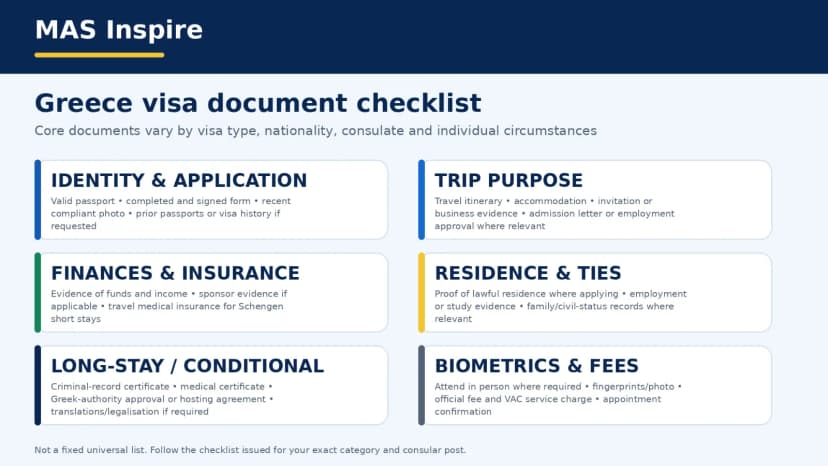
The following tables are planning aids, not exhaustive universal lists. The exact checklist issued by the Greek Embassy/Consulate or its authorised provider takes priority.
Type C — short-stay visitor checklist
| Document | Status | Notes |
|---|---|---|
| Completed Schengen application form, signed | Core | Use the current form and correct consular instructions |
| Valid passport and copies | Core | Check validity, issue date and blank-page rules |
| Recent ICAO-compliant photograph | Core | Follow the photo specification |
| Travel medical insurance | Core | Must meet Schengen requirements, including minimum €30,000 coverage and valid territorial/duration coverage |
| Travel itinerary and accommodation | Core / purpose-dependent | Reservation or invitation evidence as applicable |
| Proof of funds and income | Core | Bank statements, salary or sponsor evidence as relevant |
| Employment, study or business evidence | Conditional | Demonstrate circumstances and reason to return |
| Invitation, family relationship or event registration | Conditional | For visits, business or events |
| Previous visas and travel history | Supporting | Include if requested or useful |
| Proof of lawful residence in Vietnam | If applying in Vietnam | Residence card/permit and validity evidence; confirm local jurisdiction |
Type D — long-stay checklist
| Document | Status | Notes |
|---|---|---|
| National visa application form and passport | Core | Current Greek D-visa form and valid travel document |
| Photograph and personal appearance | Core | As instructed by the mission |
| Medical certificate | Often required | Greek national-visa guidance specifies health evidence; exact format matters |
| Travel/health insurance | Core / category-dependent | Cover the period and risks required by the mission |
| Criminal-record certificate | Often required / conditional | May be requested from nationality and/or residence countries |
| Proof of legal residence in Vietnam | If applying in Vietnam | Must establish the consular jurisdiction |
| Purpose-specific evidence | Core | Admission, employer approval/contract, hosting agreement, family records or digital-nomad evidence |
| Certified translations/legalisation | Conditional | Follow Greek authority and issuing-country rules |
| Financial evidence | Category-dependent | Use the current official threshold, where one exists |
Purpose-specific evidence
- Student: acceptance certificate from a Greek institution, course details, evidence of resources, enrolment-fee receipt where applicable.
- Employee: employer-side approval, signed employment contract, employer documentation and any category-specific qualification evidence.
- Researcher: hosting agreement with a recognised research organisation and project details.
- Family: sponsor’s residence status, proof of accommodation/resources/insurance where required, and authenticated marriage or birth certificates.
- Digital nomad: evidence of remote work for non-Greek employers/clients, income and insurance in the format required by the official portal.
- Investor: evidence of the qualifying investment and all statutory supporting documents; use current legal advice and government instructions.
How to apply: step by step
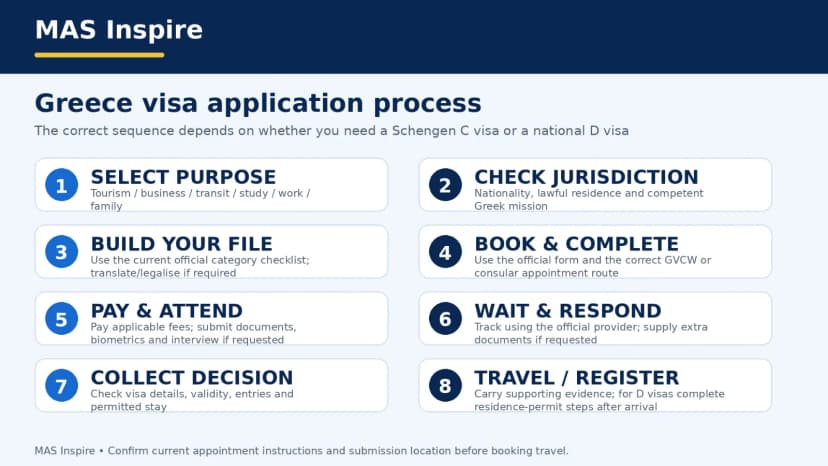
Step 1 — Choose the correct category
Decide whether the trip is a short visit, airport transit or long-term move. Identify the actual activity: tourism, business meeting, paid employment, study, research, family reunification or remote work. Do not select a visitor visa for a purpose that requires a national visa and residence permit.
Step 2 — Check nationality, residence and consular jurisdiction
Check whether your passport requires a visa. Confirm which Greek mission is responsible for your country of lawful residence and whether it accepts applications from your status. For Schengen applications, apply to Greece when Greece is your main destination. For national visas, Greek guidance directs applicants to the mission in whose jurisdiction they legally reside.
Step 3 — Prepare the documents
Use the exact checklist for your category and submission country. Check passport validity, photo format, insurance wording, bank statement period, translation and legalisation requirements. Keep documents truthful and consistent across forms, employer letters, invitations and travel bookings.
Step 4 — Identify the official appointment channel
For short-stay applications in Vietnam, the Greek Embassy states that GVCW collects visa applications and biometrics. National visa applications are submitted by appointment to the Consular Office. Follow the current Vietnam mission page rather than relying on old appointment links or third-party agents.
Step 5 — Complete the correct form
Use the current Schengen application form for Type C or the national visa form for Type D. Check that names, passport numbers, travel dates, purpose, sponsor details and accommodation information match the supporting evidence. Each applicant, including each child, may need an individual application file.
Step 6 — Pay the official fees
The standard Schengen fee is €90 for adults and €45 for children aged 6–11. Exemptions apply to some categories. The Greek Embassy in Vietnam publishes a €30 GVCW service charge for short-stay application collection, paid in Vietnamese dong. The service charge is separate from the visa fee. National visa and residence-permit fees vary by category; do not assume the Schengen fee applies to a D visa.
Step 7 — Attend biometrics or interview
Applicants may need to attend in person for fingerprints and a photograph. Previous Schengen fingerprints may be reusable in some cases, but the consulate can require a new capture. Applicants can be called for an interview or asked to provide additional evidence.
Step 8 — Submit the application
Submit the application to the authorised provider or directly to the consular office as instructed for the category. A visa centre collects files; it does not decide the application. Keep the submission receipt and reference number.
Step 9 — Track the application
Use the tracking facility or instructions provided at submission. Processing can take longer if the consulate requests further documents, conducts consultations or needs additional examination. Avoid non-refundable travel arrangements until the decision and passport are returned.
Step 10 — Check the decision and travel conditions
If approved, verify the name, passport number, visa type, validity dates, number of entries and authorised duration. A visa does not guarantee admission at the border. Carry evidence of accommodation, funds, return/onward travel, insurance and purpose. If entering on a D visa, complete the required Greek residence-permit steps before the relevant deadline.
Visa fees and financial requirements
| Item | Published amount / rule | Notes |
|---|---|---|
| Schengen Type C adult | €90 | Standard fee; exemptions may apply |
| Schengen Type C child age 6–11 | €45 | Children under six are generally fee-exempt |
| GVCW Vietnam service charge | €30 | Published by Greek Embassy in Vietnam; paid in VND |
| Schengen processing | 15 calendar days | May extend to 45 days |
| Student residence permit | €150 (flat fee) | European Commission student guidance; since Feb 2026 the permit covers the full programme length; plus ~€16 card fee; recheck current e-payment instructions |
| Digital nomad visa | €75 | National visa up to 12 months; income ≥€3,500/month net (+20% spouse, +15% per child) |
| National Type D visa | Not stated as one universal fee | Depends on category and consular rules |
| Employment/family/investor permits | Varies | Check current category-specific e-paravolo and government instructions |
| Financial means | Category- and case-specific | No universal bank balance is asserted in this guide |
For Schengen applications, show credible funds for the intended trip and explain the source of funds. There is no safe universal bank balance for every nationality and itinerary. A sudden large deposit without an explanation can raise questions. A sponsor may provide supporting evidence where the consulate accepts sponsorship.
Visa processing times
The normal Schengen processing period is 15 calendar days after the application is lodged. It can be extended up to 45 calendar days when further examination or additional documents are needed. Appointment waiting times, courier/passport return and public holidays are additional and are not included in that decision period. National visa and residence-permit timelines differ by category and authority; where a current official processing commitment is not published, treat the timeline as variable.
Applying from Pakistan or Vietnam
Pakistani passport holders applying from Pakistan
Pakistani ordinary-passport holders generally require a Schengen visa for short visits to Greece. The Greek Embassy’s Pakistan visa page lists the supporting documents and the standard €90 Schengen fee. The Embassy announced that, from 15 June 2026, appointments for visa applications including work visas are booked online through GVCW; its visa application centres operate in Islamabad and Lahore. Applicants should use the current GVCW Pakistan portal and the Embassy’s latest notices. The Embassy or Consular Office makes the decision, not the application centre.
Pakistani passport holders legally living or working in Vietnam
A Pakistani citizen who is lawfully resident in Vietnam may be able to lodge a Greece visa application in Vietnam, but the residence permit does not automatically guarantee local acceptance. Greek rules direct national visa applicants to the mission within whose jurisdiction they legally reside. For a Schengen application, the consulate may assess lawful residence and jurisdiction, and may require proof of residence status.
The Greek Embassy in Hanoi publishes the following operational arrangement:
- Short-stay applications and biometrics are collected through GVCW Vietnam.
- The Embassy’s visa information page publishes a €30 service charge, payable in Vietnamese dong.
- National visa applications are submitted by appointment to the Consular Office.
- The competent consular authority is the Greek mission in whose jurisdiction the applicant legally resides.
Before paying for an appointment or arranging travel to Hanoi, the applicant should email the Greek Consular Office at grcon.han@mfa.gr with their Pakistani nationality, Vietnamese residence status, intended visa category, current place of residence and intended travel dates. Ask for written confirmation that the mission will accept the application and which checklist and appointment channel apply. A short-term Vietnamese visa or temporary presence may not be treated in the same way as lawful residence for consular jurisdiction.
Useful contact: Greek Embassy/Consular Office in Vietnam. The Embassy and Consular Office are in Hanoi. The Honorary Consulate in Ho Chi Minh City is listed as a contact point, but applicants should not assume it accepts visa applications or decides visa cases.
Main differences
| Issue | Applying in Pakistan | Applying in Vietnam |
|---|---|---|
| Competent mission | Greek Embassy/Consular Office in Islamabad | Greek Embassy/Consular Office in Hanoi, if jurisdiction accepted |
| Submission channel | GVCW Pakistan VACs in Islamabad/Lahore | GVCW for short-stay; national visas by consular appointment |
| Local residence evidence | Pakistani address/residence evidence as requested | Valid Vietnamese residence documentation and local address |
| Extra concern | Correct VAC by residence address and category | Written confirmation of jurisdiction and acceptance for Pakistani applicant |
| Decision maker | Greek Consular Office | Greek Consular Office |
Student visa guide
Start by securing admission to an eligible Greek institution and confirming the programme’s duration and language. Obtain an official acceptance certificate, course details and any enrolment-fee receipt. Prepare evidence of sufficient funds for living costs and tuition where applicable. The ministerial means figure for students is at least €650 per month (Joint Ministerial Decision 225679/2024), assessed monthly or for the year. The consulate may require insurance, medical and criminal-record documents. After entry, apply for the student residence permit and maintain enrolment and academic progress. Student work rights are limited; check the current rules before accepting paid work. The European Commission’s student profile is a useful starting point, but the Greek authorities’ current instructions control.
Work visa and job opportunities
A lawful employment move normally begins with a Greek employer willing and able to complete the required authorisation process. The employer-side application may depend on the permitted number of jobs for the region and occupation. Once the relevant approval is granted, the applicant completes the visa process at the competent Greek mission. After arrival, the worker must apply for the appropriate residence permit. Do not begin employment before the legal authorisation allows it.
Potential sectors vary with labour-market demand and season. Applicants should verify the employer, written contract, salary, working hours, accommodation deductions, social-insurance arrangements and any recruitment charges. Never surrender a passport to an unverified recruiter or pay for a promised visa approval.
Family immigration and permanent residence
Family reunification usually requires a qualifying sponsor, an eligible relationship, lawful residence by the sponsor for the required period, and evidence meeting financial, housing and insurance rules. The Greek authority may verify family relationships and request interviews or additional civil-status records. Family members’ work rights depend on their residence category and may change at renewal.
Long-term residence can become available after the required period of lawful and continuous residence, commonly five years under the EU long-term resident framework, if income, health-insurance and integration conditions are met. Time spent in some temporary categories may count differently or be excluded. Keep copies of every residence card, renewal receipt, travel record, tax and insurance evidence.
Common application mistakes
- Choosing the wrong Schengen country to apply to when another country is the actual main destination.
- Confusing visa validity with the permitted number of days in the Schengen Area.
- Using a Type C visitor visa to undertake paid employment.
- Assuming a D visa alone completes the residence process.
- Applying in Vietnam without checking whether the Greek mission accepts the applicant’s lawful residence status.
- Submitting inconsistent travel dates, accommodation details, salary figures or sponsor information.
- Providing unexplained deposits or unreliable sponsorship evidence.
- Using outdated forms, appointment links or document checklists.
- Buying non-refundable tickets before a decision.
- Relying on agents who promise guaranteed approval or claim to influence the consulate.
Reasons for visa refusal
A refusal may result from insufficient evidence of purpose, inadequate or unclear funds, doubts about accommodation or travel plans, invalid insurance, inconsistent information, concerns about the intention to leave before expiry, missing documents, security or public-policy grounds, or failure to satisfy the legal conditions for a national visa. A refusal should be read carefully. Follow the appeal or review instructions and deadline in the written decision; a new application should address the actual refusal grounds rather than simply repeat the same file.
Frequently asked questions
1. Do Pakistani citizens need a visa for Greece?
Ordinary Pakistani passport holders generally need a visa for short visits to Greece. Check any applicable exemptions based on another qualifying residence permit or visa.
2. Can I visit Greece with a Schengen visa issued by another country?
Usually yes, if the visa is valid for the travel dates, entries and territory, and you comply with the 90/180-day rule. Your application must have been lodged with the correct main-destination country.
3. How long can I stay in Greece on a Type C visa?
The maximum short-stay allowance is generally 90 days in any 180-day period across the entire Schengen Area. Your individual visa may authorise fewer days.
4. What is the Greece Schengen visa fee in 2026?
The standard fee is €90 for adults and €45 for children aged 6–11. Exemptions and additional service-centre charges may apply.
5. How long does a Greece Schengen visa take?
The normal decision period is 15 calendar days, extendable to 45 calendar days in cases requiring further examination or documents. Appointment waiting time is separate.
6. Can I work in Greece on a tourist visa?
No. A tourist/visitor visa does not authorise ordinary employment. Use the correct employment route and obtain the required authorisation.
7. What is a Greece Type D visa?
It is a national long-stay entry visa for a qualifying purpose, generally for stays over 90 days. A residence permit may also be required after arrival.
8. Can Pakistani residents in Vietnam apply for Greece visa in Hanoi?
Potentially, if the Greek mission accepts the applicant as legally resident within its jurisdiction. A Vietnamese residence permit does not automatically guarantee acceptance. Obtain written confirmation from the Consular Office before booking.
9. Where do I submit a Greece visa application in Vietnam?
The Greek Embassy in Vietnam identifies GVCW as the collection provider for short-stay applications and biometrics. National visa applications are handled by appointment through the Consular Office. Confirm the current process before attending.
10. Is there a Greece job seeker visa?
There is no general-purpose job-seeker visa for every foreign national. Employment routes normally require a qualifying job and employer-side authorisation.
11. Can international students work in Greece?
Students may have limited part-time work rights under applicable rules. Check the current student residence conditions before working.
12. Does a Greece visa guarantee entry?
No. Border authorities can ask for evidence of purpose, funds, accommodation, insurance and return or onward travel.
13. Can I extend a Greece Schengen visa?
Extensions are exceptional and generally require force majeure, humanitarian reasons or serious personal reasons under the Schengen rules. Do not plan on extending a normal tourist stay.
14. Is the Greece Golden Visa the same as a work visa?
No. It is an investor residence route with separate investment conditions. It should not be treated as a general work authorisation.
15. How can I check the official requirements?
Use the Greek Ministry of Foreign Affairs, the competent Greek Embassy/Consulate, the Ministry of Migration and Asylum and the European Commission’s Schengen and EU Immigration Portal pages linked below.
Official immigration websites
- Greek Ministry of Foreign Affairs
- Greek Embassy in Vietnam — visas
- Greek Embassy in Vietnam — contact
- GVCW Vietnam
- Greek Embassy in Pakistan — visas
- GVCW Pakistan
- Greek Ministry of Migration and Asylum
- European Commission — Schengen visa applications
- EU Immigration Portal — Greece
- Work from Greece — Digital Nomad
Final checklist and conclusion
Before submitting an application, confirm the correct category, main destination, nationality-based visa requirement and competent consular mission. Download the latest checklist and form, check passport validity, prepare credible financial and purpose evidence, arrange compliant insurance where required, and complete the correct appointment process. Pay only official visa and provider fees and keep receipts. Attend biometrics or an interview if requested. After approval, check the visa sticker carefully and follow all entry and residence-permit conditions.
For Pakistani passport holders in Vietnam, the most important extra step is to obtain written confirmation from the Greek Consular Office in Hanoi that the applicant’s Vietnamese status and intended visa category qualify for local submission. Do this before paying fees or making non-refundable travel arrangements.
Greece offers several legitimate routes for visitors, students, workers, researchers, families and investors, but each has distinct rules. Careful preparation and direct use of official sources are the best way to reduce avoidable errors. No guide or intermediary can guarantee a visa decision.
Educational-information disclaimer: This article is general information, not legal advice. Immigration decisions are made by the competent Greek authorities. Rules and fees may change after the verification date shown above.


