


By MAS Inspire | Last reviewed: 27 November 2026
Germany is one of Europe's leading destinations for international students, skilled professionals, entrepreneurs and tourists. With internationally recognised universities, established industries and structured immigration pathways, the country offers numerous opportunities for people planning to visit, study, work or build a long-term future abroad.
However, applying for a German visa requires careful preparation. Your nationality, country of residence, qualifications, financial circumstances and purpose of travel determine which immigration requirements apply to you. This guide explains the main immigration pathways, application procedures, required documents, financial requirements and common mistakes to avoid. It also provides dedicated guidance for Pakistani passport holders living and working in Vietnam.
Table of contents
- Why Germany
- Visa types
- Visa comparison
- Eligibility
- Documents
- How to apply
- Fees and funding
- Processing times
- Pakistan and Vietnam
- Student visa
- Work visas
- Family and settlement
- Mistakes and refusals
- FAQs
- Official sources
- Final checklist
1. Why people visit, study and work in Germany
Germany attracts international applicants for several reasons:
- Higher education: Many public universities offer relatively affordable degree programmes, although tuition fees and semester contributions vary.
- Career opportunities: Established engineering, healthcare, information technology, manufacturing and research industries.
- Vocational education: Structured professional training through the Ausbildung system.
- Business opportunities: A developed economy with access to European markets.
- Tourism: Historic cities, castles, museums, mountains and cultural attractions.
- Long-term immigration: Settlement opportunities for applicants who satisfy the relevant residence requirements.
Choosing the correct visa is the first step towards pursuing these opportunities legally.

2. Types of German visas
Germany operates within the Schengen visa system while maintaining national immigration rules for longer stays. Type A covers airport transit, Type C covers short stays, and Type D covers national long-stay visas. A national visa may lead to a residence permit and eventual settlement, but neither transition is automatic.
2.1 Tourist and visitor visa — Schengen Type C
The tourist visa is suitable for applicants visiting Germany for holidays, sightseeing, family visits or other permitted short-term activities. Main requirements include a credible travel purpose, sufficient funds, accommodation arrangements, travel medical insurance and evidence supporting the applicant's intention to leave on time.
The permitted stay is normally limited to 90 days within a rolling 180-day period across the Schengen Area. A multiple-entry visa does not remove this restriction. Ordinary employment is not permitted. The standard adult fee is €90. Official Schengen visa requirements.
2.2 Business visitor visa
Business visitors may travel to Germany for legitimate short-term commercial activities, such as meetings, negotiations, conferences and trade exhibitions. Applicants should normally provide a business invitation, details of their planned activities and evidence of their employment or business responsibilities. The standard Schengen fee and short-stay duration rules apply. A business visitor visa does not generally authorise taking up employment in Germany. Federal Foreign Office.
2.3 Student visa
International students admitted to an eligible German higher education institution may apply for a national visa for studying. Applicants generally need admission evidence, academic qualifications, financial support, appropriate health insurance and any required language certificates. In 2026, the standard blocked-account requirement is €11,904. Recognised scholarships and formal declarations of commitment may provide alternative evidence. The standard national visa fee is €75. Official student visa requirements.
2.4 Language course visa
Applicants undertaking intensive German language education may qualify for a dedicated language-acquisition visa. Evidence of course enrolment, sufficient financial means and insurance is required. The permit may cover up to 12 months, and employment of up to 20 hours per week is permitted. Applicants taking language courses as preparation for an already secured university or vocational training place may need a different visa category. Official requirements.
2.5 Skilled-worker employment visa
Qualified professionals with eligible vocational or university qualifications and a concrete German job offer may qualify for employment-based residence. Professional recognition or academic comparability may be required. Regulated occupations, including certain healthcare professions, also require authorisation to practise. A German employer normally provides an employment contract or binding offer and any required employment declaration. This does not mean every applicant must have a separate sponsorship certificate. Official skilled immigration information.
2.6 EU Blue Card
The EU Blue Card is an employment-based residence pathway for eligible highly qualified professionals.
| 2026 salary requirement | Gross annual amount |
|---|---|
| Standard threshold | €50,700 |
| Qualifying shortage occupations | €45,934.20 |
| Eligible recent graduates | €45,934.20 |
| Eligible IT specialists without formal degrees | €45,934.20 |
Applicants generally require a qualifying job offer for at least six months. Special conditions apply to IT professionals without formal academic qualifications. Lower salary thresholds may involve additional approval requirements. Official EU Blue Card requirements.
2.7 Opportunity Card — Chancenkarte
The Opportunity Card allows eligible applicants to search for qualified employment in Germany without first securing a full-time job offer. There are two principal eligibility routes: a qualification fully recognised in Germany, or a qualifying foreign educational or vocational background combined with the required language proficiency and at least six eligibility points. The points-based route normally requires German at A1 level or English at B2 level.
Applicants must demonstrate sufficient financial resources. In 2026, the applicable benchmark is €1,091 per month. The initial job-search period can generally last up to one year. Limited part-time work and qualifying trial employment are permitted. Official Opportunity Card information.
2.8 Employment visa for professionally experienced workers
This pathway is intended for eligible experienced professionals taking qualified employment in non-regulated occupations. Unlike some skilled-worker pathways, full German recognition of the foreign qualification is not necessarily required. Applicants must satisfy the applicable qualification, experience, employment and remuneration requirements. Special provisions apply to IT professionals. Official requirements.
2.9 Digital nomad visa
Germany does not offer a dedicated general-purpose digital nomad visa. Remote workers should not assume that a visitor visa authorises them to live and work remotely from Germany. Depending on the circumstances, an eligible applicant may instead qualify under freelance, self-employment or another employment-based immigration provision.
2.10 Entrepreneur, startup and freelance visas
Germany provides self-employment residence pathways under Section 21 of its Residence Act. Entrepreneurs generally need to demonstrate a credible business proposal, available financing and economic or regional demand for their proposed activities. Freelancers may need evidence of clients, professional qualifications, financial sustainability and any relevant professional licence. The initial residence permission can extend for up to three years. Buying property or passively investing money does not automatically provide immigration status. Official self-employment requirements.
2.11 Family reunion and spouse visas
Eligible spouses, minor children and certain other relatives may join family members residing in Germany. Requirements depend on the sponsor's nationality and immigration status, the family relationship and the specific statutory provisions. Marriage or birth certificates, sponsor residence documents, appropriate accommodation and financial evidence may be required. Some spouses must demonstrate basic German proficiency, while exemptions apply in qualifying cases. Official visa information.
2.12 Permanent residence and settlement
Permanent residence is normally obtained after fulfilling the conditions of a qualifying residence pathway. It is not a standard initial visa that all overseas applicants can obtain directly. Qualifying residence periods, pension contributions, financial independence, language proficiency and other requirements depend on the immigration category. Certain skilled professionals and EU Blue Card holders benefit from accelerated settlement provisions.
2.13 Airport transit visa — Type A
An airport transit visa permits eligible travellers to remain within an authorised international airport transit area. It does not permit ordinary entry into Germany. Pakistani passport holders generally require an airport transit visa unless they qualify for a recognised exemption. A connecting itinerary requiring entry into the Schengen Area may instead require a Type C visa. Official transit rules.
2.14 Vocational training — Ausbildung
Germany offers residence permits for applicants undertaking eligible school-based or company-based vocational training. Applicants normally require a confirmed training place, appropriate German language proficiency and sufficient financial means. German at B1 level is generally expected where the training provider has not otherwise assessed the necessary language skills. An additional independent job of up to 20 hours per week is permitted. Official training requirements.
2.15 Research, academic exchange and internships
Germany has immigration provisions for eligible researchers, visiting academics, exchange students and study-related interns. The relevant permission depends on the applicant's academic status, host institution, research agreement, employment arrangements and internship duration. Applicants should obtain confirmation from their host institution before selecting a visa category.
2.16 Professional qualification recognition
Foreign professionals who need additional training, examinations or other qualification-recognition measures may qualify for a recognition-related residence permit. Recognition partnerships may also allow eligible workers to undertake the recognition process alongside employment. Applicants should consult Recognition in Germany.
2.17 Humanitarian protection
Germany maintains asylum, refugee protection and other humanitarian residence mechanisms. These procedures are legally distinct from ordinary study, work and visitor visas. Asylum is not a conventional overseas visa application route. Individuals seeking international protection should consult BAMF or qualified legal assistance.
3. Germany visa comparison table
| Visa or pathway | Standard adult fee | Duration or residence basis | Work rights |
|---|---|---|---|
| Tourist / family visitor | €90 | 90/180-day rule | No ordinary employment |
| Business visitor | €90 | 90/180-day rule | Specified business activities |
| Airport transit | Normally €90 | Authorised transit | No |
| Student | €75 | Programme-related | Limited employment |
| Language course | €75 | Up to 12 months | Up to 20 hrs/week |
| Skilled worker / EU Blue Card | €75 | Employment-related | Authorised employment |
| Opportunity Card | €75 | Initially up to 12 months | Limited employment |
| Experienced worker | €75 | Employment-related | Authorised employment |
| Vocational training | €75 | Training duration | Training and additional limited work |
| Entrepreneur/freelancer | €75 | Initially up to 3 years | Authorised self-employment |
| Family reunion | €75 or exempt | Family-status dependent | Depends on entitlement |
| Researcher | Normally €75 | Research-related | Authorised activities |
| Internship/exchange | Varies | Programme-dependent | Restricted to permission |
| Recognition pathway | €75 | Recognition-related | Conditional |
| Permanent residence | Separate permit fee | Indefinite | Generally unrestricted |
| Digital nomad | Not available | Not applicable | Not applicable |
| Humanitarian protection | Separate procedure | Status-dependent | Status-dependent |
Fees are standard entry-visa fees, not the total cost of immigration. Exemptions, external service fees and subsequent residence-permit charges may apply. Residence duration must not be confused with initial visa sticker validity.
4. Germany visa eligibility requirements
| Requirement | Explanation |
|---|---|
| Nationality | Determines whether a visa is required |
| Valid passport | Must satisfy travel-document rules |
| Application jurisdiction | Responsible mission must accept application |
| Genuine purpose | Travel, study, employment or other legitimate purpose |
| Financial resources | Evidence appropriate to category |
| Health insurance | Appropriate coverage |
| Qualifications | Certain academic and employment pathways |
| Language proficiency | Where applicable |
| Sponsorship or invitation | Particular residence purposes |
| Compliance | No relevant grounds preventing lawful entry |
EU, EEA and Swiss citizens generally benefit from free-movement rights. Pakistani and Vietnamese ordinary passport holders generally require a visa for short visits and an appropriate national visa for longer stays unless an exemption applies.
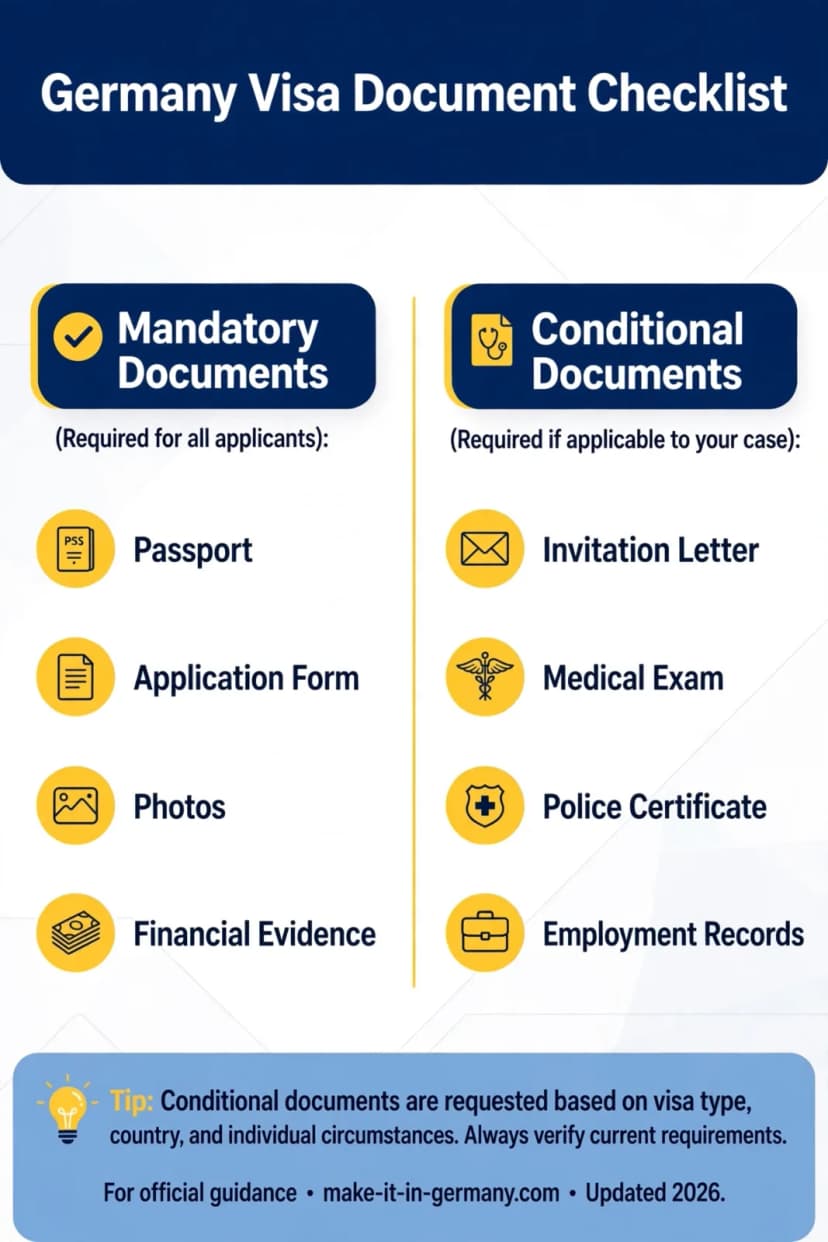
5. Complete Germany visa document checklists
General documents
| Document | Classification |
|---|---|
| Valid passport, official form, biometric photographs | Core requirements |
| Evidence of purpose | Core requirement |
| Fee | Unless exempt |
| Financial evidence, health or travel insurance | Category-dependent |
| Proof of legal residence | Jurisdiction-dependent |
| Certified translations, previous visa records, authentication | When required or requested |
Tourist and business visa
| Document | Status |
|---|---|
| Passport, Schengen form, biometric photos | Required |
| Travel medical insurance | Required unless exempt |
| Itinerary, accommodation, financial proof | Normally required |
| Employment or business evidence | As applicable |
| Business invitation | Business travel |
| Family invitation | Hosted family visit |
| Ties to country of residence | Supporting evidence |
Schengen travel medical insurance must generally provide at least €30,000 in qualifying coverage throughout the relevant territory.
Student visa
| Document | Status |
|---|---|
| Passport and national visa form | Required |
| University admission or qualifying acceptance | Required |
| Financial support | Required |
| Academic certificates and transcripts | Normally required |
| Health insurance | Required at applicable stage |
| Language certificate | Programme-dependent |
| APS certificate | Education-background dependent |
| Tuition payment receipt | Where applicable |
| CV and motivation letter | Mission-dependent |
| Scholarship confirmation | If using scholarship funding |
Employment and Opportunity Card
| Document | Employment visa | Opportunity Card |
|---|---|---|
| Passport and application | Required | Required |
| Qualification certificates | Normally required | Required |
| Recognition/comparability | Route-dependent | Route-dependent |
| Employment contract | Required | Not required for initial search |
| Employer declaration | Where applicable | If relying on employment |
| Experience records | Route-dependent | If required or claiming points |
| Language evidence | Route-dependent | Points route |
| Financial evidence | Route-dependent | Required |
| Professional licence | Regulated professions | If relevant |
Other categories
| Pathway | Main evidence | Conditional evidence |
|---|---|---|
| Language course | Enrolment and funding | Study history, schedule |
| Ausbildung | Training contract, financial support | Language, recognition |
| Research | Hosting agreement or contract | Qualifications, funding |
| Internship | Agreement and eligibility | University confirmation, training plan |
| Family reunion | Civil certificates and sponsor status | Housing, income, language |
| Self-employment | Business plan or freelance evidence | Financing, clients, licences |
| Transit | Onward itinerary and destination documents | Flight details |
| Recognition | Authority decision or agreement | Training plan, assessments |
| Settlement | Residence status and history | Income, pension, language |
These are preparation checklists, not substitutes for the current mandatory checklist issued by the responsible German mission. No universal fixed document count applies.

6. How to apply for a Germany visa: step-by-step
- Select the immigration category corresponding to your actual purpose.
- Confirm nationality rules and the mission responsible for your residence.
- Prepare qualifications, funding and purpose-specific evidence.
- Complete the official application; create a portal account where supported.
- Respond to preliminary review requests for missing or corrected information.
- Attend the appointment with biometrics, originals and required fees.
- Await the decision and track through the designated system where available.
- Receive your passport and verify personal details, dates and conditions.
- Travel with relevant supporting documents.
- Register your address and obtain a residence permit where required.
Applicants for supported employment, education and family categories can begin through the Consular Services Portal. Schengen applicants should obtain the correct VIDEX form, book through the responsible mission or designated application centre and attend their appointment. Submitting an online form alone does not complete the application. Biometrics may be reused under certain conditions; interviews and additional documents may still be requested.
7. Germany visa fees and financial requirements 2026
| Applicant | Schengen | National |
|---|---|---|
| Adult | €90 | €75 |
| Child aged 6–11 | €45 | €37.50 |
| Child under 6 | Free | €37.50 |
| Other minors | Applicable adult rate | €37.50 |
| Qualifying exempt applicants | Free | Free |
Fees are generally non-refundable when an application is refused. Application-centre services, courier charges and subsequent permits may cost extra.
| Purpose | Funding requirement |
|---|---|
| University student | €11,904 annually (€992 monthly) |
| Opportunity Card | €1,091 monthly |
| School-based Ausbildung | €959 net monthly |
| Company-based Ausbildung | €1,048 gross or €822 net monthly training allowance |
| EU Blue Card | Applicable annual gross salary threshold |
| Tourism | Sufficient funds for planned trip |
| Family reunion | Depends on sponsor and exemptions |
| Entrepreneurship | Adequate business financing and living resources |
| Other categories | Check official requirements |
Sources: Student funding, Opportunity Card, Vocational training.
Budgeting illustration: multiply the applicable monthly benchmark by the planning period, then add the €75 standard adult national visa fee and estimated additional expenses. A shorter planning period does not automatically reduce the mandatory funding requirement.
8. Germany visa processing times
| Category | Published processing guidance |
|---|---|
| Schengen tourist/business | Normally 15 calendar days |
| Schengen additional examination | Up to 45 days |
| Student / family reunion | Varies; potentially several months |
| Skilled employment / Blue Card / Opportunity Card | Varies |
| Researcher / self-employment | Varies |
| Airport transit | Check responsible mission |
Appointment availability is separate from processing time. Consider time needed for qualification recognition, document verification and preparation. Schengen applications can generally be lodged six months before travel and normally at least 15 days before travel. European Commission guidance.
9. Applying for a Germany visa from Pakistan or Vietnam
Pakistani passport holders residing in Pakistan
Applicants should consult the German Missions in Pakistan for the current procedure and responsible consular district. For student applications, the Consular Services Portal is available for Islamabad and Karachi applicants. The mission highlights previous academic certificates, transcripts and applicable tuition payment evidence as mandatory student documents, even where the portal may display them as optional. The mission also reports significant demand for student visas. Pakistan student visa procedure.
Pakistani passport holders legally residing in Vietnam
Pakistani citizens who legally live, work or study in Vietnam may potentially apply through the responsible German mission in Vietnam. However, having a Vietnamese temporary residence card or work permit does not automatically establish application eligibility. The responsible office must be satisfied that the applicant falls within its jurisdiction. German Missions in Vietnam determine responsibility for relevant national visa applications according to habitual residence.
Options include the German Embassy in Hanoi, German Consulate General in Ho Chi Minh City, and designated VFS centres in Hanoi, Ho Chi Minh City and Da Nang for applicable categories. The mission publishes separate procedures for direct and VFS submissions. Application-centre guidance.
| Additional document | Purpose |
|---|---|
| Pakistani passport | Identity and nationality |
| Vietnamese visa or residence card | Legal status |
| Work permit, if applicable | Employment authorisation |
| Employment contract | Work and residence circumstances |
| Police-issued residence confirmation | Habitual residence where required |
| Local bank statements | Financial circumstances |
| Employer leave approval | Temporary travel evidence |
| Pakistani educational certificates | Qualification assessment |
| Marriage or birth certificates | Family applications |
| Translations and authentication | As instructed |
Not every document is mandatory for every applicant. The mission should confirm the evidence required from a non-Vietnamese national.
| Subject | Pakistan | Vietnam |
|---|---|---|
| Nationality | Pakistani | Pakistani |
| Authority | German Missions in Pakistan | German Missions in Vietnam |
| Jurisdiction | Relevant district | Accepted habitual residence |
| Visa requirements | Pakistani nationality rules | Same nationality rules |
| Residence evidence | Domestic residence | Vietnamese legal and habitual residence |
| Payment | Local instructions | Generally VND equivalent |
| Appointment | Category-specific | Mission, portal or designated VFS |
| Qualification evidence | Issuing country | Still issuing country |
| Processing speed | Varies | No guaranteed advantage |
Applying from Vietnam does not make a Pakistani passport eligible for visa-free travel or remove nationality-based airport transit requirements.
Recommended jurisdiction enquiry
Dear Visa Section,
I am a Pakistani passport holder currently residing legally in Vietnam. I intend to apply for a German [visa category] visa. I hold a valid Vietnamese [residence card/visa/work permit] and currently reside in [city or province]. Could you please confirm whether I am eligible to submit my application through the German mission in Vietnam and advise which application procedure and additional residence documents are required?
Thank you for your assistance. Kind regards, [Full name].
Official sources: Vietnam visa FAQs and German Missions in Pakistan.
10. Germany student visa guide 2026
Germany offers Bachelor's, Master's, doctoral and other higher education opportunities. Applicants should obtain admission to an eligible institution and satisfy academic and language requirements. Useful resources include DAAD, university admission websites and anabin.
The standard student blocked-account amount for 2026 is €11,904, equivalent to €992 per month. A recognised scholarship or accepted declaration of commitment may provide an alternative. These funds are for living expenses rather than a government fee. Tuition, travel and other costs should be budgeted separately.
Students need appropriate insurance. University enrolment may require proof of qualifying German health insurance or an accepted exemption. Distinguish temporary entry insurance from coverage during studies.
International students holding the appropriate study residence permit can generally work 140 full days or 280 half days annually, or up to 20 hours weekly under applicable alternative rules. Check residence conditions before starting employment or freelance activities.
Eligible graduates of German higher education institutions can seek a post-study job-search residence permit for up to 18 months. A suitable job may subsequently support a skilled-worker residence permit or EU Blue Card application. Official study visa information.
11. Work visas and job opportunities in Germany
Applicants should determine whether their qualifications and experience fit a recognised immigration pathway. Germany provides opportunities in healthcare, technology, engineering, education, research and skilled trades. Availability varies by profession, employer, region and language proficiency.
Applicants with a job offer and recognised qualifications should research skilled-worker visas and the EU Blue Card. Those with foreign qualifications and experience should research experienced-worker and recognition pathways. Those without a job offer may investigate the Opportunity Card. Certain IT specialists may qualify under special provisions. This is educational guidance, not an official assessment.
| Website | Purpose |
|---|---|
| Make it in Germany | Skilled immigration and employment |
| Federal Employment Agency | Employment services |
| EURES | European employment opportunities |
| anabin | Academic qualifications |
| ZAB | Foreign qualification assessments |
| Recognition in Germany | Professional recognition |
Avoid employers or agencies offering guaranteed work permits in exchange for substantial advance payments. A job offer alone does not guarantee approval.
12. Family immigration and permanent residence
Germany permits eligible foreign residents to reunite with qualifying family members. Requirements depend on whether the sponsor is a German citizen, EU citizen, skilled worker, EU Blue Card holder, student or another lawful resident. Establish the legal relationship, sponsor status and applicable language requirements. Foreign civil-status documents may require authentication, translation or additional verification. Family reunification permits can provide employment rights depending on the applicable entitlement.
Applicants wishing to live permanently in Germany should investigate settlement eligibility under their specific residence category. Student permits may lead to graduate job search and qualified employment; Opportunity Cards may lead to qualified employment; EU Blue Cards may lead to settlement after qualifying residence. Intermediate permits and additional qualifying periods may be necessary. Permanent residence is never automatic.
Entrepreneurs operating a successful qualifying business may become eligible for settlement after three years. Freelance professionals are generally subject to a longer qualifying period, commonly five years, alongside other applicable requirements. Official self-employment information.
13. Common Germany visa application mistakes
| Mistake | Recommended approach |
|---|---|
| Wrong visa | Match category to genuine purpose |
| Wrong jurisdiction | Confirm mission responsibility |
| Outdated funding thresholds | Check current official requirements |
| Incomplete documents | Follow category checklist |
| Inconsistent details | Review forms and certificates |
| Assuming tourist visas permit work | Obtain appropriate authorisation |
| Ignoring recognition | Check anabin, ZAB or recognition authority |
| Non-refundable flights too early | Use flexible reservations where appropriate |
| Unreliable agents | Use official portals |
| Assuming Vietnamese residence guarantees submission | Obtain jurisdiction confirmation |
14. Reasons for German visa refusal
Applications may be refused for insufficient financial resources, failure to demonstrate eligibility, unreliable evidence or inadequately supported purpose. Short-stay applications may be refused where authorities are not satisfied the applicant will leave on time. Employment or education applicants may face refusal if qualifications, admission, job offer or other conditions do not meet legal criteria. Examine the written decision and instructions regarding legal remedies or a new application. Never submit fabricated bank statements, employment contracts, invitations or academic documents.
15. Frequently asked questions
Do Pakistani citizens need a visa for Germany?
Generally, yes, unless a specific exemption applies.
Can Pakistani citizens apply from Vietnam?
Potentially, if the mission accepts jurisdiction and habitual residence evidence. A temporary residence card alone is not a guarantee.
How much does a tourist visa cost in 2026?
€90 for adults, excluding additional service fees.
How much is a national visa?
€75 for adults; certain applicants qualify for exemptions.
How much money is required for a student visa?
The standard 2026 blocked-account amount is €11,904 annually. Other accepted funding methods may be available.
Can international students work?
Generally, 140 full or 280 half days annually, or up to 20 hours weekly under applicable rules.
Can I move to Germany without a job offer?
Eligible applicants may use the Opportunity Card to search for employment. Other categories may also be available.
How much funding is required for the Opportunity Card?
€1,091 monthly in 2026, subject to accepted evidence and alternatives.
Does Germany have a digital nomad visa?
No dedicated general digital nomad visa exists. Investigate appropriate self-employment or other pathways.
Can I work with a tourist visa?
A tourist visa does not generally authorise ordinary employment.
How long does a visa take?
Schengen applications normally take 15 calendar days, potentially extending to 45 days. National processing varies and may take several months.
Do Pakistanis need an airport transit visa?
Generally, yes, unless an official exemption applies. Itinerary and transit-area conditions matter.
Can international graduates remain in Germany?
Eligible graduates may receive up to 18 months to search for qualified employment.
Does a work visa guarantee permanent residence?
No. Settlement requires satisfaction of applicable residence, financial and other conditions.
Can I apply online?
Many national categories support online applications through the Consular Services Portal, followed by an appointment. Schengen applications follow a separate process.
16. Official German immigration websites
- Federal Foreign Office
- Consular Services Portal
- Make it in Germany
- German Missions in Vietnam
- German Missions in Pakistan
- European Commission
- DAAD
- BAMF
- German Residence Act
17. Final Germany visa application checklist
- [ ] Selected the correct immigration pathway.
- [ ] Checked nationality-based requirements.
- [ ] Confirmed the responsible German mission.
- [ ] Passport satisfies applicable requirements.
- [ ] Completed the correct application form.
- [ ] Collected all mandatory documents.
- [ ] Verified current financial requirements.
- [ ] Arranged appropriate insurance.
- [ ] Qualifications assessed where required.
- [ ] Prepared required translations.
- [ ] Checked fees and appointment procedure.
- [ ] All information and documents are genuine.
- [ ] Understand visa validity and employment restrictions.
- [ ] Understand post-arrival residence formalities.
Conclusion
Germany offers diverse opportunities for international visitors, students, skilled professionals, entrepreneurs and families. A successful application begins with choosing the correct category, understanding current eligibility rules and submitting genuine, complete documentation through appropriate official channels. Pakistani applicants living in Vietnam should pay particular attention to consular jurisdiction and evidence of lawful habitual residence.
MAS Inspire aims to help international applicants understand their educational and immigration options through accessible, practical information.
Disclaimer: MAS Inspire is an independent educational information resource, not a German immigration authority. This article provides general information and does not constitute legal advice or guarantee visa approval. Immigration requirements, fees and procedures may change. The responsible German authority determines individual eligibility and application outcomes.


