Georgia Visa Guide 2026: Types, Requirements, Fees and Application Steps
For Pakistani passport holders living in Vietnam. Figures checked against official Georgian sources on 27 November 2026. Always confirm the live fee on the portal checkout before paying, because Georgia's e-visa portal shows the fee that applies to your exact case.
Contents
- Introduction
- Do Pakistanis Need a Visa for Georgia?
- The Visa-Free Rule That Changes Everything: Ordinance No. 256
- Types of Georgia Visas
- Georgia Visa Fees 2026
- Processing Times
- Complete Document Checklists
- How to Apply: Step-by-Step
- Applying from Vietnam: Nearest Mission and Online Route
- Student Visas
- Work Visas and the 2026 Work-Permit Rule
- Remote Workers and Digital Nomads
- Family Reunification and Long-Stay Visas
- Extending Your Stay, Overstay and Fines
- Frequently Asked Questions
- Official Immigration Websites
Introduction
Georgia sits where Europe meets Asia, between the Black Sea and the Caucasus mountains. Tbilisi's old town, the wine region of Kakheti, the mountain town of Kazbegi and the Black Sea resort of Batumi draw a growing number of visitors every year, and Georgia's low cost of living also attracts students, remote workers and people looking for a longer stay.
For a Pakistani passport holder, Georgia is not a simple visa-free destination, but it is also not a closed one. Georgia runs an unusual two-door system. The first door is a generous visa-free rule: if you already hold a valid visa or residence permit from one of about 50 listed countries, including the United States, the United Kingdom, Canada, the Schengen states and the Gulf states, you can usually enter Georgia without a Georgian visa at all. The second door is the online e-visa portal, which Pakistanis can use only if they hold a specific supporting document, or by paying a much higher fee for a long-validity tourism visa. If neither door applies to you, the route is a consular visa through a Georgian embassy.
Which door applies to you matters more than anything else in this guide, because it decides whether you pay nothing, USD 20, or USD 300, and whether you apply online in an afternoon or through an embassy over several weeks. This guide works through the doors in order, gives the verified fees and processing times, lists the documents for each visa type, and explains how to apply from Vietnam, where Georgia has no embassy of its own.
Two 2026 changes affect every traveller, whatever your route. From 1 January 2026 every tourist entering Georgia must hold health and accident insurance with cover of at least GEL 30,000 for the whole stay. And from 1 March 2026 a foreigner without Georgian permanent residence needs a work permit before starting any paid work, freelance work or business activity in Georgia, even if they already hold a visa or residence permit. Both rules are covered in detail below.
Do Pakistanis Need a Visa for Georgia?
Yes, on a Pakistani passport alone you need a visa for Georgia. Pakistan is not on Georgia's list of visa-free nationalities, and there is no visa on arrival for Pakistani passport holders. You must sort out your entry permission before you travel.
That is the short answer, but it is not the whole answer. Many Pakistani travellers do not need to apply for a Georgian visa at all, because Georgia's Government Ordinance No. 256 lets holders of a valid visa or residence permit from a listed country enter visa-free for up to 90 days in any 180-day period. If you live in Vietnam on a Vietnamese temporary residence card, that card does not help you here: Vietnam is not on Georgia's listed-country list, so a Vietnamese residence permit does not open the visa-free door. What counts is a visa or residence permit from a listed country, most commonly the United States, the United Kingdom, Canada, a Schengen state, Australia, Japan or a Gulf state.
If you hold no such document, you have two remaining routes. The first is the e-visa portal at evisa.gov.ge. Pakistan is on the portal's supporting-document list, which means the standard USD 20 e-visa is open to you only if you hold a valid Schengen visa, a valid visa from any OECD member country, or a valid residence permit of a Schengen or OECD country. The portal also offers a C5 tourism visa of up to one year for USD 300, which sources that tested the portal with Pakistan selected in October 2026 report as available without a supporting document. The second route is a consular visa applied for at a Georgian embassy, which is the route for a Pakistani passport holder with no supporting visa at all who does not want, or cannot use, the USD 300 C5 option.
Do not confuse these three routes. A Gulf residence permit can give you visa-free entry under Ordinance No. 256 but, because the Gulf states are not OECD members and are not in Schengen, a Gulf visa is not a supporting document for the standard e-visa. A Schengen or OECD visa, by contrast, can do both jobs: it can let you enter visa-free, and it can also support an e-visa application if you prefer to hold a Georgian visa. The table below summarises the position at a glance.
| Your situation | Your route into Georgia | Stay allowed | Fee |
|---|---|---|---|
| Valid visa or residence permit of a listed country (US, UK, Canada, Schengen, Australia, Japan, Gulf states and others) | Visa-free entry under Ordinance No. 256; no application | Up to 90 days in any 180-day period | None |
| Valid Schengen visa, OECD-country visa, or Schengen/OECD residence permit, and you prefer a Georgian visa | Standard e-visa at evisa.gov.ge | 30 days; visa valid 120 days, single entry | USD 20 plus 2% service fee plus USD 15 DuVerify |
| Pakistani passport only, no supporting visa | C5 tourism e-visa (up to one year) at evisa.gov.ge, or consular visa at a Georgian embassy | C5: up to one year as issued; consular visa: as issued, typically up to 30 days single entry | C5: USD 300 plus USD 15 DuVerify; consular visa: USD 20 consular fee per secondary sources (confirm at filing) |
| Vietnamese residence card only (no listed-country visa) | Same as Pakistani passport only; the Vietnamese card does not qualify | As issued | As above |
Every traveller, on every route, must also hold health and accident insurance of at least GEL 30,000 (about USD 11,500) covering the whole stay, in Georgian or English, since 1 January 2026. Border officers can ask to see it, along with your passport, return ticket, accommodation booking and proof of funds.
The Visa-Free Rule That Changes Everything: Ordinance No. 256
Government Ordinance No. 256 of 5 June 2015 is the rule that decides whether most Pakistani travellers need a Georgian visa at all. It says that a foreigner holding a visa or a residence permit of any country listed in its annex may enter Georgia without a visa and stay for up to 90 calendar days in any 180-day period. The visa or permit must be valid on the day you enter Georgia.
The annex lists about 50 countries and territories. They include all European Union and EFTA states, the United Kingdom, the United States, Canada, Australia, New Zealand, Japan, South Korea, Israel, and all six Gulf Cooperation Council states: the United Arab Emirates, Saudi Arabia, Qatar, Kuwait, Oman and Bahrain. The full list is published by the Ministry of Foreign Affairs of Georgia; the e-visa portal and the MFA consular site both carry versions of it, and you should check the live list before you travel rather than relying on any summary, including this one.
The one-year rule for Pakistanis relying on a Gulf visa or permit
There is one important exception, and it hits Pakistani passport holders directly. Ordinance No. 122 of 17 April 2025 amended Ordinance No. 256, with effect from 16 May 2025, for citizens of 17 named countries, Pakistan included. If you are a citizen of one of those 17 countries and you rely on a visa or residence permit from a Gulf state, the document must be a multiple-entry visa or residence permit that is still valid for at least one year on the day you cross the Georgian border. A Gulf residence permit with, say, eight months left does not qualify for a Pakistani passport holder, even though the same permit would qualify a traveller of most other nationalities, for whom validity on the day of entry is enough.
The 17 countries are Afghanistan, Bangladesh, Cameroon, the Democratic Republic of Congo, Côte d'Ivoire, Eritrea, Ethiopia, Ghana, Morocco, Nigeria, Pakistan, Somalia, Sudan, Syria, Tanzania, Uganda and Yemen. The one-year condition applies to Gulf-state documents. It does not apply in the same way to a valid US, UK, Schengen, Canadian, Australian or Japanese visa or residence permit, for which the ordinary rule, valid on the day of entry, applies. Because this is a 2025 amendment that many older guides do not mention, check the current text on the MFA site or with the Georgian embassy before you book a flight on the strength of a Gulf permit.
What visa-free entry does and does not give you
Visa-free entry under Ordinance No. 256 allows a stay of up to 90 days in any 180-day period. It is not a right to work: from 1 March 2026 you need a separate work permit before any paid work in Georgia, as explained in the work section below. It does not remove the mandatory insurance rule. Carry the physical visa or residence card you are relying on, together with your passport, and make sure the document will still be valid on the day you enter. A visa that has expired, or a residence permit that you have already cancelled, does not count, and a single-entry Gulf visa that you have already used may not satisfy the multiple-entry condition.
Types of Georgia Visas
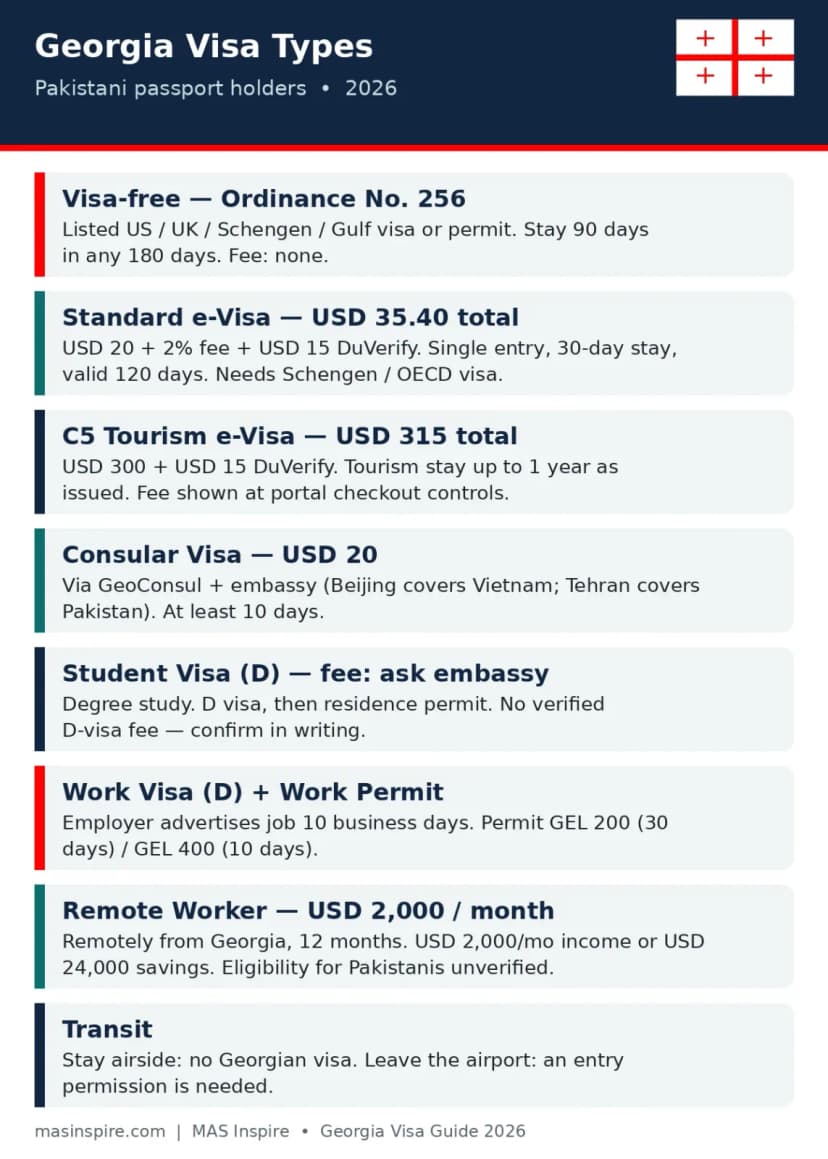
Georgia issues short-stay visas (category C) and long-stay visas (category D), plus e-visas through the online portal. The e-visa covers short stays. Long stays for work, study or family reunion start with a D visa issued by a consular mission and continue with a residence permit applied for inside Georgia. The table below compares the main routes for a Pakistani passport holder.
| Visa type | Purpose | Typical stay | Where to apply |
|---|---|---|---|
| Visa-free entry (Ordinance No. 256) | Tourism, private and short business visits | Up to 90 days in any 180 days | No application; at the border with a listed-country visa or permit |
| Standard e-visa (short-stay C) | Tourism, business, family visit and other short visits | 30 days; single entry; visa valid 120 days | Online at evisa.gov.ge (supporting document required) |
| C5 tourism e-visa | Tourism, longer stay | Up to one year as issued | Online at evisa.gov.ge |
| Tourist visa (consular, short-stay C) | Tourism and private visits | Up to 30 days, single entry, as issued | Georgian embassy via GeoConsul |
| Business visa (short-stay C) | Meetings, negotiations, conferences, commercial visits | Up to 90 days in any 180 days as issued; commonly 30 days single entry | Online e-visa (with supporting document) or embassy |
| Student visa (long-stay D) | Degree study, language courses and other study | Up to one year, renewable; residence permit follows | Georgian embassy via GeoConsul |
| Work visa (long-stay D) | Employment with a Georgian employer | Up to one year, renewable; work permit also required since 1 March 2026 | Georgian embassy via GeoConsul; work permit via labourmigration.moh.gov.ge |
| Family reunification visa (long-stay D) | Joining a spouse, parent or other close family member legally in Georgia | Up to one year, renewable; residence permit follows | Georgian embassy via GeoConsul |
| Transit visa (short-stay C) | Passing through Georgia to a third country | Short transit stay as issued | Online e-visa (with supporting document) or embassy |
| Remote-worker route (Remotely from Georgia) | Working remotely for a foreign employer or foreign clients while living in Georgia | 12 months, renewable | Online programme application; see the remote-worker section for the eligibility warning |
1. Tourist visas
Tourism is the most common reason Pakistanis visit Georgia. If you qualify for visa-free entry, you need no tourist visa. Otherwise the realistic tourist routes are the standard e-visa (USD 20, with a supporting document), the C5 tourism e-visa (USD 300, up to one year) or a consular tourist visa from an embassy (USD 20 consular fee according to secondary sources). There is no visa on arrival, so do not travel hoping to buy a visa at Tbilisi airport.
2. Business visas
Short business visits, meetings, negotiations and conferences use the short-stay C route, through the e-visa portal where a supporting document is held, or through an embassy. A business visa does not authorise employment in Georgia. Since 1 March 2026, any actual paid work, including freelance work for a Georgian client, needs the separate work permit described below. Bring an invitation letter from the Georgian company, details of the meetings, and evidence of your business in Vietnam or Pakistan.
3. Student visas
Students admitted to a recognised Georgian university or other educational institution apply for a long-stay D visa at an embassy, then apply for a temporary residence permit after arrival. Georgia's universities teach a number of programmes in English, including medicine, business and IT, and tuition is lower than in much of Europe. The student section below gives the full document list.
4. Work visas
A work visa is a long-stay D visa sponsored by a Georgian employer, and since 1 March 2026 it is only half the story: the worker also needs a Right to Labour Activity permit from the State Employment Promotion Agency before starting work. Some occupations are effectively closed to foreigners under the 2026 quota rules, including courier work, passenger transport driving and tourist guiding, which carry a zero quota. Do not accept a job offer or pay any agent until the employer has advertised the vacancy and the work-permit route is confirmed.
5. Transit visas
If you change planes at Tbilisi, Kutaisi or Batumi airport and stay airside without passing through Georgian border control, you do not need a Georgian visa for the transit itself, though your airline may still check your documents for the final destination. If you leave the airport, even for a few hours, you pass through border control and need a valid entry permission: visa-free entry, an e-visa or a consular visa. If your connection requires an overnight stay or a change of airport, apply for the relevant short-stay visa in advance.
6. Family visas
Family reunification covers joining a spouse, minor child, parent or other close family member who is legally resident in Georgia. The application is a long-stay D visa followed by a residence permit. The sponsor in Georgia must show legal residence, accommodation and sufficient means, and the relationship must be proved with civil-status documents, usually legalised or apostilled and translated into Georgian or English.
7. E-visas
The e-visa is not a separate purpose of travel; it is the online way of getting a short-stay visa. It is the fastest route for Pakistanis who hold a Schengen or OECD supporting document, with a decision in not less than five working days. The C5 tourism e-visa is the portal's higher-priced long-validity option. Neither e-visa authorises work.
8. Remote-worker route
Georgia's Remotely from Georgia programme offers a formal 12-month stay for people who work remotely for employers or clients outside Georgia, with a commonly reported income threshold of USD 2,000 per month or USD 24,000 in savings. It is not a visa in the ordinary sense and it does not give the right to work for a Georgian employer. Whether a Pakistani passport holder can use it directly is not clearly established in the official material reviewed, because the programme was framed for nationals of visa-free countries, so read the warning in the remote-worker section before planning around it.
Georgia Visa Fees 2026
Georgia's official visa fees are low by international standards, but the total you pay depends on your route, and the e-visa portal adds charges that catch people out. All fees are non-refundable, even if the visa is refused, if you make a mistake on the form, or if you never use the visa. Pay only on the official portal or at the embassy, and never pay a third-party website that claims to sell a Georgian visa: the Ministry of Foreign Affairs states on the portal that it has no relationship with any private company offering e-visa submission services.
| Fee or service | Amount | Notes |
|---|---|---|
| Visa-free entry (Ordinance No. 256) | None | No application and no fee |
| Standard e-visa | USD 20 | Single entry; plus 2% portal service fee (USD 0.40), so USD 20.40 at checkout |
| DuVerify identity check | USD 15 per applicant | Mandatory after either e-visa route; complete within 24 hours of the emailed link |
| Standard e-visa, total outlay | USD 35.40 per applicant | USD 20 plus USD 0.40 service fee plus USD 15 DuVerify |
| C5 tourism e-visa (up to one year) | USD 300 | Plus USD 15 DuVerify, so USD 315 in total; see the C5 disclosure below |
| Consular short-stay visa (embassy) | USD 20 | Consular fee from the MFA fee list as reported by secondary sources; confirm at filing, since the embassy may charge in local currency |
| Work permit, standard (30 calendar days) | GEL 200 (about USD 77) | State Employment Promotion Agency; from 1 March 2026 |
| Work permit, expedited (10 working days) | GEL 400 (about USD 154) | Same agency and route |
| Mandatory tourist insurance | From about GEL 2 to GEL 4 per day | Minimum cover GEL 30,000; buy before travel from a Georgian or foreign insurer |
| Residence permit application | Fee not verified | Applied for at a Public Service Hall after arrival; confirm the current fee there |
GEL amounts are converted at about 2.60 GEL to one US dollar, the National Bank of Georgia rate reported in October 2026. The lari moves a little against the dollar, so treat the dollar equivalents as approximate.
Figure disclosure: the C5 USD 300 fee
The USD 300 C5 fee needs an honest note. Several guides that selected Pakistan in the official e-visa application form in October 2026 report that the portal offers two options to Pakistani applicants: the standard e-visa at USD 20 with a supporting document, and the C5 tourism visa of up to one year at USD 300 without one. Other guides, checked in November 2026, describe the position differently: they say the standard e-visa is closed to a Pakistani travelling on a bare passport and that the only route is a consular visa, and they do not mention a C5 option at all. Both accounts cannot be complete. The controlling source is the portal checkout itself: when you reach the payment step, the fee shown there is the fee you pay. Do not send USD 300 to any agent or third-party site on the strength of this guide. Open evisa.gov.ge, select Pakistan as your citizenship, and read the options the form itself offers you before you pay anything.
Figure disclosure: long-stay D-visa fees
No separate official fee for long-stay D visas for work, study or family reunion could be verified from an official source for this guide. Secondary sources variously quote USD 20, USD 40 or USD 50 for these categories, and one aggregator lists USD 20 for business, work and student categories alike, which looks like a repeated short-stay figure rather than a verified D-visa tariff. This guide therefore does not state a D-visa fee as fact. The USD 20 consular fee in the table above is the MFA short-stay fee as reported by secondary sources. Ask the embassy for the D-visa fee in writing when you file, and treat any agent quoting a D-visa fee as unverified until the embassy confirms it.
Figure disclosure: the Remotely from Georgia fee
Sources also conflict on remote-worker costs. Several 2026 guides describe Remotely from Georgia as free to apply for, or with a USD 20 application fee, while one 2026 source describes a C5 digital-nomad visa at USD 300 standard or USD 500 expedited, plus GEL processing fees. These cannot all describe the same route. This guide treats the USD 2,000 monthly income threshold as the reported requirement, and treats every fee figure for the remote-worker route as unverified: confirm the fee on the official application page before paying.
Processing Times
Apply early. Georgia's e-visa is not an instant visa, and embassy applications take longer still. The table below gives the times reported by official and secondary sources; where sources disagree, the disagreement is stated.
| Route | Processing time | Notes |
|---|---|---|
| Visa-free entry (Ordinance No. 256) | None; decided at the border | Carry the listed-country visa or permit and insurance |
| Standard e-visa | Not less than 5 working days; up to 10 working days if extra checks are needed | Counted after payment and completion of DuVerify; the portal FAQ states this directly |
| C5 tourism e-visa | Not separately verified | Assume the same 5 to 10 working days as the standard e-visa; the portal does not publish a separate C5 time |
| Consular short-stay visa (embassy) | At least 10 days | Secondary sources; the embassy may take longer in busy periods |
| Long-stay D visa (work, study, family) | Not verified as a single figure | Allow several weeks; the embassy gives the estimate when you file |
| Work permit, standard | 30 calendar days | State Employment Promotion Agency |
| Work permit, expedited | 10 working days | Double fee (GEL 400) |
| Remotely from Georgia | About 5 to 10 working days | Secondary sources; confirm on the official portal |
| Residence permit (after arrival) | Not verified | Applied for at a Public Service Hall; confirm the time there |
Three deadlines inside the e-visa process catch people out, and missing any of them cancels the application. The verification email the portal sends is valid for one hour only; miss it and the application is cancelled and you start again. After the payment notification arrives, the fee must be paid within five hours or the application is cancelled. After payment, the DuVerify identity-check link must be completed within 24 hours. Use an email address you check often, and do not start an application late at night unless you can watch for these messages.
For a tourist trip, apply at least three weeks before travel: five to ten working days for the decision, plus time to fix a document query or to reapply if something goes wrong. For a consular visa, allow four to six weeks, and for study or work, start two to three months before your planned departure.
Complete Document Checklists
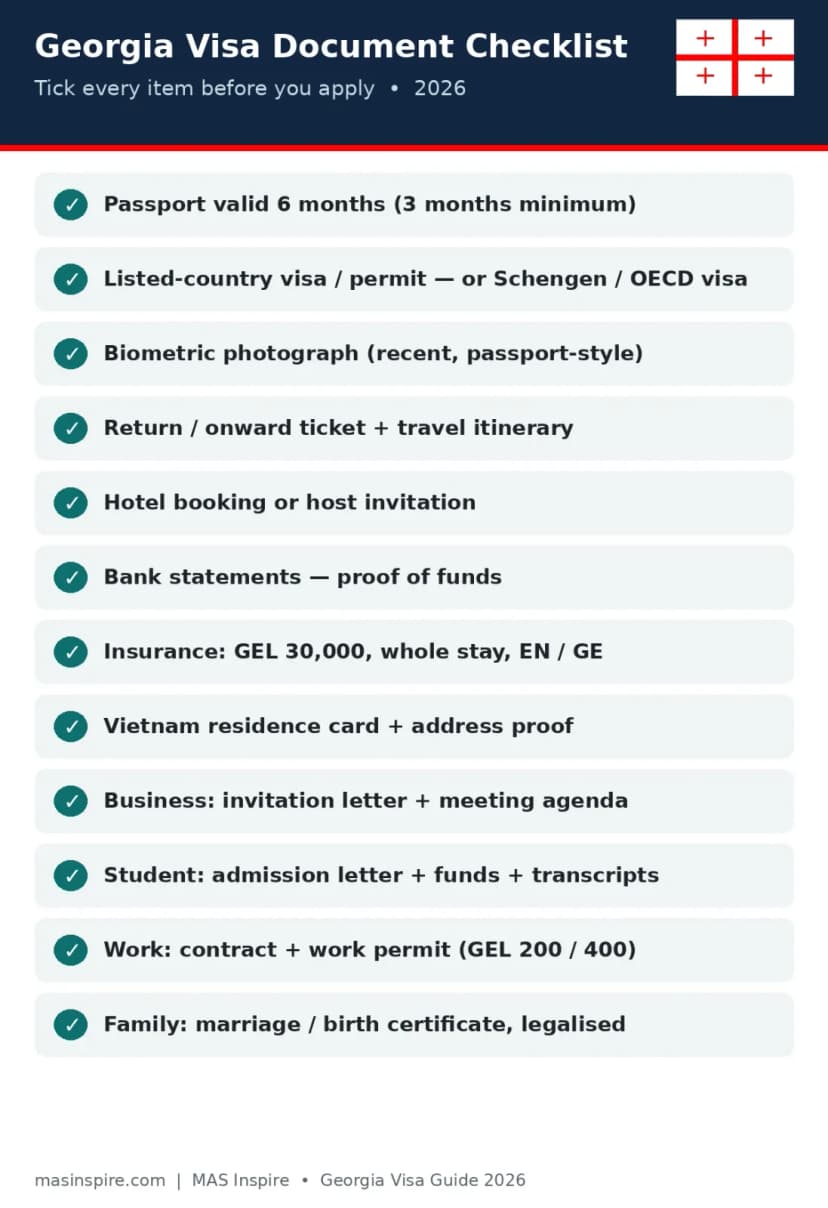
Document requirements differ by route, and the portal or the embassy can ask for extra evidence in any individual case. All documents not in Georgian or English should be translated, and civil-status and educational documents for long-stay applications usually need legalisation or an apostille. Scan everything clearly before you upload it; a blurred passport page is one of the most common reasons for delay.
Tourist e-visa and consular tourist visa
| Document | Details |
|---|---|
| Pakistani passport | Valid for at least 3 months beyond the end of your stay; several guides advise 6 months, so 6 months is the safer target. At least one blank page. |
| Supporting document (standard e-visa only) | Valid Schengen visa, or a valid visa from any OECD member country, or a valid residence permit of a Schengen or OECD country. Not required for the C5 route as reported, or for a consular visa. |
| Biometric photograph | Recent, passport-style, as specified by the portal or embassy. |
| Travel itinerary and return or onward ticket | Show your entry and exit dates and your route from Vietnam. |
| Accommodation proof | Hotel booking or host invitation covering the stay. |
| Proof of funds | Bank statements showing you can pay for the trip; the portal does not publish a fixed daily amount, so show a comfortable balance. |
| Health and accident insurance | Minimum cover GEL 30,000, valid for the whole stay, in Georgian or English. |
| Vietnam residence evidence | Your Vietnamese temporary residence card or valid Vietnamese visa, plus evidence of your address in Vietnam, to show where you live and that you can return. |
| Employment or study evidence | Employment letter, business registration, or student enrolment, to show ties to Vietnam and the purpose of the trip. |
Business visa
| Document | Details |
|---|---|
| All tourist-visa documents above | Passport, photograph, insurance, funds, tickets and accommodation. |
| Invitation letter | From the Georgian company or organisation, stating the purpose, dates and who pays. |
| Business evidence | Your employer's letter, business registration, or trade documents showing your role and the reason for the visit. |
| Meeting or conference details | Agenda, conference registration, or correspondence with the Georgian host. |
Student visa
| Document | Details |
|---|---|
| All core documents above | Passport, photograph, insurance, funds and Vietnam residence evidence. |
| Admission letter | Unconditional offer or enrolment confirmation from a recognised Georgian university or institution. |
| Proof of funds for study | Bank statements or sponsor's undertaking covering tuition and living costs for the study period. |
| Educational documents | Degree, transcripts and certificates, with legalisation or apostille and translation as the embassy requires. |
| Accommodation in Georgia | University dormitory confirmation or rental agreement. |
| Tuition payment evidence | Receipt or payment plan if the institution requires advance payment. |
Work visa
| Document | Details |
|---|---|
| All core documents above | Passport, photograph, insurance, funds and Vietnam residence evidence. |
| Employment contract | Signed contract with the Georgian employer, stating the job, salary and duration. |
| Work permit | Right to Labour Activity permit from the State Employment Promotion Agency, or evidence that the employer's application is in progress; no work before it is granted. |
| Employer's documents | Company registration and evidence that the vacancy was advertised on the national employment portal. |
| Qualifications and experience | Degree, certificates and CV relevant to the job, with translation as required. |
Family reunification visa
| Document | Details |
|---|---|
| All core documents above | Passport, photograph, insurance, funds and Vietnam residence evidence. |
| Proof of relationship | Marriage certificate, birth certificate or other civil-status document, legalised or apostilled and translated. |
| Sponsor's legal residence in Georgia | Copy of the sponsor's residence permit or Georgian ID and evidence of their status. |
| Sponsor's means and accommodation | Income evidence and proof of housing in Georgia for the family member. |
Remote-worker route
| Document | Details |
|---|---|
| Passport | Valid well beyond the intended 12-month stay. |
| Proof of remote income | Employment contract, client contracts or bank statements showing about USD 2,000 per month, or evidence of about USD 24,000 in savings. |
| Proof the work is remote and foreign-sourced | Employer or client details showing the work is for a company or clients based outside Georgia. |
| Health insurance | Covering the full stay; the GEL 30,000 tourist minimum is the floor to meet. |
| Georgian entry permission first | A Pakistani applicant still needs a valid way to enter Georgia, such as visa-free entry or a visa; the programme itself is not a substitute for entry permission. |
How to Apply: Step-by-Step
Route A: visa-free entry
Step 1: Check that your listed-country visa or residence permit is valid on the day you will enter Georgia, and that it meets the one-year rule if you are relying on a Gulf document as a Pakistani citizen. Step 2: Buy health and accident insurance of at least GEL 30,000 covering your whole stay, in Georgian or English. Step 3: Book your return or onward ticket and accommodation, and carry printed or digital copies. Step 4: At the Georgian border, present your passport, the listed-country visa or permit, your insurance, and your travel documents. No application and no fee are involved.
Route B: standard or C5 e-visa
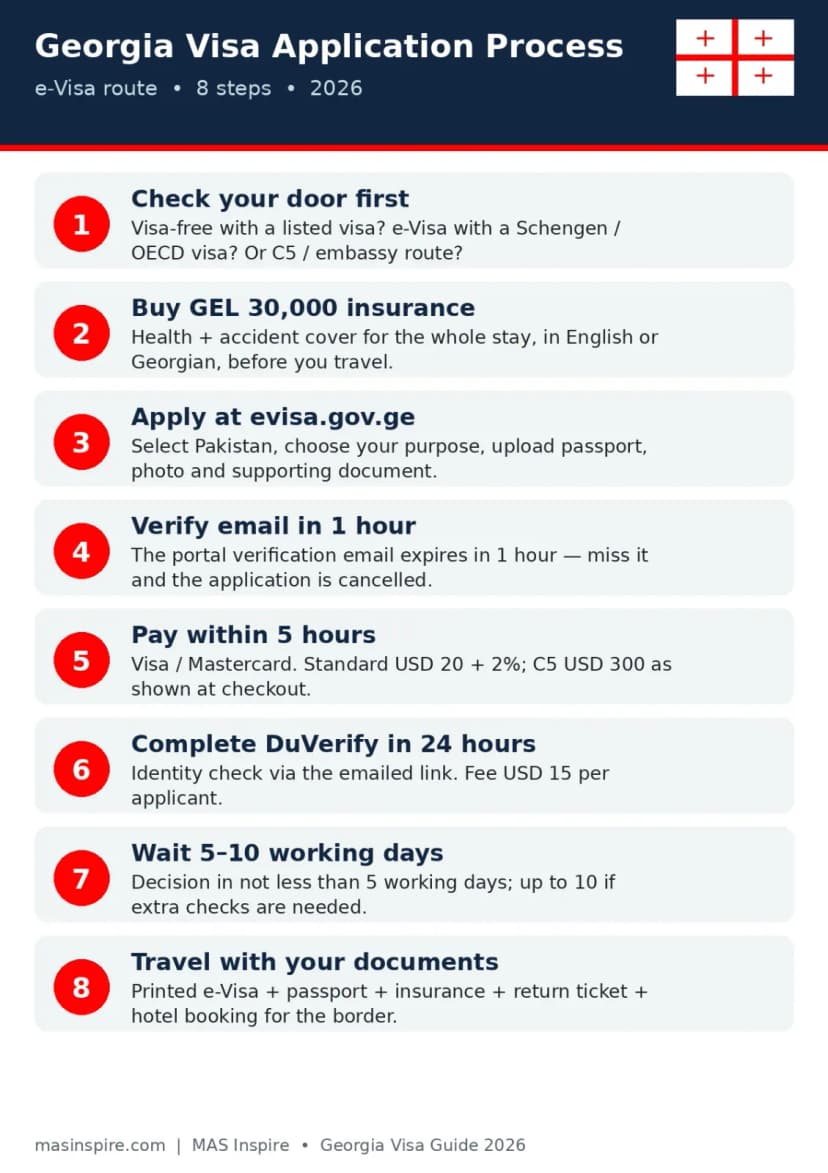
Step 1: Go to evisa.gov.ge and select Pakistan as the country of your travel document, then choose your purpose of travel. Read the options the form itself offers you and note the fee shown at checkout; this is the controlling figure. Step 2: Create the application and fill in your personal, passport and travel details exactly as they appear in your passport. Step 3: Upload your passport copy, photograph, supporting document if you are using the standard route, and the other documents the form asks for. Step 4: Verify your email within one hour of the verification message arriving, or the application will be cancelled. Step 5: When the payment notification arrives, pay by Visa or Mastercard within five hours. The standard route costs USD 20 plus a 2% service fee; the C5 route is reported at USD 300. The card does not have to be in your own name. Step 6: Complete the DuVerify identity check through the emailed link within 24 hours, and pay its USD 15 fee. Step 7: Wait for the decision, which takes not less than five working days and up to ten if extra checks are needed. Step 8: When the e-visa is issued, print it and carry it with your passport, insurance, return ticket and accommodation proof.
Route C: consular visa at an embassy
Step 1: Register on GeoConsul, the Georgian MFA online consular system at geoconsul.gov.ge, and complete the visa application form there. Step 2: Gather the documents for your visa type from the checklists above, with translations and legalisation where required. Step 3: File the application at the Georgian embassy that covers your place of residence, as explained in the next section, and pay the consular fee it quotes. Step 4: Attend any interview the embassy asks for and answer any request for extra documents promptly. Step 5: Collect your passport with the visa, check every detail on the visa sticker, including the dates and the number of entries, and report any error to the embassy at once.
Common mistakes to avoid
Do not start an e-visa application unless you can watch your email for the one-hour verification, the five-hour payment window and the 24-hour DuVerify link. Do not assume a Gulf residence permit qualifies you for visa-free entry without checking the one-year rule for Pakistani citizens. Do not travel without the GEL 30,000 insurance policy, even if nobody asked for it when you applied. Do not pay any website other than evisa.gov.ge, GeoConsul or the embassy itself. And do not book non-refundable flights or hotels before your visa is issued, because every Georgian visa fee is non-refundable and a refusal leaves you with the loss.
Applying from Vietnam: Nearest Mission and Online Route
Georgia has no embassy or consulate in Vietnam. A plan announced in 2019 to open embassies in the United Arab Emirates and Vietnam did not result in a Georgian embassy in Hanoi, and Vietnam does not appear on the current list of countries hosting a Georgian mission. That does not leave you without options: for most Pakistani residents in Vietnam the online routes are the practical ones, and the embassy route, where needed, goes through a mission in a neighbouring region.
The Embassy of Georgia in Beijing is concurrently accredited to Vietnam (and to Mongolia), which makes it the Georgian mission formally covering Vietnam. In practice, a resident of Vietnam who needs a consular visa should first contact the Beijing embassy or the MFA consular service to confirm whether the application can be filed by post or through an authorised channel, or whether an in-person visit to Beijing is required, and whether a different mission can accept the filing instead. Do not travel to Beijing, or to any other embassy, until that is confirmed in writing. For Pakistan itself, the Embassy of Georgia in Tehran is accredited to Pakistan, which is the mission a family member applying from Pakistan would normally use.
For most people reading this guide in Ho Chi Minh City or Hanoi, the sensible order is: first check whether you qualify for visa-free entry under Ordinance No. 256; if you do, you need no embassy at all. If you do not, try the e-visa portal next, with a supporting document for the USD 20 route or the C5 option as the portal presents it. Only if the portal cannot serve your case should you take the embassy route, and you should start it early because of the travel and the at-least-ten-day processing time. Keep your Vietnamese temporary residence card valid throughout, because you will need it to show your residence in Vietnam and to return to Vietnam after the trip, and a Vietnamese residence card is not a substitute for a Georgian visa or for a listed-country visa.
Flights and practical route from Vietnam
There are no direct flights from Vietnam to Georgia. The usual routes run through Istanbul, Doha, Dubai, Abu Dhabi or Bangkok, then on to Tbilisi, with Kutaisi and Batumi served mainly by low-cost carriers. Allow a generous connection time, and remember that a stopover that requires leaving the airport in the transit country is governed by that country's own visa rules, not by Georgia's. The currency in Georgia is the lari (GEL); carry a Visa or Mastercard for the e-visa payment and for travel spending, and keep some cash in lari or in a convertible currency for arrival.
Student Visas
Georgia attracts international students with English-taught programmes, modest tuition and a low cost of living, particularly in medicine, dentistry, business, IT and engineering. A Pakistani student living in Vietnam applies from Vietnam through the consular route: a long-stay D visa from a Georgian embassy, followed by a temporary residence permit after arrival in Georgia.
Start with the admission letter. You need an unconditional offer or enrolment confirmation from a recognised Georgian institution before the embassy will accept the visa application, and some institutions ask for part of the tuition in advance. The embassy will also want proof of funds covering tuition and living costs, your educational documents with legalisation or apostille and translation, accommodation in Georgia, and the mandatory health insurance. Allow two to three months from the offer letter to departure, and do not resign from a job or give up housing in Vietnam until the visa is in your passport.
After arrival, apply for a temporary residence permit at a Public Service Hall before your D visa expires. The residence permit is normally tied to the duration of your study and is renewable while you remain enrolled. Whether a student can work part-time during study is governed by the 2026 work-permit rules: from 1 March 2026 a separate Right to Labour Activity permit is required before any paid work, so do not take a job, including part-time or freelance work, on the strength of a student residence permit alone. Ask the university's international office and the Public Service Hall for the current position before you accept any work.
Work Visas and the 2026 Work-Permit Rule
Working in Georgia changed fundamentally on 1 March 2026, and any guide written before that date is now out of date on this point. Under amendments to the Law on Labour Migration adopted in June 2025 and Government Resolution No. 70 of 20 February 2026, any foreign national who does not hold a Georgian permanent residence permit must obtain a Right to Labour Activity permit from the State Employment Promotion Agency before starting any form of remunerated employment, freelance engagement or entrepreneurial activity in Georgia. This applies even if the person already holds a valid visa or a temporary residence permit. Holding a residence permit does not automatically give the right to work.
The process starts with the employer, not the worker. An employer intending to hire a foreign national must first publish the vacancy on the national employment portal, worknet.moh.gov.ge, for at least 10 business days. If no suitable local candidate emerges, the employer applies for the foreign worker through the electronic labour migration portal at labourmigration.moh.gov.ge. Self-employed foreigners apply independently through the same portal and must complete a mandatory video interview with the Agency. The standard processing time is 30 calendar days for a fee of GEL 200, and an expedited 10-working-day track costs GEL 400. The permit is initially granted for six months to one year. Both the worker and the employer face a fine of GEL 2,000 for a first offence of working without a permit.
Annual quotas also restrict some occupations. Foreign nationals are effectively barred from obtaining permits to work as couriers, passenger transport drivers or tourist guides, which carry a zero quota, and the annual quota for mountain, alpine and ski guide services is 200. English teaching is not on the zero-quota list reported in the 2026 sources, but a teaching job still needs the full permit process, and a school that offers you a job without advertising the vacancy and applying for your permit is not following the law. Be particularly careful with agents who promise a Georgian work visa for an upfront fee: a genuine offer runs through the employer, the vacancy advertisement and the Agency, and no agent can shortcut that sequence.
Foreigners who were already registered in Georgia's labour migration system with active status on 1 March 2026 have until 1 January 2027 to obtain the permit and the corresponding residence documentation, and self-employed foreigners already active on 1 March 2026 faced enforcement from 1 May 2026. If you are already in Georgia working, check your registration status now rather than waiting for the deadline.
Remote Workers and Digital Nomads
Georgia's Remotely from Georgia programme, launched in 2020, offers a formal 12-month stay for remote employees, freelancers and business owners whose income comes from outside Georgia. The commonly reported requirement is a monthly income of at least USD 2,000, or savings of about USD 24,000, together with proof that the work is performed remotely for a company or clients based outside Georgia. Applications are made online, and secondary sources report decisions in about five to ten working days. The programme does not give a residence permit, a work permit, or the right to work for a Georgian employer, and income earned from Georgian sources does not qualify.
There is an important eligibility warning for Pakistani passport holders. The programme was framed for nationals of countries that already have visa-free access to Georgia, and official descriptions of it describe the target group in those terms. A Pakistani passport holder does not have visa-free access on the passport alone. This guide could not verify from an official source whether a Pakistani applicant can enter the programme directly, or whether they must first hold a valid Georgian visa or visa-free entry and then apply. Do not plan a move to Georgia around Remotely from Georgia until the programme's own application page confirms your eligibility as a Pakistani citizen, and do not pay anyone who promises to register you.
Two further warnings apply. First, the fee is disputed: some 2026 sources describe the programme as free to apply for or as carrying a USD 20 application fee, while another describes a C5 digital-nomad visa at USD 300 standard or USD 500 expedited. Treat every fee figure for this route as unverified and confirm it on the official page. Second, the 1 March 2026 work-permit regime may affect remote workers: the new permit covers freelance engagement and entrepreneurial activity, and at least one 2026 source reports that the C5 category was introduced in April 2026 to separate the right to live in Georgia from the right to work in the local labour market. If you intend to freelance while in Georgia, take advice on whether you need a work permit as well as your remote-worker status, and do not rely on pre-2026 guides that describe Georgia as an unregulated remote-work base.
Family Reunification and Long-Stay Visas
Family reunification is a long-stay D-visa route followed by a residence permit. It covers joining a spouse, a minor child, a parent or another close family member who is legally resident in Georgia. The sponsor in Georgia must show legal residence, accommodation and sufficient means to support the arriving family member, and the relationship must be proved with civil-status documents, usually a marriage certificate or birth certificate, legalised or apostilled and translated into Georgian or English.
Long-stay D visas in general, for work, study or family reunion, are issued by Georgian embassies rather than through the e-visa portal, and the holder applies for a temporary residence permit at a Public Service Hall after arrival. Residence permits are normally issued for the duration of the underlying purpose, up to a year at a time, and are renewable while the purpose continues. Permanent residence is a separate, longer-term status with its own conditions, including years of lawful residence, and this guide does not treat it as a routine extension of a first D visa. As with the other long-stay routes, the D-visa fee could not be verified from an official source for this guide, so ask the embassy for the fee in writing when you file.
Extending Your Stay, Overstay and Fines
Whether you can extend a stay depends on how you entered. A short-stay C visa can, in principle, be extended in Georgia by application to the relevant authority, but the extension is discretionary and is not guaranteed; apply well before the visa expires, with a reason, supporting documents and a new insurance policy covering the extended period. A visa-free stay of 360 days for visa-free nationalities cannot be extended in the same way, but that rule is of limited relevance to a Pakistani passport holder, whose visa-free entry under Ordinance No. 256 is capped at 90 days in any 180 days. For a longer stay, the realistic route is to leave Georgia and apply for the appropriate long-stay visa or residence permit, rather than trying to stretch a short stay.
Apply for any extension or residence permit at a Public Service Hall (PSH) in Georgia, for example the Tbilisi branch at 2 Sanapiro Street, before your current permission expires. Bring your passport, photographs, proof of funds, accommodation evidence and insurance. Do not wait until the last day: if the application is refused or delayed past your expiry date, you may already be overstaying.
Overstay: a figure this guide will not state as fact
Overstaying in Georgia is an offence. It can lead to a fine, payable at the border or at an immigration office, and to a re-entry ban, with longer overstays carrying heavier consequences. That much is consistent across sources. The amount of the fine is not. Secondary sources published in 2026 give materially different figures for the same overstay: 150 GEL for the first day plus 50 GEL for each additional day; 180 GEL per day capped at 1,800 GEL; about 10 GEL per day capped at 1,000 GEL; and a banded scale of 180 GEL for the first ten days, 360 GEL for ten to thirty days and 720 GEL for longer overstays. One source also reports an extension fee of about 210 GEL at a Public Service Hall, which other sources do not mention at all.
Because no official tariff could be verified for this guide, this guide does not present any of those figures as the fine. The honest position is that the fine exists, it is assessed when you depart or when you attend an immigration office, and the exact amount depends on the rule the officer applies to your case. Do not budget for overstaying, and do not rely on the lowest figure you have seen online. If you have overstayed, or think you may have, contact the Public Service Hall or the Ministry of Internal Affairs before your departure date rather than hoping the matter goes unnoticed at the airport.
Frequently Asked Questions
1. Do Pakistani passport holders need a visa for Georgia?
Yes, on a Pakistani passport alone you need a visa. Pakistan is not on Georgia's visa-free nationality list and there is no visa on arrival. However, if you hold a valid visa or residence permit from a listed country such as the US, the UK, Canada, a Schengen state or a Gulf state, you can usually enter visa-free for up to 90 days in any 180 days under Ordinance No. 256.
2. Can I enter Georgia visa-free with a US, UK or Schengen visa?
Yes, if the visa is valid on the day you enter Georgia. Ordinance No. 256 covers holders of a valid visa or residence permit from about 50 listed countries, including the US, the UK, Canada, Australia, Japan and the Schengen states. Carry the physical visa and your passport, and have your insurance and return ticket ready.
3. I live in the Gulf. Does my UAE or Saudi residence permit let me enter visa-free?
It can, but as a Pakistani citizen you must meet a stricter condition added in April 2025 and in force from 16 May 2025: a Gulf visa or residence permit counts only if it is multiple-entry and still valid for at least one year on the day you cross the border. A permit with less than a year left does not qualify for the 17 named nationalities, Pakistan included.
4. Does my Vietnamese residence card help me enter Georgia?
No. Vietnam is not on Georgia's Ordinance No. 256 list, so a Vietnamese temporary residence card or Vietnamese visa does not give visa-free entry and is not a supporting document for the standard e-visa. It is still useful evidence of where you live and that you can return to Vietnam.
5. How much is the Georgia e-visa for a Pakistani passport holder?
The standard e-visa is USD 20 plus a 2% service fee, plus a mandatory USD 15 DuVerify identity check, so USD 35.40 in total. You can only use the standard route if you hold a valid Schengen visa, a visa from an OECD country, or a Schengen or OECD residence permit. The C5 tourism e-visa of up to one year is reported at USD 300 plus USD 15 DuVerify, but read the disclosure in the fees section: other guides dispute the C5 option, so the fee shown on the portal checkout is the controlling figure.
6. How long does the Georgia e-visa take?
The portal FAQ says a decision takes not less than five working days, and up to ten working days if extra checks are needed. The clock runs after you have paid and completed DuVerify. Apply at least three weeks before travel.
7. What is DuVerify and why must I pay USD 15?
DuVerify is a separate identity check that the e-visa portal requires after payment. You receive an emailed link that must be completed within 24 hours, and it costs USD 15 per applicant. Missing the 24-hour deadline can jeopardise the application, so watch your email after paying.
8. Is there a Georgian embassy in Vietnam?
No. Georgia has no embassy or consulate in Vietnam. The Embassy of Georgia in Beijing is concurrently accredited to Vietnam. For most applicants the online routes, visa-free entry or the e-visa portal, are the practical options, and anyone who needs a consular visa should confirm the filing route with the Beijing embassy or the MFA consular service before travelling.
9. Do I need travel insurance to enter Georgia?
Yes. Since 1 January 2026 every tourist entering Georgia must hold health and accident insurance with cover of at least GEL 30,000 (about USD 11,500) for the whole stay, including the arrival and departure days, in Georgian or English, on paper or on a phone. Border officers can ask to see it.
10. Can I work in Georgia on a tourist visa or visa-free entry?
No. A tourist visa and visa-free entry do not authorise work. Since 1 March 2026 every foreigner without Georgian permanent residence needs a Right to Labour Activity permit from the State Employment Promotion Agency before starting any paid work, freelance work or business activity, even if they hold a visa or residence permit.
11. Can I apply for a Georgia work visa from Vietnam?
You can start the process from Vietnam, but the employer must first advertise the vacancy on the national employment portal for at least 10 business days and then apply for your work permit. The D visa itself is issued by a Georgian embassy. A job offer alone is not enough, and you should not pay an agent who promises a work visa without this sequence.
12. What is the Remotely from Georgia programme and can a Pakistani join it?
It is a government programme offering a formal 12-month stay for people who work remotely for foreign employers or clients, with a reported income threshold of USD 2,000 per month or USD 24,000 in savings. Whether a Pakistani passport holder can join directly is not clearly established, because the programme was framed for nationals of visa-free countries. Confirm your eligibility on the official application page before planning around it.
13. How long can I stay in Georgia?
It depends on your route. Visa-free entry under Ordinance No. 256 allows up to 90 days in any 180-day period. The standard e-visa allows a stay of 30 days, with the visa valid for 120 days and single entry. The C5 tourism visa is issued for up to one year. Long-stay D visas allow up to one year and lead to a residence permit.
14. What happens if I overstay in Georgia?
Overstaying is an offence that can lead to a fine and a re-entry ban. This guide deliberately does not state a single fine figure, because secondary sources published in 2026 disagree widely, from about 10 GEL per day to 180 GEL per day, with different caps. If you have overstayed, contact a Public Service Hall or the Ministry of Internal Affairs before you travel.
15. Is there a visa on arrival in Georgia for Pakistanis?
No. There is no visa on arrival for Pakistani passport holders. You must hold visa-free entry under Ordinance No. 256, a valid e-visa, or a consular visa before you travel. Do not board a flight to Tbilisi hoping to buy a visa at the airport.
Official Immigration Websites
Use the official sites below for the rules that decide your application. Third-party guides, including this one, are no substitute for the portal checkout and the embassy's own instructions.
| Website | What it is for |
|---|---|
| evisa.gov.ge | Official Georgia e-visa portal (Ministry of Foreign Affairs); applications, fees at checkout, FAQ and the supporting-document list. Email: contact@evisa.gov.ge; tel: +995 32 294 5050. |
| geoconsul.gov.ge | GeoConsul, the MFA online consular system; consular visa applications and the Entering Georgia guidance, including the mandatory insurance rule. |
| mfa.gov.ge | Ministry of Foreign Affairs of Georgia; visa policy, Ordinance No. 256 and the list of Georgian missions abroad, including the Beijing embassy accredited to Vietnam. |
| labourmigration.moh.gov.ge | Electronic labour migration portal; Right to Labour Activity permit applications for workers and self-employed foreigners (from 1 March 2026). |
| worknet.moh.gov.ge | National employment portal where a Georgian employer must advertise a vacancy for at least 10 business days before hiring a foreign worker. |
| psh.gov.ge | Public Service Hall; residence permits, visa extensions and other in-country immigration services, including the Tbilisi branch at 2 Sanapiro Street. |
| matsne.gov.ge | Legislative Herald of Georgia; the published text of Government Ordinance No. 256 and its 2025 amendment (Ordinance No. 122), and Decree No. 602 on mandatory tourist insurance. |
| iata.org — Timatic | IATA Timatic; the entry-requirements database airlines use at check-in, useful as a cross-check before you fly. |
Editorial note: this guide was prepared on 27 November 2026 for Pakistani passport holders living in Vietnam. Immigration rules change, and Georgia changed its insurance rule in January 2026 and its work-permit rule in March 2026. Check the official sources above before you pay any fee or book travel, and treat the fee shown on the e-visa portal checkout as the final word on what you will pay.