Ethiopia Visa Guide 2026: Types, Requirements, Documents and Application Steps
Editorial date: 27 November 2026. Verified: 28 November 2026. This guide is written for Pakistani passport holders living in Vietnam. It is an educational resource, not legal advice and not an official Ethiopian government service. Immigration rules, fees and procedures can change; the amount shown on the official eVisa portal at the moment you pay is the amount that applies to your application.
Table of contents
- Introduction
- Why People Visit Ethiopia
- Do Pakistanis Need a Visa for Ethiopia?
- Types of Ethiopia Visas
- Visa Comparison Table
- Eligibility Requirements
- Complete Document Checklists
- How to Apply: Step-by-Step
- Visa Fees and Financial Requirements
- Visa Processing Times
- Applying from Pakistan or Vietnam
- Extending Your Stay in Ethiopia
- Common Application Mistakes
- Reasons for Visa Refusal and What to Do
- Frequently Asked Questions
- Official Immigration Websites
- Final Checklist and Conclusion
Introduction
Ethiopia, in the Horn of Africa, is one of the continent's oldest and most distinctive destinations: the rock-hewn churches of Lalibela, the Simien Mountains, the Danakil Depression, the historic cities of Gondar and Axum, and Addis Ababa, the diplomatic capital of Africa and home of the African Union. For a Pakistani passport holder living in Vietnam, the good news is that the route in is simple and fully online. Ethiopia's tourist eVisa is open to citizens of every country who meet the requirements, and the whole application is made on the official portal run by the Ethiopian Immigration and Citizenship Service at evisa.gov.et. There is no need to visit an embassy for a tourist trip, and no need to queue for a visa on arrival.
The single most important fact in this guide is the address of that portal. Only evisa.gov.et is official. The Immigration and Citizenship Service publishes warnings about lookalike websites that copy the portal's appearance, charge inflated fees and have no agreement with the Ethiopian Government. Applications and payments made through those sites are not accepted, and the Government takes no responsibility for money paid to them. Type the address yourself, check that the domain ends in .gov.et before you enter a passport number or a card number, and pay only on the official portal.
This guide covers the visa types that matter to a Pakistani traveller, the exact fees published on the official portal, the documents you need, the step-by-step application, processing times, extensions, and the honest limits of what could be verified. Where sources conflict — and on Ethiopia they do, because many websites still quote fees from before August 2024 — the conflict is disclosed in the text and the controlling source is named. Where a figure could not be verified at all, this guide says so rather than presenting a guess as a fact.
Why People Visit Ethiopia
Tourism and culture: Most Pakistani visitors come for sightseeing — Lalibela's monolithic churches, the castles of Gondar, the stelae of Axum, the Simien Mountains trek, the Danakil Depression, Lake Tana and its monasteries, and the coffee culture of the south. The tourist eVisa covers leisure travel, sightseeing and visiting friends and family.
Business and conferences: Addis Ababa hosts the African Union and a large conference and NGO sector, so business meetings, workshops and international conferences are a common reason to travel. Ethiopia issues separate business and workshop/conference eVisas for these purposes, and a tourist visa must not be used for work or for attending an organisation as if employed.
Transit: Addis Ababa Bole International Airport is Ethiopian Airlines' hub, and many travellers pass through on connections between Asia, Africa and Europe. Airside transit without leaving the airport does not need a visa, but leaving the airport to visit the city does — so a stopover needs an eVisa arranged in advance.
Study, work and longer stays: Ethiopia also issues eVisas for study, employment with a foreign business firm, investment, journalism, religious and NGO work, among other categories — thirteen eVisa types in total are listed on the official portal. These are specialist routes with their own requirements, usually including a registered host organisation in Ethiopia, and they are summarised briefly in this guide rather than covered in full.
Do Pakistanis Need a Visa for Ethiopia?
Yes. Pakistani passport holders need a visa to enter Ethiopia. There is no visa-free entry for Pakistanis: the only nationalities the official portal exempts from a visa are Kenya and Djibouti. A Pakistani passport holder living in Vietnam applies on exactly the same basis as a Pakistani passport holder living in Pakistan — what matters is the passport, not the country of residence.
Pakistanis are eligible for the tourist eVisa. The official portal states that citizens of all countries can apply for the tourist eVisa provided they meet the requirements, and independent visa checkers list Pakistan as "eVisa" for Ethiopia. The eVisa must be approved before you fly. It is issued by email as a PDF approval, which you print and present with your passport at Addis Ababa Bole International Airport.
Visa on arrival: do not rely on it. Ethiopia does operate a visa on arrival for tourists from a published list of eligible countries — roughly 119 countries according to current reporting, including the United States, the United Kingdom, EU countries, Canada, Australia, Japan, India, China, Saudi Arabia and the United Arab Emirates. Pakistan is not on that list. Multiple Pakistan-focused sources state plainly that visa on arrival is not granted to Pakistani nationals, and airport and layover guides place Pakistan in the "visa first — eVisa needed before you fly" group, alongside Vietnam, Nepal, Bangladesh and Sri Lanka. One Pakistan-focused guide could not confirm Pakistan's eligibility for visa on arrival at all. The safe and correct reading is: get the eVisa before you travel. Airlines may also check that you hold a visa at check-in in Ho Chi Minh City, and arriving without one risks being refused boarding or refused entry.

Types of Ethiopia Visas
The official eVisa portal lists thirteen eVisa types. The four below are the ones a Pakistani traveller is most likely to need. All eVisas are single entry unless the portal states otherwise for a specific category, and every eVisa is valid for entry only through Addis Ababa Bole International Airport.
1. Tourist eVisa (VT) — 30 days
The standard choice for a holiday, sightseeing trip or family visit. Single entry, stay of up to 30 days, fee USD 62 as published on the official portal. Validity counts from the arrival date you enter on the application form, not from the date the visa is approved, so choose your intended arrival date carefully. Tourist visa holders should not work, volunteer or attend an organisation in Ethiopia as if employed.
2. Tourist eVisa (VT) — 90 days
The same tourist visa with a longer stay: single entry, stay of up to 90 days, fee USD 152 as published on the official portal. Choose this if your trip is genuinely longer than a month, or if there is any realistic chance you will need more than 30 days — an extension costs more than the difference between the two visas (see the fees section), so the 90-day visa is cheaper than a 30-day visa plus an extension.
3. Workshop/Conference eVisa (CV) — 30 days
For attending an international conference, seminar or workshop in Ethiopia organised by a government ministry or department, a regional state government, an educational institution or university, a private-sector or government-owned organisation, the United Nations or its specialised agencies, the African Union, or a reputable NGO. Single entry, 30 days, fee USD 52 as published on the official portal. You need an official invitation letter from the conference or event organiser. The conference visa cannot be extended. Normal processing is 3 days.
4. Business and related eVisas (BRV and others)
The portal offers business categories including a Business and Related Studies Visa (BRV) and a Foreign Business Firm Employment Visa (WV), plus investment, NGO, journalism, religious and study categories. For business-type visas the Ethiopian organisation or company must first be registered and hold an approved reference code on the eVisa portal before you can apply, and you generally need an invitation or employment contract. Fee disclosure: the business-visa fee could not be verified on an official portal page in this research. Secondary sources conflict — one detailed fee table lists the BRV at USD 152 for 30 days and USD 202 for 90 days, while other guides quote around USD 72. Do not rely on either figure: the fee shown on the official portal at checkout is the controlling figure, and you should confirm it there before paying. The same applies to the investment visa, for which secondary sources list a range from USD 62 to USD 502 depending on duration and entries; those figures are likewise unverified here.
5. Embassy visa (sticker in the passport)
If you prefer a visa sticker placed in your passport rather than an electronic visa, Ethiopian embassies handle applications in person or by courier — for example the Embassy of Ethiopia in Washington, D.C. is reported to issue a single-entry tourist visa for USD 60 and a multiple-entry visa for USD 150, with one to three business days for processing. Disclosure: those embassy figures come from a secondary source only and were not verified against an official embassy page in this research, so treat them as reported, not confirmed. For most Pakistani travellers the online eVisa is simpler, cheaper to arrange and sufficient.
What does not exist: a multiple-entry tourist eVisa
Some third-party websites advertise a multiple-entry tourist eVisa for Ethiopia, at prices around USD 82. That product does not appear on the official portal's tourist visa page, which lists only the two single-entry options (30 and 90 days). Do not pay a third-party site for a multiple-entry tourist eVisa. If you leave Ethiopia, your single-entry eVisa is used up and you must apply for a new one to return.
Visa Comparison Table
| Visa type | Purpose | Entries | Maximum stay | Fee (USD) | Extendable? |
|---|---|---|---|---|---|
| Tourist eVisa (VT) | Tourism, sightseeing, visiting family | Single | 30 days | 62 | Yes — see extensions section |
| Tourist eVisa (VT) | Tourism, sightseeing, longer trip | Single | 90 days | 152 | Yes — see extensions section |
| Workshop/Conference eVisa (CV) | Conference, seminar, workshop | Single | 30 days | 52 | No |
| Business eVisa (BRV) | Business meetings and related studies | Single | 30 or 90 days | Not verified — see disclosure in the types section | Possible — confirm on the portal |
| Embassy tourist visa (sticker) | Tourism, for travellers who want a passport sticker | Single or multiple (as reported) | As issued | 60 / 150 as reported, not verified | Confirm with the embassy |
Fees in this table are the government fees published on the official portal for the tourist and conference visas. The portal's checkout figure controls if any figure here differs. All eVisa fees are non-refundable, including when an application is refused.
Eligibility Requirements
To qualify for an Ethiopian tourist eVisa as a Pakistani passport holder, you must meet the following conditions, all of which are stated by the Immigration and Citizenship Service or consistently reported from the official portal:
- Pakistani passport valid for at least six months from your intended date of entry into Ethiopia. Travellers whose passport is valid for less than six months are refused entry, and a damaged or fake passport makes you ineligible for both the eVisa and any visa on arrival.
- At least two blank pages in the passport are recommended for entry and exit stamps.
- A recent passport-size photograph that meets the portal's specifications — recent, clear, front-facing, plain background.
- A colour scan of the passport photo (bio-data) page, clear and legible, with details matching the application form exactly.
- A valid email address to receive the approved eVisa as a PDF.
- Travel details: your intended arrival date (validity counts from this date), flight details and an accommodation address in Ethiopia. If you do not yet know where you will stay on arrival, your tour operator's address is accepted.
- Payment by card: the fee is paid online by credit or debit card in US dollars. Note the portal's restriction: it does not accept card payments from applicants originating in Cuba, Iraq, Sudan, Yemen, Somalia, North Korea, Afghanistan, South Sudan, Syria or the Crimea region. Pakistan is not on that list, so a Pakistani applicant's card payment is accepted through the portal.
- Entry point: the eVisa is valid for entry only through Addis Ababa Bole International Airport. You cannot use an eVisa to enter by land or through another airport.
- Age and purpose: the tourist visa is for tourism and other non-business purposes. Business-type applicants must be 18 or over and apply under the correct business category with a registered host organisation.
Your Vietnam residence does not change any of these requirements, and it does not create any extra requirement either. The portal does not ask for a Vietnamese residence permit for a tourist eVisa, and no Vietnamese document is listed among the tourist eVisa requirements. Keep your Vietnamese temporary residence card with you when you travel anyway, because you will need it to re-enter Vietnam on your return.
Complete Document Checklists
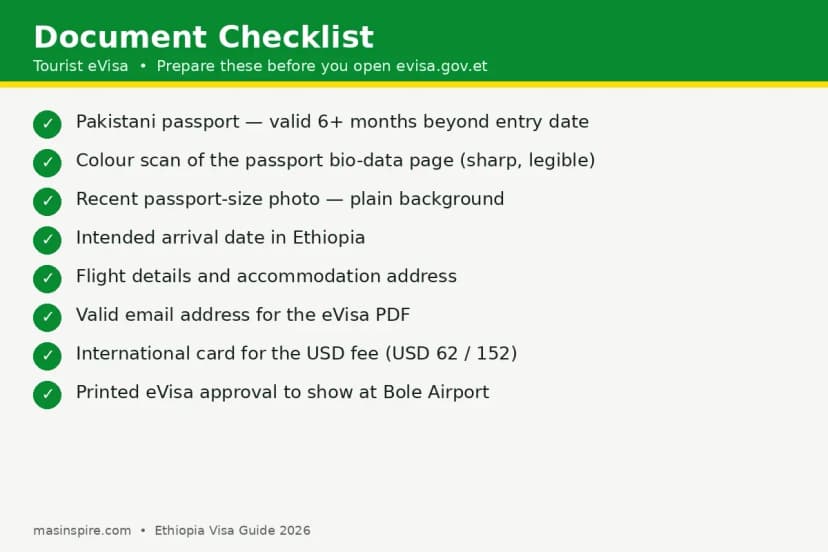
Prepare these before you open the portal. A clear scan and a matching form are the two things that most often decide an application.
Tourist eVisa checklist
- Pakistani passport — valid at least 6 months beyond your intended entry date, with at least two blank pages
- Colour scan of the passport bio-data page (PDF or image as the portal specifies, fully legible)
- Recent passport-size photograph (digital, plain background, front-facing)
- Intended arrival date in Ethiopia
- Flight itinerary or booking details
- Accommodation address in Ethiopia (hotel booking or host/tour-operator address)
- Valid email address for the eVisa PDF
- International credit or debit card for the USD fee
- Printed copy of the approved eVisa to present at Bole International Airport
- Yellow fever certificate — only if you are arriving from, or have transited more than 12 hours through, a country with a risk of yellow fever transmission (see the health section below)
Workshop/Conference eVisa checklist
- Everything on the tourist checklist above
- Official invitation letter from the conference, seminar or workshop organiser
- Details of the event: name, dates, venue and organising body
Business eVisa checklist
- Everything on the tourist checklist above
- Invitation letter from the Ethiopian company or organisation
- The host organisation's registered reference code on the eVisa portal (the organisation must be registered and approved before you apply)
- Employment contract, for a Foreign Business Firm Employment Visa
On arrival at Bole International Airport
- Passport (the same passport used for the eVisa application)
- Printed eVisa approval
- Return or onward ticket (sometimes asked for)
- Proof of accommodation (sometimes asked for)
- Yellow fever certificate, if applicable to your route
How to Apply: Step-by-Step
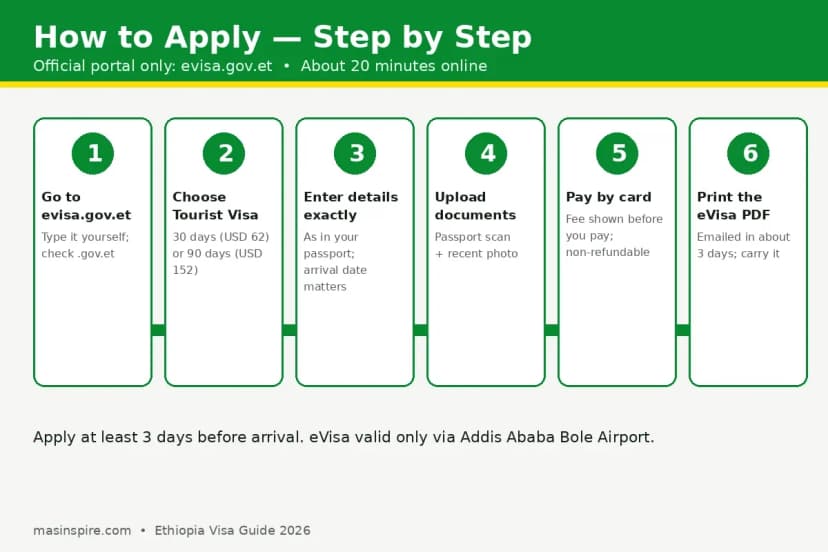
The application takes most people around twenty minutes to complete online. The slow part is waiting for the decision, so apply early and do not buy non-refundable tickets until the eVisa is approved.
- Open the official portal yourself. Type evisa.gov.et into your browser. Check the domain ends in .gov.et. Do not click a sponsored link or an agent's link to reach it.
- Choose "Apply Visa", then Tourist Visa, then 30 or 90 days. For a conference, choose the Business section and then Workshop/Conference Visa (CV). For business, choose the business category that matches your actual purpose and have the host organisation's reference code ready.
- Enter your personal and passport details exactly as they appear in your passport. Full name, date of birth, nationality (Pakistan), passport number, issue and expiry dates. The portal states it cannot modify anything after submission, and a wrong passport number means a refused application and a lost fee.
- Enter your travel details. Your intended arrival date — remember the visa's validity counts from this date — plus flight details and your accommodation address in Ethiopia.
- Upload your documents. The colour scan of your passport bio-data page and your recent passport-size photograph. Check both are sharp and legible before you submit; an unclear scan is one of the most common reasons for delay or refusal.
- Review everything, then pay. The fee is shown on the portal before you pay: USD 62 for a 30-day tourist visa, USD 152 for a 90-day tourist visa, USD 52 for a conference visa. Pay by international credit or debit card. If a payment looks as though it failed, check with your bank before paying again — the portal's terms say a duplicate payment will not be refunded.
- Wait for the email. The approved eVisa is sent to your email as a PDF. Normal processing is 3 days, so apply at least 3 days before your estimated arrival date — and in practice, apply a week or two ahead to leave room for any delay.
- Print the eVisa and carry it. Print the approval and carry a hard copy with your passport. Immigration officers at Bole International Airport check the printed document on arrival. Keep a copy with you during your stay as well.
- Check your status on the portal if it is late. Use the portal's own status page. Ethiopian embassies cannot look up your eVisa status, so phoning an embassy about a late approval will not help.
Health note — yellow fever: Ethiopia is listed by the World Health Organization as a country with a risk of yellow fever transmission in parts of the country, and Ethiopia requires a yellow fever vaccination certificate from travellers arriving from countries with a risk of yellow fever transmission, for travellers aged 9 months and over — including travellers who transited more than 12 hours through the airport of such a country. Pakistan and Vietnam are not yellow-fever risk countries, so a direct journey from Vietnam (or from Pakistan) does not trigger the certificate requirement. However, if your route transits through a risk country — for example a long stopover in an African country with yellow fever transmission — carry your International Certificate of Vaccination (the yellow booklet). WHO also recommends yellow fever vaccination for travellers going to Ethiopia itself. Disclosure: some secondary guides state that yellow fever vaccination is mandatory for all travellers to Ethiopia. That conflicts with the WHO country-requirement list, which requires the certificate only for arrivals from risk countries. The WHO position is the controlling one used in this guide; if you want certainty for your exact route, confirm with the embassy or your airline before you travel, and consider getting vaccinated in any case, since the certificate is valid for life and a vaccination on arrival, where offered, is at your own cost.
Visa Fees and Financial Requirements
The fees below for the tourist and conference visas are those published on the official eVisa portal and reproduced in current fee guides checked in November 2026. The portal checkout figure controls.
| Visa | Entry | Maximum stay | Government fee (USD) |
|---|---|---|---|
| Tourist eVisa (VT) | Single entry | 30 days | 62 |
| Tourist eVisa (VT) | Single entry | 90 days | 152 |
| Workshop/Conference eVisa (CV) | Single entry | 30 days | 52 |
| Business eVisa (BRV) | Single entry | 30 or 90 days | Not verified — portal checkout controls |
| Extension (applied for inside Ethiopia) | Entry | Additional stay | Fee (USD) |
|---|---|---|---|
| Tourist visa extension | Single entry | 30 days | 102 |
| Tourist visa extension | Single entry | 90 days | 302 |
Fee conflict — old prices still in circulation: many third-party websites still quote the pre-August 2024 prices of USD 52 for a 30-day tourist visa and USD 72 for a 90-day visa. Some guides published in 2026 still repeat those figures, and a few quote USD 52 for the tourist visa as though it were current. Those figures are out of date. The official portal's current tourist fee table lists USD 62 for 30 days and USD 152 for 90 days, with extension fees of USD 102 and USD 302, and current fee guides checked in November 2026 confirm the same figures. The official portal is the controlling source: if a website quotes USD 52 or USD 72 for a tourist eVisa, it is quoting the old price list.
What the fee does and does not cover: the fee is charged for the application, not for the visa — paying does not guarantee approval, and every payment is non-refundable, including the second payment of a duplicated transaction and the fee of a refused application. There is no separate service-centre fee, because the process is entirely online. If you apply through an agent or a third-party website you will pay extra on top of the government fee; applying yourself on evisa.gov.et costs only the government fee.
Financial requirements: the official tourist eVisa route does not publish a bank-statement or minimum-funds requirement — the portal asks for a passport and a photo. Disclosure: some Pakistan-focused agent websites claim Pakistani applicants need a certified six-month bank statement with a closing balance of PKR 1,000,000 to 2,000,000 plus an Account Maintenance Certificate, a verifiable flight itinerary and a hotel reservation. That list does not appear on the official tourist eVisa pages and looks like an agent's own document pack for an embassy application, not the eVisa requirement. This guide does not present it as an official requirement. In practice, carry proof of funds, a return ticket and a hotel booking anyway — immigration officers sometimes ask for them on arrival, and they cost nothing to have ready.
Money for the trip: budget for the visa fee plus flights (Ho Chi Minh City to Addis Ababa is usually routed via a Gulf or Asian hub, as there is no direct flight), accommodation, internal transport and a contingency for the extension fee if your plans might run long. Ethiopia's currency is the birr (ETB); carry US dollars in cash for exchange and a card that works internationally, and keep the visa fee payment receipt.
Visa Processing Times
| Route | Normal processing | When to apply |
|---|---|---|
| Tourist eVisa (online) | 3 days (3 business days as reported by current guides) | At least 3 days before arrival; a week or two ahead is safer |
| Workshop/Conference eVisa (CV) | 3 days | At least 3 days before arrival |
| Embassy tourist visa (sticker, as reported) | 1–3 business days | Confirm with the embassy |
| Visa extension (inside Ethiopia) | 1–3 days as reported | Before your current visa expires |
Processing-time disclosure: the official portal states the 3-day figure for the tourist and conference visas and advises applying at least 3 days before departure. Some current guides describe the same period as 3 business days, some say decisions usually arrive within 1–3 business days, and some report that most applicants hear back within 24–48 hours. Those are not contradictions so much as different descriptions of the same window — the portal's own advice is "at least 3 days", and that is the figure to plan around. One Pakistan-focused guide states that the portal publishes no standard processing time; that is not correct for the tourist and conference pages, which do state 3 days. There is no published express or urgent service on the official portal, and no agency can guarantee approval or a faster decision. Do not buy non-refundable tickets until the eVisa is approved, and do not apply too far in advance either: because validity counts from the arrival date you enter on the form, an application made months ahead with the wrong arrival date can waste the visa's validity window.
Applying from Pakistan or Vietnam
From Vietnam (your situation): apply online at evisa.gov.et from Ho Chi Minh City. Your Vietnamese residence is irrelevant to the application — the portal decides on your Pakistani passport, and no embassy visit is needed. You will fly out of Vietnam (normally via a Gulf, Middle Eastern or Asian hub) and enter Ethiopia only through Addis Ababa Bole International Airport, where you present your passport and printed eVisa. Keep your Vietnamese temporary residence card safe for your return to Vietnam, and check its validity covers your return date.
From Pakistan: the same online route applies — apply at evisa.gov.et before departure, with the same fees and the same 3-day processing. Ethiopia has an embassy in Islamabad, which opened in May, and it can be contacted about embassy visas and non-tourist categories such as work or study. Disclosure: the embassy's street address could not be verified from an official source in this research — one Pakistan-focused guide checked in November 2026 also could not verify it — so this guide does not publish an address. Check with the embassy before visiting, and do not travel to Islamabad for a tourist visa you can get online.
No Ethiopian embassy in Vietnam: no Ethiopian embassy or consulate in Vietnam was confirmed in this research. That does not matter for a tourist or conference trip, because the eVisa is fully online. For a work, study or other non-tourist visa that needs an embassy, contact the Embassy of Ethiopia in Islamabad or the Immigration and Citizenship Service directly, and get written confirmation of where a Vietnam-resident Pakistani should file before you make any travel plans around it.
Transit through Addis Ababa: if you are only changing planes airside at Bole International Airport without leaving the airport, you do not need a visa. If your connection is long and you want to leave the airport and visit Addis Ababa, you need an approved eVisa in advance — Pakistanis cannot count on a visa on arrival. Disclosure: Ethiopia's Council of Ministers approved visa-free stopovers of 24 hours to 7 days for Ethiopian Airlines passengers in April 2026, but reports in September 2026 said the measure still needed final approval. Treat it as not yet in force: do not plan a stopover around it until Ethiopian Airlines or the Immigration and Citizenship Service confirms it is operating.
Extending Your Stay in Ethiopia
If you need more time inside Ethiopia, apply for an extension before your visa expires at the Immigration and Citizenship Service (also referred to as the Immigration, Nationality and Vital Events Agency, INVEA) office in Addis Ababa. Bring your passport, the original visa and a letter explaining the reason for the extension. The extension fees published on the official portal are USD 102 for a further 30 days and USD 302 for a further 90 days — both higher than the original visa fee. That is why the 90-day visa at USD 152 is the cheaper choice for any trip that might run past a month: a 30-day visa (USD 62) plus a 30-day extension (USD 102) costs USD 164 in visa fees, against USD 152 for the 90-day visa outright.
The conference visa cannot be extended at all. For other categories, extension is described as possible but the exact conditions are set by the Immigration and Citizenship Service in Addis Ababa — confirm them there before your visa runs out. Never overstay: the eVisa service states that travellers who stay beyond the validity period without extending are subject to fines and legal penalties, and overstaying can block your departure until the matter is settled. Disclosure: one secondary guide quotes a specific overstay penalty of a USD 3,000 fine plus USD 30 per day of overstay, payable in foreign currency only. That figure comes from a single secondary source and was not verified on any official portal page in this research, so this guide does not present it as fact. The safe position is that overstaying carries fines and legal consequences whose amount is not published on the official portal — do not test it.
Common Application Mistakes
- Using a lookalike website. Sites such as ethiopiaevisa.com, ethiopiaimmigration.org, ethiopiaonlinevisa.com and evisaforethiopia.com are named in the Immigration and Citizenship Service's fraud warning. They charge inflated fees, their applications are not accepted, and the money is not recoverable. Only evisa.gov.et is official.
- Choosing the wrong arrival date. Validity counts from the arrival date you enter on the form, not from the approval date. Enter the date you actually intend to land.
- Paying the old fee from an outdated guide. The current tourist fees are USD 62 and USD 152. Guides quoting USD 52 and USD 72 are using the pre-August 2024 price list.
- Applying for the wrong visa type. A tourist visa does not cover business meetings, conferences or work. A conference needs the CV category with an invitation letter; business needs the correct business category with a registered host.
- Unclear uploads. A blurred passport scan or a photo that does not meet the specifications is one of the most common causes of delay or refusal. Check both files at full size before submitting.
- Details that do not match the passport. Even a small difference in name spelling or passport number can mean refusal — and the fee is not refunded.
- Paying twice after a failed payment. Check with your bank first; a duplicate payment will not be refunded.
- Counting on a visa on arrival. Pakistan is not on the visa-on-arrival list. Arriving without an approved eVisa risks refusal of boarding or refusal of entry.
- Assuming the eVisa works at any border. It is valid for entry only through Addis Ababa Bole International Airport. Land borders and other airports do not accept it.
- Booking non-refundable travel before approval. Apply first, wait for the PDF, then commit to tickets and hotels you cannot cancel.
Reasons for Visa Refusal and What to Do
The Immigration and Citizenship Service states that if an application is refused it will notify you of the refusal but not of the reason, and the fee is not refunded. That makes it worth getting the application right the first time. The usual causes reported across current guides are: an unclear passport scan or photograph; details in the form that do not match the passport exactly; applying for the wrong visa type for the trip; missing or inconsistent travel details, such as hotel and flight dates that do not match; and applying through an unofficial website that never submits to evisa.gov.et.
If your application is refused, do not simply pay and submit the same application again — the same error will produce the same result and another lost fee. Instead, re-check every field against your passport, replace any unclear upload with a sharp scan, confirm you chose the right visa category for your purpose, and make sure your travel dates and accommodation details are consistent. If the refusal followed an application through a third-party site, apply directly on evisa.gov.et. For a non-tourist purpose that was refused, contact the Embassy of Ethiopia in Islamabad or the Immigration and Citizenship Service for advice on the correct category before reapplying. There is no published appeal process for an eVisa refusal, and no agent can guarantee approval.
Frequently Asked Questions
1. Do Pakistani citizens need a visa for Ethiopia?
Yes. Pakistani passport holders need a visa for Ethiopia. There is no visa-free entry for Pakistanis — the only visa-exempt nationalities are Kenya and Djibouti. Apply for the tourist eVisa online at evisa.gov.et before you fly.
2. Can Pakistanis apply for the Ethiopia eVisa online?
Yes. The tourist eVisa is open to citizens of all countries who meet the requirements, including Pakistanis. The application is fully online at evisa.gov.et, no embassy visit is needed, and the approved eVisa is emailed to you as a PDF to print and present at Bole International Airport.
3. How much is the Ethiopia tourist eVisa?
USD 62 for a single-entry visa with a stay of up to 30 days, or USD 152 for a single-entry visa with a stay of up to 90 days, as published on the official portal. The conference visa is USD 52 for 30 days. The fee shown on the portal at checkout is the controlling figure, and all fees are non-refundable.
4. How long does the Ethiopia eVisa take to process?
Normal processing is 3 days, and the portal advises applying at least 3 days before your estimated arrival date. Current guides variously describe this as 3 business days or 1–3 business days, with many applicants hearing back within 24–48 hours. Plan around the portal's own figure of 3 days and apply a week or two ahead where you can.
5. Can Pakistanis get a visa on arrival in Ethiopia?
No — do not rely on it. Ethiopia's visa on arrival is only for tourists from a published list of eligible countries, and Pakistan is not on that list. Pakistan-focused sources state that visa on arrival is not granted to Pakistani nationals. Get the eVisa approved before you fly.
6. Is the Ethiopia eVisa single entry or multiple entry?
The tourist eVisa is single entry. Once you leave Ethiopia it is used up, and you must apply for a new eVisa to return. No multiple-entry tourist eVisa is listed on the official portal, despite some third-party sites advertising one.
7. Which airport can I enter Ethiopia through with an eVisa?
Only Addis Ababa Bole International Airport. The eVisa is not valid for entry by land or through any other airport.
8. How long must my passport be valid for Ethiopia?
At least six months beyond your intended date of entry, with at least two blank pages recommended. A passport valid for less than six months means refusal of entry, and a damaged passport makes you ineligible for the eVisa.
9. Do I need a yellow fever certificate for Ethiopia?
Only if you are arriving from, or have transited more than 12 hours through, a country with a risk of yellow fever transmission. Pakistan and Vietnam are not risk countries, so a direct journey from Vietnam does not trigger the requirement. WHO also recommends yellow fever vaccination for travellers going to Ethiopia, and the certificate is valid for life — consider getting vaccinated before you travel, and carry the yellow booklet if your route passes through a risk country.
10. Can I extend my Ethiopia visa while I am there?
A tourist visa can be extended at the Immigration and Citizenship Service office in Addis Ababa before it expires, for USD 102 (a further 30 days) or USD 302 (a further 90 days). The conference visa cannot be extended. Never overstay — fines and legal penalties apply.
11. I live in Vietnam on a Pakistani passport. Where do I apply?
Online at evisa.gov.et, from Vietnam. Your residence does not change the process: the portal decides on your Pakistani passport, no embassy visit is needed, and there is no confirmed Ethiopian embassy in Vietnam to visit. Keep your Vietnamese temporary residence card for your return to Vietnam.
12. What documents do I need for the Ethiopia tourist eVisa?
A Pakistani passport valid for at least six months, a colour scan of the passport bio-data page, a recent passport-size photograph, your intended arrival date, flight details, an accommodation address in Ethiopia, a valid email address and an international card for the fee. No bank statement is listed among the official tourist eVisa requirements.
13. What happens if my Ethiopia eVisa is refused?
The Immigration and Citizenship Service will tell you that the application was refused but not the reason, and the fee is not refunded. Check every field against your passport, replace any unclear upload, confirm you chose the right visa category, and reapply on evisa.gov.et directly — not through a third-party site.
14. Is evisa.gov.et the only official website?
Yes. The Ethiopian Immigration and Citizenship Service runs the eVisa service only at evisa.gov.et. Lookalike domains such as ethiopiaevisa.com, ethiopiaimmigration.org, ethiopiaonlinevisa.com and evisaforethiopia.com are named in the Service's fraud warning: they have no agreement with the Government, their applications are not accepted, and money paid to them is not recoverable.
15. Can I transit through Addis Ababa without a visa?
Yes, if you stay airside and do not leave the airport. If you want to leave the airport during a long connection, you need an approved eVisa in advance. A visa-free stopover scheme for Ethiopian Airlines passengers was approved in principle in April 2026 but was reported in September 2026 as still awaiting final approval, so do not plan around it until the airline or the Immigration and Citizenship Service confirms it is operating.
Official Immigration Websites
| Website | What it is for |
|---|---|
| Ethiopian eVisa portal — Tourist Visa (evisa.gov.et) | Official tourist eVisa information, fee table (USD 62 for 30 days, USD 152 for 90 days; extensions USD 102 and USD 302) and the application itself. The only official application channel. |
| Ethiopian eVisa portal — home (evisa.gov.et) | Start page of the official eVisa service run by the Ethiopian Immigration and Citizenship Service; apply, pay and check your application status here. |
| World Health Organization — yellow fever country requirements | WHO list of countries with a risk of yellow fever transmission and countries requiring a certificate: Ethiopia requires it for arrivals from risk countries (age 9 months and over). |
| UrduPoint — Ethiopia Visa for Pakistanis 2026 | Pakistan-focused guide checked 19 November 2026: eVisa eligibility for Pakistanis, Islamabad embassy presence, and the unverified embassy address noted in this guide. |
| Sky Raah — Ethiopia Visa from Pakistan 2026 | Pakistan-focused guide reviewed 30 October 2026: online eVisa route, 3-business-day processing as reported, and the embassy's direction to apply only at evisa.gov.et. |
| Layover Pass — Addis Ababa layover and transit guide | Visa-on-arrival list and the "visa first" group including Pakistan, plus the April 2026 stopover approval and its September 2026 status, checked 9 November 2026. |
| Drive Ethiopia — Ethiopia eVisa fees 2026 | Fee guide reproducing the official portal's tourist and extension fees (USD 62 / 152; extensions USD 102 / 302) and the fraud-site warning. |
| Africa Tour Operators — Ethiopia Visa Requirements | Guide to the portal's tourist visa, fees and card-payment restrictions, including the countries whose card payments the portal does not accept. |
| AlwaysPacked — Ethiopia eVisa Guide | Fee guide checked 15 November 2026 against the official portal: USD 62 / USD 152 tourist fees and 3-day processing. |
| Ethiosinia — Ethiopia Visa Guide | Guide to eVisa types, the 3-business-day processing figure and extension handling at the Immigration office in Addis Ababa. |
Final Checklist and Conclusion
Before you travel, run through this list:
- Pakistani passport valid at least 6 months beyond your entry date, with two blank pages
- Tourist eVisa applied for on evisa.gov.et — 30 days (USD 62) or 90 days (USD 152) — and approved before you fly
- Printed eVisa approval packed with your passport
- Return or onward ticket and accommodation details ready to show if asked
- Yellow fever certificate packed if your route transits a risk country for more than 12 hours
- Vietnamese temporary residence card kept safe for your return to Vietnam
- US dollars in cash and an international card for spending in Ethiopia
Ethiopia is one of the more straightforward African visas for a Pakistani passport holder: the whole process is online, the fees are published on the official portal, processing is normally three days, and no embassy visit is needed from Vietnam. The risks are almost all avoidable — lookalike websites, the old USD 52 / USD 72 fee figures still quoted across the web, the wrong visa category, and the mistaken belief that a visa on arrival will be available. Avoid those, apply on evisa.gov.et with a clear passport scan and details that match your passport exactly, and the visa is the easy part of the trip. The harder part is choosing between Lalibela, the Simien Mountains and the Danakil Depression — and that is a good problem to have.
Sources for this guide are listed in the Official Immigration Websites table above. Figures were verified against the official eVisa portal and current guides on 28 November 2026; where sources conflicted, the conflict is disclosed in the text with the controlling source named. Always confirm the fee shown on evisa.gov.et at the moment you apply, because fees change and older pages still quote earlier prices.