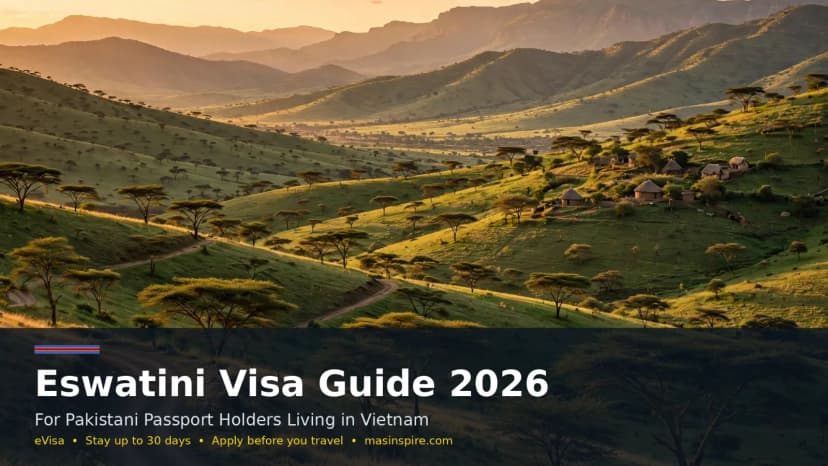
Eswatini Visa Guide 2026: Types, Requirements, Documents and Application Steps
Editorial date: 27 November 2026. Verified: 28 November 2026. This guide is written for Pakistani passport holders living in Vietnam. It is an educational resource, not legal advice and not an official government service. Immigration rules, fees and procedures change without notice, so always confirm the current rule on the official eVisa portal or with the Ministry of Home Affairs or an Eswatini mission before you book travel or pay any fee.
Table of contents
- Introduction
- Do Pakistani Passport Holders Need a Visa for Eswatini?
- Types of Eswatini Visas
- Visa Comparison Table
- Eligibility and Passport Requirements
- Complete Document Checklists
- How to Apply: Step-by-Step
- Visa Fees and Financial Requirements
- Visa Processing Times
- Applying from Vietnam
- Getting There: Flights, Transit and Arrival
- Extending Your Stay and Temporary Residence Permits
- Common Application Mistakes
- Reasons for Visa Refusal
- Frequently Asked Questions
- Official Immigration Websites
- Final Checklist and Conclusion
Introduction
Eswatini, formally the Kingdom of Eswatini and formerly known as Swaziland, is a small landlocked country in Southern Africa, bordered by Mozambique to the north-east and South Africa on its other sides. Its capital is Mbabane, its largest city is Manzini, and its main international airport is King Mswati III International Airport (SHO), near Manzini. Visitors come for the Ezulwini Valley, wildlife reserves such as Hlane Royal National Park and Mlilwane Wildlife Sanctuary, cultural festivals including the Umhlanga Reed Dance, and business in Mbabane and Manzini. The country is small enough to cross by road in a few hours, yet its immigration rules are strict about one point that matters most to this guide: most travellers who need a visa must hold it before they travel.
This guide is written for a specific reader: a Pakistani passport holder living in Vietnam, most likely in Ho Chi Minh City or Hanoi, holding a Vietnamese temporary residence card or a valid Vietnamese visa. That combination creates two practical questions that a generic guide does not answer. First, does your Pakistani passport need a visa at all? Yes, it does. Second, where do you apply from, given that there is no Eswatini embassy or high commission in Vietnam? The honest answer is that the online eVisa portal is your first and best route, and any paper application must be confirmed in writing with the mission or the Ministry of Home Affairs before you send your passport anywhere. This guide explains why, and what to do instead of guessing.
Eswatini changed its name from Swaziland in April 2018. Older websites, forms and guidebooks still say Swaziland, and the High Commission in Kuala Lumpur still appears under both names in directories. The country is the same, the immigration authority is the same, and a form that says Swaziland is not automatically invalid, but you should use the current name, Eswatini, on your own application, cover letter and travel documents, and treat any source that still calls the country Swaziland as a source that may also carry out-of-date fees and procedures.
The currency is the lilangeni (SZL, plural emalangeni, symbol E), which is pegged at one to one to the South African rand (ZAR). Government visa fees are published in emalangeni, while missions abroad quote their own charges in US dollars or local currency. That difference is the single biggest source of confusion about Eswatini visa costs, and it is disclosed in full in the fees section below rather than smoothed over with one tidy number.
A final warning before the detail: Eswatini has suspended visa on arrival, and the government advises travellers not to rely on getting a visa at the border while the eVisa system is being rolled out. Do not book a non-refundable flight to Eswatini, or to Johannesburg as a gateway, until you hold an approved visa or eVisa in hand. A visa also does not guarantee entry. The immigration officer at the port of entry makes the final decision, and can refuse entry if your documents, funds or onward travel do not match your stated purpose.
Do Pakistani Passport Holders Need a Visa for Eswatini?
Yes. Pakistani ordinary passport holders need an entry visa for Eswatini, obtained before travel. Pakistan is not on Eswatini's visa-exemption list. That list covers about 90 countries and territories, including the United Kingdom, the United States, European Union member states, Canada, Australia, Japan, South Africa, Malaysia, Singapore, Kenya, Botswana, Mozambique, Zambia and Zimbabwe, who may enter visa-free for up to 30 days, with Taiwan listed for 90 days. Pakistan does not appear on that list in any source checked for this guide, including the visa-policy summary and the High Commission of the Kingdom of Eswatini in Kuala Lumpur's published list, which was checked on 10 October 2026 by an independent visa tracker. Your Vietnamese residence does not change this: Eswatini's exemption is based on the passport you travel on, not on where you live. A Vietnamese residence card helps you prove where you are applying from, but it does not make a Pakistani passport visa-exempt.
There is no visa on arrival for Pakistani passport holders. Multiple secondary sources state that Eswatini has suspended visa on arrival generally, and the official eVisa portal describes its system as the replacement for both visiting a mission in person and obtaining a visa on arrival. One older general guide still mentions that a visa on arrival may be possible in limited cases with a local host's undertaking. That is not a route to plan around: no official source checked for this guide confirms it is available to Pakistani nationals in 2026, and the controlling advice, from the Ministry of Home Affairs through its eVisa portal, is to obtain approval before departure. Treat any agent who promises a visa on arrival at King Mswati III International Airport as a risk, not a shortcut.
The visa you need for a short visit is an entry visa, issued either as an eVisa through the official portal at evisa.gov.sz or as a paper visa through the Ministry of Home Affairs headquarters in Mbabane or an Eswatini mission abroad. The eVisa described on the official portal is for tourism or business visits. It is single entry, must be used within 90 days of issue, and permits a stay of up to 30 days. Volunteers and interns are also described as visitor-visa travellers in secondary guidance, but if your visit involves any paid work, study, or a stay longer than about one month, you need a Temporary Residence Permit instead of, or in addition to, an entry visa. Do not try to enter on a visitor visa and then take a job: work without the correct permit is a refusal and removal risk, and it can affect future applications.

Types of Eswatini Visas
Eswatini's short-stay system is built around one entry visa with different purposes, plus a separate permit system for longer stays. The names vary slightly between the eVisa portal, the Ministry of Home Affairs and individual missions, so this section groups them by purpose and states what each one does and does not allow. Choose by what you will actually do in Eswatini, not by which option looks easiest: a mismatch between your visa purpose and your real activity is one of the most common reasons for refusal and for problems at the border.
Tourist eVisa and visitor visa
The tourist or visitor visa is the standard route for sightseeing, visiting friends or family, cultural events and other non-work visits. On the eVisa portal it is a single-entry authorisation, valid for entry within 90 days of issue, with a stay of up to 30 days. The paper visitor visa issued by a mission or the Ministry can carry a longer validity, with the published government fee schedule listing single-entry visas with three months' validity and multiple-entry visas with three, six, nine and twelve months' validity. The length of stay granted on arrival is normally up to 30 days regardless of the visa's validity period: validity is how long you have to use the visa, and stay is how long you may remain once admitted. Do not confuse the two. The tourist visa does not authorise paid work, study, or running a business in Eswatini.
Business eVisa and business visitor visa
The business visitor visa covers meetings, conferences, negotiations, site visits and other short business activity that is not paid employment in Eswatini. The eVisa portal lists business alongside tourism as an eVisa purpose. A business application normally needs an invitation letter from the Eswatini company or organisation you will visit, stating who you are meeting, why, and for how long, plus a covering letter from your own employer or business in Vietnam explaining your role and that your costs are covered. A business visitor visa does not allow you to take a salaried job in Eswatini, sign an employment contract, or be paid by an Eswatini employer. If the Eswatini side wants to employ you, that is a work permit case, not a business visit.
Transit visa
Family visit visa
Temporary Residence Permit: work, study, business and dependants
Anyone who wants to stay longer than about three months, or to work, study, invest or join family in Eswatini, must apply for a Temporary Residence Permit rather than an entry visa. The permits system is administered by the Ministry of Home Affairs under the Immigration Act 1982 and the Immigration Regulations 1987, and applications are lodged with the Chief Immigration Officer in Mbabane. The published permit categories include work permits for employees and for business persons, study permits, and dependants' permits. These cases commonly require a police clearance certificate, a medical certificate, proof of qualifications, an employer letter and proof that the job was advertised locally, and they take far longer than a visitor visa: published guidance speaks of four to eight weeks for permits, and you should allow more. The Ministry published work-permit fees in emalangeni in August 2026, ranging from E1,200 for one day to one month up to E6,000 for 24 months for an employee permit, plus a separate application fee. Those figures are quoted here as published permit fees, not as visitor-visa fees, and they must be confirmed at the counter because the Ministry revises fees by notice. Do not apply for a visitor visa as a way of starting work or study and sorting the permit out later.
Visa Comparison Table
The table below summarises the routes a Pakistani passport holder living in Vietnam is most likely to use. Fees and processing times are explained in detail, with their conflicts disclosed, in the sections that follow. Where a figure is given as a range, it is because different official channels publish different figures, not because this guide is uncertain about which one to print.
| Visa or permit | Who it is for | Stay | Entries | Where to apply | Work allowed? |
|---|---|---|---|---|---|
| Tourist eVisa | Sightseeing, culture, visiting friends or family | Up to 30 days | Single entry, use within 90 days of issue | Online at evisa.gov.sz | No |
| Business eVisa | Meetings, conferences, site visits | Up to 30 days | Single entry, use within 90 days of issue | Online at evisa.gov.sz | No paid work in Eswatini |
| Paper visitor visa (single entry) | Tourism, business or family visit where the eVisa route is not used | Up to 30 days on admission | Single entry; visa validity 3 months as listed | Ministry of Home Affairs, Mbabane, or an Eswatini mission | No |
| Paper visitor visa (multiple entry) | Repeat short visits over several months | Up to 30 days per admission | Multiple entry; validity 3, 6, 9 or 12 months as listed | Ministry of Home Affairs, Mbabane, or an Eswatini mission | No |
| Transit visa | Short stopover en route to a third country | Short, as issued | As issued | Ministry of Home Affairs or an Eswatini mission | No |
| Temporary Residence Permit (work) | Employment in Eswatini | As issued, up to 24 months per issue in published fee bands | As issued | Chief Immigration Officer, Mbabane, via employer | Yes, only the job on the permit |
| Temporary Residence Permit (study) | Full-time study in Eswatini | As issued, for the course | As issued | Chief Immigration Officer, Mbabane, via the institution | Only as the permit allows |
| Temporary Residence Permit (dependant) | Joining family resident in Eswatini | As issued | As issued | Chief Immigration Officer, Mbabane | Only as the permit allows |
Eligibility and Passport Requirements
Eligibility for a visitor visa is straightforward in principle and strict in practice. You must hold a valid Pakistani ordinary passport, be able to show a genuine short-visit purpose, have enough money for your stay, hold a return or onward ticket, have somewhere to stay, and be admissible on health and character grounds. The immigration officer may also consider your travel history, your ties to Vietnam, and whether your stated plans are credible for the time and money you have. A teacher living and working in Ho Chi Minh City with a Vietnamese residence card, an employment letter and a return ticket to Vietnam is in a stronger position than an applicant with no evidence of where they live or what they will return to, so include that Vietnam evidence even though the eVisa portal's headline checklist does not always list it.
Your passport is the first thing that is checked and the easiest thing to get wrong. The sources disagree on the exact passport rule, and the disagreement is disclosed here rather than hidden. The official eVisa portal's guidance and the Ministry's general visa guidance require a passport valid for at least three months, with unused pages for the visa and entry or departure endorsements. A secondary guide for Pakistani applicants states the passport must be valid for at least 30 days after the planned stay ends, with at least two blank pages. The High Commission in Kuala Lumpur's published checklist states validity extending at least 30 days beyond the intended stay, but requires four blank pages. Other general guides state six months' validity. The controlling source for an eVisa application is the eVisa portal itself, which states three months, so a passport with at least three months' validity should meet the portal rule. The safe course, however, is to travel with at least six months' validity and at least two completely blank pages, and four blank pages if you are applying on paper through Kuala Lumpur, because that satisfies every version of the rule at once. Renew your Pakistani passport in Vietnam through the Pakistan Embassy in Hanoi before applying if your passport is close to any of these limits: a passport that expires during processing or during your trip is a common avoidable refusal.
Your passport must be undamaged, machine-readable, and signed where required. A damaged passport, a passport with a detached or altered photo page, or a passport with no blank pages will be refused or returned. Carry the same passport you applied with: the eVisa is linked to that passport number, and travelling on a different passport, including a renewed one issued after approval, means the eVisa will not match at the border. If you renew your passport after your eVisa is approved, contact the Ministry of Home Affairs before travelling and expect to apply again.
Financial eligibility has no published official minimum for visitor visas. No official Eswatini source checked for this guide states a minimum bank balance, a daily amount, or a number of months of bank statements for a tourist eVisa. The portal asks for proof of funds, and the Kuala Lumpur High Commission's paper checklist asks for three months of bank statements. Agency guides quote figures such as a closing balance of PKR 1,000,000 to PKR 2,000,000 or PKR 800,000 to PKR 1,800,000, with a six-month certified statement and an account maintenance certificate. Those figures come from commercial visa agencies, not from the Eswatini government, and this guide does not repeat them as a rule. What an officer actually looks for is credible evidence that you can pay for flights, accommodation, food and transport for the number of days you plan to stay, and that the money is genuinely yours. Provide three to six months of bank statements from your Vietnamese or Pakistani bank, salary slips or an employment letter showing your income in Vietnam, and a simple one-page budget for the trip. A large lump sum deposited days before the application, with no history behind it, can raise more questions than a modest but steady balance.
Health requirements are limited but real. A yellow fever vaccination certificate is required only if you arrive from, or have passed through, a country with a risk of yellow fever transmission. Vietnam and Pakistan are not yellow fever risk countries, and a direct journey from Vietnam via a non-endemic transit point does not normally trigger the requirement. If your routing passes through an endemic country in Africa or South America, or you spend more than 12 hours in transit there, carry the certificate. Separately, as a resident of Pakistan travelling internationally, you are subject to Pakistan's own polio vaccination requirement: under the World Health Organization's recommendations, reaffirmed in August 2026, residents of Pakistan must receive a polio vaccine dose between four weeks and twelve months before international travel and hold the international vaccination certificate, and Pakistani airports check it at departure. That is a Pakistan exit requirement, not an Eswatini entry requirement, but for a Pakistani passport holder it matters on the journey, and you should carry your NADRA-issued polio certificate. Travel health insurance is not listed as a requirement by any official source checked, but it is strongly recommended: medical care in Eswatini is limited outside Mbabane and Manzini, and a policy that covers medical evacuation to South Africa is worth having.
Complete Document Checklists
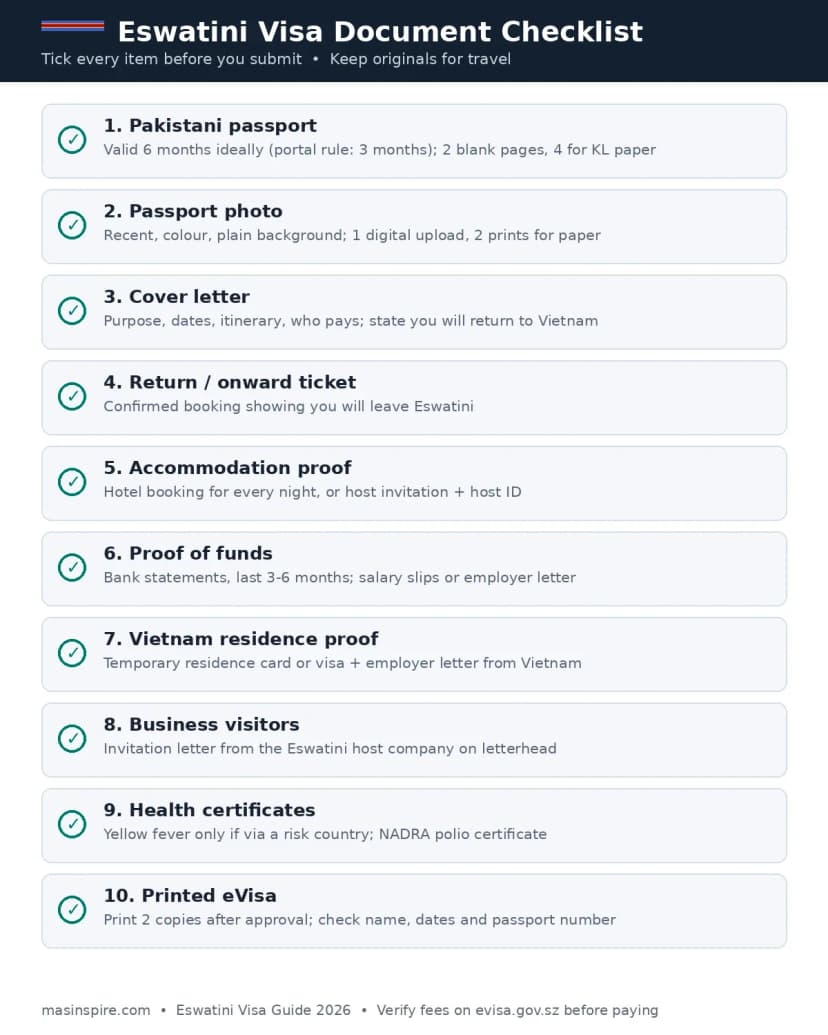
Prepare your documents before you start the online form. The eVisa portal asks you to upload scans, and a paper application asks for originals and copies. A scan that is blurred, cropped or out of date will delay or sink an otherwise good application. Scan in colour, at a readable resolution, with all four corners of each page visible, and keep the file names simple, for example passport.pdf and bank-statement.pdf. Keep the originals for travel: you will need to show your passport and your printed eVisa at the border, and you may be asked for the same supporting documents you uploaded.
Every visitor-visa applicant
| Document | Detail |
|---|---|
| Pakistani passport | Valid for at least 3 months on the portal rule, and ideally 6 months; at least 2 blank pages, or 4 for a Kuala Lumpur paper application; undamaged and machine-readable |
| Passport bio-data page scan | Clear colour scan of the page with your photo, name, passport number, dates and place of birth |
| Recent passport-size photograph | Recent, colour, plain background; one digital upload for the eVisa, two printed photos for a paper application |
| Completed application form | Online form on the eVisa portal, or the signed paper form for a mission application |
| Cover letter | Signed statement of your purpose, dates, itinerary and who is paying; state that you will return to Vietnam and give your Vietnamese address |
| Return or onward ticket | Confirmed booking showing you will leave Eswatini; a reservation is enough at application stage, but do not pay for a non-refundable ticket before approval |
| Accommodation evidence | Hotel booking for every night, or a host invitation letter with the host's address and identity document |
| Proof of funds | Bank statements for the last 3 to 6 months, salary slips or an employment letter; enough to cover the whole trip credibly |
| Vietnam residence evidence | Vietnamese temporary residence card or valid Vietnamese visa, plus an employment letter or contract from your school or employer in Vietnam |
| Yellow fever certificate | Only if you arrive from or transit through a yellow fever risk country |
| Polio vaccination certificate | NADRA-issued certificate, for departure from Pakistan and as a precaution on the journey |
| Travel insurance | Recommended, not officially required; choose a policy that covers medical evacuation |
Business visitors: add these
An invitation letter from the Eswatini company or organisation, on its letterhead, naming you, the purpose and dates of the visit, who you will meet, and whether the host covers any costs. A covering letter from your employer or your own business in Vietnam confirming your job, your salary, the business purpose of the trip and that you will return to your job. Evidence of the business relationship, such as recent correspondence, a contract, or a conference registration. If you are self-employed, include your business registration and recent business bank statements.
Family visitors: add these
An invitation letter from your host in Eswatini, a certified copy of the host's passport or Eswatini identity document or residence permit, proof of the host's address, and evidence of your relationship, such as a family registration certificate. If the host is paying for your stay, a signed undertaking and the host's bank statements or proof of income. If you are visiting a spouse or partner, include evidence of the relationship and of the partner's lawful residence in Eswatini.
Temporary Residence Permit applicants: add these
Permit cases are separate from visitor visas and need a heavier file. Expect to provide a police clearance certificate from Pakistan and from Vietnam if you have lived there, a medical certificate, certified copies of your qualifications, the employer's letter and proof that the vacancy was advertised, the institution's admission letter for study, and the prescribed permit form, listed in official guidance as Form 3 for work, business and study cases. Submit these through the employer or institution where possible, and allow weeks, not days, for the decision.
How to Apply: Step-by-Step
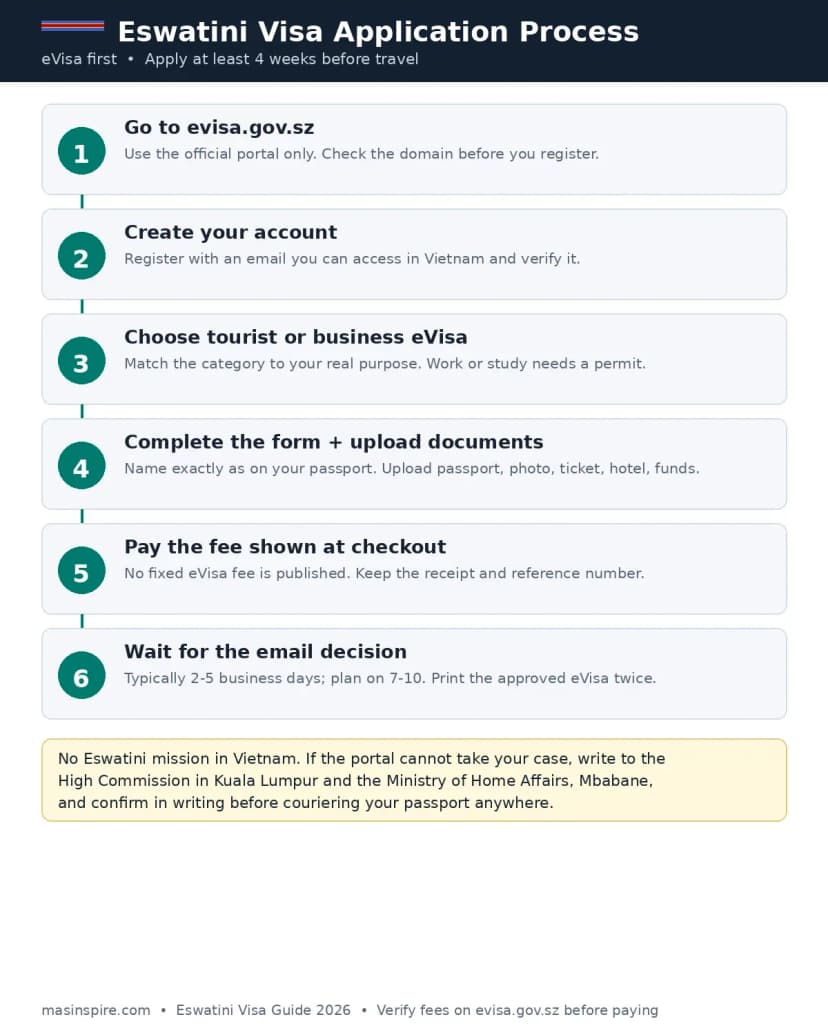
For a Vietnam-resident Pakistani, the eVisa is the route to try first. It avoids couriering your passport to another country, it is the channel the Ministry of Home Affairs is actively building, and it is the only route whose processing time and validity are described on the official portal itself. If the portal does not accept your application, or your case needs a multiple-entry visa or a permit, the paper route through a mission or the Ministry is the fallback, and it must be confirmed in writing first.
Route A: the eVisa, step by step
Step 1: Go to the official portal at evisa.gov.sz and read the guidance on its home page before you register. Check that you are on the genuine government domain, evisa.gov.sz, and not a lookalike agency site. The portal is operated by the Ministry of Home Affairs. Do not pay any other website that claims to be the official Eswatini eVisa service.
Step 2: Create an account with an email address you can access from Vietnam, and verify it as the portal asks. Use the email address you will use for all later correspondence about this application, and keep the login details safe.
Step 3: Select the visa category that matches your real purpose: tourist eVisa for sightseeing and family visits, or business eVisa for meetings and conferences. If your purpose is study, work or a long stay, stop: the eVisa is not the right route, and you need a Temporary Residence Permit.
Step 4: Complete the online form accurately and completely. Enter your name exactly as it appears on your Pakistani passport, your passport number and expiry date, your date and place of birth, your Vietnamese address and phone number, your occupation, your travel dates, and your accommodation address in Eswatini. A small spelling difference between the form and the passport can cause a refusal or a problem at the border, so check every field against the passport before you submit.
Step 5: Upload your documents: the passport bio-data scan, your recent photograph, your cover letter, your flight itinerary, your hotel booking or host invitation, and your proof of funds. Upload each document in the format and size the portal asks for, and check that each upload is legible after you attach it.
Step 6: Pay the fee shown at checkout on the portal, using the payment method the portal offers. The fee is shown only when you apply: no fixed eVisa fee is published on the portal's public pages, and this guide does not invent one. Keep the payment receipt and the application reference number. Fees are normally non-refundable, including if the visa is refused.
Step 7: Submit the application and wait for the decision by email. The portal's published processing time is typically two to five business days. Do not book non-refundable travel until the decision arrives, and do not submit a second application while the first is pending unless the Ministry asks you to.
Step 8: If the Ministry asks for clarification or extra evidence, reply promptly and completely, through the portal or the channel it names. A slow or partial reply is a common cause of delay, and a file that goes quiet can be refused for lack of evidence.
Step 9: When the eVisa is approved, download it, print at least two copies, and save a copy on your phone. Check that the name, passport number, dates and single-entry condition are all correct. Carry the printed eVisa with your passport, your return ticket, your accommodation evidence and your proof of funds, and present them at the border.
Route B: the paper visa, step by step
Step 1: Contact the mission or the Ministry before you send anything. Because there is no Eswatini mission in Vietnam, and because no published source confirms which mission covers Vietnam-resident applicants, email the High Commission in Kuala Lumpur and the Ministry of Home Affairs in Mbabane, state that you are a Pakistani passport holder resident in Vietnam, and ask in writing whether they will accept your paper application, what the current fee is, and whether you may apply by post or courier or must attend in person. Do not courier your passport until you have that answer in writing.
Step 2: Complete the official paper visa application form in full, date it and sign it. The form asks for your names, previous names, current and former nationality, date and place of birth, gender, occupation, marital status, addresses, contact details, reason for travel, duration of stay, financial resources, references in Eswatini and passport information. Answer every question; a blank field can be treated as an incomplete application.
Step 3: Assemble the paper file to the checklist in the section above, with the mission's own additions: the Kuala Lumpur checklist asks for the original passport, two copies of the application form, two colour photographs, a confirmed return air ticket, accommodation evidence, three months of bank statements and a relevant invitation for business travel. Provide originals where asked and certified copies where the checklist says certified.
Step 4: Pay the mission's fee as it directs, and keep the receipt. The Kuala Lumpur mission's published charges are USD 30 for a single-entry three-month visa and USD 100 for a multiple-entry three-month visa, also shown as RM83 for the single-entry charge, with higher multiple-entry charges. Other missions may charge differently, and the mission fee is not the same as the government emalangeni schedule or the eVisa checkout fee.
Step 5: Submit the file by the method the mission confirms, and allow the mission's stated processing time, which for Kuala Lumpur is within ten working days, with applicants advised to check the status after five working days. Keep a complete copy of everything you send, and use a tracked courier if you post your passport.
Step 6: On approval, check the visa sticker or stamp in your passport before you travel: name, passport number, validity dates, number of entries and any conditions. Report any error to the issuing office immediately, while there is still time to correct it.
Visa Fees and Financial Requirements
Eswatini visa fees are the least settled part of this guide, and this section states the conflict openly instead of choosing one number and presenting it as the fee. There are three different prices in circulation, from three different channels, and they are not the same thing.
| Channel | Single entry | Multiple entry | Notes |
|---|---|---|---|
| Government fee schedule in emalangeni (E) | E80, 3 months' validity | E300 for 3 months; E700 for 6 months; E1,000 for 9 months; E1,300 for 12 months | Published government schedule reported in several 2026 guides; confirm the current tariff before paying |
| High Commission, Kuala Lumpur | USD 30, also shown as RM83, 3 months | USD 100 for 3 months; higher charges for longer multiple-entry visas | Mission's own published charges; other missions may differ |
| Official eVisa portal | Fee shown only at checkout | Not published on the portal's public pages | Pay only the amount the portal itself displays; no fixed figure is published |
| Private visa services (not official) | About USD 70 all-inclusive in one service's listing, described as a USD 20 government fee plus a USD 50 service fee | Not listed | Commercial price, not a government fee; other agencies quote USD 50 to USD 70 |
The government emalangeni schedule is the cheapest figure in the table. At the lilangeni's peg to the rand, E80 is roughly USD 4 to USD 5, which is why one 2026 guide shows approximately USD 4.50 for a single-entry visa. That figure is arithmetically consistent with the exchange rate, but it is not the price a traveller will necessarily pay: a mission abroad charges its own consular fee, and the Kuala Lumpur mission's USD 30 is about six times the emalangeni schedule figure. Neither figure is wrong on its own; they are prices from different channels. The controlling price for your application is the one charged by the channel you actually use: the eVisa checkout amount if you apply online, or the mission's published charge if you apply on paper. Do not budget on the E80 figure and then be surprised by a USD 30 charge, and do not treat a private agency's USD 70 all-inclusive price as the government fee.
There is also no official express or priority fee published for the eVisa. On 10 November 2026 the Chief Immigration Officer, Mthokozisi Dlamini, announced at an Eswatini Air stakeholder briefing in Matsapha that the government was considering a 24-hour express visa service at an additional cost, against a current turnaround of seven working days mentioned in the same remarks. That express service has not been introduced, no express fee has been announced, and travellers should not assume expedited processing is available or budget for it. The seven-working-day figure in those remarks also conflicts with the portal's published two-to-five-business-day processing time, and both figures are reported in the processing-times section below with the conflict disclosed.
Budget for more than the visa fee. A realistic budget for a short Eswatini trip from Vietnam includes the visa fee, return flights from Ho Chi Minh City or Hanoi via Johannesburg, Durban or Maputo, a South African transit or visitor visa if your routing requires one, accommodation, food, local transport and travel insurance. Eswatini is not an expensive country by Southern African standards, but flights from Vietnam are long and costly, and the cheapest routing through Johannesburg carries its own visa cost for a Pakistani passport holder, explained in the transit section below. Do not pay any person who asks for a fee outside the official portal or the mission's published payment route, and keep every receipt.
On financial requirements, the position is as stated in the eligibility section: no official minimum bank balance is published for a visitor visa. Provide three to six months of statements and an employment letter, and make sure the balance is consistent with the trip you describe. If your host in Eswatini is paying, provide the host's undertaking and financial evidence as well as your own. A visa fee is normally non-refundable, and a refused application does not entitle you to a refund of the fee or of any agency charge.
Visa Processing Times
Processing times differ by channel, and the published figures conflict. The table below gives each figure with its source, so you can plan on the slowest credible figure rather than the fastest.
| Channel | Published processing time | Source of the figure |
|---|---|---|
| Official eVisa portal | Typically 2 to 5 business days | evisa.gov.sz portal guidance, reported in multiple 2026 trackers |
| Chief Immigration Officer, November 2026 briefing | Current turnaround 7 working days; 24-hour express under consideration, not yet available | Remarks by Mthokozisi Dlamini, 10 November 2026, Matsapha |
| High Commission, Kuala Lumpur (paper visa) | Within 10 working days; check status after 5 working days | Mission's published service information |
| Ministry paper route, general guidance | 1 to 5 business days, sometimes longer for police vetting | General visa guidance: the file goes to the Royal Eswatini Police Service for vetting, then to the Chief Immigration Officer for approval |
| Temporary Residence Permit | 4 to 8 weeks | Published permit guidance |
| Third-party agency estimates | 2 to 5 weeks for a paper visa; 5 to 15 business days in one 2026 guide | Commercial guides; not official figures |
The conflict between the portal's two-to-five-business-day figure and the Chief Immigration Officer's seven-working-day figure is real and recent. The portal figure is the one published for applicants, and the seven-day figure was given by the most senior immigration official in a public briefing in November 2026, in the context of announcing a proposed express service. One explanation is that the two figures measure different things: the portal figure may describe a straightforward online decision, while the seven-day figure may describe the full end-to-end turnaround including police vetting. Another explanation is that the portal figure is out of date or optimistic. This guide does not choose between them. Plan on seven to ten working days for an eVisa, and ten working days or more for a paper visa, and apply at least four weeks before travel. If your visa arrives in two days, you have lost nothing; if it takes ten, you have not lost your flight.
Applying from Vietnam
There is no Eswatini embassy, high commission or consulate in Vietnam. That is confirmed by the absence of Eswatini from every published list of diplomatic missions in Vietnam, and by the fact that the Eswatini government's own mission network in Asia is small: the nearest Eswatini mission to Vietnam is the High Commission of the Kingdom of Eswatini in Kuala Lumpur, Malaysia, at Suite 3 and 3a, 22nd Floor, Menara Citibank, 165 Jalan Ampang, 50450 Kuala Lumpur, telephone +603-2163 2511, email swazi@tm.net.my, with a website at eswatinikualalumpur.org. Its general office hours are Monday to Friday, 9.00 am to 4.30 pm, with visa submissions on Tuesday to Thursday, 9.30 am to 11.30 am, and visa collections on Tuesday to Thursday, 2.30 pm to 4.00 pm, according to the mission's published information. Always confirm the hours before travelling, because they change around public holidays in Malaysia and Eswatini.
What is not confirmed is whether the Kuala Lumpur High Commission covers Vietnam. No official source checked for this guide publishes a list of countries covered by the Kuala Lumpur mission, or states that it accepts applications from residents of Vietnam. The mission's published role is described in general terms as serving Malaysia and the Asia-Pacific, which is suggestive but not a confirmation, and a suggestion is not enough to send a passport to. The same gap applies to the Eswatini High Commission in London and to other missions: they are real missions, but none is published as the accredited mission for Vietnam. The Ministry of Home Affairs headquarters in Mbabane, Chief Immigration Office, P.O. Box 372, Mbabane, is the other application channel named in official guidance, and it can receive applications directly. For a traveller in Vietnam, the practical order is therefore clear: try the eVisa portal first, because it does not depend on any mission's jurisdiction; if the portal cannot take your case, write to the Kuala Lumpur High Commission and to the Ministry of Home Affairs, explain that you are a Pakistani passport holder resident in Vietnam, and ask in writing which office will accept your paper application and how to submit it.
Your Vietnamese residence is an asset in the application, so document it properly. Include a clear copy of your temporary residence card or the Vietnamese visa in your passport, your Vietnamese address, your Vietnamese phone number, and a letter from your employer or school in Ho Chi Minh City or Hanoi confirming your job, your salary, your leave dates and that you will return to work. If you are self-employed in Vietnam, include your business registration and evidence of your income there. If your Vietnamese residence is short-dated, renew it before you apply for the Eswatini visa: an application from a person whose right to live in the country they are applying from is about to expire is weaker than one from a person with a year of residence ahead of them.
Do not use a visa agent in Vietnam or Pakistan who claims to have a special arrangement with an Eswatini mission, and do not hand your original passport to anyone who cannot show you the mission's written instruction to accept it. There is no Eswatini visa application centre in Vietnam, and no authorised agent network published by the Ministry. If you use an agent for form-filling or document preparation, keep control of your passport and your payment, and verify every claim the agent makes against the official portal or the mission before you rely on it. A legitimate agent prepares your file; it does not guarantee a visa, and any guarantee of approval is a sign of fraud.
Getting There: Flights, Transit and Arrival
There are no direct flights from Vietnam to Eswatini. Every journey from Ho Chi Minh City or Hanoi routes through at least one hub, and the hub you choose decides whether you need a second visa. The most common gateway is Johannesburg, South Africa, with a connection to King Mswati III International Airport, or a road transfer from Johannesburg to the Eswatini border. Other routings go through Durban, through Maputo in Mozambique, or through the Gulf and then Johannesburg. Check the routing before you book, because the cheapest ticket is often the one that creates the extra visa problem.
The Johannesburg routing carries a specific warning for Pakistani passport holders. Under South Africa's Immigration Directive 11 of 2022, Pakistani and Bangladeshi passport holders are excluded from South Africa's airport transit exemption and need a transit visa even to connect airside at O.R. Tambo International Airport in Johannesburg, and at Cape Town, King Shaka and Lanseria airports. This is confirmed by the South African High Commission in Canberra's published transit-visa guidance, which states that a transit visa is now required for Pakistani and Bangladeshi passport holders under Directive 11 of 2022, and by a Fragomen advisory dated 1 August 2022 recording that the requirement took effect on that date. If your flight from Vietnam lands in Johannesburg and your next flight leaves from the same airport, you still need a South African transit visa in advance: there is no visa on arrival for this purpose, and the airline may refuse to board you in Vietnam without it. If you leave the airport, cross into South Africa by road to reach Eswatini, or stay overnight in Johannesburg, you need a South African port-of-entry or visitor visa rather than a transit visa, and the requirements and processing time are different again.
The practical consequence is that you must sort out South Africa before you sort out Eswatini, or choose a routing that avoids South Africa altogether. South Africa admits Pakistani passport holders to its online Visitor eVisa system, so a South African visitor eVisa can be applied for electronically, but it is set up for arrival at O.R. Tambo and is single entry, so a side trip out of South Africa needs a fresh visa to return. A routing through Maputo in Mozambique avoids South Africa, but it creates its own question: a Pakistani passport holder needs a Mozambican visa, and the land crossing from Mozambique into Eswatini must be made at an open border post with the correct documents. Whichever route you choose, confirm the transit and entry rules for every country on the itinerary, not only for Eswatini, and allow enough time between flights for a second immigration check if you change airports or terminals.
On arrival in Eswatini, present your passport, your printed eVisa or your visa, your return or onward ticket, your accommodation evidence and your proof of funds. The officer may ask about your purpose, your host, your money and your return date, and may check that your answers match the documents. Answer plainly and consistently with your application: a different story at the border from the one on the form is a reason to refuse entry. The officer will stamp your passport with your permitted stay, normally up to 30 days. Check the stamp and the date before you leave the counter, and keep the entry stamp safe: you will need to show it when you leave, and an exit without a matching entry record can cause problems on a later trip. If you enter Eswatini by road from South Africa or Mozambique, the same rules apply, and you must stop at the border post and be stamped in: crossing without an entry stamp is unlawful entry, even if you hold a valid visa.
Extending Your Stay and Temporary Residence Permits
Whether you can extend a short visit is another point on which the sources conflict, and the conflict matters if you plan a longer trip. One secondary guide for Pakistani applicants states plainly that the eVisa cannot be extended. Another 2026 guide states that extensions of up to another 30 days, making a total of 60 days, are possible through the Ministry of Home Affairs. Both cannot be the whole truth for every case. The most likely reconciliation is that the two statements describe different permissions: the eVisa itself, as a single-entry online authorisation, is not extendable, while a visitor admitted on a paper visa or a visitor's permit may apply to the Ministry of Home Affairs for an extension of stay. This guide does not present either figure as settled. Do not plan a trip that depends on an extension. Apply for the stay you need in the first place, and if you need more than 30 days, apply for a Temporary Residence Permit or a multiple-entry paper visa before you travel, and ask the Ministry in writing whether an extension is available on the permission you hold.
For a stay longer than about three months, or for any work, study or business residence, the correct route is a Temporary Residence Permit, applied for before travel or through the employer or institution in Eswatini. The permit system is described in the visa-types section above. Permit fees published by the Ministry in August 2026 for work permits range from E1,200 for one day to one month up to E6,000 for 24 months, plus a E300 application fee for Temporary Residence Permits that has applied since 1 March 2021, and a late-renewal fee of E1,000 in published permit guidance. These figures are permit fees, not visitor-visa fees, and they must be confirmed at the counter because the Ministry revises fees by notice. A permit can be cancelled if you do not start the job within 14 days of its issue or your arrival, if you stop doing that job, or if you take up other work without written approval, so read the conditions on the permit itself and keep a copy.
Common Application Mistakes
The most common mistake is applying for the wrong permission: a tourist visa for a job, a business visa for paid work, or an eVisa for a study course. Each of these is a refusal waiting to happen, and each wastes the fee. Match the visa to the real purpose, and if the purpose changes, withdraw and reapply for the right one.
The second most common mistake is an incomplete or inconsistent file. A passport scan that cuts off the machine-readable zone, a photograph that is years old, a bank statement that stops a month before the application, an invitation letter with no dates, a hotel booking that does not cover every night, or a cover letter that gives different dates from the flight booking will all delay or sink the file. Check every document against the checklist, check the dates against each other, and have someone else read the file once before you submit it.
The third mistake is ignoring the transit visa. A Pakistani passport holder who books the cheapest Ho Chi Minh City to Johannesburg ticket, without a South African transit visa, may be refused boarding in Vietnam. That is not an Eswatini refusal, and an Eswatini eVisa does not cure it. Check the transit rules for every country on the route, and get the transit visa before you book the Eswatini leg.
The fourth mistake is travelling on a passport that is about to expire, or on a different passport from the one on the eVisa. Renew the passport first, then apply. If you renew after approval, expect to apply again and pay again.
The fifth mistake is overstaying, or assuming that a visa's validity is the same as the permitted stay. A three-month or twelve-month visa validity does not mean a three-month or twelve-month stay. The stay is what the officer stamps on arrival, normally up to 30 days, and it is that date you must leave by.
Reasons for Visa Refusal
A visa can be refused without a detailed explanation, and the fee is not refunded. The most frequent reasons are an incomplete file, a passport that does not meet the validity or blank-page rule, insufficient or unconvincing proof of funds, no credible accommodation or return travel, a purpose that does not match the documents, and a weak link to the country of residence. For a Vietnam-resident applicant, the link to Vietnam matters: if you cannot show that you live and work in Vietnam and will return there, the officer may doubt that you will leave Eswatini at the end of the visit. Include your residence card, your employment letter and your return ticket to Vietnam, not only your flight to Africa.
Previous immigration history also counts. An overstay, a removal, a refused visa for another country, or a false statement on any application can lead to a refusal, and a false statement can have consequences beyond the single application. Never use a false bank statement, a false invitation letter, a false employment letter or a borrowed passport. Forged documents are routinely detected, and the result is not only a refusal but a record that makes future applications for Eswatini and for other countries harder.
If your application is refused, read the refusal notice carefully and do not reapply immediately with the same file. A second application that repeats the same weakness will be refused for the same reason, and a pattern of repeated refusals is itself a negative factor. Fix the specific weakness the refusal identifies, gather the missing evidence, wait until your circumstances have genuinely changed, and consider asking the mission or the Ministry in writing what would make a fresh application successful. There is no published appeal process for a visitor-visa refusal in the sources checked for this guide, so a fresh, stronger application is normally the only route.
Frequently Asked Questions
1. Do Pakistani passport holders need a visa for Eswatini?
Yes. Pakistan is not on Eswatini's visa-exemption list, so Pakistani ordinary passport holders must obtain an entry visa before travel. There is no visa on arrival for Pakistani nationals, and your Vietnamese residence does not make your Pakistani passport visa-exempt.
2. Can I apply for an Eswatini eVisa from Vietnam?
Yes, the official eVisa portal at evisa.gov.sz is the first route to try from Vietnam, because it does not depend on a mission's jurisdiction. Create an account, choose the tourist or business eVisa, upload your documents, pay the fee shown at checkout, and wait for the decision by email. If the portal does not accept your application, contact the Ministry of Home Affairs or an Eswatini mission and apply on paper.
3. How long can I stay in Eswatini on an eVisa?
Up to 30 days. The eVisa is single entry and must be used within 90 days of issue. The 90 days is the window to enter, not the length of stay: once admitted, you may normally stay for up to 30 days, as stamped by the officer on arrival.
4. How much does an Eswatini visa cost?
There is no single published fee. The government schedule lists E80 for a single-entry three-month visa and E300 to E1,300 for multiple-entry visas of three to twelve months. The Kuala Lumpur High Commission lists USD 30 for a single-entry three-month visa and USD 100 for a multiple-entry three-month visa. The eVisa portal shows its fee only at checkout. Pay the fee charged by the channel you use, and confirm it before paying.
5. How long does an Eswatini visa take?
The eVisa portal states typically two to five business days. The Chief Immigration Officer said in November 2026 that the current turnaround is seven working days. The Kuala Lumpur High Commission states within ten working days for a paper visa. Plan on seven to ten working days for an eVisa and ten working days or more for a paper visa, and apply at least four weeks before travel.
6. Is there an Eswatini embassy in Vietnam?
No. There is no Eswatini embassy, high commission or consulate in Vietnam. The nearest Eswatini mission is the High Commission in Kuala Lumpur, Malaysia. No published source confirms that it covers Vietnam, so write to it and to the Ministry of Home Affairs in Mbabane to confirm in writing before sending a paper application or your passport.
7. What is the eVisa processing time if I need to travel urgently?
There is no published express service. A 24-hour express visa was announced as under consideration on 10 November 2026, at an additional cost that has not been announced, but it has not been introduced. Do not book urgent travel on the assumption that an express decision is available.
8. Can I extend my Eswatini eVisa?
This is not settled in the sources. One guide states the eVisa cannot be extended; another states an extension of up to another 30 days, to a total of 60 days, is possible through the Ministry of Home Affairs. Do not plan a trip that depends on an extension. Apply for the stay you need, and ask the Ministry in writing whether an extension is available on the permission you hold.
9. How long must my passport be valid?
The eVisa portal rule is at least three months' validity, with unused pages for endorsements. The Kuala Lumpur checklist requires validity at least 30 days beyond the stay and four blank pages. Other guides say six months and two blank pages. The safe course is at least six months' validity and at least two blank pages, or four if you apply on paper through Kuala Lumpur.
10. Do I need a yellow fever certificate?
Only if you arrive from, or pass through, a country with a risk of yellow fever transmission. Vietnam and Pakistan are not yellow fever risk countries, so a direct journey from Vietnam does not normally trigger the requirement. Carry the certificate if your routing passes through an endemic country.
11. Do I need a visa for South Africa if I transit through Johannesburg?
Yes, in most cases. Under South Africa's Immigration Directive 11 of 2022, Pakistani passport holders need a South African transit visa even to connect airside at O.R. Tambo International Airport. If you leave the airport or travel by road to Eswatini, you need a South African visitor or port-of-entry visa instead. Sort out South Africa before you book the Eswatini leg.
12. Can I work in Eswatini on a tourist or business visa?
No. A tourist visa does not authorise paid work, and a business visitor visa covers meetings and conferences only, not employment by an Eswatini employer. To work in Eswatini you need a Temporary Residence Permit, normally arranged through the employer and the Chief Immigration Officer in Mbabane.
13. What documents do I need for an Eswatini visa?
A valid Pakistani passport, a recent passport-size photograph, a completed application form, a signed cover letter, a return or onward ticket, hotel bookings or a host invitation, proof of funds such as three to six months of bank statements, and your Vietnamese residence evidence. Business visitors add an invitation from the Eswatini host company; family visitors add the host's invitation and identity document.
14. Is there a minimum bank balance for an Eswatini visa?
No official minimum is published. No Eswatini government source checked for this guide states a minimum balance or a daily amount for a visitor visa. Figures quoted by agencies, such as PKR 800,000 to PKR 2,000,000, are commercial estimates, not government rules. Provide credible evidence that you can pay for the whole trip.
15. What should I do if my Eswatini visa is refused?
Read the refusal notice, do not reapply immediately with the same file, and fix the specific weakness it identifies, whether that is funds, accommodation, purpose or ties to Vietnam. The fee is normally non-refundable. A fresh, stronger application is normally the only route, as no published appeal process for visitor-visa refusals was found in the sources checked.
Official Immigration Websites
| Website | What it is | Address |
|---|---|---|
| Eswatini eVisa portal | Official online visa application portal, operated by the Ministry of Home Affairs | Official eVisa portal |
| Government of Eswatini | Official government portal, for Ministry of Home Affairs contact details | Government of Eswatini portal |
| High Commission of the Kingdom of Eswatini, Kuala Lumpur | Nearest Eswatini mission to Vietnam; confirm in writing whether it accepts Vietnam-resident applicants | High Commission website |
| South African High Commission, Canberra: transit visa | Official confirmation that Pakistani passport holders need a South African transit visa under Directive 11 of 2022 | South Africa transit visa guidance |
| Visa policy of Eswatini | Summary of the visa-exemption list, showing Pakistan is not exempt; use as a cross-check, not as an official source | Visa policy of Eswatini |
| Eswatini visa guidance for Pakistanis | Secondary guide checked 7 November 2026, for the eVisa fee, processing time and Kuala Lumpur charges quoted in this guide | Eswatini visa guide for Pakistanis |
| Eswatini eVisa launch reporting | Reporting of the 10 November 2026 briefing on the eVisa rollout and the proposed 24-hour express service | Eswatini eVisa launch report |
Only the first three rows in this table are official Eswatini government or mission websites. The remaining rows are included because they confirm a specific figure or rule used in this guide, and they are labelled as such. Do not treat a secondary guide, a directory listing or a news report as a substitute for the official portal or a written answer from the Ministry or a mission on your own case.
Final Checklist and Conclusion
Eswatini is a rewarding destination for a short visit, and the visa process for a Pakistani passport holder living in Vietnam is manageable if you start with the eVisa portal and plan around the facts that are genuinely uncertain. The settled facts are these: you need a visa before travel, there is no visa on arrival, the eVisa is single entry for up to 30 days and must be used within 90 days of issue, and there is no Eswatini mission in Vietnam. The unsettled facts are the exact fee you will pay, which depends on the channel you use, the exact processing time, which is published as two to five business days and also as seven working days, and whether a paper mission will accept your application from Vietnam. This guide has disclosed each of those conflicts rather than hiding them, because a traveller who plans on the slowest time and the higher fee is never caught out, while a traveller who plans on the fastest time and the lowest fee often is.
Before you apply, run through this final checklist. Your Pakistani passport is valid for at least six months with at least two blank pages, and it is the passport you will travel on. Your Vietnamese residence card or visa is valid beyond your return date. You have chosen the visa that matches your real purpose, and you have not described a work or study trip as a tourist visit. Your cover letter, flight dates, hotel bookings and bank statements all agree with each other. You have the invitation letter if you are visiting for business or family reasons. You have checked whether your flight routing needs a South African transit visa, and you have applied for it if it does. You have applied at least four weeks before travel, on the official portal at evisa.gov.sz, and you have kept the payment receipt and the application reference. You have printed the approved eVisa and packed it with your passport, return ticket, accommodation evidence and proof of funds.
If the eVisa portal cannot take your case, do not improvise. Write to the High Commission in Kuala Lumpur and to the Ministry of Home Affairs in Mbabane, explain that you are a Pakistani passport holder resident in Vietnam, and ask in writing which office will accept your paper application, what the current fee is, and how to submit it. Get the answer before you courier your passport anywhere. That single step, more than any other in this guide, is what separates a successful application from a lost passport and a missed trip.
Sources checked for this guide are listed in the Official Immigration Websites table above and in the package file. The eVisa portal was read live on 28 November 2026. Fees, processing times and mission jurisdiction should be re-checked on the official portal or with the Ministry of Home Affairs before travel, because they change without notice.