Estonia Visa Guide 2026: Types, Requirements, Documents and Application Steps
Introduction
Estonia is a small northern European country on the Baltic Sea, known for its medieval Old Town in Tallinn, its islands and forests, and one of the most digital governments in the world. It is a member of the European Union and the Schengen Area, so a short visit to Estonia is governed by the shared Schengen visa rules, while any stay longer than 90 days is governed by Estonian national law.
This guide is written for Pakistani passport holders who live in Vietnam — for example, teachers, professionals and their families who hold a Vietnamese temporary residence card or work permit and want to visit, work, study or live in Estonia. It explains which visa or permit fits each situation, what it costs, how long it takes, which documents to prepare, and exactly where a Vietnam resident lodges the application. Estonia has no embassy or consulate in Vietnam, and that fact shapes the whole application route, so it is covered in detail below.
All figures in this guide were checked against official Estonian sources — the Ministry of Foreign Affairs and the Police and Border Guard Board — and against the France-Visas portal, which is the filing channel for Estonia in Vietnam, on 28 November 2026. Where official sources disagree with each other, or where a figure could not be verified, the guide says so openly rather than presenting one number as settled fact. Immigration rules change, so always confirm the live official page before paying a fee or booking travel.
Do Pakistani Passport Holders Need a Visa for Estonia?
Yes. Pakistani passport holders need a visa to enter Estonia for any purpose. Pakistan is on the list of countries whose nationals must hold a visa for the Schengen Area, and Estonia applies that list with no national exception. There is no visa-free entry, no visa on arrival and no e-visa for ordinary Pakistani passports.
The visa you need depends on the length and purpose of your stay. For a visit of up to 90 days — tourism, visiting family or friends, or a short business trip — you need a Schengen short-stay visa (Type C). For a stay of more than 90 days, or for work, study, a startup or remote work, you need a national long-stay visa (Type D) or a temporary residence permit. A residence permit issued by another Schengen state does allow short visits to Estonia without a separate visa, but a Vietnamese residence card or work permit does not: Vietnam is not a Schengen state, so your Vietnamese residence status only proves where you live when you apply, it does not exempt you from the visa.
Your nationality decides whether you need a visa; your place of residence decides where you apply. Because you live in Vietnam, you lodge a short-stay application through the French authorities in Vietnam, which represent Estonia there. Long-stay visas and residence permits follow a different route, explained in the application section below.
At a Glance: Key Facts
| Item | Key fact |
|---|---|
| Visa required for Pakistanis | Yes, for every purpose and length of stay |
| Schengen short-stay visa (Type C) | Up to 90 days in any 180-day period; fee EUR 90 for adults |
| Long-stay visa (Type D) | Up to 365 days in 12 months; fee EUR 120 for adults |
| Digital nomad visa | C or D visa for remote work; up to 365 days on a D visa |
| Short-stay decision time | Usually 15 calendar days, extendable to 45 days |
| Long-stay decision time | Up to 30 days |
| Travel insurance | Minimum EUR 30,000 medical cover for Schengen and D visas |
| Funds for a short visit | EUR 70 per day of stay in Estonia |
| Passport validity | Issued within the last 10 years, valid at least 3 months beyond the visa or departure, with at least 2 blank pages |
| Where Vietnam residents apply (short stay) | France represents Estonia in Vietnam; lodge via TLScontact in Hanoi or Ho Chi Minh City |
| Estonian mission in Vietnam | None — there is no Estonian embassy or consulate in Vietnam |
| Capital and main airport | Tallinn; Lennart Meri Tallinn Airport (TLL) |

Types of Estonia Visas and Residence Permits
Estonian entry permissions fall into three families: Schengen short-stay visas, national long-stay (D) visas, and temporary residence permits. A D visa covers stays of up to a year; anything longer, or any plan to settle, needs a temporary residence permit from the Police and Border Guard Board (PPA). Time spent on a D visa does not count towards permanent residence; time on a temporary residence permit does.
| Route | Main purpose | Maximum stay | State fee (adult) | Counts towards permanent residence? |
|---|---|---|---|---|
| Schengen visa (Type C) | Tourism, family visit, short business | 90 days in any 180 days | EUR 90 | No |
| Airport transit visa (Type A) | Transit through an Estonian airport international zone | Transit only | EUR 90 | No |
| Long-stay visa (Type D) | Work, study, startup, remote work, other documented purposes | 365 days in 12 months | EUR 120 | No |
| Digital nomad visa (C or D) | Remote work for an employer or clients abroad | Up to 365 days on a D visa | EUR 120 (D) or EUR 90 (C) | No |
| Residence permit for employment | Work for an Estonian employer | Up to 5 years | EUR 250 in Estonia / EUR 280 abroad | Yes |
| Residence permit for business | Startups, shareholders, sole proprietors, large investors | Up to 5 years | EUR 350 in Estonia / EUR 380 abroad | Yes |
| Residence permit for study | Full-time study | Up to 5 years | EUR 225 in Estonia / EUR 255 abroad | Not on its own |
| Residence permit for family | Joining a close family member in Estonia | Up to 5 years | Varies by ground — confirm with the PPA | Yes |
| Long-term resident status | Settlement after 5 years on a residence permit, with Estonian at B1 level | Permanent | EUR 185 (reported — confirm with the PPA) | Already permanent |
Two things are commonly misunderstood. First, e-Residency is not a visa and not a residence permit: it is a digital identity that lets you run an Estonian company online, and it gives no right to live in Estonia. Second, a D visa on its own does not authorise employment. The right to work comes from a separate registration or permit, as explained in the work section below.
Schengen Short-Stay Visa (Type C)
The Schengen short-stay visa is the visa most readers of this guide will apply for. It allows a stay of up to 90 days in any 180-day period across the whole Schengen Area — not 90 days in Estonia plus 90 days elsewhere. The 90 days are counted on a rolling 180-day window, and since the EU Entry/Exit System (EES) was rolled out, entries and exits are recorded electronically, so overstaying is detected automatically at the border.
Who it covers
Tourists, people visiting family or friends, and short business visitors — attending meetings, conferences or trade events, without taking up employment in Estonia. If you plan to work, study or stay longer than 90 days, this is the wrong visa.
Fee and processing time
The fee is EUR 90 for adults, EUR 45 for children aged 6 to 11, and free for children under 6. The fee pays for processing, not for the visa, and it is not refunded if you are refused. A visa application centre adds its own service fee on top; the amount for Estonia applications lodged in Vietnam could not be verified at the time of writing, so confirm it when you book (see the flags in the fees section). The normal decision time is 15 calendar days from the day the application is found admissible, and it can be extended to 45 days in individual cases, for example if further documents are requested. You may apply from six months before travel, and as a rule no later than 15 calendar days before departure.
Core requirements
Your passport must have been issued within the last 10 years, be valid for at least 3 months after your planned departure from the Schengen Area, and have at least 2 blank pages. You must hold travel medical insurance with minimum cover of EUR 30,000, valid in all Schengen states and covering emergency medical treatment and repatriation. You must show sufficient funds for the stay: Estonia's reference amount notified to the European Commission is EUR 70 for each day of your stay, so a 10-day trip means showing at least EUR 700 plus the cost of your return travel. You must also show your travel itinerary, accommodation for the whole stay, and evidence that you will leave the Schengen Area — for a Vietnam resident, that means your Vietnamese residence card or work permit, your employment or teaching contract, and ties such as a lease or family in Vietnam. Applications are lodged in person, with ten fingerprints and a facial image, except for children under 12 and people physically unable to provide them.
Long-Stay D Visa
The long-stay (D) visa is a national Estonian visa for stays of more than 90 days and up to 365 days within twelve consecutive months. It also allows travel in other Schengen states for up to 90 days in any 180-day period. If two consecutive D visas are issued, the total stay must not be longer than 548 days within 730 consecutive days.
Fee and processing time
The state fee is EUR 120 for adults, EUR 60 for children aged 6 to 11, and free for children under 6. The Police and Border Guard Board reviews a long-stay visa application within 30 days of accepting it; applications lodged at a representation abroad are forwarded to the Board, so allow a few extra days on top. A D visa must be applied for in person, in your country of residence, at an Estonian representation that handles visa applications — or, if you are already in Estonia on an accepted status, at a PPA service office.
Funds required
The Ministry of Foreign Affairs publishes a table of sufficient funds for D visas. The amounts below are taken from that central table, checked on 28 November 2026. Note the disclosure in the next paragraph: one Estonian embassy page shows different figures for study and teleworking, so treat the higher figure as your planning number until the mission that will decide your file confirms otherwise.
| Purpose of stay | Applicant | Spouse | Minor child |
|---|---|---|---|
| Studies | EUR 880 per month | EUR 2,100 per month | Not applicable |
| Doctoral studies (PhD) | EUR 880 per month | EUR 704 per month | Not applicable |
| Short-term employment | EUR 1,320 one-time | Not applicable | Not applicable |
| Short-term employment in a startup company | EUR 880 one-time | EUR 704 one-time | Not applicable |
| Seasonal work | EUR 880 one-time | EUR 704 one-time | Not applicable |
| Startup business | EUR 880 per month | EUR 704 per month | Not applicable |
| Teleworking (digital nomad visa) | EUR 132 per day (EUR 3,960 per month) | Not applicable | Not applicable |
| All other applicants | EUR 70 per day (EUR 2,100 per month) | EUR 70 per day (EUR 2,100 per month) | EUR 70 per day (EUR 2,100 per month) |
Figure conflict disclosed: the Estonian Embassy in Dublin's D-visa page shows EUR 800 per month for studies (instead of EUR 880) and EUR 4,500 per month for teleworking (instead of EUR 3,960). The central Ministry of Foreign Affairs table is the more recent source and is based on the Minister of the Interior's regulation that came into force on 22 May 2026, so this guide uses its figures — but the Dublin page shows that individual missions may still apply the older amounts. Budget on the higher figure (EUR 4,500 a month for remote work, EUR 880 a month for study) and ask the mission that will decide your file, in writing, before you pay the fee.
Other D-visa conditions
All foreign public documents submitted with a D-visa application must be legalised or certified with an apostille and translated into Estonian or English. Some missions accept only original bank statements issued in a bank office with a physical stamp and signature, and not internet-banking printouts — check the requirements of the mission where you will lodge. The Ministry's central page asks for evidence of income for the three months immediately before the application; the digital nomad route asks for six months (see the next section). Where the two differ, follow the requirement for your specific purpose.
Digital Nomad Visa
Estonia's digital nomad visa is a real, established programme, created under the Aliens Act for remote work (kaugtöö). It lets you live in Estonia for up to 365 days on a D visa (or up to 90 days on a C visa) while working for a foreign employer, through your own company registered abroad, or as a freelancer serving clients mostly outside Estonia. It gives no entitlement to a residence permit or to permanent residence, and it does not allow you to work for an Estonian employer.
Income requirement
You must show legal income over the six months before you apply, showing its amount, regularity and sources. Salary, dividends, management-board remuneration, rental and investment income are counted. The amount is the subject of a genuine conflict between official Estonian sources, disclosed in full here: the Ministry of Foreign Affairs' central funds table sets EUR 132 a day, or EUR 3,960 a month, based on the Minister of the Interior's regulation in force since 22 May 2026; the e-Residency website and the Estonian Embassy in Dublin's D-visa page still state EUR 4,500 a month (EUR 150 a day). Until the mission deciding your file confirms which figure it applies, budget on EUR 4,500 a month gross and keep six months of bank statements that show that level consistently, not one strong month.
Fee, time and documents
The fee is EUR 120 for a D visa or EUR 90 for a C visa. Processing takes up to 30 days. Documents include the long-stay application form and additional form 1, a passport photo of 35 by 45 mm meeting ICAO standards, travel medical insurance covering the whole visa period, a written explanation of your intention to use the visa for teleworking, your employer's written confirmation that your duties can be performed remotely (or your company registration and client contracts if you are self-employed or freelance), proof of legal income for the previous six months, a certificate of tax or social-security payments from your country of location, and your CV. Note that visas for remote work have not been issued to citizens of Russia and Belarus since April 2022; that restriction does not affect Pakistani nationals. Also note that a long stay can create Estonian tax residency — take tax advice before you rely on the visa for a full year.
Work: Short-Term Employment and Residence Permit for Employment
There is no single document called an "Estonian work visa". Work is authorised through a combination of a visa and a registration or permit, and the correct combination depends on how long you will work and who employs you.
Short-term employment with a D visa (up to one year)
For assignments of up to 365 days, your Estonian employer registers your short-term employment with the Police and Border Guard Board before the work begins. Only an employer entered in the Estonian commercial register may apply, which rules out direct engagement by a foreign entity. The registration is confirmed within a maximum of 15 business days. You then apply for a D visa, showing the registration, your employment contract and EUR 1,320 as a one-time funds amount. The D visa fee is EUR 120. The short-term employment registration fee is reported as EUR 130; one secondary source gives a range of EUR 130 to EUR 140, so confirm the exact amount with the PPA before paying. The general limit is 365 days of work within a 455-day period, and seasonal work is capped at 270 days within 12 months. Once you arrive on the D visa, you can start work immediately.
Residence permit for employment (up to five years)
For longer employment, you need a temporary residence permit for employment, issued by the PPA for up to five years and renewable for up to ten years at a time. The right to work is built into the permit — there is no separate work permit. The general rule is that your gross monthly salary must be at least the Estonian average gross monthly wage: EUR 2,092 a month for applications from 5 March 2026 to March 2027. Higher and lower thresholds apply to specific categories: top specialists at 1.5 times the average (EUR 3,138 a month), employees of qualifying startups at 0.8 times the average (EUR 1,674 a month), and EU Blue Card holders in shortage occupations at 1.24 times the average (EUR 2,594 a month). The EU Blue Card generally requires 1.5 times the average (EUR 3,138 a month). The employer must generally obtain permission from the Unemployment Insurance Fund (Töötukassa) confirming that no suitable EU or EEA candidate was available, although top specialists, ICT professionals and startup employees are exempt. The fee is EUR 250 if you apply in Estonia or EUR 280 if you apply at a foreign representation.
Immigration quota
Estonia sets an annual immigration quota of 0.1 percent of the permanent population — 1,292 people for 2026. The quota fills within months and is allocated first come, first served, but it is a poor guide to feasibility because ICT specialists, startup staff, top specialists, academics, students and family migrants sit entirely outside it. If your route is quota-exempt, the quota does not block you; if it is not, apply early in the year.
Processing time — conflict disclosed
Sources disagree on the residence-permit decision time. One detailed guide states that the PPA decides within up to 90 days and the residence card is issued within 30 days of approval; another guide from the same publisher states that the PPA has up to 2 months to decide. This guide uses the longer figure — plan on up to 90 days for the decision, plus up to 30 days for the card — and notes that many straightforward cases conclude faster. Do not book non-refundable travel on the shorter estimate.
Study in Estonia
Estonia offers full-time study at universities including the University of Tartu and Tallinn University of Technology, with many degree programmes taught in English. For a short course of up to 90 days, a Schengen visa is enough. For full-time study longer than that, you need a D visa first and then a temporary residence permit for study.
D visa for study
Apply for a D visa showing your university admission or confirmation letter, proof of funds of EUR 880 per month (see the conflict note in the D-visa section: one embassy page still shows EUR 800), travel medical insurance of at least EUR 30,000, and accommodation arrangements. The D-visa fee is EUR 120 and processing takes up to 30 days.
Residence permit for study
The residence permit for study is issued for up to five years. The fee is EUR 225 if you apply in Estonia or EUR 255 at a foreign representation. You must show school confirmation and income of four times the subsistence level — which is the same EUR 880 a month figure in the D-visa funds table, since the subsistence level behind it is EUR 220 a month. Students may work alongside their studies under the conditions of their permit, and doctoral (PhD) students show the same EUR 880 a month for themselves and EUR 704 a month for a spouse. Study time on a residence permit does not on its own lead to permanent residence, but it can count in combination with later employment-based residence. Apply well before your semester starts: the permit decision can take up to 90 days, so a D visa is often the practical bridge that lets you arrive and begin while the permit is processed.
Startup, Business and e-Residency
Startup visa
Founders of innovative, scalable technology companies can apply through the Startup Estonia route. Your business plan is assessed by the Startup Estonia expert committee, which gives a positive assessment if the startup is innovative and growth-oriented. One secondary guide reports that the committee's evaluation typically takes about 10 working days, but that timing could not be verified against an official source, so treat it as indicative only. With a positive assessment, you apply for a D visa (EUR 120, funds of EUR 880 per month for yourself and EUR 704 per month for a spouse) or a residence permit for business. Startup employees benefit from the lower 0.8 times salary threshold (EUR 1,674 a month) and are exempt from the immigration quota and the labour-market test.
Residence permit for business
The residence permit for enterprise covers company owners, shareholders, sole proprietors and large investors, and is issued for up to five years. The fee is EUR 350 if you apply in Estonia or EUR 380 at a foreign representation. For the enterprise route, an investment of at least EUR 65,000 in share capital is reported as the requirement; confirm the current figure with the PPA, as investment thresholds are set in the Aliens Act and can change.
e-Residency is not a visa
Estonia's e-Residency programme gives you a digital identity card that lets you establish and run an Estonian company online, sign documents and use Estonian e-services. It does not give you the right to enter Estonia, live there, or work there, and it is not a route to a visa or residence permit. Do not confuse an e-Residency card with immigration status.
Family Reunion and Other Routes
If your spouse, minor child or other close family member is lawfully living in Estonia, you can apply for a temporary residence permit to join them, issued for up to five years. The inviting family member must show sufficient legal income and accommodation, and the exact fee depends on the ground of the application — for example, one secondary source reports EUR 115 where the inviting person is an Estonian citizen, but that figure rests on a single secondary source and could not be verified against the PPA fee schedule, so confirm it with the PPA before relying on it. Researchers and academics have their own permit grounds and are exempt from the immigration quota. After five years of living in Estonia on a temporary residence permit, with permanent legal income, health insurance and Estonian language at B1 level, you can apply for long-term resident status; the fee for that status is reported as EUR 185, again to be confirmed with the PPA. Citizenship can be applied for after eight years of residence, with two exams and release from your existing citizenship.
Fees, Processing Times and Funds Compared
| Item | Fee | Processing / decision time | Notes |
|---|---|---|---|
| Schengen visa (Type C), adult | EUR 90 | 15 calendar days, up to 45 days | Non-refundable |
| Schengen visa (Type C), child 6–11 | EUR 45 | 15 calendar days, up to 45 days | Free under 6 |
| Long-stay visa (Type D), adult | EUR 120 | Up to 30 days | Up to 365 days in 12 months |
| Long-stay visa (Type D), child 6–11 | EUR 60 | Up to 30 days | Free under 6 |
| Residence permit for employment | EUR 250 in Estonia / EUR 280 abroad | Up to 90 days (see conflict note) | Plus up to 30 days for the card |
| Residence permit for business | EUR 350 in Estonia / EUR 380 abroad | Up to 90 days | Up to 5 years |
| Residence permit for study | EUR 225 in Estonia / EUR 255 abroad | Up to 90 days | Up to 5 years |
| Short-term employment registration | EUR 130 (one source: EUR 130–140) | Up to 15 business days | Filed by the employer |
| Visa refusal appeal (PPA) | EUR 160 | PPA review within 30 days | Appeal within 10 days |
| TLScontact service fee (France, Vietnam) | Reported EUR 25 — not verified for Estonia applications | — | Confirm at booking; see flag below |
Unverified figure disclosed: a secondary guide on French visas in Vietnam reports a TLScontact service fee of EUR 25, paid at the centre in dong. That figure was reported for France applications, not specifically for Estonia-representation applications lodged through the same centres, and it could not be verified against an official TLScontact or France-Visas page for Estonia. Do not budget on it as a confirmed Estonia fee — check the fee shown when you book your appointment. All state fees above are non-refundable, even if the visa or permit is refused, and all fees are paid in euros or the local equivalent at the rate set by the mission or centre on the day of payment.
Funds to show, at a glance: EUR 70 per day for a short visit; EUR 880 per month for study or a startup; EUR 1,320 one-time for short-term employment; EUR 3,960 a month on the Ministry's central table for remote work — or EUR 4,500 a month on the older figure still shown by some official pages, which is the safer planning number. Always show original stamped bank statements where the mission requires them, and keep the balance comfortably above the minimum rather than exactly at it.
Complete Document Checklists
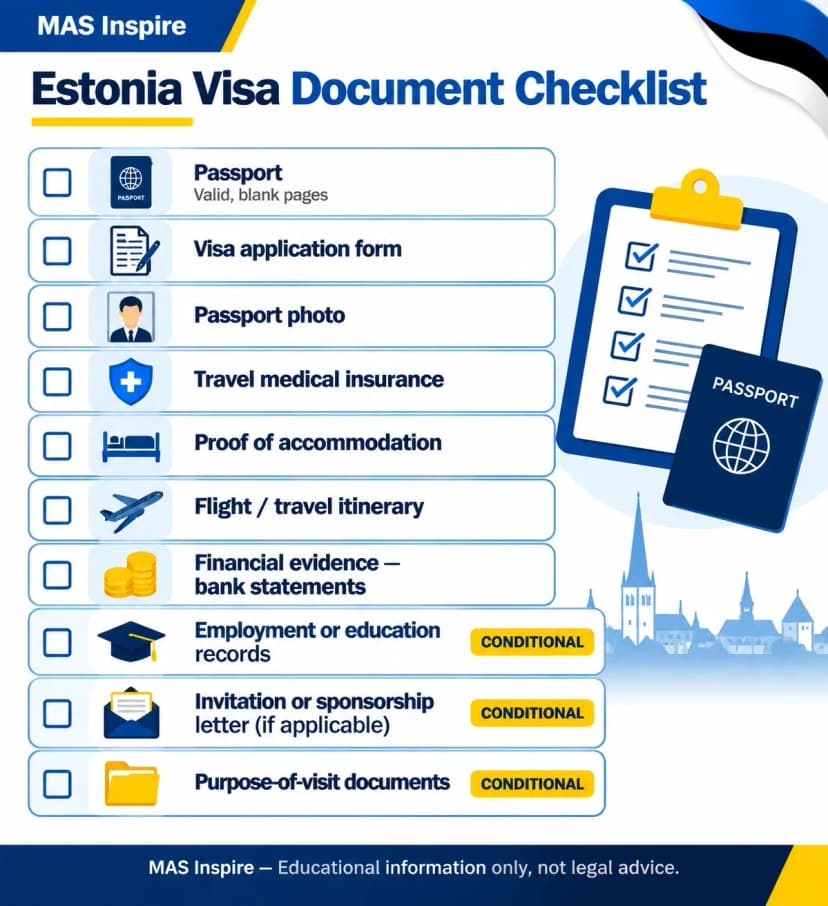
Every applicant needs the core documents below. The purpose-specific lists add to them, they do not replace them. All foreign public documents must be legalised or certified with an apostille and translated into Estonian or English.
Core documents for every applicant
| Document | Requirement |
|---|---|
| Passport | Issued within the last 10 years, valid at least 3 months beyond the visa or departure, with at least 2 blank pages |
| Visa application form | Completed online and signed; one form per person |
| Passport photo | One colour photo, 35 by 45 mm, meeting ICAO standards, no older than 6 months |
| Travel medical insurance | Minimum EUR 30,000 cover, valid in all Schengen states (C visa) or for the whole visa period (D visa) |
| Proof of funds | Bank statements showing the required amount for your purpose; some missions require original stamped statements, not internet printouts |
| Accommodation proof | Hotel booking or host invitation covering the whole stay |
| Travel itinerary | Flight reservation and day-by-day plan |
| Vietnam residence proof | Temporary residence card (TRC) or work permit, plus a copy of each — this proves where you live and that you will return |
| Employment or status proof | Employer letter on letterhead confirming leave, purpose and return to your job; or school letter for students; or business licence for the self-employed |
| Biometrics | Ten fingerprints and a facial image at the appointment (children under 12 exempt) |
Extra documents by purpose
| Purpose | Extra documents |
|---|---|
| Tourism | Day-by-day itinerary, confirmed hotel bookings, evidence of ties to Vietnam |
| Family visit | Invitation from the host in Estonia, host's ID and residence proof, evidence of the relationship |
| Business | Invitation from the Estonian company, your employer's letter, trade-fair or conference registration |
| Work (D visa) | Employment contract, short-term employment registration confirmation from the PPA, salary evidence |
| Study | University admission or confirmation letter, proof of EUR 880 per month, previous education certificates |
| Digital nomad | Remote-work explanation letter, employer's remote-work confirmation or company registration and client contracts, 6 months of income proof, tax or social-security certificate, CV |
| Startup or business | Startup Estonia committee assessment, business plan, company registration, investment evidence |
| Family reunion | Family member's residence permit and ID, proof of relationship, sponsor's income and accommodation proof |
| Children travelling | Birth certificate, consent letter from both parents if travelling with one parent or alone, parents' passport copies |
How to Apply from Vietnam: Step-by-Step
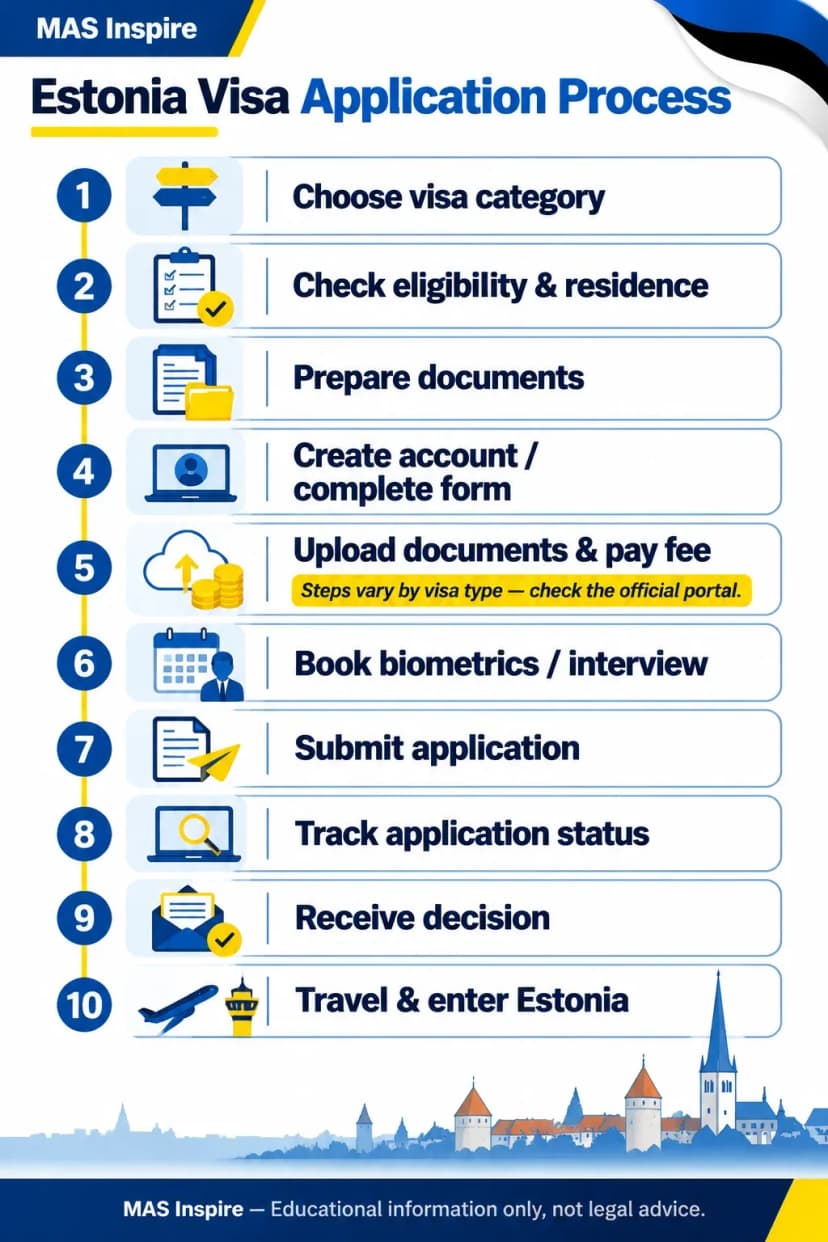
Short-stay (Schengen) visa — through France
Estonia has no mission in Vietnam. Under a Schengen representation agreement, France represents Estonia in Vietnam for short-stay visas. You therefore lodge the application at the French channel, on the French appointment system and to French timetables, but the visa you receive is an Estonian Schengen visa, and Estonia's rules on fees, subsistence and appeals still govern it.
- Confirm Estonia is your main destination. Apply through the France channel only if Estonia is where you will spend the most nights, or, if nights are equal, where you first enter the Schengen Area. If another country is your main destination, apply to that country instead.
- Complete the form on France-Visas. Fill in the online form at France-Visas, which gives you a reference number, the document list for your case and the visa fee. Fill in one form per person.
- Book an appointment with TLScontact. Book through the TLScontact website for Vietnam. There are two centres: Hanoi, at the Pacific Place Building, 8th floor, 83B Ly Thuong Kiet, Cua Nam, Hoan Kiem, Hanoi; and Ho Chi Minh City, at the Vincom Dong Khoi Building, 14th floor, 72 Le Thanh Ton and 45A Ly Tu Trong, Ben Nghe Ward, District 1. Both take applications by appointment only, Monday to Friday, 8:00 a.m. to 12:00 p.m. and 1:30 to 4:30 p.m. The call centre number is +84 24 39 39 26 62. Only applicants legally living in Vietnam can lodge at these centres, so bring your TRC or work permit.
- Attend in person with originals and copies. Bring the original of every document and a copy of each, which the centre keeps. Give your fingerprints and facial image, and pay the EUR 90 visa fee plus the centre's service fee. Fees are paid at the centre in dong at the French chancery rate.
- Track and collect. Follow your application on the TLScontact website. Collect your passport at the centre once you are notified; collection is available without an appointment, Monday to Friday from 8:00 a.m. to 6:00 p.m. and on Saturday. The normal decision time is 15 calendar days from admissibility, extendable to 45 days, so apply at least three to four weeks before travel and no later than 15 days before departure.
Long-stay (D) visa and residence permit — a different route
France's representation agreement in Vietnam covers short-stay visas. It does not cover long-stay D visas or residence permits. For a D visa or residence permit, you must apply at an Estonian representation that handles visa applications — the nearest Estonian missions that issue visas include Singapore and New Delhi, and the full list published by the Ministry of Foreign Affairs also includes Abu Dhabi, Ankara, Astana, Beijing, Canberra, Cairo, Dublin, Kyiv, London, Ottawa, Seoul, Tbilisi, Tel Aviv, Tokyo and Washington, with Seoul and Singapore taking long-stay visas only. Confirm with the mission you plan to use before travelling to lodge, because representation arrangements change and at least one mission on the list has suspended taking applications. Residence permit applications can also be lodged in Estonia at a PPA service office if you are already there on an accepted status, and your Estonian employer or university will normally guide you on which route to use. Do not book travel to a mission until it has confirmed in writing that it accepts your application.
Applying from Pakistan
If you are in Pakistan rather than Vietnam, the route is different again: Estonia has no embassy in Pakistan, and Schengen visas for Estonia are handled by the Embassy of Hungary in Islamabad, which represents Estonia there. Appointments are booked through the VFS Global (Gerry's) visa centres in Islamabad, Lahore or Karachi, and the Hungarian Embassy decides the application. The fee is the standard Schengen fee of EUR 90 for adults, EUR 45 for children aged 6 to 11, and free for children under 6, paid in rupees at the centre. Confirm the current arrangement with the Hungarian Embassy before applying, as representation agreements can change.
Extending Your Stay, Refusals and Appeals
Extending a stay
A Schengen short stay cannot simply be extended because you want more time: extension of the period of stay is possible only in limited circumstances, such as force majeure, humanitarian reasons or serious personal reasons, and is decided by the Police and Border Guard Board. A D visa or period of stay can likewise be extended only on a documented ground under the Aliens Act. If you think you may need longer than 90 days, apply for the correct long-stay route before you travel rather than relying on an extension.
If your visa is refused
A refusal is given on the standard EU form, which ticks one or more grounds from Article 32 of the EU Visa Code — for example, a false or forged document, purpose and conditions of stay not justified, insufficient means of subsistence, the 90 days in 180 already used, an alert in the Schengen Information System, or the intention to leave not being established. The last two grounds — weak purpose and doubts about return — are the most common for first-time applicants. There is no mandatory waiting period before reapplying, and for most people reapplying with a stronger, fixed file is faster than appealing. The visa fee must be paid again in full on reapplication, and it is not refunded.
Appeal — deadline changed, disclose the old figure
If you wish to contest a refusal, you may appeal to the Police and Border Guard Board. Since 18 July 2025 the deadline is 10 days from the date you became aware of the refusal decision — older guides that say 30 days or one month are out of date and following them will cost you the appeal. The state fee for reviewing the appeal is EUR 160. The appeal must not add documents that change the content of the original application, or evidence of circumstances that arose after the refusal, or documents you were obliged but failed to submit with the original application — so the first file has to be right. The PPA's official page states that it reviews the appeal and, if necessary, makes a new decision within 30 days of the appeal being lodged. One secondary guide states that the PPA makes a new decision within 10 days; the PPA's own page is the controlling source, so plan on 30 days. If the PPA upholds the refusal, you may file a complaint with the Tallinn Administrative Court within 10 days of notification of the appeal decision. An appeal does not give you a right to enter or stay in the Schengen Area while it is processed.
Overstaying
Do not overstay. The 90/180 rule is counted across the whole Schengen Area, entries and exits are recorded electronically under the Entry/Exit System, and an overstay can lead to a refusal of future visas, a Schengen Information System alert, a fine or removal. If an emergency prevents you from leaving on time, contact the PPA before your stay expires and apply for an extension on that ground.
Official Immigration Websites
| Organisation | What it is for | Website |
|---|---|---|
| Estonian Ministry of Foreign Affairs — long-stay (D) visa | D-visa rules, funds table and document lists | https://vm.ee/en/consular-visa-and-travel-information/visa-information/application-long-stay-d-visa |
| Estonian Ministry of Foreign Affairs — D-visa documents (Tbilisi) | Detailed D-visa document list with funds table | https://tbilisi.mfa.ee/necessary-documents-to-apply-for-a-d-visa/ |
| Estonian Embassy in Dublin — D visa | D-visa application page showing the older EUR 4,500 / EUR 800 figures | https://dublin.mfa.ee/applying-for-long-stay-d-visa/ |
| Police and Border Guard Board (PPA) — contesting a visa decision | Appeal deadline, EUR 160 fee and procedure | https://www.politsei.ee/en/instructions/visa-and-extending-period-of-stay/contesting-a-decision |
| France-Visas — Vietnam | Short-stay applications for Estonia in Vietnam; TLScontact centres in Hanoi and Ho Chi Minh City | https://france-visas.gouv.fr/en/web/france-visas/vietnam |
| Estonian e-Residency | Digital identity for running an Estonian company online — not a visa | https://www.e-resident.gov.ee/ |
| Startup Estonia | Startup visa assessments for founders | https://startupestonia.ee/ |
| Work in Estonia | Employment, relocation and salary information for foreign workers | https://www.workinestonia.com/ |
| Study in Estonia | Degree programmes and study information for international students | https://www.studyinestonia.ee/ |
| European Commission — Schengen visas | EU-wide Schengen visa rules, fees and the 90/180 rule | https://home-affairs.ec.europa.eu/policies/schengen/schengen-visas_en |
Note on the last two rows: the e-Residency, Startup Estonia, Work in Estonia and Study in Estonia addresses, and the European Commission Schengen visas address, are the programmes' well-known official home pages. The core figures in this guide rest on the Ministry of Foreign Affairs, PPA and France-Visas pages listed above, which were checked directly during research.
Frequently Asked Questions
1. Do Pakistani passport holders need a visa for Estonia?
Yes. Pakistan is on the list of nationalities that need a visa for the Schengen Area, and Estonia applies that list with no exception. You need a visa for tourism, business, study, work or any other purpose, and there is no visa on arrival or e-visa for ordinary Pakistani passports.
2. I live in Vietnam. Where do I apply for an Estonia tourist visa?
Through France, which represents Estonia in Vietnam for short-stay visas. Complete the form on France-Visas, then book an appointment with TLScontact in Hanoi or Ho Chi Minh City, attend in person with your documents and biometrics, and collect your passport from the centre. Estonia has no embassy in Vietnam.
3. How much is the Estonia Schengen visa fee?
EUR 90 for adults, EUR 45 for children aged 6 to 11, and free for children under 6. TLScontact adds its own service fee, which could not be verified specifically for Estonia applications in Vietnam — confirm it when you book. The fee is not refunded if you are refused.
4. How long does the Schengen visa take?
Usually 15 calendar days from the day your application is found admissible, and it can be extended to 45 days if further checks or documents are needed. Apply from six months before travel and no later than 15 calendar days before departure.
5. How long can I stay in Estonia on a Schengen visa?
Up to 90 days in any 180-day period, counted across the whole Schengen Area on a rolling basis — not 90 days per country. Entries and exits are recorded electronically under the Entry/Exit System.
6. How much money do I need to show for a short visit?
Estonia's reference amount is EUR 70 for each day of your stay, plus the cost of your return travel. A 10-day trip therefore means showing at least EUR 700. Show original stamped bank statements where the mission requires them, and keep the balance comfortably above the minimum.
7. What is the Estonia digital nomad visa income requirement?
This is genuinely disputed between official Estonian sources. The Ministry of Foreign Affairs' central funds table sets EUR 132 a day (EUR 3,960 a month), based on the regulation in force since 22 May 2026; the e-Residency website and the Estonian Embassy in Dublin still state EUR 4,500 a month. Budget on EUR 4,500 a month gross, evidenced over the six months before you apply, and confirm the figure in writing with the mission that will decide your file.
8. Can I work in Estonia on a D visa?
Not on the visa alone. The right to work comes from a short-term employment registration by your Estonian employer (for assignments up to 365 days) or from a temporary residence permit for employment (for longer stays). Your employer must register the employment with the Police and Border Guard Board before you start work.
9. What salary do I need for an Estonian work permit?
For a general residence permit for employment, your gross monthly salary must be at least the Estonian average wage — EUR 2,092 a month for applications from 5 March 2026 to March 2027. Top specialists need EUR 3,138 a month, startup employees EUR 1,674 a month, and EU Blue Card holders in shortage occupations EUR 2,594 a month.
10. Can I study in Estonia, and what does it cost in fees?
Yes. Apply for a D visa (EUR 120) with your university admission letter and proof of EUR 880 per month, then a residence permit for study (EUR 225 in Estonia or EUR 255 abroad). The permit decision can take up to 90 days, so apply well before your semester starts.
11. Is Estonia's e-Residency a visa?
No. e-Residency is a digital identity that lets you run an Estonian company online. It gives no right to enter Estonia, live there or work there, and it is not a route to a visa or residence permit.
12. Can I apply for a D visa or residence permit in Vietnam?
No — France's representation agreement in Vietnam covers short-stay visas only. For a D visa or residence permit, apply at an Estonian representation that handles visa applications, such as Singapore or New Delhi, or lodge in Estonia at a PPA service office if you are already there on an accepted status. Confirm with the mission before travelling to lodge.
13. What happens if my Estonia visa is refused?
You can reapply immediately with a stronger file — there is no mandatory waiting period — or appeal to the Police and Border Guard Board within 10 days of learning of the refusal, paying a EUR 160 fee. The appeal deadline was shortened from 30 days to 10 days on 18 July 2025, so do not rely on older guides. Reapplying is usually faster than appealing.
14. Can I extend my stay in Estonia?
Only on limited grounds, such as force majeure, humanitarian reasons or serious personal reasons, decided by the Police and Border Guard Board. Do not plan a trip that depends on an extension; apply for the correct long-stay route before you travel.
15. Do I need travel insurance for Estonia?
Yes. Travel medical insurance with minimum cover of EUR 30,000 is required for both Schengen and D visas, covering emergency medical treatment and repatriation, and for a D visa it must cover the whole visa period.
Editorial note: This guide was checked against official Estonian and French sources on 28 November 2026. Fees, funds thresholds and representation arrangements change; confirm the live official pages linked above before paying any fee or booking travel. This guide is educational information, not legal advice.