Eritrea Visa Guide 2026: Types, Requirements, Documents and Application Steps
Editorial date: 27 November 2026. Research verified: 28 November 2026. Written for Pakistani passport holders living in Vietnam.
Table of contents
- Introduction
- Do Pakistani Passport Holders Need a Visa for Eritrea?
- Types of Eritrea Visas
- Visa Comparison Table
- Eligibility Requirements
- Complete Document Checklists
- How to Apply: Step-by-Step
- Visa Fees and Financial Requirements
- Visa Processing Times
- Applying from Pakistan or Vietnam
- Travel Permits Inside Eritrea
- Entry, Stay, Extensions and Exit Rules
- Health, Money and Practical Travel Notes
- Common Application Mistakes and Reasons for Refusal
- Frequently Asked Questions
- Official Immigration Websites
- Final Checklist and Conclusion
Introduction
Eritrea is one of the most tightly controlled destinations in the world for visitors. It is a small Horn of Africa state on the Red Sea coast, with its capital at Asmara, a UNESCO-listed city famous for its Italian-era Art Deco architecture, and a coastline that includes the port of Massawa and the Dahlak islands. Very few tourists visit each year, and the government manages foreign travel closely: every visitor needs a visa in advance, and every journey outside the capital needs a separate travel permit.
This guide is written for Pakistani passport holders who live in Vietnam and are considering a trip to Eritrea. That combination matters, because there is no Eritrean embassy or consulate in Vietnam, and no published rule says which Eritrean mission serves residents of Vietnam. You will almost certainly have to apply through a mission in another country, by post or through a visit, and you should expect a slow, paper-based process with approval referred back to Asmara.
Eritrea does not operate a general e-Visa system, and there is no reliable visa-on-arrival route for Pakistani nationals. Do not book non-refundable flights or hotels until the visa is in your passport. This guide is an educational resource, not legal advice and not an official Eritrean government service. Immigration rules, forms, fees and processing times change without notice, and the Eritrean embassy that handles your application is the final authority on what it requires.
Two warnings belong at the top. First, several governments advise against non-essential travel to Eritrea, and the United Kingdom advises against all but essential travel to most of the country and against all travel within 25 kilometres of its land borders. Read the current travel advice before you decide to go. Second, figures in this guide are only as good as their sources. Eritrea publishes very little visa information, so fees and processing times differ from one embassy to another, and third-party guides disagree with each other. Where sources conflict, this guide says so and names the controlling source, rather than presenting one unverified figure as fact.
Do Pakistani Passport Holders Need a Visa for Eritrea?
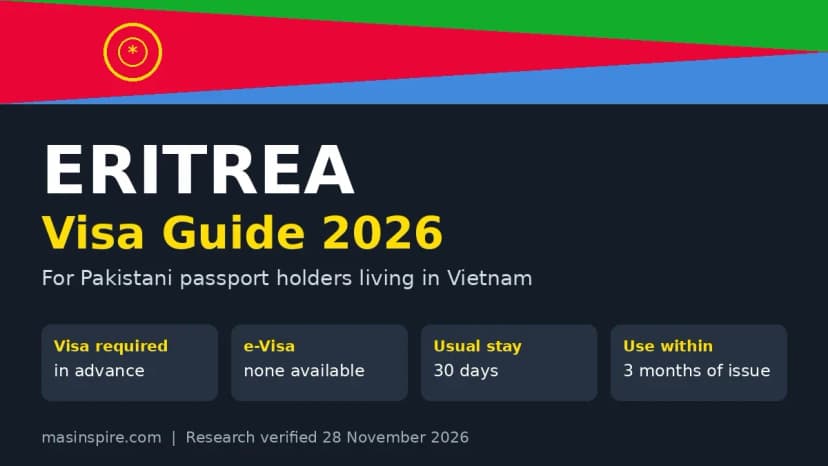
Yes. Pakistani passport holders must hold a valid Eritrean entry visa before travelling. There is no visa-free entry for Pakistani nationals, no e-Visa, and no visa exemption that applies to ordinary Pakistani passports. The United Kingdom Foreign, Commonwealth and Development Office states plainly that you must have a visa to enter Eritrea, and the United States Department of State states that you must obtain your visa before travelling. The Government of Canada likewise lists tourist, business, official and transit visas as required, and states that all visas must be obtained prior to travel.
There is no general visa-on-arrival system. Some travel-industry sources describe a narrow exception in which a local sponsor asks the Eritrean Immigration Authority to arrange a visa on arrival at least 48 hours before the traveller arrives, but other official and government sources say there is no visa on arrival at all, and accounts differ on whether such an arrangement ever works in practice. This guide treats visa on arrival as not available to Pakistani nationals. Do not fly to Asmara expecting to be issued a visa at the airport. Airlines act as a first checkpoint and may refuse boarding to a passenger who cannot show a valid visa, because the airline bears the cost of carrying back a refused passenger.
The visa is an entry visa issued by an Eritrean embassy or consulate abroad, on the standard application form known as Form B62.3. Approval is commonly referred to Asmara, which is one reason processing is slow. A visa does not guarantee entry: immigration officers at Asmara International Airport make the final decision, and they can ask to see your return ticket, accommodation details and proof of funds.
Dual nationals should take extra care. Travellers who enter Eritrea on an Eritrean national identity card or an Eritrean passport need an exit visa from the Immigration Office in Asmara before leaving the country. This does not normally apply to a Pakistani passport holder travelling only on a Pakistani passport, but if you hold Eritrean nationality as well, ask the embassy about exit-visa rules before you travel.

Types of Eritrea Visas
Eritrea does not publish a single consolidated list of visa categories with definitions, so the categories below are drawn from the visa requirements published by its embassies, chiefly the Embassy of Eritrea in Washington, D.C., together with government travel advice. The embassy that handles your application decides which category fits your trip, so confirm the category with that mission before you apply.
1. Tourist visa
The standard entry visa for sightseeing and leisure travel. It is normally issued as a single-entry visa. According to the Washington embassy, a tourist visa must be used within three months of the date of issue, and the stay granted on entry is usually one month. You will need a provisional travel itinerary showing your planned date of arrival, and the form asks for the hotel name or the address and telephone details of the place where you will stay. Independent tourism is heavily managed in Eritrea: in practice many tourist applications involve a licensed Eritrean tour operator or a local sponsor, and you should expect questions about your itinerary and accommodation.
2. Family visit visa
For visiting family or friends living in Eritrea. The Washington embassy charges a higher fee for family visit visas than for tourist visas, which suggests the category is treated distinctly. Expect to give the name, address and contact details of your host in Eritrea, and your host may be asked to follow up with the Immigration Office in Asmara. A family visit visa is normally single-entry, must be used within three months of issue, and usually allows a stay of one month after entry.
3. Business visa
For meetings, negotiations, conferences and other short business activity. You will need a letter from the Eritrean company or institution inviting you, stating the purpose and duration of the trip, and usually a supporting letter from your own employer. A business visa does not authorise you to take up employment in Eritrea. The Washington embassy charges a higher fee for work-related categories than for tourist visas; see the fees section for the figures and their limits.
4. Work visa
For taking up employment in Eritrea. This requires a sponsoring employer in Eritrea and approval from the Eritrean authorities. Do not travel on a tourist or business visa intending to work. The Washington embassy lists a work-visa fee of 100 US dollars, but that figure applies to applications made in Washington and other missions set their own fees.
5. Student visa
For study in Eritrea. The Washington embassy lists a student-visa fee of 50 US dollars and a minimum processing time of at least 15 days. You will need proof of admission from the Eritrean institution and evidence that you can support yourself during your studies. Study places for foreign students are very limited, so confirm admission and the visa category with the embassy before making any other plans.
6. Transit visa
For passing through Eritrea on the way to another country. The Government of Canada lists a transit visa as required. If you remain airside and do not pass through immigration, a transit visa may not be needed, but flight connections through Asmara are rare, so confirm with the embassy and your airline whether a transit visa applies to your routing. Third-party guides quote a transit fee of around 40 US dollars, but that figure is not verified against an official source and should be confirmed with the mission.
7. Official and diplomatic visas
For government officials and diplomats travelling on official business. The Washington embassy issues official visas free of charge on presentation of a diplomatic note or note verbale stating the purpose and duration of the stay, together with proof of diplomatic status. These categories do not apply to ordinary travellers.
Categories that do not exist for Eritrea
There is no published job-seeker visa, digital nomad visa, retirement visa or investment visa for Eritrea, and no permanent-residence route that an ordinary visitor can apply for from abroad. If an agent offers you one of these, treat the offer with suspicion and verify it directly with an Eritrean embassy before paying anything.
Visa Comparison Table
The table below summarises the main categories. Fees and processing times are shown as reported, with the source of each figure. Because each Eritrean embassy sets its own fee, the Washington figures are the only ones verified against an official embassy publication, and they apply only to applications made in Washington. Figures from third-party guides are labelled as such and are not presented as official.
| Visa type | Purpose | Entries | Use within | Usual stay on entry | Fee reported | Processing reported |
|---|---|---|---|---|---|---|
| Tourist | Sightseeing, leisure | Single entry (usual) | 3 months from issue | 1 month | 50 US dollars at the Washington embassy; 70 to 90 US dollars in third-party Pakistan-focused guides | At least 15 business days in Washington; 10 to 15 working days in other third-party guides |
| Family visit | Visiting family or friends | Single entry (usual) | 3 months from issue | 1 month | 70 US dollars at the Washington embassy | At least 15 business days in Washington |
| Business | Meetings, conferences | Single entry (usual) | 3 months from issue | As issued | 90 to 120 US dollars in third-party guides; not published by the Washington embassy | 2 to 4 weeks in third-party guides; not published officially |
| Work | Employment in Eritrea | As issued | As issued | As issued | 100 US dollars at the Washington embassy | At least 15 business days in Washington |
| Student | Study | As issued | As issued | As issued | 50 US dollars at the Washington embassy | At least 15 days in Washington |
| Transit | Passing through Eritrea | Single entry | As issued | Short stay only | Around 40 US dollars in third-party guides; not verified officially | Not published officially |
| Official / diplomatic | Official government travel | As issued | As issued | As issued | No fee at the Washington embassy | At least 10 days in Washington |
Read the table with care. The stay granted is the stay printed on your visa and stamped by the immigration officer on arrival, not an automatic entitlement. A single-entry visa ends as soon as you leave Eritrea, even if the printed stay period has not run out. Multiple-entry visas are reported by some Pakistan-focused guides, with validity of three to six months, but no official embassy source consulted for this guide publishes a multiple-entry tourist fee or validity, so treat multiple entry as something to ask the mission about rather than something you can count on.
Eligibility Requirements
The core eligibility requirements are consistent across the sources consulted. You must hold a Pakistani passport valid for at least six months beyond the dates of your trip, with at least two blank consecutive pages for the visa and entry stamps. The United Kingdom Foreign, Commonwealth and Development Office states the six-month and two-blank-page rules expressly, and the Washington embassy requires a passport valid at least six months beyond the dates of the trip.
You must be able to show the purpose of your visit and the means to pay for it. The Washington embassy requires proof of sufficient funds to cover all expenses, a provisional travel itinerary with a planned date of arrival, and the name of your hotel or the address and telephone details of your host. If you are not a citizen of the country where you apply, the embassy will ask for proof of your lawful residence there, such as a residence permit or permanent resident card. For a Vietnam-resident Pakistani, that means your Vietnamese temporary residence card or visa, and proof of your address in Vietnam.
You must apply to an Eritrean embassy or consulate, normally the one covering your country of residence, and you must apply before you travel. There is no online application portal for the general public: the Washington embassy uses an online form, Form B62.3, completed and signed online through its consular system, followed by mailing the original passport to the embassy. Other missions use paper forms, so follow the instructions of the mission you apply to.
Health requirements are limited but real. A yellow fever vaccination certificate may be required if you arrive from, or have transited through, a country with a risk of yellow fever transmission. The United Kingdom advice says to check the vaccinations and certificates you need at least eight weeks before travel, and notes that a yellow fever certificate may be required depending on your circumstances. Some commercial guides present yellow fever vaccination as universally required for Eritrea, but the official advice makes it conditional on your route, so check your transit countries rather than assuming either way. A polio vaccination certificate from NADRA is reported by a Pakistan-focused guide as needed to leave Pakistan; that is a Pakistani exit requirement, not an Eritrean entry requirement, and you should confirm it with the Pakistani authorities before departure.
Finally, you must be prepared for the possibility of refusal without a detailed explanation. Eritrea is one of the most restrictive countries for visitors, refusals occur even when full documentation is submitted, and there is no published appeal process for a refused tourist visa. Apply early, keep copies of everything you submit, and do not spend money you cannot afford to lose until the visa is issued.
Complete Document Checklists
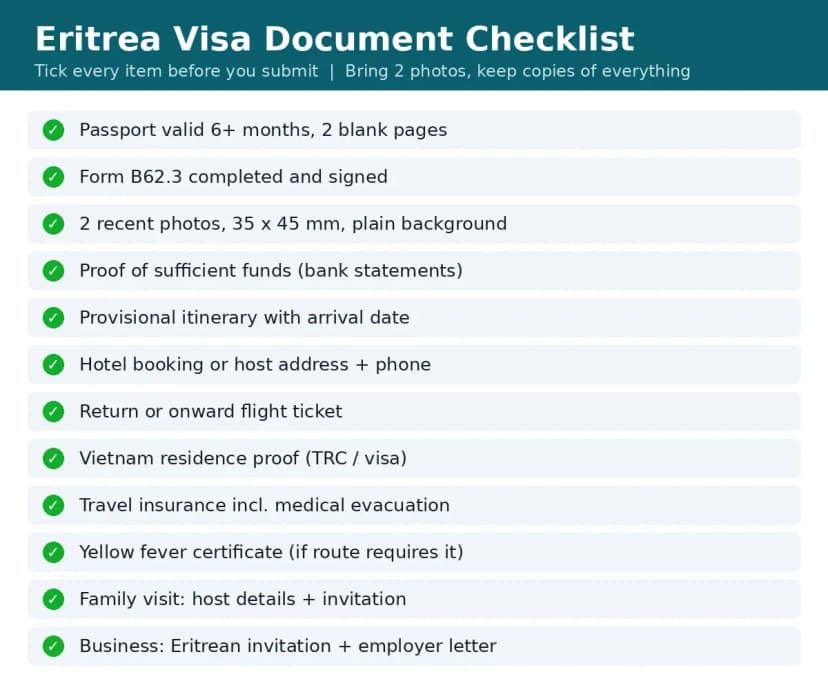
The lists below combine the document requirements published by the Embassy of Eritrea in Washington, D.C., the requirements stated in United Kingdom government travel advice, and the documents named in Pakistan-focused guides. Items marked as embassy-published come from the Washington mission; items marked as guide-reported come from third-party guides and should be confirmed with the mission you apply to, because each embassy sets its own list.
Documents every applicant needs
- Pakistani passport, valid at least six months beyond the dates of your trip, with at least two blank consecutive pages, and undamaged (embassy-published).
- Completed and signed visa application Form B62.3 (embassy-published). The Washington embassy requires the form to be completed and signed online; other missions may use a paper form.
- One recent passport photograph, 35 by 45 millimetres, on a plain background (embassy-published). Some guides say two photographs; bring two so that you are covered either way.
- Proof of sufficient funds to cover all expenses, such as bank statements (embassy-published). The Washington embassy does not state a minimum balance, and no official source consulted for this guide states one.
- Provisional travel itinerary showing your planned date of arrival in Eritrea (embassy-published).
- Proof of accommodation: the name of your hotel, or the address and telephone details of the family home where you will stay (embassy-published).
- Return or onward flight ticket or booking (guide-reported, and consistently required by airlines and immigration officers).
- Proof of lawful residence in the country where you apply, if you are not a citizen there, such as your Vietnamese temporary residence card (embassy-published). For a Vietnam-resident Pakistani this is essential.
- Travel health insurance covering medical treatment and medical evacuation is strongly recommended (guide-reported). Eritrea has limited medical facilities, and several governments advise comprehensive cover including evacuation.
- Yellow fever vaccination certificate, if you arrive from or transit through a country with yellow fever risk (official advice; conditional, not universal).
Extra documents for a family visit
- Name, address and telephone details of your host in Eritrea, and your relationship to them.
- A letter of invitation from your host, if the mission asks for one.
- Your host may be asked to attend or follow up with the Immigration Office in Asmara on your behalf, so agree this with your host before you apply.
Extra documents for a business trip
- Letter of invitation from the Eritrean company or institution, stating the purpose and duration of the trip.
- Supporting letter from your own employer in Vietnam or Pakistan, stating your position, the purpose of the trip and that your employment continues.
- Details of any conference, meeting or event you will attend.
Extra documents for work or study
- For work: a letter from your sponsoring employer in Eritrea and evidence of approval from the Eritrean authorities.
- For study: proof of admission from the Eritrean institution and evidence of funds for the period of study.
- For official travel: a diplomatic note or note verbale stating the purpose and duration of the stay, and proof of diplomatic status.
A note on bank statements
Some Pakistan-focused commercial guides quote a required closing bank balance of 800,000 to 2,000,000 Pakistani rupees, or a six-month statement with an account maintenance certificate. Those figures come from commercial agents, not from any official Eritrean source consulted for this guide, and the Washington embassy states no minimum balance at all. This guide does not present any bank-balance figure as a requirement. Prepare a genuine statement that honestly shows you can afford the trip, and ask the mission whether it wants a particular statement period.
How to Apply: Step-by-Step
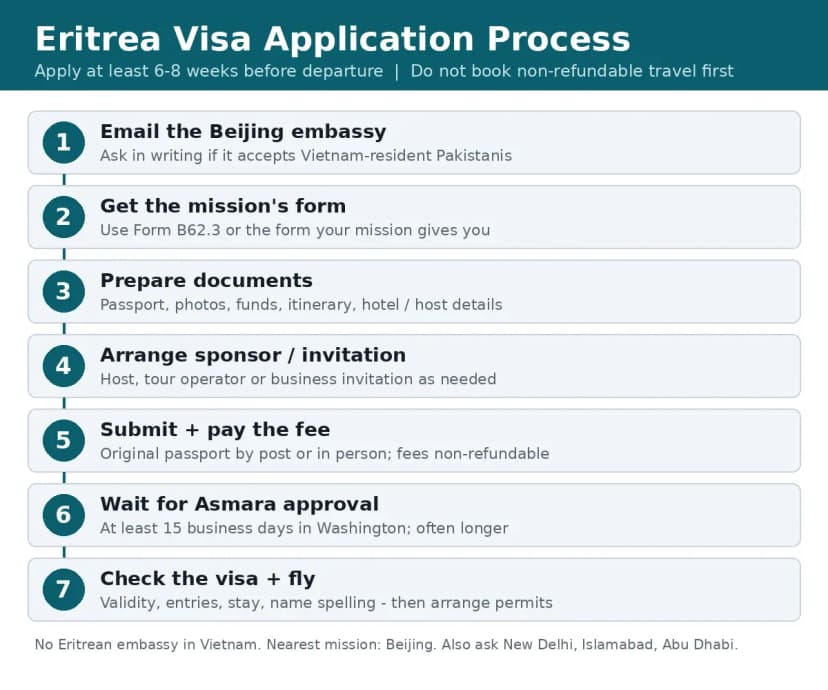
There is no single application route, because there is no Eritrean embassy in Vietnam and no published accreditation for Vietnam. The steps below are the process as published by the Washington embassy and as described in government travel advice, adapted for a Vietnam-resident Pakistani. Confirm each step with the mission you apply to before you act on it.
Step 1: Decide which mission to approach
Contact the Eritrean embassy in Beijing, China, first: it is the closest Eritrean embassy to Vietnam, and its address and telephone number are published. Ask, in writing, whether it accepts visa applications from Pakistani nationals who are resident in Vietnam, what form it uses, what fee it charges, how it accepts payment, and whether you must attend in person or may apply by post or courier. If Beijing does not accept your application, ask it which mission does. The other candidate missions are New Delhi, Islamabad, Abu Dhabi and Dubai, Cairo, and Riyadh. Do not assume any of them will accept you; each mission decides its own jurisdiction, and none has published that it serves Vietnam residents.
Step 2: Get the application form and the mission's own checklist
Ask the mission for its current form and document list. The Washington embassy uses Form B62.3, completed and signed online through its consular system, with a 35 by 45 millimetre photograph uploaded. Other missions may use a paper form. Use the form the mission you apply to gives you, not a copy reposted on a third-party website, and complete every field, including your host or hotel details, previous visits and emergency contact.
Step 3: Prepare your documents
Gather the documents in the checklists above. Check that your passport has at least six months validity beyond your trip and two blank consecutive pages. Get two recent passport photographs. Print your itinerary and accommodation details. Prepare proof of funds and proof of your Vietnamese residence. Make a full photocopy of your passport and of everything you submit, and keep the copies separate from the originals.
Step 4: Arrange your sponsor or invitation, if your category needs one
For a family visit, confirm with your host that they will act as your reference and, if needed, follow up with Immigration in Asmara. For business, obtain the invitation letter from the Eritrean company. For tourism, confirm your hotel booking and, if the mission asks for it, arrange a licensed Eritrean tour operator. Do not invent a sponsor: a false invitation is a reason for refusal and can cause lasting problems.
Step 5: Submit the application and pay the fee
Submit the form, photograph, passport and supporting documents exactly as the mission instructs, and pay the fee in the way it specifies. The Washington embassy requires the original passport to be mailed to the embassy, charges 50 US dollars for a tourist visa plus 13 dollars for photo printing and 10 dollars for services, and states that all fees are non-refundable. Other missions may require cash, a money order or a bank transfer, and will charge their own fee. Keep the payment receipt and any tracking number.
Step 6: Wait, and respond promptly to any contact
Processing is slow and approval is commonly referred to Asmara. The mission may contact you for an interview or for extra documents. Answer promptly and in writing where possible. Do not book non-refundable travel while you wait.
Step 7: Collect your passport and check the visa
When the passport is returned, check the visa before you leave the embassy or before you travel: the validity dates, the number of entries, the permitted stay, and the spelling of your name and passport number. The visa must be used within three months of the date of issue, and the stay granted on entry is usually one month. If anything is wrong, raise it with the mission immediately rather than discovering it at the airport.
Step 8: Prepare for arrival
Before you fly, arrange your travel permit plans for any travel outside Asmara, confirm your accommodation, carry your return ticket and proof of funds, and carry cash in US dollars: cards do not work in Eritrea and there are no functioning international ATMs. Keep a photocopy of your passport and visa separate from the originals.
Visa Fees and Financial Requirements
There is no single published fee schedule for Eritrean visas. Each Eritrean embassy sets its own fee, and the fee for the same visa type differs from one mission to another. That is the single most important fact in this section, and it is the reason this guide reports fees by source instead of giving one figure.
| Fee item | Amount reported | Source | Applies to |
|---|---|---|---|
| Tourist visa | 50 US dollars | Embassy of Eritrea in Washington, D.C., official tourist visa requirements | Applications made in Washington only |
| Photo printing fee | 13 US dollars | Embassy of Eritrea in Washington, D.C. | Applications made in Washington only |
| Services fee | 10 US dollars | Embassy of Eritrea in Washington, D.C. | Applications made in Washington only |
| Tourist visa total in Washington | 73 US dollars | Calculated from the three Washington figures above | Applications made in Washington only |
| Family visit and other categories | 70 US dollars | Washington embassy fee schedule as reported in 2026 | Applications made in Washington only |
| Work visa | 100 US dollars | Washington embassy fee schedule as reported in 2026 | Applications made in Washington only |
| Student visa | 50 US dollars | Washington embassy fee schedule as reported in 2026 | Applications made in Washington only |
| Official visa | No fee | Embassy of Eritrea in Washington, D.C. | Applications made in Washington only |
| Tourist visa | 70 to 90 US dollars | Third-party Pakistan-focused guides | Not verified against an official source |
| Tourist visa | 40 US dollars | One Pakistan-focused commercial guide | Not verified against an official source; conflicts with the figures above |
| Single-entry visit visa | 70 to 80 US dollars | One Pakistan-focused commercial guide | Not verified against an official source |
| Multiple-entry visit visa | 100 to 120 US dollars | One Pakistan-focused commercial guide | Not verified against an official source |
| Business visa | 90 to 120 US dollars | Third-party guides | Not verified against an official source |
| Transit visa | Around 40 US dollars | Third-party guides | Not verified against an official source |
What you should take from this table: the only fee verified against an official embassy publication is the Washington tourist fee of 50 US dollars, plus 13 dollars for photo printing and 10 dollars for services, a total of 73 dollars for an application made in Washington. Every other figure comes from commercial guides and has not been verified against an official source. The mission you apply to, whether Beijing, New Delhi, Islamabad, Abu Dhabi or another, will charge its own fee, and you must ask it for the amount, the currency and the payment method before you submit. All fees are non-refundable, and an embassy will not process your file until the fee is paid.
On financial requirements, the Washington embassy requires proof of sufficient funds to cover all expenses but states no minimum amount. No official source consulted for this guide states a minimum bank balance. Commercial guides quote balances of 800,000 to 2,000,000 Pakistani rupees; those figures are agent claims, not official requirements, and this guide does not adopt them. Budget honestly for the trip itself: international flights to Asmara are expensive and infrequent, accommodation and transport inside Eritrea are paid in cash, and you should carry enough US dollars in cash for the whole stay, because cards do not work and there are no functioning international ATMs.
Visa Processing Times
Processing times conflict across sources, and the conflict is itself the finding. The table below reports each figure with its source, so you can see why this guide recommends applying at least six to eight weeks before departure.
| Processing time reported | Source | Scope |
|---|---|---|
| At least 15 business days | Embassy of Eritrea in Washington, D.C., current online system | Tourist visas in Washington; a minimum, not a promised completion date |
| Minimum of 10 days | Embassy of Eritrea in Washington, D.C., older published tourist visa requirements | Tourist visas in Washington; conflicts with the current 15-business-day figure from the same embassy |
| About 10 working days | Pakistan-focused guide, citing the Embassy in Switzerland | Not verified against an official source |
| 7 to 10 working days for a single-entry visa; 10 to 15 working days for a multiple-entry visa | One Pakistan-focused commercial guide | Not verified against an official source |
| 2 to 4 weeks | Several third-party guides | General estimate; not verified against an official source |
| 4 to 8 weeks | One Pakistan-focused commercial guide, citing Asmara clearance | Not verified against an official source |
| 2 to 25 business days | One 2026 visa guide | General range across missions; not verified against an official source |
The controlling source is the mission you apply to, and the only official figure is the Washington embassy's current minimum of at least 15 business days. Note that the same embassy's older published requirements said a minimum of 10 days, so even the official figures have changed over time. The safest reading is that processing commonly takes several weeks, that approval is referred to Asmara, and that the total time from submission to passport return can be longer than the embassy's minimum, especially when postage is involved. Apply at least six to eight weeks before your planned departure, and do not book non-refundable flights or hotels until the visa is in your passport.
Applying from Pakistan or Vietnam
Your position as a Pakistani passport holder living in Vietnam is the hardest part of this application, and it deserves its own section. There is no Eritrean embassy or consulate in Vietnam. There is also no published list saying which Eritrean mission is accredited to Vietnam, or which mission accepts applications from residents of Vietnam. This guide therefore cannot name a single correct mission for you. It can only name the realistic candidates and tell you what to ask each of them.
The candidate missions nearest Vietnam
| Mission | City and country | Why it is a candidate | What is not confirmed |
|---|---|---|---|
| Embassy of Eritrea in China | Beijing, China | Closest Eritrean embassy to Vietnam; address and telephone published | Whether it accepts applications from Pakistani nationals resident in Vietnam |
| Embassy of Eritrea in India | New Delhi, India | Large regional mission; reported by one source as stating the entry visa is valid for one month from entry and extendable | Whether it accepts applications from Vietnam residents |
| Embassy of Eritrea in Pakistan | Islamabad, Pakistan | Your country of nationality; listed in the published list of Eritrean missions | Whether it is currently operating and accepting applications; some Pakistan-focused guides state that Eritrea has no embassy in Pakistan, which conflicts with the mission list |
| Embassy of Eritrea in the UAE | Abu Dhabi, with a Consulate-General in Dubai | Major regional mission, commonly used by applicants in the Gulf | Whether it accepts applications from Vietnam residents |
| Embassy of Eritrea in Egypt | Cairo, Egypt | Regional mission on a common flight route to Asmara | Whether it accepts applications from Vietnam residents |
| Embassy of Eritrea in Saudi Arabia | Riyadh, with a consulate in Jeddah | Major regional mission | Whether it accepts applications from Vietnam residents |
There is no Eritrean embassy in Thailand, Malaysia or Singapore, so there is no nearer South-East Asian option. The practical approach is to email the Beijing embassy first, explain that you are a Pakistani national lawfully resident in Vietnam, and ask in writing whether it will accept your application, what its form, fee and payment method are, and whether you must attend in person. Keep the reply. If Beijing declines, work through the other missions in the same way, and ask each one which mission it recommends.
What changes because you live in Vietnam
You will need to prove your lawful residence in Vietnam, normally with your temporary residence card and your Vietnamese visa or residence stamp. The Washington embassy expressly requires proof of residency for non-citizens applying in its jurisdiction, and the same requirement is reasonable to expect elsewhere. Your Vietnamese residence does not guarantee that any particular Eritrean mission will accept your application: embassies commonly serve residents of their host country, and a mission in Beijing, for example, may only serve residents of China. That is why written confirmation before you travel or post your passport is essential.
Think about the logistics before you commit. If the mission requires your original passport by post, use a tracked courier and keep a photocopy. If it requires you to attend in person, factor in the cost of travel to Beijing, New Delhi, Islamabad, Abu Dhabi or Cairo, plus the visa you may need to enter that country. If you apply from Pakistan during a visit home, note the conflicting reports about the Islamabad mission: the published list of Eritrean missions includes an embassy in Islamabad, but some Pakistan-focused guides state that Eritrea has no embassy in Pakistan and direct applicants to missions in the UAE or elsewhere. Verify the Islamabad mission's current status directly before relying on it.
There is no Pakistani embassy in Eritrea, and consular help inside Eritrea is limited. If you run into difficulty in Asmara, your options for outside help are narrow, which is another reason to keep copies of your documents, your return ticket and your travel insurance details with you and with someone at home.
Travel Permits Inside Eritrea
A visa is not enough to travel freely in Eritrea. All foreign nationals, including tourists, diplomats and aid workers, must obtain a government-issued travel permit for travel beyond 25 kilometres outside Asmara. This is confirmed by the Government of Canada, the United States Department of State and the United Kingdom Foreign, Commonwealth and Development Office, and it is strictly enforced at military and police checkpoints on every road out of the capital.
Applications are made to the relevant ministry: the Ministry of Tourism for tourists, the Ministry of Trade and Industry for business travellers, and the Ministry of Foreign Affairs for diplomats and non-governmental organisation staff. The United States Department of State states that applications for travel permits are available at the two Ministry of Tourism offices on Harnet Avenue and Airport Road in Asmara. The Eritrean Ministry of Tourism's Tourism Service Center, on Harnet Avenue next to the Sweet Asmara Cafe, is the desk that issues the Travel Permit for Foreigners, and regional administration offices, known as zoba offices, issue permits for travel outside the area where you live or work.
To apply, you give your passport and visa details, your destinations, your mode of transport, the number of days and nights you will stay, and your hotel accommodation for overnight visits. Permits are issued per destination, and you must carry them with you: checkpoints check them, and even with a permit, foreign nationals have been prevented by local authorities from travelling outside Asmara's surrounding province. Some destinations are refused without explanation, some areas, including the border zones, are not permitted at all, and tourists have been refused permission to use public transport outside Asmara. Build the permit applications into your schedule at the start of the trip, allow several days for them, and do not assume a permit will be granted.
The fee for a travel permit was reported as 20 nakfa per destination, plus a few nakfa for photocopies of your passport and visa, in February 2017 prices published by the Ministry of Tourism's Tourism Service Center. That figure is nine years old and has not been verified against a current source, so this guide reports it as dated and does not present it as the current fee. Ask at the Tourism Service Center when you arrive.
Entry, Stay, Extensions and Exit Rules
On arrival at Asmara International Airport, present your passport with the visa, your return or onward ticket, and your accommodation details. Immigration officers decide the stay you are granted, and the date they stamp governs your trip, even if a guide or an agent told you a different period. The usual pattern, reported consistently across sources, is that the visa must be used within three months of the date of issue and the stay granted on entry is one month. Some sources describe the visa validity as one to three months; the three-month use window and one-month stay are the figures best supported by the sources, including the Washington embassy's statement that tourist and family visit visas must be used within 90 days of issuance and provide a stay of one month after entry.
Extensions are possible but not guaranteed. If you need to stay longer than one month, apply to the Immigration Office in Asmara before your authorised stay expires. The older Eritrean embassy guidance states that the original visa can be renewed twice, that you will need a photograph for the extension, and that a fee must be paid in euros or dollars. That guidance is old and the extension fee amount is not verified against a current source, so confirm the fee and the procedure at the Immigration Office when you arrive. Do not overstay: a fine is charged for exceeding the permitted stay and is paid on departure, and overstaying can cause problems with future applications.
Currency rules are strict. You must declare foreign currency of 10,000 US dollars or more on arrival, and you must declare amounts over 10,000 US dollars on departure. You are not allowed to take more than 1,000 Eritrean nakfa out of Eritrea. Some government advice reports the export limit as 500 nakfa; the 1,000-nakfa figure comes from the United States Department of State and the United Kingdom advice, and this guide follows those, while noting the lower figure reported elsewhere. The nakfa is pegged to the US dollar at 15 nakfa to one dollar and is not convertible outside Eritrea, so do not leave the country holding nakfa you cannot use.
On departure, keep your exchange receipts and your travel permit paperwork, and allow extra time at the airport. If you entered on an Eritrean identity card or Eritrean passport as a dual national, you need an exit visa from the Immigration Office in Asmara before leaving.
Health, Money and Practical Travel Notes
Health preparation starts at least eight weeks before travel. Check the vaccinations and certificates you need, and discuss malaria prophylaxis with a travel health specialist: malaria prophylaxis is recommended for all areas of Eritrea except Asmara and altitudes above 2,200 metres. A yellow fever certificate may be required if you arrive from or transit through a country with yellow fever risk, and it is recommended for travellers visiting the lowland regions. Hepatitis A and typhoid vaccination are commonly recommended because of food and water risks. Medical facilities in Eritrea are limited, so comprehensive travel and medical insurance covering overseas medical expenses, medical evacuation and repatriation is strongly advised by several governments.
Money is cash only. The currency is the Eritrean nakfa, pegged at 15 nakfa to one US dollar and not convertible outside Eritrea. Credit and debit cards do not work for everyday purchases, there are no functioning international ATMs, and you must exchange currency only at official rates at authorised banks, keeping every exchange receipt. Bring enough US dollars in cash for the whole trip, declare amounts of 10,000 dollars or more on arrival, and account for what you have spent on departure.
Flights to Asmara are few and usually route through Cairo, Dubai or Addis Ababa. The main gateway is Asmara International Airport. Check your airline's requirements carefully: airlines may refuse boarding if you cannot show a valid visa, and they may ask for your return ticket and accommodation details.
Inside the country, expect limited internet and no data roaming, and note that local SIM cards can only be purchased by non-residents through the Eritrean Ministry of Tourism after submission of application forms and fees. Photographing government buildings, military installations, police officers and infrastructure such as roads, bridges, dams and airports is prohibited, and a permit from the Ministry of Tourism is needed to photograph some sites such as the tank graveyard in Asmara. Electronic items must be declared on entry. The import and use of plastic bags is prohibited, and visitors may be required to surrender them on entry.
Safety advice is serious and should be read in full before you decide to travel. The United Kingdom advises against all but essential travel to most of Eritrea and against all travel within 25 kilometres of its land borders. Canada advises avoiding non-essential travel to Eritrea because of ongoing tensions and conflict with neighbouring countries. The United States rates Eritrea at Level 2, exercise increased caution, citing travel restrictions, limited consular assistance, landmines and wrongful detentions, and notes that landmines remain in many remote areas. Do not leave main paved highways on foot or by car in border areas, and do not travel to border regions at all.
Common Application Mistakes and Reasons for Refusal
Most failed Eritrea applications fail on the basics, and most of those failures are avoidable. The mistakes below are drawn from the published requirements and from the patterns reported across the guides consulted.
- Applying to the wrong mission, or assuming a mission will accept you. Because no mission has published that it serves Vietnam residents, applying without written confirmation of jurisdiction is the most common error for a Vietnam-resident applicant. Email first, get the answer in writing, and keep it.
- Arriving without a visa, or assuming a visa on arrival will be arranged. There is no reliable visa-on-arrival route for Pakistani nationals, and the sponsor-arranged version described in some industry guides is not confirmed by official sources. Do not fly without a visa in your passport.
- Submitting a passport with less than six months validity or fewer than two blank consecutive pages. Both rules are stated expressly in United Kingdom government advice and in the Washington embassy's requirements, and airlines check them at check-in.
- Leaving the form incomplete, especially the host or hotel details, the planned date of arrival and the emergency contact. Form B62.3 asks for all of these, and an incomplete form is a reason for delay or refusal.
- Using a third-party copy of the form instead of the form the mission gives you, or paying a fee quoted by an agent instead of confirming the mission's own fee. Each embassy sets its own fee and its own form, and fees are non-refundable.
- Booking non-refundable flights and hotels before the visa is issued. Processing is slow, approval is referred to Asmara, and refusal is possible even with full documentation.
- Inventing a sponsor, a hotel booking or an invitation letter. A false document is a reason for refusal and can cause lasting problems with future applications.
- Travelling outside Asmara without a travel permit. The permit rule is enforced at checkpoints, and travelling without one can lead to being turned back or detained.
- Assuming a tourist visa allows work. It does not. A business visa does not authorise employment either; work requires a work visa with a sponsoring employer.
- Overstaying. A fine is charged on departure, and overstaying damages future applications. Apply for an extension at the Immigration Office in Asmara before your stay expires, and do not count on the extension being granted.
Refusals are not always explained. Eritrea's visa system is restrictive, processing involves approval in Asmara, and there is no published appeal process for a refused tourist visa. If you are refused, ask the mission in writing whether it will give reasons and whether a fresh application is possible, but do not assume a second application will succeed without a change in circumstances.
Frequently Asked Questions
1. Do Pakistani citizens need a visa for Eritrea?
Yes. Pakistani passport holders must obtain an Eritrean entry visa in advance from an Eritrean embassy or consulate. There is no visa-free entry, no e-Visa and no reliable visa-on-arrival route for Pakistani nationals.
2. Can I get a visa on arrival in Eritrea?
No, not reliably. Official and government sources say there is no visa on arrival. Some travel-industry guides describe a sponsor-arranged visa on arrival requested at least 48 hours before arrival, but that arrangement is not confirmed by official sources and other sources contradict it. Do not fly to Asmara expecting a visa at the airport.
3. Is there an e-Visa for Eritrea?
No. Eritrea does not operate a general e-Visa system for Pakistani nationals. Applications are made through an Eritrean embassy or consulate, using Form B62.3. One commercial website has claimed an Eritrean e-Visa portal is accepting applications; that claim is not supported by official sources and should not be relied on. Use only the embassy route.
4. Where do I apply if I live in Vietnam?
There is no Eritrean embassy in Vietnam and no published accreditation saying which mission serves Vietnam residents. Email the Embassy of Eritrea in Beijing first, explain that you are a Pakistani national resident in Vietnam, and ask in writing whether it will accept your application. If it declines, ask which mission does. Other candidates are New Delhi, Islamabad, Abu Dhabi, Cairo and Riyadh, but none has confirmed that it accepts Vietnam-resident applicants.
5. How much does an Eritrea tourist visa cost?
It depends on the mission. The only fee verified against an official embassy publication is the Washington embassy's tourist fee of 50 US dollars, plus 13 dollars for photo printing and 10 dollars for services, a total of 73 dollars for applications made in Washington. Third-party guides quote 70 to 90 US dollars for a tourist visa and 40 dollars in one case. Ask the mission you apply to for its own fee before you submit, and remember all fees are non-refundable.
6. How long does an Eritrea visa take to process?
Sources conflict. The Washington embassy's current system states at least 15 business days; its older published requirements said a minimum of 10 days. Third-party guides report 7 to 10 working days, 10 to 15 working days, 2 to 4 weeks, and 4 to 8 weeks. Apply at least six to eight weeks before departure and do not book non-refundable travel until the visa is issued.
7. How long can I stay in Eritrea on a tourist visa?
Usually one month after entry. The visa itself must normally be used within three months of the date of issue. The exact stay is the period printed on your visa and stamped by the immigration officer on arrival, so check it when you arrive.
8. Can I extend my Eritrea visa?
Yes, you can apply for an extension at the Immigration Office in Asmara before your authorised stay expires. Older embassy guidance states the visa can be renewed twice, with a photograph and a fee payable in euros or dollars, but the current extension fee is not verified. Extensions are discretionary and are not guaranteed.
9. What documents do I need for an Eritrea visa?
A Pakistani passport valid at least six months beyond your trip with two blank consecutive pages, a completed and signed Form B62.3, a recent 35 by 45 millimetre photograph, proof of sufficient funds, a provisional itinerary with your arrival date, proof of accommodation or host details, a return or onward ticket, and proof of your lawful residence in Vietnam. Family visits, business, work and study each need extra documents, listed in the checklists above.
10. Do I need a yellow fever certificate for Eritrea?
It depends on your route. A yellow fever certificate may be required if you arrive from, or transit through, a country with yellow fever risk. It is not presented as a universal requirement in official government advice, although some commercial guides state it as universal. Check your transit countries and your travel health advice at least eight weeks before travel.
11. Do I need a travel permit to leave Asmara?
Yes. All foreign nationals need a government-issued travel permit for travel beyond 25 kilometres outside Asmara. Tourists apply through the Ministry of Tourism, including at its Tourism Service Center on Harnet Avenue in Asmara. Permits are issued per destination, take several days, and are checked at checkpoints. Some destinations are refused without explanation.
12. Can I work in Eritrea on a tourist or business visa?
No. A tourist visa does not authorise paid employment, and a business visa does not authorise you to take up employment either. Work requires a work visa with a sponsoring Eritrean employer and approval from the Eritrean authorities.
13. Is there an Eritrean embassy in Pakistan?
The published list of Eritrean diplomatic missions includes an embassy in Islamabad, but some Pakistan-focused guides state that Eritrea has no embassy in Pakistan and direct applicants to missions in the UAE or elsewhere. That is a direct conflict. Verify the Islamabad mission's current status directly before relying on it, and do not travel to Islamabad for a visa without confirmation.
14. What happens if I overstay my visa in Eritrea?
A fine is charged for exceeding your permitted stay and is paid on departure. Overstaying can also damage future visa applications. Apply for an extension at the Immigration Office in Asmara before your stay expires.
15. Is it safe to travel to Eritrea?
Several governments advise caution. The United Kingdom advises against all but essential travel to most of Eritrea and against all travel within 25 kilometres of its land borders. Canada advises avoiding non-essential travel. The United States rates Eritrea at Level 2, exercise increased caution, citing travel restrictions, limited consular assistance, landmines and wrongful detentions. Read the current travel advice from your own government before you decide to go, and do not travel to border areas.
Official Immigration Websites
The table below lists the official and government sources used for this guide. Eritrea has no central immigration website or online visa portal for the general public, so the most authoritative sources are the published requirements of its embassies and the travel advice of foreign governments. Links were checked on 28 November 2026. If a link has moved, search for the issuing body by name rather than following a reposted copy.
| Source | What it covers | Website |
|---|---|---|
| Embassy of Eritrea in Washington, D.C. (official) | Tourist visa requirements, Form B62.3, fee of 50 US dollars, processing of at least 15 business days | us.embassyeritrea.org |
| Embassy of Eritrea in Washington, D.C. (official) | Official visa requirements, no fee, minimum of 10 days processing | us.embassyeritrea.org |
| United Kingdom Foreign, Commonwealth and Development Office | Entry requirements, passport validity of six months and two blank pages, visa requirement, yellow fever advice, advice against travel near borders | gov.uk |
| United States Department of State | Travel advisory, visa-before-travel rule, travel permits beyond 25 kilometres of Asmara, currency declaration rules | travel.state.gov |
| Government of Canada | Travel advice, visa requirements, travel permit rule, advice to avoid non-essential travel | travel.gc.ca |
| Embassy of Eritrea in Belgium (official mission site) | Worldwide list of Eritrean embassies and consulates, including Beijing, New Delhi, Islamabad, Abu Dhabi and Cairo | eritrea.be |
| Embassy of Eritrea in Belgium, Ministry of Tourism | Travel Permit for Foreigners, Tourism Service Center on Harnet Avenue, Asmara | eritrea.be |
| New Zealand Ministry of Foreign Affairs and Trade | Contact details for the Embassy of the State of Eritrea in Beijing, China | mfat.govt.nz |
| TravelHealthPro (United Kingdom, National Travel Health Network and Centre) | Vaccinations and health certificates for Eritrea, including yellow fever | travelhealthpro.org.uk |
Final Checklist and Conclusion
Eritrea is a destination that rewards patience and punishes assumptions. The visa must be obtained in advance, there is no e-Visa and no reliable visa on arrival, processing is slow, and the mission that serves a Pakistani resident of Vietnam is not published anywhere. The figures that matter most, the fee and the processing time, differ from one embassy to another, and the only fee verified against an official publication is the Washington embassy's 50 US dollars for a tourist visa. Everything else in this guide is reported with its source so that you can judge it for yourself.
Before you apply, work through this final checklist.
- Read the current travel advice from the United Kingdom, Canada or the United States and decide whether the trip is worth the risk.
- Email the Eritrean embassy in Beijing and ask in writing whether it accepts applications from Pakistani nationals resident in Vietnam, and what its form, fee and payment method are.
- Check your passport: at least six months validity beyond your trip and at least two blank consecutive pages.
- Complete Form B62.3 or the form your mission gives you, with your host or hotel details, your arrival date and your emergency contact.
- Prepare two recent 35 by 45 millimetre photographs, proof of funds, your itinerary, your accommodation details, your return ticket and proof of your Vietnamese residence.
- Confirm your sponsor or invitation arrangements, and agree with your host that they will follow up with Immigration in Asmara if asked.
- Pay the mission's own fee, keep the receipt, and keep a full copy of everything you submit.
- Apply at least six to eight weeks before departure, and book nothing non-refundable until the visa is in your passport.
- When the visa arrives, check the validity dates, the number of entries, the permitted stay and the spelling of your name.
- Before you fly, arrange cash in US dollars, travel insurance including medical evacuation, and your plans for travel permits outside Asmara.
- On arrival, carry your passport, visa, return ticket and travel permits with you, and apply for any extension at the Immigration Office in Asmara before your stay expires.
If any figure in this guide has changed by the time you read it, the mission you apply to is the authority that counts. Get its requirements in writing, keep the reply, and let that reply, not a guide, decide your application.
Research verified 28 November 2026. Editorial date: 27 November 2026. This guide is an educational resource, not legal advice and not an official Eritrean government service.