Equatorial Guinea Visa Guide 2026: Types, Requirements, Documents and Application Steps
Table of contents
- Introduction
- Why People Visit, Study, and Work in Equatorial Guinea
- Types of Equatorial Guinea Visas
- Visa Comparison Table
- Eligibility Requirements
- Complete Document Checklists
- How to Apply: Step-by-Step
- Visa Fees and Financial Requirements
- Visa Processing Times
- Applying from Pakistan or Vietnam
- Student Visa Guide
- Work Visa and Job Opportunities
- Family Immigration and Permanent Residence
- Common Application Mistakes and Reasons for Visa Refusal
- Frequently Asked Questions
- Official Immigration Websites
- Final Checklist and Conclusion
Introduction
Equatorial Guinea is a small Spanish-speaking country on the west coast of Central Africa, made up of a mainland region, Rio Muni, between Cameroon and Gabon, and several islands, including Bioko, home to the city of Malabo, and remote Annobon. It is a member of the Central African Economic and Monetary Community (CEMAC) and its currency is the Central African CFA franc (XAF). In January 2026 the government formally made Ciudad de la Paz, a new mainland city, the national capital in place of Malabo, although Malabo remains the main international gateway and the city where most embassies and expatriate services are based.
This guide is written for Pakistani passport holders living in Vietnam who are planning a trip to Equatorial Guinea for tourism, business, study, work or family reasons. The single most important fact is that Pakistani passport holders must have a visa before travelling. There is no visa on arrival. Since 1 July 2023 the standard route for short visits has been the online eVisa, applied for in advance through the official portal equatorialguinea-evisa.com, which is operated for the Government of Equatorial Guinea by VFS Global as technical partner. Travellers who arrive at Malabo airport without an approved eVisa or an embassy visa are refused entry.
This guide is an educational resource, not legal advice and not an official Equatorial Guinea government service. Immigration rules, forms, fees and procedures can change without notice, and several figures differ between sources. Where sources conflict, the conflict is disclosed in the text and the controlling source is named. Always obtain written confirmation from the responsible Equatorial Guinea authority before booking non-refundable travel.
Why People Visit, Study, and Work in Equatorial Guinea
Tourism and culture: Visitors come for Malabo's Spanish colonial architecture and cathedral, the beaches of Bioko Island, the rainforests and wildlife of Rio Muni, Monte Alen National Park, and the volcanic landscapes of Annobon. Tourism is still small-scale, so book tours and accommodation in advance.
Business: The economy has been built on oil and gas, and the government is trying to diversify into agriculture, fisheries, tourism and services. Business visitors come for meetings, conferences and project work in energy, construction and logistics. A business visit is not the same as taking up paid employment: attending meetings on a business eVisa is permitted, but working for a local employer requires a work permit and residence card.
Education and training: A small number of foreign students attend institutions in Malabo and Bata, and some come for short training courses or conferences. There is no dedicated student category on the eVisa portal, so study travel is handled through the embassy route, as explained in the student visa section below.
Employment: Foreign workers are employed mainly in oil and gas, construction, hospitality, health care and education. Employment is strictly regulated: the employer must sponsor the worker, obtain a letter of invitation from the Ministry of National Security, and secure a work permit from the Ministry of Labour. The government also applies a nationalisation quota, requiring most companies to employ a large majority of Equatorial Guinea citizens.
Family and longer stays: Some travellers visit family members who live and work in Equatorial Guinea, while others relocate for a posting of a year or more. Short family visits use the tourist eVisa with a host invitation. Longer stays require registration with the local authorities and a residence permit, not simply a longer tourist visa.

Types of Equatorial Guinea Visas
The visa system has two layers: the eVisa portal, which offers online applications for tourist and business categories only, and the embassy and letter-of-invitation system under Decree 49/2019, which covers four visa types and is the route for work, study, conferences and humanitarian travel. A visa issued for one purpose does not authorise a different purpose: a tourist eVisa does not authorise paid work, and a business eVisa does not authorise residence.
1. Tourist eVisa
For leisure, sightseeing and short private visits, including visiting family or friends. It is applied for online, is normally single entry, and is linked to a short-term visa valid for 90 days. The portal states that all nationalities can apply. It asks for a hotel reservation or host invitation, return ticket, travel insurance, bank statements and a yellow fever certificate. Entry on an eVisa is only through Malabo International Airport.
2. Business eVisa
For business meetings, conferences and commercial activities. In addition to the tourist eVisa documents, it requires an invitation letter or a letter detailing the business need on the letterhead of the inviting company. The same fee and processing time apply. It does not authorise paid employment or the signing of a local employment contract.
3. Conference and seminar visa
Under Decree 49/2019, a separate visa category exists for attending conferences and seminars. This is an embassy-route visa, not an eVisa category. Applicants should expect to need the conference invitation or registration, standard identity and travel documents, and a letter of invitation where the mission asks for one. No fee or processing time could be verified from an official source.
4. Emergency and humanitarian visa
Decree 49/2019 also provides a visa for emergency and humanitarian causes: an embassy-route category for urgent, compassionate travel, handled case by case. No standard fee, processing time or document list could be verified; contact the nearest mission directly before travelling.
5. Transit
There is no verified, published transit-visa rule for Equatorial Guinea. One secondary source reports that travellers holding a valid United States, United Kingdom or Schengen visa may transit without a visa for up to 24 hours, but this could not be confirmed on any official page, so do not rely on it. If your journey involves a stopover, get written confirmation from the airline and the responsible mission before booking.
6. Work visa and work permit
There is no work eVisa. Working requires an employer-sponsored process: a letter of invitation (Autorizacion de Entrada) from the Ministry of National Security, a visa application at an embassy, a work permit from the Ministry of Labour, and then a residence card. Work permits start with a one-year B1 permit, renewable as a two-year BR permit and then a three-year C permit (see the work visa section).
7. Student visa
There is no student category on the eVisa portal. Study travel is handled through the embassy route, with admission evidence and a letter of invitation. No official fee, processing time or validity period could be verified (see the student visa section).
8. Residence permit
A residence permit is not a visa, but it is the document that allows a long-term stay. Long-term visitors must obtain a residence permit of one-year validity from the Ministry of National Security; holders do not need a visa to enter. Permits are normally valid for one or two years. There is no clear published route to permanent residence: most expatriates renew one-year permits linked to their employment.
Visa Comparison Table
| Visa or permit | Route | Purpose | Validity / stay | Fee (verified) | Processing time (verified) |
|---|---|---|---|---|---|
| Tourist eVisa | Online portal | Tourism, private and family visits | Valid 90 days; stay up to 90 days | USD 50 + USD 25 VFS fee (excl. tax) = USD 75 | Up to 72 hours |
| Business eVisa | Online portal | Meetings, conferences, commercial activity | Valid 90 days; stay up to 90 days | USD 50 + USD 25 VFS fee (excl. tax) = USD 75 | Up to 72 hours |
| Conference / seminar visa | Embassy | Attending a conference or seminar | Not verified | Not verified | Not verified |
| Emergency / humanitarian visa | Embassy | Urgent compassionate travel | Case by case | Not verified | Not verified |
| Transit | Not verified | Passing through to a third country | Not verified | Not verified | Not verified |
| Work visa + work permit | Embassy, employer-sponsored | Paid employment | B1 1 year, BR 2 years, C 3 years | B1 XAF 75,000 (reported) | Decision within 7 days (reported) |
| Residence permit | In country | Long-term stay | 1 or 2 years | XAF 200,000 / 400,000 (reported) | Not verified |
Fees marked as reported come from the in-country fee schedule published by a Malabo law firm, not from the eVisa checkout or an official fee page, and may have changed. The only fees verified on the official portal are the eVisa fees of USD 50 plus USD 25.
Eligibility Requirements
Visa required: Pakistani passport holders need a visa for Equatorial Guinea; Pakistan is not on any published visa-exemption list. The exemption is limited to CEMAC member states (Cameroon, Central African Republic, Chad, Congo-Brazzaville and Gabon, up to 90 days) and to Barbados, Tunisia (30 days), Turkey (90 days) and the United Arab Emirates (90 days). The Democratic Republic of the Congo and Lebanon are sometimes listed as exempt, but no official source confirms this.
eVisa eligibility: The official portal states that all nationalities can apply for the tourist eVisa. That means a Pakistani passport holder may submit an application; it does not guarantee approval, and approval and admission at the border remain discretionary. There is no published list of nationalities barred from the eVisa.
Passport validity: Your passport must have an expiry date at least six months after the date you arrive in Equatorial Guinea. This is stated by the United Kingdom government, the United States State Department and the eVisa portal. The United States State Department also states that one blank page is required for entry. Some secondary sources say two blank pages are needed. The controlling official sources say one blank page, but because border practice can differ, travel with at least two blank pages if your passport has them.
Yellow fever vaccination: A certificate proving yellow fever vaccination is mandatory for all travellers entering Equatorial Guinea, and the vaccine must have been received at least ten days before arrival. Travellers who cannot show proof may be vaccinated at the airport or denied entry. Carry the original International Certificate of Vaccination with your passport. Travellers arriving from Uganda or the Democratic Republic of the Congo have been reported since June 2026 as subject to a 21-day Ebola-related quarantine at their own expense; confirm this before travel if it applies to your route.
Polio certificate: Some secondary summaries list a polio certificate among the entry requirements, but this could not be confirmed on the primary pages read for this guide, so it is not presented here as an Equatorial Guinea entry rule. Separately, Pakistan requires departing travellers to carry proof of polio vaccination, so carry a certificate issued through NADRA or your vaccination clinic when leaving Pakistan.
Return travel, accommodation and funds: The eVisa portal requires a return flight ticket, proof of accommodation (hotel reservation) or a host invitation for private stays, and bank statements for the previous three months, certified by the bank. For embassy tourist applications, the Washington embassy is reported to ask for proof of at least USD 1,000 per month of stay; confirm this with the mission handling your application, as it has not been verified on an official page.
Entry point: eVisa holders can only enter through Malabo International Airport, according to the portal's published guidance. Do not book a flight that arrives at Bata or enters by land or sea on an eVisa without written confirmation. The mainland land borders were reported closed from 15 December 2025, with no published reopening date; confirm this before any overland plan.
Registration and customs: If you stay more than 90 days, you must register at the local police station, and long-term visitors must obtain a residence permit of one-year validity from the Ministry of National Security. All foreign nationals must also register at the City Hall nearest to their place of residence. Cash of more than USD 10,000 or XAF 5,000,000 must be declared on entry and exit. Always carry your passport and visa: travellers have reported delays and threats of detention where passports were not properly stamped, so make sure the border officer stamps your passport on arrival.

Complete Document Checklists
The exact document list depends on the route and category. The lists below are drawn from the official eVisa portal's tourist and business pages, the Washington embassy's requirements as reported by secondary sources, and the letter-of-invitation requirements published by a Malabo law firm. Always check the live portal checklist for your category before uploading, because the portal's own list controls.
Tourist eVisa checklist
- Pakistani passport bio-data page, valid at least six months beyond arrival, with blank pages for the entry stamp
- Passport-style photograph, recent, colour, plain white background
- Completed online application form on equatorialguinea-evisa.com
- Hotel reservation or other proof of accommodation
- Return flight ticket
- Travel insurance covering the stay
- Bank statements for the previous three months, certified by the bank
- Yellow fever vaccination certificate (International Certificate of Vaccination)
- Visas issued within the previous three months, if any
- Payment card (MasterCard, Visa or UnionPay) for the online fee
Business eVisa checklist (tourist documents plus)
- Invitation letter, or a letter detailing the business need, on the letterhead of the inviting Equatorial Guinea company or your employer
- For a private or family stay instead of a hotel, an invitation letter from the host, the host's house-registration evidence, and the host's Equatorial Guinea identity card if the host is a national, or passport copy if the host is a foreign national (reported by a secondary source)
Embassy visa checklist (tourist, as reported for the Washington embassy)
- Completed and signed visa application form
- Original passport, valid at least six months, with at least one blank page
- Two passport photographs
- Flight itinerary and proof of accommodation
- Proof of available funds of at least USD 1,000 per month of stay (reported, not verified on an official page)
- International vaccination booklet, including yellow fever certificate
- Prepaid return envelope if applying by post (Washington embassy practice)
Work visa and letter of invitation checklist
- Copy of the applicant's passport, police clearance report and updated curriculum vitae
- Sworn oath and application letter from the employer or Equatorial Guinea national inviting the foreigner
- Application letter to the Ministry of Mines and Hydrocarbons, and a favourable resolution from that ministry, if the person is being permanently transferred into Equatorial Guinea
- Proof of payment of the applicable fees at the Public Treasury's account
- Employment contract approved by the Ministry of Labour, using the ministry's standard template
- Medical examination on arrival, including HIV and tuberculosis screening at an approved clinic (reported by a secondary source)
Residence card checklist (first application)
An application letter to the Director of National Security, the CNDGE residence card form, three white-background passport photographs, the original passport showing lawful entry, an HIV/AIDS test result, an affidavit of the activity planned in Equatorial Guinea, the employment contract and the company's Tax Identification Number, and the City Hall registration certificate.
Document notes: Equatorial Guinea does not accept apostille stamps: foreign documents must be legalised through an Equatorial Guinea embassy or consulate. Pakistani educational and civil documents may therefore need legalisation through the responsible mission, so start early. Names, passport numbers and dates must match exactly across every document. Carry the original yellow fever certificate, not only a photograph of it.
How to Apply: Step-by-Step
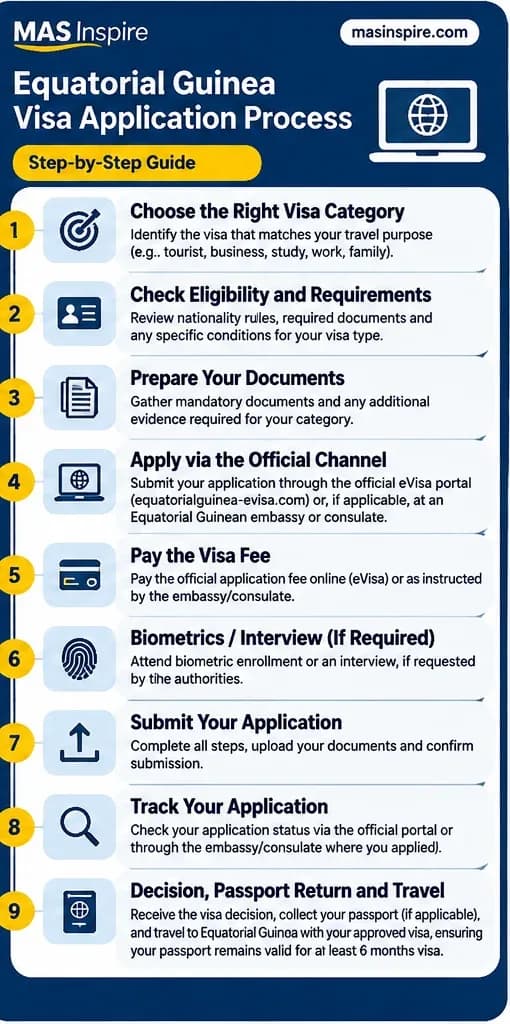
Route A: Tourist or business eVisa (the standard route)
- Confirm your trip purpose and dates, and check that your passport is valid for at least six months beyond your arrival date.
- Get your yellow fever vaccination at least ten days before arrival and obtain the International Certificate of Vaccination.
- Book refundable or flexible flights and accommodation, and arrange travel insurance. Do not pay for non-refundable travel before approval.
- Go to the official portal, equatorialguinea-evisa.com, and register with an email address you can access while travelling.
- Complete the online application form, select the tourist or business category, and upload the required documents listed for that category.
- Pay the fee online: USD 50 eVisa fee plus USD 25 VFS service fee, excluding taxes, by MasterCard, Visa or UnionPay credit or debit card. The fee is non-refundable.
- Wait for the decision: the portal states up to 72 hours for a complete application, with pre-approval normally received 24 to 72 hours after payment when the documents are correct.
- Check your email for the eVisa. If approved, download the PDF, print it, and carry the printout with your passport for boarding and arrival.
- Fly to Malabo International Airport. On arrival, present your passport, printed eVisa approval and yellow fever certificate. Border officials issue your visa and stamp your passport: make sure the stamp is placed before you leave the counter.
- If you will stay more than 90 days, register at the local police station and apply for a residence permit before your authorised stay expires.
Route B: Embassy visa (work, study, conferences, humanitarian travel)
- Identify the responsible mission. There is no Equatorial Guinea embassy in Vietnam or in Pakistan. The Embassy of Equatorial Guinea in Beijing is concurrently accredited to Vietnam, so it is the mission to contact first from Vietnam. Confirm in writing whether it accepts applications from a Pakistani national resident in Vietnam, and whether you must apply in person or may apply by post or through an agent.
- For work travel, your employer in Equatorial Guinea must first obtain a letter of invitation (Autorizacion de Entrada) from the Ministry of National Security. You cannot complete a work-visa application without it.
- Complete the embassy's application form, gather the documents in the embassy checklist above, and legalise any foreign documents through the embassy or consulate, since apostilles are not accepted.
- Submit the application and pay the mission's fee. Embassy fees differ from the eVisa fee and are set by each mission, so confirm the amount and payment method in writing before you pay.
- Wait for the decision, collect your passport with the visa, and check that the visa's validity dates, entries and personal details are correct before you travel.
Visa Fees and Financial Requirements
| Item | Fee | Source and status |
|---|---|---|
| Tourist or business eVisa (government fee) | USD 50 | Official eVisa portal, verified |
| VFS Global service fee | USD 25 (excluding taxes) | Official eVisa portal, verified |
| eVisa total before tax | USD 75 | Official eVisa portal, verified; the final checkout total may be higher once taxes apply |
| Embassy tourist or business visa, 30 / 60 / 90 days (Washington) | USD 200 | Secondary source reporting the Washington embassy |
| Embassy visa, 90 to 180 days (Washington) | USD 300 | Secondary source reporting the Washington embassy |
| Embassy expedited service (Washington) | USD 50 extra | Secondary source reporting the Washington embassy |
| Letter of invitation (in country) | XAF 10,000 | In-country fee schedule reported by a Malabo law firm |
| Residence permit, 12 / 24 months | XAF 200,000 / XAF 400,000 | In-country fee schedule reported by a Malabo law firm |
| Work permit B1 (1 year) / BR (2 years) / C (3 years) | XAF 75,000 / XAF 10,000 / XAF 150,000 | In-country fee schedule reported by a Malabo law firm |
Fee conflict disclosed: The eVisa costs USD 75 before tax, while the Washington embassy is reported to charge USD 200 for a tourist or business visa of up to 90 days. These are not the same product: the eVisa is an online short-stay authorisation processed through VFS Global, while the embassy visa is a paper visa issued by a mission with its own tariff. Do not use one route's fee to budget for the other. Some secondary sources quote about USD 100 for a tourist eVisa and USD 150 to 200 for a business eVisa: those figures are not supported by the official portal, which publishes USD 50 plus USD 25.
Payment and funds: The eVisa fee is paid online only, in United States dollars, by MasterCard, Visa or UnionPay credit or debit card. The portal describes the fee as a non-refundable online processing fee. Keep the payment receipt and the application reference number, and contact the portal helpdesk about a failed or duplicate payment before paying a second time. For the eVisa, prepare bank statements for the previous three months, certified by the bank. No official minimum balance for the eVisa could be verified: show genuine, regular funds that clearly cover flights, accommodation and daily costs for the whole trip. Equatorial Guinea is expensive by regional standards, particularly Malabo, and credit cards are accepted only at a few major hotels, with a limited number of ATMs in Malabo and Bata.
Visa Processing Times
| Route | Processing time | Source |
|---|---|---|
| Tourist or business eVisa, complete application | Up to 72 hours | Official eVisa portal, verified |
| eVisa pre-approval after payment, documents correct | Normally 24 to 72 hours | Official eVisa portal guidance, verified |
| Embassy tourist or business visa (Washington) | 5 to 7 days; 1 to 3 days with expedited service | Secondary source reporting the Washington embassy |
| Work permit decision, complete application | Within 7 days of receipt by the General Directorate of Labour | Malabo law firm reporting the labour procedure |
| Embassy visa, general estimate | About 5 working days | VFS Global estimate reported by a secondary source; not an official commitment |
Processing-time conflict disclosed: The official portal says up to 72 hours for a complete eVisa application, while some secondary sources quote one to three working days for a tourist eVisa, three to seven for a family visit eVisa, and five to ten for a business eVisa. Those longer figures are not published on the portal. The 72-hour figure is the controlling one and applies only to a complete application: an incomplete file, an unreadable document, or a payment problem will delay the decision. The United States government advises travellers to contact the nearest embassy at least 60 days before a planned trip; that is general advice for embassy-route cases, not the eVisa processing time. Apply at least two to four weeks before departure, and do not book non-refundable travel until the approval is in your inbox.
Applying from Pakistan or Vietnam
From Vietnam: There is no Equatorial Guinea embassy or consulate in Vietnam. The Embassy of Equatorial Guinea in Beijing is concurrently accredited to Vietnam: the diplomatic-missions list records Vietnam among the countries covered by the Beijing embassy, and Vietnam's own Ministry of Agriculture has described the Ambassador of Equatorial Guinea to China as concurrently accredited to Viet Nam. The embassy's published address is No. 2, Dong Si Jie, San Li Tun, Chaoyang District, Beijing 100600, China, telephone +86 10 6532 3679. For most Pakistani residents in Vietnam, the practical route is the online eVisa, which can be completed from Vietnam without visiting any embassy. Use the Beijing embassy only if you need a paper visa (for work, study or another embassy-route category), and get written confirmation first that it accepts applications from a Pakistani national resident in Vietnam.
From Pakistan: No Equatorial Guinea embassy in Pakistan could be verified, and no mission accredited to Pakistan could be confirmed. The eVisa is therefore the practical route for applicants in Pakistan as well. Apply online from Pakistan, and contact the eVisa portal helpdesk at Info.eqevisa@vfsglobal.com if the portal asks for a document you cannot obtain locally.
Vietnam residence and flights: Your Vietnamese temporary residence card or visa is useful evidence of where you live and of your return to Vietnam, but it does not change the visa requirement: the requirement follows your Pakistani passport, not your place of residence. Carry your Vietnamese residence document when you travel, because you will need it to re-enter Vietnam. There are no direct flights from Vietnam or Pakistan to Malabo; typical routings go through a European or Middle Eastern hub, or through Addis Ababa, Istanbul, Paris or Madrid. Check whether your transit airport requires a transit visa for Pakistani passport holders. Remember that eVisa holders must arrive through Malabo International Airport.
Pakistan-side requirements: Carry a polio vaccination certificate when leaving Pakistan, as Pakistan requires departing travellers to show proof of polio vaccination. Keep your passport, eVisa printout, yellow fever certificate, return ticket and hotel booking together in hand luggage, not in checked baggage.
Student Visa Guide
There is no student eVisa category on the official portal, which offers tourist and business categories only. A Pakistani student who wants to study in Equatorial Guinea should therefore plan on the embassy route and should not book travel on a tourist eVisa with the intention of studying: a tourist visa does not authorise enrolment or residence as a student.
Expect the embassy to ask for an admission or acceptance letter, academic records, proof of funds for tuition and living costs, a passport valid for at least six months, photographs, a completed application form, and the international vaccination booklet including yellow fever. A letter of invitation or an entry authorisation may also be required. No official student-visa fee, processing time or validity period could be verified: confirm them in writing with the Beijing embassy or the institution's international office before applying.
Teaching is mainly in Spanish, with French and Portuguese also official, so check the language of instruction before accepting a place, and ask whether the institution provides accommodation, will sponsor your letter of invitation, and has experience receiving Pakistani students. Students staying beyond 90 days will need a residence permit, and paid work needs a separate work authorisation.
Work Visa and Job Opportunities
Equatorial Guinea's main employment sectors for foreign workers are oil and gas, construction, hospitality, health care and education, concentrated in Malabo and Bata. English teaching jobs exist but are far fewer than in Vietnam or the Gulf, and most teaching posts require Spanish. Do not travel on a tourist or business eVisa to look for work or to start a job: that is not permitted, and working without a permit can lead to fines, detention and deportation.
The lawful route is employer-sponsored and runs in stages. First, the employer obtains a letter of invitation (Autorizacion de Entrada) from the Ministry of National Security, submitting the applicant's passport copy, police clearance report, curriculum vitae, a sworn oath and application letter, and proof of fee payment; a permanent transfer also needs a favourable report from the Ministry of Mines and Hydrocarbons. Second, the worker applies for a visa at an Equatorial Guinea embassy. Third, after entry, the employer secures an employment contract approved by the Ministry of Labour, using the ministry's standard template, plus an employment authorisation and work permit. Fourth, the worker applies for a residence card through the Centro Nacional de Documentacion para Guinea Ecuatorial.
Work permit categories are: B1 (initial, one year), BR (renewal, two years), C (renewal, three years), A (temporary, six months), I (informal sector, one year), PCP (self-employed, up to three years), PTA (agriculture, three years) and PP (permanent, for foreigners meeting conditions rooted in the country). United States nationals are exempt from the work-permit requirement for up to 90 days per year; no similar exemption applies to Pakistani nationals. A work permit is cancelled if the residence-card application is rejected or if the holder changes employer, and an employment contract with a foreigner who has no valid work permit is null and void.
The employer must prove it cannot find a suitable local worker: the government requires that 70 to 90 per cent of workers at a company be citizens of Equatorial Guinea, according to secondary reporting. A job offer alone is therefore not enough. Before accepting an offer, verify that the employer is registered and paying tax in Equatorial Guinea, that it will sponsor the letter of invitation and work permit, and that the contract will be approved by the Ministry of Labour. Never pay a recruitment agent for a guaranteed work visa, and never hand your passport to an intermediary: the Spanish embassy has warned that residence and work permits are slow, expensive and difficult to renew, and that passport stamps do not replace a residence permit. On arrival, workers must pass a medical examination, including HIV and tuberculosis screening at an approved clinic such as Centro Medico La Paz, according to secondary reporting. A work-permit decision is reported within seven days of a complete application, but the full sponsorship process takes considerably longer, so allow several months.
Family Immigration and Permanent Residence
Short family visits use the tourist eVisa: the visiting family member applies online, with a hotel booking or a host invitation from the family member in Equatorial Guinea. For a private stay, secondary sources report that the host must provide an invitation letter, house-registration evidence, and a copy of the host's Equatorial Guinea identity card or passport. There is no published family-reunification visa category with its own fee, processing time or document list, so this guide does not invent one: confirm the exact requirements for your case with the portal helpdesk or the responsible mission.
For a longer family stay, the route is the residence permit, not a longer tourist visa. Family members apply in country through the Ministry of National Security, with the sponsor's residence card and employment documents, proof of the family relationship (marriage or birth certificate, legalised through the embassy since apostilles are not accepted), and the standard residence-card documents. No official processing time or fee for family residence could be verified beyond the reported residence-permit fees of XAF 200,000 for 12 months and XAF 400,000 for 24 months.
There is no clear published route to permanent residence for foreigners. Most expatriates live in Equatorial Guinea on one-year residence permits linked to their employment and renew them for as long as the job lasts. A permanent work permit (PP) exists, but no published criteria for it could be verified. Anyone promising a fast track to permanent residence or citizenship in exchange for a fee should be treated with caution.
Common Application Mistakes and Reasons for Visa Refusal
Arriving without a visa: The most serious mistake is assuming a visa on arrival exists. It does not. Since 1 July 2023 no visa has been issued on arrival, and travellers who arrive at Malabo airport without an eVisa are systematically refused entry.
Using the wrong route: Applying for a tourist eVisa to work, study or live in Equatorial Guinea is a misuse of the category. The eVisa is for short tourism and business visits only. Work and study need the embassy route, a letter of invitation and, for work, a work permit.
Using an unofficial website: Several lookalike websites sell Equatorial Guinea visa services. Use only equatorialguinea-evisa.com, the address given by the United Kingdom and French governments and by VFS Global's 2023 announcement. Another address sometimes cited, evisa.guineaecuatorial.gob.gq, could not be found as a working official portal.
Yellow fever certificate problems: Travelling without the certificate, or with a vaccination given less than ten days before arrival, risks refusal of entry or vaccination at the airport. Carry the original certificate.
Unclear funds or accommodation: Missing or uncertified bank statements, a hotel booking that does not cover the whole stay, or a return ticket that does not match the stated dates are common reasons for delay or refusal. The invitation letter must match the stated purpose: a business invitation for a tourist trip, or a hotel booking for a claimed family stay, creates a mismatch.
Overstaying: Staying beyond the authorised 90 days without registering and obtaining a residence permit risks a fine for exiting with an expired visa, according to the reported in-country fee schedule, and can affect future applications. Apply for an extension or a residence permit before the authorised stay expires.
Refusal and reapplication: No official appeals process for an eVisa refusal is published. If an application is refused, correct the problem identified, gather stronger evidence, and submit a new application, paying the fee again, since it is non-refundable. For an embassy refusal, ask the mission in writing for the reason and whether a new application is possible.
Frequently Asked Questions
1. Do Pakistani passport holders need a visa for Equatorial Guinea?
Yes. Pakistani passport holders must have a visa before travelling. Pakistan is not on any published visa-exemption list, and there is no visa on arrival.
2. Is there an Equatorial Guinea eVisa, and where do I apply?
Yes. Since 1 July 2023 Equatorial Guinea has offered an online eVisa for all nationalities through the official portal equatorialguinea-evisa.com, operated by VFS Global for the Ministry of Foreign Affairs. The portal offers tourist and business categories.
3. How much does the Equatorial Guinea eVisa cost?
USD 50 for the eVisa plus a USD 25 VFS Global service fee, excluding taxes, making USD 75 before tax. The fee is non-refundable and is paid online by MasterCard, Visa or UnionPay card. Embassy visas cost more: the Washington embassy is reported to charge USD 200 for up to 90 days.
4. How long does the eVisa take to process?
Up to 72 hours for a complete application, according to the official portal; pre-approval is normally received 24 to 72 hours after payment when the documents are correct. Apply at least two to four weeks before departure in practice.
5. How long is the visa valid, and how long can I stay?
Short-term visas are valid for 90 days, and the permitted stay is up to 90 days. The eVisa is normally single entry. If you stay more than 90 days you must register at the local police station and obtain a residence permit.
6. How long must my passport be valid?
Your passport must have an expiry date at least six months after the date you arrive. The United States State Department also requires one blank page for entry, while some secondary sources say two. Travel with at least two blank pages if your passport has them, to be safe.
7. Do I need a yellow fever vaccination?
Yes. A yellow fever vaccination certificate is mandatory for all travellers entering Equatorial Guinea. The vaccine must have been received at least ten days before arrival. Carry the original International Certificate of Vaccination with your passport.
8. Is there an Equatorial Guinea embassy in Vietnam or Pakistan?
No. There is no Equatorial Guinea embassy in Vietnam and none in Pakistan could be verified. The Embassy of Equatorial Guinea in Beijing is concurrently accredited to Vietnam, so it is the mission to contact from Vietnam for a paper visa. For tourist and business visits, the online eVisa means no embassy visit is needed.
9. Can I get a visa on arrival at Malabo airport?
No. Since 1 July 2023 no visa has been issued on arrival, and travellers who arrive without an approved eVisa or an embassy visa are refused entry. Arrive with the printed eVisa approval and your yellow fever certificate.
10. Which airport must I arrive through?
eVisa holders can only enter through Malabo International Airport, according to the portal's published guidance. Do not book a flight arriving at Bata, or plan to enter by land or sea, on an eVisa without written confirmation.
11. Do I need an invitation letter?
For a tourist eVisa, a hotel reservation is enough unless you are staying privately, in which case a host invitation is needed. For a business eVisa, an invitation letter or a letter detailing the business need on company letterhead is required. For work travel, the employer must first obtain a formal letter of invitation from the Ministry of National Security.
12. Can I work in Equatorial Guinea on a tourist or business eVisa?
No. Neither visa authorises paid employment. Working requires an employer-sponsored letter of invitation, a visa, a work permit from the Ministry of Labour and a residence card. Working without a permit can lead to fines, detention and deportation.
13. Can I study in Equatorial Guinea, and is there a student visa?
There is no student category on the eVisa portal. Study travel is handled through the embassy route, with an admission letter from the institution and a letter of invitation. No official student-visa fee, processing time or validity period could be verified.
14. Can I extend my stay or my visa?
Visitors who need more than 90 days must register at the local police station and obtain a residence permit from the Ministry of National Security. The reported in-country fee schedule lists a 15-day visa extension at XAF 30,000; apply before your authorised stay expires.
15. What should I do if my visa application is refused?
Identify the reason first: the most common causes are an incomplete file, an unreadable document, insufficient proof of funds or accommodation, a passport validity problem, or a missing yellow fever certificate. No official eVisa appeals process is published, so fix the problem and submit a new application, paying the non-refundable fee again.
Official Immigration Websites
| Website | What it is | Use it for |
|---|---|---|
| equatorialguinea-evisa.com | Official eVisa portal, operated by VFS Global for the Government of Equatorial Guinea | Tourist and business eVisa applications, document lists, fees and processing times |
| equatorialguinea-evisa.com/faq | eVisa portal help and frequently asked questions | How to apply, payment, and what happens after approval |
| equatorialguinea-evisa.com/business-visa.html | eVisa portal business visa page | Business eVisa documents, invitation-letter requirement and fees |
| gov.uk — Equatorial Guinea entry requirements | United Kingdom Foreign, Commonwealth and Development Office travel advice | Passport validity, visa requirement, 90-day validity, residence permits and yellow fever |
| travel.state.gov — Equatorial Guinea travel advisory | United States Department of State travel advisory | Visa requirement, yellow fever, passport validity, blank page, currency limits and safety level |
| clarenceabogados.com — Visa, immigration and employment | Malabo law firm guide to Equatorial Guinea immigration law | Letter of invitation, Decree 49/2019 visa types, work permits, residence cards and in-country fees |
| en.mae.gov.vn — Equatorial Guinea and Viet Nam | Vietnam Ministry of Agriculture and Environment | Confirmation that the Ambassador of Equatorial Guinea to China is concurrently accredited to Viet Nam |
| Wikipedia — List of diplomatic missions of Equatorial Guinea | Diplomatic missions list | Beijing embassy's concurrent accreditation, including Vietnam; no embassy listed in Vietnam or Pakistan |
Only the first three rows are Equatorial Guinea government or government-authorised sources. The remaining rows are foreign-government travel advice, a Malabo law firm and a diplomatic-missions list, included because no single official Equatorial Guinea government website publishes the full visa rules in English.
Final Checklist and Conclusion
Before you apply, work through this final checklist.
- Passport valid at least six months beyond arrival, with at least one blank page (two if possible)
- Yellow fever vaccination received at least ten days before arrival, with the original certificate in hand
- Polio vaccination certificate for departure from Pakistan
- Trip purpose decided: tourist or business eVisa online, or embassy route for work, study, conferences or humanitarian travel
- Hotel reservation or host invitation, return flight ticket, travel insurance and three months of certified bank statements ready to upload
- Business travellers: invitation letter or business-need letter on company letterhead
- Work travellers: employer's letter of invitation from the Ministry of National Security confirmed before applying
- Application submitted only on equatorialguinea-evisa.com, fee of USD 50 plus USD 25 paid by card, receipt and reference number saved
- Approval received by email, PDF downloaded and printed, carried with the passport
- Flight booked to Malabo International Airport, with any transit visa for the connection checked in advance
- Vietnamese residence document carried for re-entry to Vietnam
- Cash over USD 10,000 or XAF 5,000,000 declared on entry and exit
- If staying more than 90 days: police registration and residence permit planned before the authorised stay expires
For a Pakistani passport holder living in Vietnam, Equatorial Guinea is a visa-before-travel destination with a straightforward online route for short visits: the eVisa costs USD 75 before tax, is normally decided within 72 hours, and covers a stay of up to 90 days for tourism or business, arriving through Malabo. Everything beyond a short visit is harder. Work needs an employer, a letter of invitation, a work permit and a residence card. Study needs an embassy application with no published fee or processing time. Family stays beyond 90 days need a residence permit, and there is no verified fast route to permanent residence. The yellow fever certificate is non-negotiable and the passport must have six months' validity.
Several figures differ between sources, notably the embassy fee of USD 200 against the eVisa fee of USD 75, the blank-page requirement of one against two, and the business-stay extension. This guide names the controlling source for each figure rather than hiding the disagreement. Re-check the official portal and the responsible mission shortly before you travel, and get any answer that affects your trip in writing.
Editorial note: This guide was researched and verified on 28 November 2026. Editorial date: 27 November 2026. Fees, processing times and entry rules should be re-checked on the official eVisa portal before travel.