Ecuador Visa Guide 2026: Types, Fees and How to Apply from Vietnam
Updated: 27 November 2026. Written for Pakistani passport holders living in Vietnam. Always confirm the live e-VISAS portal before paying any fee or booking non-refundable travel.
Contents
- Introduction
- Do Pakistanis Need a Visa for Ecuador?
- At a Glance: Key Facts
- Types of Ecuador Visas
- Tourist Visa in Detail
- Transit Visa: Passing Through Ecuador
- Temporary Residence Visas: Work, Student, Rentista and Digital Nomad
- Permanent Residence
- Fees, Processing Times and Validity Compared
- Where and How to Apply from Vietnam
- Document Checklist
- How to Apply: Step-by-Step
- Extending Your Stay and Overstaying
- Galapagos: Transit Control Card and Park Fee
- Money, Travel and Practical Tips
- Official Immigration Websites
- Frequently Asked Questions
Introduction
Ecuador is a small South American country with an outsized range of landscapes: the colonial streets of Quito, the Avenue of the Volcanoes in the Andes, the Amazon rainforest, Pacific beaches and the Galapagos Islands, one of the most famous wildlife destinations in the world. The country uses the United States dollar as its official currency, which makes budgeting straightforward for visitors, and Spanish is the official language, so some basic Spanish goes a long way outside the main tourist hotels.
For a Pakistani passport holder, Ecuador is not a visa-free destination and there is no visa on arrival. The good news is that the whole visa process is handled online through the Ecuadorian Ministry of Foreign Affairs and Human Mobility, known as the Cancilleria, and its e-VISAS platform. Because the application is online, living in Vietnam does not put you at a disadvantage: you do not need to travel to an embassy to lodge a tourist visa application, and Ecuador has no embassy in Vietnam in any case.
This guide explains which visa you need, what it costs, how long it takes, which documents to prepare, how to apply from Ho Chi Minh City or Hanoi, and what extra rules apply if you plan to visit the Galapagos. Where official sources and secondary sources disagree, this guide says so plainly and names the source that controls, so you can plan around the stricter figure rather than the friendlier one.
Do Pakistanis Need a Visa for Ecuador?
Yes. Pakistan is on Ecuador's official list of nationalities that must obtain a visa before entering the country. Pakistani passport holders cannot enter Ecuador visa-free, and there is no visa on arrival for a Pakistani passport. You must hold a valid Ecuadorian visa, issued in advance through the e-VISAS platform, before you travel.
Most nationalities can enter Ecuador without a visa for up to 90 days, but that visa-free rule does not apply to Pakistan. The e-visa list published by Ecuador includes Pakistan alongside countries such as Afghanistan, Bangladesh, China, Cuba, Egypt, India, Iran, Iraq, Kenya, Nepal, Nigeria, the Philippines, Sri Lanka, Syria, Venezuela, Vietnam and Yemen. Vietnam is also on the visa-required list, so your Vietnamese residence permit does not change the requirement: it is your Pakistani passport that decides it.
No exemption was found for Pakistani passport holders who already hold a United States, United Kingdom, Schengen or Gulf visa or residence permit. Some countries waive their visa for travellers holding a valid United States or Schengen visa, but no such exemption for Ecuador was found in the sources checked for this guide. Do not assume that a valid visa for another country will get you into Ecuador. Apply for the Ecuadorian visa itself.
Children also need a visa. Every traveller, including infants and children travelling on their own passport, needs their own visa, and minors need the additional parental documents listed in the checklist below.
At a Glance: Key Facts
| Item | What applies to a Pakistani passport holder |
|---|---|
| Visa required? | Yes, in advance. No visa-free entry and no visa on arrival. |
| Where to apply | Online only, on the Cancilleria e-VISAS platform. No embassy visit is needed for a tourist visa. |
| Tourist visa fee | USD 50 application fee plus USD 30 issue fee, USD 80 in total. No VAT is charged on either amount. |
| Tourist stay | 90 days counted from the day you enter Ecuador. |
| Passport validity | At least 6 months from the date of entry. |
| Processing time | No typical time is published. The legal maximum for a decision is 60 business days, and the ministry recommends applying at least 30 days before travel. See the processing-time disclosure in the fees section. |
| Embassy in Vietnam | None. Ecuador has no embassy or consulate in Vietnam, and no accredited mission for Vietnam was confirmed in the sources checked. The online application makes this unnecessary for a tourist visa. |
| Currency | United States dollar (USD). |
| Galapagos extras | Transit Control Card USD 20 per person, plus Galapagos National Park entry fee USD 200 for most foreign adults and USD 100 for foreign children under 12. |
| Working on a tourist visa | Not allowed. A tourist visa cannot be used for work, paid service or any income-generating activity. |

Types of Ecuador Visas
Ecuadorian immigration law divides foreign visitors into three groups: temporary visitors, temporary residents and permanent residents. A Pakistani applicant will normally use one of the categories below. Choose the category that matches the real purpose of your trip, because a tourist visa cannot later be used to work or study, and the wrong category is one of the commonest reasons for delay or refusal.
| Visa | Who it is for | Stay | Government fee (USD) |
|---|---|---|---|
| Temporary visitor, tourist | Holidays, sightseeing, visiting family or friends | 90 days from entry | 50 application + 30 issue = 80 |
| Temporary visitor, transit | Passing through Ecuador to a third country | Up to 30 days validity; air transit no more than 24 hours | 50 application + 30 issue = 80 |
| Temporary visitor, business or acts of commerce | Short commercial visits, meetings, trade activities without local employment | Short stay; confirm the period on the live portal | Not verified for this guide; confirm on the live portal before applying |
| Temporary residence, work | Employment with an Ecuadorian employer under a registered contract | Up to 2 years | 50 application + 270 issue = 320 |
| Temporary residence, student | Study at a recognised school, university or language institution, including professional practice | Length of the course, at least 6 months and up to 2 years | 50 application + 80 issue = 130 |
| Temporary residence, rentista | Living on passive income from abroad, such as rent, dividends or annuities | Up to 2 years | 50 application + 270 issue = 320 |
| Temporary residence, digital nomad (Visa Nomada) | Remote work for employers or clients outside Ecuador | Up to 2 years, renewable once for a further 2 years | 50 application + 270 issue = 320 |
| Temporary residence, professional | Degree holders whose qualification is registered with SENESCYT | Up to 2 years | 50 application + 270 issue = 320 |
| Temporary residence, investor | Investment of at least 100 basic salaries in Ecuador | Up to 2 years | 50 application + 270 issue = 320 |
| Temporary residence, retiree (jubilado) | Retirees with a pension from abroad | Up to 2 years | 50 application + 270 issue = 320 |
| Permanent residence | After at least 21 continuous months of temporary residence, or on other legal grounds such as family | Indefinite | 50 application + 225 issue = 275 |
Two cautions about this table. First, the business visitor fee could not be verified from the official sources checked for this guide, so it is marked as not verified rather than guessed. Older secondary articles quote different figures for business, study and work categories, including USD 100 for business, USD 150 for study and USD 200 for work; those figures come from a launch article about the e-visa system and do not match the consular tariff figures used elsewhere in this guide. The tariff figures in this table, USD 50 plus USD 270 for most temporary residence categories and USD 50 plus USD 80 for students, are the ones corroborated by multiple sources citing the official procedure pages, and the live portal checkout is the controlling source at the moment you pay. Second, applicants aged 65 or over pay half the visa fees, and applicants with a recognised disability of 30 percent or more are exempt from the visa fees, under the consular tariff. Confirm your discount on the live portal, because it must be applied there.
Tourist Visa in Detail
The temporary visitor tourist visa is the category almost every Pakistani holidaymaker will use. It is applied for online, it is issued electronically, and it allows a stay of 90 days counted from the day you enter Ecuador.
The fee is USD 50 to lodge the application and USD 30 when the visa is granted, USD 80 in total, with no VAT on either amount. The USD 50 application fee is paid when you register the request, and it is not refunded if the visa is refused. The USD 30 issue fee is paid only after approval, when the decision enables the payment option on the portal. Payment can be made online by credit or debit card, or by deposit at Banco del Pacifico in Ecuador. If you pay by bank deposit, note that bank payments are processed only during the bank's business hours.
There is one timing rule that catches applicants out: if the first payment is not completed by 23:55 Ecuador time on the same day you register the request, the system may delete the application. Register the request only when you are ready to pay the USD 50 immediately, and remember that Ecuador is 12 hours behind Vietnam, so 23:55 in Quito is 11:55 the next day in Ho Chi Minh City.
The tourist visa requires a passport valid for at least six months, a recent colour photograph with a white background, proof of lawful means of support, a travel itinerary and return air tickets. The photograph must be 5 by 5 centimetres, in JPG format, and no larger than 1 MB. Adults must also provide a police or criminal record certificate, apostilled or legalised and translated into Spanish, valid for 180 days. The means-of-support rule is set out in Ministerial Agreement 0000070: in the sources checked, it is described as bank or credit card statements showing at least one basic salary, USD 482 in 2026, for each month of the stay, or a paid tour invoice covering the whole trip, or a letter from a sponsor living in Ecuador who takes responsibility for your upkeep. That description comes from secondary sources summarising the agreement, so treat the one-salary-per-month figure as reported rather than as a figure read on the live portal, and show comfortably more than the minimum if you can.
A tourist visa does not allow you to work, provide paid services or earn income in Ecuador. If you intend to work, even remotely for an Ecuadorian client, apply for the correct residence category instead.
Transit Visa: Passing Through Ecuador
Since 2025, Pakistani passport holders also need a transit visa simply to change planes in Ecuador. This is a recent and important change, because travellers who used to transit visa-free through Quito or Guayaquil now need a visa in advance.
Ecuador announced on 8 June 2025 that it would require transit visas for travellers from countries that need a visa to enter Ecuador, and for citizens of other countries designated by the Ministry of Foreign Affairs and Human Mobility. The sources disagree on the date the rule took effect: the Copa Airlines notice to travel agencies says the requirement took effect on 21 July 2025 under Executive Decree No. 54, while another secondary source states 1 September 2025. The announcement date of 8 June 2025 is consistent across sources. Whichever start date applied, the rule is in force now, so plan on needing a transit visa for any connection through Ecuador.
The transit visa is the temporary visitor transit category, applied for on the same e-VISAS platform while you are outside Ecuador, at least 20 days before the planned transit date. The fee is the same as the tourist visa: USD 50 to apply and USD 30 on approval, USD 80 in total, with no VAT. The visa is valid for a maximum of 30 days and is normally issued for a single transit, although a second transit may be allowed within the same 30-day validity if your itinerary requires it and the circumstances are justified.
The 30-day validity does not mean you can spend 30 days in Ecuador. For air transit, the onward and connecting flights must be on a single reservation and the stop in Ecuador must not exceed 24 hours. For land or sea transit, the journey must be completed within a maximum of five days from the date of entry. With a transit visa you cannot stay in Ecuador as a tourist, work, or remain beyond the permitted transit period.
Transit applicants must show a passport valid for at least six more months, a criminal record certificate may be requested for applicants over 18, and financial solvency must be shown with bank statements in the applicant's own name covering the last three months, at a level of at least one unified basic salary in force on the application date, USD 482 in 2026. Air transit applicants must submit a single flight reservation showing the connection in Ecuador and the final destination country.
Temporary Residence Visas: Work, Student, Rentista and Digital Nomad
Temporary residence visas are for people who want to live in Ecuador for longer than a holiday. Every temporary residence visa lasts up to two years, and most categories cost USD 50 to apply plus USD 270 when the visa is granted, USD 320 in total. The student visa is cheaper, at USD 50 plus USD 80, USD 130 in total. Time spent as a temporary resident counts towards permanent residence after 21 continuous months, which is covered in the next section.
The amounts below are expressed in basic salaries, known as the Salario Basico Unificado or SBU. The SBU for 2026 is USD 482, and it is reset each January, so the dollar figures move with it. Always convert the SBU multiple on the live procedure page rather than relying on a figure from an earlier year.
Work visa
A foreign employee of an Ecuadorian employer needs the temporary residence work category before starting work. The file needs an employment contract, proof of the contract's registration, and evidence from the employer, and the visa costs USD 50 plus USD 270. Self-employed consultants and independent workers can qualify under the same work category with a notarised services contract and a RUC tax number or municipal operating permit. Do not start work while holding only a tourist visa.
Student visa
The temporary residence student visa covers regular students in basic, secondary, undergraduate and postgraduate education, students at recognised official language institutions, and pre-professional or professional practice placements. The visa lasts as long as the course, with a minimum term of six months and a maximum of two years, and it can be renewed with updated study documents. You need an enrolment or admission certificate from an accredited Ecuadorian institution, a passport valid for at least six months, a criminal record certificate from every country you lived in during the last five years for applicants over 18, apostilled or legalised and translated and valid for 180 days, proof of lawful means of support, and health insurance valid for the whole visa period. The fee is USD 50 to apply plus USD 80 on grant, USD 130 in total. Public universities in Ecuador teach mainly in Spanish, and foreign applicants for public universities also need a school-leaving certificate recognised by the education ministry, a process that is free of charge. Private universities set their own admission rules, so apply to them directly.
Rentista and retiree visas
The rentista visa is for people living on passive income from abroad, such as dividends, rent or annuities, rather than active work. The retiree or jubilado visa is the equivalent route for pensioners. Both require certified proof of permanent lawful income of at least three basic salaries a month, USD 1,446 in 2026, plus USD 250 a month per dependant according to the sources checked, and health insurance for the whole visa period. The fee is USD 50 plus USD 270. The rentista visa does not authorise local employment.
Digital nomad visa (Visa Nomada)
Ecuador has a dedicated remote-work residence, the Visa Nomada, which is formally a rentista temporary residence visa for remote work. It suits salaried remote employees, freelancers and owners of foreign companies who serve employers or clients based outside Ecuador and want a two-year base without a local job. You must show foreign-source income of at least three basic salaries a month, USD 1,446 in 2026, over the three months before filing, or 36 basic salaries a year, USD 17,352 in 2026, plus USD 250 a month per dependant. The visa lasts two years and is reported to be renewable once for a further two years, after which permanent residence is the usual next step. The fee is USD 50 plus USD 270, with a 50 percent discount for applicants aged 65 or over and a full exemption for a disability of 30 percent or more. Remote work for foreign employers or clients only is allowed; local employment is prohibited. The whole application is filed online on the e-VISAS platform, from abroad or from inside Ecuador while a tourist stay is still valid.
Professional visa
Degree holders can qualify for temporary residence as professionals if their university degree is apostilled, translated and registered with SENESCYT, Ecuador's higher-education authority. The income baseline is one basic salary a month, USD 482 in 2026, from any lawful source, including a salary once the degree is registered. The fee is USD 50 plus USD 270, and the visa lasts up to two years.
Investor visa
The investor temporary residence visa requires an investment of at least 100 basic salaries, about USD 48,200 in 2026, in a 730-day bank deposit, real estate, Ecuadorian company shares, or a state contract. The fee is USD 50 plus USD 270, and the visa lasts up to two years.
Permanent Residence
Permanent residence in Ecuador is indefinite. The main route is time: after at least 21 continuous months as a temporary resident, you can apply for permanent residence, provided you file before your current temporary visa or migratory status expires. Because a temporary visa runs for two years, the practical window is roughly months 21 to 24, about three months, less whatever time the file takes to assemble, so start preparing the folder well before month 21.
The fee is USD 50 to apply plus USD 225 when the visa is granted, USD 275 in total, with a 50 percent discount for applicants aged 65 or over and a full exemption for a recognised disability of 30 percent or more. The official procedure title uses the words more than 21 months, while the requirements section refers to evidence of at least 21 continuous months, so plan to file once you have clearly passed 21 continuous months, not on the exact day.
The file needs evidence of the qualifying period, including a record of your temporary residence, a police or criminal record certificate issued in Ecuador for applicants over 18, a passport with at least six months of validity, a recent photograph, lawful-means evidence and documents explaining the original temporary-visa basis. A migration-movement history, which records your entries and exits, can help reconcile any travel during the qualifying period. The application is filed online only, on the e-VISAS platform, and the same-day payment rule applies to the USD 50 application fee. Other permanent-residence grounds exist, including family relationships and Mercosur or Andean arrangements, but the 21-month route is the one most temporary residents will use. Pakistani nationals are not covered by the Mercosur or Andean treaty routes, which are for citizens of those regional blocs.
Fees, Processing Times and Validity Compared
| Visa | Application fee (USD) | Issue fee (USD) | Total (USD) | Validity / stay |
|---|---|---|---|---|
| Tourist | 50 | 30 | 80 | 90 days from entry |
| Transit | 50 | 30 | 80 | Up to 30 days validity; air transit 24 hours maximum |
| Student | 50 | 80 | 130 | Course length, 6 months to 2 years |
| Work, rentista, digital nomad, professional, investor, retiree | 50 | 270 | 320 | Up to 2 years |
| Permanent residence | 50 | 225 | 275 | Indefinite |
| Tourist extension (e-VISAS route) | 50 | 30 | 80 | Up to 90 extra days |
| Tourist extension (migration office route) | One third of the basic salary, USD 160.67 in 2026 | Up to 90 extra days |
All visa fees are charged in United States dollars, and no VAT is charged on the visa application or issue fees. Applicants aged 65 or over pay half the fees, and applicants with a recognised disability of 30 percent or more are exempt.
Processing time: read this disclosure before you plan
Ecuador does not publish a typical processing time for the tourist visa, and the secondary sources disagree sharply. One travel guide states 10 to 15 working days, another states 3 to 8 weeks, and the e-visa launch article states 2 to 3 business days for tourism. None of those figures is the official figure. The official e-VISAS guidance, as summarised in the sources that read it directly, says the law allows the authorities up to 60 business days to respond to a visa application, and recommends submitting at least 30 days before travel. The 60-business-day period can be extended if documents are missing, additional documents are requested, an interview is held, or the authenticity of a document is investigated. The controlling source is therefore the 60-business-day legal maximum on the official guidance, not the shorter figures in secondary guides. Apply at least 60 business days before travel if you possibly can, and never book non-refundable travel until the visa is issued. If the ministry emails you asking for missing information, you have ten business days to respond, so check the email address on your e-VISAS account every day while the application is pending.
How long you can stay
The tourist visa allows 90 days counted from the day you enter Ecuador. The general visitor rule is described as a maximum of 90 days in a one-year period calculated from the date of first entry, and days are cumulative across trips within that year rather than resetting at each border crossing. A newer regulation reported in secondary sources sets a higher annual ceiling for temporary visitors, with non-South American visitors limited to 270 days in a chronological year and an overall ceiling of 360 days, and a reported extension rule under which the statute allows up to 180 further days while the regulation applied by migration still says 90. Those newer caps could not be confirmed against the tourist visa service page checked for this guide, so they are disclosed here as reported and unresolved, and the safe planning figure remains 90 days on the tourist visa plus one extension of up to 90 days, applied for before the first 90 days expire.
Where and How to Apply from Vietnam
You apply online from Vietnam. There is no need to visit an embassy, and in practice there is no Ecuadorian embassy to visit: Ecuador has no embassy or consulate in Vietnam. The list of diplomatic missions in Vietnam records an Ecuadorian embassy in Hanoi only as a mission to open, not as an operating mission, and a 2018 plan to open an embassy in Hanoi has not produced a mission. No published source checked for this guide names an Ecuadorian mission accredited to Vietnam, so this guide does not name one. Do not travel to another country expecting an Ecuadorian consulate there to handle your application unless the e-VISAS portal or the Cancilleria tells you to: the tourist visa is issued by the ministry in Quito through the online platform.
The nearest Ecuadorian missions in Asia are the embassy in Beijing, the embassy in New Delhi, the embassy in Jakarta, the embassy in Tokyo and the embassy in Seoul, with consulates-general in Guangzhou and Shanghai. They are listed here only as the nearest missions, not as missions accredited to Vietnam, because no accreditation to Vietnam was confirmed for any of them. For a tourist visa you should not need them at all. If the portal asks for an interview, it may be held virtually; the sources checked describe virtual or in-person interviews as a possibility if the reviewing office requires one, and the e-VISAS account will tell you which applies to your case.
For Pakistan, secondary sources report that Ecuador has no embassy in Pakistan and that its ambassador in Qatar has been accredited to Pakistan. That accreditation is reported by a secondary source, not confirmed on an official mission list checked for this guide, so it is noted here as reported only. It does not affect an applicant living in Vietnam, who applies online in any case.
Your Vietnamese residence status matters in two practical ways. First, your police certificate must cover the countries where you have lived. The residence categories require a criminal record certificate from every country of residence in the last five years, so a Vietnam-resident Pakistani should expect to need both a Pakistani police certificate and a Vietnamese police clearance, each apostilled or legalised and translated into Spanish. Start the Vietnamese clearance early, because it is issued by the Vietnamese authorities and takes time. Second, keep your Vietnamese residence permit valid for your return. Ecuador does not control your re-entry to Vietnam, but a trip that outlasts your Vietnamese temporary residence card will cause problems on the way home, so check its expiry date before you travel.
One Pakistan-side requirement to note: a polio vaccination certificate from NADRA is needed to leave Pakistan. That is a Pakistani exit requirement, not an Ecuadorian entry requirement, and it matters only if your journey starts with a departure from Pakistan rather than from Vietnam. No yellow fever or other vaccination requirement for entry to Ecuador was verified in the sources checked for this guide, so check the live official guidance and your airline's requirements before travel rather than assuming either way.
Document Checklist
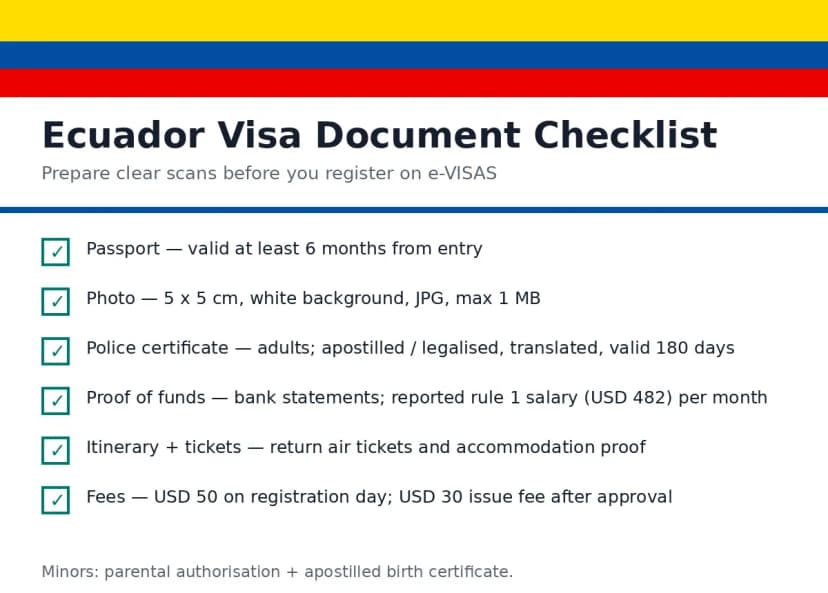
Prepare clear scans of every document. The portal will reject unreadable uploads, and a request for corrected documents costs you time against the ten-business-day response window. Keep the originals for your trip, and carry a printed copy of the issued e-visa with your passport.
Tourist visa checklist
- Pakistani passport valid for at least 6 months from the date of entry, with a clear scan of the bio-data page.
- Recent colour photograph, 5 by 5 centimetres, white background, JPG format, no larger than 1 MB.
- Police or criminal record certificate for adult applicants, apostilled or legalised and translated into Spanish, valid for 180 days. For a Vietnam resident, expect to need certificates covering Pakistan and Vietnam.
- Proof of lawful income or means of support, such as bank statements. The reported rule is at least one basic salary, USD 482 in 2026, for each month of the stay, or a paid tour invoice, or a sponsor letter from Ecuador.
- Travel itinerary and return air tickets.
- Proof of accommodation, such as a hotel booking or an invitation letter from a host in Ecuador.
- Payment of the USD 50 application fee on the same day you register the request, and the USD 30 issue fee after approval.
- Travel health insurance is not listed among the tourist visa requirements on the official service page summarised for this guide, but it is a sensible purchase and is required for residence visas, so consider it essential in practice.
Transit visa checklist
- Passport valid for at least 6 months on the application date.
- Single flight reservation showing the connection in Ecuador and the final destination country, on one reservation for air transit.
- Bank statements in your own name covering the last three months, showing at least one basic salary, USD 482 in 2026.
- Criminal record certificate, if requested, for applicants over 18.
- Visa for the final destination country, if that country requires one. A visa for the next country does not by itself exempt you from the Ecuadorian transit rule.
Temporary residence checklist (work, student, rentista, digital nomad)
- Passport valid for at least 6 months, and a recent photograph in JPG format with a white background.
- Criminal record certificate from every country of residence in the last five years, for applicants over 18, apostilled or legalised and translated, valid for 180 days.
- Category evidence: an employment contract or services contract for work, an enrolment or admission certificate for students, proof of passive income or pension for rentista and retiree applicants, proof of remote income for digital nomad applicants, an apostilled degree registered with SENESCYT for professional applicants, or proof of investment for investor applicants.
- Proof of lawful means of support under Ministerial Agreement 0000070.
- Health insurance valid for the whole visa period.
- Fees: USD 50 to apply plus USD 270 on grant for most categories, or USD 50 plus USD 80 for students.
- Minors need parental authorisation and an apostilled birth certificate.
How to Apply: Step-by-Step
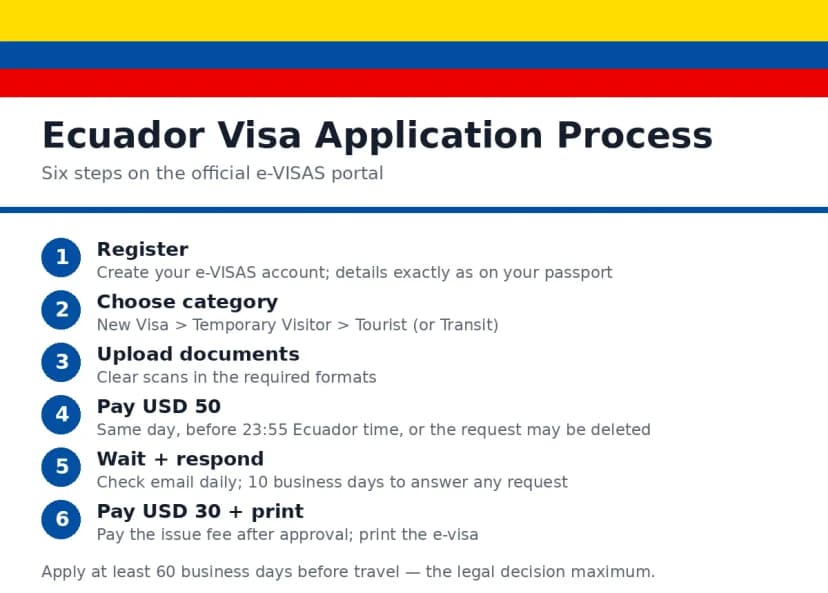
- Register on the e-VISAS platform at the official digital services portal of the Cancilleria. Create an individual account with an email address you can access, and follow the verification message. Enter your personal and passport details exactly as they appear on your passport, because the guidance warns that account information cannot simply be corrected after saving.
- Open a new procedure, select New Visa, choose Temporary Visitor, and then the tourist category, Visitante Temporal Turista, for a holiday, or the transit category if you are only connecting through Ecuador.
- Upload clear scans of all the documents in the checklist for your category. Check every file is readable and in the required format before you submit.
- Pay the USD 50 application fee straight away, on the same day you register the request, online by card or by deposit at Banco del Pacifico. If the first payment is not completed by 23:55 Ecuador time on the same day, the system may delete the application. Your status should then change to review of information.
- Monitor the portal and your email every day. If the ministry asks for missing or corrected information, you have ten business days to respond. An interview, virtual or in person, may be requested.
- After approval, pay the USD 30 issue fee for a tourist or transit visa when the payment option is enabled, then download and print the electronic visa and carry it with your passport. For residence categories, pay the applicable issue fee, USD 270 for most categories or USD 80 for students, and follow the portal instructions for registration and your Ecuadorian identity card after arrival.
Apply early. The ministry recommends applying at least 30 days before travel, and the legal maximum for a decision is 60 business days, so an application lodged 30 days before departure may still be pending when you want to fly. The safest plan is to apply at least 60 business days before travel and to keep all travel bookings changeable until the visa is issued.
Extending Your Stay and Overstaying
A tourist stay can be extended once, by up to 90 additional days, provided you apply and pay the fee before your current permitted stay expires. There are two different extension procedures, and the fee depends on which one applies to you, which is a genuine source of confusion in the guides.
Visa-required nationals, which includes Pakistani passport holders, apply for the tourist extension through the e-VISAS portal, following the same steps as the initial tourist visa application. On that route the fee is reported as USD 50 to apply plus USD 30 on grant, USD 80 in total. Visa-exempt nationals apply at a SAM migration support office instead, and the fee there is one third of the unified basic salary, USD 160.67 in 2026, since the basic salary is USD 482. The two figures are both reported in the sources checked, for different channels, so the controlling figure is the one shown on the channel you actually use. For a Pakistani tourist, that is the e-VISAS route at USD 80, but confirm the live portal checkout before paying, because the extension fee is one of the figures most likely to change.
The extension window matters. For the migration-office route, sources state the request must be made between the 80th and 90th day of the authorised stay. For the e-VISAS route, apply well before the current stay expires and do not leave it to the last day. One secondary source states that an extension can be requested up to 30 days after the regular stay ends, with a fine of 50 percent of the basic wage for failing to apply while the visa was valid. That late-application claim conflicts with the rule that the extension must be requested before the stay expires, so do not rely on it: apply before expiry.
Overstaying is expensive. Under the Human Mobility Law as amended by the October 2025 reform, a tourist overstay is fined one basic wage, USD 482 in 2026, and a late change of migratory status is fined half a basic wage, USD 241. Fines must be paid within 30 days of the day after notice. A person who leaves after an overstay may return within a year only after paying one basic wage or obtaining a consular visa. Older guides quote overstay fines of around USD 500 or more, which is consistent in scale with the USD 482 figure, and the USD 482 figure is the one tied to the current law in the sources checked. Do not overstay and hope it will be overlooked: unpaid fines block re-entry.
Galapagos: Transit Control Card and Park Fee
The Galapagos Islands are a province of Ecuador, not a separate country, and your Ecuadorian visa covers entry to the islands. Two extra payments apply on top of the visa, and they are separate charges collected by different bodies, so budget for both.
First, every non-resident visitor needs a Transit Control Card, known in Spanish as the Tarjeta de Control de Transito or TCT. It costs USD 20 per person, including children, and it is the province's migration control document, not a park ticket. The card covers up to 60 days of tourism per calendar year and is not extendable. Since 29 May 2025 the card has been registered online in advance through the Galapagos Governing Council portal, with payment by card and a digital card presented as a QR code, validated at the dedicated counters in Quito or Guayaquil airport before your Galapagos flight and checked again on arrival and departure. The official guidance is to complete the registration 24 to 48 hours before you fly, and the portal asks for your passport details, your round-trip flight with a return date no more than 60 days after arrival, and the name of your hotel or cruise. The sources disagree on the payment step: the newer account describes paying USD 20 online and showing a QR code, while an older account describes pre-registering online and then paying USD 20 at the airport counter. The newer online-payment account is dated May 2025 and later, so it is the one to follow, but carry a card that works for the online payment and allow time at the airport counter in either case. Without a TCT you cannot board a Galapagos flight, and some airlines will not issue a boarding pass without the registration confirmed in their system.
Second, the Galapagos National Park entry fee is paid in cash, in United States dollars, at the park counter in the arrivals hall at Baltra or San Cristobal airport. Since 1 August 2024 the fee for most foreign non-resident visitors aged 12 and over has been USD 200, doubled from the USD 100 charged for the previous 26 years. Foreign children under 12 pay USD 100, and infants under 2 are free. Bring crisp USD bills, because damaged bills are routinely refused, and card readers at the counter are reported to fail often. For most foreign adults the two Galapagos charges together come to USD 220 per person, USD 20 for the Transit Control Card plus USD 200 for the park fee.
Galapagos flights depart only from mainland Ecuador, from Quito or Guayaquil, and there are no direct international flights to the islands. Biosecurity inspectors check every bag on arrival, and you cannot bring fresh fruit, vegetables, seeds, live plants or animals of any kind. Keep both receipts, the park fee receipt and the Transit Control Card, because they are checked during the trip and when you leave the islands.
Money, Travel and Practical Tips
Ecuador uses the United States dollar, so there is no currency conversion to calculate on arrival, but bring cash in good condition. Crisp bills matter in Ecuador, and damaged or marked notes are often refused even by banks. ATMs are available in Quito, Guayaquil and Cuenca, but carry enough cash for the Galapagos park fee and for smaller towns.
The main international airports are Mariscal Sucre International Airport in Quito and Jose Joaquin de Olmedo International Airport in Guayaquil. There are no direct flights from Vietnam to Ecuador. Expect a long journey with at least two connections, commonly through East Asia or the Middle East and then through the United States or another American hub. Check the transit visa rules for every country you connect through, not only Ecuador: a United States transit, for example, needs its own visa for a Pakistani passport holder, and that is a separate application with its own waiting time.
Quito sits at about 2,850 metres above sea level, so allow a day or two to adjust to the altitude before strenuous activity, drink water, and take it slowly on arrival. Spanish is the language of daily life, and English is spoken in tourist hotels and tour agencies but not everywhere, so learn basic Spanish phrases and keep your hotel address written in Spanish. The security situation varies by region, and official travel advice for coastal provinces, including Guayas where Guayaquil is located, has been stricter than for Quito and the highlands, so check current travel advice for the areas you plan to visit before you travel, use registered transport at night, and keep copies of your passport and visa separate from the originals.
Keep your documents organised: passport, printed e-visa, return ticket, hotel bookings, travel insurance details, bank statements and the police certificate you used for the application. If you visit the Galapagos, add the Transit Control Card QR code and USD 200 in cash per adult for the park fee. If anything goes wrong, your first point of contact is the Cancilleria through the e-VISAS portal, and in an emergency the nearest Ecuadorian mission in Asia.
Official Immigration Websites
| Website | What it is for |
|---|---|
| Ministry of Foreign Affairs and Human Mobility (Cancilleria) | Ecuador's foreign ministry; the authority that issues visas and publishes official visa information. |
| e-VISAS digital services portal | The official online platform for visa applications, including tourist, transit and residence visas, and for tracking your application. |
| Galapagos Governing Council | The provincial authority that issues the Galapagos Transit Control Card (TCT) and publishes Galapagos entry rules. |
| Visa policy of Ecuador | Reference list of visa-required and visa-free nationalities, including Pakistan, and the transit visa announcement of 8 June 2025. |
| Ecuador visa for Pakistanis | Secondary guide checked 19 November 2026, summarising the tourist and transit fees, the 90-day stay and the e-VISAS process for Pakistani applicants. |
| Ecuador visa requirements, entry rules | Secondary guide checked 26 November 2026, summarising the official tourist and transit service pages, including the 60-business-day decision period and the extension rules. |
| Copa Airlines transit visa notice | Airline notice of 30 July 2025 on the transit visa requirement, effective 21 July 2025 under Executive Decree No. 54, with the list of visa-required nationalities including Pakistan. |
| Ecuador remote work and nomad visa | Secondary guide researched September 2026 on the Visa Nomada, rentista and professional routes, the 2026 basic salary of USD 482 and the USD 50 plus USD 270 tariff. |
| List of diplomatic missions in Vietnam | Reference showing Ecuador has no operating embassy in Vietnam, with an embassy in Hanoi listed only as a mission to open. |
Sources were checked on 27 and 28 November 2026. The e-VISAS portal checkout is the controlling source for fees at the moment you pay. If the portal and this guide disagree, follow the portal and re-check the fee before paying.
Frequently Asked Questions
Do Pakistani passport holders need a visa for Ecuador?
Yes. Pakistan is on Ecuador's list of visa-required nationalities. You must obtain a visa in advance through the e-VISAS platform. There is no visa-free entry and no visa on arrival for a Pakistani passport.
How much is the Ecuador tourist visa for a Pakistani applicant?
USD 80 in total: USD 50 to lodge the application, paid when you register the request, plus USD 30 when the visa is granted. No VAT is charged on either amount. The USD 50 application fee is not refunded if the visa is refused.
How long can I stay in Ecuador on a tourist visa?
90 days counted from the day you enter Ecuador. The general rule is a maximum of 90 days in a one-year period calculated from the date of first entry, and one extension of up to 90 additional days is possible if you apply before the first 90 days expire.
How long does the Ecuador tourist visa take to process?
No typical processing time is published. The official guidance allows the authorities up to 60 business days to decide, and recommends applying at least 30 days before travel. Secondary guides quote 10 to 15 working days, 3 to 8 weeks, or 2 to 3 business days, but none of those is the official figure, so plan on the 60-business-day maximum and apply early.
Where do I apply for an Ecuador visa from Vietnam?
Online, on the Cancilleria e-VISAS platform. Ecuador has no embassy or consulate in Vietnam, and no accredited mission for Vietnam was confirmed, so there is no embassy visit to make. The visa is issued by the ministry in Quito through the online platform.
Do I need a visa just to change planes in Ecuador?
Yes, since 2025. Pakistani nationals need a transit visa to connect through Ecuador, applied for on the e-VISAS platform at least 20 days before transit. The fee is USD 50 plus USD 30, the visa is valid for up to 30 days, and an air transit stop must not exceed 24 hours on a single reservation.
Does a United States, United Kingdom or Schengen visa exempt me from the Ecuador visa?
No exemption was found in the sources checked for this guide. Do not assume that a visa or residence permit for another country will get you into Ecuador. Apply for the Ecuadorian visa itself.
What documents do I need for the tourist visa?
A passport valid for at least 6 months, a recent colour photo 5 by 5 centimetres in JPG format no larger than 1 MB, a police certificate for adults apostilled or legalised and translated into Spanish and valid for 180 days, proof of lawful means of support, a travel itinerary, return air tickets and proof of accommodation.
How long must my passport be valid for Ecuador?
At least 6 months from the date of entry. Use a passport valid for at least 6 months beyond your intended arrival, and preferably beyond the whole trip.
Can I work in Ecuador on a tourist visa?
No. A tourist visa cannot be used for work, paid service or any income-generating activity. To work for an Ecuadorian employer you need the temporary residence work visa, and to work remotely for foreign clients you need the digital nomad visa.
Does Ecuador have a digital nomad visa?
Yes. The Visa Nomada is a rentista temporary residence visa for remote work. You must show foreign-source income of at least three basic salaries a month, USD 1,446 in 2026, or 36 basic salaries a year, USD 17,352. It lasts up to two years, costs USD 50 plus USD 270, and local employment is prohibited.
Can I extend my tourist stay in Ecuador?
Yes, once, by up to 90 additional days, if you apply before your current stay expires. Pakistani nationals apply through the e-VISAS portal, where the fee is reported as USD 50 plus USD 30. A separate migration-office route charges one third of the basic salary, USD 160.67 in 2026, so confirm the fee on the channel you use.
What happens if I overstay in Ecuador?
A tourist overstay is fined one basic wage, USD 482 in 2026, and fines must be paid within 30 days of the day after notice. A person who leaves after an overstay may return within a year only after paying one basic wage or obtaining a consular visa.
What extra fees apply for the Galapagos Islands?
Two separate charges: a Transit Control Card of USD 20 per person, registered online 24 to 48 hours before your Galapagos flight, and a Galapagos National Park entry fee of USD 200 for most foreign adults aged 12 and over and USD 100 for foreign children under 12, paid in cash on arrival. Together that is USD 220 per adult.
Is health insurance required for an Ecuador visa?
Health insurance is required for temporary residence visas and must cover the whole visa period. It is not listed among the tourist visa requirements on the official service page summarised for this guide, but it is a sensible purchase for any trip, and you should carry proof of cover with your travel documents.
Disclaimer: visa rules change without notice. This guide was verified on 27 and 28 November 2026 and is for general information only. Confirm the live e-VISAS portal and the Cancilleria website before applying, paying fees or booking travel.