

By MAS Inspire | Last reviewed: 27 November 2026 (1 Oct 2026 student-rules change added; key figures re-verified 27 November 2026)
Introduction
Denmark attracts visitors, international students, skilled professionals, researchers, entrepreneurs and families. The right immigration route depends on the purpose and length of the stay. A short visit normally falls under the Schengen visa system; a longer stay for study, employment or family life normally requires a Danish residence permit, and employment usually also requires a work authorisation.
This guide explains the main routes and the official application channels. It is an educational guide, not legal advice. Danish rules, fees, salary thresholds and processing estimates can change. Check the live government page for your exact case immediately before applying. A permit is never guaranteed by meeting a checklist or paying a fee.
Why People Visit, Study, and Work in Denmark
Denmark is known for its universities, research environment, international companies, design and technology sectors, and high standard of public services. Copenhagen, Aarhus, Odense and Aalborg host major education and employment opportunities. Visitors may travel for tourism, family visits, meetings, conferences or cultural events. International students can apply to approved higher-education programmes, while eligible professionals may use schemes such as the Pay Limit, Positive List, Fast-Track or Researcher schemes.
The attraction of Denmark does not itself create an immigration entitlement. Applicants must qualify under a specific route and comply with its conditions.
Types of Denmark Visas and Residence Permits
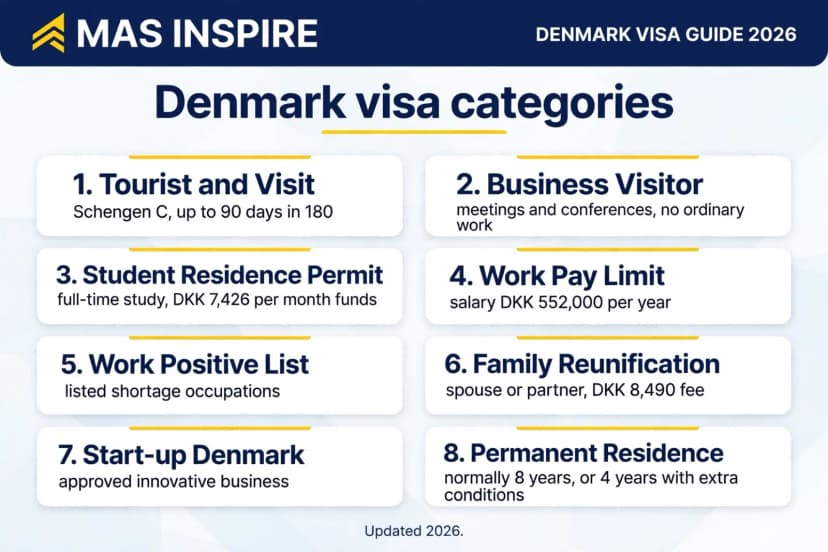
1. Schengen short-stay visa: tourism, family and private visits
A short-stay visa may be used for tourism, visiting friends or relatives, or another permitted temporary visit. It generally allows a stay of up to 90 days in any 180-day period across the Schengen area; the visa sticker may permit one, two or multiple entries and has its own validity dates. Validity is not the same as the number of days the holder may stay.
Applicants must establish the purpose and conditions of the visit, have suitable accommodation and sufficient means, hold an acceptable travel document, and demonstrate that they intend to leave the Schengen area before the authorised stay ends. Travel medical insurance must cover the Schengen area and the full planned stay, with at least EUR 30,000 in medical and repatriation coverage. An invitation from a Danish host is useful where relevant; the official invitation form is recommended but not universally compulsory.
The standard adult visa fee is EUR 90; children aged 6–11 generally pay EUR 45. Children under six are generally fee-exempt. Some nationality-specific facilitation or fee rules and exemptions apply. A visa-centre service charge may be additional. The Danish authorities' short-stay pages explain that normal decisions are often made within 15 calendar days, but admissibility checks, consultation, additional documents or referral can extend the period, normally up to 45 days.
A short-stay visa does not authorise ordinary employment or long-term residence. Business visitor activities such as meetings, negotiations or attending conferences may be permitted where they remain within visitor rules; productive work may require a work permit or exemption.
2. Business and conference visits
There is no separate general “business visa” that removes the Schengen short-stay rules. A business traveller normally applies for a Schengen short-stay visa and identifies the business purpose. Include an invitation from the Danish company or event organiser, meeting or conference details, employer letter, evidence of who pays expenses, accommodation and itinerary. The exact activities matter: meetings and negotiations are different from taking up employment or delivering services in Denmark. Confirm whether a work-permit exemption applies before undertaking any work.
3. Higher-education student residence permit
Non-EU/EEA/Swiss nationals admitted to an eligible full-time Danish higher-education programme can apply for a residence permit. The institution must be recognised/approved for the relevant programme, and the applicant must meet the admission and language-of-instruction requirements. The programme generally must be full-time; a permit is not normally granted for part-time study.
For 2026, the official self-support benchmark is DKK 7,426 per month, up to DKK 89,112 for a 12-month period. The authority specifies acceptable evidence, including a recent bank statement in the applicant's name or documentation of secured scholarship/student-loan funding. If the institution provides free accommodation and/or food, the calculation may be affected under the official rules; check the current guidance rather than assuming a reduction.
The 2026 application fee shown by SIRI is DKK 3,060, with a normal processing time of 2 months and a possible extension to 3 months if more information is needed. Students in state-approved higher-education programmes are generally granted a limited work permit: 90 hours per month from September through May and full-time in June, July and August. The rules differ for non-state-approved programmes: applicants who applied on or after 2 May 2025 generally do not receive a work right. Check the exact programme's approval status and the permit conditions. Some graduates receive a job-seeking period, subject to the applicable programme and rules; it is not a universal entitlement for every course. Important change from 1 October 2026: for applications submitted on or after 1 October 2026, the post-study job-seeking period is up to 1 year (previously up to 3 years), and accompanying family members can no longer be granted a residence permit under the student rules. PhD students are not affected — they still receive up to 3 years and their family members can still be granted permits. Applications submitted before 1 October 2026 keep the previous rules.
4. Basic and youth education; folk high schools
Separate student routes exist for eligible basic/youth programmes and folk high-school courses. A basic/youth programme must meet the authority's approval rules; a residence permit may be granted for no more than one year in the described route, and a permit is not generally available for a complete Danish high-school qualification. Vocational basic programmes have restrictions, with limited exceptions for international collaboration/exchange.
Folk high-school permits are for approved schools and courses. Work is generally not allowed under a folk high-school permit. The permitted stay is subject to course participation and a maximum total period described by SIRI (up to 18 months). These are not substitutes for a general language-school or private-course visa. Applicants should check whether the exact institution and course qualify.
5. Work and employer-sponsored permits
Most non-EU/EEA/Swiss nationals need a Danish residence and work permit before starting employment, unless a specific exemption applies. The job, employer, salary and terms must satisfy the chosen scheme. A job offer alone does not automatically grant permission to work.
- Pay Limit Scheme: For a job offer meeting the annual salary threshold. The 2026 threshold is DKK 552,000. A specific educational background or occupation is not required under the scheme, but all other conditions apply. SIRI lists a DKK 6,810 fee and a normal processing time of 1 month, potentially up to 3 months.
- Supplementary Pay Limit Scheme: A separate route with its own threshold and conditions. The 2026 threshold is DKK 446,000 per year (from 1 January 2026), with extra conditions including the job being advertised on Jobnet and EURES for at least two weeks. Check the official page for the current amount and labour-market conditions before relying on it.
- Positive List for Skilled Work: For a job on the current shortage-occupation list. The list is updated on 1 January and 1 July. SIRI lists DKK 6,810 and a normal processing time of 3 months, potentially 4 months.
- Positive List for People with a Higher Education: For relevant higher-education jobs included on the separate list. Confirm the exact job title and qualification match.
- Fast-Track Scheme: For employment with a SIRI-certified company. It has several tracks, including pay limit, supplementary pay limit, short-term, researcher and educational tracks. The standard fee shown is DKK 6,810. Normal processing is generally 1 month for several tracks (up to 2 months if further information is needed); the quick job-start option may be available, normally in about 10 days, subject to conditions. The employer normally submits the application with the applicant's authorisation.
- Researcher Scheme: For a genuine research position with a Danish research institution or company, where the role is research-related and salary/conditions meet Danish standards. SIRI lists DKK 6,810 and a normal processing time of 1 month, potentially 2 months.
- Other work routes: Authorisation, trainee, special individual qualification and other specific schemes exist. Eligibility is route-specific. Denmark does not have a general open work permit for anyone who wishes to move there and search for any job.
The applicant normally needs a signed employment contract or job offer with detailed salary and terms, passport copies, fee receipt and relevant qualifications/authorisations. The employer may have to complete part of the application. Do not start work before the permit or applicable legal authorisation is in force.
6. Job-seeking after qualifying study or work
Denmark does not offer a general standalone “job seeker visa” for any overseas applicant. A job-seeking residence period may be granted to certain people after an eligible Danish study programme or under specified work-permit schemes. The duration depends on the original permit and route. For applications submitted on or after 1 October 2026, the post-study job-seeking period is up to 1 year (PhD students still up to 3 years); applications submitted before 1 October 2026 keep up to 3 years. Some other job-seeking periods, for example six months after job loss, depend on the original permit and route. Some job-loss situations have a six-month job-seeking route. This is a follow-on permission, not an independent route for arriving in Denmark without an eligible basis.
7. Start-up Denmark and entrepreneurship
The Start-up Denmark scheme is for an innovative business idea with potential to contribute to Danish growth and create jobs. The idea must be assessed and approved by the expert panel before a residence permit can be granted. It is not a passive investor visa and does not provide residence merely for purchasing property or making an ordinary investment. SIRI lists a DKK 3,060 processing fee and a normal processing time of 2 months, potentially 4 months. Applicants must provide business approval, evidence of ability to support themselves, passport copies and business/ownership information.
8. Family reunification and accompanying family
A spouse or cohabiting partner of a person resident in Denmark may qualify under the family-reunification rules. The couple must satisfy detailed conditions, which can include age, valid marriage or documented cohabitation, integration-related requirements, housing, self-support and financial security. Exemptions or alternative rules may apply depending on the sponsor's status and EU law. A spouse route is not automatic simply because one partner has a Danish address.
The current spouse/partner application page lists a fee of DKK 8,490 and an expected maximum processing time of 10 months. Other family-member routes have separate criteria and may have different rules. Certain workers, researchers and students can bring accompanying family if the primary permit category allows it; family members' work rights depend on the permit and conditions. Note the 1 October 2026 change: students who apply on or after that date cannot bring accompanying family members under the student rules (PhD students excepted).
9. Permanent residence and settlement
Permanent residence is a status, not an entry visa. Under the general Danish rules, applicants normally need eight years of uninterrupted legal residence and must meet basic conditions, including continuing to satisfy the underlying permit conditions and other statutory requirements. In some cases, the period can be reduced to four years if all four supplementary requirements are met. The general route also requires Danish-language and employment/self-support conditions and has detailed rules about public benefits, debt, criminality and residence continuity.
The official page currently lists an expected maximum processing time of 12 months and a fee of DKK 7,570 for work/study cases or DKK 4,970 for family-reunification/asylum cases. EU-law permanent residence is a different route, generally based on five years of qualifying actual residence. Do not confuse permanent residence with Danish citizenship, which has separate rules.
10. Transit, exchange, internship and training
An airport transit visa may be required for certain nationalities and routes, even when the traveller does not intend to enter the Schengen area. Whether one is required depends on nationality, airport, itinerary and applicable exemptions. A transit visa does not authorise entry or work.
Exchange students generally use the appropriate student residence route where the programme qualifies. Internships may require a specific work permit or may be covered by a limited exemption depending on the internship's nature, educational link and duration. Do not assume an internship is unpaid and therefore permit-free. Training, educational attachment and authorisation routes also have their own criteria. Use the exact SIRI category matching the placement.
11. Humanitarian protection and asylum
Asylum is for people seeking international protection and must be requested in accordance with Danish asylum procedures; it is not a general migration or employment route. Humanitarian residence permits are exceptional. The official Danish information explains that a humanitarian permit may be considered for a foreign national registered as an asylum seeker in Denmark where significant humanitarian considerations warrant it. This guide does not assess protection claims. Anyone needing protection should consult official authorities or qualified legal assistance.
12. Digital nomad and investor routes
Denmark does not currently advertise a general digital-nomad visa or a passive investor/golden-visa programme. A remote worker should not assume that a tourist visa permits residence while working remotely. A person may qualify under a genuine Danish employment, researcher, entrepreneur or other specific permit only if the scheme's actual requirements are met. Property purchase alone does not create residence rights.
Visa Comparison Table
| Route | Main purpose | Typical permission | 2026 fee shown by authority | Published processing estimate |
|---|---|---|---|---|
| Schengen short stay | Tourism, private visit, qualifying business visit | Up to 90 days in 180 | EUR 90 adult; EUR 45 age 6–11 | Normally 15 days; may extend to 45 |
| Higher education | Full-time eligible study | Course-linked residence | DKK 3,060 | 2 months; up to 3 |
| Basic/youth or folk high school | Eligible approved study | Course-limited | DKK 3,060 | 2 months; up to 3 |
| Pay Limit work | Qualifying high-salary job | Work/residence permit | DKK 6,810 | 1 month; up to 3 |
| Positive List skilled work | Listed shortage occupation | Work/residence permit | DKK 6,810 | 3 months; up to 4 |
| Fast-Track | Job at certified company | Track-specific work/residence | DKK 6,810 | Often 1 month; track varies |
| Researcher | Qualifying research employment | Work/residence permit | DKK 6,810 | 1 month; up to 2 |
| Start-up Denmark | Approved innovative business | Entrepreneur residence | DKK 3,060 | 2 months; up to 4 |
| Spouse/partner family reunification | Join qualifying partner | Family residence | DKK 8,490 | Up to 10 months |
| Permanent residence | Settlement after qualifying residence | Permanent status | DKK 7,570 work/study; DKK 4,970 family/asylum | Up to 12 months |
Fees are government case-processing fees where stated. Visa-centre service fees, biometric services, translations, legalisations and document costs may be additional. “Normal” or “expected maximum” processing estimates are not guarantees.
Eligibility Requirements
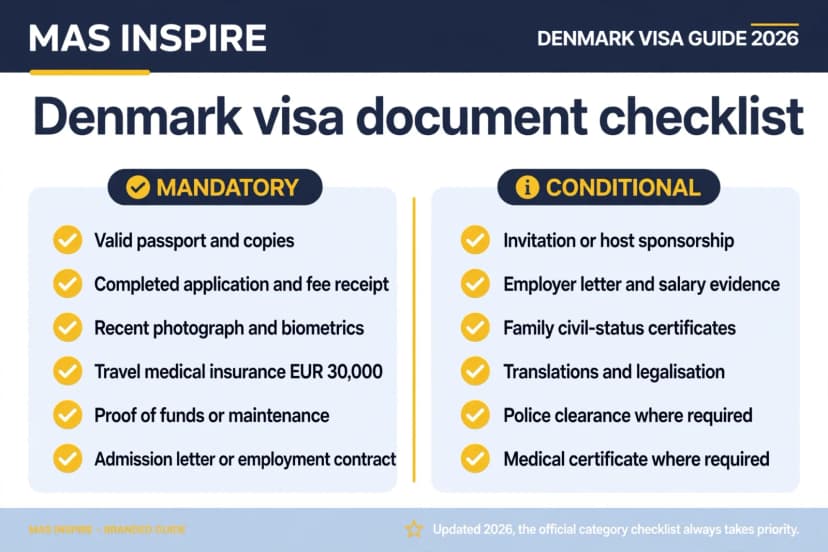
The following checklist is a starting point, not a universal fixed document count. The authority may request further evidence, and the exact form depends on the route.
| Document or evidence | Short-stay visit | Student | Work | Family |
|---|---|---|---|---|
| Valid passport and copies | Mandatory | Mandatory | Mandatory | Mandatory |
| Correct application and fee evidence | Mandatory | Mandatory | Mandatory | Mandatory |
| Photo and biometrics | Normally required | Required | Required | Normally required |
| Purpose evidence | Itinerary/invitation | Admission and programme details | Contract/job offer | Relationship and sponsor evidence |
| Funds/support | Means for trip | 2026 maintenance proof | Salary/terms and route rules | Sponsor/applicant support rules |
| Accommodation | Usually relevant | Address/accommodation details as applicable | As applicable | Housing condition may apply |
| Insurance | Schengen travel insurance | Coverage as required by residence/study circumstances | As required by circumstances | As required by circumstances |
| Qualifications | If relevant | Academic and language evidence | Qualifications/licence if relevant | Not usually central |
| Civil-status documents | If relevant | If relevant | If relevant | Marriage/cohabitation and family records |
| Translations/legalisation | As requested | As requested | As requested | As requested |
For a Schengen visit, prepare the passport, completed application, photograph, travel medical insurance, itinerary, accommodation, evidence of funds, purpose/invitation and evidence relevant to return plans. For a student permit, prepare the admission confirmation, passport, proof of funds, fee receipt, and the institution's portion of the application. For a work permit, prepare the employment contract/job offer, passport, qualifications or authorisation where relevant, and employer details. For family reunification, prepare identity documents, marriage certificate or cohabitation evidence, sponsor's residence/status documents, and evidence addressing the specific statutory conditions.
Documents not in an accepted language may need certified translation. The Danish mission in Vietnam specifically says Vietnamese-language documents submitted through VFS must be translated into English and legalised by the relevant local authorities, except passports. Requirements can differ by document and case; verify with VFS and the competent authority before paying for legalisation.
How to Apply: Step-by-Step
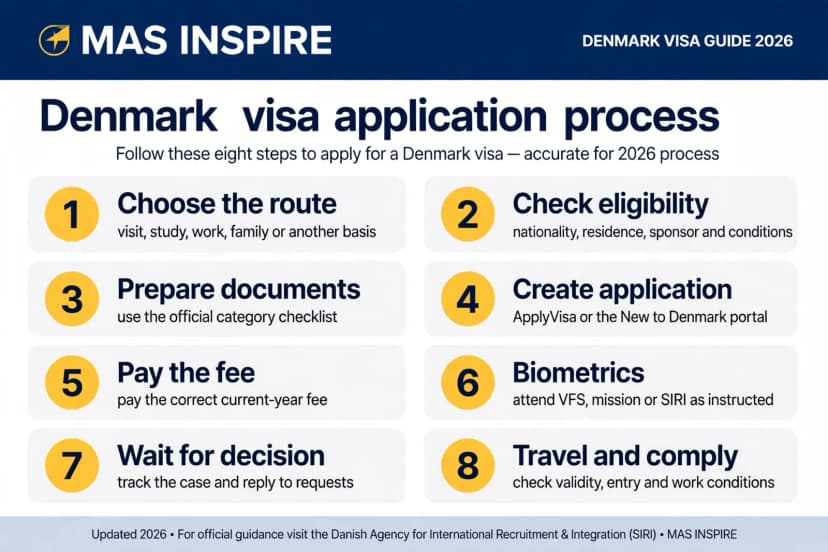
- Choose the correct route. Decide whether the purpose is a visit, study, employment, family reunification, entrepreneurship or another recognised category. Do not use a visitor visa to undertake work or long-term study.
- Check nationality and where you may apply. Determine whether your passport requires a Schengen visa, whether a transit visa is needed, and which Danish mission or visa centre accepts applications from your country of lawful residence.
- Check the current criteria. Read the official New to Denmark page for the exact permit, including salary levels, approved programme, sponsor requirements and any exemptions.
- Prepare the documents. Use the route-specific official checklist. Arrange translations, certification or legalisation only where required. Ensure names, dates and passport details match across records.
- Create the relevant online case. Short-stay applicants use the Danish ApplyVisa portal where applicable. Residence/work applicants normally create a Case Order ID through New to Denmark and use the designated SIRI or Immigration Service form. Some employer or institution-led applications have a first section completed by the employer or school.
- Pay the correct fee. Pay the government fee for the correct year and case type. Save the receipt. Visa application centres may charge a separate service fee. Fees can change on 1 January.
- Book biometrics or an appointment. Attend the designated VFS centre or Danish mission as instructed. Bring originals and copies requested locally. Biometrics are normally required for residence permits and many visa applications, subject to exemptions.
- Submit the application. Submit through the official portal and/or appointment channel. Ensure all required sections have been completed by the applicant, sponsor, employer or educational institution as applicable.
- Track the case and respond. Use the tracking method supplied by the application centre or authority. Reply promptly to requests for additional documents. Do not assume that a published normal processing time is a deadline.
- Read the decision before travelling or working. Check validity dates, entry conditions, work restrictions, permitted hours and any registration requirements. Carry the decision and supporting documents when travelling. A visa or permit does not remove border-control checks.
Not every application follows all ten steps in this exact order. Follow the instructions attached to the selected category.
Visa Fees and Financial Requirements
| Item | 2026 amount / rule | Notes |
|---|---|---|
| Standard Schengen adult visa | EUR 90 | Service fee extra; exemptions/facilitation may apply |
| Schengen child age 6–11 | EUR 45 | Under-six applicants generally exempt |
| Schengen travel medical insurance | Minimum EUR 30,000 cover | Whole Schengen area and planned stay |
| Higher-education student maintenance | DKK 7,426/month | Maximum DKK 89,112 for 12 months under 2026 benchmark |
| Pay Limit salary threshold | DKK 552,000/year | 2026 standard Pay Limit Scheme |
| Supplementary Pay Limit salary threshold | DKK 446,000/year | 2026 supplementary scheme; extra conditions apply |
| Positive List / Pay Limit / Fast-Track / Researcher fee | DKK 6,810 | Confirm exact case type |
| Higher-education student permit fee | DKK 3,060 | 2026 SIRI listing |
| Start-up Denmark fee | DKK 3,060 | Expert-panel approval required |
| Spouse/partner reunification | DKK 8,490 | Current official page; case-specific exemptions may apply |
The student maintenance amount is a financial-capacity test, not a tuition fee. Tuition fees are set by the institution and programme and are separate. Denmark does not publish one universal bank-balance figure for every visa category. Short-stay applicants must demonstrate sufficient means for their individual itinerary and circumstances.
Visa Processing Times
The official pages surfaced for this guide list 15 days as the usual short-stay processing period in Vietnam, with 45 days indicated by the Danish mission in Pakistan in cases handled there; the applicable legal maximum and extensions depend on the case. For student and work routes, use the category-specific estimates in the comparison table. Family reunification and permanent residence have longer expected periods. Processing can take longer if an application is incomplete, extra checks are needed, or the authority asks for further evidence. Apply well before travel and avoid non-refundable bookings until a decision is issued.
Applying from Pakistan or Vietnam
Pakistani passport holders
Pakistani ordinary passport holders require a visa to enter Denmark and the other Schengen states. The Danish Ministry of Foreign Affairs says applications can be lodged at designated Visa Application Centres in Islamabad, Karachi and Lahore. The Danish mission in Pakistan warns that short-stay cases may take up to 45 days after the application is considered admissible and advises applicants to check VFS appointment availability and apply early. The official page warns against agents offering false documents; false or misleading information can lead to refusal and other consequences.
Pakistani citizens legally living or working in Vietnam
A Pakistani national does not become visa-exempt because they hold a Vietnamese residence card or work permit. They still need the appropriate Danish/Schengen visa for a short visit, and the application must be supported by evidence of their legal status and circumstances in Vietnam.
The Danish Ministry of Foreign Affairs' Vietnam page says short-stay visa and residence-permit applications in Vietnam are submitted through VFS Global in Hanoi or Ho Chi Minh City. It also says Vietnamese-language documents must be translated into English and legalised by the relevant local authorities, except passports. Denmark's case processing for Vietnam is handled by the Embassy of Denmark in Bangkok; the Embassy in Hanoi does not decide Schengen cases submitted through VFS Vietnam. The Vietnam page states a normal handling time of 15 days from submission at VFS for the cases it describes.
For a Pakistani applicant who is legally resident in Vietnam, the Vietnam channel is a practical local submission route, but do not assume that a Vietnamese residence permit by itself settles jurisdiction or guarantees acceptance. Before booking, ask VFS Vietnam to confirm that it will accept an application from a Pakistani national holding the specific Vietnamese residence status, and confirm what proof of residence is required. If the applicant is only temporarily visiting Vietnam, or lacks valid local residence, the mission may direct them to apply in Pakistan or another country where they are legally resident. For long-stay residence permits, follow the separate SIRI process and the mission/VFS instructions for biometrics and document submission.
Pakistan versus Vietnam: practical differences
| Issue | Applying in Pakistan | Applying in Vietnam |
|---|---|---|
| Submission locations | Islamabad, Karachi, Lahore | Hanoi, Ho Chi Minh City |
| Processing authority | Danish mission/assigned regional handling | Embassy of Denmark in Bangkok for cases lodged through Vietnam |
| Published short-stay timing on country page | Up to 45 days after admissibility | Normal 15 days from VFS submission (page guidance) |
| Residence evidence | Pakistan identity/address and any relevant status | Valid Vietnamese residence/work status and proof requested by VFS |
| Local document language | Check mission instructions | Vietnamese documents translated into English and legalised, except passports |
| Nationality rule | Pakistani ordinary passport requires visa | Same Pakistani nationality-based visa requirement |
Use the country-specific VFS checklist. Processing times are not directly comparable because case circumstances, admissibility and workload differ.
Student Visa Guide
For higher education, first secure admission to an eligible full-time programme. The educational institution completes its part of the application where the online process requires it. The student then completes their part, pays the fee and supplies passport and maintenance documentation. Confirm the institution and programme's state-approved status; private or unapproved programmes may not qualify for a student residence permit.
For the 2026 financial benchmark, plan for DKK 7,426 per month, up to DKK 89,112 for 12 months. The authority specifies a bank statement dated no more than 30 days before submission and showing the applicant's name, balance, date and currency, or approved evidence of scholarship/student-loan support. Students in qualifying state-approved higher-education programmes may work 90 hours monthly from September to May and full-time in June, July and August. Work outside those limits or work without a permit can jeopardise residence status. Check the exact work conditions printed on the permit.
Work Visa and Job Opportunities
Start with a genuine job offer and identify the scheme that fits the salary, job title, employer and qualifications. The Positive Lists are occupation-based and updated twice yearly; Pay Limit is salary-based; Fast-Track requires a certified employer; and the Researcher Scheme requires a genuine research position. An employer may need to provide detailed contract terms and complete part of the application. A general job offer or an online vacancy is not itself a work permit.
The 2026 Pay Limit threshold is DKK 552,000 per year. Do not use that amount as the threshold for other schemes. Check current supplementary-pay-limit figures and list occupations on SIRI's live pages. Never pay an unverified recruiter for a guaranteed permit or submit a contract that does not reflect the actual job and salary.
Family Immigration and Permanent Residence
Family reunification is a detailed legal assessment. Couples should review the applicant and sponsor requirements together before paying the fee. Prepare relationship evidence, civil-status documents, sponsor status and housing/financial information where relevant. Certain accompanying family members of qualifying workers, researchers or students may apply under a separate accompanying-family category; they should not automatically use spouse reunification rules.
Permanent residence normally follows years of qualifying legal residence and requires more than simply holding a residence card for the required period. The general route includes residence continuity, current permit compliance, language, employment/self-support and other conditions. The faster four-year route is exceptional and requires all four supplementary requirements as well as the basic conditions. EU-law permanent residence is a separate legal pathway.
Common Application Mistakes
- Choosing a tourist visa for a purpose that involves employment or long-term study.
- Applying to Denmark when another Schengen country is the main destination or purpose.
- Using an unapproved school or a part-time programme for a student route that requires approved full-time study.
- Miscalculating the 90-days-in-180-days short-stay limit.
- Providing a bank statement that is stale, not in the applicant's name, or does not show the required balance and currency.
- Confusing gross salary, net salary and the specific salary threshold used by a work scheme.
- Omitting blank passport pages or submitting a passport that fails the validity rules.
- Failing to translate or legalise documents when the local mission requires it.
- Assuming a Vietnam residence card makes a Pakistani passport visa-free or automatically establishes local application eligibility.
- Booking travel before the visa is issued or starting work before work authorisation is valid.
- Using forged documents, false employment details or misleading travel plans.
Reasons for Visa Refusal
A short-stay application may be refused if the purpose or conditions of the visit are not established, the applicant lacks sufficient means or valid insurance, the travel document is unacceptable, there are concerns about the intention to leave, or security/public-policy grounds apply. A residence permit may be refused if the applicant does not meet the selected scheme's criteria, the job or programme is ineligible, salary/terms are below the required standard, the sponsor conditions are not met, documents are missing or unreliable, or required fees/biometrics are not completed. A refusal is case-specific. Read the written decision for appeal or reapplication instructions and deadlines.
Frequently Asked Questions
1. Do Pakistani citizens need a visa for Denmark in 2026?
Yes. Pakistani ordinary passport holders need a visa before travelling to Denmark and other Schengen states. Diplomatic and service passport exemptions may apply under the official country guidance.
2. Can a Pakistani living in Vietnam apply for a Denmark visa in Ho Chi Minh City?
The Danish Ministry of Foreign Affairs lists VFS application centres in Hanoi and Ho Chi Minh City. A Pakistani resident should confirm acceptance for their specific Vietnamese residence status with VFS before booking; a residence card does not guarantee jurisdiction.
3. How much is a Denmark tourist visa in 2026?
The standard adult Schengen fee is EUR 90; children aged 6–11 generally pay EUR 45. A VFS service fee may be additional, and exemptions or special nationality rules can apply.
4. How long can I stay in Denmark on a Schengen visa?
Generally, up to 90 days in any rolling 180-day period across the Schengen area, subject to the visa's validity and entries.
5. How much money does a Danish student need to show in 2026?
For eligible higher education, SIRI states DKK 7,426 per month, up to DKK 89,112 for 12 months, subject to the official rules on acceptable evidence and any qualifying accommodation/food arrangements.
6. Can international students work in Denmark?
Students in state-approved higher-education programmes generally have permission for 90 hours per month from September to May and full-time in June, July and August. Other programmes may have different or no work rights.
7. What is the Denmark Pay Limit amount for 2026?
The standard Pay Limit Scheme threshold is DKK 552,000 per year for 2026. The supplementary scheme has separate conditions and threshold.
8. Does Denmark have a job seeker visa?
There is no general overseas job-seeker visa. Certain eligible graduates and permit holders may qualify for a job-seeking residence period linked to their existing Danish status.
9. Does Denmark have a digital nomad visa?
Denmark does not currently list a general digital-nomad visa. A visitor visa should not be treated as permission for long-term remote residence or employment.
10. Is there a Denmark golden visa for property buyers?
No general passive-investment or property-purchase residence route is listed. Start-up Denmark is an entrepreneur scheme requiring an approved innovative business idea, not a passive investor route.
11. How long does a Denmark student permit take?
SIRI lists a normal processing time of two months for higher-education applications, potentially three months if more information is needed.
12. How long does spouse reunification take?
The current official spouse/partner page lists an expected maximum processing time of 10 months. The actual case may take less or longer if further information is required.
13. Can I work on a tourist visa?
No. A Schengen visitor visa does not grant general employment rights. Some narrowly defined business or other activities may be exempt, but check the applicable rules before undertaking them.
14. How do I get permanent residence in Denmark?
The general route normally requires eight years of uninterrupted legal residence and satisfaction of basic and supplementary conditions. A four-year route is possible only in specified circumstances when all four supplementary requirements are met.
15. Does a Danish visa guarantee entry?
No. A visa permits travel to the border, but border authorities may still check whether entry conditions are met. Carry supporting documents and comply with the visa conditions.
Official Immigration Websites
- New to Denmark — official immigration and residence portal
- Danish Ministry of Foreign Affairs — where to apply
- Danish ApplyVisa portal
- Short-stay tourist/private visit requirements
- Higher-education student residence permit
- Pay Limit Scheme
- Positive List for Skilled Work
- Fast-Track Scheme
- Researcher Scheme
- Start-up Denmark
- Spouse/partner family reunification
- Permanent residence permit
- SIRI — New rules for students from 1 October 2026
- Denmark in Vietnam — visa application instructions
- Denmark in Pakistan — visa information
Final Checklist and Conclusion
Before submitting, confirm that you have selected the correct category; checked the current rules for your nationality and country of lawful residence; verified that the school, employer, sponsor or business meets the relevant criteria; used the current-year fee; prepared all mandatory documents; translated and legalised records where required; booked biometrics through the correct channel; and checked processing estimates and travel dates. Keep copies of everything and answer any official request promptly.
Denmark offers several legitimate routes for visits, education, skilled work, research, entrepreneurship and family life, but each route has distinct conditions. Use the official Danish immigration portal as the final authority and obtain qualified advice if your circumstances are complex. MAS Inspire provides educational information and does not represent the Danish government or guarantee immigration outcomes.


