

By MAS Inspire | Last reviewed: 27 November 2026 (key figures re-verified 27 November 2026; State Council Order No. 841 note added)
Independent educational information. This guide covers mainland China. Hong Kong and Macao have separate immigration arrangements. MAS Inspire is not a Chinese government authority. Requirements depend on nationality, purpose and place of application; the authorities decide every application and entry request. Recheck the linked official instructions before applying.
Contents
- Introduction
- Why People Visit, Study, and Work in China
- Types of China Visas
- Visa Comparison Table
- Eligibility Requirements
- Complete Document Checklists
- How to Apply: Step-by-Step
- Visa Fees and Financial Requirements
- Visa Processing Times
- Applying from Pakistan or Vietnam
- Student Visa Guide
- Work Visa and Job Opportunities
- Family Immigration and Permanent Residence
- Common Application Mistakes
- Reasons for Visa Refusal
- Frequently Asked Questions
- Official Immigration Websites
- Final Checklist and Conclusion
Introduction
The right China visa starts with your actual purpose: sightseeing, a trade meeting, a degree, employment or joining family. Nationality and residence then determine whether an exemption applies and where your application can be accepted. A business invitation cannot turn a tourist application into permission to work.
Keep four documents separate. An entry visa allows travel to seek admission for its stated purpose. A work permit authorizes qualifying employment. A residence permit authorizes residence under an approved purpose. Permanent residence requires a separate approval process. None should be promised simply because you obtain another. See the Exit and Entry Administration Law.
Why People Visit, Study, and Work in China
Visitors may combine historic sites and major cities; students may pursue language learning, university degrees or research; businesses may attend exhibitions or meet suppliers. These plans need different immigration evidence. Before booking, write down the activity, intended dates, host and source of funding. That short description helps you select the correct category and prepare consistent documents.
For study, compare the institution, teaching language and total cost. For employment, establish whether the employer can secure the required authorization. A scholarship, admission offer or job offer supports an application but does not replace the visa decision. The MFA category guide is the national starting point.
Types of China Visas
Tourism, business and exchanges: L, M and F
L is for tourism. The applicable checklist may require round-trip and accommodation reservations or a qualifying invitation. Nationality-specific procedures can differ, particularly for Pakistani applicants. M covers commercial and trade visits, supported by a business or trade-fair invitation. F covers exchanges, visits and study tours, supported by a Chinese host's invitation. Hanoi also lists a business licence or company assignment letter for M/F applications. These are not general employment permissions. Official checklists: L, M, F.
Study and language courses: X1 and X2
X1 covers study exceeding 180 days; X2 covers study of 180 days or less. The distinction follows course length, not whether the subject is Chinese language or a university degree. X1 normally requires admission and JW201/JW202 study documentation, followed by residence formalities after arrival. X2 requires admission and any additional evidence specified by the receiving mission. Hanoi X1 checklist · Hanoi X2 checklist.
Employment and recognized talent: Z and R
Z is the employment entry category. An employer normally obtains a Foreigner's Work Permit Notification before the overseas visa application; specified occupations have alternative approval documents. Long-term employment also requires the appropriate work and residence authorization. Official Z checklist.
R is for officially recognized high-level or urgently needed talent. The Chinese host requests competent-authority talent confirmation; a degree alone does not establish eligibility. Published measures allow qualifying applicants five-to-ten-year multiple-entry visa validity and waive visa and expedited surcharges; centre charges must be checked separately. Working still requires work authorization. The validity is not permission to remain continuously for ten years. R implementation measures.
Young science and technology talent: K
K was established from 1 October 2025. Official guidance describes qualifying young STEM graduates with at least a bachelor's degree from well-recognized universities or research institutions, or young talent engaged in relevant teaching or research at those institutions. A Chinese employer or inviter is not required under the policy explanation. Activities include relevant exchanges, entrepreneurship and business.
Verification limitation: The sources checked did not establish a universal numerical age limit, institution list, fixed visa term, fee or Vietnam-specific operational checklist. Confirm acceptance and detailed conditions with your mission. K must not be advertised as an unrestricted work permit or a route for every job seeker. MFA K explanation.
Family and private affairs: Q1, Q2, S1 and S2
Q1/Q2 relate to Chinese citizens or foreign permanent residents; S1/S2 generally relate to foreign residents working or studying in China, or qualifying private affairs. The long-term categories involve residence; short visits are limited to the stay actually granted, up to the category's 180-day ceiling. S1's family scope is narrower than S2's. Family permission does not automatically authorize employment. National family-category instructions.
Transit, crew, journalism and permanent-residence entry
G is the transit visa when an exemption is unavailable. C serves qualifying international transport crew and drivers. J1/J2 cover resident and short-term journalists, with press authorization. D is entry connected with already approved permanent residence; it is not an open settlement application. Purpose-specific approvals appear in the checklist below. Regulations, Articles 6–7.
Job seekers, remote workers, entrepreneurs and researchers
The national list contains no dedicated general job-seeker or digital-nomad visa, and no universal visa labelled startup or investor. K is targeted; M is a business-visit category. However, qualifying graduates and innovation teams may obtain specifically endorsed entrepreneurship residence permissions. These require evidence and local approval. NIA entrepreneurship and internship provisions.
Researchers may fit F, Z, R or K depending on whether they are visiting, employed or qualify for a talent route. An internship needs its own assessment: F is not a blanket permission for practical work, paid or unpaid. Existing students and invited overseas students have distinct arrangements. Do not begin work merely because a host calls it training.
Visa-free entry and urgent port visas
China has separate nationwide, transit and regional exemptions. The current MFA unilateral-waiver FAQ lists eligible ordinary passports for visits of up to 30 days; Pakistan and Vietnam are not on that nationwide unilateral list. Most listed arrangements currently expire on 31 December 2026; Russia's extends to 31 December 2027, while Brunei has no stated expiry. Bilateral agreements must be checked separately.
The 240-hour transit scheme covers 57 nationalities, including Vietnam since 20 August 2026, through designated ports and permitted areas. Pakistan is not eligible. It requires confirmed onward travel to a third country or region; Vietnam–China–Vietnam is not that itinerary. 24-hour transit is a separate framework open to all nationalities under its conditions; leaving the restricted port area requires temporary entry permission. NIA transit rules.
Hainan and organized regional/cruise groups have their own conditions. Vietnam also joined Hainan's 30-day scheme in August 2026; Vietnamese residence does not give a Pakistani passport these rights. Expansion notice · Regional schemes. Urgent humanitarian or qualifying business port visas require evidence and authorization; they are not a general visa-on-arrival service. NIA port-visa guidance.

Visa Comparison Table
| Purpose | Code | Duration framework | Work position |
|---|---|---|---|
| Tourism | L | Stay and entries as granted | No general employment right |
| Trade/business meetings | M | As granted | Business visits, not ordinary employment |
| Academic/cultural exchange | F | As granted | Activity-specific; not a general work permit |
| Long/short study | X1 / X2 | Over 180 / up to 180 days | Only separately permitted study-related activity |
| Authorized employment | Z | Entry plus applicable work/residence permission | Within approved employment |
| Recognized high-level talent | R | Eligible multiple-entry validity may be 5–10 years | Separate work authorization required |
| Qualifying young STEM talent | K | Confirm current mission conditions | No assumed unrestricted work right |
| Chinese/PR family | Q1 / Q2 | Residence / short visit up to 180 days | No automatic work right |
| Foreign-resident family/private affairs | S1 / S2 | Over 180 / up to 180 days | No automatic work right |
| Transit | G | As granted | Transit purpose |
| International transport duties | C | As granted | Specified crew/transport duties |
| Resident/visiting journalism | J1 / J2 | Over 180 / up to 180 days | Approved journalism |
| Approved permanent-residence entry | D | Complete required arrival formalities | Rights follow approved PR status |
Sources: Hanoi category directory, K amendment, and R measures. For every code, use the shared fee, application, biometrics and processing sections below; overseas fees are not universally fixed by visa letter.
Eligibility Requirements
Confirm your passport type, nationality, lawful place of application, genuine purpose and host or approval requirements. A Vietnamese residence card proves a residence status; it does not establish Chinese visa-free eligibility or guarantee that a particular Chinese mission accepts your case.
For visa applications, Hanoi specifies at least six months' passport validity and two blank visa pages. Exemption schemes can have different passport-validity rules. Check the specific route rather than applying one rule to all travellers. Hanoi basic documents.
Visa validity is the window for using the visa to enter. Entries determines how many admissions it can support. Duration of stay limits each visit. A six-month multiple-entry visa does not authorize six continuous months in China. The issued document and residence requirements control. Regulations, Article 36.

Complete Document Checklists
There is no universal fixed document count. Required means a core item for the stated application; conditional means mandatory when the stated circumstance applies; recommended means preparation advice rather than a universal legal requirement. A document called “supporting” by a mission may still be required.
Core and conditional application documents
| Document | Status | Practical requirement |
|---|---|---|
| Passport and identity-page copy | Required | Meet the accepting mission's validity/page rules |
| Current online form, confirmation and photo | Required | Complete, upload, print and sign the specified pages |
| Category-specific evidence below | Required for that route | Use genuine, consistent records |
| Vietnam visa/residence/entry evidence | Conditional: applying there as a foreign national | Original and copy of lawful-status evidence |
| Previous Chinese visas/passports | Conditional | Include relevant history and former Chinese nationality evidence |
| Birth/guardian/consent records | Conditional: minors or other relevant cases | Follow the mission's detailed parental requirements |
| Bank records, sponsor income, employment/leave evidence | Conditional | Submit when required; amount and format depend on the mission and route |
| Police, medical, translation or apostille records | Conditional | Depends on route, issuing country and receiving authority |
| Personal copies and an expense plan | Recommended | Keep a complete record and realistic funding explanation |
Sources: Hanoi basic checklist and HCMC physical-submission requirements.
Purpose-specific evidence
| Route | Required purpose evidence | Conditional additions |
|---|---|---|
| L | Applicable travel/accommodation reservations or qualifying invitation | Inviter identification; nationality-specific group-tour documents |
| M / F | Business, fair or exchange invitation | Company assignment/business licence; special invitation verification |
| X1 | Admission plus JW201/JW202 | Funding, scholarship and school/mission additions |
| X2 | Admission | DQ/electronic study confirmation if required |
| Z | Work Permit Notification or approved statutory alternative | Employer's upstream qualification, police and health evidence |
| R | Official high-level-talent confirmation | Evidence requested by the confirming authority |
| K | Evidence meeting published young-STEM criteria | Obtain the accepting mission's operational checklist |
| Q1 | Invitation, inviter ID/PR documents and relationship evidence | Foster-care authorizations where applicable |
| Q2 | Invitation and inviter ID/PR documents | Relationship proof if the mission requires it |
| S1 / S2 family | Invitation, foreign sponsor passport/status and relationship evidence | Private-affair evidence for non-family cases |
| G | Confirmed onward ticket with date and seat | Destination-entry evidence as requested |
| C | Transport-company guarantee or relevant Chinese invitation | Operational supporting records |
| J1 / J2 | Press notification/authorization and media-employer letter | Mission press-office procedures |
| D | Confirmation of approved permanent-residence status | Required post-entry documentation |
Use the national purpose-document instructions with the linked local category pages, R rules and K explanation.
Translations and authentication
Since 11 September 2026, Vietnamese public documents within the Apostille Convention's scope can be used in mainland China with a Vietnamese apostille instead of consular legalization. This applies when authentication is needed; it does not mean every supporting document needs an apostille. Confirm translation, document age and format with the receiving institution. Chinese Embassy notice, 18 September 2026.
How to Apply: Step-by-Step
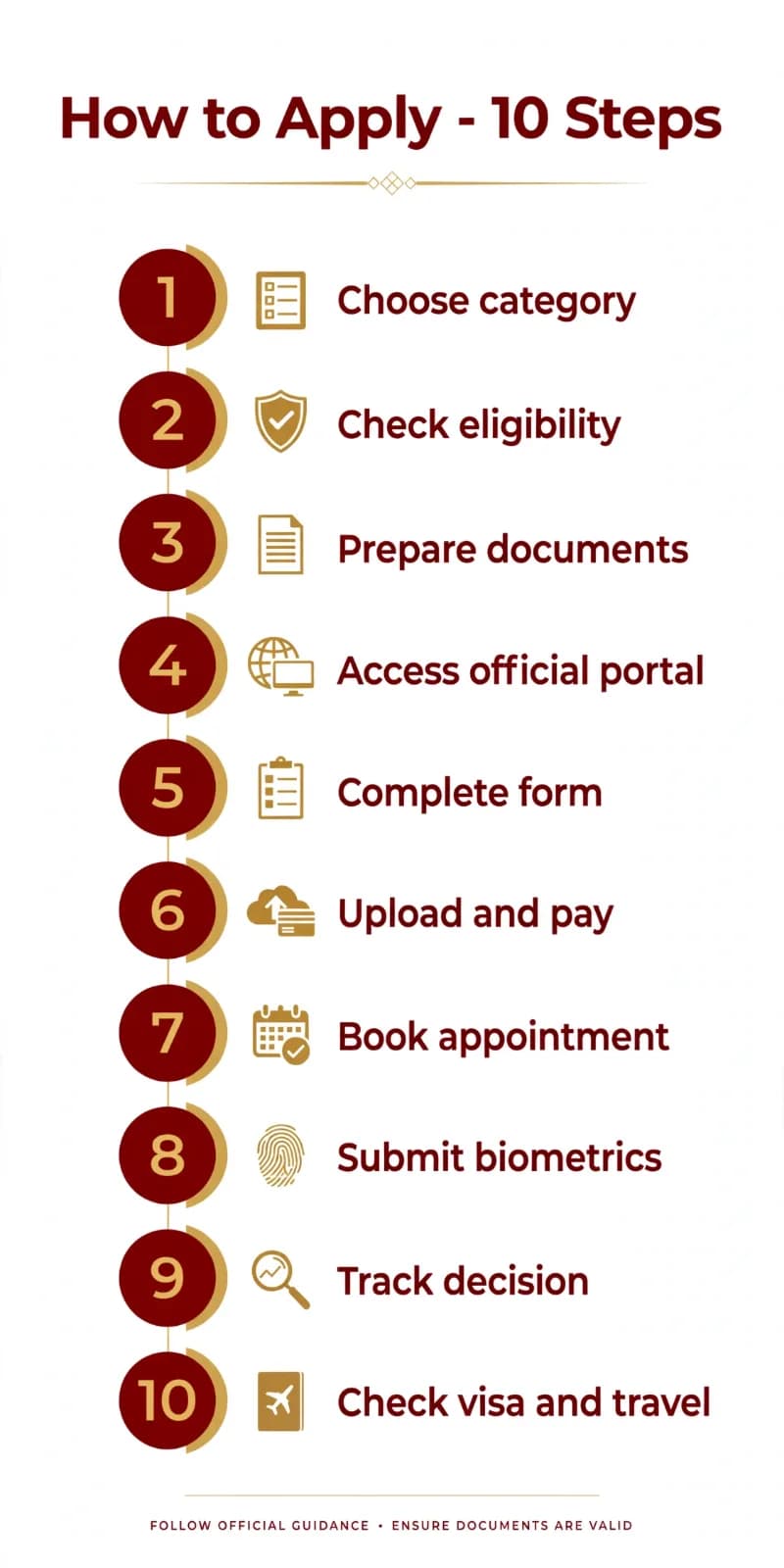
The following sequence describes ordinary mainland-visa applications through Vietnam's Chinese Visa Application Service Centres. Other countries and special categories can use different arrangements.
| Stage | What to do | What happens next |
|---|---|---|
| 1. Select the route | Choose the purpose/category; check exemptions | Identify the correct application |
| 2. Confirm eligibility | Check nationality, residence and consular jurisdiction | Obtain local instructions where unclear |
| 3. Prepare evidence | Obtain invitations, admission/work approvals and conditional documents | Scan clear, complete records |
| 4. Register | Select the correct city at the official centre portal and create/sign into an account | Access the current online form |
| 5. Complete the form | Match names, dates, funding and purpose to your evidence | Review before submission |
| 6. Upload and submit | Submit the online application and requested files | Wait for preliminary review; answer requests |
| 7. Follow attendance instructions | Arrange an interview/biometrics only where required | Do not assume exemption means remote completion |
| 8. Submit physically and pay | After online review completes, bring passport, confirmation, signed pages and requested originals | Pay in the sequence specified by that centre |
| 9. Track the case | Use the account/status facility and collection receipt | Provide further evidence if requested |
| 10. Collect and prepare to travel | Check identity, category, entries, validity and stay | Carry relevant evidence and plan arrival formalities |
HCMC currently does not offer online payment. Hanoi specifies service payment in VND on submission and visa-fee payment in USD on collection. Online review completion is preliminary, not approval of the visa. An online request to correct or resubmit files is also different from a final consular refusal. HCMC process · Hanoi process.
Fingerprints in 2026: The embassy exempts short-term applicants staying no longer than 180 days through 31 December 2026. D, J1, Q1, S1, X1 and Z cases requiring residence permits remain subject to collection under the applicable rules. Other exemptions may apply; the mission can require attendance or an interview. Current embassy notice.
After arrival, hotels register guests. For non-hotel stays, you or your host must register within 24 hours; NIA introduced a nationwide online channel in September 2026. Residence-required entrants must complete the relevant residence application, generally within 30 days. Check specific short-term Z exceptions. Accommodation registration · Residence guidance.
Visa Fees and Financial Requirements
Visa fees depend on nationality, entry entitlement, location and exemptions. Centre service charges are separate. The following are verified examples, not a worldwide price list for every visa code.
| Fee item | Published amount | Scope and source |
|---|---|---|
| Vietnamese citizen: regular single / double / six-month multiple / one-year multiple | USD 45 / 68 / 90 / 135 | Vietnam embassy schedule through 31 December 2026 |
| Generic third-country schedule in Vietnam: same entry sequence | USD 23 / 34 / 45 / 68 | Same schedule; nationality exceptions apply |
| US / Canadian regular visas in Vietnam | USD 139 / USD 60 | US journalism USD 171; confirm special cases |
| HCMC centre service, regular / express / urgent | VND 760,000 / 1,160,000 / 1,520,000 | August 2026 schedule, VAT included; visa fee additional |
| Pakistani citizen applying in Karachi | Government fee PKR 0; regular centre fee PKR 13,200 | October–December 2026 schedule; service includes GST |
| R qualifying talent visa | Visa and expedited surcharges waived | R measures; confirm centre charges |
| Residence permit in China | CNY 400 / 800 / 1,000 | Less than one year / one to under three years / three to five years; NIA |
| Permanent-residence application and card | CNY 1,500 + CNY 300 | National service listing; separate from a D visa |
HCMC's service fee is non-refundable even if a visa is refused; express/urgent service requires approval. Do not assume its service rates apply in Hanoi or Da Nang. A Vietnam-specific source expressly confirming the Pakistani government-fee exemption was not located, so Pakistani residents should request the actual nationality-specific total from their chosen centre.
Financial evidence: No single national bank-balance amount was identified for all L, M, F, X, Z or family applicants. Check your mission, sponsor and institution. Pakistan's published F/M invitation-exemption route specifies six months of statements with funds covering at least USD 100 per day or equivalent PKR; this is not a universal China visitor threshold. Its returned-application guidance separately gives USD 2,500 per academic year for self-funded students. Pakistan instructions · Student-funding guidance.
Visa Processing Times
| Procedure | Published indication | Important limit |
|---|---|---|
| Hanoi ordinary application | Collection on fourth working day; express third | After physical submission, subject to examination |
| Da Nang ordinary application | Collection on seventh working day; express sixth | Local procedure; availability must be checked |
| HCMC ordinary application | Typically three or four working days | Complete in-person file |
| Online preliminary review | No fixed duration verified | Additional uploads can extend the process |
| R qualifying talent visa | Published expedited procedure: two working days | R measures; prior talent confirmation and any further checks are additional |
| In-China residence permit | Up to 15 working days in NIA service guidance | Separate residence procedure |
| Permanent residence | NIA guide: within six months; service listing: 180 working days | NIA and national listing differ; confirm locally |
These are not guaranteed end-to-end deadlines. Work/talent approval, admission, online review, public holidays and additional checks are separate. HCMC advises submitting online at least 30 days before travel. Planning notice. For K and other specialist cases, obtain a case-specific estimate rather than applying the ordinary-service table automatically.
Applying from Pakistan or Vietnam
Pakistani passport holders legally living or working in Vietnam
A Pakistani ordinary passport normally needs a visa for an ordinary mainland visit unless a specific exemption genuinely applies. Living in Vietnam does not make the passport eligible for Vietnam's 240-hour transit or Hainan privileges. The 24-hour transit framework and narrowly defined group schemes must be considered separately.
Prepare your Pakistani passport, Vietnamese legal-stay/residence evidence and entry record, current address, and employment or study evidence where applicable. Add the purpose-specific documents and relevant Chinese travel history. The centre may require originals and copies. Lawful-residence application guidance.
Before committing to travel, ask the receiving centre whether it accepts your nationality/category at your current address, what Vietnamese status it requires, and whether special invitations or additional police/financial documents apply. The generic Vietnam tourism checklist does not expressly establish that every Pakistani resident can obtain an individual L visa locally.
| Vietnam location | Official application portal | Jurisdiction action |
|---|---|---|
| Hanoi | Hanoi centre | Confirm your current residential address is covered |
| Ho Chi Minh City | HCMC centre | Confirm nationality/category acceptance and address coverage |
| Da Nang | Da Nang centre | Check the current consular district and local instructions |
Some published province lists retain older administrative names. Da Nang's current consular profile is a better starting point for its district than legacy lists, but confirm your precise address with the centre. Da Nang consular-area profile. Centres receive ordinary applications; the Chinese mission makes the decision.
How applying in Pakistan differs
Pakistan's embassy instructions describe Group L tourism of at least five people, authorized tourism invitations and particular F/M invitation routes. They also require Pakistani ID evidence and police clearance for applicants aged ten or above, covering birth to the present. The police certificate needs an apostille if it lacks a verifiable QR code. These are Pakistan-post requirements, not a universal Vietnam checklist. Consult the complete Pakistan embassy instructions.
The Karachi government-fee exemption does not eliminate centre fees. Equally, do not assume Vietnam's generic third-country rate is the final Pakistani charge. Obtain the local calculation before submission.
Student Visa Guide
Start with genuine admission, the course duration and its language requirements. The institution should supply the appropriate study documents. JW201/JW202 supports X1; the short-study DQ form appears in some official guidance but is not a universal requirement in the national X2 list. Ask the school and receiving mission which electronic confirmation to provide. Shanghai study-document guidance.
Budget for tuition, accommodation, insurance, living expenses and travel using the institution's actual figures. Scholarship applicants should use CampusChina and the CSC application system, following the relevant dispatching authority or university's timetable. Scholarship selection and visa approval are separate. Official scholarship guide.
Student work is conditional. Regulated higher-education work-study generally allows up to eight hours weekly and forty monthly; during winter/summer holidays, sixteen weekly and eighty monthly. Off-campus work requires school approval and a residence-permit endorsement, with eligibility including age at least eighteen, at least six months' remaining study residence and at least a year at the current institution. These rules do not give every X2 language student a job entitlement. Curriculum internships are distinct, and off-campus internships also require the relevant authorization. MOE work-study rules · NIA endorsement requirements.
Work Visa and Job Opportunities
Look for a genuine employer with a role that can receive foreign-worker authorization. Agree on duties, location, pay, contract term and who handles the work-permit process. A recruitment promise is not government approval. For ordinary professional employment, the employer-led sequence is notification approval, visa where required, and the appropriate work/residence permissions.
The employer's application may require qualifications, relevant experience, criminal-record and health evidence, a contract, passport and photograph. These are upstream work-permit documents; not every item is separately required at every Z-visa counter. Talent classifications and exceptions mean a commonly quoted degree/experience rule should not be applied to all workers. Government working-and-living guide · Work-permit notification guidance.
Do not start a job on L, M, F, student or family permission alone. Check changes of employer, role or location with the responsible authority before starting the new arrangement. Short-term assignments also need assessment; some Z cases have specific work-certificate and residence exceptions. Current Z guidance.
Family Immigration and Permanent Residence
For a Chinese citizen or foreign permanent-resident sponsor, start with Q. For a foreign worker/student sponsor, start with S. S1 generally covers spouses, parents, children under eighteen and parents-in-law; Q1 and S2 use broader family definitions. Check sponsor status, kinship evidence and the intended period before applying. Foster care requires additional formal documents. Q1 checklist · S1 checklist · S2 checklist.
Permanent residence has separate qualifying investment, senior employment/talent, contribution and family routes. The standard spouse route includes five years of marriage, five consecutive years living in China with at least nine months each year, and stable support/accommodation. Other family routes differ. Core evidence includes identity, health/criminal-record documents and the selected route's relationship, employment, tax or investment records. NIA permanent-residence guide.
Published investment benchmarks are USD 500,000, USD 1 million or USD 2 million in paid-in capital, depending on the qualifying industry/location; the rules also require three consecutive years of stable investment and good tax records. Confirm the precise threshold and local route. Purchasing property or forming a company does not itself guarantee settlement. Permanent-residence regulations. D entry follows approved status; it does not bypass this assessment.
Humanitarian protection
Refugee-status screening and recognized-refugee identity documentation are addressed in Article 46 of the immigration law. They are distinct from ordinary embassy visas and urgent humanitarian port procedures. Anyone needing protection should obtain case-specific assistance from the responsible authorities and qualified support; no protection outcome is guaranteed. Official legal text, Article 46.
Common Application Mistakes
- Choosing a category because it seems easier rather than matching the real activity.
- Assuming Vietnamese residence transfers Vietnamese nationality-based exemptions.
- Treating online review completion as final approval or the whole processing period.
- Using expired fingerprint notices, obsolete fee tables or old province lists.
- Submitting inconsistent names, dates, funding declarations or unverifiable invitations.
- Confusing entry validity with stay duration or forgetting arrival registration.
- Starting employment or an off-campus internship before authorization.
The Pakistan embassy's returned-application guidance illustrates document-quality, invitation and consistency problems. Use its local requirements only where applicable.
Reasons for Visa Refusal
Legal grounds include an unexpired exclusion following removal, specified public-health concerns, security/public-order grounds, false information, inability to support the stay and failure to supply required information. Authorities are not obliged to explain every refusal. An invitation or previously issued visa does not guarantee a new decision. Law, Article 21.
If refused or asked to resubmit, read the actual notice, distinguish an incomplete online submission from a final refusal, and address the stated issue with genuine evidence. Ask the mission about any applicable next procedure; this guide does not invent a universal appeal right or success rate.
Since 15 September 2026, State Council Order No. 841 (Regulations on Exit and Entry Administration) provides for a one-to-five-year entry ban where a foreign national submits false materials or false statements in a visa application. Lexology summary
Frequently Asked Questions
1. Do Pakistani ordinary-passport holders need a China visa?
Generally yes for an ordinary mainland visit. They are outside the current unilateral 30-day and 240-hour transit lists. Particular 24-hour transit or organized-group exemptions have separate conditions. NIA transit rules.
2. Can a Pakistani citizen apply from Vietnam?
Lawful Vietnamese residence supports a local application, but the accepting centre must confirm nationality, category and jurisdiction requirements. A residence card does not guarantee acceptance. Hanoi application-location guidance.
3. Can Vietnamese citizens use 240-hour visa-free transit?
Yes, since 20 August 2026, when all itinerary, passport, port and permitted-area conditions are met. The journey must continue to a third country or region. NIA expansion.
4. Is an online China visa application fully electronic?
Vietnam's current centre process still includes passport and document submission after preliminary online review. Completing the online stage is not visa issuance. HCMC process.
5. Are fingerprints required in Vietnam in 2026?
For applications in Vietnam, short-term applicants staying no longer than 180 days are exempt through 31 December 2026. Residence-required categories remain subject to collection and applicable exceptions. Embassy notice.
6. What is the difference between X1 and X2?
X1 covers study longer than 180 days and leads to residence formalities; X2 covers study of 180 days or less. The school and mission determine the required evidence. Student categories.
7. Can international students work part time?
Only under the applicable authorized work-study or internship arrangement. Off-campus activities require the relevant school approval and residence endorsement; a student visa alone is insufficient. MOE rules.
8. Does K require a Chinese employer?
The official policy explanation says no employer or inviter is required. Applicants must still meet the detailed young-STEM criteria and confirm the receiving mission's operational requirements. MFA K guidance.
9. Does China offer a general digital-nomad visa?
No dedicated general digital-nomad category appears in the national ordinary-visa list. Do not assume a tourist or business visa authorizes ongoing remote work. Current visa regulations.
10. Is a Chinese visa free for Pakistani applicants?
Karachi's current schedule waives the government visa fee but charges a centre service fee. The exact payable total for a Pakistani applicant in Vietnam needs local confirmation. Karachi fees.
11. How much money must I show?
There is no single verified national amount for every applicant. Requirements depend on the mission, category and funding arrangement; some Pakistan-post routes publish specific amounts. Pakistan instructions.
12. Does marrying a Chinese citizen automatically give permanent residence?
No. The spouse route has separate residence, marriage-duration and support conditions, followed by an application and assessment. NIA permanent-residence guide.
Official Immigration Websites
- MFA national visa instructions: categories and evidence.
- China Online Visa Application: use only where your mission directs.
- Chinese Visa Application Service Centres: select the actual application city.
- National Immigration Administration: entry, transit and residence guidance.
- Chinese Embassy in Vietnam: current local notices.
- Chinese Embassy in Pakistan: Pakistan application instructions.
- CampusChina: official scholarship information.
For further educational reading, visit MAS Inspire's verified News & Study Abroad hub. Requirements in another country's guide do not apply to China.
Final Checklist and Conclusion
- Confirm the correct category or precisely applicable exemption.
- Confirm nationality, lawful-residence and current consular-jurisdiction rules.
- Gather core documents and every conditional item relevant to your case.
- Use the current official form and consistent, truthful supporting evidence.
- Budget for government, centre and any separate residence charges.
- Follow online review, physical submission and attendance instructions.
- Check the issued visa's entries, validity and permitted stay.
- Arrange accommodation registration and required residence/work formalities.
A well-prepared application matches the evidence to the intended activity and the receiving mission's current instructions. Use this guide to organize the process, then rely on the competent authority for your individual requirements and decision.


