


By MAS Inspire | Last reviewed: 27 November 2026 (fees, funds and programme changes re-verified 27 November 2026)
Introduction
Canada is a popular destination for international students, skilled professionals, entrepreneurs, tourists and families. Its universities, multicultural communities and immigration programmes attract applicants from around the world.
However, travelling to Canada requires more than choosing a destination and booking a flight. Depending on your nationality, purpose of travel and personal circumstances, you may need a visitor visa, electronic travel authorization (eTA), study permit, work permit or permanent residence approval.
This comprehensive Canada visa guide explains the main immigration categories, application requirements, government fees, financial requirements and application procedures for 2026. It also includes dedicated guidance for Pakistani citizens legally residing or working in Vietnam.
- Introduction
- Why Choose Canada?
- Types of Canadian Visas
- 1. Canada Tourist and Visitor Visa
- 2. Electronic Travel Authorization (eTA)
- 3. Canada Business Visitor Visa
- 4. Canada Study Permit
- 5. Canada Work Permit
- 6. Canada Job Seeker Visa
- 7. Skilled-Worker Immigration and Express Entry
- 8. Canada Digital Nomad Options
- 9. Entrepreneur, Start-Up and Investor Immigration
- 10. Family Sponsorship
- 11. Parent and Grandparent Super Visa
- 12. Canada Transit Visa
- 13. Exchange, Internship and Training Programmes
- 14. Researchers and Academic Professionals
- 15. Humanitarian Protection
- Visa Comparison Table
- Eligibility Requirements
- Document Checklists
- How to Apply
- Visa Fees and Financial Requirements
- Processing Times
- Applying from Pakistan or Vietnam
- Canada Student Visa Guide
- Work Permits and Job Opportunities
- Family Immigration and Permanent Residence
- Common Mistakes and Refusals
- Frequently Asked Questions
- How much is a Canada tourist visa in 2026?
- Can Pakistani citizens apply for a Canada visa from Vietnam?
- Does a Vietnamese residence card allow visa-free travel to Canada?
- How much money does a single international student need?
- Can I work in Canada with a tourist visa?
- How many hours can international students work?
- Does Canada offer a job seeker visa?
- Does Canada have a digital nomad visa?
- Is IELTS mandatory for every Canadian visa?
- Is the Start-Up Visa Program open?
- Can a visitor visa guarantee six months in Canada?
- Is Express Entry a work visa?
- Can studying in Canada guarantee permanent residence?
- Can I apply again after a visa refusal?
- Can a visa agency guarantee approval?
- Official Immigration Websites
- Final Checklist and Conclusion
Why Choose Canada?
Canada offers opportunities for people with different educational, professional and personal goals.
International applicants commonly choose Canada for:
Recognized universities and colleges.
Undergraduate, postgraduate and research programmes.
Employment opportunities across multiple industries.
Multicultural communities.
Natural attractions and tourism.
Family reunification.
Skilled-worker immigration programmes.
Long-term settlement opportunities for eligible applicants.
Studying or working in Canada does not automatically guarantee permanent residence. Applicants must independently satisfy the requirements of an available immigration programme.

Types of Canadian Visas
Canada's immigration system distinguishes between documents used for travel, permits authorizing activities and permanent immigration status.
1. Canada Tourist and Visitor Visa
A Temporary Resident Visa (TRV), commonly called a visitor visa, allows eligible foreign nationals to travel to Canada for temporary purposes.
Suitable purposes include tourism, visiting relatives, attending private events and other permitted short-term activities.
Main requirements:
A valid passport.
A credible purpose of travel.
Sufficient funds to cover the visit.
Evidence of ties outside Canada.
Compliance with immigration and admissibility requirements.
The government application fee is CAD $100 per person, with biometrics potentially costing an additional CAD $85.
Visitors normally receive authorization to stay for up to six months, although the border officer may authorize a different period.
A multiple-entry visa may remain valid for several years. Its expiry date does not determine how long you can remain in Canada during each visit.
A visitor visa generally does not authorize employment.
2. Electronic Travel Authorization (eTA)
An eTA is an electronic travel authorization linked to an eligible traveller's passport.
It is primarily used by visa-exempt foreign nationals travelling to Canada by air, as well as certain other eligible travellers.
Application fee: CAD $7.
Generally valid for up to five years or until the passport expires, whichever comes first.
Does not independently authorize employment or long-term study.
Ordinary Pakistani and Vietnamese passport holders generally require a visa rather than an eTA, unless a separate exemption applies.
3. Canada Business Visitor Visa
Canada does not generally issue a separate immigration status called a business visitor visa. Business visitors normally travel using the appropriate visitor visa or eTA.
Permitted activities may include:
Attending business meetings.
Participating in conferences.
Negotiating contracts.
Visiting business partners.
Attending certain short-term commercial training activities.
Applicants must demonstrate that their principal business and income source remain outside Canada and that they are not entering the Canadian labour market.
Documents may include an invitation from a Canadian business, employer authorization, business registration records and evidence of financial support.
Applicants performing actual work in Canada may require a work permit.
4. Canada Study Permit
International students generally require a study permit for educational programmes lasting more than six months.
A study permit authorizes eligible students to study in Canada under specified conditions. It is not an entry visa.
Applicants normally need:
A letter of acceptance from a Designated Learning Institution (DLI).
Evidence of available financial resources.
A valid passport.
A Provincial or Territorial Attestation Letter (PAL/TAL), unless exempt. From January 1, 2026, students in degree-granting master's or doctoral programmes at public Designated Learning Institutions do not need a PAL/TAL.
A Quebec Acceptance Certificate (CAQ), where applicable.
Medical examination or additional documents when required.
The study permit fee is CAD $150.
Since September 1, 2026, a single applicant studying outside Quebec must demonstrate at least CAD $23,448 for annual living expenses, in addition to tuition and transportation costs.
Qualifying students can work off campus for up to 24 hours per week during regular academic sessions.
5. Canada Work Permit
Canada has two principal types of work permits.
Employer-specific work permit
This permit authorizes employment according to specified conditions, which may identify the employer, occupation, location or employment period.
An employer may need to obtain a Labour Market Impact Assessment (LMIA). Some employment categories qualify for an LMIA exemption.
Open work permit
An open work permit allows eligible applicants to work for most employers without obtaining an individual employer-specific permit.
Open work permits are available only to qualifying applicants, such as certain graduates, spouses and applicants under designated immigration programmes.
The standard work permit fee is CAD $155. Open work permit applicants generally pay an additional CAD $100 holder fee, unless exempt.
The duration depends on the immigration programme, employment conditions, passport validity and IRCC's decision.
6. Canada Job Seeker Visa
Canada does not have a general-purpose job seeker visa allowing any foreign national to enter the country and begin unrestricted employment.
Applicants can search for employment from abroad and apply for an appropriate work permit once they satisfy the relevant requirements.
Eligible applicants may independently qualify for Express Entry or an open work permit.
Entering Canada as a visitor does not grant permission to start a job.
7. Skilled-Worker Immigration and Express Entry
Express Entry is Canada's online application management system for three federal economic immigration programmes:
Federal Skilled Worker Program.
Federal Skilled Trades Program.
Canadian Experience Class.
Depending on the programme, applicants may need skilled employment experience, approved language test results, educational qualifications and settlement funds.
Eligible applicants enter a candidate pool and may receive an Invitation to Apply for permanent residence.
Creating an Express Entry profile does not grant immigration status or permission to work.
Applicants should review the current Comprehensive Ranking System (CRS) rules and invitation rounds rather than relying on historical points calculations. Note (November 2026): IRCC changed how CRS points are awarded on 3 November 2026 and paused invitation draws while candidate profiles are rescored — check the current CRS rules and the latest invitation rounds before relying on past cut-off scores.
8. Canada Digital Nomad Options
Canada does not offer a standalone digital nomad visa.
Certain remote workers may qualify to stay temporarily as visitors while working remotely for an overseas business without entering the Canadian labour market.
Applicants must retain valid visitor status and ensure their activities do not require a Canadian work permit.
Remote employment arrangements should be reviewed carefully, especially when Canadian clients or employers are involved. Tax obligations may also apply independently of immigration status.
9. Entrepreneur, Start-Up and Investor Immigration
Business immigration options depend on federal and provincial programme availability.
Canada's federal Start-Up Visa Program was paused on June 30, 2026. It is not currently available for new applications.
The federal Self-Employed Persons Program is also paused (no new applications accepted since April 30, 2024; IRCC extended the pause until further notice in a program delivery update on 12 March 2026).
Certain provinces may offer entrepreneur pathways with requirements relating to:
Personal net worth.
Business investment.
Management experience.
Business plans.
Active business operation.
Language proficiency.
These requirements differ by province. There is no universal Canadian investment amount that guarantees permanent residence.
10. Family Sponsorship
Eligible Canadian citizens and permanent residents may sponsor qualifying family members for permanent residence.
Common sponsorship categories include:
Spouses.
Common-law partners.
Conjugal partners.
Dependent children.
Parents and grandparents, subject to programme availability.
Relationship authenticity, sponsor eligibility and financial responsibilities are important parts of these applications.
Sponsorship alone does not automatically authorize the sponsored person to work or remain in Canada while an application is being processed.
11. Parent and Grandparent Super Visa
The Super Visa is intended for eligible parents and grandparents of qualifying hosts in Canada.
It allows substantially longer visits than an ordinary visitor visa, generally up to five years per authorized stay.
Applicants must satisfy requirements relating to family relationships, host income, medical insurance and admissibility.
The government visa application fee is CAD $100, although insurance, medical examinations and biometrics may involve additional expenses.
The Super Visa does not grant permanent residence or unrestricted work authorization.
12. Canada Transit Visa
A transit visa may be required when a traveller from a visa-required country passes through a Canadian airport for no more than 48 hours.
The transit visa application is free.
Applicants normally need a passport, onward travel itinerary and other relevant travel documents.
Travellers planning to visit Canada during their journey or remain for more than 48 hours generally require a visitor visa instead.
13. Exchange, Internship and Training Programmes
Exchange students and interns may require study permits, work permits or a programme-specific exemption.
International Experience Canada (IEC) offers opportunities through participating countries and certain recognized organizations.
Eligibility depends on nationality, age and programme rules.
Pakistani and Vietnamese nationals should not assume direct eligibility for IEC simply because they live in another country.
The IEC participation fee is CAD $184.75 for the 2026 season, with additional fees potentially applying. Note: IRCC raises the IEC fee to CAD $187.75 from 1 December 2026. The 2026 season invitation pools closed in November 2026 and the 2027 season had not been announced as of 27 November 2026.
14. Researchers and Academic Professionals
Researchers, university lecturers, postdoctoral fellows and visiting academics may qualify for different immigration arrangements depending on their activities.
Possible routes include:
Study permits for academic degree programmes.
Employer-specific work permits.
LMIA-exempt academic employment.
Eligible short-term research or work permit exemptions.
Universities and research institutions should confirm the correct immigration requirements before the applicant travels.
15. Humanitarian Protection
Canada maintains refugee protection, resettlement and humanitarian immigration mechanisms.
These are intended for individuals meeting specific protection or humanitarian criteria.
They are not ordinary tourist, employment or study immigration pathways. Applicants should seek qualified legal assistance where necessary.
Visa Comparison Table
| Category | Main purpose | Base government fee (CAD) | Duration |
|---|---|---|---|
| Visitor visa | Tourism and family visits | $100 | Usually up to 6 months per stay |
| Business visitor | Permitted business activities | $100 if TRV required | Usually up to 6 months |
| eTA | Eligible air travel | $7 | Up to 5 years of authorization |
| Study permit | Education | $150 | Generally programme length plus 90 days |
| Employer-specific work permit | Authorized employment | $155 | Varies |
| Open work permit | Eligible employment | $255 normally | Varies |
| Super Visa | Parent and grandparent visits | $100 | Generally up to 5 years per stay |
| Transit visa | Airport transit | Free | Up to 48 hours |
| IEC | Eligible youth mobility | $184.75 (2026 season; $187.75 from 1 Dec 2026) | Programme dependent |
| Economic permanent residence | Skilled immigration | $1,590 for principal applicant | Permanent status, subject to obligations |
| Start-Up Visa | Entrepreneur immigration | Programme paused | Not open to new applicants |
Additional fees and exceptions may apply. Always verify the latest official fee schedule. Fees checked against the IRCC fee list on 27 November 2026. IRCC raises the Temporary Resident Permit fee to $250.50 and the International Experience Canada fee to $187.75 on 1 December 2026.
Eligibility Requirements
Canadian immigration requirements depend on the selected application category.
Temporary residents generally need to demonstrate that they have a legitimate purpose for travelling, sufficient financial resources and the ability to comply with their authorized stay.
Students need appropriate admission documents. Workers must have a qualifying employment arrangement or independent eligibility for an open work permit.
Permanent residence applicants must satisfy their chosen immigration programme's selection and admissibility requirements.
Criminal history, certain medical conditions, previous immigration violations and misrepresentation can affect admissibility.
Applicants must provide accurate information about their identity, travel history, employment, family members and previous visa applications.

Document Checklists
There is no single document checklist that applies to every Canadian visa applicant. Use the personalized checklist generated by IRCC and any applicable visa office instructions.
Visitor and business visitor applications
| Core documents | Conditional documents | Supporting evidence |
|---|---|---|
| Passport | Invitation letter, where required | Employment confirmation |
| Required application information | Proof of legal residence in another country | Travel history |
| Financial evidence | Business invitation for relevant trips | Proposed itinerary |
| Purpose-of-travel evidence | Medical examination if requested | Family and economic ties |
Study permit applications
| Core documents | Conditional documents | Supporting evidence |
|---|---|---|
| Passport | PAL/TAL unless exempt | Study plan |
| DLI acceptance letter | Quebec CAQ | Academic transcripts |
| Proof of financial support | Medical examination | Scholarship evidence |
| Required application information | Custodianship documents for applicable minors | Sponsor income records |
Work permit applications
| Core documents | Conditional documents | Supporting evidence |
|---|---|---|
| Passport | Positive LMIA | Professional CV |
| Required application information | Employer offer number for applicable LMIA-exempt employment | Employment references |
| Evidence of work permit eligibility | Professional licence | Qualification certificates |
| Employment documents for employer-specific applications | Medical examination | Evidence of relevant experience |
Permanent residence applications
| Core documents | Conditional documents | Supporting evidence |
|---|---|---|
| Identity documents | Educational Credential Assessment | Additional employment records |
| Programme eligibility evidence | Approved language test | Relationship history |
| Police certificates as instructed | Proof of settlement funds | Additional financial records |
| Required application forms | Provincial nomination | Supplementary explanations |
| Medical examination as instructed | Marriage and family documents | Address and travel records |
Family sponsorship and Super Visa applications
| Core documents | Conditional documents | Supporting evidence |
|---|---|---|
| Identity documents | Marriage certificate | Communication history |
| Sponsor or host eligibility evidence | Host income documents | Family photographs |
| Proof of relevant relationship | Super Visa medical insurance | Shared financial records |
| Required application information | Medical and police documents | Proof of joint residence |
Documents in languages other than English or French generally require translations meeting IRCC's applicable standards.
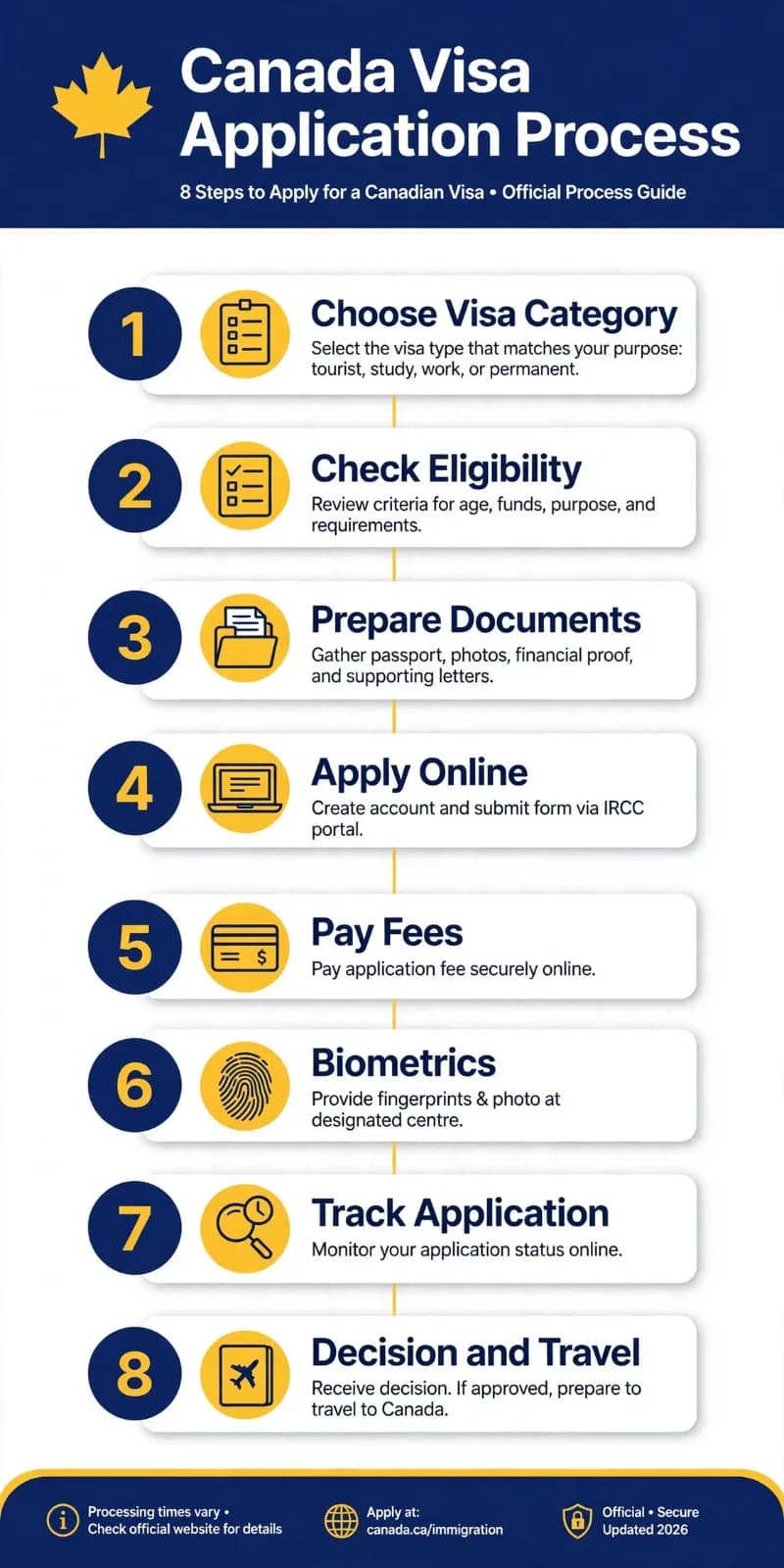
How to Apply
Step 1: Select the correct immigration category
Identify whether your intention is tourism, business, education, employment, family reunification or permanent settlement.
Step 2: Confirm your eligibility
Review the requirements for your passport nationality and current country of residence. Applicants residing outside their home country should check whether additional local instructions apply.
Step 3: Prepare programme-specific documents
Obtain admission letters, employment documents, sponsor records and financial evidence before completing the application.
Step 4: Access the official application portal
Depending on the programme, you may need the IRCC secure account, IRCC Portal, Permanent Residence Portal or another designated platform.
Step 5: Complete the required application information
Common form references include:
| Form | Purpose |
|---|---|
| IMM 5257 | Temporary resident visa |
| IMM 1294 | Study permit application from outside Canada |
| IMM 1295 | Work permit application from outside Canada |
Online application systems may collect this information directly. Follow the specific instructions in your selected portal.
Step 6: Upload documents and pay the required fees
Check that your documents are clear, complete and consistent.
Pay through the official application system or another authorized government payment method.
Step 7: Submit your application
Complete the required declarations and save your submission confirmation.
Express Entry and certain other immigration programmes require an invitation before the full permanent residence application can be submitted.
Step 8: Complete biometrics or an interview
If biometrics are required, IRCC will issue instructions explaining how to provide them.
Book an appointment at an authorized Visa Application Centre and attend within the deadline (normally 30 days from the date of your Biometric Instruction Letter).
An interview or medical examination may also be requested.
Step 9: Track your application
Monitor your IRCC account, email and any applicable application status tracker.
Respond promptly to further document requests.
Step 10: Receive your decision and prepare to travel
If approved, visa-required travellers may receive instructions to submit their passport for visa issuance.
Study and work permit applicants approved outside Canada generally receive a port-of-entry introduction letter.
Carry your passport, relevant authorization and supporting documents when travelling. Final admission remains subject to border examination.
Visa Fees and Financial Requirements
Government application fees
| Application or service | Fee (CAD) |
|---|---|
| Visitor visa | $100 |
| Electronic Travel Authorization | $7 |
| Study permit | $150 |
| Employer-specific work permit | $155 |
| Open work permit holder additional fee | $100 |
| Biometrics, individual | $85 |
| Biometrics, eligible family maximum | $170 |
| Visitor status extension | $100 |
| Temporary Resident Permit | $246.25 (rises to $250.50 from 1 Dec 2026) |
| Family sponsorship — sponsor a spouse, partner, parent or grandparent (incl. sponsorship, processing and right of permanent residence fees) | $1,260 |
| Economic permanent residence, principal applicant | $1,590 |
| Economic permanent residence, accompanying spouse | $1,590 |
| Economic permanent residence, dependent child | $270 |
| Transit visa | $0 |
A Temporary Resident Permit is an exceptional authorization and should not be confused with an ordinary visitor visa.
Additional costs may include document translations, medical examinations, police certificates, language testing, educational assessments, insurance and VAC services.
Student financial requirements
For applications submitted on or after September 1, 2026, IRCC publishes the following annual living-expense requirements outside Quebec:
| Family members including applicant | Required funds (CAD) |
|---|---|
| 1 | $23,448 |
| 2 | $29,192 |
| 3 | $35,888 |
| 4 | $43,572 |
| 5 | $49,419 |
| 6 | $55,736 |
| 7 | $62,054 |
| Each additional member | $6,318 |
Tuition and transportation costs must be accounted for separately. Quebec applies its own financial requirements.
For example, an individual student with CAD $18,000 in first-year tuition and estimated transportation expenses of CAD $1,500 would need to account for a total of CAD $42,948.
Acceptable financial evidence may include bank records, qualifying education loans, scholarship letters and documented financial sponsorship.
IRCC's current guidance includes six months of bank statements as one possible form of evidence, together with evidence explaining the source of funds.
Visitor financial requirements
Canada does not publish a universal minimum bank balance that guarantees visitor visa approval.
The required resources depend on the length of the trip, accommodation arrangements, travel expenses and personal circumstances.
Express Entry financial requirements
Certain Federal Skilled Worker and Federal Skilled Trades applicants must demonstrate settlement funds.
The Canadian Experience Class and certain applicants with authorized Canadian employment and valid job offers may qualify for an exemption.
Applicants should use the current IRCC settlement funds table, which is periodically updated. The table IRCC had posted as of November 2026 (dated 7 July 2025) requires:
| Family members | Minimum settlement funds (CAD) |
|---|---|
| 1 | $15,263 |
| 2 | $19,001 |
| 3 | $23,360 |
| 4 | $28,362 |
| 5 | $32,168 |
| 6 | $36,280 |
| 7 | $40,392 |
| Each additional family member | $4,112 |
Confirm the live table on the IRCC website before you apply, as the amounts are updated annually.
Processing Times
Canadian visa processing times depend on the immigration category, country of application, application completeness, verification requirements and current application volumes.
| Category | Processing time guidance |
|---|---|
| Visitor visa | Check current IRCC country-specific estimate |
| Study permit | Check current IRCC country-specific estimate |
| Eligible doctoral study permit | Check current IRCC country-specific estimate |
| Work permit | Varies by country and programme |
| Express Entry | Varies by programme |
| Family sponsorship | Varies by sponsorship category |
| Super Visa | Check current official estimate |
| Start-Up Visa | Paused for new applications |
Processing estimates are not guarantees. Biometrics, additional checks and incomplete documents can affect timelines.
Applying from Pakistan or Vietnam
Pakistani passport holders applying from Pakistan
Pakistani citizens generally require a Temporary Resident Visa to travel to Canada.
Applications can normally be submitted online through the relevant IRCC portal.
Authorized Visa Application Centres in Pakistan include centres in Islamabad, Karachi and Lahore, according to IRCC's directory. Applications from Pakistan are decided by the Canadian visa office in Islamabad.
Applicants should provide documents reflecting their personal, educational, professional and financial circumstances.
Pakistani passport holders legally residing in Vietnam
Pakistani citizens living or working in Vietnam may be able to apply online while residing there.
IRCC also states that applicants legally admitted to a country other than their country of citizenship may use the nearest VAC for applicable paper visitor visa procedures.
This does not mean all immigration categories have identical residence requirements.
Applicants should accurately declare their Pakistani nationality and Vietnamese residence.
Useful documents may include:
Pakistani passport.
Valid Vietnamese visa or Temporary Residence Card (TRC).
Vietnamese work permit or exemption evidence, if applicable.
Employment contract in Vietnam.
Recent salary and bank records.
Evidence of local accommodation.
Explanation of the applicant's current residence and travel purpose.
Evidence of continued employment or other commitments in Vietnam.
A Vietnamese residence card does not turn a Pakistani citizen into a Vietnamese passport holder for Canadian visa purposes.
Pakistan versus Vietnam application comparison
| Requirement | Applying from Pakistan | Pakistani citizen applying from Vietnam |
|---|---|---|
| Passport nationality | Pakistani | Pakistani |
| Canadian visa requirement | Generally required | Generally required |
| Residence evidence | Pakistan residence information | Evidence of lawful Vietnamese status |
| Employment evidence | Pakistani employment records, if relevant | Vietnamese employment records, if relevant |
| Financial evidence | Applicable financial records | Vietnamese or overseas financial records |
| Biometrics | Authorized VAC | Authorized VAC serving the applicant |
| Decision-making authority | IRCC | IRCC |
| Approval guarantee | None | None |
For applicants in Vietnam, consult the current official VAC directory for Hanoi and Ho Chi Minh City service availability and appointment procedures before visiting. Applications from Vietnam are decided by the Canadian visa office in Ho Chi Minh City.
Canadian diplomatic missions do not automatically serve as walk-in visa application offices. VAC personnel collect biometrics and transmit authorized documents; they do not decide immigration applications.
Canada Student Visa Guide
International students should begin by selecting a Designated Learning Institution and confirming the immigration conditions associated with their programme.
Obtain an acceptance letter
You must normally receive an official Letter of Acceptance (LOA) from a Canadian DLI before applying for a study permit.
Check the PAL/TAL requirement
Many study permit applicants require a Provincial or Territorial Attestation Letter.
From January 1, 2026, students entering degree-granting master's and doctoral programmes at public DLIs qualify for an exemption.
Other exemptions also exist. Students planning to study in Quebec must separately review provincial requirements.
English and French language requirements
Canadian universities and colleges establish their own admission language standards.
There is no single universal IELTS score that applies to all Canadian study permit applicants.
Students must distinguish institutional admission requirements from immigration requirements for later programmes, such as the Post-Graduation Work Permit.
Health insurance
Health coverage for international students varies by province and institution.
Some students may qualify for provincial coverage, while others must arrange insurance through their institution or a private insurer.
Confirm coverage before travelling.
Part-time work rules
Eligible international students can work off campus for up to 24 hours per week during regular academic sessions.
Eligible students may work additional hours during scheduled academic breaks when the relevant conditions are met.
Students enrolled solely in English or French as a second language generally do not qualify for ordinary off-campus student work authorization.
Do not rely on future part-time employment to satisfy the initial study permit financial requirements.
Post-Graduation Work Permit
A Post-Graduation Work Permit (PGWP) may allow eligible graduates to work in Canada following completion of their studies.
Not every institution or programme qualifies.
Applicants should investigate programme eligibility, language requirements, applicable fields of study and permit duration before paying tuition.
Work Permits and Job Opportunities
Foreign professionals should determine whether their occupation and employer arrangement qualify for Canadian employment authorization.
Industries commonly researched by international applicants include information technology, healthcare, engineering, construction, manufacturing and skilled trades.
Employment demand does not automatically create work permit eligibility.
For regulated occupations, applicants may need recognition of qualifications and provincial professional licensing.
Use Canada's official Job Bank to research vacancies and labour market information.
Avoid employers or intermediaries promising guaranteed visas in exchange for substantial recruitment payments.
Family Immigration and Permanent Residence
Canada offers multiple permanent residence pathways for eligible applicants.
These include:
Express Entry.
Provincial Nominee Program (PNP).
Atlantic Immigration Program.
Rural and Francophone community pathways.
Quebec-selected immigration programmes.
Family sponsorship.
Programme criteria and application intake can change.
Permanent residents ordinarily have the right to live, study and work in Canada, subject to applicable law.
To maintain permanent resident status, individuals generally must satisfy a residency obligation of 730 days within a five-year period, with certain exceptions.
Permanent residence and Canadian citizenship are separate statuses.
Common Mistakes and Refusals
Common application mistakes
Avoid the following:
Selecting the wrong immigration category.
Submitting incomplete or inconsistent documents.
Providing unexplained large bank deposits.
Using outdated financial requirements.
Ignoring nationality-based restrictions.
Failing to disclose previous visa refusals.
Assuming a visitor visa permits employment.
Choosing a study programme without checking PGWP eligibility.
Missing biometrics deadlines.
Submitting false employment or educational records.
Assuming that living in Vietnam changes Pakistani passport requirements.
Reasons for visa refusal
Canadian immigration applications may be refused for reasons including insufficient financial evidence, an unclear travel purpose, failure to demonstrate programme eligibility, inadmissibility and inconsistent information.
Temporary resident applicants may also be refused when the officer is not satisfied that they will comply with their authorized stay.
Misrepresentation can result in serious immigration consequences, including a potential five-year inadmissibility period.
If refused, read the decision carefully and identify the specific concerns before deciding whether to submit another application or seek professional legal guidance.
Frequently Asked Questions
How much is a Canada tourist visa in 2026?
The government application fee is CAD $100. Individual biometrics generally cost an additional CAD $85 when required.
Can Pakistani citizens apply for a Canada visa from Vietnam?
They may apply online while legally residing in Vietnam, subject to the specific immigration category and its application requirements.
Does a Vietnamese residence card allow visa-free travel to Canada?
No. Canadian visa requirements generally depend on passport nationality and applicable exemptions.
How much money does a single international student need?
For applications from September 1, 2026, a single student outside Quebec needs CAD $23,448 for annual living expenses, plus tuition and transportation.
Can I work in Canada with a tourist visa?
A visitor visa does not normally authorize employment in Canada.
How many hours can international students work?
Eligible students can work off campus for up to 24 hours weekly during regular academic sessions.
Does Canada offer a job seeker visa?
There is no general standalone job seeker visa granting unrestricted employment authorization.
Does Canada have a digital nomad visa?
No standalone digital nomad visa exists. Certain overseas remote workers may qualify for temporary visitor arrangements.
Is IELTS mandatory for every Canadian visa?
No. Language testing requirements depend on the immigration programme and educational institution.
Is the Start-Up Visa Program open?
No. The federal programme was paused on June 30, 2026.
Can a visitor visa guarantee six months in Canada?
No. The border officer determines the authorized period of stay.
Is Express Entry a work visa?
No. Express Entry manages applications for selected permanent residence programmes.
Can studying in Canada guarantee permanent residence?
No. Graduates must independently qualify for an available permanent residence programme.
Can I apply again after a visa refusal?
In many cases, yes. However, applicants should address the refusal reasons and provide relevant evidence rather than simply resubmitting the same application.
Can a visa agency guarantee approval?
No. Canadian immigration decisions are made by the relevant government authorities.
Official Immigration Websites
| Resource | Purpose |
|---|---|
| IRCC application fees — fee list | Official government fees |
| IRCC fee changes — including 1 Dec 2026 rises | Fee updates |
| IRCC secure account — register | Create an IRCC account |
| IRCC sign in to your account | Visitor visa, eTA, Super Visa accounts |
| Study permit — proof of financial support | Student funds requirements |
| International Experience Canada | IEC programme and fees |
| Start-Up Visa and Self-Employed intake pause | Business programme status |
| Find a visa application centre | VAC locations and services |
| Visa offices outside Canada | Which office decides your application |
| EduCanada | Official study-in-Canada information |
| Canada Job Bank | Official job listings and labour market information |
| Canada Border Services Agency | Border entry and customs information |
All links checked live on 27 November 2026.
Final Checklist and Conclusion
Before submitting a Canadian immigration application, confirm that you have:
Selected the correct immigration category.
Checked your nationality and residence requirements.
Prepared the official application checklist.
Verified current government fees.
Provided credible financial evidence.
Completed accurate application declarations.
Checked passport validity.
Prepared for biometrics and medical examinations, where applicable.
Reviewed current processing estimates.
Saved your application confirmation.
Canada offers significant educational, professional and family opportunities for eligible international applicants. A carefully prepared application based on current official requirements is essential.
Disclaimer: MAS Inspire provides educational information and is not a Canadian government authority. This article does not constitute individualized immigration or legal advice. Fees, immigration programmes and regulations may change. Applicants should verify the latest requirements directly with IRCC or consult an authorized Canadian immigration professional.


