


By MAS Inspire | Last reviewed: 27 November 2026 (key figures re-verified 27 November 2026; electronic-VITEM note added)
Brazil attracts visitors with its beaches, rainforests, cultural festivals and major cities. It also offers routes for international students, researchers, employees, investors, remote professionals and families joining relatives. The right immigration route depends on what you intend to do in Brazil, how long you will stay and which passport you hold.
This guide explains the main Brazilian visa and residence pathways, the documents applicants may need, the application process and special considerations for Pakistani citizens who live or work legally in Vietnam. It is an educational guide, not a decision on an individual case.
Why People Visit, Study, and Work in Brazil
Brazil is the largest country in South America and has diverse regional economies, universities, research institutions, natural environments and cultural attractions. International visitors commonly travel for tourism, family visits, conferences and business meetings. Longer-term applicants may come for a university course, a research project, a Brazilian job, a family relationship, an investment or remote work for a foreign employer.
The purpose matters. A tourist or business visitor cannot simply take a local job. A student's permission is linked to the study route and its conditions. A remote worker must fit the digital-nomad rules rather than use that label as a substitute for a Brazilian employment visa.

Types of Brazil Visas
Brazil's framework uses the terms VIVIS (visitor visa) and VITEM (temporary visa), alongside residence authorization. The list below describes the principal routes; not every route is a stand-alone visa with a universal checklist.
| Category | Main purpose | Main route / notes |
|---|---|---|
| Tourist / visitor | Tourism, family visits, short unpaid activities | VIVIS if required by nationality; up to 90 days per visit under the general rule |
| Business visitor | Meetings, trade fairs, contract discussions, short business visits | Usually VIVIS; no ordinary paid employment in Brazil |
| Student | Regular course, exchange or study programme | VITEM IV or in-country study residence authorization |
| Work / employer-sponsored | Employment, technical work or qualifying service | Work-based residence authorization, commonly initiated by sponsor through MigranteWeb, then consular visa |
| Job seeker | Looking for work | No general-purpose open job-seeker visa identified in the official categories reviewed; secure a qualifying basis before working |
| Skilled worker | Professional employment or specialist role | Work-based route; sponsor and category-specific evidence normally required |
| Digital nomad | Remote work for a foreign employer | Temporary visa or residence authorization under RN 45/2021; not for Brazilian employment |
| Investor / entrepreneur | Productive investment or qualifying business activity | Investment-based residence under applicable rules; amounts and business plan depend on the current legal category |
| Family reunion | Join qualifying Brazilian or foreign resident family member | VITEM XI abroad or residence authorization in Brazil, depending on location and circumstances |
| Permanent residence | Long-term residence under a legal basis | Usually an authorization/status under a qualifying route, not a generic direct application for everyone |
| Transit | Airside international connection or stopover | Airside transit on a single through-ticket may not require a visa; if entry through immigration is needed, VIVIS may be required |
| Exchange / internship | Academic exchange or supervised internship | Often VITEM IV for longer stays; short activity may fall under VIVIS depending on nationality and conditions |
| Research / academic | Research, teaching or academic extension | VITEM I or visitor route for short, non-employment activity, depending on duration and relationship with host |
| Humanitarian / refugee | Protection where legal criteria are met | Humanitarian temporary routes and asylum/refugee procedures are distinct from ordinary visitor visas |
Visitor visa (VIVIS): tourism, family visits and business
The visitor visa is intended for short stays, generally not exceeding 90 days, for purposes such as tourism, business, transit, artistic or sporting activities, conferences and certain unpaid academic or voluntary activities. Visa exemption depends on nationality and the applicable bilateral or unilateral rules. Check the current official nationality table before applying. The separate electronic visitor visa (e-Visa, USD 80.90 via brazil.vfsevisa.com) applies only to US, Canadian and Australian citizens, in force since 10 April 2025; Pakistani applicants use the consular VIVIS route.
A VIVIS holder cannot undertake ordinary paid employment in Brazil. Business meetings, attending a fair or negotiating a contract are not the same as being employed by a Brazilian company. If the proposed activity includes technical assistance or salaried work, ask the consulate whether a temporary work route is required.
Brazilian authorities generally distinguish the visa's period of validity (the period in which it can be used to seek entry) from the permitted stay. The Federal Police states that visitor visas are generally valid for one year, with longer validity possible in reciprocity cases. The actual permitted stay is governed separately and is usually up to 90 days, subject to the applicable rules and any lawful extension.
Student visa (VITEM IV)
VITEM IV is used for qualifying study, exchange and internship purposes. Applicants should have an admission or acceptance document from a Brazilian educational institution, school or host organization. Consular guidance may specify course-load rules; one official consular page, for example, describes a 15-hour weekly minimum for regular courses, with exceptions considered in defined circumstances. Confirm the rule with the post handling the application and the institution's programme classification.
Student visa holders may be permitted to undertake paid work where the working hours are compatible with the course load, subject to the applicable rules and Federal Police guidance. A student should not assume that the visa allows unrestricted full-time employment or a change to any employer or institution.
For study lasting up to 90 days, a visitor visa may be the appropriate category if the nationality requires one. Longer study generally requires the temporary student route. Research leading to a postdoctoral appointment may be treated as researcher activity rather than ordinary student activity.
Work visa and employer-sponsored residence
Foreign nationals coming to Brazil under an employment contract or to perform qualifying technical assistance/emergency work generally need a temporary work visa (VITEM V) and prior authorization. The sponsoring Brazilian company normally initiates the residence-authorization process with the Ministry of Justice and Public Security through MigranteWeb 2.0. The authority reviews the sponsor's and applicant's documents. After approval, the applicant follows the consular visa instructions.
A job offer is not itself a visa, and a visitor visa is not a work permit. Applicants should receive a clear written description of the role, employer, location, salary or service arrangement, duration and legal basis. On arrival, temporary visa holders must complete the required registration with the Federal Police within the applicable period, commonly 90 days for the relevant temporary-visa registration process.
Digital nomad visa / residence authorization
Brazil's digital-nomad framework is established by Normative Resolution No. 45 of 9 September 2021. It applies to a foreign national who can perform professional activities remotely using information and communication technology for an employer outside Brazil, without an employment relationship in Brazil. It is not a route for taking a job with a Brazilian employer.
The application is made through a Brazilian consular post abroad or, where eligible, through the in-country residence-authorization procedure. The applicant should prepare proof of remote work and the foreign employer/client relationship, evidence of income or financial capacity as specified in the current rule, health insurance and the standard identity and criminal-record documents required by the competent post. Under RN 45/2021 the financial threshold is foreign-source income of at least USD 1,500 per month, or available bank funds of at least USD 18,000 (Muse enhancement, verified 25 Nov 2026 against the resolution as reported by the IBA and multiple 2026 guides). Confirm the evidence format in the current consular checklist. The visa is normally granted for one year and renewable for an equal period.
Investor and entrepreneur routes
Brazil provides residence pathways for qualifying investment and certain business activities. The legal basis and evidence depend on the type of investment, the business structure, the source and transfer of funds, the business plan and the expected economic or other contribution. The Ministry of Justice's labour immigration portal directs applicants to the appropriate route and MigranteWeb procedure.
The published thresholds are: at least R$500,000 of the applicant's own funds invested in a Brazilian company under RN 13/2017 (R$150,000 for qualifying innovation or scientific/technological research projects), or at least R$1,000,000 in urban real estate under RN 36/2018 (R$700,000 in the North and Northeast) (Muse enhancement, verified 25 Nov 2026). Before transferring capital, obtain the current applicable resolution and confirm the required minimum, eligible investment type, documentation and whether the investment must be made by the applicant personally or through a qualifying entity.
Family reunion (VITEM XI / residence authorization)
Family reunion can be available to qualifying spouses or partners, children, parents and other relatives within the categories defined by Brazilian rules. The sponsor may be a Brazilian citizen or a foreign national with qualifying residence status. The family member abroad may apply for a temporary family-reunion visa through a Brazilian embassy or consulate. A person already in Brazil may apply for residence authorization at a Federal Police unit, if eligible.
Evidence normally includes the applicant's passport, completed form, proof of family relationship, the sponsor's Brazilian identity or CRNM and proof of the sponsor's residence in Brazil. Criminal-record certificates and other supporting documents may be required. Documents issued abroad may need apostille/legalization and Portuguese translation according to the receiving authority's instructions.
Permanent residence and settlement
Brazil does not offer one universal permanent-residence visa for every foreign applicant. Permanent or indefinite residence may follow from specified legal bases, including family, certain investment or work situations, treaty-based residence, refugee recognition and other statutory categories. Some routes initially grant temporary residence and allow renewal or conversion if the conditions remain satisfied.
After a residence authorization is approved, the foreign national generally registers with the Federal Police and receives a Registro Nacional Migratório (RNM) number and Carteira de Registro Nacional Migratório (CRNM). The CRNM is an identity/residence document, not a substitute for a visa required to enter Brazil from abroad.
Transit, exchange, internship and research
Brazil no longer uses a separate general transit-visa category in the way some countries do. Official consular guidance says an international passenger who remains in the designated airport transit area and holds a combined through-ticket to a third country may not need a Brazilian visa. If tickets are separate, the traveller needs to clear immigration, or the traveller intends to leave the international transit area, a visitor visa may be required depending on nationality.
Short research or academic activities without an employment relationship may fit VIVIS. Activities exceeding 90 days, or those performed under an employment agreement, may require VITEM I or another temporary-residence category. Internships are generally linked to an educational institution and may be covered by VITEM IV for longer stays. Paid internship work is subject to the specific rules and course compatibility requirements.
Humanitarian protection and refugee status
Refugee recognition is a protection process, not an ordinary migration or employment visa. A person may seek recognition in Brazil if they have a well-founded fear of persecution for a protected reason or have left because of a serious and widespread human-rights violation, as defined by Brazilian law. Applications are registered through Sisconare and examined by CONARE. Humanitarian reception and statelessness protection are separate legal categories. People facing risk should seek qualified legal or protection advice; do not use an asylum claim as a shortcut for a routine visa problem.
Visa Comparison Table
| Route | Work rights | Sponsor / host | Stay or validity | Fee information |
|---|---|---|---|---|
| VIVIS tourism | No ordinary paid work | Not normally; invitation may support business/family visit | Stay generally up to 90 days; visa validity separate | Consular fee varies by nationality and post |
| VIVIS business | No salaried or technical employment | Brazilian invitation often relevant | Usually up to 90 days | Check consular post |
| VITEM IV study | Limited/conditional work may be allowed if compatible with studies | Brazilian school/university | Often issued for up to one year; residence period confirmed at registration | Consular fee varies; domestic registration charges may apply |
| VITEM V work | Work for approved role/employer | Normally required | Depends on authorization and registration | Consular fee plus any domestic charges |
| Digital nomad | Remote work for foreign employer; not Brazilian employment | Foreign employer/client evidence | Temporary route; check current authorization period | Consular fee varies; domestic registration charges may apply |
| Family reunion | Residence rights according to authorization; work may be allowed under status | Qualifying family sponsor | Depends on legal basis | Domestic fees may apply; consular fee varies |
| Investor | As authorized under the investment route | Applicant/business/investment | Depends on resolution and approval | R$500,000 company (R$150,000 innovation); R$1m real estate (R$700k North/Northeast) — check current resolution |
| Refugee | Work rights may be available under Brazilian law after documentation | No ordinary employer sponsor | Protection process | No ordinary visa fee for asylum request indicated in the service description |
Eligibility Requirements
Before selecting a category, check all of the following:
- Nationality: Does your passport require VIVIS? Are there nationality-specific additional checks or prior authorization?
- Residence: Which consular post has jurisdiction over your current lawful residence? Does it accept non-citizen residents?
- Purpose: Do your planned activities match the category? Tourism, business meetings, employment, research and remote work are legally different.
- Duration: Is the activity under or over 90 days? Does it require a temporary visa and subsequent residence registration?
- Sponsor: Is a Brazilian employer, university, family member or investment entity required?
- Documents: Can you provide authentic civil, financial, academic, employment and criminal-record evidence in the required form?
- Financial capacity: Provide evidence appropriate to the category and your trip. Do not assume there is one minimum balance for every applicant.

Complete Document Checklists
The exact list is set by the consular post and visa category. The tables below separate common core documents from conditional evidence.
Common visitor-visa documents
| Commonly required / core | Conditional or supporting |
|---|---|
| Valid passport or travel document | Previous passports and visas |
| Online visa application form and receipt (RER), completed as instructed | Cover letter explaining itinerary and purpose |
| Recent passport photograph meeting local specifications | Return/onward itinerary or airline booking |
| Proof of consular fee payment | Hotel booking or host address/contact details |
| Documents supporting purpose of visit | Invitation from Brazilian company, event or family member |
| Evidence requested by the consulate | Bank statements, payslips or employer letter |
Student / exchange / internship documents
| Core / category-specific | Conditional or supporting |
|---|---|
| Passport, form/RER and photo | Proof of legal residence in country of application |
| Admission or acceptance letter from Brazilian institution | Scholarship award or funding confirmation |
| Evidence of course, research or internship dates | Academic transcripts and qualifications |
| Financial support evidence where requested | Accommodation and travel arrangements |
| Police certificate / civil documents where required | Parental consent for minors |
Work / digital-nomad / investor documents
| Core / category-specific | Conditional or supporting |
|---|---|
| Passport, form/RER and photo | CV, qualifications, professional registration |
| Prior residence authorization where the category requires it | Employment contract or detailed service agreement |
| Employer / host / business documentation | Company registration, business plan or investment proof |
| Remote-work evidence for digital nomad | Foreign employer confirmation, client contracts and income evidence |
| Criminal-record / civil documents as required | Health insurance, accommodation and dependants' documents |
Family-reunion documents
| Core / category-specific | Conditional or supporting |
|---|---|
| Applicant passport, form/RER and photograph | Birth or marriage certificate, partnership evidence |
| Sponsor's Brazilian ID or valid CRNM | Sponsor's proof of residence in Brazil |
| Evidence of qualifying family relationship | Proof of dependency where required for adult relatives |
| Criminal-record documents where required | Sponsor's declaration and additional civil records |
Document handling: Foreign civil records may need apostille or legalization and translation into Portuguese by a sworn translator in Brazil, depending on the document, country and procedure. Do not translate, notarize or apostille documents until you have checked the consulate's current instructions. Never submit altered documents or false declarations.
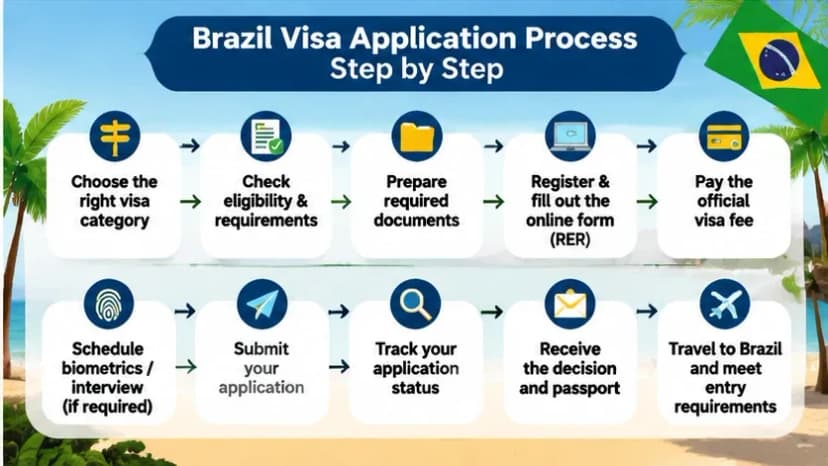
How to Apply: Step-by-Step
Note (1 September 2026): Since 1 September 2026, Brazil issues temporary visas (VITEM) electronically — the approved visa is emailed as a PDF with a QR code and no passport sticker is affixed — to nationals of countries that are exempt from the visitor visa (VIVIS). This does not apply to nationals who need a VIVIS, including Pakistani passport holders, who still follow the consular process described below. Confirm the current procedure with the consular post handling your case.
- Choose the correct category. Identify the actual purpose: visit, study, employment, remote work, investment, family reunion or protection.
- Check nationality and residence rules. Use the official nationality table and ask the consular post responsible for your lawful residence whether it accepts your application.
- Prepare the documents. Use the current checklist for that post and category. Keep originals, clear scans and certified translations where required.
- Open the official application system. Complete the Brazilian Ministry of Foreign Affairs' online visa application form through the Consular Integrated System, where applicable. Some posts use e-Consular for pre-screening and appointments.
- Complete the correct form accurately. Ensure names, passport data, parents' names, travel dates and purpose match the supporting evidence.
- Upload or submit documents and pay the fee. Follow the consulate's payment method. Consular fees are not necessarily the same as Federal Police residence-registration fees.
- Attend biometrics or interview if requested. Not every category or post uses the same process. Bring original documents when instructed.
- Submit the application. Use the appointment, courier or electronic procedure specified by the responsible post. Do not send a passport unless the post instructs you to.
- Track the application. Use the consulate's tracking instructions or contact channel. A published processing estimate is not a guarantee.
- After the decision, check travel and registration obligations. Review the visa details, entry deadline, permitted stay and any Federal Police registration deadline. A visa does not guarantee admission at the border.
Visa Fees and Financial Requirements
There are two different fee groups:
- Consular visa emoluments: Charged by the Brazilian embassy or consulate. The amount and payment currency depend on nationality, reciprocity, visa category and the consular jurisdiction. The Embassy of Brazil in Hanoi publishes its local fee schedule and payment instructions. Confirm the applicable visa line directly with the Consular Section.
- Residence and CRNM fees in Brazil: The Ministry of Justice's published residence information lists R$168.13 for processing/evaluation of residence-authorization requests (GRU code 140066) and R$204.77 for issuing the CRNM (GRU code 140120), where applicable. These charges are not the visitor-visa fee and may not apply to every case.
No universal minimum bank balance applies to all applicants. Financial evidence should demonstrate that the applicant can fund the intended stay, in the format and period required by the consulate. A specific consular checklist may set an indicative daily amount or request recent bank statements. Follow the post handling your case rather than importing a financial figure from another consulate's website.
Visa Processing Times
Brazil's government service pages do not provide one universal processing time for every visa category and consular post. Processing depends on the post's workload, document completeness, security or prior-authorization checks, interview availability and the legal route. Pakistani applicants may face additional prior authorization for a visitor visa, which can extend the processing time.
Apply well before travel and do not buy non-refundable tickets on the assumption that a visa will be issued by a particular date. If the consulate publishes a processing estimate, treat it as an estimate only.
Applying from Pakistan or Vietnam: Pakistani Passport Holders
Pakistani passport holders should pay particular attention to nationality-specific requirements. A Brazilian consular guidance page lists Pakistan among nationalities requiring additional documents for VIVIS and indicates that prior authorization from Brazil's Ministry of Foreign Affairs may be necessary. The additional documents listed include:
- Original birth certificate showing the applicant's full parents' names, translated into English or Portuguese with the required translator certification;
- Proof of employment showing occupation and employer name/address;
- Return flight confirmation with entry and exit dates;
- Hotel/lodging reservation or full details of contacts in Brazil;
- Bank statements for the last three months.
The consular authority may request further documents. These additional requirements do not replace the general VIVIS checklist.
If you live or work legally in Vietnam
A Vietnamese residence card or work permit is useful evidence of lawful residence, but it does not automatically establish that the Brazilian Embassy in Hanoi must accept your application. Before preparing the final submission:
- Contact the Embassy of Brazil in Hanoi at the official consular contact channel published on its website. Ask whether it accepts VIVIS and VITEM applications from Pakistani citizens who hold valid Vietnamese residence/work status.
- Ask whether it requires a minimum remaining validity period on the Vietnamese residence card, proof of address, local employment evidence or a local bank statement.
- Ask whether Pakistan-specific prior authorization applies to your case and whether the additional birth certificate, employment, flight, lodging and bank evidence must be originals or certified copies.
- Request the current visa fee, payment instructions, appointment route, document legalization/translation rules and estimated processing range in writing.
- If Hanoi declines jurisdiction, contact the Embassy of Brazil in Islamabad and ask whether it will accept a Pakistani citizen's application while the applicant is temporarily resident in Vietnam, or whether filing in Pakistan is required.
Applying from Pakistan versus Vietnam
| Issue | Applying in Pakistan | Applying in Vietnam |
|---|---|---|
| Consular jurisdiction | Brazilian Embassy in Islamabad, subject to its rules | Embassy in Hanoi, only if it accepts the applicant's residence status and category |
| Nationality screening | Pakistan-specific VIVIS checks apply where relevant | Pakistan-specific checks do not disappear because the applicant lives in Vietnam |
| Residence evidence | Pakistani address/identity and local evidence as requested | Valid Vietnamese residence card/work permit and proof of local address may be requested |
| Employment evidence | Pakistan employer documents if applicable | Vietnamese employer and work status evidence may be relevant |
| Fees | Islamabad's current fee schedule | Hanoi's current fee schedule; confirm visa-specific amount |
| Document legalization | Follow Islamabad's checklist | Follow Hanoi's checklist; do not assume Vietnamese-issued and Pakistani-issued documents follow identical rules |
Important: The public sources reviewed do not conclusively confirm a blanket right for Pakistani nationals resident in Vietnam to lodge every type of Brazilian visa application in Hanoi. Written confirmation from the Embassy is essential. Do not travel to another country solely to apply without confirming jurisdiction and appointment availability.
Work Visa and Job Opportunities
Applicants seeking Brazilian employment should first identify a genuine employer or qualifying activity. The employer or applicant, as applicable, must use the correct MigranteWeb procedure for prior residence authorization. The consulate issues the visa only after the necessary approval has been recorded. A visitor visa does not authorize ordinary paid work.
The Ministry of Justice's labour immigration portal covers work, research, investment, religious activity, volunteering and other qualifying routes. Applicants should check professional licensing, Portuguese-language expectations, credential recognition and regulated-profession requirements separately. Avoid recruiters who promise a guaranteed visa or request payment for a fictitious job offer.
Student Visa Guide
Obtain a formal acceptance from a recognized Brazilian educational institution and confirm the course classification and duration. The institution should specify whether the course is regular study, exchange, research or internship. Prepare the acceptance letter, proof of funds or scholarship, identity documents and any criminal-record or civil documents required by the consulate. Confirm whether the visa is VITEM IV or a short-term visitor route. After arrival, comply with Federal Police registration instructions and keep your enrolment active.
Family Immigration and Permanent Residence
Family reunion is available only where the relationship and sponsor meet the legal categories. Prepare civil records that prove the relationship, the sponsor's identity/residence evidence and any dependency evidence. The residence authorization may be requested in Brazil at the Federal Police if the applicant is already in the country and qualifies; an applicant abroad may seek the corresponding temporary family-reunion visa at a consular post.
Permanent or indefinite residence is possible under specified legal grounds, not simply because a person has visited Brazil repeatedly or rented a home. Keep residence registration current and obtain advice before changing category, leaving Brazil for an extended period or allowing a residence document to expire.
Common Application Mistakes
- Choosing VIVIS for a trip that actually involves employment or technical services.
- Assuming a visa-free nationality rule applies to every passport type or every purpose.
- Confusing visa validity with the authorized period of stay.
- Filing at a consulate without confirming it has jurisdiction over the applicant's lawful residence.
- Submitting untranslated, unlegalized or inconsistent civil documents.
- Using an old checklist or fee table from another Brazilian consulate.
- Treating an invitation letter as a substitute for a work authorization.
- Booking non-refundable travel before a decision.
- Omitting prior refusals or providing false financial, employment or family information.
Reasons for Visa Refusal or Delay
A consular authority may refuse or delay an application if the purpose is unclear, the selected category does not fit the activities, required documents are missing, evidence is inconsistent, financial support is not adequately demonstrated, the applicant does not meet nationality or jurisdiction rules, or additional security/administrative checks are pending. A refusal does not necessarily mean that every future application will fail. Read the decision and follow the official procedure for any permitted review or new application. Never conceal relevant facts or submit fabricated evidence.
Frequently Asked Questions
1. Do all nationalities need a visa for Brazil?
No. Brazil has visa exemptions for certain nationalities and purposes. Check the current official nationality table for the passport you will use.
2. How long can I stay in Brazil on a visitor visa?
The general visitor stay is up to 90 days, subject to the applicable rules. Any extension must be requested lawfully and is not automatic.
3. Can I work in Brazil on a tourist or business visa?
No ordinary paid employment is permitted under VIVIS. A qualifying work activity requires the correct temporary visa/residence route.
4. Can I apply for a Brazil visa online?
The online visa application form is part of the process, but the consular post may also require e-Consular pre-screening, an appointment, original documents or an interview.
5. Is there a digital nomad visa for Brazil?
Yes. Brazil has a digital-nomad route under Normative Resolution No. 45/2021 for remote work for a foreign employer, not employment by a Brazilian company.
6. Can international students work in Brazil?
Student visa holders may undertake paid work when it is compatible with their course load and the applicable rules. It is not unrestricted work permission.
7. Does a Brazilian employer need to sponsor a foreign worker?
For the ordinary employment-based route, prior residence authorization is generally required and the Brazilian sponsor initiates the MigranteWeb process.
8. Can I apply for a Brazilian visa from Vietnam if I am Pakistani?
Possibly, but lawful residence in Vietnam does not automatically guarantee that Hanoi will accept the application. Obtain written confirmation from the Embassy of Brazil in Hanoi.
9. What extra documents may Pakistani applicants need?
Published Brazilian consular guidance lists a full birth certificate, proof of employment, return flight details, lodging/contact information in Brazil and three months of bank statements for Pakistani VIVIS applicants. Prior authorization may also be required.
10. How much does a Brazil visa cost?
The consular fee depends on nationality, category and consular post. Domestic residence/CRNM fees are separate; the published charges include R$168.13 and R$204.77 for specified procedures where applicable.
11. Is there a separate transit visa?
Brazil uses the visitor-visa framework for transit requiring a visa. If you remain airside on a single through-ticket, a visa may not be required; leaving the transit area or using separate tickets can change the result.
12. Can I get permanent residence in Brazil?
Some legal categories lead to permanent or indefinite residence, but there is no universal direct permanent-residence route for all applicants. Eligibility depends on the legal basis.
13. How long does a Brazil visa take?
There is no single national processing time for all visa types and consulates. Prior authorization, security checks and incomplete documents can extend the process.
14. Does a Vietnamese residence card guarantee that I can apply in Hanoi?
No. It is evidence of lawful residence, but the Embassy must confirm whether it accepts the applicant's nationality and category under its consular jurisdiction rules.
15. Does a visa guarantee entry into Brazil?
No. A visa permits the holder to seek entry. Border authorities make the admission decision under Brazilian law.
Official Immigration Websites
- Brazil Ministry of Foreign Affairs — Consular Portal
- Visa application form — Consular Integrated System
- Embassy of Brazil in Hanoi
- Embassy of Brazil in Islamabad
- Ministry of Justice — Migration and residence authorization
- MigranteWeb 2.0
- Federal Police — Immigration services
- Sisconare / refugee services
Final Checklist and Conclusion
Before applying, confirm your nationality's visa requirement, choose the correct category, check consular jurisdiction, prepare authentic documents, confirm the fee and payment method, and obtain written guidance if any rule is unclear. If you are a Pakistani citizen living or working in Vietnam, ask Hanoi to confirm jurisdiction and Pakistan-specific additional screening before you submit or pay.
Brazil offers a range of lawful ways to visit, study, work, join family or establish residence. The safest application is one that accurately reflects the real purpose of travel and follows the current instructions of the competent Brazilian authority. No agent or website can guarantee approval.
Disclaimer: This article is general educational information, not legal advice or an official Brazilian government publication. Immigration rules, fees, forms and consular practices can change. Check official sources and seek qualified legal advice for complex or high-stakes cases.


