Bangladesh Visa Guide 2026: Types, Requirements, Fees and How to Apply
By MAS Inspire | Editorial draft: 27 November 2026 (fees re-verified 27 November 2026)
Table of contents
- Introduction
- Why people visit, study and work in Bangladesh
- Types of Bangladesh visas
- Visa comparison: purpose, stay and work rights
- Eligibility requirements
- Complete document checklists
- How to apply for a Bangladesh visa: step by step
- Visa fees and financial requirements
- Visa processing times
- Applying from Pakistan or Vietnam
- Student visa guide
- Work visa and job opportunities
- Family immigration and permanent residence
- Visa on Arrival: who may qualify?
- Common application mistakes
- Reasons a Bangladesh visa may be refused or delayed
- Frequently asked questions
- Official Bangladesh immigration websites
- Final checklist and conclusion
Introduction
Bangladesh welcomes visitors for tourism, business, study, employment, investment, family visits, research, medical treatment and other approved purposes. The correct route depends on the reason for travel, the applicant's nationality, the place of application and, for many long-stay or work-related cases, a sponsoring institution or competent government authority.
The most important update for applicants is the Bangladesh Visa Policy 2026, issued by the Ministry of Home Affairs in August 2026. It sets out 34 visa categories. This guide explains the main routes, the supporting evidence identified by the policy, the application process, and special considerations for Pakistani passport holders who legally live or work in Vietnam.
A visa is permission to seek entry under stated conditions; it is not a guarantee of admission at the border. Read the visa sticker carefully because its validity dates, number of entries and permitted stay may differ. Always check the official Bangladesh visa portal and the Bangladesh mission responsible for your place of residence.
Why people visit, study and work in Bangladesh
Bangladesh attracts visitors interested in Dhaka's history and architecture, the Sundarbans, river landscapes, cultural events and family connections. Business travellers may attend meetings, inspect products, negotiate contracts, recruit staff or assess investment opportunities. Universities and approved institutions host international students, interns and researchers. Employers, development partners, NGOs and project authorities may sponsor eligible foreign specialists and technical personnel.
The purpose of travel determines the visa class. A tourist visa does not authorize employment, even unpaid employment, and a business visitor visa is not a substitute for an employment visa or work permit.
Types of Bangladesh visas
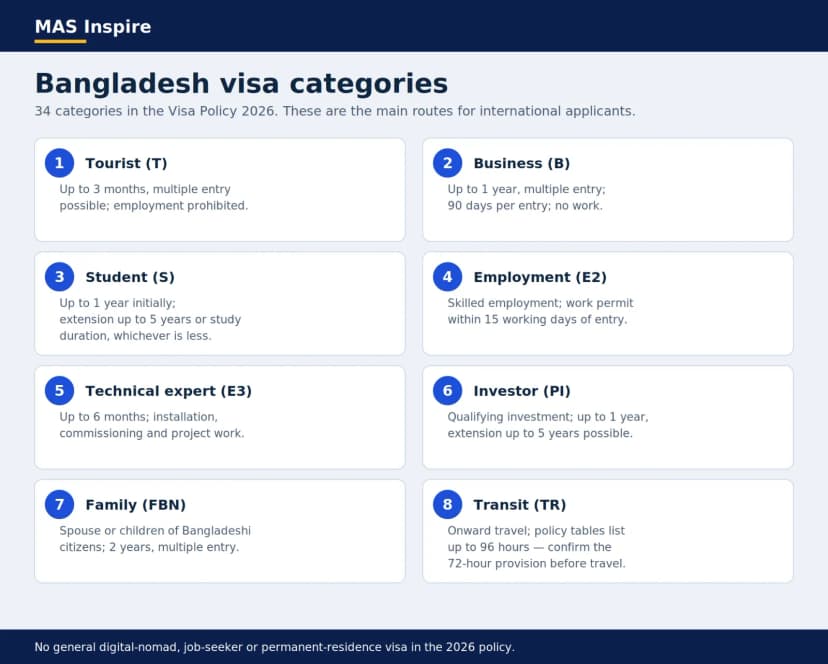
The 2026 policy identifies 34 categories. The following table summarizes the most relevant routes for international applicants; specialist diplomatic, crew, journalist, religious and dependent classes are also included below.
| Visa category | Main purpose | Key conditions in the 2026 policy |
|---|---|---|
| T — Tourist | Tourism, recreation, casual visits to friends/relatives, conferences, workshops, study tours and seminars | Up to 3 months; multiple entry may be granted; employment prohibited |
| B — Business | Business meetings, investment analysis, trade fairs, product checks and negotiations | Up to 1 year, multiple entry, 90 days' stay per entry; employment prohibited |
| S — Student | Academic study or qualifying academic internship | Initially up to 1 year, multiple entry; extension up to 5 years or study duration, whichever is less; employment prohibited |
| E2 — Employment | Skilled/expert employment in eligible public or private organizations | Initially up to 6 months, multiple entry; work permit required through competent authority |
| E3 — Technical expert | Installation, commissioning, maintenance, supervision, inspection and technical/project support | Up to 6 months, multiple entry, generally 90 days per stay; work-permission conditions apply |
| E1 — Development partner | Direct staff of a development partner involved in an eligible government-related project | Up to 6 months initially; extension may be available up to 5 years or full tenure, whichever is less |
| N1 — NGO | Employment with a registered NGO | Initially up to 3 months, multiple entry; extension linked to NGO Affairs Bureau work permit |
| PI — Private investor | Qualifying investment in an industrial/commercial establishment | Up to 1 year, multiple entry; extension may be available up to 5 years/work-permit validity |
| FBN — Family/Bangladeshi origin | Foreign spouse/children of Bangladeshi citizens and eligible people of Bangladeshi origin up to third generation | 2 years, multiple entry; extension may be available up to 3 years; employment prohibited |
| TR — Transit | Transit through Bangladesh to a third country or seafarer sign-on/sign-off | Up to 96 hours under the category entry in the policy |
| R — Researcher | Research, apprenticeship or training at an approved institution | Up to 1 year or program duration, whichever is less; employment prohibited |
| MT / MA — Medical | Treatment at registered medical facilities / accompanying patient | MT up to 3 months initially, possible extension up to 1 year; MA is coterminous with patient |
| J — Journalist | Short assignment, reporting, documentary work or specified media posting | Special approval and assignment documents; duration depends on assignment |
| M / RT — Religious | Missionary service or attendance at Tabligh/Ijtema and other approved religious purposes | Category-specific stay limits and approvals apply |
| A / A1 / A2 / D / ND | State, government, international-organization and diplomatic purposes | Official recommendation/Note Verbale; some classes are gratis |
| C — Crew | International airline, ship or transport crew | Up to 3 years multiple entry subject to per-entry stay restrictions |
| P — Performer | Contracted sports or cultural activity | Up to 30 days initially; extension depends on contract and policy |
Categories that are not general immigration routes
The 2026 policy does not list a general digital-nomad visa, job-seeker visa, points-tested skilled-worker migration program or general permanent-residence visa. A foreign professional normally needs a qualifying employer, project, institution or other sponsor and the correct visa/work-permission route. A student visa is not an unrestricted work route. Family and dependent visas generally prohibit employment unless the visa class expressly allows it.
Bangladesh does provide No Visa Required (NVR) facilities for specified people of Bangladeshi origin and qualifying family members, and the policy includes a specific investor-related provision. NVR is not a general permanent-residence permit. Its eligibility and evidence requirements are set out in the policy and should be checked with the mission.
Visa comparison: purpose, stay and work rights
| Applicant's purpose | Likely category | Employment permitted? | Sponsor/evidence commonly required |
|---|---|---|---|
| Holiday or family/friend visit | T | No | Accommodation address, return ticket; invitation/host evidence may be requested |
| Commercial meetings or trade fair | B | No | Bangladesh-registered business invitation, registration/trade licence and financial evidence |
| Degree or academic program | S | No under the policy | Admission/offer letter and financial solvency evidence |
| Skilled employment | E2 | Only within approved work authorization | Employer, ministry/authority recommendation and work permit |
| Technical project assignment | E3 | Only within approved scope/authorization | Project/technical assignment and competent-authority recommendation |
| NGO role | N1 | Only within approved NGO work permission | Appointment letter attested by NGO Affairs Bureau and work permit |
| Investment | PI | Not automatically; work in own company may require permit | Investment authority recommendation and proof of qualifying investment |
| Research/training | R | No | Approved institution, offer/program evidence and financial proof where applicable |
| Family member | Relevant dependent class or FBN | Generally no | Principal visa holder's documents and relationship records |
| Transit | TR | No | Confirmed onward ticket and third-country visa where applicable |
Visa validity and permitted stay are not interchangeable. For example, a multiple-entry business visa may be valid for up to a year while limiting each stay to 90 days. The visa label and current policy control.
Eligibility requirements
Applicants should establish all of the following before applying:
- Nationality: Visa fees and entry eligibility can differ by passport and reciprocity arrangement. Some nationalities may qualify for Visa on Arrival only in specified circumstances.
- Residence and jurisdiction: Apply through a Bangladesh mission that accepts applications from the country where you legally reside. A residence card in a third country does not automatically create a right to apply there.
- Purpose: The activity described in the form must match the visa category and supporting documents.
- Passport: The 2026 policy says visitors must hold a passport valid for at least six months. A mission may require sufficient blank pages.
- Sponsor/approval: Work, study, NGO, investor, research and other special categories require the relevant employer, institution, authority or organization evidence.
- Financial capacity: Where the policy or mission requests it, provide bank statements, a bank solvency certificate or a financial guarantee. The policy does not publish one universal minimum bank balance for all applicants.
- Security or police checks: Some categories and individual cases may be referred for security clearance or police reporting.

Complete document checklists
The lists below separate core documents from category-specific evidence. The mission may request additional documents or an interview. Do not assume that every item is mandatory for every applicant.
General application documents
| Document | Status | Notes |
|---|---|---|
| Completed online MRV application form, printed and signed as instructed | Core | Complete at visa.gov.bd |
| Original passport | Core | At least 6 months' validity under the 2026 policy; submit for visa stamping as instructed |
| Passport biodata-page copy | Core | Include existing Bangladesh visas/entry stamps if relevant |
| Recent photograph | Core, mission specification applies | Hanoi currently specifies one 37 mm × 37 mm photograph taken within the last 6 months |
| Visa fee receipt | If fee applies | Pay only using the method confirmed by the mission |
| Travel itinerary, accommodation address and return/onward ticket | Purpose-dependent | Particularly relevant to visitor/tourist applications |
| Invitation or host documents | Purpose-dependent | Include host identity/contact details and business registration evidence where applicable |
| Residence permit/long-term visa for country of application | If applying as a third-country national | Particularly important for Pakistani applicants applying in Vietnam |
| Financial evidence | If requested/category requires | Bank statement, solvency certificate or financial guarantee; no universal minimum established |
| Marriage/birth/adoption documents | If applying as a dependent/family member | Use registered/legal documents; check translation and attestation rules |
Category-specific evidence
| Category | Core category evidence identified by policy or official mission guidance | Conditional/supporting evidence |
|---|---|---|
| Tourist T | Application, passport, Bangladesh accommodation address and return ticket | Detailed itinerary, hotel booking, host invitation and host's Bangladesh ID/passport copy |
| Business B | Invitation from a Bangladesh-registered business | Incorporation/trade licence, 3–6 months' applicant bank statements and employer letter from country of residence |
| Student S | Admission/offer letter from an institution | Bank solvency/financial guarantee; institutional attestation/recommendation as requested |
| Employment E2 | Employer/authority recommendation and relevant employment evidence | Work permit, contract, TIN and tax evidence for later extension |
| Technical E3 | Recommendation from ministry/BIDA/BEPZA/Hi-Tech Park/PPA or other competent authority | Technical assignment, project scope, work permit, tax and police/security records for extension |
| NGO N1 | Appointment letter attested by NGO Affairs Bureau | NGO work permit, organization recommendation, TIN/tax evidence and security clearance |
| Investor PI | Recommendation confirming bona fide investor status from BIDA/BEZA/BEPZA/Hi-Tech Park/Ministry/PPA | Investment certification, company registration and tax documents; work permit if working in own company |
| Research R | Offer/admission and institutional/authority recommendation | Bank solvency or proof of funds, except where policy exempts government-organization trainees |
| Family FBN/dependent | Principal's passport/visa and relationship evidence | Registered marriage certificate, birth certificate, adoption documents or affidavit/proof of Bangladeshi origin |
| Transit TR | Third-country visa (where required) and onward ticket | Seafarer's continuous discharge certificate for seamen/mariners |
| Medical MT/MA | Recommendation from registered Bangladesh physician/hospital/medical centre | Financial evidence, patient records and proof of relationship for attendant |

How to apply for a Bangladesh visa: step by step
The exact route depends on the category and mission. A typical application follows this sequence:
- Choose the correct category. Match the real activity to T, B, S, E2, E3, PI, N1, R, FBN, TR or another policy category. Do not use a tourist visa to work.
- Check nationality and application location. Review the relevant mission's jurisdiction and nationality-specific tariff. If applying outside your passport country, obtain confirmation that the mission accepts third-country applications.
- Secure sponsor or institutional documents. Obtain the employer, university, NGO, business host, investor authority, hospital or research institution evidence required for the category.
- Prepare the general documents. Check passport validity, photograph specifications, invitation details, itinerary, accommodation and financial evidence.
- Complete the online MRV form. Use the official portal at visa.gov.bd. Enter passport and travel details carefully and select the correct visa purpose.
- Print and sign the application. Follow the instructions generated by the portal and the mission. An online form submission alone does not mean the visa application is complete.
- Confirm and pay the fee. Use the tariff and payment method confirmed by the mission. Keep the receipt. Fees are generally non-refundable if the application is refused or withdrawn.
- Submit the passport and documents. Follow the mission's in-person, authorized representative or postal procedure. The original passport is generally required for visa stamping.
- Attend an interview or provide additional evidence if requested. The consular officer may seek further documents or refer the case to Bangladesh for clearance.
- Collect the passport and check the visa. Verify name, passport number, visa category, validity, entries and permitted stay before travel. Carry supporting documents for inspection on arrival.
Not every applicant will have biometrics or an interview. The Bangladesh mission will advise whether either is required. Do not book non-refundable travel based only on an application receipt.
Visa fees and financial requirements
Bangladesh visa fees are not one universal amount. The 2026 policy says fees apply on the basis of reciprocity or bilateral agreements/arrangements. The online portal and responsible mission are the controlling sources for an applicant's nationality and visa class.
| Fee or financial figure | Amount | What it applies to | Important qualification |
|---|---|---|---|
| Vietnam national, single-entry visa (Hanoi Embassy tariff) | US$45 | Single-entry visa application for Vietnamese nationals | Not a Pakistan-passport tariff |
| Vietnam national, multiple-entry visa (Hanoi Embassy tariff) | US$135 | Multiple-entry visa application for Vietnamese nationals | Not a Pakistan-passport tariff |
| Transit visa under the 2026 policy's mandatory conditions | US$20 or equivalent foreign currency | Transit permission described in the policy, up to the next connecting flight and not more than 72 hours in that provision | Confirm category and fee with the mission; the TR category table separately states up to 96 hours |
| Employment-related visa conversion fee | US$200 | Certain eligible Visa-on-Arrival conversions undertaken for employment | Exceptions and permitted conversion classes apply; do not assume all VOA holders can convert |
| NVR application fee | US$80 or equivalent | Eligible applicants for No Visa Required facility | Eligibility and verification required; Hanoi's published table lists US$50 for NVR stamping — confirm the amount with the mission before paying |
| Investor threshold mentioned in policy | USD 100,000 | Qualifying investment provision for PI/NVR facilities | Requires certification by the competent investment/financial authority; not a visa fee |
The policy also states that specified official visa classes (A, A1, A2, FA2, D and ND) are gratis. The policy contains an overstay penalty schedule: Tk 1,000 per day for the first 15 days; Tk 2,000 per day where overstay exceeds 15 days, up to 90 days; and Tk 3,000 per day where overstay exceeds 90 days, alongside possible legal proceedings. Avoid relying on a future waiver; apply for an extension before expiry.
Pakistani applicants: No Pakistan-specific fee is stated in the Hanoi Embassy's published fee table. Do not use the Vietnamese fee as an estimate. Request the exact tariff and payment instructions from the Embassy before paying.
Visa processing times
Processing time varies with nationality, category, completeness, security screening and the need for approval from Bangladesh. The Bangladesh Embassy in Hanoi currently states that a visa is generally processed within 5–7 working days after the application is received at the Embassy reception counter. The clock should not be assumed to start when the online form is completed or an email is sent. The Embassy warns that interviews, additional documents or references to competent authorities in Bangladesh can delay issuance.
Other Bangladesh missions publish their own service estimates. Apply well before travel and use the mission's current published timeframe rather than assuming the Hanoi estimate applies worldwide.
Applying from Pakistan or Vietnam
Pakistani passport holders applying from Pakistan
A Pakistani citizen should confirm the competent Bangladesh mission's current application instructions, any nationality-specific processing or security requirements, the applicable fee and whether prior approval is required. Prepare the MRV form, original passport, photograph, purpose-specific evidence and financial or sponsor documents. Do not assume that a general Visa-on-Arrival list includes Pakistani ordinary passport holders: Pakistan is not among the tourist/business nationalities enumerated in the 2026 policy's general list.
Pakistani passport holders legally living or working in Vietnam
The Bangladesh Embassy in Hanoi says it primarily issues visas to Vietnamese and Lao citizens. It may consider a third-country applicant if the person holds either a Vietnam Resident Card or a Long-Term Visa, subject to approval by the competent authorities in Bangladesh. Therefore:
- A Pakistani passport holder should email the Embassy before starting payment or sending the original passport.
- State full name, nationality, passport number, Vietnam residence status, requested visa class and intended travel dates.
- Attach or be ready to provide a clear copy of the Vietnam Resident Card or Long-Term Visa and evidence of lawful residence.
- Provide the employer letter in Vietnam where relevant, plus the Bangladesh invitation/employment/admission documents required for the intended category.
- Wait for written confirmation that the Embassy will accept the third-country application and instructions on fee and submission.
- Expect additional scrutiny or referral to Bangladesh; local residence does not guarantee approval. Note: under the 2026 policy, a person arriving from India or Pakistan on a visa of 90 days or more must register with the immigration authorities at the port of entry within 14 days of arrival.
Hanoi contact: mission.hanoi@mofa.gov.bd. The Embassy is at Villa D6B-05, Vuon Dao Compound, 675 Lac Long Quan Road, Tay Ho District, Hanoi (per the Embassy's 9 October 2026 visa guideline). The Embassy's published process asks applicants to complete and print the MRV form, email their name, nationality, passport number and requested entry type for payment instructions, then submit the printed form, documents and bank receipt. Its published estimate is 5–7 working days after reception-counter receipt, subject to further checks.
Student visa guide
The S category is for a foreign student pursuing an academic program or qualifying academic internship. The policy allows an initial visa of up to one year with multiple entries. An extension may be granted up to five years or the full study period, whichever is less. Employment in Bangladesh is prohibited under the student category.
The policy lists a completed application, passport copy, proof of admission/offer and a bank solvency certificate or other proof of financial solvency (with a stated exception for trainees of government organizations). An extension may require a current institutional recommendation, passport pages showing the visa and arrival stamp, and a police report if required. Students should confirm that the institution is approved by the Government of Bangladesh and obtain any required institutional attestation before applying.
Work visa and job opportunities
Bangladesh does not offer a general open work visa for anyone arriving to search for a job. Employment is connected to a specific approved category and employer/project. The main routes include E2 for eligible skilled/expert employees, E3 for technical and project personnel, E1 for direct development-partner staff, N1 for eligible NGO employees, and PI for qualifying private investors.
The Ministry of Home Affairs policy requires people arriving for work in specified classes to apply for a work permit with the competent authority within 15 working days of first entry. Depending on the employer and sector, the authority may be BIDA, BEZA, BEPZA, the Bangladesh Hi-Tech Park Authority, NGO Affairs Bureau, PPA or another competent body. BIDA's published FAQ states that work permits are initially issued for one year and extensions are normally allowed for up to five years; it also says an expatriate should submit a BIDA work-permit application within 15 days after arrival where BIDA is the competent authority. Note: the Invest Bangladesh Act 2026 merged BIDA and BEZA into Invest Bangladesh (in force 20 August 2026); references to BIDA in older guidance now mean Invest Bangladesh. Verify which authority has jurisdiction before relying on this general summary.
A visa and work permit are distinct approvals. Do not begin work merely because an entry visa has been issued. Changing employer may require cancellation of the existing work permit and a new visa/permit process; consult BIDA or the relevant authority before changing roles.
Family immigration and permanent residence
Bangladesh's policy contains several dependent visa classes linked to a principal A2, E1, E2, E3, J, M, N1, P, PI, S or R holder. The exact dependent class and permitted duration depend on the principal's category. The policy generally prohibits dependent employment. Typical evidence includes the principal's passport and visa, sponsor recommendation, registered marriage certificate, children's birth certificates and legal adoption records where relevant.
The FBN category is for a foreign spouse or child of a Bangladeshi citizen, or an eligible foreign citizen of Bangladeshi origin up to the third generation and their spouse/children. The policy describes a two-year multiple-entry visa, potentially extendable up to three years, and prohibits employment. NVR may be available to specified foreign nationals of Bangladeshi origin and qualifying family members. These routes should not be confused with a general permanent-residence or citizenship pathway. Obtain case-specific advice on nationality, ancestry evidence and any dual-citizenship implications.
Visa on Arrival: who may qualify?
Visa on Arrival is not a universal alternative to applying in advance. The 2026 policy describes 30-day, single-entry VOA for specified classes and nationalities at designated ports, subject to immigration-officer satisfaction with the invitation and supporting evidence. The listed tourism/business nationalities include Singapore, Malaysia, Indonesia, China, Japan, South Korea, Brunei, Saudi Arabia, UAE, Qatar, Kuwait, Oman, Bahrain, Egypt, the United States, Canada, Brazil, Australia, New Zealand, Russia, Turkey, the United Kingdom and other European countries. Other qualifying situations include certain government-invited investors/development partners, people arriving from countries without a Bangladesh diplomatic mission, eligible Bangladeshi-origin family members, diplomatic/UN officials and people with prior Ministry of Home Affairs approval.
The Special Branch VOA information page says applicants should be prepared to show a return ticket and at least USD 500 in cash or a credit card (except government-duty travellers), as well as pay the fee at the port in USD, euros or pounds sterling. The Special Branch page does not state the VOA fee amount; secondary reporting gives US$50 — confirm at the port. Because public guidance can differ by category and nationality, confirm eligibility before boarding. Pakistani passport holders should not assume they qualify under the general tourism/business nationality list.
Common application mistakes
- Selecting tourist or business status for an activity that is actually employment.
- Assuming the online MRV form itself completes the application.
- Using another nationality's fee table.
- Applying at an embassy that does not accept third-country applicants without prior confirmation.
- Submitting an invitation without the host's registration details or clear purpose/dates.
- Omitting a required work-permit recommendation, institutional admission letter or NGO attestation.
- Treating visa validity as the permitted stay for each entry.
- Booking non-refundable travel before the visa is issued.
- Overstaying or applying for extension after the required lead time.
- Providing inconsistent or false information. Misrepresentation can lead to refusal, cancellation or other consequences.
Reasons a Bangladesh visa may be refused or delayed
The Ministry's policy requires case-by-case examination. Common risk factors include an unclear or unsupported purpose, incorrect category, incomplete documents, insufficient evidence where financial proof is required, inconsistent details, missing sponsor approvals, security concerns, or failure to satisfy nationality/jurisdiction rules. A mission may request an interview or refer a case to Bangladesh. Fees are not refundable if an application is declined. No adviser or agency can guarantee approval.
Frequently asked questions
1. Do I need a visa to visit Bangladesh?
It depends on your nationality, passport type, purpose and any applicable visa exemption or NVR entitlement. Check with the Bangladesh mission and official portal before travel.
2. Can I apply for a Bangladesh visa online?
You can complete the MRV form online at visa.gov.bd, but the normal mission process also requires submission of the original passport and supporting documents. It is not a universally completed online-only process.
3. How long can I stay on a tourist visa?
The 2026 policy provides for a tourist visa of up to three months, with multiple entry possible. The actual validity and permitted stay are determined by the visa issued.
4. Can I work in Bangladesh on a tourist or business visa?
No. The policy prohibits employment on both T and B categories. Use the correct employment or project category and obtain the required work permit.
5. How much does a Bangladesh visa cost?
Fees depend on nationality, visa category and reciprocity arrangements. Check the online portal and the responsible mission's tariff. The Hanoi fee for Vietnamese nationals is not the fee for Pakistani nationals.
6. How long does processing take?
It varies. Hanoi publishes a general estimate of 5–7 working days after reception-counter receipt, but extra checks or approvals can extend the time.
7. Can a Pakistani citizen apply at the Bangladesh Embassy in Vietnam?
The Hanoi Embassy may consider third-country applications if the applicant has a Vietnam Resident Card or Long-Term Visa, subject to approval by Bangladesh's competent authorities. Ask the Embassy for written confirmation before applying.
8. Does a Vietnam work permit guarantee that a Pakistani applicant can apply in Hanoi?
No. The Embassy's published rule refers to a Resident Card or Long-Term Visa and requires competent-authority approval. It does not guarantee acceptance based solely on a work permit.
9. Can Pakistani citizens get a Bangladesh Visa on Arrival?
Do not assume so. Pakistan is not listed among the nationalities in the 2026 policy's general tourist/business VOA list. Check for a specific prior approval or other qualifying basis.
10. Is there a Bangladesh digital nomad visa?
The 34 categories in the 2026 policy do not include a general digital-nomad category. Remote work should not be assumed to be authorized under a tourist visa.
11. Can I work while studying in Bangladesh?
The S student category states that employment is prohibited. Do not undertake paid or unpaid work without explicit authorization under the applicable rules.
12. Can I change my visa category after arrival?
The 2026 policy generally says a visa category cannot be changed after entry, with limited conversion possibilities for certain Visa-on-Arrival holders. Confirm the permitted conversion route before travel; do not rely on changing status after arrival.
13. Is there a permanent-residence visa?
The policy does not create a general permanent-residence route. Family, NVR, investor and work-related permissions have their own eligibility and conditions and should not be described as automatic permanent residence.
14. What happens if I overstay?
The policy sets daily penalties that increase with the length of overstay and indicates that legal proceedings may also be possible. Apply for an extension at least 15 days before expiry, as the policy instructs.
15. Are visa fees refundable if refused?
No. The policy states that visa fees are not refunded if an application is declined.
Official Bangladesh immigration websites
- Bangladesh Online MRV Visa Application
- Ministry of Home Affairs — Visa Policy 2026 (PDF)
- Department of Immigration and Passports
- Special Branch — Visa on Arrival information
- Bangladesh Investment Development Authority
- BIDA FAQ — foreign employee/work permit information
- Bangladesh Embassy in Hanoi — Visa information
- Bangladesh Embassy in Hanoi — application process
Final checklist and conclusion
Before submitting, confirm that you have selected the correct visa class, checked nationality and application jurisdiction, secured any required sponsor approval, completed and printed the MRV form, prepared the original passport and supporting evidence, confirmed the exact fee and payment method, and obtained written clarification for any third-country application. After issuance, check the visa sticker and comply with its entry, stay and work conditions. Apply for an extension before expiry if eligible.
Bangladesh's 2026 framework contains a wide range of routes for visitors, business travellers, students, employees, investors, researchers and family members. The correct route is determined by the applicant's actual purpose and supporting approvals—not simply by the length of stay desired. Pakistani nationals in Vietnam should pay particular attention to the Hanoi Embassy's third-country application rule and obtain confirmation before submitting an application.
Disclaimer: MAS Inspire provides educational information only and is not a government authority or immigration law firm. Immigration policies, fees and procedures may change. Confirm all requirements with the Bangladesh Ministry of Home Affairs, DIP or the relevant Bangladesh mission. This guide does not guarantee visa approval.