Benin Visa Guide 2026: Types, Requirements, Fees and How to Apply
By MAS Inspire | Editorial draft: 27 November 2026 (fees re-verified 27 November 2026)
Table of contents
- Introduction
- Why people visit, study and work in Benin
- Types of Benin visas
- Visa comparison table
- Eligibility requirements
- Complete document checklists
- How to apply: step by step
- Visa fees and financial requirements
- Visa processing times
- Applying from Pakistan or Vietnam
- Student visa guide
- Work visa and job opportunities
- Family immigration and permanent residence
- Common application mistakes
- Reasons for visa refusal
- Frequently asked questions
- Official immigration websites
- Final checklist and conclusion
Introduction
Benin, on the Gulf of Guinea in West Africa, welcomes visitors for tourism, family visits, business, professional assignments and education. Its immigration system is relatively compact, but applicants must distinguish between the permission to enter, the purpose-specific visa, the right to work and the right to reside for an extended period.
The most important current legal reference is Benin's Decree No. 2026-049, dated 4 March 2026, made under Law No. 2025-15 of 2 July 2025. The decree lists two broad entry-visa classes—transit and stay—and four types of stay visa: tourist/visit, business, professional and study. It also provides for ordinary and privileged resident cards. These categories should not be confused with labels used by travel agents or other countries.
Many short-stay applicants use the government's electronic visa platform at evisa.bj. The official FAQ recommends applying at least seven days before arrival. Applicants planning to study, take up employment or establish long-term residence should check the separate printed-visa and residence procedures with the Directorate of Emigration and Immigration (DEI).
No visa guarantees admission. Border officials may verify the purpose of travel, supporting documents and compliance with entry conditions. This guide is educational information, not legal advice. Rules, fees and administrative practice can change.
Why people visit, study and work in Benin
Visitors travel to Benin for its Atlantic coastline, historic cities, cultural heritage and business links. Cotonou is the country's main commercial centre and an important gateway for regional trade. Porto-Novo is the constitutional capital, while Ouidah is associated with major historical and cultural sites. The country also attracts visitors for conferences, supplier meetings, investment exploration, family visits and health-related travel.
Students may come for university programmes, vocational courses, research or other formal training. Professional travellers may be assigned to a local employer, project, institution or commercial operation. These purposes matter: a short business visit is not automatically permission to take up paid employment, and an ordinary visitor visa should not be used as a substitute for a professional visa or work authorisation.
Types of Benin visas
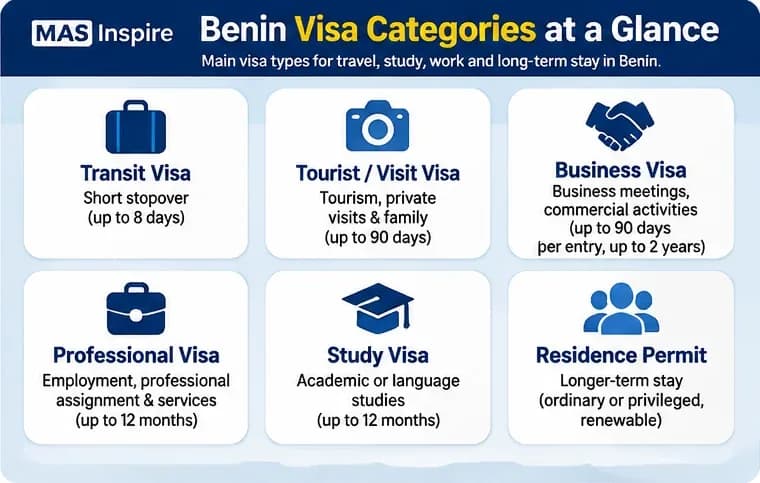
1. Transit visa
The transit visa is for a foreign national entering Benin to cross from one border to another while travelling to a third country. Article 5 of Decree No. 2026-049 limits the transit stay to eight days. The applicant must show a passport or travel document valid for more than 15 days from the application date and evidence of the right to enter the final destination, such as a visa, residence document, citizenship document, transport ticket or accommodation evidence.
The decree says transit visas are issued online and sets a two-day issuance period, provided the legal conditions are met. The official e-Visa portal should be checked for the currently available transit workflow and fee; a separate transit fee was not clearly displayed in the official fee schedule reviewed.
2. Tourist or visit visa (e-Visa)
This is the main route for tourism, family visits and other short visits, including certain health-related or professional visit purposes described by the DEI. Article 6 permits a stay of up to 90 days and says it may be renewed for the same duration. The official e-Visa portal offers 30-day and 90-day validity choices, with single- or multiple-entry options as shown in its fee schedule.
The tourist/visit visa is not a general work permit. Do not assume that a visitor may take up paid employment, provide ongoing services to a local employer or remain indefinitely by making repeated entries. If the real purpose is employment or study, ask the DEI which category applies.
3. Business visa
The business visa is for economic, commercial or industrial activity. The decree describes a visa validity period of two years, with a maximum stay of 90 days on each entry. It may be renewed for the same validity period. Examples of appropriate activities may include meetings, negotiations, trade events, supplier visits and commercial exploration, subject to the conditions on the issued visa.
A business visa is not equivalent to permission to work as an employee in Benin. Applicants should carry an invitation or supporting letter from the Beninese company or organisation, explain the commercial purpose and avoid describing productive local employment as a business visit.
4. Professional visa
The professional visa is for a foreign national travelling to Benin for professional activity. The decree permits a stay of up to 12 months, renewable for the same duration. It is issued as a printed visa or passport vignette rather than through the standard online tourist/transit channel. A foreign applicant should expect the DEI or diplomatic mission to request evidence of the professional assignment, employer or host organisation, role, qualifications and legal employment arrangements.
The visa must be distinguished from any work permit, employment-contract visa or other labour approval required for the specific job or sector. Benin's official public-service catalogue lists work-permit and worker-contract services as related services to the e-Visa service. Employers should clarify the sequence with the Ministry of Labour and DEI before the employee starts work.
5. Study visa
The study visa covers study or training and permits a stay of up to 12 months, renewable for the same duration. The DEI requires a passport with more than six months' validity, a photograph, a foreign personal identification certificate (CIPE), accommodation evidence and the relevant fee receipt in its published study-visa document list. The published checklist also mentions host identity or residence-card evidence where accommodation is provided by a person in Benin.
Applicants should also prepare an admission or enrolment letter, course dates, evidence of tuition arrangements and proof of how living costs will be met, even where the public checklist does not state a fixed minimum amount. The authority may request further evidence. The study visa does not itself establish an unrestricted right to work.
Categories that are not listed as separate Beninese visa classes
The 2026 decree does not name a separate job-seeker visa, skilled-worker visa, digital-nomad visa, startup visa, entrepreneur visa, spouse visa, family-reunification visa, internship visa or researcher visa. This does not mean that every activity is impossible; it means applicants must not assume those labels correspond to a distinct visa product. A relevant visitor, business, professional or study category may apply, while residence and work approvals are assessed separately.
Humanitarian protection and refugee status are distinct protection processes, not ordinary visitor visas. Benin's DEI lists a 1951 Convention travel document for a person already recognised as a refugee, with the request channelled through the National Commission for Assistance to Refugees (CNAR). Anyone seeking protection should contact the competent Beninese protection authority or UNHCR rather than apply for a tourist visa as a substitute.
Visa comparison table
| Category | Main purpose | Maximum stay / validity in decree | Channel | Work rights |
|---|---|---|---|---|
| Transit | Cross Benin en route elsewhere | Up to 8 days | Online | No general work right |
| Tourist / visit | Tourism, family, health or visit | Up to 90 days; renewable | Online | No general employment right |
| Business | Economic, commercial or industrial visits | Up to 90 days per entry; visa valid 2 years | Printed / mission or DEI process as directed | Business visit only; not employment |
| Professional | Professional activity | Up to 12 months; renewable | Printed / mission or DEI | Labour approval may also be required |
| Study | Study or training | Up to 12 months; renewable | Printed / mission or DEI | No unrestricted work right stated |
| Ordinary resident card | Longer-term residence | 3 years | DEI / public-service process | Depends on separate work permission |
| Privileged resident card | Longer-term established residence | 10 years | DEI / public-service process | Depends on applicable labour rules |
Eligibility requirements
The first eligibility question is nationality. Article 2 establishes a general visa requirement for foreign nationals unless an exemption applies. The official e-Visa FAQ states that African nationals can visit visa-free for 90 days. The Ministry of Foreign Affairs has published a list of 53 African countries covered by a non-reciprocal exemption. The list includes, among others, South Africa, Algeria, Ghana, Kenya, Morocco, Nigeria, Rwanda, Senegal, Tunisia and Zimbabwe. Verify the current list and any treaty-based exemption before booking.
For a visa application, check the following:
- Your passport nationality and passport type (ordinary, official or diplomatic).
- Whether an exemption applies to that passport, purpose and length of stay.
- Whether the intended activity matches the selected category.
- Whether your passport has the validity required for that visa.
- Whether you have a genuine host, employer, school or onward destination where relevant.
- Whether the application must be online or submitted through a diplomatic mission / DEI.
- Whether a separate work permit, contract visa, foreigner identification certificate or resident card is needed.
The 2026 decree requires a passport or travel document with more than six months' validity for visa applications other than transit. Transit applicants need more than 15 days' validity at application. The decree does not establish a universal minimum bank balance for all visa categories.
Complete document checklists
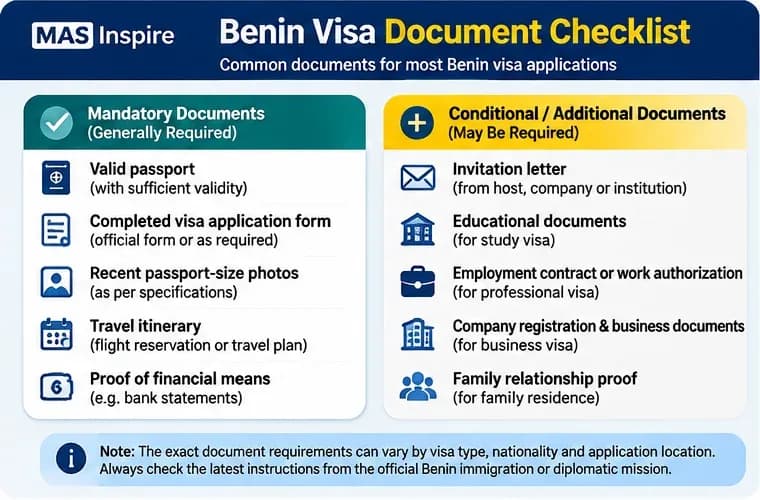
The following table separates items expressly identified in official requirements from additional evidence that is prudent or may be requested. The issuing authority may request further documents in an individual case.
| Category | Officially stated / baseline documents | Conditional or supporting evidence |
|---|---|---|
| Transit | Passport valid more than 15 days; evidence of right to enter final destination | Onward ticket, final-destination visa or residence card, itinerary, accommodation if relevant |
| Tourist / visit | Passport valid more than 6 months; photograph; exit transport evidence; accommodation evidence; host identity / residence evidence where applicable; fee receipt | Invitation letter, family relationship evidence, medical appointment / treatment evidence, itinerary, funds evidence |
| Business | Passport valid more than 6 months; exit transport evidence; accommodation evidence; host identity / residence evidence where applicable; fee receipt | Company invitation, meeting schedule, employer letter, business registration or conference details |
| Professional | Passport valid more than 6 months; DEI's general visa checklist and fee receipt | Employment contract or assignment letter, employer details, job description, qualifications, work permit / contract approval if required |
| Study | Photograph; CIPE; passport valid more than 6 months; accommodation evidence; host identity / residence evidence where applicable; fee receipt | Admission letter, enrolment confirmation, tuition and funding evidence, course calendar, guardian documents for minors |
| Ordinary resident card | Application form; passport valid more than 1 year; CIPE; livelihood / employment / income / sponsor evidence; police clearance from origin or last residence for first application; Benin police record for renewal; fee receipt; two photos in DEI checklist | Employment contract, promise of contract, business or income evidence, sponsor undertaking, certified translations / legalisation if requested |
| Privileged resident card | Application form; passport; CIPE; Benin police clearance; fee receipt; two photos | Evidence of permanent employment/activity, property, genuine marital residence, or functioning company / industrial or commercial establishment |
The DEI's tourist checklist and resident-card checklists should be consulted alongside the decree. The official study-visa checklist includes the CIPE and accommodation / host documents. The DEI's published checklist is not a guarantee that the same document set applies to every nationality or case.
How to apply: step by step
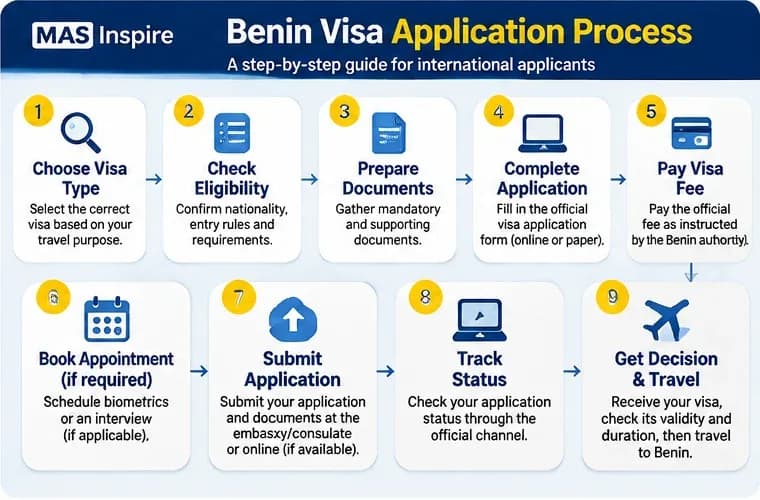
For online transit and tourist / visit applications
- Choose the correct purpose. Transit is for crossing Benin; tourist/visit is for a short visit. Do not use a visitor application to conceal work or study.
- Check the passport exemption. Review the official exemption list and confirm any special passport or treaty rule.
- Prepare the evidence. Have passport details, travel dates, accommodation and onward-travel information ready. Upload the documents requested by the portal.
- Open the official e-Visa site. Use https://evisa.bj/ rather than an unofficial agent's website.
- Complete the application carefully. The official FAQ says an issued e-Visa cannot be modified. Check names, passport number, entry date and visa choice before submitting.
- Pay the government fee. The official portal says payment cards must support 3-D Secure 2. The e-Visa fee is non-refundable according to the FAQ.
- Complete any additional checks. Follow any instruction from the authorities; do not assume an interview or biometrics appointment is required for every e-Visa.
- Submit and retain the reference. Keep the application reference and email used in the request.
- Track the request. The portal provides a status-check facility using the request number.
- Travel with the issued approval. Carry the e-Visa and supporting documents. Check passport validity, health and border-entry requirements again before departure.
For business, professional and study visas
These categories are issued in printed form or by a passport vignette under Article 7. Contact the DEI or the Beninese diplomatic / consular mission responsible for your place of lawful residence to confirm the current form, appointment route, originals, legalisation, fee and submission process. The decree delegates authority to Beninese diplomatic and consular representations for visas that cannot be obtained online. Do not assume the ten online steps above apply unchanged.
For a resident card
A foreign national seeking to establish residence should follow the DEI resident-card process. The decree requires a passport valid more than one year, the foreigner personal identification certificate (CIPE), livelihood / employment / sponsor evidence, a police clearance and the fee receipt. The DEI's checklist additionally specifies an application form and two photographs. Confirm whether the CIPE must be obtained before filing and how to book collection.
Visa fees and financial requirements
Published entry-visa fees
| Visa / service | Published amount | Notes |
|---|---|---|
| e-Visa, 30 days, single entry | €50 online / €60 embassy-handled | Official e-Visa fee page; confirm current portal total |
| e-Visa, 30 days, multiple entry | €75 online / €85 embassy-handled | Official e-Visa fee page |
| e-Visa, 90 days, multiple entry | €100 online / €110 embassy-handled | Official e-Visa fee page |
| Professional visa, 1 month | €70 / 45,916 XOF | DEI service page; confirm current order and payment amount |
| Professional visa, 3 months | €90 / 59,036 XOF | DEI service page |
| Professional visa, 6 months | €120 / 78,715 XOF | DEI service page |
| Professional visa, 1 year | €180 / 118,072 XOF | DEI service page |
| Study visa, 1 month | €70 / 45,916 XOF | DEI service page |
| Study visa, 3 months | €90 / 59,036 XOF | DEI service page |
| Study visa, 6 months | €120 / 78,715 XOF | DEI service page |
| Study visa, 1 year | €180 / 118,072 XOF | DEI service page |
| Business visa | €70/€90/€120/€180 (1/3/6/12 mo) | DEI — same rates as professional/study |
The official e-Visa fee page was posted in 2020 but remains accessible on the official portal in 2026. The DEI's service page publishes professional and study visa rates, including reduced rates for dual nationals. The March 2026 decree says visa and resident-card fees are fixed by joint ministerial order. Because the order itself was not located in the material reviewed, applicants should treat the displayed rates as the latest official published reference, not a guaranteed quote.
Resident-card fees published by DEI
| Resident status | Published validity | Published fee |
|---|---|---|
| Ordinary card — ECOWAS national | 3 years | 50,000 XOF |
| Ordinary card — non-ECOWAS national | 3 years | 250,000 XOF |
| Privileged card — ECOWAS national | 10 years | 100,000 XOF |
| Privileged card — non-ECOWAS national | 10 years | 800,000 XOF |
| Special Economic Zone (Glo-Djigbé) card | 5 years | 350,000 XOF |
The DEI describes the ZES card as a special route for foreign investors and operators active in the Glo-Djigbé Special Economic Zone. Its treatment is a special-zone arrangement and should not be confused with the ordinary or privileged residence classes in Articles 15–20 of Decree No. 2026-049.
Financial evidence: The decree permits an ordinary-residence applicant to demonstrate means of subsistence, a third-party guarantee or another legitimate interest in residing in Benin. It does not publish a universal minimum bank balance. Do not rely on unofficial websites that state a fixed balance without an official source.
Visa processing times
The official e-Visa FAQ says online processing may take one hour to 96 hours and recommends applying at least seven days before entry. It also says applicants cannot submit more than 90 days before the intended entry date. Transit visas are to be issued within two days under Article 12 of Decree No. 2026-049, if the conditions are met. The decree says timelines for other visas are set by ministerial order; a current official public timeline for business, professional, study or resident-card cases was not independently verified.
Do not book non-refundable travel on the assumption that an application will be processed at the fastest end of the range. Additional checks, missing documents or technical problems may extend the process.
Applying from Pakistan or Vietnam
Pakistani passport holders
Pakistan is not included in the official Beninese list of 53 African visa-exempt countries. A Pakistani ordinary passport holder should therefore plan to obtain a Benin visa before travel, unless a specific bilateral or individual exemption applies. For tourism or a short visit, the online e-Visa route is available to foreign applicants through evisa.bj. The official FAQ says the platform accepts applications from any foreigner wishing to visit Benin, subject to exemptions.
A Pakistani applicant should prepare a passport with the required validity, a recent photograph, travel dates, accommodation evidence and exit-ticket information where requested. A business applicant should add a genuine invitation and evidence of the commercial purpose. A student should obtain the study admission documents and follow the printed-visa process. A professional applicant should coordinate with the employer about the professional visa and any work permit or contract approval.
Pakistani citizens legally living or working in Vietnam
A Vietnam residence card, work permit or temporary-residence document proves a person's status in Vietnam; it does not automatically create visa-free access to Benin or guarantee that a Beninese embassy will accept a long-stay application from Vietnam. For the online tourist/visit e-Visa, the applicant should follow the official portal's nationality and passport instructions. The portal does not state that a Vietnamese residence permit is a prerequisite for the standard e-Visa.
For a printed business, professional or study visa, contact the DEI and the Beninese Ministry of Foreign Affairs to identify the diplomatic mission with jurisdiction over Vietnam residents. No Beninese resident embassy in Vietnam was confirmed in the official sources reviewed. Benin's embassy is listed at 38 Guang Hua Lu, Beijing, China, but the public evidence reviewed did not establish that it formally handles every application from Vietnam. Confirm jurisdiction, appointment availability, original-document handling and whether an application can be lodged by courier before sending a passport.
Useful evidence for a local application may include the Vietnamese temporary residence card, work permit, employer letter, proof of address and evidence of lawful stay. These are supporting proof of residence in the place of application; they do not replace Benin's category-specific documents.
Applying from Pakistan versus Vietnam
The visa category and nationality rules remain the same. The practical difference is where the applicant is lawfully resident and which mission accepts the file. An applicant in Pakistan should contact the Beninese mission accredited to Pakistan or the DEI for the current route. An applicant in Vietnam should first obtain written confirmation of the responsible mission. In either location, the standard tourist e-Visa can be requested online, but printed visas and residence formalities may require physical submission or collection.
Student visa guide
A foreign student accepted by a Beninese university, school or training institution should apply for the study category rather than relying on a tourist visa for a long course. The decree permits study stays up to 12 months and renewal for the same period. The DEI checklist calls for a photo, CIPE, passport valid more than six months, accommodation evidence and a payment receipt. It also identifies the host's identity document or residence card where a private host provides accommodation.
Prepare an admission letter, programme dates, evidence of tuition arrangements and a realistic funding plan. Ask the institution whether it can provide an official invitation or accommodation certificate. The published rules do not establish a general minimum bank balance for every student. A student should not assume that the study visa allows unrestricted employment; seek written approval before undertaking paid work or an internship.
Work visa and job opportunities
Benin's professional visa is the relevant stay-visa category for professional activity. However, visa permission and labour authorisation are separate legal questions. Benin's labour materials include a work-permit procedure, and Decree No. 2024-1462 provides that an employer may recruit a foreign worker who is not irregularly resident, while work in certain strategic sectors may be conditional on obtaining a permit. Older Labour Code provisions also describe employer-submitted work-permit and employment-contract formalities. These provisions should be read together with later rules and current administrative instructions.
A prospective employee should therefore:
- Obtain a written offer or assignment from a Beninese employer.
- Ask the employer to determine whether the role / sector requires a work permit or contract visa.
- Have the employer coordinate with the Ministry of Labour and DEI before work begins.
- Apply for the appropriate professional visa and complete any required foreigner identification procedure.
- Obtain a resident card if the stay and settlement rules require one.
The official materials reviewed do not establish a separate job-seeker visa, digital-nomad visa or points-based skilled-worker immigration route. Do not enter as a tourist intending to work without the correct approvals.
Family immigration and permanent residence
The 2026 decree does not list a standalone spouse or family-reunification visa. A family visit may fit the tourist/visit category for a short stay, while a person seeking to settle must examine the resident-card rules and any applicable family or special-status provisions with the DEI. The ordinary resident card requires proof of means or third-party support / another legitimate interest and good character. A privileged resident card is available to an ordinary resident who has obtained two renewals and demonstrates a qualifying lasting connection: permanent employment or activity, property, an effective marital residence in Benin, or creation of a functioning business / industrial or commercial establishment. The Minister may also grant privileged status where the person's residence is of particular interest to Benin.
Ordinary cards are valid for three years; privileged cards are valid for ten years and both are renewable. These are long-term residence statuses, not an automatic grant of citizenship or an explicit guarantee of permanent residence. The term “permanent residence” should therefore be used cautiously in public-facing content. Naturalisation is a separate legal process governed by nationality law and is outside the visa process.
Common application mistakes
- Selecting a tourist visa when the real purpose is paid work or long-term study.
- Assuming a residence permit from another country creates Benin visa exemption.
- Using an unofficial visa agent or lookalike website instead of the government portal.
- Entering passport details or travel dates incorrectly; the official FAQ says an issued e-Visa cannot be modified.
- Applying too early (more than 90 days before entry) or too late (inside the recommended seven-day lead time).
- Paying before checking that the card supports 3-D Secure 2.
- Failing to carry accommodation, onward-travel, invitation or admission evidence.
- Treating visa validity as the same as permitted stay on each entry.
- Assuming a business visa authorises local employment.
- Assuming a professional visa replaces all labour permits or residence requirements.
- Sending an original passport to a mission before confirming jurisdiction and safe submission arrangements.
Reasons for visa refusal
The Beninese decree confirms that refusals are notified. It does not publish a single exhaustive list of refusal grounds. Common risk factors in any immigration assessment include an incomplete or inconsistent application, invalid or insufficiently valid passport, unclear purpose of travel, missing host or accommodation evidence, unsupported funding, incorrect visa category, suspected false information, failure to meet an exemption or entry condition, or concerns about compliance with earlier immigration conditions.
Article 24 of Decree No. 2026-049 states that a visa refusal or refusal to renew a visa is not subject to appeal under that decree and that the person concerned must leave Benin within three days of notification. Article 25 provides for a challenge to a refusal of a resident card under the conditions and time limits in the governing law. Because these consequences are significant, obtain qualified legal advice promptly if refused. Never submit forged documents or make a false declaration.
Frequently asked questions
1. Do Pakistani citizens need a visa for Benin?
Yes, Pakistani ordinary passport holders should plan to obtain a visa. Pakistan is not among the 53 African countries on Benin's published visa-exemption list. Confirm any special passport or individual exemption before travel.
2. Can I apply for a Benin visa online?
Yes. The official e-Visa platform accepts online applications for visitor e-Visas and the decree also provides online issuance for transit visas. Business, professional and study visas follow a printed-visa process.
3. What is the official Benin e-Visa website?
Use https://evisa.bj/. Check that the domain is correct before entering passport or payment details.
4. How much does a Benin e-Visa cost?
The official fee page lists €50 for 30-day single entry, €75 for 30-day multiple entry and €100 for 90-day multiple entry when applying yourself. Embassy-handled prices are €60, €85 and €110 respectively. Confirm the current amount at checkout.
5. How long does Benin e-Visa processing take?
The official FAQ says one hour to 96 hours and recommends applying at least seven days before entry.
6. How long can I stay in Benin on a tourist visa?
The decree allows a tourist/visit stay of up to 90 days. The validity and entries shown on the issued visa govern the actual permission granted.
7. Can I work in Benin on a business visa?
A business visa is for economic, commercial or industrial visits, not a general employment authorisation. Paid employment requires the correct professional and labour approvals.
8. Is there a Benin digital nomad visa?
No separate digital-nomad visa is named in Decree No. 2026-049. Remote work circumstances should be referred to the DEI for a written determination rather than assuming visitor status permits it.
9. Is there a job-seeker visa for Benin?
No standalone job-seeker visa is listed in the current decree.
10. Can I study in Benin on a tourist e-Visa?
For formal study or training, the decree provides a study visa of up to 12 months, renewable. Apply under the study category and follow the DEI / mission process.
11. Does a Vietnam residence card let a Pakistani citizen apply for Benin visa in Vietnam?
It proves lawful residence in Vietnam but does not guarantee that a Beninese mission in Vietnam has jurisdiction to accept the application. Confirm the responsible mission before submitting a printed-visa application.
12. Is there a Beninese embassy in Vietnam?
No resident Beninese embassy in Vietnam was confirmed in the official sources reviewed. Benin's embassy in Beijing is listed publicly, but applicants must confirm directly whether it handles Vietnam-resident applications.
13. What is a Benin resident card?
It is a separate residence document. The decree provides a three-year ordinary card and a ten-year privileged card, subject to eligibility and documentation.
14. Is there a minimum bank balance for Benin residence?
The decree requires evidence of means of subsistence, a third-party guarantee or another legitimate interest, but the official material reviewed did not specify a universal minimum balance.
15. Can a refused Benin visa be appealed?
Article 24 of Decree No. 2026-049 says visa refusals and refusals to renew a visa are not subject to appeal under the decree. It also states that the applicant must leave Benin within three days of notification. Seek legal advice immediately if this affects you.
Official immigration websites
- Benin e-Visa portal
- e-Visa FAQ
- e-Visa costs
- Directorate of Emigration and Immigration
- DEI services and visa / residence categories
- DEI document library
- Official public-service catalogue — e-Visa
- Decree No. 2026-049
- Official visa-exemption list
- Ministry of Labour
Final checklist and conclusion
Before travelling or submitting a long-stay application, confirm that you have:
- Checked the exemption rules for your exact nationality and passport type.
- Selected transit, tourist/visit, business, professional or study for the genuine purpose.
- Checked the live fee and application channel with the official authority.
- Prepared the passport, photo, travel / host / school / employer evidence required for the category.
- Confirmed whether CIPE, a work permit, contract approval or resident card is required.
- Applied early enough and retained the application reference and payment receipt.
- Confirmed the mission's jurisdiction if applying for a printed visa from outside Benin.
- Rechecked border, health and airline requirements before departure.
Benin's 2026 framework is clear about the core entry and residence categories, but some administrative details—particularly the current ministerial fee order, long-stay processing timelines and mission jurisdiction for applicants in Vietnam—need confirmation directly with the authorities. Use the official portals, keep copies of every document and do not travel or begin work on the assumption that an application receipt is an approval.
Disclaimer: This article is for general educational purposes only and is not legal advice. Immigration decisions are made by the competent Beninese authorities. Verify current requirements before making travel, study, employment or investment commitments.