

By MAS Inspire | Last reviewed: 27 November 2026 (fees, funds and work-permit thresholds re-verified 27 November 2026)
Important: This guide is educational information, not legal advice and not an official Austrian government publication. Immigration rules, fees, annual shortage occupation lists and consular procedures can change. Always check the official page for your visa category and the Austrian representation responsible for your place of legal residence before paying fees or making travel arrangements. A visa or residence permit is never guaranteed.
Table of contents
- Introduction
- Why visit, study or work in Austria?
- Types of Austria visas and residence permits
- Visa comparison table
- Eligibility requirements
- Document checklists
- How to apply
- Fees and financial requirements
- Processing times and validity
- Applying from Pakistan or Vietnam
- Austria student residence permit
- Work visas and job opportunities
- Family immigration and permanent residence
- Common mistakes and refusal risks
- Frequently asked questions
- Official websites
- Final checklist
Introduction
Austria is a member of the European Union and the Schengen Area. The correct immigration route depends on the purpose and length of the proposed stay. A short visit, a university degree, employment, family reunification and long-term settlement do not use the same permission.
For most short visits, the relevant document is a Schengen Visa C, which generally allows a stay of up to 90 days in any 180-day period across the Schengen Area. A national Visa D is for certain longer stays, generally 91 days to six months. A person planning to live in Austria for more than six months normally needs an appropriate Austrian residence title. A visa is not a substitute for a residence permit or an employment authorisation.
This guide is written for international applicants, with additional practical information for Pakistani passport holders who legally live or work in Vietnam.
Why visit, study or work in Austria?
Austria offers established universities, vocational and research institutions, a developed labour market and access to the wider Schengen region for eligible short-term travel. Vienna, Graz, Linz, Salzburg and Innsbruck are among its principal education and employment centres. German is important for many jobs and everyday administration, although some university programmes and specialist roles use English.
The route should be selected by the real purpose of travel. A visitor cannot use a tourist visa to take up ordinary employment. A student permit does not automatically authorise unrestricted work. A Schengen visa issued by Austria also does not grant the right to settle or work in another Schengen country.
Types of Austria visas and residence permits
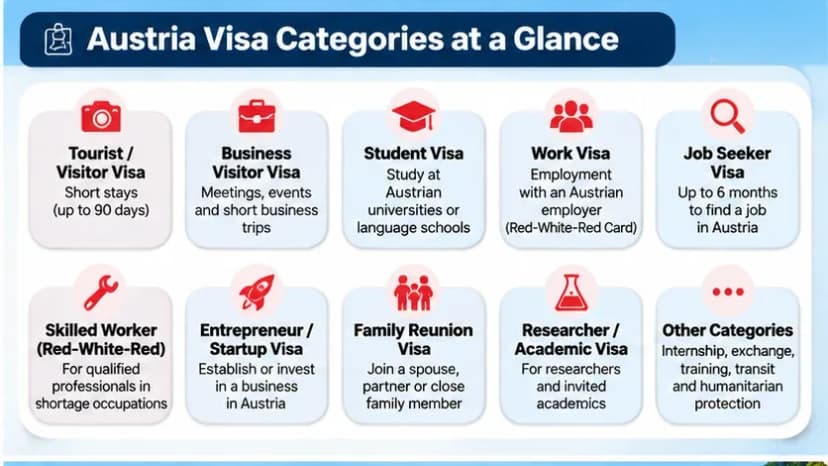
1. Tourist and private visitor — Schengen Visa C
A Visa C may be appropriate for tourism, visiting family or friends, or another permitted short stay. It generally allows up to 90 days in any 180-day period. The visa's printed validity dates and authorised number of entries must also be respected. It does not authorise ordinary employment.
Applicants normally provide a valid travel document, application form, photograph, travel medical insurance, itinerary, accommodation details, evidence of sufficient funds, and evidence supporting the purpose of the trip and intention to leave before the authorised stay ends. An invitation or host declaration may be relevant for a private visit. The consulate can request additional evidence.
Official information: Austrian Ministry of Foreign Affairs — Visa
2. Business visitor — Schengen Visa C
Business meetings, conferences, negotiations and similar short business activities may fall within a Visa C visit, provided the planned activities are permitted and the stay is short. A business invitation should explain the host organisation, purpose, dates and who will cover expenses. This route is not a general work permit and should not be used to perform employment that requires Austrian work authorisation.
3. Student residence permit
Third-country nationals admitted to an eligible Austrian higher education programme and planning to stay longer than six months generally apply for a Residence Permit – Student. Eligible programmes include regular degree studies at recognised institutions and certain non-degree programmes, including qualifying programmes of at least 40 ECTS. A purely language-learning course by itself does not normally qualify under the standard student permit route.
The initial application is generally lodged with the competent Austrian representation abroad. The Austrian residence authority decides the residence-permit application. The permit is normally issued for 12 months, subject to the specific rules and circumstances. Students must show adequate funds, accommodation and comprehensive health insurance. Student employment is possible up to 20 hours per week when the employer obtains the required AMS employment permit.
Official information: OeAD — Residence Permit Student
4. Language study
A short language course may be possible on a Visa C or Visa D, depending on its duration and the applicant's circumstances. A long-term language-only course does not automatically qualify for a Residence Permit – Student. Applicants should ask the Austrian embassy which permission matches the course, its duration and the legal basis of the stay.
5. Work and employer-sponsored routes
Austria does not have one universal work visa. Many third-country nationals use a Red-White-Red Card (RWR Card), an EU Blue Card, or another specific residence title. The RWR Card combines residence and work authorisation and is normally tied to the qualifying employer or activity for the initial period.
Main RWR Card groups include very highly qualified workers, skilled workers in shortage occupations, other key workers, graduates of Austrian higher education institutions, certain regular workers in tourism/agriculture/forestry, self-employed key workers and start-up founders. Eligibility, points, salary and evidence differ by category. A job offer is required for most employed-worker categories.
The EU Blue Card is a separate highly skilled employment route. In 2026, the official salary threshold is at least €55,678 gross annually, including special payments, alongside the qualifying higher-education qualification (or specified ICT professional experience alternative), a binding job offer matching the qualification and the applicable labour-market test.
Official information: Migration.gv.at — Immigration and residence
6. Job-seeker Visa for very highly qualified workers
A six-month Job Seeker Visa is available to qualifying very highly qualified applicants who reach at least 70 points under the official criteria. It is not a general job-search visa for every occupation or graduate. If the applicant secures a suitable offer during the authorised period, they may apply for the corresponding RWR Card if all requirements are met.
7. Skilled workers in shortage occupations
Applicants may qualify for an RWR Card if they have completed training in an occupation on the applicable shortage list, have a binding Austrian job offer with the required remuneration, and reach at least 55 points. Shortage lists are updated by regulation and can include nationwide and regional occupations. Check the list applicable to the year of application; do not rely on an old list or a job title alone.
8. Other key workers
This RWR category generally requires a qualifying job offer, a labour-market test and at least 55 points. For 2026, the official minimum gross monthly remuneration stated for this category is €3,465. Other criteria, including age, qualifications, experience and language, also matter.
9. Start-up founders and self-employed key workers
A start-up founder RWR Card is for establishing an innovative company in Austria. The applicant must have a coherent business plan, controlling influence over the new company, at least €30,000 in capital with an equity share of at least 50%, and at least 50 points. Additional investment, an approved incubator or funding agency and age can contribute points.
A self-employed key worker route is different. It requires a macroeconomic benefit beyond the applicant's own business activity. The official examples include a sustained transfer of at least €100,000 in investment capital, creation or protection of jobs, transfer of know-how or new technology, or significance for a region. There is no points system for this category.
Austria does not provide a general, standalone digital-nomad visa. Remote work for a foreign employer does not by itself create an Austrian residence entitlement.
10. Family reunification
The correct title depends on the sponsor's status. Eligible family members commonly include spouses, registered partners and unmarried minor children. Under the Settlement and Residence Act, spouses and registered partners generally must be at least 21 when applying. Family members of RWR Card or EU Blue Card holders may qualify for an RWR Card Plus, which gives unrestricted labour-market access, subject to the legal requirements.
Other family categories have different conditions and some are quota-limited. Evidence of relationship, accommodation, comprehensive health insurance and sufficient income is commonly required. Some applicants must provide German-language evidence before immigration, subject to exemptions.
11. Permanent residence / Long-term Resident – EU
A third-country national may qualify for Long-term Resident – EU after five years of uninterrupted qualifying lawful residence, if the general requirements are met and Module 2 of the Integration Agreement has been completed. Module 2 corresponds to German at B1 level and knowledge of Austria's fundamental values and legal/social system. The status is not automatic after five years; the applicant must apply and satisfy the conditions.
12. Transit visa
Airport transit rules depend on nationality and itinerary. Pakistani nationals are among the nationalities listed by Austria as requiring an Airport Transit Visa (Category A) when remaining in the international transit area, unless an exemption applies. This is distinct from a Visa C, which permits entry into the Schengen territory. Confirm whether an exemption applies to the particular passport, residence document and route.
13. Exchange, internship and training
The appropriate route depends on duration, remuneration, host institution and whether the activity is employment under Austrian law. A student exchange may be covered by a student mobility residence permit in qualifying cases. Internships can require employment authorisation or a different residence title. Unpaid observation is not automatically exempt. Obtain written guidance from the host institution and competent authority before starting.
14. Researcher and academic
Researchers may qualify for a Settlement Permit – Researcher based on a hosting agreement with an eligible research institution and the general residence conditions. Researcher mobility provisions may also apply in specific cases. A research visit or conference of short duration may instead use a short-stay visa or a visa exemption, depending on nationality and activity.
15. Humanitarian protection
Asylum and subsidiary protection are protection procedures, not ordinary migration or work-visa options. They apply where a person meets the relevant international and Austrian legal criteria. A person seeking protection should obtain advice from qualified legal aid or the competent Austrian authorities. This guide does not assess individual protection claims.
Visa comparison table
| Route | Main purpose | Typical permission / duration | Work rights |
|---|---|---|---|
| Visa C | Tourism, private or business visit | Up to 90 days in 180 | No ordinary employment |
| Visa D | Certain longer temporary stays | 91 days to six months | Only as expressly permitted |
| Residence Permit – Student | Eligible study programme | Usually 12 months; renewal possible | Up to 20 hours/week with AMS permit |
| RWR Card | Qualified employment / defined founder categories | Usually 24 months | As authorised by category |
| EU Blue Card | Highly qualified employment | Usually up to 24 months or contract plus period | Employer/job conditions apply |
| Job Seeker Visa | Very highly qualified job search | Up to six months | No general work right while searching |
| RWR Card Plus | Family / qualifying transition | Depends on route; often 1–3 years | Unrestricted labour-market access |
| Long-term Resident – EU | Long-term settlement | Five-year card, renewable | Free labour-market access |
Eligibility requirements
The applicant must meet the requirements of the selected category. For short-stay visas, authorities assess the purpose and conditions of the trip, means of support, insurance, accommodation, travel history and intention to leave before the permitted stay ends. For residence titles, general requirements commonly include:
- Adequate and regular means of subsistence.
- Health insurance covering all risks in Austria.
- Adequate accommodation under local standards.
- A valid travel document and current photograph.
- Any category-specific admission, job offer, hosting agreement, family relationship or business evidence.
- German-language evidence where the particular residence title requires it.
For 2026, the published standard income reference rates for general residence requirements are €1,308.39 per month for a single person, €2,064.12 for a married couple or registered partnership, plus €201.88 for each child. These figures are not a universal visa bank-balance rule. The calculation and treatment of regular expenses depend on the legal route. Student permit funds are calculated under a separate age-based formula.
Document checklists
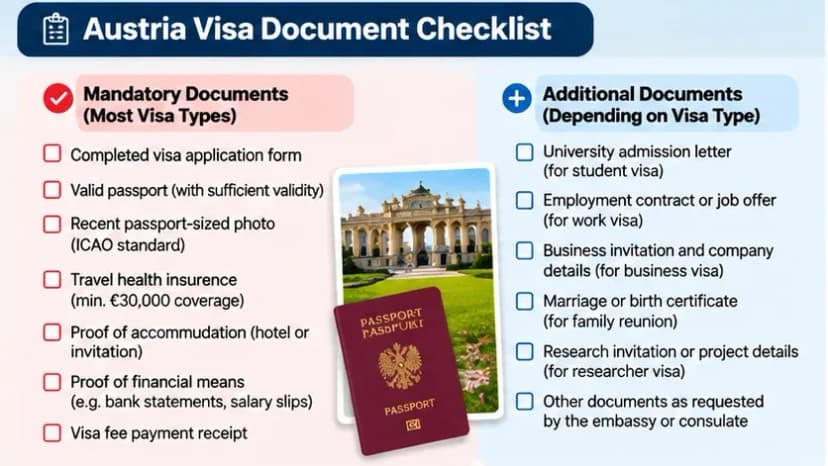
The authority may ask for further documents. The list below is a preparation aid, not a claim that every item is mandatory for every applicant.
| Document | Visa C / D | Student permit | Work / RWR | Family |
|---|---|---|---|---|
| Completed official form | Yes | Yes | Yes | Yes |
| Valid passport and copies | Yes | Yes | Yes | Yes |
| Recent ICAO-compliant photo | Yes | Yes | Yes | Yes |
| Purpose evidence / itinerary | Yes | Admission | Job / category evidence | Sponsor and relationship |
| Financial evidence | Yes | Yes | Category / general rules | Yes |
| Accommodation evidence | Usually | Yes | General residence rules | Yes |
| Health / travel insurance | Travel insurance | All-risks cover | All-risks cover | All-risks cover |
| Admission letter / CoE equivalent | If relevant | Yes | No | No |
| Employment contract / offer | Business invitation if relevant | No | Usually | Sponsor evidence |
| Qualifications / work history | If relevant | Academic records | Often | If relevant |
| Civil-status certificates | If relevant | If relevant | If relevant | Usually |
| Police clearance | If requested | If requested | Often / category-dependent | If requested |
| Translations / legalisation | If required | If required | If required | If required |
Student-specific preparation
- Admission or enrolment confirmation from the Austrian institution.
- Proof of sufficient funds for the applicable 12-month period (or applicable mobility-period rule).
- Proof of accommodation and all-risks health insurance.
- Passport, photograph and signed application.
- Civil-status documents where relevant.
- Evidence explaining the source of funds if requested by the authority.
Employment-specific preparation
- Binding job offer or employment contract where required.
- Employer declaration and category-specific forms.
- Qualification certificates, transcripts and evidence of recognition or comparability where relevant.
- Employment reference letters showing dates, role and duties.
- Evidence for points claimed, such as language certificates, age and work experience.
- For founders: detailed business plan, capital/equity proof, company structure and innovation evidence.
Translation and legalisation
Documents not in German may need certified translation. Foreign public documents may need legalisation or apostille, depending on the country and document. The embassy or Austrian authority should confirm the exact process. Do not assume that an ordinary photocopy or an informal translation will be accepted.

How to apply: step-by-step
- Choose the correct route. Decide whether the purpose is a short visit, temporary stay, study, employment, family reunification or settlement.
- Check nationality and residence. Confirm visa requirements, airport transit rules and the competent Austrian consular post for the country where you legally reside.
- Check category eligibility. Verify the current official requirements, including salary, points, shortage occupation, admission or sponsor conditions.
- Prepare documents. Use the relevant official checklist. Arrange translations, legalisation and original documents early.
- Obtain the required offer or admission. A job-seeker visa is limited to very highly qualified applicants; most work routes require an offer.
- Book the correct appointment. Follow the official embassy or authorised service-provider instructions. Residence permit applications and visa applications may have different appointment channels.
- Submit and pay. Attend in person where required, submit biometrics and pay the official fee plus any clearly disclosed service fee.
- Wait for the decision. Provide additional documents promptly if requested. Use only the official tracking channel.
- Follow the decision instructions. If a residence permit is approved, a visa D may be needed to enter Austria and collect the residence card.
- After arrival, comply with local rules. Collect the residence card, register your address where required, maintain insurance and funds, and do not work beyond the permission granted.
Fees and financial requirements
| Item | Official 2026 amount / rule |
|---|---|
| Schengen Visa C, adult | €90 |
| Schengen Visa C, age 6–12 | €45 |
| Schengen Visa C, under 6 | Fee-exempt |
| National Visa D, over age 6 | €195 |
| National Visa D, under age 6 | €97 |
| Residence permit application (e.g. Student) | €218 |
| Long-term Resident – EU application | €275 |
| Student funds, under 24 | €722.58/month |
| Student funds, age 24 or over | €1,308.39/month |
| Student funds, couples | €2,064.12/month |
| Each child added to student calculation | €201.88/month |
| EU Blue Card salary threshold | €55,678 gross/year |
| Other Key Worker minimum gross monthly pay | €3,465 |
| Start-up founder minimum company capital | €30,000; at least 50% equity |
| Self-employed key worker investment example | €100,000 sustained transfer |
Fees can be non-refundable and local payment amounts may be converted into local currency. Service-provider charges, translation, legalisation, insurance, courier and document fees may be additional. Confirm the fee with the relevant Austrian representation before applying.
Processing times and validity
| Procedure | Published information |
|---|---|
| Schengen visa | Normally 15 calendar days; may extend to 45 days |
| Student residence permit | Generally up to 90 days; may extend by another 90 days if additional documents are required |
| Visa D | Varies by case and consular workload |
| RWR Card / EU Blue Card | Depends on completeness, AMS assessment and authority workload; no single guaranteed time |
| Family / settlement title | Varies by category, quota and authority |
Apply well in advance. OeAD recommends early preparation, ideally starting around 12 months ahead for students, and notes that appointment availability and document legalisation can add time. A Visa D generally permits a stay of 91 days to six months and cannot simply be extended in Austria. A residence title is required for a longer stay.
Applying from Pakistan or Vietnam
Pakistani passport holders
Pakistani citizens require a visa or residence permit for Austria. The Austrian Embassy in Islamabad states that Schengen Visa C applications are handled through VFS Global application centres in Islamabad, Lahore and Karachi, while Visa D and student residence permit appointments are arranged directly with the embassy's consular section according to its instructions. The embassy assesses the application; VFS is a receiving service provider and does not decide the case.
The embassy's appointment and fee information can change. Applicants in Pakistan should check the current Islamabad page before booking. Pakistani passport holders should also check airport transit requirements: Pakistan is on Austria's published Category A transit-visa list, subject to exemptions.
Pakistani citizens legally residing or working in Vietnam
A Pakistani national who is legally resident in Vietnam may be able to apply through the Austrian Embassy in Hanoi if that embassy is competent for the applicant's lawful place of residence and accepts the application. A Vietnamese work permit, temporary residence card or other proof of lawful residence is important, but it does not automatically guarantee that the embassy will accept every application locally. Confirm jurisdiction and appointment eligibility with the embassy before booking.
The Austrian Embassy in Hanoi's visa information states that Visa C applications are lodged through VFS Global in Hanoi or Ho Chi Minh City. Its instructions distinguish visa applications from residence-title applications, which are lodged at the embassy by appointment. The Vietnamese-language embassy page provides the local VFS information. Ask the embassy directly about the correct process for a Pakistani passport holder resident in Vietnam, including the required evidence of Vietnamese residence and any nationality-specific arrangements.
Documents to prepare when applying from Vietnam
- Pakistani passport and copies of relevant pages.
- Valid Vietnamese residence card, work permit or other evidence of lawful stay.
- Proof of actual residence in Vietnam and contact details.
- Relevant Vietnamese employment, income or study evidence.
- Austrian invitation, admission or job documents, as appropriate.
- Financial evidence, insurance and accommodation.
- Previous passports, visas and travel history where relevant.
- Translations and legalisation if requested.
Pakistan versus Vietnam: practical difference
The substantive Austrian eligibility rules do not become easier merely because the applicant applies from Vietnam. The practical difference is the consular jurisdiction, appointment channel, local payment currency, service provider and evidence of lawful residence. A person who is only visiting Vietnam should not assume that the Hanoi embassy will accept an application. If the applicant's ordinary legal residence is Pakistan, Islamabad may remain the competent post.
Official local pages: Austrian Embassy Islamabad · Austrian Embassy Hanoi — Visa information
Austria student residence permit
A non-EEA student intending to stay more than six months generally needs a Residence Permit – Student. First secure admission to an eligible Austrian institution. Check that the course type qualifies: a degree programme, certain non-degree programmes with at least 40 ECTS, preparatory study required by the admission decision, or other specifically recognised study route. A stand-alone language course is not automatically enough.
2026 financial evidence
OeAD publishes these monthly amounts:
- Under 24 years: €722.58.
- Age 24 or above: €1,308.39.
- Couples: €2,064.12.
- Each child: €201.88.
The funds generally need to be demonstrated for 12 months in advance for the standard student route. They must be in a bank account or savings account in the applicant's name and accessible from Austria. If accommodation costs exceed the official monthly allowance threshold (€386.43 in 2026), additional funds are required. The applicant must also show sufficient funds for health insurance. The authority may request evidence of the source of funds.
Health insurance and work
Travel insurance may cover the initial entry period, but the residence permit requires all-risks health insurance providing cover in Austria. Do not assume that a travel policy alone satisfies the residence-permit condition.
Students can work up to 20 hours per week with an employment permit. The employer applies to the Public Employment Service (AMS) before work begins. Do not start paid work on the assumption that student status alone is sufficient.
Work visas and job opportunities
Start with a genuine Austrian employer and a role that matches the proposed permit. Check whether the occupation appears on the current shortage list, whether the employer can meet the relevant salary rules and whether your qualifications can be documented. The RWR Card for shortage occupations generally needs a binding offer, relevant completed training and at least 55 points. The other-key-worker category has a 2026 minimum gross monthly salary of €3,465, a points threshold and a labour-market test.
The EU Blue Card is an alternative for qualifying highly skilled workers and has a 2026 gross annual salary threshold of €55,678. Very highly qualified applicants without an offer may explore the six-month job-seeker visa if they reach 70 points. It is not an open job-search route for all applicants.
Family immigration and permanent residence
Family reunification is tied to the sponsor's Austrian status. Spouses, registered partners and minor children are the principal family-member categories under the relevant settlement law. General conditions commonly include adequate income, accommodation and comprehensive health insurance. Some family members must show German A1 before immigration; exemptions apply to defined categories.
After five years of qualifying uninterrupted lawful residence, an applicant may be eligible for Long-term Resident – EU if the general conditions and Module 2 (German B1 and civic knowledge) are satisfied. Time spent under some temporary residence statuses may be treated differently under the applicable rules. Obtain a residence-history assessment before relying on a five-year calculation.
Common application mistakes
- Choosing Visa C for a purpose that requires a residence permit or work authorisation.
- Treating a residence permit as a Schengen-wide work permit.
- Applying from a country where the applicant is not legally resident without confirming consular competence.
- Using an old shortage-occupation list or salary figure.
- Assuming that a university admission letter alone guarantees a student permit.
- Showing funds that are not accessible from Austria or cannot be explained.
- Providing inconsistent travel dates, employment details or financial statements.
- Failing to arrange certified translations or required legalisation.
- Starting work before the required employment authorisation is issued.
- Booking non-refundable travel before a decision.
Reasons for visa refusal
A short-stay application may be refused if the authority is not satisfied about the purpose or conditions of the visit, sufficient means, insurance, reliability of documents, intention to leave, or other entry conditions. Residence and work applications may fail if a category-specific requirement is not met, such as a missing job offer, insufficient points, inadequate salary, an ineligible programme, insufficient funds, lack of insurance or missing accommodation evidence. False documents or material inconsistencies can seriously damage an application. Read the refusal notice carefully and use the appeal or review route stated in the decision. A previous refusal does not automatically mean every future application must be refused.
Frequently asked questions
1. Do Pakistani citizens need a visa for Austria?
Yes. Pakistani citizens generally require a visa or residence permit for Austria. The exact route depends on the purpose and duration of the stay.
2. Can a Pakistani living in Vietnam apply for an Austria visa in Hanoi?
Potentially, if legally resident in Vietnam and the Austrian Embassy Hanoi confirms it is the competent post and accepts the application. Residence in Vietnam does not automatically guarantee local jurisdiction.
3. How much is an Austria tourist visa in 2026?
The standard adult Schengen Visa C fee is €90. Applicants aged 6–12 pay €45; children under six are generally fee-exempt. Service fees may be additional.
4. What is the Austria Visa D fee?
The published fee is €195 for applicants over six and €97 for children under six, subject to exemptions and local payment rules.
5. Can I work in Austria on a tourist visa?
No. A tourist or ordinary business visitor visa does not authorise ordinary employment.
6. How much money does an Austrian student need in 2026?
OeAD lists €722.58 per month for students under 24 and €1,308.39 for those aged 24 or older. The standard route generally requires 12 months of funds, plus additional funds where accommodation exceeds the stated threshold and for insurance.
7. Can international students work in Austria?
Yes, up to 20 hours per week with the required AMS employment permit. The employer must apply before the student starts work.
8. Is there an Austria digital nomad visa?
Austria does not offer a general standalone digital-nomad visa. A remote-work arrangement alone does not establish a residence right.
9. Is there an Austria job-seeker visa?
Yes, a six-month Job Seeker Visa exists for very highly qualified workers who reach at least 70 points under the official system.
10. What is the EU Blue Card salary requirement in 2026?
The published minimum is €55,678 gross annually, including special payments, alongside the qualification, job-offer and labour-market conditions.
11. How long does an Austria Schengen visa take?
The normal Schengen decision period is 15 calendar days. It can be extended to 45 days where further examination is needed.
12. How long does an Austrian student residence permit take?
OeAD says a decision generally takes up to 90 days and may be extended by another 90 days if additional documents are required. Appointment waiting times are separate.
13. Can I settle permanently in Austria?
Long-term Resident – EU may be available after five years of qualifying uninterrupted lawful residence, if the general conditions and Integration Agreement Module 2 are met.
14. Does an Austria Schengen visa allow travel to other Schengen countries?
A valid uniform Schengen visa generally allows short visits across the Schengen Area within the authorised dates and 90/180-day limit. It does not permit work or settlement in other countries.
15. Can I apply for a student permit with only a German language course?
Not automatically. The standard Residence Permit – Student route is for eligible higher-education and qualifying study programmes; a language-only course does not generally qualify.
Official websites
- Austrian Ministry of Foreign Affairs — Visa
- Austrian Ministry of Foreign Affairs — Embassy Islamabad
- Austrian Embassy Hanoi — Visa information
- Austrian Embassy Hanoi — official website
- Migration.gv.at — Official immigration portal
- OeAD — Student residence permit
- OeAD — Visa C or Visa D
- European Commission — Schengen visa applications
- EUR-Lex — Schengen Visa Code
Final checklist and conclusion
Before applying, confirm the exact route, nationality rules, consular jurisdiction, current fee, appointment method and latest category-specific checklist. Make sure funds, insurance and accommodation meet the applicable requirements. Students should verify that their programme qualifies and that employment is authorised before starting work. Workers should confirm the employer, salary, points and permit category. Pakistani citizens living in Vietnam should confirm with the Austrian Embassy Hanoi that their Vietnamese residence status allows them to lodge the application there.
Austria offers several lawful routes for visiting, studying, working and joining family, but each has distinct requirements. Use the official links above, submit accurate documents and allow enough time for processing. No adviser, agency or website can guarantee approval.


