Armenia Visa Guide 2026: Types, Requirements, Fees and Application Steps
Last verified: 25 November 2026 Prepared for MAS Inspire | Educational information, not legal advice
Important nationality update (verified 27 November 2026): Armenia repealed its invitation-only nationality list with effect from 16 June 2026 (Government Decision 643-N). Pakistani passport holders can currently apply for the visitor e-Visa at evisa.mfa.am (USD 8 for up to 21 days; USD 39 for up to 120 days; decision within three working days). The repeal is temporary — it was a facilitation measure around the COP 17 conference and the Ministry of Internal Affairs has proposed reinstating equivalent rules, while the MFA website still shows the old invitation-only list — so run the eligibility check on evisa.mfa.am and confirm the live position before booking non-refundable travel. A Vietnamese residence permit does not itself create a visa exemption: the temporary 2026–2027 exemption covers residence permits issued only by the US, EU/Schengen states, the UAE, Bahrain, Qatar, Saudi Arabia, Kuwait or Oman.
Table of contents
- Introduction
- Why visit, study or work in Armenia
- Types of Armenia visas and permissions
- Visa comparison table
- Eligibility requirements
- Document checklists
- How to apply
- Fees and financial requirements
- Processing times and validity
- Applying from Pakistan or Vietnam
- Student visa and residence guide
- Work permission and employment
- Family immigration and permanent residence
- Common mistakes and refusal risks
- Frequently asked questions
- Official immigration websites
- Final checklist and conclusion
Introduction
Armenia is a destination for visitors, students, business travellers, employees, entrepreneurs and people joining family members. Its immigration system uses several different legal instruments. A visitor visa permits a defined short stay; a residence card records a longer-term residence basis; and employment authorisation is handled through a separate employer-led process. These permissions are not interchangeable.
The first step is always to check the applicant’s citizenship and travel-document type in the Ministry of Foreign Affairs (MFA) visa tool. Armenia has visa-exempt nationalities, visitor visa applicants and e-Visa-eligible applicants; an invitation-only procedure applied to some nationalities until it was repealed on 16 June 2026. Rules can change and some exemptions are time-limited. Use the official MFA visa page rather than relying on a third-party eligibility list.
This guide was checked on 27 November 2026. Official online information can change after that date; confirm the live rule, fee and consular channel before applying.
Why visit, study or work in Armenia
Visitors travel to Armenia for tourism, family visits, cultural experiences, meetings and other short-term purposes. Yerevan is the principal administrative and commercial centre, while the country also has historic monasteries, mountain landscapes and established higher-education institutions. Students may seek degree programmes, language study or academic exchange. Employers may recruit foreign specialists where the relevant employment and residence procedures are satisfied.
A visitor visa does not authorise employment. A business visitor should limit activities to those allowed by the visitor category and should not treat meetings or commercial exploration as permission to take up local employment.
Types of Armenia visas and permissions
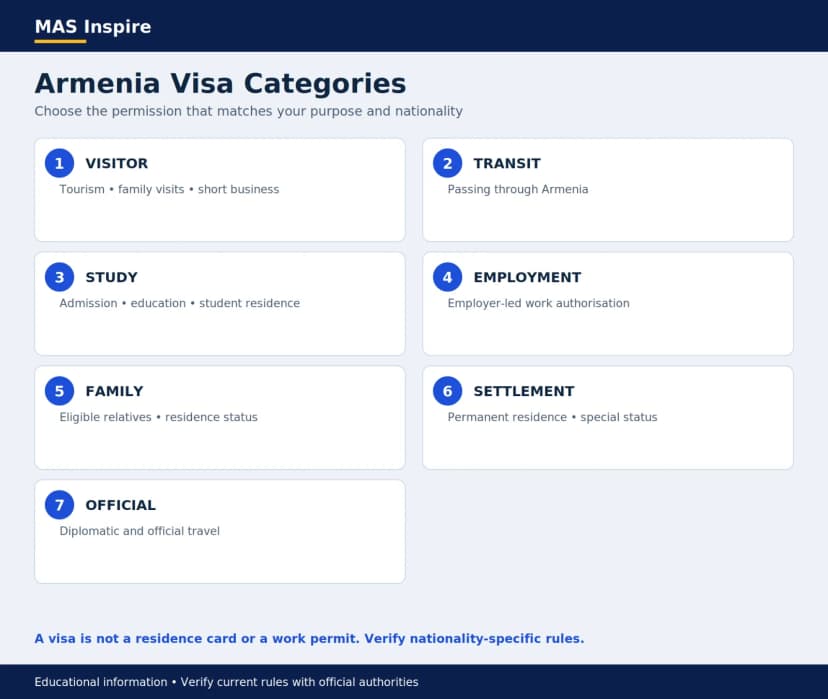
1. Visitor visa
The visitor category covers short visits such as tourism, private visits and qualifying business visits. Depending on the approved visa, it may permit a stay of up to 21 days or up to 120 days. Multiple-entry visitor visas are also listed in the MFA fee schedule. A visa’s validity and the maximum permitted stay are separate concepts; read the actual visa sticker or electronic grant.
The standard e-Visa system lists visitor options for up to 21 days and up to 120 days. Applicants must be eligible for the electronic route. Some nationalities were required to obtain an invitation and apply through a diplomatic mission instead; that list was repealed with effect from 16 June 2026.
2. Visa-free entry
Citizens of countries covered by Armenia’s unilateral exemptions or bilateral/multilateral agreements may enter without obtaining a visitor visa, subject to the exact terms for their passport. The MFA states a general maximum of 180 days in one year for visa-free visitors unless an international agreement provides another period. This is not a universal entitlement: check the country-specific rule and passport type.
3. Electronic visa (e-Visa)
The official e-Visa system is operated by Armenia’s MFA. It offers eligible applicants a fully online visitor-visa application, payment and status-check process. The portal currently displays USD 8 for a visitor visa of up to 21 days and USD 39 for up to 120 days. The published standard processing period is up to three working days, but additional document requests or checks can delay a case. The fee is non-refundable.
The e-Visa was not available to every nationality while the invitation-only list was in force. That list was repealed with effect from 16 June 2026 (Government Decision 643-N), and the MFA has confirmed the e-Visa is open to nationals of all countries, including Pakistan. The repeal is temporary and may be reversed, so confirm the live eligibility position on the portal before applying.
4. Transit visa
Armenia’s official fee schedule lists single-entry and multiple-entry transit visas. A transit visa is relevant to a traveller passing through Armenia where a visa is required; it is not a substitute for a visitor visa if the traveller intends to enter for tourism or another non-transit purpose. Confirm whether the itinerary and nationality require a transit visa with the MFA or responsible mission.
5. Study and student residence
Study is a recognised ground for temporary residence status. A foreign student should first secure admission from an Armenian educational institution and then follow the applicable entry-visa and residence process. The Migration and Citizenship Service (MCS) lists foreign students studying at Armenian educational institutions among groups whose temporary residence status is granted free of charge. The exact entry visa, if required, remains a separate question.
6. Employment and employer-sponsored residence
For most foreign hires, the Armenian employer initiates the application through the official work permit system. The MCS says employers submit employment-based residence applications online. After the Ministry of Labour and Social Affairs consents to employing the foreign national, the employer must complete the foreign employee’s personal data within 15 working days. The MCS publishes a 30-day period for issuance of the employment-based residence card after the employer submits the application. EAEU citizens have a different permission framework.
There is no general-purpose job-seeker visa identified in the official visa categories reviewed for this guide. A person should not enter as a visitor and assume that this creates a right to work.
7. Entrepreneur and business residence
Entrepreneurial or business activity is recognised as a possible basis for temporary residence; the MFA also lists business activity as a potential basis for permanent residence. This is not an automatic investor visa. Applicants must substantiate the qualifying activity and satisfy the MCS requirements. The official material reviewed does not establish a universal minimum investment amount or a standard digital-nomad visa.
8. Family reunification
Eligible family relationships can support temporary residence. The MFA lists spouses, parents and children of certain Armenian residents, and specified relatives of Armenian citizens or special-passport holders. The MCS describes close-relative grounds and lists free temporary residence for specified close relatives of Armenian citizens. The precise relationship and sponsor’s status matter; not every extended family relationship qualifies.
9. Permanent and special residence
Armenia distinguishes temporary residence cards, permanent residence cards and special passports. The MFA lists temporary cards for up to one year, permanent cards for five years and special passports for ten years. Permanent residence eligibility includes certain family relationships with Armenian citizens or special-passport holders combined with adequate accommodation/property and three years of lawful residence, business activity, or Armenian origin. Special residence is a separate status and should not be confused with ordinary permanent residence.
10. Official and diplomatic visas
Official and diplomatic visas are issued for qualifying official or diplomatic purposes. The MFA fee table lists these categories as free. They are not general-purpose alternatives for ordinary visitors.
11. Exchange, internship, research and training
The official sources reviewed do not establish a separate general visa class for every exchange, internship, researcher or training scenario. The correct route depends on the activity, institution, host and whether work or a residence basis is involved. Obtain written guidance from the host institution and Armenian authorities before travel.
12. Humanitarian protection
A person seeking asylum or international protection should use the Armenian protection procedures and seek specialist legal or humanitarian assistance. This is not a visitor-visa route and should not be treated as a normal migration or work category. Border rules recognise that asylum claims are treated differently from ordinary inadmissible entry cases.
Visa comparison table
| Route | Main purpose | Permission / stay | Work rights | Key point |
|---|---|---|---|---|
| Visa-free | Short visit | Country-specific; general rule up to 180 days/year unless agreement differs | No general employment right | Check exact nationality and passport |
| Visitor e-Visa | Tourism / qualifying short visit | Up to 21 or 120 days, as granted | No | Only eligible nationalities |
| Visitor visa via mission | Visitor purposes | Up to 120 days in general visa framework | No | Fallback if the invitation-only list returns (suspended since 16 Jun 2026) |
| Transit visa | Transit | As issued | No | Not for a substantive visit |
| Student residence | Study | Temporary residence, generally up to one year and renewable | Not a general work authorisation | Admission and residence basis required |
| Employment-based residence | Local employment | Residence card, normally up to one year | Within approved employment framework | Employer applies via workpermit.am |
| Family residence | Qualifying family link | Temporary residence; other routes depend on eligibility | Not automatically unrestricted | Relationship and sponsor evidence needed |
| Permanent residence | Long-term settlement | Five-year card, renewable | Subject to applicable law | Must meet a statutory ground |
| Special residence | Special statutory grounds | Ten-year special passport | Confirm case-specific rights | Separate from permanent card |
Eligibility requirements
Eligibility depends on citizenship, travel-document type, purpose, invitation status and any relevant residence or sponsor relationship. Applicants should confirm all of the following:
- Whether their nationality is visa-exempt, e-Visa eligible, visa-required or invitation-only.
- Whether the application must be lodged at an Armenian diplomatic mission abroad.
- Whether an invitation must be submitted before the visa application.
- Whether the passport meets the validity and condition requirements specified by the issuing authority.
- Whether the declared purpose matches the visa category.
- Whether the applicant can provide credible evidence of accommodation, funds, itinerary, host, admission, employment or family relationship as relevant.
- Whether they are legally resident in the country from which they plan to apply, if the mission requires proof of local residence.
The MFA’s temporary visa exemption effective 1 July 2026 to 1 July 2027 applies to nationals of 111 specified countries who hold qualifying residence permits issued by the United States, EU member states, Schengen states, UAE, Bahrain, Qatar, Saudi Arabia, Kuwait or Oman, valid for at least six months from entry. A Vietnamese residence permit is not among the listed issuing jurisdictions. This temporary measure should be checked against the live MFA list before travel.

Complete document checklists
The lists below are planning aids, not a promise that every item is mandatory in every case. The responsible mission or portal may request additional evidence.
Visitor / e-Visa checklist
| Document | Status | Notes |
|---|---|---|
| Passport/travel document scan | Mandatory for e-Visa | Use the correct document type and issuing country |
| Completed application form | Mandatory | Submit through the official portal or mission form |
| Recent photograph | Mandatory for e-Visa; check mission instructions | Follow image specifications |
| Official fee payment | Mandatory | Non-refundable where stated |
| Invitation | Conditional | Required for nationalities on invitation-only list |
| Flight itinerary / accommodation | Supporting | Provide consistent travel plans if requested |
| Bank statement / proof of means | Supporting / may be requested | No universal minimum balance identified in reviewed official material |
| Travel medical insurance | Supporting / check route | Do not assume it is universally mandatory unless instructed |
| Prior visas / residence permits | Supporting / may be requested | Useful where relevant to travel history |
Invitation-only applicants (suspended since 16 June 2026)
This procedure is currently suspended: the invitation-only list was repealed with effect from 16 June 2026 and the MFA no longer processes stand-alone invitation letters. It is described here only in case the list is reinstated. The MFA states that invitations should be submitted through e-request.am. Invitations may be presented by Armenian-registered legal entities, government bodies, local self-government bodies, accredited diplomatic missions and international organisations. Individuals submit invitations to the Migration and Citizenship Service. The MFA visa page describes the invitation package as including the prescribed invitation, a copy of the invited person’s passport, visa application and proof of the applicable invitation-related state fee. Confirm the current invitation fee and procedure before payment.
Temporary residence checklist
| Document | Status | Notes |
|---|---|---|
| Application form | Required | Completed at the service point for ordinary temporary residence |
| Three colour photos, 35 × 45 mm | Required | As specified by MCS |
| Passport and copy | Required | Include notarised Armenian translation |
| Evidence of residence ground | Required | Study, work, business, family or other lawful ground |
| Medical certificate | Required on published MCS checklist | Confirm form and validity |
| State-duty payment receipt | Required unless exempt | Fee exemptions apply to listed groups |
| Birth/family documents | Conditional | MCS lists additional documents for relevant child/family cases |
Employment / student / family supporting evidence
Students should prepare admission or enrolment evidence, programme details and identity documents. Employees should coordinate with the employer because the employer-led online application is central to the employment-based procedure. Family applicants should prepare civil-status records, proof of the relationship and the sponsor’s Armenian status. Foreign-language documents may need translation, notarisation or legalisation; ask the receiving authority for the exact format before ordering translations.
How to apply: step-by-step
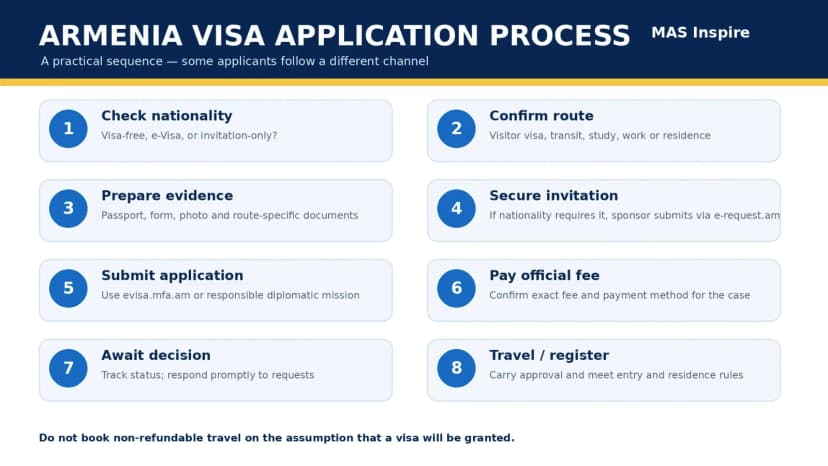
- Choose the correct category. Define the real purpose: visit, transit, study, employment, family residence or settlement.
- Check nationality and residence rules. Use the MFA visa search tool with the exact passport type. Do not assume that a Vietnamese residence permit overrides a nationality-based restriction.
- Confirm whether an invitation is required. If the passport nationality is on the invitation-only list, arrange the invitation before attempting a visitor visa application.
- Prepare documents. Follow the checklist for the selected route. Keep names, dates, itinerary and purpose consistent.
- Use the official channel. Eligible visitor applicants use evisa.mfa.am. Others should contact the responsible Armenian embassy or consulate. Residence applications are handled through the MCS; employment applications are employer-led through workpermit.am.
- Complete the form accurately. Do not omit refusals, prior travel or material facts requested by the authority.
- Pay the official fee. Confirm the fee for the exact category and current payment channel. Retain the receipt.
- Attend any appointment or interview. Biometrics or an interview may depend on the mission and case. Do not assume a universal biometric requirement from the sources reviewed.
- Track and answer requests. Use the official status-check method or mission contact. Supply further information within the stated deadline.
- Check the decision before travelling. Verify name, passport number, validity, entries and permitted stay. At the border, carry supporting documents and comply with entry conditions.
Visa fees and financial requirements
The MFA consular fee page states that its displayed fees are valid from 1 January 2026. Published amounts include:
| Service | Official fee |
|---|---|
| Visitor visa, up to 21 days | AMD 3,000 / USD 8 / EUR 7 |
| Visitor visa, up to 120 days | AMD 15,000 / USD 39 / EUR 34 |
| Multiple-entry visitor, up to 60 days, six-month validity | AMD 20,000 / USD 52 / EUR 46 |
| Multiple-entry visitor, up to 120 days, one-year validity | AMD 40,000 / USD 103 / EUR 91 |
| Single-entry transit visa | AMD 10,000 / USD 26 / EUR 23 |
| Multiple-entry transit visa, one-year validity | AMD 18,000 / USD 47 / EUR 41 |
| Temporary residence card, up to one year | AMD 105,000 |
| Permanent residence card, five years | AMD 140,000 |
| Special passport, ten years | AMD 150,000 |
Official e-Visa portal amounts are displayed as USD 8 and USD 39 for the two standard visitor periods. Fees are non-refundable where the schedule says so. The MCS lists free temporary residence for specified groups, including minors, qualifying close relatives of Armenian citizens and foreign students/teaching staff at Armenian educational institutions. Confirm whether an exemption applies to the applicant’s exact circumstances. The 2026 amendments raise residence duties (temporary residence to AMD 150,000 plus AMD 5,950 card issuance; permanent residence to AMD 250,000 plus AMD 5,950) — the new rates apply from 1 January 2027 at the latest, and the online-platform launch may trigger them sooner. Confirm the live fee on the MCS page before paying.
No universal minimum bank balance for all visitors was found in the official sources reviewed. Applicants should provide credible financial evidence where requested rather than relying on unofficial figures. Budget separately for translations, notarisation, travel, insurance and any service costs not included in the state fee.
Visa processing times and validity
| Procedure | Published period / validity | Important qualification |
|---|---|---|
| e-Visa | Up to 3 working days | May take longer if extra checks/documents are requested |
| Entry visa through mission | National Services Gateway says typically within 15 days | Confirm mission-specific current estimate |
| Temporary residence card | 30 days; may be extended by another 30 days under the general administrative procedure | Apply on a valid residence basis |
| Employment-based residence | 30 days after employer submits application | Employer completes the online process |
| Temporary residence card validity | Up to one year | Renewable; extension application at least 30 days before expiry per MFA |
| Permanent residence card validity | Five years | Renewable for five-year periods |
| Special passport validity | Ten years | Separate special status |
Processing times are estimates or statutory service periods, not guarantees of approval. Do not purchase non-refundable travel based only on a quoted processing time. A visitor visa can be extended by up to 60 days at AMD 500 per day.
Applying from Pakistan or Vietnam
Pakistani passport holders legally living or working in Vietnam
Pakistan was expressly included in Armenia’s invitation-only list, but that list was repealed with effect from 16 June 2026 (Government Decision 643-N). Pakistani passport holders can currently apply for the visitor e-Visa online at evisa.mfa.am (USD 8 up to 21 days; USD 39 up to 120 days; decision within three working days). Because the repeal is temporary and the MFA website still shows the old rule, confirm the live eligibility position on the portal before applying or booking travel. If the invitation-only list is reinstated, the embassy-and-invitation route below applies again.
A Pakistani applicant should generally:
- If the invitation route is in force again, obtain a qualifying invitation from an eligible Armenian inviter and ensure it is submitted through the required channel.
- Contact the Embassy of Armenia in Hanoi before preparing a consular application. Ask whether it accepts applications from Pakistani nationals who are legally resident in Vietnam, whether it has jurisdiction, and what appointment, original-document and translation rules apply.
- Prepare the Pakistani passport, Vietnamese residence card/visa or other proof of lawful stay, the invitation, completed visa form, photograph and fee receipt, plus any evidence specifically requested by the Embassy.
- Ask whether the applicant must apply in Vietnam or whether the Embassy will direct them to another Armenian mission. The fact that an Armenian Embassy is present in Hanoi does not itself prove that it accepts every third-country national’s visa application.
Embassy of Armenia in Vietnam: N679, 73 D5C Vuon Dao, Phu Thuong Ward, Tay Ho District, Hanoi; telephone +84 24 37585228; email armvietnamembassy@mfa.am. Confirm current consular appointment arrangements before visiting.
Applying from Pakistan
A Pakistani citizen applying from Pakistan can currently use the same e-Visa route (see above). If the invitation-only list is reinstated, they should identify the Armenian diplomatic mission responsible for Pakistan (there is no Armenian embassy in Pakistan) and confirm the current filing location, invitation acceptance and document requirements. A move from Pakistan to Vietnam does not itself alter the passport-based rule.
Other nationalities applying from Vietnam
Non-Pakistani applicants should check the MFA visa tool using their own nationality and passport type. A valid Vietnamese residence permit may help establish lawful residence for a consular application, but it is not an Armenian visa and does not create a visa exemption by itself. The temporary exemption running from 1 July 2026 to 1 July 2027 names residence permits issued by specified countries and regions; Vietnam is not included in that list.
Student visa and residence guide
The first practical requirement is an offer or admission from an Armenian educational institution. From 1 November 2026 the educational institution files the student’s temporary-residence application through the unified electronic platform; students no longer apply independently. The student should ask the institution for an admission letter, enrolment confirmation, programme dates, fee information and any supporting documents it can provide. Next, check whether the student’s nationality requires a visitor/entry visa before arrival. The entry visa and the right to reside for study are separate legal steps.
The MCS recognises study as a ground for temporary residence. The general temporary residence checklist includes an application, three 35 × 45 mm colour photos, passport and copy with notarised Armenian translation, evidence of the residence ground, medical certificate and proof of state-duty payment. The MCS lists foreign students at Armenian educational institutions among categories receiving temporary residence status free of charge. Confirm that the specific institution and programme meet the authority’s requirements and ask whether the fee exemption applies before payment.
The reviewed official sources do not establish a universal student work entitlement. Students should obtain written advice before accepting paid work or an internship.
Work permission and employment
A foreign national intending to work in Armenia should secure a genuine offer and have the prospective employer check the work-permit process. The employer initiates the application online through workpermit.am, enters the vacant position and, after obtaining the relevant ministry consent, completes the foreign worker’s personal details within 15 working days. The MCS says the employment-based residence card is issued within 30 days after the employer submits the application and lists a fee of AMD 105,000.
The official process recognises certain exemptions and a different approach for EAEU nationals. Check the current exemption list in the application platform; do not assume that a particular occupation or nationality is exempt. A visitor visa or visa-free entry does not by itself authorise local employment. There is no general digital-nomad or job-seeker visa established in the official sources reviewed for this guide.
Family immigration and permanent residence
Temporary residence may be available to spouses, parents and children of certain Armenian residents, and to specified relatives of Armenian citizens or special-passport holders. The applicant should prepare official proof of relationship, the sponsor’s Armenian citizenship or residence status and any accommodation or other evidence requested.
Permanent residence is a separate status. The MFA identifies qualifying family applicants who have adequate accommodation/property and have legally lived in Armenia for three years, applicants conducting business activity in Armenia, and persons of Armenian origin. The permanent card is valid for five years and may be renewed for another five-year period. The permanent residence fee shown by the MFA is AMD 140,000. This is not an automatic conversion after a visitor visa; the applicant must meet a statutory basis and submit the supporting evidence.
Special residence status is separate and may be relevant to persons of Armenian origin or other statutory grounds. Its ten-year special passport should not be confused with citizenship or a standard permanent residence card. Confirm rights and eligibility with the MCS or an Armenian mission.
Common application mistakes and refusal risks
- Assuming the invitation-only list is still in force (repealed 16 Jun 2026) — or assuming it will stay repealed; check the live position on evisa.mfa.am before applying.
- Assuming residence in Vietnam overrides nationality-based restrictions.
- Treating a visitor visa as permission to work or study long-term.
- Submitting an invitation that has not been lodged through the required Armenian channel.
- Providing inconsistent travel dates, accommodation, purpose or sponsor details.
- Using an expired passport, incorrect photo or incomplete form.
- Failing to provide translations or civil documents in the format required by the receiving office.
- Paying a third-party website instead of the official government portal.
- Assuming a published processing time guarantees a decision by a travel date.
- Concealing prior refusals or providing false documents.
A refusal may result from failure to meet the legal category, missing or unreliable evidence, unresolved security or admissibility concerns, incorrect information or lack of a required invitation. The MFA says e-Visa fees are non-refundable and the granting of a visa is a sovereign decision. Review the refusal communication and seek qualified advice where appropriate; do not submit fabricated evidence or repeated applications without addressing the underlying issue.
Frequently asked questions
1. Do all nationalities need a visa for Armenia?
No. Some nationalities are visa-exempt, while others require a visa. The MFA visa search tool is the authoritative starting point.
2. Can Pakistani citizens apply for an Armenia e-Visa?
Yes — currently. The invitation-only list was repealed with effect from 16 June 2026 (Government Decision 643-N), and the MFA has confirmed the e-Visa is open to nationals of all countries, including Pakistan. Apply at evisa.mfa.am (USD 8 up to 21 days; USD 39 up to 120 days). The repeal is temporary, so confirm the live position on the portal before booking travel.
3. Can a Pakistani citizen apply from Vietnam?
Yes — the e-Visa is applied for online, so a Pakistani citizen resident in Vietnam can apply from Vietnam like any other applicant, subject to the live eligibility position (see FAQ 2). If a consular application is ever needed again, first ask the Armenian Embassy in Hanoi whether it accepts their application and what proof of lawful Vietnamese residence it requires.
4. Does a Vietnamese residence permit make a Pakistani citizen visa-exempt?
No general exemption follows from Vietnamese residence. The temporary 2026–2027 exemption names residence permits issued by specified jurisdictions, not Vietnam.
5. How much does an Armenia e-Visa cost?
The official portal displays USD 8 for a visitor visa up to 21 days and USD 39 for up to 120 days. Confirm the amount on the portal before paying.
6. How long does an Armenia e-Visa take?
The published standard processing time is up to three working days. Extra checks or requests can delay the decision.
7. Can I work in Armenia on a visitor visa?
A visitor visa does not itself grant local employment rights. An employer-led work-permit and residence process may be required.
8. How does an employer apply for a foreign worker?
The employer submits the application through workpermit.am and completes the employee details after the relevant ministry consent.
9. Can foreign students obtain residence in Armenia?
Yes. Study is a recognised ground for temporary residence, subject to admission and the MCS requirements.
10. Is temporary residence free for students?
The MCS lists foreign students, teaching staff and lecturers studying or working at Armenian educational institutions among groups granted temporary residence free of charge. Confirm the applicant and institution qualify.
11. How much does a temporary residence card cost?
The published standard fee is AMD 105,000, with exemptions for specified groups.
12. How long is an Armenian temporary residence card valid?
Up to one year, with the possibility of extension. Apply for extension at least 30 days before expiry as stated by the MFA.
13. How long is permanent residence valid?
The permanent residence card is valid for five years and can be extended for another five years.
14. Is there a digital nomad visa?
No general digital-nomad visa was identified in the official sources reviewed. A person should not assume that remote work automatically qualifies for a visitor or residence category.
15. Is a visa approval guaranteed if I submit all documents?
No. Complete documentation does not guarantee approval. The authorities assess each application under the applicable law.
Official immigration websites
- Armenian Ministry of Foreign Affairs — Visa rules
- MFA — Invitation-only nationality list
- MFA — Consular fees
- Official Armenia e-Visa portal
- National Services Gateway — Entry visa / e-Visa
- Migration and Citizenship Service — Temporary residence
- Migration and Citizenship Service — Employment-based residence
- MFA — Temporary and permanent residency
- Official work permit system
- Armenian Embassy in Vietnam
- Armenian Embassy in Vietnam — contacts
- Armenian National Security Service — Border crossing rules
Final checklist and conclusion
Before submitting an Armenia application, confirm the passport-specific route, check whether an invitation is mandatory, choose the correct visa or residence category, obtain current official forms, prepare the evidence and translations, verify the fee, and contact the responsible mission if applying from a third country. Pakistani passport holders in Vietnam should contact the Embassy in Hanoi before booking an appointment and should arrange the invitation first. Students and workers should distinguish entry permission from residence status and employment authorisation.
Armenia offers visitor, study, employment, family and settlement pathways, but each has its own legal basis and process. Use the official links above and obtain written confirmation where nationality, consular jurisdiction or an exemption is unclear.
Disclaimer: This guide is educational information, not legal advice and not an official publication of the Government of Armenia. Immigration rules, fees, eligibility and processing times can change. MAS Inspire does not guarantee visa approval. Applicants should verify all details with the Armenian MFA, Migration and Citizenship Service or the responsible diplomatic mission before making travel or financial commitments.