Argentina Visa Guide 2026: Types, Requirements, Fees and Application Steps
Contents
- Introduction
- Why visit, study and work in Argentina
- Types of visas
- Visa comparison
- Eligibility and documents
- How to apply
- Fees and processing
- Applying from Pakistan or Vietnam
- Study and work
- Family and permanent residence
- Mistakes and refusals
- FAQs
- Official websites
- Final checklist
Introduction
Argentina offers short-stay entry routes for visitors and a range of temporary and permanent residence categories for people intending to study, work, join family or establish longer-term residence. The correct route depends on your passport, purpose, length of stay, sponsor and where you are legally resident.
Do not assume that a tourist entry allows employment, that a residence permit is the same as a visa, or that a residence card issued by another country removes Argentina's nationality-based visa requirement. Pakistani passport holders need to plan for a visa and should allow time for consular review.
Why People Visit, Study, and Work in Argentina
Argentina attracts visitors to Buenos Aires, Patagonia, Iguazú Falls, Mendoza and its cultural and natural heritage. Students may enrol in recognised public or private institutions, while workers may be recruited by Argentine employers or transferred by an overseas company. Family-based residence is available to qualifying relatives. Argentina also has a temporary digital-nomad route, but it is restricted to nationals of countries that do not require a tourist visa—so it is not a route for Pakistani passport holders.

Types of Argentina Visas
1. Tourist visa
For tourism and recreation, with an authorised stay of up to 90 days. The general Cancillería checklist includes a passport valid for at least six months at entry, two 4×4 cm colour photographs, a completed and signed visa form, proof of income, return reservation, hotel booking and itinerary (or an invitation letter where appropriate), payment and a consular interview. The general published fee is USD 150 or EUR 150, paid in the local currency of the consular representation. The consulate may ask for additional evidence. A visa is discretionary; meeting the checklist does not guarantee issuance.
2. Business visa
For short business activities such as meetings and commercial visits, not ordinary local employment. The maximum authorised stay is 60 days. The published requirements include a valid passport, photos, application form, invitation from an Argentine host registered with RENURE, proof of commercial or employment activity in the applicant's country of residence, return travel reservation, accommodation evidence, fee and interview. Published consular fee: USD/EUR 200. Confirm whether the planned activity fits the business category; productive work may require a work/residence route.
3. Congresses, fairs, technical, scientific, artistic or professional activities
A special short-stay visa is listed for attending congresses and fairs or undertaking specified technical, scientific, artistic or professional activities, with a stay of up to 30 days. The official Spanish page lists a registered RENURE invitation, proof of occupation/activity abroad, travel and accommodation evidence, form, photographs and interview. Published fee: USD/EUR 200. Ask the consulate to classify the exact activity before applying.
4. Student visas
Argentina publishes different student routes depending on the duration and type of institution/programme. The official student visa page for studies under 365 days requires a programme of study and electronic student-data filing by the host institution with DNM; the institution must be registered with RENURE. Proof of sufficient funds, police documentation in specified cases, a signed form, photos, passport and interview are also listed. The fee is USD/EUR 150. For studies exceeding 365 days, the separate student visa +365 days route requires institution filing and RENURE registration, proof of funds, police certificates for applicants aged 16 or over, an affidavit, interview and a USD/EUR 250 consular fee, plus the migration fee. The consulate of the applicant's place of residence handles the long-duration route. The exact residence validity is determined by the category and decision, not merely the course's advertised duration.
5. Work / migrant-worker temporary residence
Foreign nationals hired for lawful paid employment under an employment relationship may qualify for temporary residence as migrant workers. The official DNM checklist includes a valid passport, Argentine police certificate (for applicants over 16), foreign police certificates for countries where the applicant lived more than one year during the previous three years (where applicable), proof of address and regular entry. The employer-side evidence includes a signed pre-contract setting out the parties, duties, hours, duration, work address and remuneration; employer CUIT/ARCA registration; employer registration in RENURE; and early employment registration (alta temprana) within 30 calendar days after the residence application begins. The DNM page states a one-year temporary residence, renewable. The visa application itself must be coordinated with the Argentine consular office at the applicant's place of residence. Do not work until the appropriate permission is in force.
6. Expatriate / transferred staff
Argentina lists a visa for expatriate staff transferred to Argentina by an employer. Applications are submitted to the Argentine consular office in the foreign national's place of residence. The public directory does not provide a universal fee or complete document list for every transfer scenario; obtain the relevant post's checklist and confirm whether the employer must be registered with RENURE and what corporate assignment evidence is required.
7. Digital nomad temporary residence
Argentina's digital-nomad temporary residence allows up to 180 days, renewable for an equal period, for remote services provided to people or companies domiciled outside Argentina. Critically, the official DNM service says this route is only for nationals of countries that do not require a tourist visa to enter Argentina. Applicants must show a valid passport, regular entry, Argentine criminal-record check (over 16), address, a CV, description of remote work, evidence such as contracts or income receipts, and a professional reference. The official service says the process is in person and not through Ra.D.Ex. The DNM fee table lists 120 consular units (about US$120) for the online application from abroad, plus a consular fee — confirm the current total before applying. Pakistani passport holders are not eligible under the published nationality condition.
8. Rentista (income from assets)
Temporary residence may be available to applicants who support themselves using lawful income from assets or sources abroad. The DNM requires income equivalent to at least five Argentine minimum living and mobile wages (SMVM) and evidence that the income comes from assets such as financial instruments, real estate or business interests—not remuneration for personal work. The transfer of funds into Argentina must be through financial institutions authorised by the Central Bank. A one-year temporary residence, renewable, is shown on the current DNM service page. The SMVM changes; do not convert this into a fixed USD figure without checking the current official wage value and exchange basis. At the November 2026 SMVM of ARS 398,800, five SMVM is ARS 1,994,000 per month (about US$1,300); the SMVM is revised monthly, so check the current value before applying.
9. Pensioner
A pensioner route exists for a person receiving a regular and permanent pension from a government, international organisation or private company for services performed abroad. The DNM service page specifies a minimum monthly amount equivalent to five SMVM. At November 2026 rates that is ARS 1,994,000 per month (about US$1,300); the SMVM is revised monthly. Evidence includes the pension award and recent pension receipts. The precise current validity, filing route and fee must be confirmed with DNM/consulate for the individual case.
10. Family reunification
Temporary residence for family reunification is available to qualifying spouses, parents and children of Argentine citizens, and qualifying spouses, parents or unmarried dependent children under 18 (or older children with disabilities) of temporary or permanent residents. The DNM page describes a maximum period of three years or the period authorised to the temporary-resident family member, renewable, with multiple entries. Applicants need identity, Argentine and relevant foreign police records where applicable, address and proof of regular entry, plus official evidence of the family relationship and the sponsor's status. A permanent visa route may apply to certain close relatives of Argentine citizens; confirm the correct procedure with the consulate.
11. Permanent residence and settlement
The DNM permanent-residence page lists qualifying family relationships, qualifying temporary residence history and certain other legal bases. Its published guidance states that a non-Mercosur national may qualify through three years of temporary residence, subject to conditions including actual presence in Argentina for at least 50% of the authorised period and not being outside the country for six consecutive months or more. The permanent-residence application requires identity, criminal-record evidence, address, regular entry and category-specific supporting documents. Permanent residence is not automatic merely because a person has lived in Argentina for a given number of years.
12. Transit, humanitarian and other special categories
Argentina's Migration Law recognises transitory subcategories including tourists, transit passengers, border-neighbourhood transit, international transport crew, seasonal migrant workers, academics, medical treatment and special cases. Humanitarian grounds and refugee protection are assessed under their applicable legal frameworks. These are not generic tourist visas. Contact DNM or the responsible consular authority for the route and current requirements. No general job-seeker visa or universal skilled-worker points system was identified in the official sources reviewed. Investor residence is recognised in the statutory framework, but applicants must obtain current case-specific criteria from DNM; do not assume a startup or investment plan alone qualifies.
Visa Comparison Table
| Route | Main purpose | Published stay / residence | Published fee (consular unless noted) | Work rights |
|---|---|---|---|---|
| Tourist | Tourism | Up to 90 days | USD/EUR 150 | No ordinary employment |
| Business | Meetings / commercial visits | Up to 60 days | USD/EUR 200 | Not a general work permit |
| Congress / technical / professional | Events and specified activities | Up to 30 days | USD/EUR 200 | Only activity authorised |
| Student under 365 days | Study | Course/category-based | USD/EUR 150 | Confirm restrictions with DNM |
| Student over 365 days | Long-term study | Course/category-based | USD/EUR 250 + migration fee | Confirm restrictions with DNM |
| Migrant worker | Local employment | DNM page: 1 year, renewable | Check current DNM/consular schedule | Yes, within authorised basis |
| Digital nomad | Remote work for foreign clients/employers | 180 days, renewable once | Not displayed on service page | Remote services for foreign-based clients only |
| Rentista | Foreign passive income | 1 year, renewable | Check Ra.D.Ex | Not a substitute for local employment authorisation |
| Family reunion | Qualifying family relationship | Up to 3 years / sponsor's temporary period | Check Ra.D.Ex/consulate | Depends on residence status and law |
| Permanent residence | Settlement | Permanent | Check DNM | Broad work access as resident |
Eligibility Requirements
Eligibility is a combination of nationality, purpose, duration, sponsorship, legal residence and personal admissibility. Start with the passport you will use, not the country where you currently live. A Pakistani citizen resident in Vietnam remains a Pakistani national for Argentina's visa-waiver analysis.
For consular visas, applicants generally need a valid passport, completed form, photographs, evidence supporting the trip purpose, funds/accommodation/travel arrangements where relevant, and an interview. For residence applications, DNM commonly requires identity, Argentine and foreign police certificates (depending on age and residence history), address and proof of regular entry, plus category-specific evidence. Foreign documents may need apostille or consular legalisation and certified Spanish translation. Follow the precise consular/DNM instructions; do not assume photocopies or English-language documents will be accepted without formalities.

Complete Document Checklists
| Document | Tourist / business | Student | Work / residence |
|---|---|---|---|
| Passport and copies | Mandatory | Mandatory | Mandatory |
| Visa form and photos | Mandatory | Mandatory | As instructed by consulate / DNM |
| Proof of funds | Income evidence | Sufficient funds | Category-specific |
| Return itinerary / accommodation | Usually required | As requested | Address in Argentina |
| Invitation / admission | Host invitation for business | Programme and institution filing | Employer pre-contract / family evidence |
| RENURE | Inviter for business/event | Host institution | Employer where applicable |
| Police certificates | May be requested | Specified longer study cases | Commonly required for residence applicants over 16 |
| Apostille / legalisation / translation | If requested | If applicable | Often required for foreign civil / police records |
| Interview | Yes on published consular routes | Yes | As instructed |
Conditional evidence: birth and marriage certificates, parental consent for minors, custody/guardianship records, professional credentials, medical records, proof of pension or passive income, tax/ARCA documents and sponsor identity documents. The authority can request additional material. This is not a fixed-count document list.
How to Apply: Step-by-Step
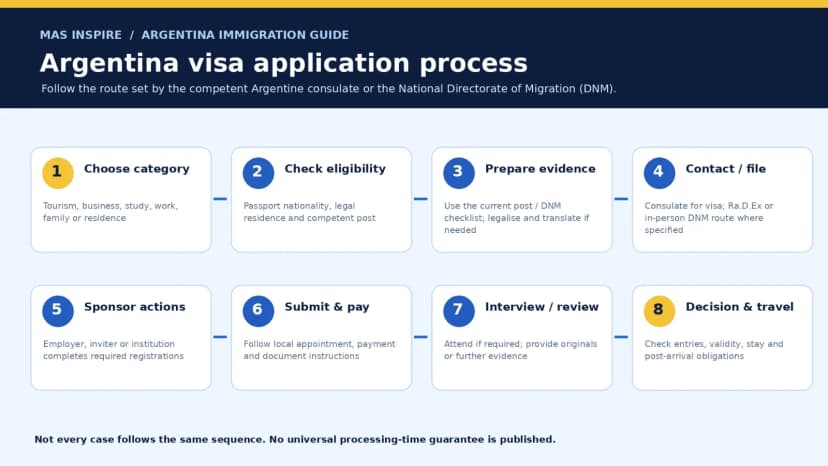
- Choose the correct category. Match the actual planned activity to tourism, business, study, employment, family or another recognised basis.
- Check nationality and residence rules. Pakistani passport holders require a visa. Confirm the competent consulate and whether it accepts an application from a third-country resident.
- Prepare documents. Use the current checklist from the specific consular post or DNM page. Arrange apostilles/legalisation and Spanish translations where required.
- Contact the authority. Tourist, business and other consular visas usually start by contacting the relevant Argentine consulate. Residence routes may use Ra.D.Ex; digital nomad applications follow the separate in-person DNM process.
- Complete the form and sponsor steps. Ensure employer, institution or inviter has completed any required RENURE or DNM filing.
- Submit and pay. Follow the consulate's method. Pakistan's embassy requires email submission in advance and says the fee is deposited after interview confirmation.
- Attend interview / appointment. Bring originals and any requested copies. Biometrics should be provided only if the authority instructs you to do so.
- Track the application. Use the method given by the consulate or DNM; no universal public processing-time guarantee is published.
- Receive the decision. Check visa class, entries, validity and authorised stay before travel.
- Travel and comply. Carry supporting documents, respect entry conditions and complete any residence formalities after arrival.
Not every application follows all ten steps. Ra.D.Ex residence cases and consular visa applications are different procedures.
Visa Fees and Financial Requirements
| Item | Officially published figure | Notes |
|---|---|---|
| Tourist visa | USD 150 or EUR 150 | Payable in local currency at the consular representation |
| Business visa | USD 200 or EUR 200 | Maximum stay 60 days |
| Congress / technical / professional visa | USD 200 or EUR 200 | Maximum stay 30 days |
| Student visa under 365 days | USD 150 or EUR 150 | Plus any separately applicable charges if advised |
| Student visa over 365 days | USD 250 or EUR 250 | Migration fee also applies |
| Rentista income threshold | At least 5 SMVM per month | Amount changes with official minimum wage |
| Pensioner threshold | At least 5 SMVM per month | Amount changes with official minimum wage |
| Other DNM residence fees | Not stated here | Check current DNM migration-fee table / Ra.D.Ex before payment |
Consular fees are not the same as DNM migration fees, translation, apostille, courier, travel or document costs. Do not use an old exchange-rate conversion as a fee quote. Confirm the exact local-currency amount and payment instructions before paying.
Visa Processing Times
The general Cancillería pages do not promise a universal processing time. The Embassy of Argentina in Pakistan instructs applicants to submit complete visa applications by email at least 45 days before the intended travel date; this is an advance-submission requirement, not a guaranteed decision time. Incomplete applications may not be processed. Applicants in Vietnam should ask the Embassy in Hanoi for a current estimate and appointment availability. Residence processing depends on the category, documentation and DNM workload. Avoid non-refundable travel bookings before visa issuance.
Applying from Pakistan or Vietnam
Pakistani passport holders
Pakistan passport holders require a visa for Argentina. The Argentine Embassy in Pakistan's tourist visa instructions, updated 31 August 2026, list a passport valid at least six months, two 4×4 cm photos, completed form, six months of bank statements certified by the bank, return itinerary, internal itinerary, secure hotel booking or properly formalised invitation, a signed visa request letter, employment evidence and the consular fee of USD/EUR 150. The embassy says applications for all visa purposes should be emailed at least 45 days before intended travel and an in-person interview is mandatory. This Pakistan-post checklist may be more specific than the general global checklist; follow the post responsible for your application. Argentina’s Electronic Travel Authorization (AVE) does not apply to Pakistani passport holders — Pakistan is not on the AVE nationality list, so a US visa does not replace the consular visa.
Pakistani citizens legally living or working in Vietnam
The Embassy of Argentina in Vietnam states that its consular jurisdiction covers the entire territory of Vietnam and lists its Hanoi contact details: 4th Floor, Leadvisors Place, 41A Ly Thai To Street, Hoan Kiem District, Hanoi; telephone +84 24 3831 5262; email eviet@mrecic.gov.ar (consular queries: consulareviet@mrecic.gov.ar). This confirms geographic jurisdiction, not automatic acceptance of every non-Vietnamese resident's application. Before preparing a full file, email the consular section with your Pakistani nationality, Vietnamese residence status, intended visa class, planned travel date and current city. Ask whether it will accept your application, whether you must apply in Pakistan, and whether additional proof of Vietnamese lawful residence is needed.
If accepted in Vietnam, prepare the Argentine consulate's requested documents and evidence of your lawful stay in Vietnam (for example, valid residence card/permit and relevant local status evidence) if requested. Do not assume a Vietnamese work permit or temporary residence card waives Argentina's visa requirement. The main practical difference from applying in Pakistan is the consular post and its local submission rules—not the underlying Pakistani nationality-based visa requirement. The Pakistan Embassy's 45-day rule applies to applications submitted to that post; do not assume Hanoi follows the same timeline. The Pakistan embassy’s own page states a tourist visa can be applied for at any Argentine embassy or consulate — it is not mandatory to apply at the place of residence — but Hanoi’s acceptance should still be confirmed in writing.
Student Visa Guide
Secure admission before applying. Ask the institution whether it is registered with RENURE and has electronically filed your student details with DNM. Confirm whether the course is under or over 365 days and whether the official or non-official education route applies. Prepare the programme, funds evidence, passport, photographs, form and police documentation/affidavit if applicable. For a programme longer than 365 days, apply through the consular office where you reside and budget for the USD/EUR 250 consular fee plus migration fee. Do not assume that student status grants unrestricted employment; confirm work rights for the exact residence class.
Work Visa and Job Opportunities
Secure a genuine job offer before starting the migrant-worker residence process. The employer must provide a compliant pre-contract and evidence of its registration and tax status, including RENURE and ARCA/CUIT records. The contract must state duties, hours, duration, work location and remuneration. A local job-seeker visa is not identified in the official categories reviewed. A business visa is not a substitute for a work authorisation. For an overseas employee transfer, ask the consulate about the expatriate-staff route and the corporate assignment evidence required.
Family Immigration and Permanent Residence
Family reunification depends on a legally recognised relationship to an Argentine citizen or a temporary/permanent resident. Prepare official civil-status records and proof of the sponsor's status; foreign records may need apostille/legalisation and Spanish translation. For permanent residence based on time in Argentina, the DNM page describes a three-year temporary-residence period for non-Mercosur nationals, together with presence and other conditions. Family-based permanent residence and the permanent route for children of Argentine citizens have their own rules.
Citizenship is separate from permanent residence. The current naturalisation page, reflecting Law 346 as amended in 2025, says adults born abroad must have held temporary or permanent residence for more than two years and have lived continuously and legally in Argentina for the two years before applying without leaving the country, with lawful means of support and other documents. It also recognises a relevant-investment route subject to official criteria. The investment route was announced on 2 October 2026 as a US$350,000 non-refundable contribution or a US$800,000 government bond, but no legal instrument had been published and applications had not opened as of mid-November 2026 — confirm before relying on it. Obtain legal advice before relying on a naturalisation strategy; citizenship eligibility and residence eligibility are not the same.
Common Application Mistakes
- Applying under a tourist or business category while intending to work locally.
- Assuming a Vietnamese residence permit changes Pakistani nationality-based visa rules.
- Applying to a consular post without confirming jurisdiction and acceptance of third-country residents.
- Using an unregistered inviter, employer or educational institution where RENURE registration is required.
- Submitting incomplete bank statements, unsigned forms or inconsistent travel plans.
- Ignoring apostille, legalisation or certified Spanish translation requirements.
- Treating the five-SMVM income threshold as a fixed currency amount.
- Booking non-refundable flights before the visa is issued.
- Confusing visa validity with authorised stay or residence validity.
Reasons for Visa Refusal
A consulate may refuse or decline to issue a visa where the applicant does not satisfy the category requirements, cannot substantiate the travel purpose or funds, provides inconsistent or incomplete evidence, fails to attend a required interview, has inadmissibility or immigration-compliance concerns, or cannot establish a credible plan to comply with the authorised stay. The authority may request additional evidence. Never submit false documents or conceal material facts. Follow the refusal notice and ask the issuing post whether review or a fresh application is available.
Frequently Asked Questions
1. Do Pakistani citizens need a visa for Argentina?
Yes. Official Argentine consular information identifies Pakistani passports as visa-required.
2. Can a Pakistani citizen apply from Vietnam?
The Argentine Embassy in Vietnam has nationwide jurisdiction, but public information does not guarantee that it accepts every third-country resident. Ask Hanoi in writing before applying.
3. Does a Vietnam residence permit remove the Argentina visa requirement?
No. It proves residence in Vietnam; it does not change Pakistani nationality.
4. How long can a tourist stay in Argentina?
The standard tourist visa permits up to 90 days, subject to the visa issued and entry decision.
5. How much is the tourist visa fee?
The general published fee is USD 150 or EUR 150, paid in local currency at the consular representation. Local procedures should be confirmed.
6. How much is an Argentina business visa?
The published fee is USD/EUR 200 and the authorised stay is up to 60 days.
7. Can I work in Argentina on a tourist visa?
A tourist visa is for tourism and does not authorise ordinary local employment.
8. Is there an Argentina digital nomad visa?
Yes, a 180-day renewable temporary-residence category exists, but it is limited to nationals of countries that do not require a tourist visa. Pakistani passport holders do not meet that published condition.
9. Can I study in Argentina for more than one year?
Yes. A separate student visa for studies exceeding 365 days is published, with institution filing, RENURE and other requirements.
10. Is there a job-seeker visa?
No general job-seeker visa was identified in the official sources reviewed. A qualifying job offer and work-residence route are generally needed.
11. What is the rentista income threshold?
At least five SMVM per month, from qualifying foreign passive income. Check the current SMVM value.
12. Can I obtain permanent residence after three years?
The DNM lists a three-year temporary-residence basis for non-Mercosur nationals, subject to presence and other conditions. It is not automatic.
13. Does Argentina publish a guaranteed visa processing time?
No universal guaranteed processing time was found. Pakistan's Embassy asks applicants to submit at least 45 days in advance.
14. Do I need an interview?
The published tourist, business and student consular procedures include an interview. The responsible post will confirm requirements for other routes.
15. Does a visa guarantee entry?
No. A visa does not remove border inspection or guarantee admission.
Official Immigration Websites
- Argentina Ministry of Foreign Affairs — visas directory
- Tourist visa
- Business visa
- Student visa under 365 days
- Student visa over 365 days
- Temporary residence — migrant worker
- Temporary residence — digital nomad
- Temporary residence — rentista
- Family reunification
- Permanent residence
- Migration Law 25,871 — updated text
- Naturalisation
- Embassy of Argentina in Vietnam — jurisdiction and contacts
- Embassy of Argentina in Pakistan — tourist visa
- Embassy of Argentina in Pakistan — general visa information
Final Checklist and Conclusion
Before applying, confirm your nationality's visa requirement, select the correct visa or residence category, identify the competent consulate, check whether it accepts applications from your country of legal residence, obtain the current checklist and fee instructions, arrange any required sponsor or institution registration, prepare authentic documents and certified translations, and allow sufficient time for an interview and decision. Pakistani citizens in Vietnam should first obtain written confirmation from the Argentine Embassy in Hanoi about local application acceptance.
Argentina's immigration rules provide several pathways, but each has specific conditions. A carefully prepared application improves clarity; it does not guarantee approval. Always rely on the current official instructions from Cancillería and DNM.
Educational information only; not legal advice. Immigration rules, fees and procedures can change. Confirm the requirements with the competent Argentine authority before making travel or financial commitments.