Antigua and Barbuda Visa Guide 2026: Types, Requirements, Fees and Application Steps
Research verified: 25 November 2026 Prepared for: MAS Inspire Status: Educational information for human review; not an official government publication.
Important: Immigration rules, fee schedules and entry decisions can change. Always check the Department of Immigration and the relevant application portal immediately before applying or travelling. A visa or eVisa does not guarantee admission at the border.
Table of contents
- Introduction
- Why People Visit, Study, and Work in Antigua and Barbuda
- Types of Antigua and Barbuda Visas
- Visa Comparison Table
- Eligibility Requirements
- Complete Document Checklists
- How to Apply: Step-by-Step
- Visa Fees and Financial Requirements
- Visa Processing Times
- Applying from Pakistan or Vietnam
- Student Visa Guide
- Work Visa and Job Opportunities
- Family Immigration and Permanent Residence
- Common Application Mistakes
- Reasons for Visa Refusal
- Frequently Asked Questions
- Official Immigration Websites
- Final Checklist and Conclusion
Introduction
Antigua and Barbuda is a twin-island state in the eastern Caribbean, known for its beaches, sailing, historic sites and tourism economy. Travellers may visit for holidays, business meetings, family visits, study or employment. The correct immigration route depends on nationality, purpose, intended length of stay and whether the person plans to work or reside in the country.
The Department of Immigration provides an electronic visa system for people whose travel documents require a visa. Some nationalities are exempt for short visits, while certain visa-required travellers may qualify for a tourist visa on arrival if they hold a qualifying third-country visa or residence card and meet the other conditions.
A visitor visa, work permit, student permission, residence permit and citizenship by investment are not interchangeable. In particular, a visitor entry permission does not itself authorize local employment. Applicants should identify the correct permission before buying non-refundable travel or making relocation plans.
Why People Visit, Study, and Work in Antigua and Barbuda
Visitors come for leisure, sailing, family visits, conferences and commercial meetings. Students may enrol at an approved educational institution. Employers may seek overseas workers where local recruitment and labour-permit requirements are satisfied. People with family ties or long-term residence may have routes to a residence permit.
The islands also operate a Citizenship by Investment Programme. This is a citizenship route subject to statutory due diligence and prescribed investment, government and other fees. It is not an ordinary visa and should not be marketed as a guaranteed or instant residence solution.
Types of Antigua and Barbuda Visas
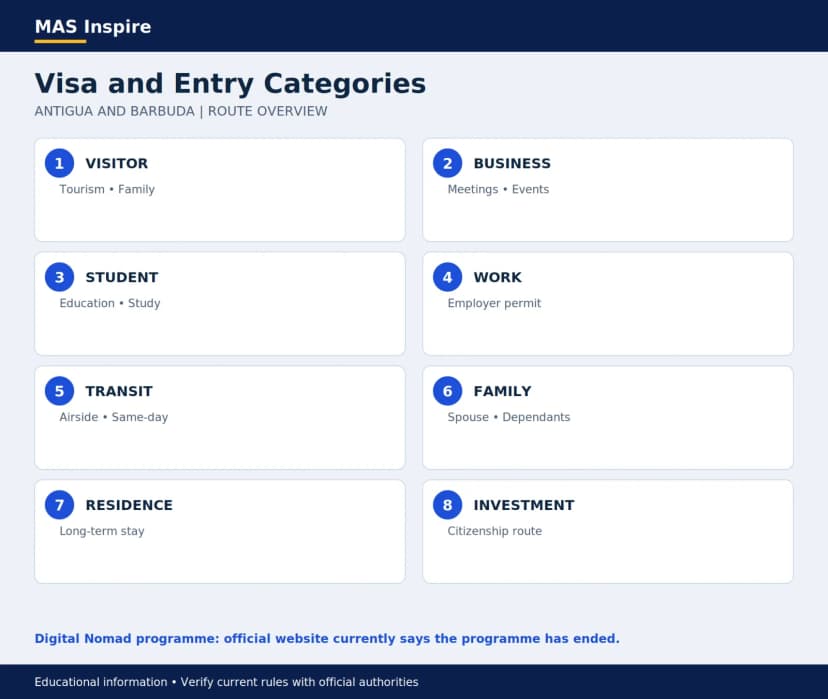
1. Tourist and visitor entry
A visitor permission is for a temporary visit such as tourism, visiting friends or relatives, or another permitted short-term purpose. Visa-required nationals generally apply through the official eVisa system. The eVisa FAQ says the passport or travel document should be valid for at least six months from the intended arrival date.
The immigration officer at the port of entry makes the final admission decision. Visitors should be prepared to show a return or onward ticket, accommodation details and evidence that they can support themselves. The precise period of stay is determined by the permission granted; do not assume that the visa's validity period is the same as the authorized stay.
2. Business visitor
The general visa information page recognizes short visits for holiday or business by nationals who are visa-exempt, subject to conditions including a stay no longer than six months, onward or return ticket, accommodation confirmation, sufficient means and a valid passport. Visa-required business visitors should use the appropriate visitor visa process and accurately state the business purpose.
A business visit is not permission to take local employment, provide services as a locally hired worker or undertake activities that require a work permit. For conferences or official delegations, check any event-specific government instructions.
3. Student permission
Antigua and Barbuda has student permit arrangements administered through Immigration. The published student-permit FAQ says a visitor who entered for a vacation cannot simply change status to student while in the country. Applicants should arrange the correct student permission before commencing studies.
The residence-permit FAQ lists an acceptance letter, evidence of accommodation, notarized sponsorship letter, financial-support letter, passport, police certificate, health certificate and insurance among the documents for a student attending an educational institution. It also states that students under that status are not permitted to work. The student FAQ says unpaid work connected with studies may be permitted, but ordinary gainful or unpaid occupation is prohibited; it identifies specific internship, research or training situations where a work permit is required. Confirm the exact rule for the programme with Immigration and the institution.
4. Work permit and employer-sponsored employment
Non-citizens generally require a work permit to work lawfully. The official government forms directory lists a Work Permit Form under the Department of Labour. The Immigration Department's extension FAQ explains that a work permit is granted by the Labour Department, while the Immigration Department separately handles the person's entry permission and passport endorsement.
A work permit is not a visitor visa, nor does it automatically create permanent residence. The employer and prospective employee should obtain current Labour Department instructions on sponsorship, recruitment evidence, occupation, duration, fees and renewals. The official public sources reviewed for this guide did not provide a reliable, current consolidated schedule of work-permit fees or processing times.
5. Job seeker and skilled-worker routes
No separate general job-seeker visa or points-based skilled-worker immigration category was verified in the official immigration material reviewed. A person should not travel as a visitor intending to start local employment without first securing the required work authorization. CARICOM and OECS nationals may have distinct free-movement or skills-certificate arrangements; those rules should not be assumed to apply to other nationalities.
6. Digital nomad / Nomad Digital Residence
The official Nomad Digital Residence website currently displays the statement “This program has ended.” Although legacy pages still describe former eligibility criteria, fees and a two-year stay, those details must not be treated as an open application offer. There is no current basis in the reviewed official information to recommend this programme to new applicants.
7. Entrepreneur, startup and investor options
No general startup or entrepreneur visa was verified in the public immigration visa categories reviewed. Business investors may investigate the Citizenship by Investment Programme's approved business-investment option, but that is a citizenship programme with specific investment thresholds and due diligence, not a standard investor residence visa. Ordinary company formation or investment does not by itself confer permission to live or work in the country.
8. Family, spouse and dependent arrangements
A person married to an Antiguan and Barbudan citizen may apply for a resident permit after meeting the published marriage-duration and other conditions. The Immigration Department's residence page says a person married to a citizen for at least one year may apply, provided the person meets the other legal requirements. The residency FAQ lists a marriage certificate, evidence of the spouse's citizenship, passport, police certificate, health certificate and insurance.
Dependants of work-permit holders do not automatically acquire a right to reside or work. The extension FAQ says that ordinarily a work-permit holder cannot simply bring a spouse or children to live in the country without a separate application and approval by the Chief Immigration Officer.
9. Permanent residence / resident permit
The Department of Immigration states that a person who has been legally and ordinarily resident for at least four years, or married to an Antiguan and Barbudan citizen for at least one year, may apply for a resident permit. The applicant must not have entered illegally, must intend to remain permanently and must not have been convicted of an offence. This is an application pathway, not automatic permanent residence after four years. A resident permit is normally granted for three years, and the holder must reside in Antigua and Barbuda for at least half of the permit’s validity.
Published documents include proof of prescribed fee payment, police certificates from Antigua and Barbuda and places where the applicant lived for more than six months, a health certificate, evidence of tax contributions, passport bio page and birth and/or marriage certificate. Further documents may be requested.
The residency FAQ also identifies distinct categories, including work-permit holders who have resided for at least four years and persons of independent means who have lawfully resided for at least two years. Eligibility is category-specific and should be confirmed before applying.
10. Transit
The official visa application process says same-day transit passengers who would normally require a visa do not need one if they have proof of onward travel within 24 hours and remain within the airport's controlled space. This exception should not be assumed to cover an overnight stop, airport exit or a change of itinerary. Confirm with the airline and Immigration before departure.
Cruise-ship visitors who would normally require a visa are stated to be exempt when they arrive in the morning and depart the same day. This is a narrow cruise exception, not a general visitor exemption.
11. Exchange, internship, training and research
No separate broad exchange, researcher or internship visa category was verified. The student-permit FAQ addresses internships longer than three months when integral to a course, and employment connected with approved research or training, as situations that may require a work permit. Obtain written guidance from the educational institution, host organization and Labour Department before the activity begins.
12. Humanitarian protection
People who fear persecution or serious harm should seek advice from the competent Antiguan and Barbudan authorities or a qualified refugee-law professional. This guide does not identify a dedicated online humanitarian visa category or publish a complete asylum procedure. Humanitarian protection should not be confused with an ordinary visitor visa.
Visa Comparison Table
| Route | Main purpose | Permission / authority | Work rights | Fee and duration |
|---|---|---|---|---|
| Visitor / tourist eVisa | Holiday, family visit, short visit | Immigration eVisa | No local employment | US$100 single-entry / US$200 multiple-entry (portal — confirm); stay shown in approval |
| Visa on arrival | Qualifying tourist visit for some visa-required nationals | Immigration at port of entry | No | US$100 per passenger |
| Business visitor | Meetings or short business visit | Visitor permission / eVisa as applicable | No local employment | Check portal; stay as granted |
| Student permit | Attend an educational institution | Immigration student permission | Generally no; narrow study-related exceptions | Current fee not verified |
| Work permit | Authorized employment | Labour Department permit plus immigration endorsement/permission | Only as authorized | Current fee and duration must be confirmed |
| Transit exception | Same-day air transit | Airport controlled-space exception | No | No transit visa if conditions met |
| Resident permit | Qualifying long-term residence/family grounds | Immigration Department | Depends on underlying status and conditions | Prescribed fee; confirm current amount |
| Citizenship by Investment | Citizenship through approved investment | Citizenship by Investment Unit | Citizenship rights after approval | Investment and government fees apply |
| Digital Nomad | Remote work for foreign employer | Programme | Legacy programme | Programme ended |
Eligibility Requirements
The first eligibility test is nationality. The official visa-exemption list should be checked using the passport that will be used for travel. Pakistani nationals are expressly listed among Commonwealth nationals who require a visa. A residence permit issued by Vietnam does not change Pakistani nationality or independently remove the Antigua and Barbuda visa requirement.
Visa-required travellers should also assess whether they qualify for the limited tourist visa-on-arrival facility. The Immigration Department says this can apply to holders of a valid US visa or permanent resident card, Canadian visa or permanent resident card, UK visa or resident card, or Schengen visa or resident card. The visit must be solely for tourism or a casual visit; the traveller must not have residence or occupation in Antigua and Barbuda, must hold a passport valid for at least six months, and must show assured financial standing, a return ticket and sufficient maintenance funds. The facility does not apply to diplomatic or official passport holders.
A person who does not meet the arrival-visa conditions should obtain the appropriate eVisa before travelling. The eVisa FAQ advises applying at least seven working days before departure, while noting expedited processing may be available for an additional charge.
Complete Document Checklists
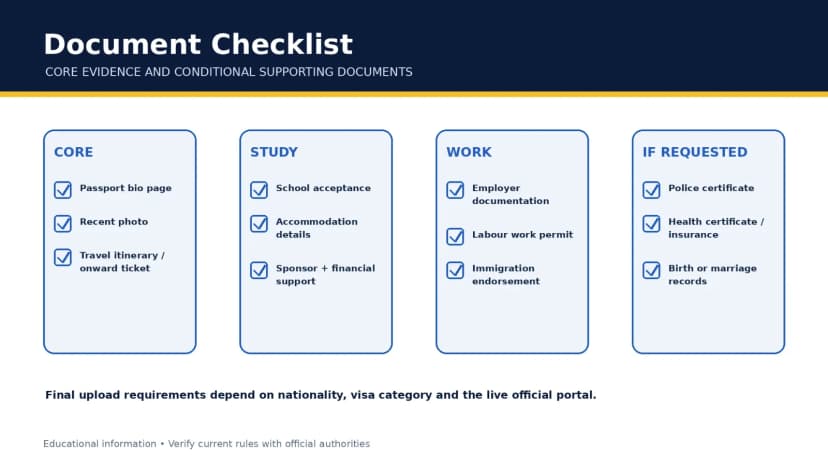
The checklist below separates published requirements from prudent supporting evidence. The exact upload list is generated by the official application flow and can vary by nationality and visa type.
| Document | Visitor eVisa | Student | Work permit / employment | Resident permit |
|---|---|---|---|---|
| Passport bio page | Required | Required | Required | Required |
| Passport validity | At least 6 months from arrival for eVisa | Confirm with Immigration | Confirm with Labour/Immigration | Valid passport |
| Recent photograph | Required; 45 × 35 mm in eVisa instructions | As requested | As requested | As requested |
| Return/onward ticket | Journey evidence required | As requested | May be required for entry extension | Listed in some residence FAQ categories |
| Accommodation | Recommended / may be requested | Required in student residence checklist | As requested | As requested |
| School acceptance | Not applicable | Required | Not applicable | Required for student category |
| Financial evidence | As requested / demonstrate maintenance | Financial support letter | As requested | Financial sustainability for some categories |
| Sponsor / invitation | If relevant | Notarized sponsorship letter listed | Employer documentation | Depends on category |
| Police certificate | May be requested by nationality | Listed | May be requested | Required |
| Health certificate / insurance | As requested | Listed | May be required | Listed |
| Marriage / birth evidence | If relevant | For dependants | For dependants | Required where relevant |
| Labour permit | Not applicable | Not applicable | Required for employment | Work-permit history may be relevant |
Visitor eVisa documents explicitly listed by Immigration: passport bio page, valid travel document and evidence of the proposed journey into and out of Antigua and Barbuda; the eVisa process page also specifies a recent colour photograph measuring 45 mm × 35 mm on a white background. Further requirements may be generated based on nationality and travel dates.
Student and residence documents: the Department's student and residency FAQs list additional evidence such as school acceptance, accommodation, sponsorship, financial support, police certificate, health certificate and insurance. Check the latest form and category-specific instructions.
Work permit: use the official Department of Labour form and obtain the current employer checklist directly from the Labour Department. Do not assume that the visitor eVisa checklist is sufficient for employment.

How to Apply: Step-by-Step
- Choose the correct route. Identify whether the trip is tourism, business, study, employment, transit or a longer-term residence application.
- Check nationality and residence. Use the official visa-exemption list. A foreign residence permit does not normally replace a visa required by the passport nationality.
- Check the relevant conditions. If relying on visa on arrival, verify every condition, including the qualifying third-country visa or residence card and tourist-only purpose.
- Prepare documents. Scan the passport bio page, photograph, travel evidence and any additional documents shown by the official portal.
- Use the official application channel. For eVisa, start from the Department of Immigration website and follow its Electronic Visa Process link. For a work permit, use the Department of Labour's official Work Permit Form.
- Complete the correct form accurately. Ensure names, passport number, nationality, dates and purpose match the passport and supporting evidence.
- Upload and pay. Pay only through the official government portal or other payment method confirmed by the responsible department. eVisa processing fees are non-refundable.
- Attend any requested appointment or interview. The published eVisa process is online; biometrics or an interview should not be assumed unless the authority requests it.
- Track and respond. Monitor the email address used in the application and respond promptly to requests for further evidence.
- Check the approval before travel. Confirm the visa details match the passport, print or save the approval, and carry onward-ticket, accommodation and financial evidence. Entry remains subject to the border officer.
Not every route follows all ten steps. Student, work and residence applications may require separate processes and approvals from different government departments.
Visa Fees and Financial Requirements
| Item | Published amount | Notes |
|---|---|---|
| Tourist visa on arrival | US$100 | Per passenger, including children; only for eligible travellers |
| eVisa | US$100 single-entry / US$200 multiple-entry (portal — confirm at checkout) | Official FAQ says the fee depends on visa type; check the portal before payment |
| Multiple-entry eVisa | Not separately stated in FAQ | One-year multiple-entry option is described; confirm price in portal |
| Student permit | Not verified | Contact Immigration for current prescribed fee |
| Work permit | Not verified | Confirm with Department of Labour |
| Resident permit | Prescribed fee | Current amount must be checked with Immigration |
| Digital Nomad | Not available | Programme ended; legacy prices are not current offers |
Citizenship by Investment: financial thresholds
The official Citizenship by Investment Unit currently lists the following minimum investment options:
| Investment route | Published minimum |
|---|---|
| National Development Fund contribution | US$230,000 |
| Approved real estate | US$300,000, held for at least five years |
| Sole business investment | US$1,500,000 |
| Joint business investment | US$5,000,000 total; each investor contributes at least US$400,000 |
| University of the West Indies Fund | US$260,000, inclusive of processing fees; for a family of six or more (one member gets a one-year tuition-only scholarship) |
These are not necessarily the total costs. Government processing fees, due-diligence fees, passport fees and other charges may apply to each family member. Government processing fees are US$10,000 for a single applicant and US$20,000 for a family of up to four (plus US$10,000 per additional dependant). The published fee schedule lists a principal-applicant due-diligence fee of US$8,500 and passport fee of US$300 per person. The official fee schedule is subject to change. Applicants must use an authorized agent and should review the current official schedule and eligibility rules before transferring funds. Citizenship also carries a presence condition: five days in Antigua and Barbuda within the first five calendar years.
Visa Processing Times
The eVisa FAQ recommends applying at least seven working days before departure and says expedited processing is available at an additional cost. The FAQ states a decision email is sent within seven working days of application, extendable to 15 days and exceptionally up to 30 days. This is advice, not a guaranteed service standard. The general eVisa FAQ does not publish a universal guaranteed decision time for every nationality or application type.
Current standard processing times for student permits, work permits and resident permits were not independently verified in a current consolidated government schedule. Processing may depend on completeness, checks, departmental workload and the need for additional evidence. Avoid booking non-refundable travel based solely on an estimated timeline from an agent.
Applying from Pakistan or Vietnam
Pakistani passport holders
The official government material identifies Pakistan among Commonwealth nationalities that require a visa. Pakistani ordinary passport holders should therefore plan to obtain an eVisa before departure unless they clearly qualify for the specific visa-on-arrival exception. Do not rely on the fact that Pakistan is a Commonwealth member as a visa exemption.
Pakistani nationals legally living or working in Vietnam
A Vietnamese temporary residence card, work permit or long-stay visa proves a person's status in Vietnam; it does not change the nationality of the passport used to enter Antigua and Barbuda. The applicant remains subject to the visa rules applicable to Pakistani passport holders.
The official sources reviewed do not confirm a dedicated Antigua and Barbuda visa application office in Vietnam or a special local filing arrangement for Pakistani residents. The electronic visa process is the most clearly documented route. Before applying, the applicant should:
- Use the Pakistani passport details in the application.
- Keep the Vietnam residence card and work permit available as evidence of lawful residence and ties to Vietnam, if requested.
- Provide a clear itinerary, accommodation and return or onward travel evidence.
- Include employment confirmation, approved leave and financial records if relevant to the portal's requirements or an officer's request.
- Check whether a valid US, Canadian, UK or Schengen visa or residence card creates eligibility for the tourist visa-on-arrival facility.
- Contact the eVisa Unit if the portal requests a local mission or residence-country detail that cannot be completed accurately.
Applying from Pakistan versus Vietnam
The core nationality-based visa requirement is the same. Applying online while physically in Vietnam does not create a different visa category or exemption. The practical difference is the supporting evidence: an applicant in Vietnam may use valid Vietnamese residence and employment documents to explain lawful residence, current work and intention to return. An applicant living in Pakistan would instead provide relevant Pakistani residence, employment and financial evidence.
Neither a Vietnam residence card nor a Pakistani national identity document guarantees approval. The applicant should not send original passports or pay an intermediary unless the official authority has confirmed the process.
Student Visa Guide
A prospective student should first obtain admission from an educational institution and ask the institution to confirm the correct immigration procedure. The Immigration Department's student-permit FAQ indicates that student status is distinct from visitor status and that a person who entered as a tourist cannot simply switch to student status while in Antigua and Barbuda.
The published student residence checklist includes:
- School acceptance letter.
- Evidence of a place of residence.
- Notarized sponsorship letter.
- Financial-support letter confirming the applicant can maintain themselves while studying.
- Passport.
- Police certificate of character.
- Health certificate.
- Proof of insurance.
The authority may request additional evidence. Student status does not ordinarily permit employment. The student FAQ describes limited study-related unpaid activity and says a work permit is required for certain internships longer than three months and approved research or training arrangements. Obtain written confirmation before accepting any placement or paid work.
Work Visa and Job Opportunities
There is no verified general job-seeker visa in the public immigration material reviewed. A person who has a job offer should ask the employer to coordinate with the Department of Labour about the work permit before the employee starts work.
The official forms directory publishes a Work Permit Form under the Department of Labour. Immigration's extension FAQ makes clear that the Labour Department's work permit and the Immigration Department's permission to remain are separate matters. A work permit holder remains a conditional visitor for immigration purposes and may need to maintain a valid entry permission or extension.
Do not work on a tourist visa or assume that a business visitor permission allows local employment. A permit may be limited by employer, role or period; confirm the exact endorsement before changing jobs or duties.
Family Immigration and Permanent Residence
A spouse of an Antiguan and Barbudan citizen may apply for a resident permit after at least one year of marriage, subject to the other legal requirements. The authority lists the marriage certificate, proof of the spouse's citizenship, passport, police certificate, health certificate and insurance among relevant documents.
The general resident-permit route is described for people lawfully and ordinarily resident for at least four years who intend to remain permanently and meet the statutory conditions. The Department also publishes distinct criteria for certain work-permit holders and persons of independent means. A work permit alone does not equal residence.
Family members of work-permit holders should not assume automatic derivative status. Immigration says separate approval may be required for dependants. Ask the Chief Immigration Officer before arranging relocation for a spouse or child.
Common Application Mistakes
- Applying under the wrong purpose, such as selecting tourism when the real purpose is employment.
- Assuming a Vietnamese residence card removes the visa requirement attached to a Pakistani passport.
- Relying on a visa-on-arrival exception without holding one of the qualifying third-country visas or residence cards.
- Treating the visa's validity period as the permitted duration of stay.
- Uploading a photograph that does not meet the stated size or background requirements.
- Entering passport details incorrectly or using a different name format from the passport.
- Failing to provide a return or onward ticket, accommodation details or financial evidence when requested.
- Paying an unofficial agent without confirming authorization.
- Starting employment or a course before the correct permission is issued.
- Relying on old digital-nomad programme pages even though the official site says the programme has ended.
Reasons for Visa Refusal
The Immigration Department retains discretion over visa decisions and admission. Potential problems include incomplete or inconsistent forms, invalid travel documents, unsupported travel purpose, insufficient evidence of maintenance or onward travel, failure to meet the relevant visa category, inaccurate declarations, or concerns arising from immigration or security checks.
A visa-on-arrival applicant may be refused that facility if the qualifying third-country visa or residence card is not valid, the visit is not solely tourism/casual visit, or the applicant cannot show the required passport validity, funds and return ticket. An eVisa holder can still be refused entry at the border.
Never submit fabricated bank statements, employment letters, invitations or residence documents. If refused, use the decision notice and official contact channel to understand whether a fresh application or other lawful remedy is available.
Frequently Asked Questions
1. Do Pakistani citizens need a visa for Antigua and Barbuda?
Yes. Pakistan is listed by the official government among Commonwealth countries whose citizens require a visa.
2. Can a Pakistani living in Vietnam apply online?
The official eVisa process is online and is the clearest published route. A Vietnamese residence permit does not remove the Pakistani passport's visa requirement.
3. Can Pakistani citizens get a visa on arrival?
Some visa-required travellers may qualify if they hold a valid US, Canadian, UK or Schengen visa or residence card and meet all tourist-only conditions. Confirm eligibility with Immigration before travel.
4. How much is the visa on arrival?
The Immigration Department publishes a fee of US$100 per passenger, including children.
5. What is the eVisa fee?
It varies according to the visa type. The official FAQ directs applicants to select the application type in the portal to see the amount. The portal lists US$100 for a single-entry eVisa and US$200 for a multiple-entry eVisa (confirm at checkout).
6. How long must my passport be valid?
The eVisa FAQ specifies at least six months from the intended arrival date.
7. How early should I apply?
The official FAQ advises applying at least seven working days before departure. This is not a guarantee of approval by that date.
8. Can I work on a tourist visa?
No. Non-citizens generally need a work permit for local employment.
9. Can I study on a visitor visa?
Student permission is separate. The student FAQ says a tourist cannot simply change visitor status to student after arrival.
10. Can international students work?
The published student-permit information generally prohibits employment, with narrow study-related exceptions. Obtain written confirmation before undertaking an internship or placement.
11. Is there a digital nomad visa?
The official programme website currently states that the programme has ended. Do not rely on legacy pages describing its former conditions or fees.
12. Is there a job-seeker visa?
No separate general job-seeker visa was verified in the official material reviewed.
13. How can I qualify for a resident permit?
The Department publishes a route for people legally and ordinarily resident for at least four years, and a separate route for a person married to an Antiguan and Barbudan citizen for at least one year, subject to conditions.
14. Does a work permit give permanent residence?
No. Immigration describes work-permit holders as conditional visitors with permission to work. Residence requires a separate qualifying application.
15. Does an eVisa guarantee entry?
No. Border officers retain the right to refuse entry, including to an eVisa holder.
Official Immigration Websites
- Department of Immigration: https://immigration.gov.ag/
- General visa information: https://immigration.gov.ag/visa-services/general-visa-information/
- Visa application process: https://immigration.gov.ag/visa-services/visa-application-process/
- Countries exempt from visa: https://immigration.gov.ag/visa-services/countries-exempt-from-visa/
- Visa on arrival: https://immigration.gov.ag/visa-services/visa-on-arrival/
- Visa FAQs: https://immigration.gov.ag/frequently-asked-questions/visa-faqs/
- Student permit FAQs: https://immigration.gov.ag/frequently-asked-questions/student-permit-faqs/
- Extension FAQs: https://immigration.gov.ag/frequently-asked-questions/extentions-faqs/
- Residence permit: https://immigration.gov.ag/general-services/residency/
- Government forms: https://forms.gov.ag/ministry_forms.php
- Citizenship by Investment Unit: https://cip.gov.ag/
- Citizenship investment fees: https://cip.gov.ag/schedule-of-fees/
- Nomad Digital Residence programme status: https://nomad.gov.ag/ui/
Final Checklist and Conclusion
Before travelling or applying, confirm:
- Your passport nationality against the official visa-exemption list.
- Whether you need an eVisa or meet every visa-on-arrival condition.
- That your passport has the required validity.
- That the application category matches the real purpose of travel.
- That every document is genuine, legible and consistent.
- That the correct fee appears in the official portal before payment.
- That student or employment permission is issued before starting the activity.
- That you understand the permitted stay and any extension requirements.
- That your eVisa approval matches your passport details.
- That you carry onward travel, accommodation and financial evidence.
- That any family member has the required separate permission.
Antigua and Barbuda offers different routes for visitors, students, workers, qualifying family members and investors, but the rules are not interchangeable. Pakistani passport holders need to pay particular attention to the nationality-based visa requirement, even when legally resident in Vietnam. The safest approach is to use official government channels, obtain the correct permission before travel and verify fees and requirements again immediately before applying.
Educational-information disclaimer: This guide is general information, not legal advice and not an official statement by the Government of Antigua and Barbuda. Immigration decisions are made by the competent authorities. MAS Inspire is an independent educational publisher and is not a government immigration authority, embassy, law firm or visa agency.