Table of contents
- Introduction
- Why People Visit, Study, and Work in Angola
- Types of Angola Visas
- Visa Comparison Table
- Eligibility Requirements
- Complete Document Checklists
- How to Apply: Step-by-Step
- Visa Fees and Financial Requirements
- Visa Processing Times
- Applying from Pakistan or Vietnam
- Student Visa Guide
- Work Visa and Job Opportunities
- Family Immigration and Permanent Residence
- Common Application Mistakes
- Reasons for Visa Refusal
- Frequently Asked Questions
- Official Immigration Websites
- Final Checklist and Conclusion
Introduction
Angola, on Africa's southwest Atlantic coast, attracts visitors for business, family visits, tourism, education, investment and employment. Luanda is the main international gateway and commercial centre, while the country's Atlantic coastline, national parks, cultural heritage and regional business links provide other reasons to travel.
The correct entry permission depends on both your purpose and your nationality. Angola has several distinct visa classes. A tourist visa does not authorise paid employment; a study visa is not a general work permit; and a work visa is tied to the employment that justified its issue. A residence-establishment visa is different from a temporary-stay visa.
Angola also has a tourism-only visa exemption for citizens of 98 listed countries. This does not mean that every visitor can enter visa-free, and it does not cover work, study or residence. Pakistani passport holders are not on the published list and should expect to need a visa unless a separate treaty-based exemption applies to their individual circumstances.
This guide is an educational resource, not legal advice and not an official Angolan government service. Immigration rules, forms, fees and procedures can change. Always obtain written confirmation from the responsible Angolan authority before committing to travel.
Why People Visit, Study, and Work in Angola
Tourism and culture: Travellers visit Luanda, coastal destinations, historic sites and natural areas. Tourism is the purpose covered by the 98-country exemption. Other nationalities generally need the relevant tourist visa or electronic authorisation if eligible.
Business: Angola's energy, infrastructure, construction, logistics, agriculture, mining and services sectors attract business visitors and investors. A business meeting or prospecting trip is not the same as taking up paid employment. Choose the appropriate ordinary/business or electronic business route and confirm permitted activities with the consular authority.
Education and training: The study visa covers formal study at public or private schools and vocational training centres, and can cover qualifying internships. It does not generally permit paid work, except an internship connected with the training.
Employment: Foreign nationals who will perform paid work need the work visa and employer documentation. The visa is limited to the specific professional activity and employer that applied for it.
Family and longer stays: Temporary-stay visas may be available for specified family, religious, research and humanitarian grounds. Those wishing to establish residence use the residence-establishment route and subsequent residence authorisation process.

Types of Angola Visas
Angola's Law No. 13/19 identifies the following relevant consular categories. The statutory description should be read alongside current operational instructions from the mission processing the application.
1. Tourist visa and tourism exemption
The tourist visa is for recreational, cultural or sporting visits and certain family visits or business-prospecting activities described by law. The law says it permits multiple entries, a stay of up to 30 days and extension twice. However, the current US Embassy service page describes use within 60 days and one renewal. The two figures describe different things: the 60-day figure is the e-visa/pre-authorisation use window (the electronic authorisation must be used to enter within 60 days of issue), while the visa itself is valid for 120 days with multiple entries and a stay of up to 30 days, extendable twice under Law No. 13/19. Confirm the exact validity and extension rules in writing with the responsible mission.
Citizens of 98 countries listed under Presidential Decree 189/23 are exempt from a tourist visa for up to 30 days per entry, with a 90-day annual ceiling. The exemption is for tourism only. Pakistan is not on the published list. Check the current list.
2. Ordinary / business visa
An ordinary visa is used for certain business and private/family visits that do not amount to paid employment. The precise scope and duration must be checked with the mission because current consular sites may present ordinary/business services differently from the law and older guidance. It does not authorise paid work. Business visitors should have a clear explanation of meetings, counterparties and itinerary and should not perform operational employment activities without the correct work permission.
The 2026 SME e-visa platform has been reported as handling supported tourist and business visa applications. Check evisa.ao to see whether your nationality and intended trip qualify. Do not assume all ordinary/business cases are eligible for online issuance.
3. Transit visa
A transit visa is for a traveller who must stop in Angola while travelling to a third country. Under Article 50, it is valid for 60 days, allows one or two entries and permits a stay of up to five days. It is not extendable under that provision. Applicants should provide evidence of onward travel and any transit itinerary required by the mission. Do not use a transit visa for a visit whose real purpose is tourism, business meetings or work.
4. Short-stay visa
A short-stay visa is intended for urgent travel. Article 52 states that it is valid for 72 hours, permits a stay of up to 10 days and may be extended once for an equal period. It does not permit paid work or establishment of residence. The 72-hour wording concerns visa validity, not a guaranteed processing time. The urgency and supporting evidence should be explained to the mission.
5. Study visa
A study visa is for attendance at a public or private school, vocational training centre or qualifying educational programme, and for internships in public or private organisations when connected to the programme. Law No. 13/19 provides multiple entries and a stay of up to one year, extendable for an equal period until studies are completed. It does not permit general paid employment; the statutory exception is an internship related to the training.
The Angolan Embassy's public checklist includes a completed and signed form, passport valid for six months, admission/enrolment evidence, proof of means of subsistence and vaccination certificate. A photograph is also listed among documents to bring. Ask the mission whether police clearance, medical evidence, accommodation and authenticated translations are required for your case. Study visa requirements.
6. Medical-treatment visa
This category is for treatment at a public or private hospital in Angola. Article 54 provides multiple entries and a stay of up to 180 days, extendable on justified grounds until treatment is completed. It does not authorise work or residence. Applicants should expect to document the receiving hospital, treatment plan, appointment or acceptance, funding and any companion arrangements. Confirm the exact checklist and fee with the mission.
7. Work visa
A work visa permits paid professional activity in Angola. Under Article 55, it allows multiple entries and a stay of up to 365 days, renewable for an equal period until the end of the contract. It only permits the professional activity for which it was issued and work for the employer that applied for it. It does not itself establish residence.
A job offer alone may not be enough: the employer normally has to provide the contract or promise of contract and supporting company/sector approvals required by the relevant authorities. The embassy's public list includes a signed form, passport valid at least six months, employment contract or promise, criminal-record certificate, medical certificate and international vaccination certificate. Work visa requirements.
There is no general job-seeker visa identified in the statutory list reviewed. Applicants should secure a legitimate employer-sponsored route before travelling to take up work.
8. Temporary-stay visa
Article 56 provides temporary-stay grounds that include a mission for a religious institution or NGO, scientific research and university mobility, accompanying certain visa holders, family members of foreign residents, and spouses of Angolan citizens. It also recognises specified humanitarian protection situations and certain victims of labour-related offences. The normal visa permits multiple entries and up to 365 days, renewable for an equal period while the underlying reason continues. Special statutory exceptions and permissions apply to certain family, research, employment-conflict and humanitarian cases.
The law allows paid work only in specified temporary-stay circumstances, including certain accompanying-family categories and a defined employment-conflict provision. Do not infer a general right to work from the visa name. The embassy checklist includes a completed form, passport valid six months, documented justification, criminal record, medical certificate and vaccination certificate. Temporary-stay requirements.
9. Residence-establishment visa
This visa is for a foreign national intending to establish residence in Angola. Article 57 describes multiple entries and an initial stay of 90 days, and authorises paid professional activity. It is an entry route, not the residence card itself: the applicant must follow the relevant procedure for residence authorisation after entry. Confirm the current deadline, documentation and residence-permit process with the competent SME office and mission.
10. Investor visa
The investor visa is a territorial visa granted by the migration authority to an investor or representative/attorney of an investing company for implementation of a registered investment proposal under the private-investment framework. Article 59 provides multiple entries and a stay of up to two years, renewable for equal periods in line with the investment purpose. After three years of uninterrupted stay on an investor visa, a temporary residence authorisation may be available if the investment authority confirms that the project remains valid. The route does not apply automatically to every entrepreneur, freelancer or small-business founder. Confirm the investment registration and immigration steps with AIPEX / Invest in Angola and SME.
11. Border visa
The border visa is an exceptional territorial category for unforeseen and duly justified circumstances where a traveller could not apply at a consular post. The law describes a single entry and a stay of up to 15 days, non-extendable, for specified technical or similar activities. It is not a routine substitute for applying in advance. In November 2026, Angola's public information agency reported that border visa applications moved to an exclusively online SME process from 20 November 2026. Verify the live procedure directly with SME before relying on a border application. SME notice reported 20 November 2026.
12. Diplomatic, official and courtesy visas
These are special-purpose categories for eligible diplomatic, official or service travel and are not ordinary visitor routes. They are generally handled through diplomatic channels and the appropriate note or official documentation.
Categories not identified as standalone routes
The statutory categories reviewed do not identify a general digital-nomad visa, startup visa, job-seeker visa or independent skilled-migration points programme. There is no separate generic exchange/researcher visa in the list; study or temporary-stay categories may cover qualifying internships, academic mobility or research. Do not advertise these as independent Angolan visa classes without new official evidence.
Visa Comparison Table
| Category | Main purpose | Statutory stay / validity summary | Work rights | Fee |
|---|---|---|---|---|
| Tourism | Recreation, culture, sport; specified visits | Law: up to 30 days; validity 120 days; operational mission page differs | No | Confirm with mission / portal |
| Visa-exempt tourism | Tourism for listed nationalities | 30 days per entry; 90 days per year | No | No tourist visa fee |
| Ordinary / business | Business prospecting or permitted private visit | Varies; confirm category-specific rules | No paid work | Check official portal / mission |
| Transit | Stopover en route | Valid 60 days; stay up to 5 days | No | Not officially published |
| Short-stay | Urgent travel | Valid 72 hours; stay up to 10 days; one equal extension | No | Not officially published |
| Study | Education / qualifying internship | Up to 1 year; extendable for equal period | Only qualifying course-related internship | Not officially published |
| Medical treatment | Hospital treatment | Up to 180 days; extension may be possible | No | Not officially published |
| Work | Employer-sponsored paid work | Up to 365 days; renewable until contract ends | Only approved role/employer | Not officially published |
| Temporary stay | Listed family, research, religious, humanitarian grounds | Up to 365 days; renewable while grounds continue | Only specified statutory situations | Not officially published |
| Residence-establishment | Establish residence | 90-day initial stay under Article 57 | Yes, under statutory terms | Not officially published |
| Investor | Registered investment project | Up to 2 years; renewable | Project-linked activity; confirm | Not officially published |
| Border | Exceptional unforeseen technical/similar entry | 15 days, single entry, non-extendable | Only the narrow permitted activity | Check SME portal |
Visa validity and authorised stay are different concepts. The visa sticker/approval and current law control the individual case. Mission guidance may vary and should be reconciled before travel.
Eligibility Requirements
Applicants should establish the following before beginning an application:
- Nationality: check the 98-country tourist exemption and any separate bilateral agreement. Pakistani citizens are not listed in the 98-country exemption list.
- Purpose: select the visa class that matches the real activity. Tourism, business meetings, employment, study and residence are not interchangeable.
- Place of application: apply through the Angolan mission responsible for your nationality or lawful residence, or through an electronic portal where the category and nationality are eligible. A residence card in a third country does not automatically create a right to lodge there.
- Passport: public mission guidance commonly requires at least six months' validity. Check blank-page and passport-condition requirements directly.
- Supporting evidence: show a credible itinerary, accommodation, funds, sponsor or host details, admission or employment evidence as relevant.
- Health and character documents: yellow-fever vaccination evidence is important. Police clearance and medical certificates apply to certain long-stay categories; verify whether translations and legalisation are required.
- No entry prohibition: applicants must not be subject to a legal bar to entry.
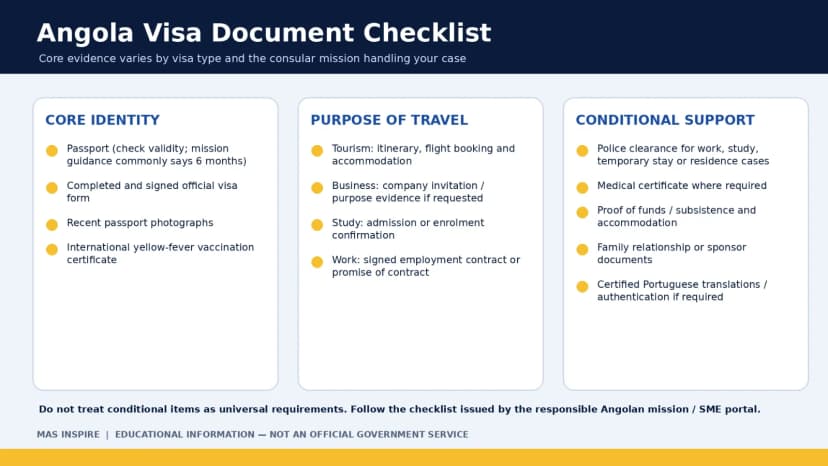
Complete Document Checklists
The table separates recurring evidence from category-specific evidence. It is not a universal fixed-count checklist. The competent mission may require additional items.
| Document | Tourist / business | Study | Work | Temporary stay / residence | Notes |
|---|---|---|---|---|---|
| Valid passport | Required | Required | Required | Required | Mission public guidance commonly says 6 months' validity |
| Completed signed visa form | Required | Required | Required | Required | Use the form / portal specified for the category |
| Recent photographs | Usually | Mission checklist | Mission checklist | Mission checklist | Number and format vary |
| Yellow-fever vaccination certificate | Required by public tourist checklist | Required by public study checklist | Required by public work checklist | Confirm; often requested | International certificate |
| Flight itinerary / accommodation | Tourist | If requested | If requested | If requested | Confirm with mission |
| Invitation / host letter | Business / family where applicable | Admission letter | Employer documentation | Sponsor / family / institution | Conditional on purpose |
| Admission / enrolment | No | Required | No | If research or training basis | Official school / institution |
| Employment contract / promise | No | No | Required | Only where the specific ground requires it | Must match the sponsoring employer and role |
| Criminal-record certificate | May be requested | Confirm | Public checklist says required | Public checklist says required | Translation/authentication may apply |
| Medical certificate | Not generally shown on tourist list | Confirm | Public checklist says required | Public checklist says required | Issuing country and format to confirm |
| Proof of funds / subsistence | Recommended / if requested | Public checklist says required | Employer evidence / as requested | Confirm | No universal public minimum verified |
| Family relationship evidence | If family visit | If dependent | If dependent | Required where family basis | Birth/marriage records, as relevant |
| Investment registration | No | No | No | No | Required for investor route, not ordinary business visit |
Translation and authentication
Portuguese is Angola's official language. Ask the mission whether documents not in Portuguese need certified translation and whether the original document must be notarised, authenticated or legalised. Do not assume that a Vietnamese, Pakistani or other foreign public document will be accepted without formalities.
How to Apply: Step-by-Step
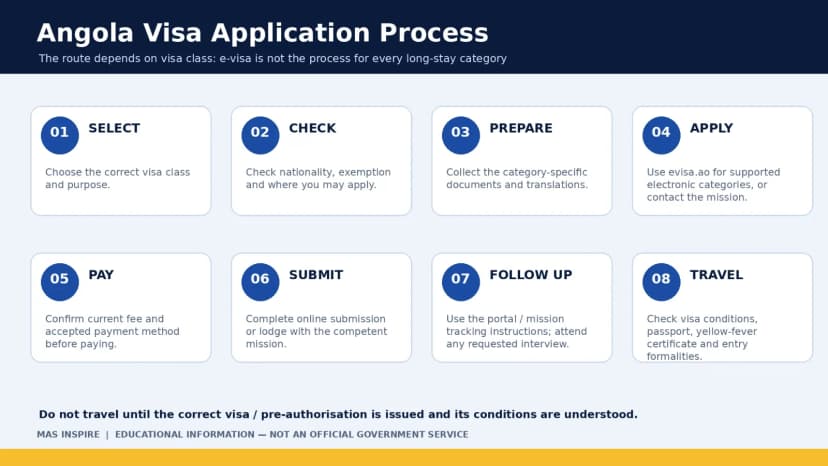
- Define the purpose accurately. Decide whether the trip is tourism, business prospecting, transit, study, treatment, employment, temporary stay or residence.
- Check nationality-based exemptions. Use the official 98-country list. If you are not eligible, continue to the relevant visa route.
- Confirm where to apply. Contact the Angolan mission covering your current lawful residence. Ask whether it accepts third-country nationals and what residence evidence is required.
- Confirm the current category checklist. Use the Angolan consular visa pages and ask for any local checklist or form.
- Use the correct online route if eligible. For electronic tourist/business applications, check evisa.ao. The 2026 portal migration means old bookmarks may not lead to the current workflow. Other categories may still require a mission application.
- Prepare and translate documents. Ensure names, dates and passport details match across the form, invitation, bookings and certificates.
- Submit and pay only through the verified channel. Confirm the exact amount, currency, payment recipient and refund policy before paying. Do not transfer money to an intermediary based only on a social-media message.
- Attend any appointment or interview. Requirements vary by category and mission. Some embassy pages support online form completion and document upload; other cases may require in-person presentation.
- Track the application. Use the tracking facility provided by evisa.ao or follow the mission's written instructions. Do not assume a published service target guarantees approval.
- Check the issued permission before travel. Verify name, passport number, category, entries, validity dates, permitted stay and conditions. Carry supporting documents and required vaccination evidence.
- Comply with entry and stay rules. Final admission remains subject to border formalities. Apply for any extension or residence authorisation before the current permission expires.
Visa Fees and Financial Requirements
Angola's official consular fee information states that fees are fixed by state legislation, can be revised and are confirmed by the Consular Section when an appointment is made. It does not provide a current, universal fee schedule for each visa category. Accordingly:
- Tourist visa: amount not officially published on the public mission service page reviewed; confirm with the mission or current e-visa checkout.
- Business / ordinary visa: no fixed current amount independently verified; check evisa.ao or the mission.
- Study, work, transit, medical, temporary-stay and residence visas: no current universal amount independently verified in this research.
- Visa-exempt tourism: no tourist visa fee because no tourist visa is required, but normal travel and border requirements still apply.
The study visa mission checklist expressly asks for proof of means of subsistence. Other cases may also require financial evidence. No universal minimum bank balance or daily maintenance amount was verified. Do not use unofficial figures as if they were a government rule. Official consular fees page. The e-visa portal has been reported to list a tourist/short-stay fee of 36,600 Kz (about US$34–40); the portal's own fee schedule was incomplete at its August 2026 launch, so confirm the amount shown at checkout before paying.
Visa Processing Times
The current public US Embassy service pages state that processing time is confirmed by the Consular Section when booking. The public tourist page does not publish a fixed processing period. The Embassy's visa-exemption page states that tourism visa applications are decided within three working days, and the official e-visa portal advertises processing in 72 hours. The new electronic visa platform is reported in 2026 to support electronic tourist/business applications and online tracking; third-party reports refer to short service targets, but this guide does not present those as a guaranteed official processing time. Long-stay applications may require additional review or authorisations. Apply well before travel and do not purchase non-refundable tickets on the assumption of approval.
| Category | Published time verified? | Practical instruction |
|---|---|---|
| Tourist | No universal time; mission confirms | Check evisa.ao or the responsible mission |
| Business / ordinary | Not officially published in a universal schedule | Confirm portal eligibility and current estimate |
| Transit / short-stay | Not officially published | Contact mission and explain urgency / itinerary |
| Study / work / temporary stay / residence | Not officially published universally | Allow time for supporting checks and any approvals |
| Investor | Not officially published universally | Coordinate investment registration and SME steps |
Applying from Pakistan or Vietnam
Pakistani passport holders
Pakistan is not among the 98 nationalities listed for Angola's tourism-only visa exemption. A Pakistani national should therefore plan to obtain the correct visa for tourism or business unless the competent authority confirms a separate applicable exemption. Work, study, medical and residence purposes require their respective permissions even for nationals of visa-exempt countries.
Pakistani citizens legally living or working in Vietnam
Angola's Ministry of Foreign Affairs lists an Angolan Embassy in Hanoi. The published directory entry gives the address as PR AL9-21 D5 Yoon Dao, Tay Ho, Hanoi and telephone numbers 0084-983569593 / 0084-62581607. The directory does not publish a visa-specific application procedure, consular fee or clear statement about accepting Pakistani applicants who are residents in Vietnam. Note: published Hanoi addresses differ across directories (the MFA directory lists D5 Vuon Dao, Tay Ho; a 2026 Hanoi directory lists Villa A4, Van Phuc Diplomatic Compound) — confirm the current address and phone before visiting. Contact the Embassy before preparing a full file and ask:
- Does the Embassy accept visa applications from Pakistani passport holders who are legally resident in Vietnam?
- Must the applicant hold a temporary residence card, work permit, long-term visa or another form of proof of lawful residence?
- Does the Embassy accept applications from residents throughout Vietnam or only within a defined consular jurisdiction?
- Which visa classes can be lodged in Hanoi, and which must be filed through evisa.ao or another authority?
- What are the current document, translation, authentication, appointment, payment and passport-return rules?
A Vietnamese residence permit demonstrates lawful residence in Vietnam; it does not guarantee that Angola's Embassy will accept the application locally or approve the visa. Keep a copy of your Vietnamese residence card, visa, work permit (if applicable), address registration and evidence of lawful status available if requested.
Applying from Pakistan versus Vietnam
| Issue | Applying in Pakistan | Applying in Vietnam |
|---|---|---|
| Mission | Contact the Angolan diplomatic/consular office responsible for Pakistan | Angola MFA lists an Embassy in Hanoi; confirm its current visa service |
| Residence evidence | Pakistani residence/nationality documents as required | Vietnamese lawful-residence evidence may be requested |
| Local acceptance | Follow mission jurisdiction | Must be confirmed; residence alone is not enough |
| Forms and fees | Obtain current local mission instructions | Obtain Hanoi-specific instructions in writing |
| Supporting documents | Pakistan-issued police/medical/civil records may be relevant | Records from Vietnam may also be requested if residence duration or category requires them |
| Processing | Depends on mission and category | Depends on Hanoi mission and category; no verified local time published |
If the Hanoi Embassy does not accept the application, ask it to identify the correct mission or competent channel in writing. Do not assume that a Pakistani applicant must automatically travel to Pakistan or that another regional embassy will accept the file without jurisdiction confirmation.
Student Visa Guide
The study visa is the appropriate route for formal education, vocational training and qualifying internships in Angola. Before applying, obtain a formal admission or enrolment document from the institution and make sure the programme, dates and location are clear. Confirm whether the school or training centre is authorised to host foreign students.
The public Embassy checklist lists a signed form, passport valid six months, proof of admission or enrolment, proof of means of subsistence and vaccination certificate. A passport photograph is also listed among the documents to bring. The statute allows multiple entries and a stay of up to one year, renewable for an equal period until the programme ends. It does not authorise ordinary employment. An internship connected to the training is the stated exception; obtain written confirmation before undertaking any paid or productive activity.
Applicants should ask whether police clearance, medical evidence, accommodation, tuition payment proof, guardian consent (for minors), certified translations or authenticated educational records are needed. No official universal bank-balance threshold or study visa fee was verified.
Work Visa and Job Opportunities
A foreign national who intends to work for pay in Angola should secure a genuine offer and the employer's support before travelling. The work visa is linked to the professional activity and the employer that requested it. It does not authorise a switch to an unrelated employer or unrestricted self-employment.
The Embassy's public checklist identifies the employment contract or promise of contract, passport, completed form, criminal-record certificate, medical certificate and international vaccination certificate. Employers may need to obtain sector-specific or labour-related approvals. The exact company documents and any applicable quotas or approvals should be confirmed with the relevant Angolan authorities and the mission.
Angola's economy has employment activity in oil and gas, mining, construction, engineering, logistics, agriculture, infrastructure and services. These sectors are not a promise of vacancies or visa eligibility. There is no general job-seeker visa identified in the statutory categories reviewed. Avoid recruiters who request large advance payments for a guaranteed visa or job.
Family Immigration and Permanent Residence
Angola's temporary-stay category can cover certain family relationships, including family members of valid foreign residents, family members accompanying specified visa holders and spouses of Angolan citizens. The statutory basis and work rights differ by ground. A spouse of an Angolan citizen should ask the mission which temporary-stay or residence-establishment route is appropriate and what civil-status records must be authenticated.
A residence-establishment visa is intended for people seeking to establish residence and allows an initial stay of 90 days under Article 57. It permits paid professional activity under the statute, but applicants must complete the subsequent residence authorisation process. A temporary-stay visa should not be mistaken for permanent residence.
For investors, Article 59 describes a possible temporary residence authorisation after three years of uninterrupted stay on an investor visa, provided the investment project remains valid and the competent investment body confirms it. This is a conditional route, not automatic permanent residence. No general permanent-residence-by-investment amount or guaranteed settlement route was verified.
Humanitarian protection and asylum are separate legal matters. People needing protection should seek qualified legal assistance and contact the competent Angolan authorities or UNHCR; a routine visitor visa is not a substitute for an asylum procedure.
Common Application Mistakes
- Applying for tourism when the real purpose is paid work or long-term study.
- Assuming that a 98-country tourism exemption covers non-tourism activity.
- Relying on an old SME portal bookmark instead of checking the current evisa.ao platform.
- Treating a visa's validity period as the number of days one may stay.
- Assuming that a Vietnamese residence permit guarantees local consular acceptance.
- Submitting police, medical, school or company records without required translation or authentication.
- Using inconsistent spellings, passport numbers or dates across supporting documents.
- Paying an unverified intermediary or relying on an unpublished fee quote.
- Booking non-refundable travel before visa issuance.
- Assuming a tourist or ordinary/business visa authorises employment.
Reasons for Visa Refusal
The authorities may refuse an application where the applicant does not meet legal conditions or cannot establish the stated purpose. Practical risk factors include incomplete or inconsistent documents, an unsuitable visa class, unclear source of funds, weak evidence of the host or sponsor, missing employer or school documents, invalid passport, adverse immigration or security information, false statements, or a legal prohibition on entry. These are general risk factors, not a complete official refusal list. The applicant should request the formal reason and available review options from the authority that made the decision. Never submit altered documents or conceal relevant facts.
Frequently Asked Questions
1. Do Pakistani citizens need a visa for Angola?
Pakistani citizens are not on the published 98-country tourism exemption list. They should plan to obtain the appropriate visa unless an authority confirms a separate exemption applies.
2. Can Pakistani citizens apply for an Angola visa in Vietnam?
Angola has an Embassy in Hanoi, but public information reviewed does not confirm that it accepts applications from every third-country resident. Ask the Embassy directly and provide proof of lawful Vietnamese residence if requested.
3. Does a Vietnamese residence permit guarantee that I can apply in Hanoi?
No. It proves lawful residence in Vietnam but does not itself guarantee consular jurisdiction or acceptance of an application.
4. What is the Angola tourist visa duration?
Law No. 13/19 describes a 30-day stay, multiple entries and a 120-day validity period, extendable twice. The 60-day figure in some embassy guidance is the e-visa/pre-authorisation use window (enter within 60 days of issue), not the visa's validity. Confirm the current rule with the mission and check the visa issued.
5. Which nationalities are exempt from an Angola tourist visa?
The Angolan Embassy publishes a list of 98 countries under Presidential Decree 189/23. The exemption is tourism-only and permits up to 30 days per entry and 90 days per year.
6. Can I work in Angola on a tourist or business visa?
No. Paid employment requires the appropriate work permission. A work visa is tied to the employer and activity that justified it.
7. Is there an Angola job-seeker visa?
No general job-seeker visa appears in the statutory categories reviewed. Secure an employer-sponsored work route before starting paid work.
8. Is there an Angola digital nomad visa?
No standalone digital-nomad category was identified in the statutory visa list reviewed. Do not assume remote work is permitted on a tourist visa; obtain written guidance for your circumstances.
9. What documents are required for an Angola study visa?
The public mission checklist includes a signed form, passport valid for six months, admission or enrolment proof, proof of subsistence and vaccination certificate. Further documents may be requested.
10. Does an Angola work visa allow me to change employers?
The statute limits the visa to the professional activity and employer that requested it. Obtain authorisation before any change.
11. How much does an Angola visa cost?
A current universal fee schedule was not verified. The official consular page says the fee is confirmed by the Consular Section and may be revised. Check the responsible mission or the portal checkout.
12. How long does an Angola visa take to process?
There is no universal current processing time verified for all categories. The consular section confirms timing for its cases; electronic processing depends on the portal and category. Apply early. For tourism visas, the Embassy's exemption page states decisions within three working days, and the e-visa portal advertises 72-hour processing.
13. Can I extend my stay in Angola?
Some categories can be extended under statutory conditions. Tourist, study, medical and temporary-stay extension rules differ. Apply to the competent authority before your permitted stay expires.
14. Is the investor visa the same as permanent residence?
No. It is an investment-linked visa. The law describes a possible temporary residence authorisation after three years of uninterrupted investor-visa stay, subject to project validation and other requirements.
15. Do I need a yellow-fever vaccination certificate?
Public Angolan mission tourist, study and work checklists include an international vaccination certificate. Check current health and border requirements before departure and carry the certificate if required.
Official Immigration Websites
- SME electronic visa portal — supported electronic visa applications and status services.
- Angolan Ministry of Foreign Affairs — diplomatic and consular information.
- Angolan Embassy — visa requirements — category pages and application instructions.
- Angolan Embassy — visa-exemption list — Decree 189/23 and listed nationalities.
- Angolan Embassy — consular fees — fee confirmation instructions.
- Angola MFA — embassies directory — includes the Hanoi Embassy listing.
- AIPEX / Invest in Angola — investment registration and investor information.
Final Checklist and Conclusion
Before travelling, confirm that you have:
- Selected the correct visa category for the real purpose of travel.
- Checked your nationality against the current exemption list.
- Confirmed the correct application channel and consular jurisdiction.
- Obtained the current category checklist and application form.
- Prepared a valid passport, photographs and all purpose-specific evidence.
- Arranged yellow-fever vaccination evidence and any required police/medical certificates.
- Confirmed translation, notarisation and authentication requirements.
- Verified the current fee, currency and payment recipient with the official authority.
- Checked processing time, entries, visa validity and permitted stay.
- Received the visa or electronic authorisation before travelling, where required.
- Understood work restrictions, extension rules and residence obligations.
Angola offers several routes for short visits, education, employment, family circumstances, investment and residence. The safest approach is to match the visa to the activity, follow the current SME or consular process, and verify fees and documents directly with the responsible authority. No visa approval is guaranteed.
Educational-information disclaimer: This guide is general information, not legal advice. Immigration rules and administrative practice may change without notice. Confirm all requirements with the Angolan Migration and Foreigners Service or the competent Angolan diplomatic mission before applying. MAS Inspire is an independent educational publisher and is not an Angolan government authority or visa-issuing body.