Andorra Visa Guide 2026: Types, Requirements, Documents and Application Steps
Introduction
Andorra is a small mountain principality in the eastern Pyrenees, between France and Spain. It attracts visitors for skiing, hiking, shopping, mountain scenery and cultural experiences. It also receives foreign workers, students, entrepreneurs, remote professionals and people seeking long-term residence.
The phrase “Andorra visa” can be misleading. Andorra does not issue an ordinary tourist visa for short visits. It is not an EU member and is not part of the Schengen Area. Nevertheless, Andorra can only be reached by road through France or Spain, both of which are in Schengen. A traveller who needs a Schengen visa must therefore obtain the correct Schengen visa before travelling. Because crossing into Andorra means leaving Schengen, the traveller generally needs a double-entry or multiple-entry Schengen visa to return to France or Spain.
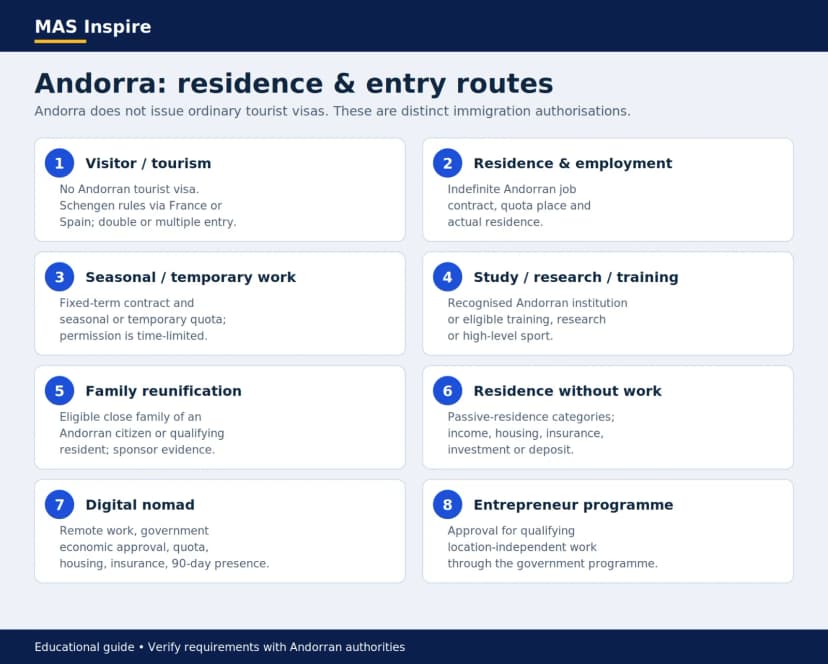
For a move to Andorra, the question is different: applicants need the correct Andorran immigration authorisation. The available routes include residence and work, seasonal work, study and research, family reunification, residence without work, digital nomad residence and entrepreneur-programme residence. Each route has its own conditions, evidence and fee.
This guide explains the distinction and outlines the official procedures as checked on 27 November 2026. Always verify the live Government procedure and the relevant French or Spanish consular rules before paying fees or making travel arrangements.
Why People Visit, Study, and Work in Andorra
Visitors come for the Pyrenean landscape, ski resorts, hiking trails, thermal spas, historic villages and shopping. Many combine a visit with travel in France or Spain. Andorra la Vella is the capital and the country's principal urban centre.
People who plan a longer stay may be attracted by Andorra's mountain lifestyle, small-country environment and opportunities in tourism, hospitality, retail, sport, services and specialised professional activities. However, a visitor's permission to enter does not confer the right to work or reside long-term. A job offer, study placement, qualifying family relationship or other statutory basis is needed for the appropriate authorisation.
Types of Andorra Visas and Immigration Authorisations
1. Tourist and private visits
There is no Andorran tourist visa. Visitors must carry a valid travel document and satisfy any entry requirements imposed by the Schengen country through which they travel. Visa-exempt nationalities still need to meet ordinary border conditions. Visa-required nationalities must obtain a Schengen visa from the competent French or Spanish authority, depending on the journey.
2. Business visits
Short business visits—such as meetings or commercial discussions—do not appear as a separate Andorran visitor-visa class in the official material reviewed. The traveller must meet the same external-border rules as any other visitor. A visit must not be used to undertake employment that requires an Andorran work authorisation. A host invitation, meeting agenda and evidence of the purpose of travel may support a Schengen application, but the competent consulate determines the required documents.
3. Residence and work as an employee (A.1)
This route is for a newcomer with an indefinite employment contract from a company legally established in Andorra, who obtains a place within the applicable immigration quota and establishes permanent and effective residence in the Principality. The authorisation permits residence and work during its validity. The first authorisation lasts one year, followed by three renewals of two years each. After seven years, subsequent renewals are generally issued for ten years, with exceptions for nationals of states covered by relevant agreements.
The employer and employee must provide the official application, passport, criminal-record evidence, accommodation evidence, civil-status documents, CV and qualifications, medical-review documents, employment contract and professional/salary terms. Foreign official documents must be apostilled or legalised. Registration with the parish Comú is required within the Government's stated deadline after authorisation.
4. Temporary and seasonal work (G.1 and related routes)
Temporary immigration authorisation allows temporary residence and work for the authorised period. The standard G.1 procedure requires a fixed-term contract with a legally established Andorran employer and a place under the relevant quota. The period is linked to the season specified when the authorisation is granted. Special winter-season quotas are published for sectors such as ski resorts, hotels, cleaning, retail and travel agencies. These quotas and eligible sectors change by decree; an employer should confirm the current quota before recruitment.
5. Frontier or cross-border work
Andorra has authorisations for people who work in the Principality while living outside it. These are not ordinary residence permits. The official Government work section lists frontier-work authorisations and temporary frontier-work authorisations. Applicants should use the relevant current procedure and must not assume that a residence-and-work permit and a frontier-work permit have identical residence conditions.
6. Study, internship, sports training and research (F)
The F authorisation permits residence in Andorra for study at a Government-recognised educational establishment offering official qualifications or approved courses. It also covers qualifying training placements, high-level sports training and scientific or similar research. The permit lasts for the academic year or the duration of the approved placement, training or research activity.
The Government requires a completed application, valid passport, criminal-record certificate for adult applicants, sworn declaration, recent 35 × 45 mm photograph, accommodation proof, civil-status evidence, comprehensive health insurance and proof of sufficient financial means. The published page states that an adult applicant's means must represent at least 100% of Andorra's minimum wage; it also specifies household thresholds of 100% for each adult and 70% for each minor. The relevant evidence may include three recent payslips and CASS record for an employee, or a bank solvency certificate and sworn income declaration for other applicants. Enrolment, study calendar, programme content and duration are also required. Internship applicants must provide additional education and placement evidence.
The study authorisation is not a general right to take up employment. Applicants should confirm any permitted work activity with Immigration and the institution before accepting paid work.
7. Family reunification (B.1)
The Government's family-reunification route allows eligible family members to reside in Andorra with an Andorran citizen or a qualifying resident who lives in the country. The listed eligible relationships include a spouse or stable partner, minor children and certain dependent adult children, dependent ascendants aged at least 65 or retired, and certain persons under legal guardianship. The sponsor's status, ability to support the family and the applicant's relationship evidence are central. The Government page states that the maximum duration of ten years is available when reunification is with an Andorran citizen; other cases follow the applicable rules.
8. Residence without work / passive residence (D.1)
This is not a tourist permission. It is a residence authorisation for people who meet a specific statutory category and do not use the route to take ordinary local employment. The Government's D.1 procedure page includes subcategories for internationally projecting professionals, persons of recognised international standing in science, culture or sport, and residence connected with certain private care facilities. The general route also includes passive-residence arrangements, whose investment, financial, insurance, housing, quota and presence requirements are category-specific and have been amended by legislation.
The official tariff lists an initial issue fee of €3,000 for residence without work and a renewal fee of €500. Those amounts are administrative fees only; they do not include any required investment, AFA deposit, housing, insurance or other financial commitment. Applicants must confirm the exact subcategory and current statutory requirements directly with Immigration before committing funds. For the passive-residence subcategory, Law 2/2026 (in force 13 February 2026) requires a permanent investment of at least €1,000,000 in Andorran assets (or €400,000 via the Housing Fund) plus a non-refundable €50,000 payment to the Andorran Financial Authority (€12,000 per dependant), 90 days’ principal residence per year, and a place within the 2026 quota (163 of 200 residence-without-work places, Decree 74/2026).
9. Digital nomad residence (D.3)
Andorra's D.3 authorisation is for a person whose work does not require a fixed geographical location and is carried out using telecommunications and technology. The applicant must be within the applicable quota, establish principal and effective residence in Andorra for at least 90 days per calendar year, obtain the required favourable assessment from the competent Ministry of Economy, prove suitable housing, show sufficient means and maintain the required health and incapacity insurance. The initial authorisation is two years; the first renewal is two years, the second is three years and subsequent renewals are generally ten years, subject to treaty exceptions.
This is a residence category, not a general visa for every remote employee. Applicants should establish whether their work and business arrangement meets the Government's definition before applying.
10. Entrepreneur programme residence (D.4)
The Government lists a residence authorisation for participants in its foreign entrepreneur programme. The published criteria describe location-independent work using telecommunications and technology, acceptance into the programme, quota availability and principal and effective residence in Andorra for at least 90 days per calendar year. The initial authorisation is one year and may be renewed for successive one-year periods. The file includes a favourable assessment from the Ministry of Economy, housing evidence, financial means, insurance and other general documents.
11. Job seeker, startup, investor, transit and permanent residence routes
No general Andorran job-seeker visa or standalone transit visa was identified in the official sources reviewed. There is no ordinary tourist visa. Entrepreneur and self-employed routes exist, but they are not a generic startup visa and require the relevant legal and economic approvals. Residence without work includes specific passive-residence categories; it should not be simplified into a single “golden visa”. The official materials reviewed do not establish a separate visa for exchange visitors beyond the study/training/research authorisation. Nor should long-term renewable residence automatically be described as permanent residence or citizenship: those are separate legal questions requiring individual advice and current law.
Andorra Visa and Permit Comparison Table
| Purpose | Andorran route | Core basis | Work rights | Validity / duration | Government fee information |
|---|---|---|---|---|---|
| Tourism / private visit | No Andorran visa | Schengen entry compliance via France or Spain | No local employment right | Short visit; comply with Schengen stay limits | No Andorran tourist visa fee |
| Business meetings | No separate visitor visa identified | Schengen entry compliance; genuine business purpose | No employment without authorisation | Short visit | No Andorran visitor fee identified |
| Employee | A.1 residence and work | Indefinite local contract + quota + residence | Yes, under permit conditions | 1 year; three 2-year renewals; then generally 10-year renewals | €190.96 initial issue |
| Seasonal / temporary employee | G.1 and seasonal quota | Fixed-term contract + quota | Yes, during authorised period | Season or approved temporary period | €190.96 listed for temporary authorisation |
| Frontier worker | C.1 / related frontier route | Employment in Andorra while residing abroad | Yes, within permit scope | As granted / renewed | €190.96 initial frontier authorisation listed |
| Student / research / internship | F | Recognised institution or qualifying activity | Not a general work permit | Academic year or activity period | Check live tariff / e-tramits for exact route fee |
| Family member | B.1 | Eligible relationship to Andorran or qualifying resident | Do not assume work rights; check permit | Depends on sponsor and category | €22.61 listed for family-reunification residence/work issue categories |
| Residence without work | D.1 subcategories | Category-specific means, housing, insurance, presence and other criteria | Generally no ordinary local employment | Depends on subcategory | €3,000 initial; €500 renewal listed for residence without work |
| Digital nomad | D.3 | Remote work + economic approval + quota + 90-day presence | Remote activity within approved route | 2 years; 2 years; 3 years; then generally 10 years | €224.61 (per the e-tramits procedure page — confirm on the live tariff) |
| Entrepreneur programme | D.4 | Approved entrepreneur programme + quota + 90-day presence | Activity as authorised by programme | Initial 1 year; successive 1-year renewals | Check live tariff / e-tramits |
Note: Fees above are Andorran Government tariff amounts where the relevant line is explicitly identified. They are not Schengen visa charges. A current fee can change; check the Government tariff on the day of filing.
Eligibility Requirements
Eligibility depends on the chosen route. For a standard employee permit, the applicant needs a qualifying indefinite contract, an employer established in Andorra, quota availability and a genuine plan to live and work in the Principality. For temporary work, a fixed-term contract and the relevant seasonal or temporary quota apply. A student must be accepted by a qualifying institution or programme and meet the insurance and financial requirements. A family applicant must fit one of the recognised relationships and provide official proof. Digital nomads and entrepreneur-programme applicants need the relevant economic approval, quota and residence commitments. Passive-residence applicants must meet the exact subcategory's financial and legal conditions.
All applicants should check criminal-record requirements, medical-review requirements, accommodation and local registration rules. Foreign public documents must be apostilled or legalised. Translation into Catalan may be requested by Immigration; check the applicable regulation and the document's language before arranging translation.
Complete Document Checklists
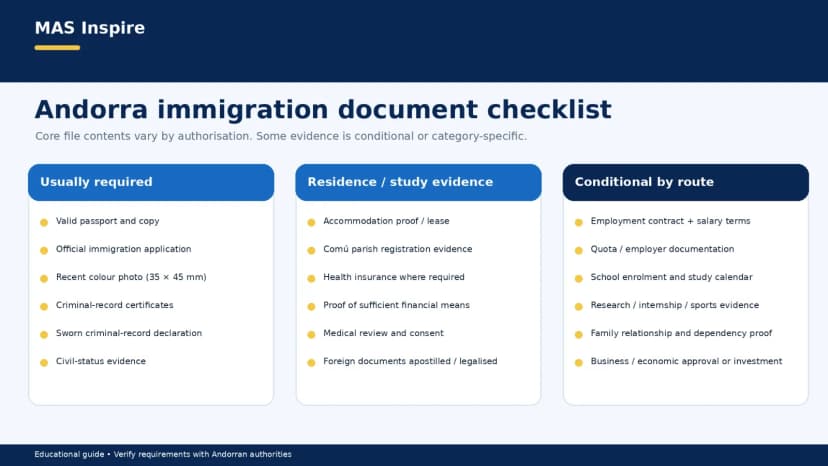
These lists are planning aids, not a guarantee that every item applies to every route. The Government describes some lists as indicative and non-exhaustive and may request further evidence.
Core immigration file (route-dependent)
| Document | Status | Notes |
|---|---|---|
| Official immigration application | Required | Use the form linked from the exact Government procedure. |
| Valid passport and copy | Required | EU/EEA identity documents may be accepted for certain procedures. |
| Recent colour photograph | Required for listed routes | Government employee and study pages specify 35 × 45 mm and less than six months old. |
| Criminal-record certificate(s) | Required for listed adult routes | Country of origin, nationality and/or residence as specified by route. |
| Sworn criminal-record declaration | Required for listed routes | Use the Government form. |
| Accommodation evidence | Commonly required | Lease, ownership title or accepted accommodation certificate; address certificate may also be needed. |
| Civil-status evidence | Where relevant / required by procedure | Birth, marriage, divorce, death or stable-partner evidence. |
| Foreign-document apostille / legalisation | Required for foreign official documents | Translation may also be required. |
| Medical review and consent | Required in listed procedures | Follow the Immigration Medical Service instructions. |
| Comú registration evidence | Post-approval requirement | Deadline varies by authorisation; follow the decision and procedure page. |
Employee-specific evidence
- Indefinite employment contract with an Andorran company for the standard A.1 route.
- Employer's statement of professional duties and salary conditions.
- CV and copies of diplomas or evidence of professional qualifications.
- CASS points statement if previously employed in Andorra.
- Evidence of accommodation and civil status.
- Any quota, employer or occupational evidence requested by the current procedure.
Student, research and training evidence
- Admission or enrolment certificate from the recognised Andorran institution.
- Study calendar, programme content and duration.
- Proof of exclusive student or qualifying research status where required.
- Health insurance covering 100% of medical or healthcare expenses for the planned period, as specified by the Government page.
- Evidence of financial means. The Government page sets the adult applicant's baseline at 100% of the Andorran minimum wage and gives household thresholds for accompanying adults and minors.
- For internships: relevant academic/professional qualification, evidence the applicant has not entered the labour market, placement calendar and required agreement with the competent ministry / foreign educational centre.
- For high-level sports training: federation registration or affiliation and training calendar.
Family-reunification evidence
- Sponsor's Andorran nationality or qualifying residence authorisation and proof of residence.
- Official marriage, stable-partner, birth, dependency or guardianship evidence as applicable.
- Sponsor's financial and accommodation evidence where required.
- Passports, criminal-record and other general documents requested for the applicant.
Residence without work, digital nomad and entrepreneur evidence
- Evidence of the precise D.1, D.3 or D.4 legal category.
- Housing ownership or lease evidence meeting the minimum habitability requirements.
- Evidence of sufficient means and any required investment or AFA deposit for the chosen category.
- Health and incapacity insurance as specified by the route (some age groups have different coverage requirements).
- Written commitment to the minimum 90 days' principal and effective residence where required.
- Ministry of Economy approval for digital nomad or entrepreneur-programme categories, as applicable.
- Business viability, prior accounts, three-year business plan, professional qualifications or international recognition where required by the chosen D.1 subcategory.
How to Apply: Step-by-Step
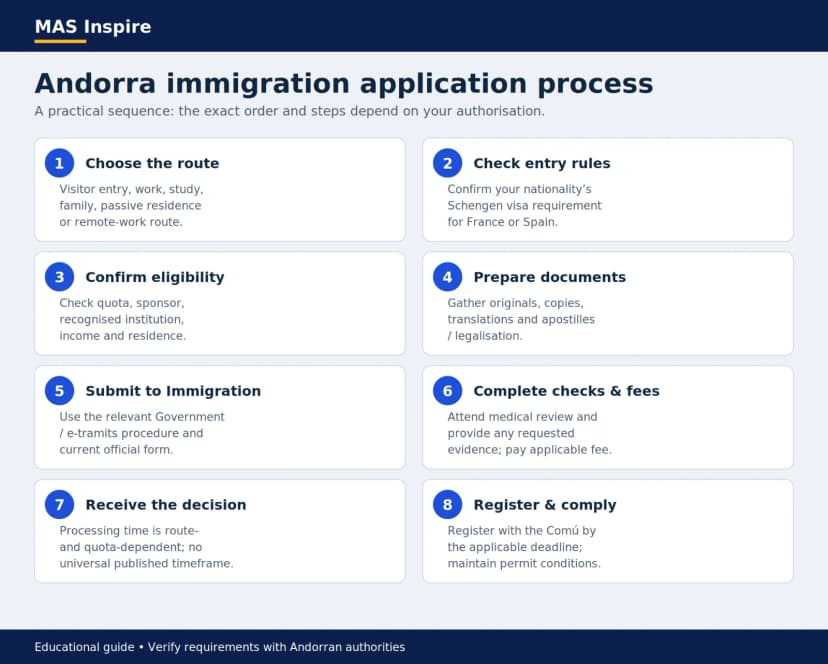
- Define the purpose. Decide whether the plan is a short visit, employment, seasonal work, study, family reunification, passive residence, digital nomad activity or an entrepreneur programme.
- Check the border route. Identify whether you will enter through France or Spain. Check whether your nationality requires a Schengen visa and whether your itinerary requires two or multiple entries.
- Check the Andorran category. Use the Government's Immigration pages and e-tramits procedure list. For work, confirm the employer, contract and quota. For study, confirm that the institution and course qualify.
- Confirm current quota and conditions. Do not rely on an old quota notice or an employer's informal assurance. Quotas may be amended or exhausted.
- Download the correct official form. Andorran immigration applications use the official form for the relevant authorisation. Do not substitute a Schengen visa form for an Andorran residence application.
- Prepare original evidence. Obtain the correct criminal-record certificates, civil-status documents, housing evidence, insurance, financial proof and route-specific papers.
- Authenticate and translate documents. Arrange apostilles or legalisation for foreign official documents. Check whether a Catalan sworn translation is required.
- Submit through the specified Government procedure. Follow the in-person or electronic filing method shown on the current e-tramits / Government procedure page. Do not assume every route uses the same channel.
- Complete medical and other checks. Attend the required medical review and respond promptly to requests for additional evidence.
- Pay the correct fee and retain proof. Use the current Government tariff. Keep receipts and the application reference.
- Wait for the decision. No single processing time applies to every route. A quota, incomplete file or additional checks can affect the outcome.
- After approval, complete local registration. Register with the relevant parish Comú within the deadline stated for your permit. Keep the authorisation valid and comply with its work, residence, insurance and presence conditions.
- Arrange Schengen travel separately. An Andorran residence authorisation is not automatically a Schengen visa. Confirm your right to cross France or Spain and re-enter Schengen whenever leaving Andorra.
Andorra Visa Fees and Financial Requirements
Andorra does not charge an ordinary tourist-visa fee because it does not issue an Andorran tourist visa. The Schengen visa fee, where applicable, is charged under the rules of the responsible Schengen state and is separate from Andorran immigration charges. The standard Schengen short-stay fee is €90 for adults (€45 for children aged 6–11; free under 6).
The Government's immigration tariff lists, among other amounts:
| Government tariff item | Published amount |
|---|---|
| Initial residence-and-work authorisation | €190.96 |
| Initial family-reunification residence-and-work authorisation | €22.61 |
| Initial temporary immigration authorisation | €190.96 |
| Initial frontier-work authorisation | €190.96 |
| Initial self-employed residence-and-work authorisation | €190.96 |
| Initial residence-without-work authorisation | €3,000 |
| Renewal of residence-and-work authorisation | €22.61 |
| Renewal of residence without work | €500 |
| Application receipt for ordinary immigration request | €5.73 |
| Application receipt for residence without work | €6.79 |
These figures are the Government's published administrative tariff lines reviewed for this guide. Check the live tariff and the exact authorisation before filing. The fee schedule does not establish all route-specific investment deposits or financial thresholds. The Government's study page separately specifies financial means linked to the Andorran minimum wage. Passive-residence and specialised professional routes may involve additional investment, non-remunerated AFA deposits, insurance, housing and income tests. Never interpret a Government application fee as the total cost of qualifying for residence.
Visa and Permit Processing Times
The official procedure pages reviewed do not publish one general processing time for all Andorran immigration authorisations. A quota-limited work route can depend on available places, employer evidence, the completeness of the application and any medical or additional-document checks. Seasonal quotas may be issued and amended by separate decrees. Applicants should ask the Government Immigration Service or consult the live procedure page for a current estimate before making non-refundable arrangements.
For Schengen applications, processing is determined by the responsible French or Spanish consular authority and its current appointment and processing rules. Check that authority's current website; do not use an Andorran immigration processing estimate for a Schengen application.
Applying from Pakistan or Vietnam
Pakistani passport holders
Pakistan is listed in Annex I of the EU Visa Regulation, meaning Pakistani nationals require a Schengen visa for short stays unless a specific exemption applies. Andorra itself does not issue a tourist visa, but a Pakistani visitor normally needs a Schengen visa to travel through France or Spain. The visa should allow at least two entries if the traveller will enter Andorra and then return to Schengen. A multiple-entry visa is appropriate for repeated exits and re-entries, subject to the consulate's decision.
A Pakistani applicant living in Pakistan should apply to the French or Spanish mission responsible for the intended Schengen entry / main destination. A Pakistani citizen legally resident in Vietnam may generally apply in Vietnam under the local consular process if they can prove lawful residence there. The correct consulate is determined by the main destination or purpose of the Schengen journey—not simply by whichever consulate has the earliest appointment.
Pakistani citizens legally living or working in Vietnam
A Vietnamese temporary or permanent residence card, work permit or other lawful-residence evidence can establish local filing eligibility, but it does not turn a Pakistani passport into a visa-exempt nationality. The applicant should:
- Confirm whether France or Spain is the main destination or responsible Schengen state for the planned itinerary.
- Present proof of lawful residence in Vietnam and comply with the relevant mission's local jurisdiction and appointment rules.
- If applying for France, use France-Visas Vietnam. The French Embassy in Hanoi and Consulate-General in Ho Chi Minh City decide applications; TLS Contact centres in Hanoi and Ho Chi Minh City receive files by appointment.
- If applying for Spain, consult the Spanish Embassy in Hanoi's consular page. It states that foreign citizens lawfully residing in Vietnam may lodge applications for Spain when Spain is the sole or main destination. The Embassy's designated BLS centres receive applications in Hanoi and Ho Chi Minh City.
- Provide the standard Schengen evidence: passport, application, photographs, travel medical insurance, itinerary, accommodation, financial means, employment or business evidence, Vietnamese residence status, and credible reasons to return to Vietnam or the country of lawful residence.
- Request a double-entry or multiple-entry visa and explain the Andorra excursion and the need to re-enter Schengen. Approval of the requested number of entries is not guaranteed.
- Separately obtain the Andorran residence/work/study authorisation if the purpose is to move to Andorra. A Schengen visa does not authorise employment or long-term residence in Andorra.
There is no evidence in the sources reviewed of a dedicated Andorran embassy or consulate in Vietnam that issues Andorran tourist visas. The Andorran permit process is handled by the Andorran Government; Schengen entry applications are handled by France or Spain.
Student Visa and Study Authorisation Guide
A person accepted by a qualifying Andorran school or educational institution should begin with the institution and then review the Government's F immigration authorisation. The applicant should confirm that the establishment is recognised by the Government and that the intended programme meets the official definition. The permit covers the academic year; qualifying internships, high-level sports training and research are authorised for their relevant activity period.
Prepare the application, passport, criminal-record documents for adults, photograph, housing and civil-status evidence, health insurance and proof of means. The official Government page specifies insurance covering all medical and healthcare expenses and means equivalent to 100% of the Andorran minimum wage for the adult applicant. The household thresholds described by the page are 100% for each adult and 70% for each minor. The institution's enrolment confirmation, calendar, content and duration should be included. Minors require additional guardian consent and custody arrangements.
Do not assume that a student authorisation permits unrestricted employment. Ask Immigration and the institution about any work rights attached to the exact authorisation before accepting a job.
Work Visa and Job Opportunities
The standard route for a foreign employee is the A.1 residence-and-work authorisation. Secure a genuine indefinite contract from an Andorran company and confirm that a place is available in the applicable quota. The employer's role is important: a job offer alone is not the same as an approved immigration authorisation. The permit initially lasts one year and is subject to the renewal sequence published by the Government.
Temporary jobs are common in seasonal sectors, but they require a fixed-term contract and the applicable temporary quota. The Government publishes specific winter-season quotas and updates them by decree. Applicants should have the employer verify the precise sector, quota and contract period before travelling. Working as a tourist or entering on a Schengen visitor visa does not authorise local employment.
Family Immigration and Permanent Residence
Family reunification is available to specified family members of an Andorran citizen or qualifying resident who lives in Andorra. The relationship categories include spouse or stable partner, children and certain dependent ascendants, subject to the legal conditions. Prepare official civil-status and dependency evidence and confirm the sponsor's eligibility and financial obligations.
Long-term renewable residence is not the same as permanent residence or citizenship. The authorisation's renewal rules, any residence-duration requirement and eligibility for nationality are separate legal issues. Do not promise a permanent-residence outcome based solely on holding a renewable permit for a number of years.
Common Application Mistakes
- Treating Andorra as a Schengen member or assuming a single-entry Schengen visa is enough for an Andorra visit.
- Confusing an Andorran immigration authorisation with a Schengen visa.
- Starting work before the appropriate Andorran work authorisation is granted.
- Applying under an outdated or incorrect quota.
- Using a generic student or remote-work label without meeting the precise statutory category.
- Submitting foreign certificates without the required apostille or legalisation.
- Omitting a required sworn declaration, medical document, insurance policy or accommodation evidence.
- Providing financial evidence that does not meet the exact category's rules.
- Assuming that a Vietnamese residence permit waives Schengen visa requirements for a Pakistani passport holder.
- Requesting a single-entry Schengen visa despite planning to exit Schengen into Andorra and return.
- Booking non-refundable travel or housing before the relevant permissions are approved.
Reasons for Visa or Permit Refusal
A Schengen consulate may refuse a visa if the purpose of travel is not credible, documents are incomplete or inconsistent, financial means are insufficient, travel insurance or accommodation evidence is inadequate, or the authority is not satisfied that the applicant meets the entry conditions. The border authority may also refuse entry even where a visa has been issued if entry conditions are not met.
An Andorran authorisation may be refused or delayed if the applicant does not fit the legal category, the quota is unavailable, the employment contract or institutional placement is not qualifying, documents are missing or unauthenticated, financial or insurance conditions are unmet, or the applicant fails medical, criminal-record or other statutory checks. Applicants should answer truthfully, submit genuine documents and use the review or appeal route stated in any formal decision.
Frequently Asked Questions
1. Do I need a visa to visit Andorra?
No Andorran tourist visa is required. You may still need a Schengen visa to enter through France or Spain, depending on your nationality.
2. Is Andorra part of the Schengen Area?
No. Andorra is not part of the Schengen Area. Entering Andorra from France or Spain means leaving Schengen.
3. Do I need a double-entry Schengen visa for Andorra?
If your nationality requires a Schengen visa, the Andorran tourism authority says it must allow at least two entries so that you can return to Schengen after visiting Andorra. Repeated visits may require multiple entries.
4. Can I work in Andorra on a tourist visit?
No. A visitor status does not authorise local employment. You need the relevant Andorran work authorisation.
5. How can I get an Andorran work permit?
The standard employee route requires an indefinite contract with a legally established Andorran company, quota availability and effective residence in Andorra.
6. Does Andorra have a student visa?
The Government provides an immigration authorisation for study, qualifying training, high-level sports training and research. It is tied to the course or activity period.
7. Can Pakistani citizens visit Andorra without a visa?
Pakistani nationals require a Schengen visa for short stays under the EU visa list, unless an individual exemption applies. The visa must allow re-entry after leaving Schengen for Andorra.
8. Can a Pakistani living in Vietnam apply for a Schengen visa in Vietnam?
A Pakistani citizen who is legally resident in Vietnam can generally apply through the locally competent French or Spanish procedure, subject to proof of lawful residence and the mission's rules. The Vietnamese residence permit does not remove the visa requirement.
9. Is there a digital nomad visa in Andorra?
Andorra lists a D.3 digital-nomad residence authorisation. It requires remote work, economic approval, quota availability, housing, sufficient means, insurance and at least 90 days' effective residence per calendar year.
10. Is there a passive-residence option?
Yes. The Government lists residence-without-work categories. Conditions, investment or deposits, financial means and insurance depend on the exact subcategory.
11. How much does an Andorra visa cost?
There is no Andorran tourist-visa fee. Government immigration fees vary by permit; for example, the tariff lists €190.96 for initial residence-and-work and €3,000 for initial residence without work. Schengen visa fees are separate.
12. How long does an Andorran permit take?
There is no single processing time for all categories in the official material reviewed. Check the current procedure and quota with the Government.
13. Can my family join me in Andorra?
Eligible family members may apply through the family-reunification authorisation if the sponsor and relationship meet the law.
14. Does an Andorran residence permit let me live anywhere in the EU?
No. Andorra is not an EU or Schengen member. An Andorran residence authorisation is not an EU residence permit and does not by itself grant a right to live or work in France or Spain.
15. Where do I apply?
Use the Andorran Government's Immigration and e-tramits pages for Andorran residence and work authorisations. Apply for any required Schengen visa through the responsible French or Spanish consular authority.
Official Immigration Websites
- Government of Andorra — Immigration and residence
- Government of Andorra — Residence and work
- Government of Andorra — Work authorisations
- Government of Andorra — Immigration fees
- Government of Andorra — Immigration legislation and quotas
- Andorra tourism authority — Passports, visas and customs
- EU Commission — Applying for a Schengen visa
- EU Visa Regulation — Annex I visa-required nationalities
- France-Visas — Vietnam
- Embassy of Spain in Hanoi — Schengen visas
Final Checklist and Conclusion
Before travelling or applying, confirm the exact purpose and authorisation category; check whether a Schengen visa is required for France or Spain; ensure that a visa-required traveller has sufficient entries to leave and re-enter Schengen; check the current Andorran quota; obtain the correct official application form; prepare passport, criminal-record, civil-status, housing, financial and insurance evidence; apostille or legalise foreign official documents; arrange any required translation and medical examination; pay the correct current Government fee; and complete parish registration after approval within the stated deadline.
Andorra is straightforward for many short-term visitors in the sense that it does not impose its own tourist visa. It is more complex for people who intend to live, study or work there, because those plans require a specific immigration authorisation and may be subject to quotas, financial conditions and local registration. The safest approach is to separate the Schengen border question from the Andorran residence question and verify both with the relevant official authorities before making commitments.
Educational disclaimer: This guide is general information, not legal advice, immigration representation or a guarantee of approval. Laws, quotas, fees, forms and consular procedures can change. The applicant is responsible for checking the current official requirements. MAS Inspire is an independent educational publisher and is not an Andorran government body, embassy, consulate or visa agency.