Malta Visa Guide 2026: Types, Requirements, Fees and How to Apply
By MAS Inspire | Editorial draft: 27 November 2026 (fees and rules re-verified 27 November 2026)
Introduction
Malta is a small English-speaking island state in the Mediterranean and a member of the European Union and the Schengen area. It draws visitors for its history, beaches and sunshine, students for its English-language schools and universities, and workers for its iGaming, finance, tourism and technology sectors.
For Pakistani passport holders, Malta follows the Schengen rules for short stays: you need a Schengen visa before you travel. Longer stays — work, study or residence — need a national long-stay visa or a residence permit, usually applied for before you travel.
This Malta visa guide explains the Schengen and national visa routes, the Single Permit work system, the student rules, the Nomad Residence Permit, the fees, the documents and the practical points for a Pakistani citizen living in Vietnam.
Table of contents
- Why choose Malta?
- Malta visa categories
- Visa comparison
- Eligibility
- Documents
- Application procedure
- Fees
- Processing times
- Pakistan and Vietnam
- Student visa
- Work visas
- Family and permanent residence
- Mistakes
- Refusals
- FAQs
- Official websites
- Final checklist
1. Why people visit, study and work in Malta
- An English-speaking EU country with 300 days of sunshine, historic Valletta, Mdina and Gozo, and clear blue water for diving and swimming.
- Schengen membership: a Malta Schengen visa also lets you travel to other Schengen countries within the 90/180-day rule.
- A leading destination for learning English, with language schools and universities teaching in English.
- Growing sectors — iGaming, financial services, technology, tourism and maritime — that employ non-EU workers through the Single Permit system.
- A Nomad Residence Permit for remote workers earning at least €42,000 a year from foreign employers or clients.
2. Types of Malta visas
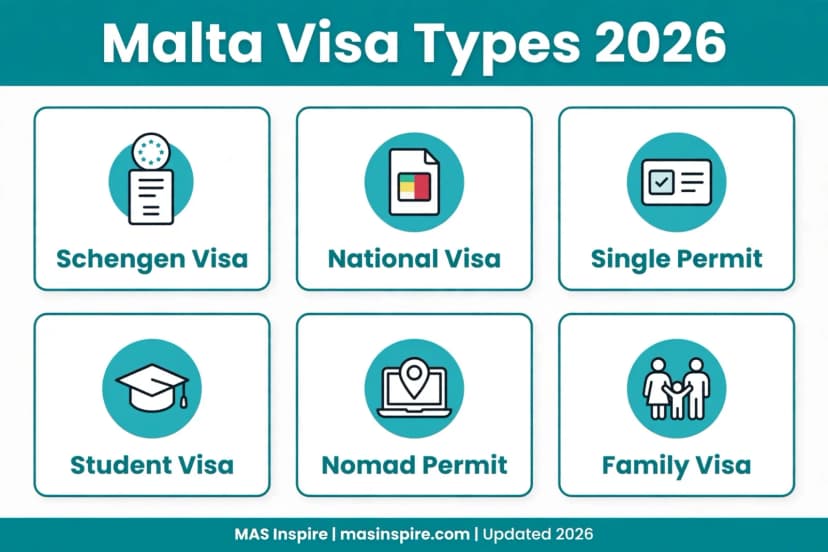
Schengen short-stay visa (Type C)
For tourism, business meetings, conferences and family visits of up to 90 days in any 180-day period. The fee is €90 for adults and €45 for children aged 6 to 11; children under 6 are exempt. You need travel medical insurance with at least €30,000 cover valid across the Schengen area, a return ticket, accommodation evidence and proof of funds (commonly cited at €48 per day of stay). Applications are usually collected by VFS Global.
Airport transit visa (Type A)
For transiting through the international transit area of a Maltese airport without entering Malta. Most travellers who change planes without leaving the airport do not need one, but check the Schengen transit list for your nationality and routing.
National long-stay visa (Type D)
For stays longer than 90 days — work, study, family reunification and other long-term purposes. Applied for before you travel, through VFS Global or a Maltese mission. The D visa is normally valid for up to one year and leads to a residence permit issued in Malta by Identità.
Single Permit (work and residence)
The main route for non-EU nationals taking up salaried employment in Malta. It combines the work and residence authorisation in one permit. Your Maltese employer applies online through the Single Permit portal; the application fee is €300. The employer must first advertise the vacancy through Jobsplus and obtain a Declaration of Suitability. Once approved, Identità issues an Approval in Principle (AIP), normally valid for 60 days, and you then apply for the entry visa. Processing takes a minimum of 6–8 weeks.
Student visa (Type D for studies)
For full-time study at an institution registered with the Malta Further & Higher Education Authority (MFHEA), at MQF Level 5 or higher for higher education, or for English-language courses below Level 5. You must prove funds of at least 75% of the national minimum wage for every month of study — with the 2026 minimum wage at €229.44 a week, that is about €746 a month — over and above paid tuition. You cannot work for the first 13 weeks (90 days), then only 20 hours a week once your employer has a €230 Jobsplus Employment Licence.
Nomad Residence Permit
For third-country nationals who work remotely for employers or clients outside Malta. You need a gross yearly income of at least €42,000 from remote work (the threshold since 1 April 2024), a clean record and private health insurance. The application fee is €300 per person plus a €100 residence-card fee. The permit lasts one year and can be renewed up to a maximum of four years. Remote-work income is not taxed in Malta for the first 12 months, then at a flat 10%.
Family reunification
For spouses and dependent children joining a person legally resident in Malta. Family reunification is effectively closed until the sponsor has a professional salary and 12 months' residence — confirm the current conditions with Identità before relying on this route.
Seasonal worker permit
For seasonal work, normally in tourism, agriculture or hospitality, for up to nine months in any 12-month period. Stays over 90 days need a single application to Identità endorsed by the employer, with a €300 fee. Seasonal work does not count towards long-term residence.
Malta Permanent Residence Programme (MPRP)
A residence-by-investment programme for third-country nationals. Applicants must show capital of €500,000 (including €150,000 in financial assets) or €675,000 (including €75,000 in financial assets), plus property and contribution requirements. This is a specialist route — take licensed advice before applying.
Working Holiday Visa
Malta's Working Holiday Visa is only for citizens of Australia and New Zealand aged 18 to 30. Pakistani passport holders are not eligible.
Digital nomad visa (see Nomad Residence Permit)
Malta's digital nomad route is the Nomad Residence Permit above — it is a residence permit, not a visa, and it is applied for online through the Residency Malta Agency.
3. Malta visa comparison table
| Visa | Purpose | Duration | Work rights |
|---|---|---|---|
| Schengen visa (Type C) | Tourism / business / family | Up to 90 days in any 180 | No |
| National visa (Type D) | Work / study / long stay | Up to 1 year | As authorised |
| Single Permit | Salaried employment | 1 year, renewable | Yes — named employer |
| Student visa (Type D) | Study | Duration of course | After 13 weeks: 20 hrs/week |
| Nomad Residence Permit | Remote work for foreign employer | 1 year, renewable to 4 years | Remote work only |
| Seasonal worker | Seasonal work | Up to 9 months in any 12 | Yes — named employer |
| Family reunification | Joining family | Linked to sponsor | As authorised |
| MPRP | Residence by investment | Long term | As authorised |
Always consult the individual visa page before relying on duration or work rights. Visa validity, entry deadlines and permitted stay are different concepts.
4. Malta visa eligibility requirements
Eligibility depends on the selected visa. Nevertheless, international applicants should prepare to establish several fundamental facts.
Identity and nationality
Your passport must identify you accurately. Names, dates of birth and nationality should match your application and supporting records. If names differ across academic, employment or civil documents, provide appropriate explanations and official evidence.
Genuine purpose
Your activities must correspond to the visa you request. Tourists should establish that their visit is temporary. Students must satisfy student-specific genuineness requirements. Workers must demonstrate that the employment meets applicable criteria.
Financial capacity
Some visas require evidence that applicants can support themselves or their accompanying family members. For a Schengen visit, funds of about €48 per day of stay are commonly cited. For study, you must prove at least 75% of the national minimum wage for every month of study — about €746 a month in 2026 (75% of €229.44 a week) — over and above paid tuition. For the Nomad Residence Permit the threshold is €42,000 gross a year.
Health and character
Applicants may need health examinations, vaccination certificates or police clearance certificates, depending on visa category and personal circumstances. Follow the instructions issued through the official application system.
English-language proficiency
Certain student and skilled migration pathways require acceptable English-language evidence. The required test, score and exemption rules vary by route. For Malta, check the institution's or employer's requirements separately from the immigration requirements.
5. Complete Malta visa document checklists
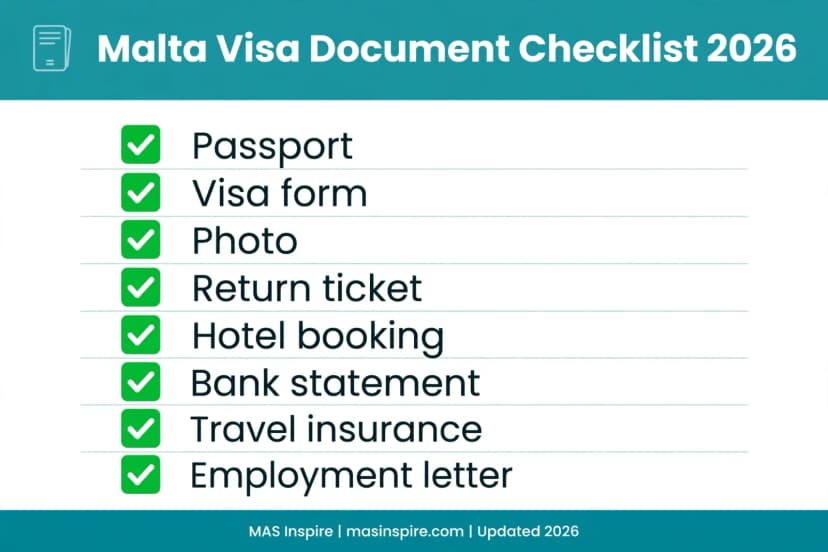
The following tables are preparation guides, not exhaustive statutory document lists. Your individual checklist and the instructions of the mission or portal determine the evidence you must submit.
General application documents
| Document | Classification |
|---|---|
| Valid passport and identity information | Core |
| Correct visa application | Core |
| Applicable visa payment | Required where charged |
| English translations | Required for relevant non-English documents |
| Passport photograph | Where requested |
| National identity document | Where applicable |
| Health examination / vaccination certificate | Conditional |
| Police clearance | Conditional |
| Biometrics | When instructed |
| Previous visa and travel records | Where relevant |
| Proof of legal residence overseas | Conditional or supporting |
Tourist and business visitor checklist
| Document | Classification |
|---|---|
| Passport | Core |
| Travel purpose | Core eligibility evidence |
| Financial records | Financial capacity evidence |
| Proposed itinerary | Supporting |
| Employment and approved leave letter | Supporting |
| Family or business invitation | Conditional/supporting |
| Conference registration | Where applicable |
| Accommodation information | Supporting |
| Responsibilities outside the destination | Supporting |
Student visa checklist
| Document | Classification |
|---|---|
| Passport | Core |
| Admission / enrolment letter | Normally required |
| Proof of funds | When required |
| Academic transcripts and qualifications | Supporting |
| English test | When required |
| Scholarship or loan evidence | If applicable |
| Parental consent and welfare arrangements | For relevant minors |
| Dependant documentation | Where permitted |
Work visa checklist
| Document | Classification |
|---|---|
| Passport | Core |
| Qualifications and certificates | Visa-specific |
| Employment history | Visa-specific |
| Employer sponsorship / authorisation | Sponsored visas |
| Employment contract | Sponsored visas |
| English proficiency | Where required |
| Professional registration | Regulated occupations |
Family immigration checklist
| Document | Classification |
|---|---|
| Passport and civil identity records | Core |
| Sponsor eligibility | Relevant sponsored visas |
| Marriage or relationship records | Partner applications |
| Evidence of shared life | Partner applications |
| Birth or adoption records | Relevant family applications |
| Financial and household evidence | Where relevant |
| Sponsorship documentation | Where required |
| Character and health evidence | As applicable |
Never purchase fabricated bank statements, employment certificates, educational documents or relationship evidence.
6. How to apply for a Malta visa: step-by-step
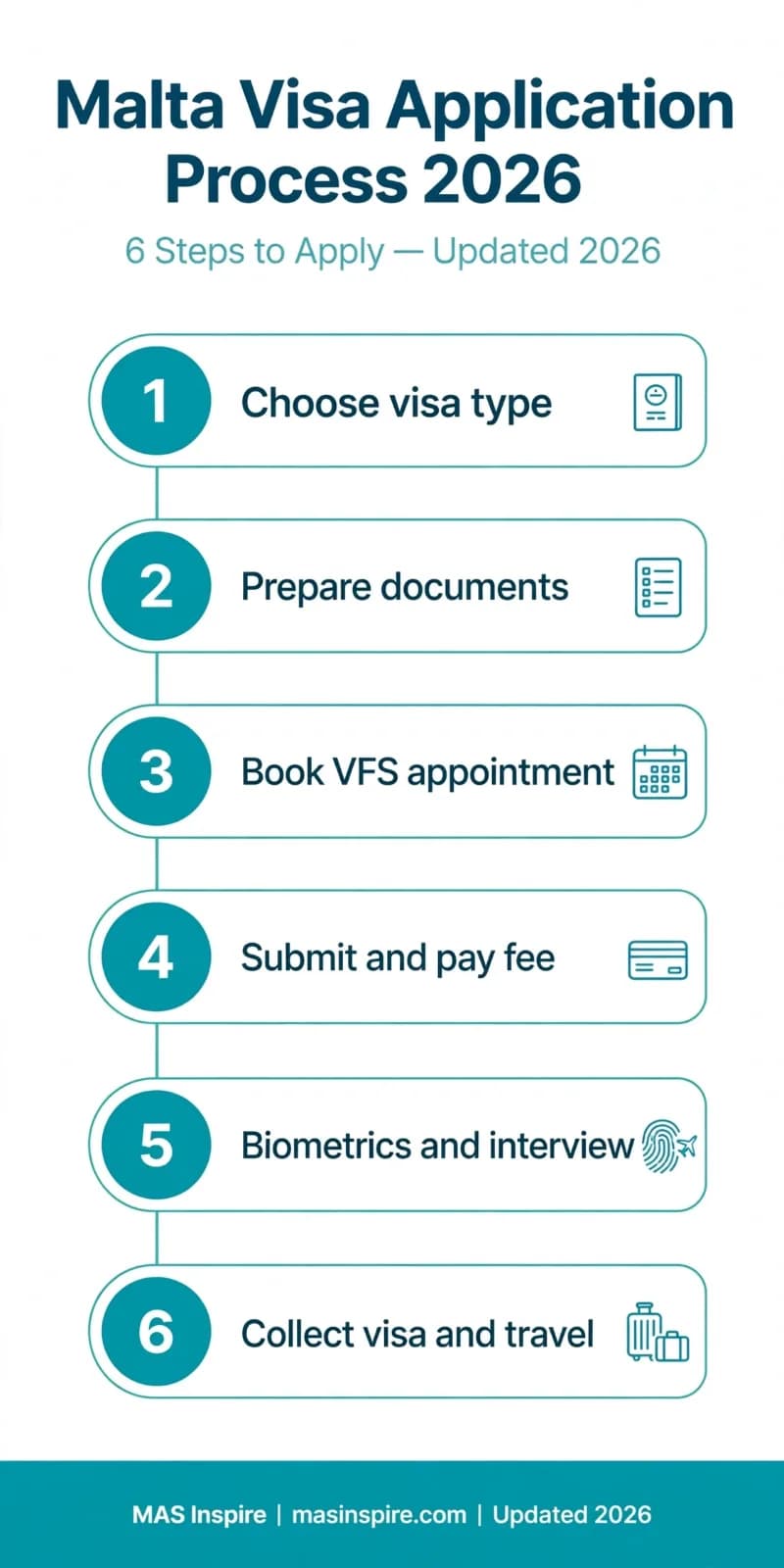
- Choose the correct visa category. Use the official visa pages to identify the route that corresponds to your intended activities.
- Check eligibility. Confirm passport restrictions, application location requirements, age limits, financial criteria and sponsorship arrangements.
- Prepare your documentation. Scan documents clearly, organise supporting evidence and arrange appropriate English translations where necessary.
- Create your account or obtain the form. Use the official portal or the mission's application form — never a look-alike website.
- Complete the application. Provide accurate personal information, employment records, travel history and details of family members. Declare previous immigration refusals where requested.
- Upload documents, pay and lodge. Attach the required evidence and pay the applicable charges through the authorised system. Retain the application reference and payment confirmation.
- Complete additional requirements. The mission or immigration authority may request biometrics, medical examinations, interviews or further documents after lodgement. Only use authorised service providers and follow your individual instructions.
- Monitor your application. Check the portal or your email regularly and respond to requests within the specified deadlines.
- Receive the immigration decision. Read the grant or refusal notice carefully, including the stay period, entry deadline and conditions. If refused, read the official decision to identify the reasons and any applicable review rights.
- Prepare to travel. Check your passport details, permitted arrival date, stay period, entry conditions and employment restrictions before travel. A visa grant does not remove the obligation to comply with border requirements.
7. Malta visa fees and financial requirements in 2026
The following amounts are the charges reported for 2026, re-verified 27 November 2026. They are base charges, not total immigration expenses — health checks, biometrics, translations, travel and other costs are extra. Confirm the exact charge on the official source before payment, as charges change without notice.
| Visa or service | Reported fee |
|---|---|
| Schengen visa — adult | €90 |
| Schengen visa — child 6 to 11 | €45 |
| Schengen visa — child under 6 | Free |
| Single Permit application | €300 |
| Seasonal single application | €300 |
| Nomad Residence Permit application | €300 per person |
| Nomad residence card | €100 per person |
| Jobsplus Employment Licence (student work) | €230 |
| National visa (Type D) | Confirm with the mission — fee varies by category |
| VFS Global service fee | Payable locally — confirm at the centre |
For a Schengen visit, funds of about €48 per day of stay are commonly cited. For study, you must prove at least 75% of the national minimum wage for every month of study — about €746 a month in 2026 (75% of €229.44 a week) — over and above paid tuition. For the Nomad Residence Permit the threshold is €42,000 gross a year.
8. Malta visa processing times
Processing times vary with the visa route and individual application. The figures below are the published or reported times found during this review; they should not be interpreted as guaranteed deadlines.
| Visa category | Processing information |
|---|---|
| Schengen visa | Standard Schengen target: 15 calendar days; allow longer in busy periods |
| Single Permit | Minimum 6–8 weeks from a complete application |
| National visa (Type D) | 6–8 weeks is commonly reported; confirm with the mission |
| Nomad Residence Permit | About 60 days from submission of a complete application |
| Student visa (Type D) | Allow several weeks; apply as soon as you hold the admission letter |
Processing can take longer when documentation is incomplete, identity requires additional verification or health and character checks remain outstanding. Applicants should avoid non-refundable travel arrangements before receiving a decision.
9. Applying for a Malta visa from Pakistan or Vietnam
Pakistani passport holders living in Vietnam
Malta has no embassy in Vietnam and no embassy in Pakistan. Short-stay Schengen applications for Malta are normally collected by VFS Global, and long-stay applications go through VFS Global or a Maltese mission. The Identità Central Visa Unit publishes the list of application centres — it includes centres in India (New Delhi, Mumbai, Bengaluru, Chennai and others), Nigeria, Ghana, Kenya, South Africa and the Philippines, among others. For a Pakistani citizen resident in Vietnam, confirm in writing with the Identità Central Visa Unit which centre or mission accepts your application and whether you must travel to it in person, before you book flights or pay any fee. This point was not confirmed on an official page during this review, and it is the single most important practical question for this route.
Your Vietnamese temporary residence card (TRC), work permit and Vietnamese bank statements are supporting evidence of your circumstances. They do not change the Schengen rules, which depend on your passport.
Malta's Entry/Exit System (EES) registration applies at the external Schengen border: your fingerprints and photo are taken on first entry. The European Travel Information and Authorisation System (ETIAS) is not yet in operation and you do not need it — it applies to visa-exempt travellers in any case, not to visa-required Pakistani passport holders.
Never pay anyone for a Malta job. Maltese law prohibits employment agencies from charging applicants, and employers may not take money from workers for recruitment. The Single Permit fee is the employer's. A genuine offer comes with a named employer, a Jobsplus vacancy clearance and an Approval in Principle — check the company in the Malta Business Registry and the vacancy on Jobsplus before you send a passport scan.
| Additional document | Purpose |
|---|---|
| Pakistani passport | Identity and nationality |
| Vietnamese residence card or valid visa | Lawful residence |
| Vietnamese work permit or exemption | Employment authorisation where applicable |
| Employment contract | Current employment |
| Employer-approved leave | Short visits |
| Vietnamese bank statements | Financial circumstances |
| Pakistani financial records | Additional evidence if relevant |
| Vietnamese accommodation records | Residence evidence |
| Police certificates | If requested |
| Factor | Pakistan | Vietnam |
|---|---|---|
| Nationality | Pakistani | Pakistani |
| Residence evidence | Circumstances in Pakistan | Lawful residence in Vietnam |
| Employment evidence | Pakistani employer if relevant | Vietnamese employer if relevant |
| Biometrics | Local instructions | Local instructions |
| Eligibility | Passport and visa rules | Passport and visa rules |
There is no universal rule that applying from Vietnam results in faster processing or a higher probability of approval.
10. Malta student visa guide 2026
Choose a full-time course at an institution registered with the Malta Further & Higher Education Authority (MFHEA), leading to a qualification at MQF Level 5 or higher for higher education, or an English-language course below Level 5. Check the MFHEA register before enrolling — only registered institutions qualify.
Your enrolment letter must state the institution name as registered, the course name, MQF level, ECTS credits, duration, contact hours per week and the lecture address.
Prove funds of at least 75% of the national minimum wage for every month of study — about €746 a month in 2026 — over and above paid tuition, with bank statements for the last three months and a bank certificate.
You cannot work for the first 13 weeks (90 days). After that you may work 20 hours a week once your employer has a €230 Jobsplus Employment Licence. Graduates can apply for a 9-month post-study job-seeking permit.
Family reunification is effectively closed until you have a professional salary and 12 months' residence — do not plan to bring family immediately.
11. Malta work visas and job opportunities
Find a Maltese employer willing to hire you. The employer must advertise the vacancy through Jobsplus and obtain a Declaration of Suitability showing no suitable EU worker was found.
The employer applies online through the Single Permit portal and pays the €300 application fee. You provide your passport copy (including blank pages), signed CV in Europass format, qualifications, employment contract and health insurance.
If you work in tourism or hospitality, you need the Skills Pass (Part 1 and Part 2) from the Institute of Tourism Studies.
Once Identità approves the permit, you receive an Approval in Principle (AIP), normally valid for 60 days. You then apply for the national D visa through VFS Global or a Maltese mission, with the original AIP — VFS will refuse the file without it.
Processing takes a minimum of 6–8 weeks. Do not resign from a job, book flights or pay an agent until the AIP is issued.
Avoid employment scams
Be cautious of recruiters who promise guaranteed sponsorship, permanent residence or unusually high salaries in exchange for large upfront payments. Check the employer's legitimacy and seek regulated immigration assistance where necessary.
12. Family immigration and permanent residence
Spouses and dependent children of a person legally resident in Malta can apply for family reunification through Identità, with proof of the relationship, the sponsor's residence status, accommodation and funds.
Family reunification is effectively closed until the sponsor has a professional salary and 12 months' residence. Confirm the current income and residence conditions with Identità before applying.
Family members who want to work need their own authorisation — a dependant's residence does not automatically give work rights.
Permanent residence in Malta, where it exists, has separate eligibility requirements, including residence and other statutory criteria. A long-stay visa is not automatically a route to permanent residence or citizenship — check the specific rules before relying on them.
13. Common Malta visa application mistakes
- Applying for a Schengen visa when you need a national D visa (or the reverse) — stays over 90 days need the long-stay route.
- Starting a Single Permit application without an Approval in Principle — VFS will refuse the file at the counter without the original AIP.
- Paying an agent or 'employer' for a Malta job — agencies may not charge applicants, and the permit fee is the employer's. If someone asks for money for a job, it is a scam.
- Enrolling at an institution that is not registered with MFHEA — the visa will be refused.
- Showing student funds below 75% of the minimum wage per month of study, or forgetting that the funds must be over and above paid tuition.
- Working in the first 13 weeks as a student, or working without the Jobsplus Employment Licence.
- Booking non-refundable travel before the visa or the AIP is issued.
Careful preparation can reduce avoidable errors but cannot guarantee a successful decision.
14. Reasons for a Malta visa refusal
Schengen visas are refused for weak travel purpose, insufficient funds, no credible ties to return to, inadequate insurance, or inconsistent documents. A refusal notice states the reason and whether an appeal is possible.
Single Permits are refused when the employer cannot show the vacancy was advertised, the contract does not meet Maltese labour law, or the applicant's documents are incomplete. The employer should confirm the full list with Identità and Jobsplus before lodging.
Student visas are refused when the institution is not MFHEA-registered, the funds are below the 75% threshold, or the enrolment letter lacks the required details. Fix the specific reason and re-apply with a complete file.
15. Frequently asked questions
Do Pakistani citizens need a visa for Malta?
Yes. Pakistan is a visa-required country for the Schengen area, so Pakistani passport holders need a Schengen visa for short stays and a national visa or residence permit for longer stays.
How much is a Malta Schengen visa in 2026?
€90 for adults, €45 for children aged 6 to 11, and free for children under 6. The fee has applied since 11 June 2024. A VFS Global service fee is payable separately at the centre.
How long can I stay in Malta on a Schengen visa?
Up to 90 days in any 180-day period, across the whole Schengen area — not 90 days per country.
How do I work in Malta?
Your Maltese employer applies for a Single Permit through Identità and Jobsplus, pays the €300 fee, and obtains an Approval in Principle. You then apply for a national D visa with the original AIP. Processing takes a minimum of 6–8 weeks. You cannot apply for the permit yourself.
What is the Malta Nomad Residence Permit?
A residence permit for third-country nationals who work remotely for foreign employers or clients. You need at least €42,000 gross a year from remote work, pay a €300 application fee plus a €100 card fee, and the permit lasts one year, renewable up to four years.
How much money do I need to study in Malta?
You must prove at least 75% of the national minimum wage for every month of study — about €746 a month in 2026 (the minimum wage is €229.44 a week) — over and above paid tuition, with three months of bank statements and a bank certificate.
Can students work in Malta?
Not for the first 13 weeks (90 days). After that you may work 20 hours a week once your employer has a €230 Jobsplus Employment Licence. Graduates can apply for a 9-month post-study job-seeking permit.
Can a Pakistani living in Vietnam apply for a Malta visa?
Malta has no mission in Vietnam, and applications are normally collected by VFS Global or a Maltese mission. Confirm in writing with the Identità Central Visa Unit which centre or mission accepts your application — this was not confirmed on an official page during this review.
What is the Malta minimum wage in 2026?
€229.44 a week for adults aged 18 and over, including the 2026 Cost of Living Adjustment of €4.66 a week — about €994 a month. The hourly rate is €5.74.
Do I need ETIAS for Malta?
No. ETIAS is not yet in operation, and when it starts it will apply to visa-exempt travellers, not to visa-required Pakistani passport holders. The Entry/Exit System (EES) does apply at the border.
Can my family join me in Malta?
Spouses and dependent children can apply for family reunification, but it is effectively closed until the sponsor has a professional salary and 12 months' residence. Confirm the current conditions with Identità.
Is there a Malta Working Holiday Visa for Pakistanis?
No. Malta's Working Holiday Visa is only for citizens of Australia and New Zealand aged 18 to 30.
What is the Skills Pass for Malta?
A two-part qualification from the Institute of Tourism Studies, mandatory for non-EU nationals working in tourism or hospitality in Malta. Your employer should arrange it before you start work.
Can I travel to other Schengen countries on a Malta visa?
Yes. A Malta Schengen visa lets you travel to other Schengen countries within the 90/180-day rule, provided Malta is your main destination or first entry as declared.
What insurance do I need for a Malta visa?
Travel medical insurance with at least €30,000 cover, valid across all Schengen countries for the whole stay.
16. Official Malta immigration websites
| Resource | Purpose |
|---|---|
| Identità — Central Visa Unit (national long-stay visa) | Official source |
| Identità — Working and residing in Malta | Official source |
| Residency Malta Agency — Nomad Residence Permit | Official source |
| Jobsplus — Employment services | Official source |
| Department of Industrial and Employment Relations (DIER) — minimum wage 2026 | Official source |
| European Commission — Schengen visa policy | Official source |
| VFS Global — Malta visa application centres | Official source |
17. Final checklist and conclusion
- [ ] Selected the correct visa category and route.
- [ ] Confirmed nationality and application location eligibility.
- [ ] Prepared passport and supporting documents.
- [ ] Checked current visa charges.
- [ ] Confirmed financial capacity requirements.
- [ ] Prepared English translations where needed.
- [ ] Completed sponsorship or nomination requirements.
- [ ] Submitted truthful information through the official portal.
- [ ] Checked biometrics and health examination instructions.
- [ ] Understood visa conditions before travelling.
Malta offers a range of opportunities for international visitors, students, skilled professionals and families. Choosing an appropriate visa, understanding current immigration regulations and preparing accurate evidence are essential parts of the application process.
For Pakistani citizens living in Vietnam, the most important consideration is that citizenship, legal residence and immigration eligibility are separate matters. Always consult the official immigration authority before lodging an application.
Disclaimer: MAS Inspire provides independent educational information and is not a Malta government authority. This article does not constitute personalised immigration or legal advice. Immigration rules, fees and processing priorities may change. Visa approval is not guaranteed.