Bonaire, Sint Eustatius and Saba Visa Guide 2026: Types, Requirements, Fees and How to Apply
MAS Inspire | Verified 27 November 2026 | Educational information, not legal advice
Bonaire, Sint Eustatius and Saba (the BES islands or Caribbean Netherlands) are public entities within the Kingdom of the Netherlands. They are not a separate sovereign country and do not operate three independent visa systems. Their immigration rules are distinct from the European Netherlands and the Schengen Area.
Table of contents
- Introduction
- Why people visit, study and work in the BES islands
- Types of visas and residence permissions
- Visa comparison table
- Eligibility requirements
- Complete document checklists
- How to apply
- Visa fees and financial requirements
- Visa processing times
- Applying from Pakistan or Vietnam
- Student visa and study residence
- Work permits and job opportunities
- Family immigration and permanent residence
- Common application mistakes
- Reasons for refusal
- Frequently asked questions
- Official immigration websites
- Final checklist and conclusion
Introduction
Bonaire, Sint Eustatius (Statia) and Saba are three Caribbean islands that form the Caribbean Netherlands. They are part of the Kingdom of the Netherlands, but their entry and residence rules are not the same as the rules for Amsterdam, Rotterdam or other destinations in the European Netherlands. A Schengen visa does not automatically authorise travel to the BES islands, and a Caribbean visa does not authorise travel to the European Netherlands or other Schengen countries.
For a visit of up to 90 days, a traveller may need a short-stay Caribbean visa depending on nationality and circumstances. For a stay exceeding 90 days, most foreign nationals need a local residence permit. Some nationalities must first obtain an Authorisation for a Temporary Stay (MVV) before travelling. A person intending to work may also need a separate work permit (TWV), normally arranged by the employer.
This guide distinguishes the travel visa from the underlying residence permission and work authorisation. It uses official Dutch government and Caribbean Netherlands sources available on 27 November 2026. Immigration rules, fees and document lists can change; confirm the current instructions for the relevant island and application location before paying or travelling.
Why people visit, study and work in the BES islands
Visitors travel to Bonaire for diving, marine parks, wind sports, nature and its salt flats; Saba for hiking and Mount Scenery; and Statia for its historic sites, marine environment and The Quill. The islands also host education, healthcare, tourism, hospitality, conservation, public-service and small-business activity. These opportunities do not create an automatic right to reside or work. Applicants must qualify under the relevant admission purpose and, for employment, satisfy local labour-market rules.

Types of visas and residence permissions
1. Tourism and private visits
A short-stay Caribbean visa is the principal visa for a visa-required visitor travelling for tourism, holidays or a private visit. It allows travel to and between the Caribbean parts of the Kingdom covered by the visa. For Bonaire, Saba and Statia, the maximum stay is generally 90 consecutive days in a 180-day period. The visa's printed validity and number of entries must be checked separately from the permitted stay. Visa-exempt travellers still have to meet entry conditions.
A tourism visa does not permit paid employment. The official short-stay guidance says a person intending to work needs a work permit and must contact the local authorities. A visitor should not use a tourist stay as a substitute for a residence and employment application.
Official sources: Caribbean visa overview, short-stay Caribbean visa, visa-free entry conditions.
2. Business visitor or official visit
Business meetings, conferences, negotiations and official visits may be supported by a short-stay Caribbean visa. The applicant should use the business/official-visit checklist and provide an invitation or evidence of the event, the organisation being visited, itinerary and who pays. This is a visitor route, not permission to take up local employment or provide ordinary paid services in the local labour market. The precise activities must be checked with the authorities if they go beyond meetings or a temporary visit.
3. Study and language study
A person admitted for a course or study programme may apply for residence for the purpose of study. The official IND-CN fee schedule lists study as a residence purpose. The student must provide the education institution's documentation and evidence of sufficient means, including tuition. The published IND-CN means guidance says a student's monthly contribution must be at least 50% of the gross monthly minimum wage under the BES Minimum Wage Act, supplemented by tuition fees. The applicable wage amount depends on the island and is updated; do not rely on historical examples.
The official forms library includes a guarantee from an educational institution and a declaration of intent/reference request for study. A short visit to attend an event or brief course should not be confused with long-term student residence. No separate general language-school visa category was identified; the study route and institution's eligibility should be confirmed directly with IND-CN.
Sources: IND-CN forms and enclosures, means of existence, 2026 IND fees.
4. Employment and employer-sponsored residence
A foreign national who intends to live and work on one of the islands generally needs the appropriate residence permission. For many nationalities, the MVV must be obtained before entry. Separately, employers are required to recruit locally first. If local recruitment does not prove possible despite best efforts, the employer may be permitted to employ a foreign national under strict conditions and must apply for a work permit (TWV). A tourist visa or residence permit alone is not a substitute for a required TWV.
The employer should establish the job offer, recruitment efforts, employment terms and supporting evidence. From 1 November 2026, the IND-CN announced additional documents for certain paid-employment applications, including a certificate of no debt and a summary wage statement. The applicant must submit the required documents themselves. The exact TWV checklist is published by RCN Unit SZW and should be checked at the time of filing.
Sources: work permits, residence procedure for other nationalities, new application procedure effective 1 November 2026.
5. Job seeker and skilled-worker routes
No separate stand-alone job-seeker visa or points-based skilled-worker visa for the BES islands was identified in the official IND-CN immigration categories reviewed. A person normally needs a qualifying residence purpose and, for paid work, the employer's required work permit. Finding a vacancy does not itself confer permission to enter, reside or work. Highly qualified applicants should still follow the local employer-led process rather than assuming that European Netherlands highly skilled migrant rules apply.
6. Digital nomad and remote work
No dedicated digital-nomad visa was identified in the official BES immigration categories reviewed. Remote work for a foreign employer should not be assumed to be authorised by tourist admission. Applicants should ask IND-CN in writing whether their precise arrangement fits an available residence purpose and whether local work authorisation or tax obligations arise.
7. Self-employment, entrepreneurship and investment
The official IND-CN fee schedule recognises residence purposes for self-employed persons and investors. These are residence categories, not a blanket startup visa. Applicants must establish a genuine qualifying business or investment, meet the applicable means and documentary tests, and obtain any required local licences. The official means guidance states that a self-employed applicant must show income at least equal to the gross monthly minimum wage; for a first application, a bank statement in the business or applicant's name showing at least the gross annual income under the BES Minimum Wage Act is required. The applicable threshold varies with island wage rates and should be confirmed.
Investors and self-employed applicants should check the current IND-CN form, business evidence and 2026 fees. Do not interpret payment of the application fee as approval or as proof that a business proposal qualifies.
Sources: means of existence, forms and enclosures, 2026 fees.
8. Family reunification and family formation
A qualifying spouse, registered partner, child or other eligible family member may apply for residence under family reunification or family formation rules. The sponsor must meet the applicable relationship, residence and financial requirements. Relationship documents may need legalisation/apostille and translation. From 1 November 2026, applicants for family reunification must also submit proof of income under the new procedure. The precise qualifying relationships and supporting documents must be confirmed using the current IND-CN form; do not assume every extended-family relationship qualifies.
Source: new application procedure.
9. Internship, trainee, exchange and volunteer placements
IND-CN's fee schedule and forms recognise trainees/interns and volunteers. These are purpose-specific residence applications, not general work visas. An internship organisation or volunteer organisation may act as reference/guarantor, and the applicant must meet the purpose-specific means and document requirements. The official means guidance says internship resources should reach at least 50% of the island's gross minimum wage and may include an internship allowance, student finance and eligible covered costs. For volunteers there is no fixed means standard stated on that page, but accommodation and ability to support oneself must be demonstrated; the organisation acts as guarantor. For non-Dutch/non-American volunteers, the organisation must apply for a work permit.
Source: means of existence.
10. Researcher and academic activity
No separate researcher visa label was verified in the official public categories reviewed. A researcher should identify the actual legal purpose: study, paid employment, internship, volunteer placement or another approved residence purpose. A host institution's invitation is useful evidence but does not by itself establish immigration status or work rights. Obtain a written classification from IND-CN before travel.
11. Pensioners, independent means and winter visitors
The official IND-CN means guidance recognises retired persons, people of independent means and long-term winter visitors. The winter-visitor purpose is described as a stay of up to six months per year. The published means guidance uses 120% of the gross monthly minimum wage for retired persons, long-term winter visitors and persons of independent means, with a separate couple standard for winter visitors. These are minimum-income formulas, not universal fixed dollar figures; consult the current island-specific minimum wage.
12. Permanent residence
A foreign national who has lived lawfully and continuously for at least five years in the public entities on the basis of a fixed-term residence permit may apply for a permanent/indefinite residence permit, subject to conditions and supporting evidence. This is not automatic after five years. IND-CN assesses the application and may require proof of independent, sustainable and sufficient financial resources. The 2026 application fee is listed as $196.
Source: permanent residence application.
13. Transit
The official government guidance says that in most cases a visa is not needed merely to transit through the Caribbean parts of the Kingdom, but individual circumstances and nationality matter. Verify whether the traveller must pass immigration, change airports or terminals, collect baggage, or stay overnight. Transit is not permission to enter for tourism or work.
14. Humanitarian protection
The islands operate within the Kingdom's legal framework for protection and asylum. This is not a visitor visa or a general migration route. Anyone seeking protection should contact the competent local authorities or qualified legal assistance immediately. This guide does not attempt to set out individual asylum eligibility or procedural deadlines.
Visa comparison table
| Purpose | Correct route / permission | Work allowed? | Fee / duration note |
|---|---|---|---|
| Tourism/private visit | Short-stay Caribbean visa if required | No paid work | Up to 90 consecutive days in 180 for BES; visa fee depends on application location |
| Business meetings | Short-stay Caribbean visa if required | No ordinary local employment | Purpose-specific invitation/evidence; check permitted activity |
| Study | Study residence permit; MVV first where required | No automatic general work right | 2026 IND fee $196; study-specific funds and tuition |
| Paid employment | Residence permit and employer TWV where required; MVV for many nationalities | Only within authorisation | 2026 residence fee $326; TWV separate/confirm |
| Self-employment | Self-employed residence purpose | Only within approved scope and required authorisations | 2026 fee $922; business/means evidence |
| Investor | Investor residence purpose | Not a general employment permission | 2026 fee $922; eligibility is case-specific |
| Family | Family reunification/formation residence | Depends on permit conditions | 2026 adult fee $196; proof of income now required |
| Internship | Trainee/intern residence and work authorisation as applicable | Limited to placement/permission | 2026 fee $326 |
| Volunteer | Volunteer residence and work permit as applicable | Limited to approved volunteer activity | 2026 fee $326; organisation guarantor |
| Pensioner/independent means | Residence purpose for pensioner/independent means | No general work permission | 2026 fee $326 (pensioner) or $922 (independent means) |
| Winter visitor | Long-term winter visitor residence purpose | No general work permission | Maximum six months per year; 2026 fee $922 (same schedule line as person of independent means) |
| Permanent settlement | Indefinite residence permit | Subject to status and other rules | 2026 fee $196; at least five years' qualifying lawful continuous stay |
| Job seeker/digital nomad | No separate category identified | No | Do not assume a route exists |
Eligibility requirements
The first eligibility question is nationality. The official visa checker should be used for the exact passport and travel circumstances. Pakistani ordinary passport holders are not on the general visa-exempt nationality list and should expect to need a short-stay Caribbean visa for a visit unless a specific exemption applies. A diplomatic or official passport may be treated differently; the government list contains passport-type exceptions, so do not generalise an ordinary-passport rule to every document.
For residence applications, nationality affects the order of steps. IND-CN states that nationals of EU/EEA states and specified countries (including Australia, Canada, Japan, Monaco, New Zealand, Vatican City, the United States, South Korea and Switzerland) can generally enter first and apply locally. Nationals of Africa, the Middle East, Asia, South and Central America and the Caribbean must apply for an MVV before entry if they intend to work or stay longer than three months. Pakistani nationals fall within the Asia group.
For short-stay visa-free travel, the Government lists passport validity, proof of onward/return travel, proof of purpose, sufficient funds and medical insurance. Published indicative funds are US$150–200 per person per day for hotel accommodation or US$100 per person per day when staying with family, unless a sponsor assumes financial responsibility. Insurance must cover at least US$15,000 and include hospital care, emergency treatment and repatriation. These are entry requirements for visa-free travel and should not be mistaken for a universal residence-permit income threshold.
Sources: visa-needed checker, travel without a visa, IND-CN nationality procedure.
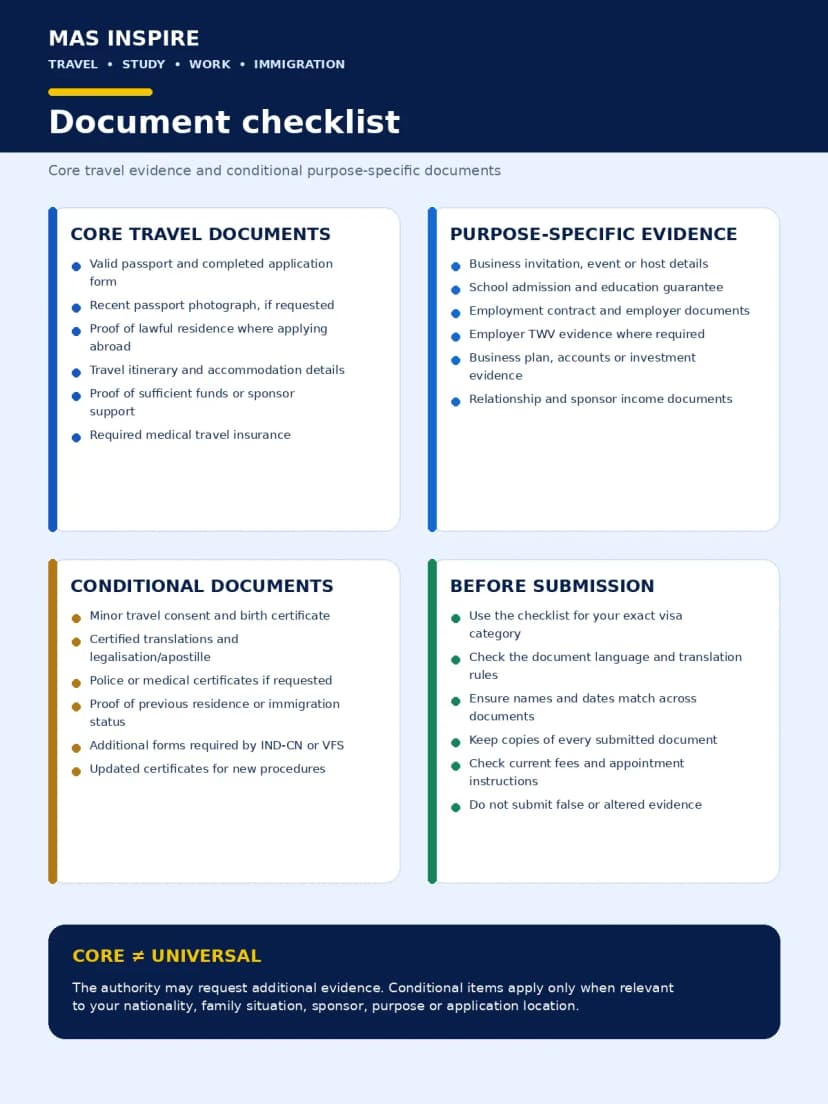
Complete document checklists
The authority can request additional documents or an interview. The following separates core documents from conditional evidence; the official checklist for the applicant's purpose and location takes precedence.
Short-stay tourism checklist
| Document | Status / notes |
|---|---|
| Completed, signed Caribbean visa application form | Mandatory for visa application |
| Passport/travel document | Mandatory; no more than 10 years old, at least two blank visa pages, signed, and valid at least three months after departure |
| Recent colour photograph | Mandatory unless VFS takes a digital photo; 3.5 × 4.5 cm, light background, under six months old |
| Proof of lawful residence where applying | Mandatory; residence permit should remain valid at least three months after departure where applicable |
| Evidence of social/economic ties | Required according to circumstances: employment letter and payslips, student enrolment, business/tax evidence, property or family-care evidence |
| Accommodation | Hotel/rental booking or evidence of owned accommodation; family invitation and host details where relevant |
| Financial evidence | Usually three months of bank statements and, if employed, recent payslips; sponsor evidence if another party pays |
| Travel reservation | Return/onward itinerary; paid ticket is not required by the official checklist |
| Travel medical insurance | Mandatory; at least US$15,000 and required medical/emergency/repatriation coverage |
| Minor travel consent | Conditional for a child travelling without one/both parents or guardians; birth record, consent, parent ID and any custody/death/guardianship evidence as applicable |
Official checklist: Tourism document checklist.
Business, family visit, study/event short-stay documents
Start with the tourism core documents, then add the purpose-specific evidence. A business visitor should provide an invitation from the host organisation, reason and schedule for the visit, and details of who pays. A family/friend visitor should provide an invitation and host's relevant residence/contact details, plus sponsorship evidence if the host pays. A short study, cultural, sporting or religious event visitor should provide enrolment, event registration or organiser invitation, dates, funding and accommodation details. Use the official business checklist and the purpose links from the short-stay application page.
Long-stay Caribbean visa checklist
| Document | Status / notes |
|---|---|
| Completed, signed Caribbean visa form | Mandatory |
| Passport | No more than 10 years old, two blank pages, signed and valid at least three months after intended travel |
| Recent photograph | Dutch photo standard; VFS may take digital photo |
| Proof of legal residence in country of application | Mandatory; original and colour copy |
| MVV-BES / local authorisation for temporary stay | Purpose evidence for Bonaire, Saba or Statia; obtain through the local admission process |
| Travel reservation | Required evidence; paid ticket not necessary under checklist |
| Minor consent/guardianship documents | Conditional |
| Additional purpose documents | Employment, study, family, investor or other evidence listed by IND-CN |
Official checklist: Long-stay Caribbean visa checklist. A long-stay visa is only applied for when the residence-permit process has also been started; it is a travel document to collect the approved residence permission, not the residence permission itself.
Residence/work supporting evidence
Depending on the purpose, IND-CN forms may require passport copies, civil-status records, sponsor/reference documents, proof of income, employer declaration, payslips, tax evidence, educational institution guarantee, business records, bank statements, accommodation details and police/character records where specified. Do not assume every item applies to every category. Civil-status documents may require legalisation or apostille and translation into Dutch or English. From 1 November 2026, paid-employment and self-employment applicants must also provide a certificate of no debt and summary wage statement; family reunification applicants must provide proof of income. The applicant is responsible for obtaining and submitting these new supporting records.
Official resources: forms and enclosures, new application procedure.
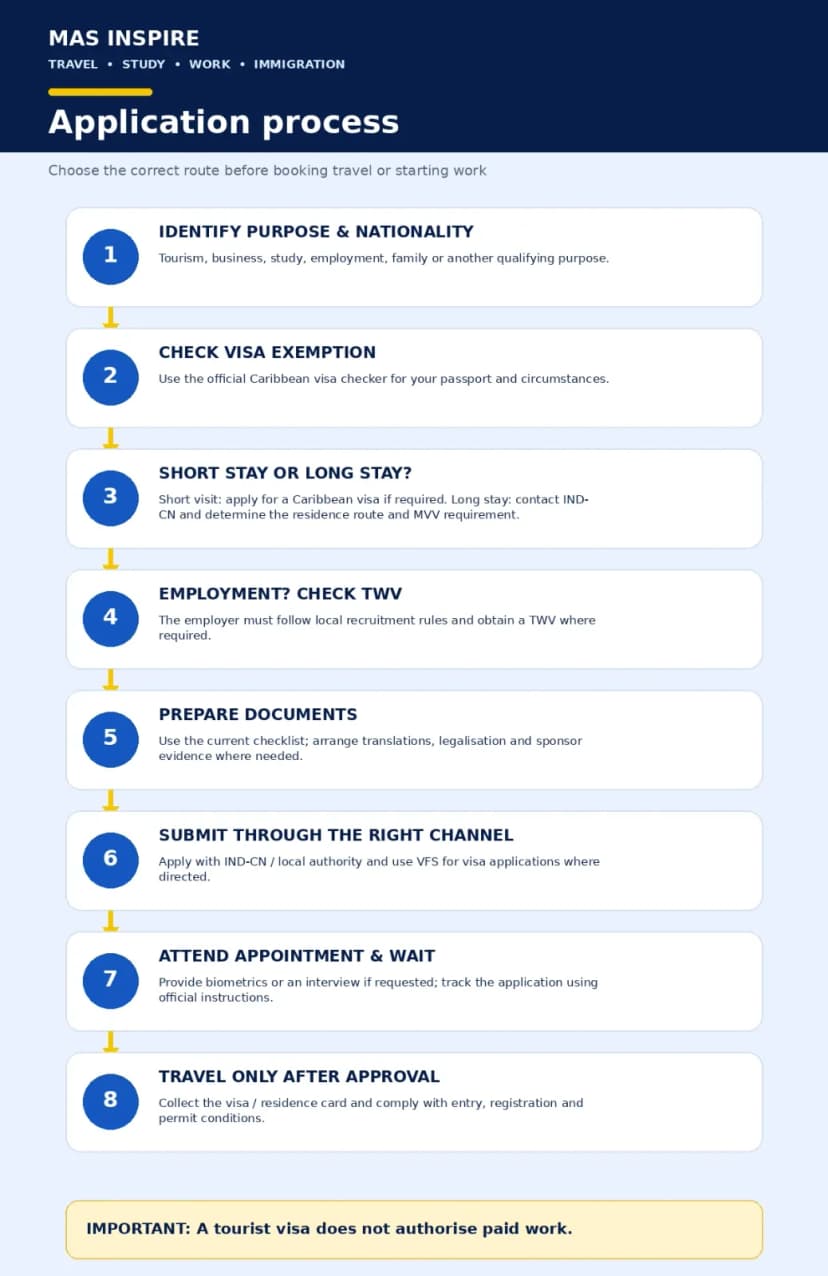
How to apply: step-by-step
- Choose the purpose accurately. Tourism, business visit, study, paid employment, self-employment, family, internship, retirement and investment are different purposes. A short-stay visit is not a work or settlement route.
- Check nationality and residence. Use the official visa checker. For a residence application, establish whether your nationality requires an MVV before entry. Pakistani nationals are within the Asia group for the IND-CN MVV procedure.
- Identify the island and responsible authority. Contact IND-CN for residence/admission and RCN Unit SZW for a TWV. Do not assume that a permit for one Caribbean island or the European Netherlands is interchangeable.
- Obtain the current checklist and forms. Use the official forms/enclosures page and the location-specific NetherlandsWorldwide instructions. Check document age, translations and legalisation.
- Arrange sponsorship or reference evidence if applicable. Employers, family sponsors, educational institutions or volunteer organisations may need to initiate or support the application.
- Submit the local residence/MVV application in the required order. For nationals who require an MVV, apply before travelling. IND-CN says an applicant who submits an MVV application personally while on an island must leave within eight days and await the decision in their country of origin; an authorised reference may apply on the applicant's behalf.
- Apply for the long-stay Caribbean visa if required to collect the approved permit. The long-stay visa application is made at the designated Dutch embassy/VFS location. In Vietnam, the official page directs applicants to VFS Global in Hanoi or Ho Chi Minh City.
- Complete biometrics or attend an appointment. Short- and long-stay visa applications in Vietnam are in person. The authority may ask for an interview or additional documents.
- Pay the applicable fees and retain receipts. Visa fees are separate from local IND-CN residence fees and any employer work-permit charges or VFS service fee.
- Wait for written decisions and follow collection instructions. Do not travel or start work until the required permissions are in place. On arrival, comply with the conditions printed on the permit and any registration requirements.
This is a practical sequence, not a claim that every category uses ten identical steps. For a short-stay tourist, the local residence and MVV steps do not apply. For an employer-sponsored worker, the employer's TWV process is also necessary where required.
Visa fees and financial requirements
Short-stay visa fee in Vietnam (2026)
| Visa service | Official fee |
|---|---|
| Caribbean visa, adult | €80 |
| Caribbean visa, child aged 6–11 | €40 |
| Caribbean visa, child under 6 | Free |
These are the 2026 consular fees published for Vietnam. VFS may charge a separate service fee. Payment in VND uses the current official exchange rate. The fee may be non-refundable if the application is refused or incomplete.
Source: Consular fees in Vietnam.
IND-CN residence fees effective 1 January 2026
| Residence application purpose | Initial / fixed-term fee (USD) | Extension fee (USD) |
|---|---|---|
| Family reunification/formation – adult | $196 | $196 |
| Family reunification/formation – minor | $65 | $65 |
| Paid employment | $326 | $326 |
| Self-employed person | $922 | $724 |
| Investor | $922 | $391 |
| Trainee or intern | $326 | Not separately shown in this table |
| Volunteer | $326 | Not separately shown in this table |
| Pensioner | $326 | $326 |
| Person of independent means | $922 | $391 |
| Study | $196 | $196 |
| Permanent residence | $196 | — |
| Return visa | — | $36 |
The table is a summary of the official one-page 2026 IND-CN fee schedule. It includes the listed categories only; check the official schedule for change-of-restriction, readmission, continuation and other cases. MVV application fees are purpose-dependent and separately listed in the schedule. Fees are indexed annually on 1 January. Work-permit charges, external provider service fees, translations, legalisation, travel and insurance are additional where applicable.
Source: IND-CN 2026 application fee schedule.
Financial thresholds
For short-stay visa-free travellers, the government publishes indicative means of US$150–200 per person per day when staying in a hotel, or US$100 per person per day when staying with family; a sponsor may assume financial responsibility. Travel insurance must cover at least US$15,000. For residence, the IND-CN means-of-existence page uses formulas tied to each island's gross minimum wage. It specifies, among other standards, 120% of the monthly gross minimum wage for a retired person or person of independent means, and 50% plus tuition for a student. Because the wage amount changes and differs by island, the guide does not convert these formulas into a potentially stale flat amount.
Source: Means of existence.
Visa processing times
For short-stay applications in Vietnam, the official guidance says the earliest application is six months before intended travel and that most applicants receive a decision within 15 calendar days. Some cases take longer if extra checks, an interview or documents are required. Long-stay visa applications in Vietnam are also usually decided within 15 calendar days, but this is the visa-sticker stage and does not represent the total time for the local residence/MVV decision. IND-CN processing times for residence and work permits vary with category and completeness; no single universal current processing time was verified. Submit a complete application and ask IND-CN for the current estimate.
Sources: short-stay application in Vietnam, long-stay application in Vietnam, IND-CN contact.
Applying from Pakistan or Vietnam
Pakistani passport holders
Pakistani ordinary passport holders should assume a Caribbean visa is required for a short visit unless the official checker identifies a specific exemption. The general visa-free list does not include Pakistan for ordinary passports. Some diplomatic passports have a different treatment, which must not be confused with an ordinary passport.
For residence longer than three months or employment, Pakistan is in Asia; IND-CN says nationals of Asia must obtain an MVV before entering the islands. The residence application and MVV are handled under the local Caribbean Netherlands process. A sponsor/reference such as an employer or first-degree relative living on the island may apply on the applicant's behalf if authorised. If the applicant submits the MVV application personally while on an island, IND-CN says they must leave within eight days and await the decision in their country of origin.
If applying for a short-stay visa while resident in Pakistan, NetherlandsWorldwide lists VFS Global centres in Islamabad, Karachi and Lahore. The official Pakistan page describes the document checklists and usually 15-calendar-day short-stay decision period. Check current appointment availability and fee details before attending.
Sources: Pakistan short-stay application, IND-CN residence procedure, visa-needed checker.
Pakistani citizens legally living or working in Vietnam
A Pakistani citizen who is legally resident in Vietnam may apply through the Netherlands' designated visa channel in Vietnam, subject to the location's rules. The official short-stay and long-stay pages list VFS Global in Hanoi and Ho Chi Minh City. Applicants must present valid proof of lawful residence in Vietnam and evidence of their social/economic ties there. An employed applicant should prepare a recent employer letter showing position, contract duration and salary, together with recent payslips and bank statements. A self-employed applicant may use business/tax evidence and bank statements; a student should provide proof of enrolment.
A Vietnamese residence card or work permit does not waive the Caribbean visa requirement and does not guarantee that the Dutch authorities will accept the application in Vietnam. It establishes local residence for the purpose of applying there; the visa decision remains individual. The tourist checklist says that a residence permit used as proof of local residence must remain valid at least three months after departure from the Caribbean parts of the Kingdom. The applicant should also show a credible reason to return to Vietnam and consistent evidence of funds, itinerary and accommodation.
For short-stay applications in Vietnam, applicants must apply in person, including children. Documents must be in English or Dutch; Vietnamese documents must be translated into English by a notary public office according to the country-specific page. The published 2026 Caribbean visa fee in Vietnam is €80 for an adult, €40 for a child aged 6–11 and free for a child under 6, plus any VFS service fee.
For a long-stay visa in Vietnam, an applicant can only apply after also applying for the local residence permit. The Vietnam page lists VFS in Hanoi and Ho Chi Minh City and says most long-stay visa applications are decided within 15 calendar days. Pakistani nationality still triggers the local MVV-before-entry rule for the residence route; residence approval and the visa to collect it are separate stages.
Sources: Vietnam short-stay application, Vietnam long-stay application, tourism document checklist, Vietnam fees.
Student visa and study residence
A student planning a stay beyond the visitor period should obtain admission from a suitable education provider and ask the provider and IND-CN which study residence form and guarantee are required. The IND-CN forms library includes education-institution guarantees and study declarations. Students must demonstrate sufficient resources; the official means page states a monthly contribution of at least 50% of the gross monthly minimum wage plus tuition. A one-off payment must equal 12 times the monthly 50% amount plus tuition. Study residence does not automatically authorise unrelated employment. The 2026 fee is $196 for the initial fixed-term study residence application and $196 for an extension. Pakistani students must also follow the MVV procedure before entry.
Work permits and job opportunities
The local labour market is protected. Employers must first recruit locally and can employ a foreign national temporarily only if local recruitment has not succeeded despite best efforts and the legal conditions are met. The employer applies for the TWV. The foreign worker must also hold the correct residence permission and MVV if their nationality requires it. Do not start paid work while holding only a visitor visa.
The official RCN work-permit page provides the TWV form and a checklist dated 20 November 2026. The 2026 residence fee for paid employment is $326, but this is not the work permit fee. From 1 November 2026, paid-employment and self-employment applicants must submit a certificate of no debt and summary wage statement as part of the new application-document procedure.
Family immigration and permanent residence
Family applications depend on a qualifying relationship and the sponsor's status and financial capacity. Marriage/partnership certificates and birth records may need legalisation or apostille and reliable translation. The IND-CN's new procedure requires proof of income for family-reunification applications from 1 November 2026. The 2026 residence fee is $196 for an adult family member and $65 for a minor.
Permanent residence may be available after at least five years of uninterrupted lawful residence based on a fixed-term permit, but the applicant must satisfy the applicable conditions and provide evidence. It is not an automatic conversion. The published 2026 permanent-residence fee is $196. Naturalisation is a separate process with additional residence, integration and language conditions; permanent residence and Dutch citizenship are not the same thing.
Common application mistakes
- Applying for a Schengen visa when the destination is Bonaire, Saba or Statia.
- Assuming a Caribbean visa permits entry to the European Netherlands.
- Assuming a visa-exempt nationality or a Vietnamese residence card removes all entry conditions.
- Treating a tourist/business visa as work authorisation.
- Starting a long-stay visa application before the residence/MVV process has been initiated.
- Using an outdated form, fee table or income threshold.
- Submitting Vietnamese-language documents without the required translation.
- Omitting evidence of legal residence and economic ties in the country of application.
- Failing to include the 1 November 2026 additional documents where relevant.
- Buying non-refundable travel before permission is granted.
Reasons for visa refusal
The authorities may refuse a visa or residence application where the applicant does not meet the applicable legal conditions, cannot establish the purpose of travel, provides incomplete or inconsistent documents, lacks credible funding or accommodation evidence, fails to show lawful residence in the country of application, does not satisfy sponsor or employment requirements, or raises public-order, security or immigration-compliance concerns. These are general risk areas, not an exhaustive statutory list. The refusal notice should be read carefully for the actual reason and any objection or appeal deadline. Do not submit false documents or conceal prior refusals.
Frequently asked questions
1. Do I need a visa to visit Bonaire?
It depends on nationality and circumstances. Use the official Caribbean visa checker. Pakistani ordinary passport holders generally need a short-stay Caribbean visa.
2. Is a Schengen visa valid for Bonaire?
A Schengen visa is not the same as a Caribbean visa. Check the specific exemption rules; do not assume Schengen permission covers the BES islands.
3. How long can I stay as a tourist?
For Bonaire, Saba and Statia, the general maximum is 90 consecutive days in a 180-day period, subject to the permission granted and local entry rules.
4. Can I work with a tourist visa?
No. A short-stay Caribbean visa does not authorise paid work. A work permit and the correct residence permission may be required.
5. Can Pakistani citizens apply from Vietnam?
If legally resident in Vietnam, they may apply through VFS Global in Hanoi or Ho Chi Minh City, subject to proof of lawful residence and local application requirements. This does not guarantee approval.
6. Does a Vietnam residence card guarantee a Caribbean visa?
No. It is evidence of legal residence in Vietnam, not a visa exemption or guarantee of approval.
7. What is the adult Caribbean visa fee in Vietnam in 2026?
The published fee is €80, excluding any VFS service fee.
8. How long does a Caribbean visa take in Vietnam?
Most short- and long-stay visa applications are decided within 15 calendar days, but extra checks can take longer. The residence-permit stage is separate.
9. Do Pakistani nationals need an MVV for long-term residence?
Pakistani nationals fall within the Asia group for IND-CN's rule requiring an MVV before entry for work or a stay longer than three months.
10. Is there a digital nomad visa?
No dedicated digital-nomad category was identified in the official categories reviewed. Obtain written advice from IND-CN before relying on remote work as a basis to stay.
11. Is there a job-seeker visa?
No separate job-seeker visa was identified in the official categories reviewed. A job offer does not replace residence permission and any required employer TWV.
12. Can I study on a tourist visa?
A short visit to attend an event or short course may fit a visitor purpose. A longer study programme requires the appropriate study residence route.
13. Can my spouse or children join me?
Potentially, through the applicable family-reunification or family-formation category, if relationship, sponsor and financial conditions are met.
14. Can I obtain permanent residence after five years?
You may apply after at least five years of uninterrupted lawful residence on a qualifying fixed-term permit, subject to all conditions. It is not automatic.
15. Is a Caribbean visa valid in Curaçao or Aruba too?
A short-stay Caribbean visa generally covers travel to and between the Caribbean parts of the Kingdom, subject to its entries, validity and destination-specific stay rules. Check the visa sticker and current official rules.
Official immigration websites
- NetherlandsWorldwide — Caribbean visas
- Do I need a Caribbean visa?
- Short-stay Caribbean visa
- Long-stay Caribbean visa and residence permit
- Tourism document checklist
- Long-stay document checklist
- Consular fees in Vietnam
- IND Caribbean Netherlands — immigration and naturalisation
- IND-CN forms and enclosures
- IND-CN fees
- RCN Unit SZW — work permits
Final checklist and conclusion
Before applying, identify the correct island and purpose, verify nationality-specific visa rules, determine whether an MVV is required, obtain the current IND-CN and visa checklists, prepare lawful-residence evidence for the country where you apply, arrange the right sponsor or employer process, check the 2026 fees and any 1 November 2026 additional documents, translate/legalise records as required, and wait for written permission before travelling or working.
The BES islands are an attractive destination, but their immigration arrangements require careful separation of visitor visas, residence permits and work permits. Pakistani applicants living in Vietnam should pay particular attention to the MVV rule for long stays, local-residence evidence, VFS application location and translation requirements. No visa or residence outcome is guaranteed.
Disclaimer: This article is for general educational purposes and is not legal advice or an official government publication. MAS Inspire is an independent educational resource and is not affiliated with or endorsed by the Government of the Netherlands, IND-CN, RCN Unit SZW or VFS Global. Rules and fees may change. Always confirm the current requirements with the official authority before applying.