Bolivia Visa Guide 2026: Types, Requirements, Fees and How to Apply
Introduction
Bolivia welcomes visitors for tourism, business-related visits, education, employment, family reasons, medical treatment and other specific purposes. Its immigration system is not based on a single visa for every traveller. The correct route depends on the applicant's nationality, reason for travel, length of stay and whether the person intends to work or establish residence.
The most important first step is to check Bolivia's nationality-based tourist visa groups. Some passport holders can enter for tourism without obtaining a visa in advance. Others must obtain a tourist visa, while Group III nationals need prior consultation with Bolivia's General Directorate of Migration (DIGEMIG). Pakistani passport holders are included in Group III in the Bolivian Embassy in the UK's published list.
This 2026 guide explains Bolivia's main visa and residence routes, the documents applicants may need, the application process, published fees and special considerations for Pakistani citizens legally living or working in Vietnam. It is an educational guide, not legal advice or a promise of approval. Always use the official links and confirm the current instructions with the responsible Bolivian mission.
Table of contents
- Why People Visit, Study, and Work in Bolivia
- Types of Bolivia Visas
- Visa Comparison Table
- Eligibility Requirements
- Complete Document Checklists
- How to Apply: Step-by-Step
- Visa Fees and Financial Requirements
- Visa Processing Times
- Applying from Pakistan or Vietnam
- Student Visa Guide
- Work Visa and Job Opportunities
- Family Immigration and Permanent Residence
- Common Application Mistakes
- Reasons for Visa Refusal
- Frequently Asked Questions
- Official Immigration Websites
- Final Checklist and Conclusion
Why People Visit, Study, and Work in Bolivia
Bolivia is known for the Andes, the Uyuni Salt Flat, Lake Titicaca, historic cities, Indigenous cultures and biodiversity across highland, valley and lowland regions. Visitors may travel for holidays, cultural experiences, family visits, meetings or other permitted short-term activities.
International students may pursue recognised education or exchange programmes. Foreign nationals may also enter for authorised employment, temporary assignments, volunteering, academic exchange, religious activity, medical treatment or family reasons. The legal route must match the real purpose of the visit. A tourist entry permission should not be treated as a work authorisation.

Types of Bolivia Visas
Bolivia's published visa framework includes several visa classes. The name of an entry visa should not be confused with the separate stay authorisation that may be required after arrival.
1. Tourist or visitor visa
A tourist visa is for rest, recreation and visits. It does not authorise paid employment or other income-generating activity in Bolivia. Group I nationals generally do not need a tourist visa; Group II nationals do; Group III nationals need a visa after prior consultation with DIGEMIG. Pakistan appears in Group III.
The Ministry's general checklist includes a passport valid for at least six months, the visa declaration form, travel itinerary or return ticket, accommodation reservation or an eligible invitation, evidence of financial means, a current 4 x 4 photograph with a red background, and yellow-fever vaccination evidence when visiting designated high-risk areas. Group III applicants must also obtain the DIGEMIG authorisation required for their case.
2. Business visits and multiple-entry travel
Bolivia's official framework does not present a separate, universally described “business visitor visa” in the same way some countries do. A short business trip must be classified by the consulate according to the activities planned. Meetings and exploratory visits may be treated differently from paid work, local service delivery or an assignment for a Bolivian entity. Applicants should describe their activities accurately and ask whether a tourist/visitor, specific-purpose or multiple visa is appropriate.
A multiple-entry visa is listed in Bolivian consular tariff tables, including a one-year multiple-entry product in some mission schedules. It is an entry document, not a general work permit.
3. Student visa
Bolivia provides a student visa for foreign nationals intending to study at primary, secondary or qualifying higher-education institutions. Official consular guidance asks for evidence of the intended studies, such as a study certificate, school-leaving qualification, degree or academic record, with the relevant documents legalised by the competent consular office. Police, criminal or judicial record certificates may be required for applicants aged 16 or over, subject to the applicable instructions.
A student entry visa does not itself mean that the holder has completed all residence formalities. DIGEMIG's regulations provide for temporary stay for study, with duration linked to the programme and renewals under the applicable rules. The migration regulation describes study residence of up to three years, renewable for periods of up to three years until studies are completed. The regulation also states that study-based temporary stay does not lead to definitive residence through that category alone. Ask DIGEMIG about any separate permission required for internships or paid work.
4. Work and employer-supported entry
Foreign nationals coming to perform paid or other lucrative work need the correct specific-purpose/work route and the corresponding stay authorisation. The official specific-purpose visa guidance covers work, temporary work and certain other non-tourism activities. Evidence of the activity is required; an invitation or supporting letter from the company or organisation is required where applicable. The employer or host should provide a clear description of the role, duration, location and contractual arrangement.
Bolivia's temporary stay rules recognise work-related residence for foreign nationals undertaking remunerated or lucrative activities, with duration linked to the work activity. Do not begin work merely because a tourist visa or entry stamp has been issued.
5. Job-seeker and skilled-worker routes
No separate general job-seeker visa or points-based skilled-worker immigration visa was identified in the official visa categories reviewed. A person who wants to work should generally secure a legitimate activity, employer or other qualifying basis and apply under the relevant work/specific-purpose and temporary-stay rules. Do not travel as a tourist intending to work without first obtaining official confirmation of the correct status.
6. Digital nomad visa
No standalone Bolivian digital-nomad visa was identified in the official visa categories reviewed. Remote work for an overseas employer should not automatically be assumed to be permitted under tourist status. Applicants should obtain written guidance from a Bolivian consulate or DIGEMIG describing the exact work arrangement, income source and intended stay.
7. Investor, entrepreneur and startup activity
No dedicated startup or digital entrepreneur visa was identified in the official consular categories reviewed. Business establishment, investment, company management and operational work can trigger different legal and registration requirements. A visitor visa should not be used as a substitute for authorisation to carry out local commercial activity. Obtain advice from DIGEMIG and the relevant Bolivian business authorities before committing funds.
8. Family and spouse routes
Bolivia recognises specific-purpose entry for family reasons and temporary stay based on qualifying family ties. Applicants should provide civil-status and relationship evidence, proof of the relative's legal status in Bolivia, and any documents required to establish dependency or the family relationship. The consular guidance lists family as an exception to the general financial-solvency evidence requirement for specific-purpose visas, but the exact evidence remains case-specific.
9. Permanent or definitive residence
Bolivia's Migration Law recognises definitive/permanent stay. The statutory framework provides for definitive stay after at least three years of qualifying stay, subject to the applicable requirements and exceptions. The regulation lists documents including the application declaration, valid passport or foreigner's identity document, current police/criminal record evidence, proof of activity in Bolivia, a documented declaration of financial solvency, photograph and payment receipt. Certain family members may qualify through the principal applicant under the law's family provisions. Do not assume every temporary category counts in the same way: the student category specifically has a restriction concerning definitive residence.
10. Transit visa
A transit visa is included in the statutory visa classes and in some consular tariff schedules. Whether it is needed depends on the traveller's nationality, itinerary, airport/land transit arrangements and whether the traveller passes immigration control. Confirm the requirement with the airline and Bolivian consulate before booking. Do not rely on an assumption that an airside connection is always visa-free.
11. Exchange, internship, training and research
Official specific-purpose visa guidance includes academic-exchange work and related activities; student visas also cover recognised study and exchange arrangements. The regulations distinguish exchange students with a state or private agreement from students without such an agreement. No separate general researcher or internship visa was clearly identified in the current consular overview. The host university, research body or employer should ask the consulate which specific-purpose or student route applies and whether the activity is remunerated.
12. Humanitarian, courtesy, official and diplomatic visas
Bolivia's law and consular tariff framework recognise humanitarian, courtesy, official and diplomatic visa classes. These are special-purpose categories, not ordinary alternatives for tourists or job applicants. Humanitarian protection and refugee status are separate legal processes administered under the applicable protection framework; applicants should contact the competent Bolivian authorities or UNHCR for current procedures. Humanitarian visa eligibility is assessed individually.
Visa Comparison Table
| Route | Main purpose | Work rights | Main authority / next step | Published duration information |
|---|---|---|---|---|
| Tourist/visitor | Holiday or visit | No paid work | Consulate; Group III requires DIGEMIG consultation | Tourist entry commonly up to 30 days on the visa; extensions/regularisation depend on DIGEMIG rules |
| Specific-purpose: work | Employment or lucrative activity | Only the authorised activity | Consulate and DIGEMIG | Entry permission may be up to 180 days; temporary stay depends on work activity |
| Specific-purpose: family | Qualifying family reason | Not automatically | Consulate and DIGEMIG | Case-specific; temporary family stay may be available |
| Student | Recognised study | Not automatically; confirm separate permission | Consulate, education provider and DIGEMIG | Entry visa up to 60 days in the published consular description; study stay may be granted for longer periods |
| Exchange student | Approved exchange | Only if expressly authorised | Consulate and host institution | Regulation describes up to 180 days for exchange with agreement |
| Medical/health | Specialist treatment | No general work right | Consulate and DIGEMIG | Health-related temporary stay may be one year, renewable as permitted |
| Transit | Transit through Bolivia | No | Consulate/airline | Check visa and itinerary-specific validity |
| Humanitarian | Exceptional humanitarian circumstances | Depends on status/authorisation | Competent Bolivian authority | Case-specific |
| Multiple-entry | Repeated entries for permitted purposes | Not by itself | Consulate | Some consular tariff schedules describe one year |
| Definitive residence | Long-term settlement | Subject to status and other laws | DIGEMIG | Generally requires at least three years of qualifying stay, subject to exceptions |
Eligibility Requirements
Eligibility depends first on nationality and purpose. A passport from a Group I country may permit tourist entry without a visa, while Group II and Group III nationals must follow the applicable visa process. Group III applications require prior review by DIGEMIG. Visa-free tourist entry does not remove the need to satisfy border officers or comply with the permitted stay.
Common requirements include:
- A passport with at least six months' validity, as stated in official consular guidance.
- A completed visa declaration/application form.
- A genuine and clearly documented purpose of travel.
- Accommodation evidence or an eligible invitation where required.
- An itinerary or return/onward travel details for tourist applications.
- Evidence of financial means where applicable.
- Police/criminal record certificates for specific-purpose and other categories when required.
- Yellow-fever vaccination evidence if travelling to areas designated as high risk.
- Additional documents based on the applicant's nationality, age, residence, sponsor and visa category.
There is no universal minimum bank balance published in the general guidance reviewed. The consulate may assess whether the applicant's funds reasonably cover the trip or stay. Do not submit altered statements or unsupported financial claims.
Complete Document Checklists
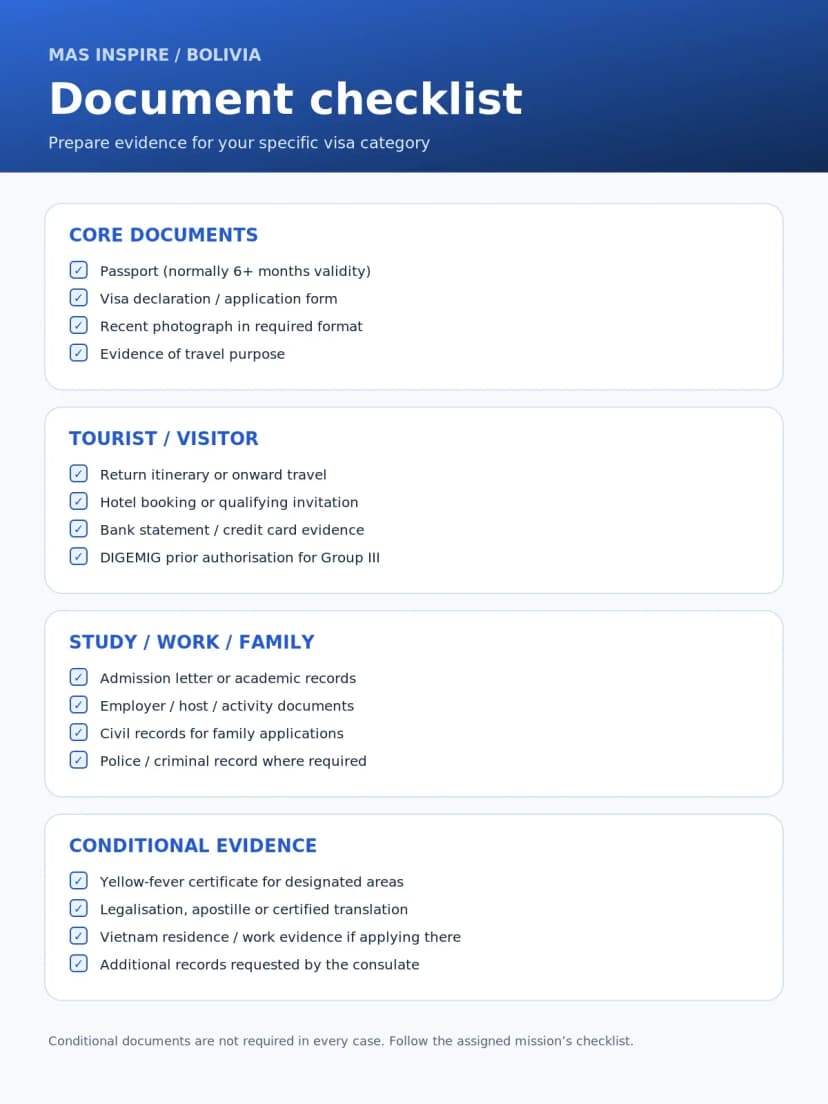
The lists below distinguish common official requirements from conditional evidence. The consulate may request additional or different documents.
Tourist or visitor checklist
| Document | Status | Notes |
|---|---|---|
| Valid passport (minimum six months) | Officially listed | Provide copies as instructed; keep the original available |
| Visa declaration/application form | Officially listed for applicants who need a visa | Use the official visa portal |
| Recent 4 x 4 photograph, red background | Officially listed in general guidance | Confirm exact print/digital specifications |
| Return ticket or itinerary | Officially listed | A reservation may be sufficient if the consulate says so |
| Hotel booking or qualifying invitation | Officially listed | Invitation should meet the Bolivian registration/notarial requirements where applicable |
| Bank statement/card evidence | Officially listed | No universal minimum balance published |
| Yellow-fever certificate | Conditional | Required if visiting designated high-risk areas; check current health rules |
| DIGEMIG prior authorisation | Mandatory for Group III tourist applicants | Pakistan is listed in Group III |
| Vietnam residence permit and employment evidence | Conditional for Vietnam-based applicants | Supports local lawful-residence and consular-jurisdiction request; does not guarantee local acceptance |
Specific-purpose, work, family or health checklist
| Document | Status | Notes |
|---|---|---|
| Passport valid at least six months | Officially listed | Applies to specific-purpose visa types |
| Visa declaration form | Officially listed | Complete the relevant category accurately |
| Evidence of intended activity | Officially listed | Employment contract, host letter, treatment confirmation or family evidence as relevant |
| Invitation from entity/company | Conditional | Official guidance says this is required where applicable, with supporting company/entity documents; exceptions include certain temporary-work, health and family cases |
| Police/criminal/judicial certificate | Officially listed for applicants over 16, subject to category rules | From country of origin or residence as applicable |
| Financial solvency evidence | Generally listed, with exceptions | Official guidance identifies religious and family grounds as exceptions |
| Yellow-fever certificate | Conditional | If visiting designated high-risk areas |
| Photograph | Officially listed | Confirm required format with mission |
| Translations, legalisation or apostille | Conditional | Ask the receiving mission which authentication chain it accepts |
Student checklist
| Document | Status | Notes |
|---|---|---|
| Passport and visa form | Officially listed | Check validity and form instructions |
| Admission/acceptance or study certificate | Essential evidence of purpose | From the recognised school, university or programme |
| Academic records/qualifications | Official guidance lists examples | Certificates, diploma, degree, transcript or school record; legalise as directed |
| Police/criminal record certificate | Conditional/officially listed | Not applicable to children under 16 in the cited consular guidance |
| Yellow-fever certificate | Conditional | Depends on destination within Bolivia and current health rules |
| Financial and accommodation evidence | May be requested | Confirm with mission and institution |
| Exchange agreement | Conditional | Relevant to exchange programmes and their duration/category |
Definitive residence checklist
The migration regulation lists a declaration/application, valid passport or foreigner's identity document, current criminal/police record evidence as applicable, proof of activity in Bolivia, documented financial solvency, a recent photograph and proof of payment. The applicant must also meet the qualifying stay period or an applicable statutory exception. DIGEMIG may require further records or updated certificates.
How to Apply: Step-by-Step
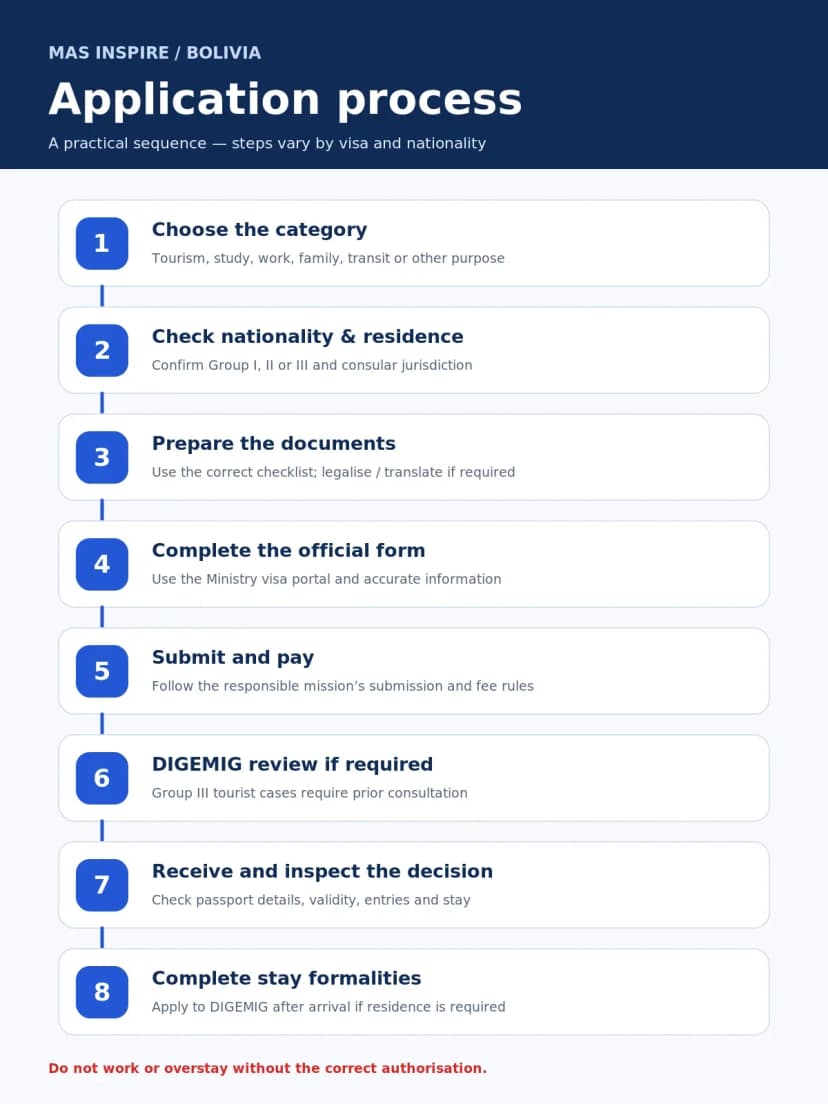
Bolivia's process varies by nationality and visa class. Use these steps as a planning sequence, not a claim that every applicant completes every stage.
- Choose the correct category. Identify whether the trip is tourism, study, employment, family, medical treatment, transit or another specific purpose. If work or long-term residence is intended, do not select tourism merely because it appears simpler.
- Check nationality and residence rules. Confirm whether the passport is Group I, II or III. Pakistani passport holders are Group III in the published embassy list and need DIGEMIG consultation for tourist entry. Ask the responsible mission whether it accepts applications from your country of lawful residence.
- Prepare the documents. Use the checklist for the exact category. Arrange translations and legalisation only as instructed by the receiving mission. Keep originals and clear scans.
- Open the official visa portal if applicable. Start at visas.cancilleria.gob.bo. Use the official government site rather than an agent's imitation portal.
- Complete the correct declaration. Ensure names, passport numbers, travel dates, host details and purpose match the supporting documents.
- Upload or submit documents. Follow the assigned consulate's instructions. Some missions request electronic copies first and originals at an appointment; others may use a different workflow.
- Pay the confirmed fee. Obtain written confirmation of the amount, currency, payment method, refund policy and whether any additional local bank or service charges apply. Do not pay an unofficial intermediary.
- Attend biometrics or an interview if instructed. The general visa guidance reviewed does not establish a universal biometric appointment for every category. Follow the mission's case-specific instruction.
- Wait for DIGEMIG/consular review and check status. Group III tourist cases require prior consultation. Use the tracking method provided by the consulate or portal; no universal tracking timeline is published.
- Review the visa before travel. Check name, passport number, validity, entries and permitted stay. Carry the supporting documents used in the application. At the border, admission remains subject to immigration inspection.
- Complete post-arrival formalities. If the purpose requires temporary stay or residence, register/apply with DIGEMIG within the applicable deadline. Do not work or overstay while waiting for a status change unless the authority has expressly authorised it.
Visa Fees and Financial Requirements
Bolivia's published fees are not a single flat price for every nationality and mission. Reciprocity, visa type, tariff updates and the consular office can affect the amount.
| Visa or fee item | Published amount | Currency | Important qualification |
|---|---|---|---|
| Multiple-entry visa (one-year multiple entries in a mission tariff table) | 200 | US dollars | Published in Bolivian consular tariff tables; confirm current availability and applicability |
| Special sticker tourist visa for United States citizens and Puerto Rico | 160 | US dollars | Listed in the 2025 national consular tariff; special category, not the ordinary tourist fee for all applicants |
| Specific-purpose work / temporary work / family / health | 100 | US dollars | Shown in a Bolivian consular tariff table; mission and category confirmation required |
| General tourist visa under the 2025 tariff | 50 | US dollars | Resolution No. 150/2025 lists the reciprocal tourist visa tariff; nationality rules still apply |
| Regular student visa / student exchange without state agreement | 50 | US dollars | Listed in consular tariff tables; reciprocity and current mission tariff may affect charge |
| Transit visa | 50 | US dollars | Listed in consular tariff tables; confirm requirement by nationality and itinerary |
Fee warning: The highest amounts above are the highest published visa fees identified in the official tariff materials reviewed, not a promise that each is available to every applicant. The $US 160 special sticker fee is specifically described for United States and Puerto Rico nationals. The $US 200 multiple-entry fee appears in mission tariff tables and must be reconfirmed. The 2025 national tariff resolution is the best current national source for the general tourist fee, while category-specific local tables may display different prices. Ask the mission to quote the exact charge for your passport and case before payment.
No universal minimum bank balance was found in the official general guidance. Tourist applicants are asked for evidence of financial solvency, commonly bank statements and/or a credit card. Specific-purpose applications generally require financial evidence, with stated exceptions for family and religious grounds. The amount should be credible for the proposed itinerary and circumstances; do not treat an unofficial online figure as a government minimum.
Visa Processing Times
The official sources reviewed do not publish a guaranteed processing time that applies to all visa categories and nationalities. Group III applications require consultation with DIGEMIG. The Ministry described an electronic authorisation system in earlier material, but that historical description is not a current processing-time commitment.
Allow a generous buffer before travel. Processing may depend on the completeness of the file, verification of documents, consular workload, the need for DIGEMIG review, security checks, holidays and requests for additional evidence. Do not buy non-refundable tickets based solely on an assumed turnaround time. Ask the mission for its current estimate in writing.
Applying from Pakistan or Vietnam
Pakistani passport holders
Pakistan is listed in Group III on the Bolivian Embassy in the UK's published tourist visa group page. Group III applicants require a tourist visa following prior consultation with DIGEMIG. The official tourist checklist includes a passport valid for at least six months, visa form, itinerary/return travel, accommodation or qualifying invitation, financial evidence, photograph and yellow-fever evidence if relevant, plus DIGEMIG authorisation.
A Pakistani citizen should not assume that a visa can be obtained at the border or that an application will be approved simply because the traveller has a valid visa for another country. Confirm the current Group III list and exact submission route with the Bolivian mission assigned to the place of lawful residence.
Pakistani citizens legally living or working in Vietnam
A Pakistani national who lives or works legally in Vietnam should take these additional steps:
- Obtain proof of lawful Vietnamese residence, such as a valid temporary residence card, visa or other status document, and proof of employment or study if relevant.
- Contact Bolivia's Ministry of Foreign Affairs and the nearest Bolivian consular office listed in the official directory. Ask specifically which mission has jurisdiction over Vietnam and whether it accepts Group III applications from Pakistani residents of Vietnam.
- Ask whether the mission will process the application in Vietnam, require an in-person appointment in another country, or direct the applicant to a different consular district.
- Ask how the DIGEMIG prior authorisation is initiated, whether the applicant or host in Bolivia must provide information, and whether originals, translations or legalised copies are required.
- Obtain the current fee, payment currency and method in writing before submitting payment.
The official Bolivian consular directory reviewed did not list a resident Bolivian embassy or consulate in Vietnam. That does not by itself establish which neighbouring mission is competent. The applicant must receive direct confirmation. A Vietnamese residence permit can help establish that the person is lawfully resident in Vietnam, but it does not change Pakistani nationality, remove Group III requirements or guarantee that a particular mission will accept the file.
Applying from Pakistan compared with Vietnam
| Issue | Applying while in Pakistan | Applying while resident in Vietnam |
|---|---|---|
| Nationality group | Pakistani passport remains Group III | Same Group III classification |
| DIGEMIG consultation | Required for Group III tourist entry | Same requirement |
| Consular jurisdiction | Contact the Bolivian mission responsible for Pakistan | Must confirm which mission covers Vietnam; directory reviewed did not list a Vietnam office |
| Proof of residence | Pakistani address/identity and any local status requested | Valid Vietnam residence status and supporting evidence may be requested |
| Local submission | Depends on the responsible mission | Do not assume local acceptance or a Vietnam-based appointment |
| Fees and processing | Confirm with assigned mission | Confirm with assigned mission; currency and payment channel may differ |
Student Visa Guide
Start by securing admission to an eligible Bolivian educational institution or a documented exchange programme. Ask the institution to issue an official acceptance or enrolment letter showing the course, dates, study level and any scholarship or sponsorship arrangements. Check whether the programme falls under a student visa or a specific-purpose category.
The consular guidance lists academic evidence such as certificates of study, school-leaving records, degrees or transcripts and says these may need prior legalisation by the competent consular office. Applicants aged 16 or older may need police/criminal/judicial certificates from the country of origin or last residence. Additional requirements can include proof of funds, accommodation, health/vaccination evidence and exchange agreements.
The published consular description states that the student visa may be valid for up to 60 days and enables the student to apply to DIGEMIG for temporary study stay. The migration regulation describes study stay for up to three years, renewable in periods of up to three years until completion. Exchange students with a state or private agreement are treated separately; the regulation describes a 180-day period for that route. Verify the applicable duration with the consulate and DIGEMIG before travel.
A student visa is not a blanket work permit. Obtain written confirmation before accepting paid work, internships or freelance assignments.
Work Visa and Job Opportunities
A foreign national intending to work in Bolivia should identify the Bolivian employer, host entity or qualifying activity before applying. The specific-purpose visa guidance covers work and temporary work. Supporting evidence may include an employment contract, letter from the employer, company documents, details of the work and the intended duration. Where the official rules require an invitation from an entity or company, the host should prepare it with supporting documentation.
After entry, the worker may need to apply for temporary work-related stay through DIGEMIG. The regulation describes this status as applicable to remunerated or lucrative work, with duration depending on the activity. The worker should also verify tax, labour, professional licensing and social-security obligations separately. A tourist visa does not authorise local employment.
No separate general job-seeker visa, points-based skilled-worker category or digital-nomad visa was identified in the official categories reviewed. An overseas remote-work arrangement is not automatically exempt from immigration rules. Explain the work arrangement to the consulate and request a written classification before travel.
Family Immigration and Permanent Residence
Foreign nationals with qualifying family relationships in Bolivia may be eligible for a family-specific entry or temporary-stay route. Prepare official birth, marriage, adoption or other civil-status records, evidence of the relative's identity and legal status in Bolivia, and proof of dependency where relevant. The authority may require legalisation, apostille or certified translation.
The Migration Law provides a route to definitive residence after at least three years of qualifying stay, subject to statutory conditions and exceptions. It also provides for certain dependent family members of a person granted definitive residence. The regulation lists supporting evidence including valid identity documents, current criminal/police certificates, proof of activity in Bolivia, documented financial solvency, photograph and fee receipt. Study-based temporary stay has a specific restriction and should not be assumed to qualify for definitive residence.
Common Application Mistakes
- Selecting tourism when the real purpose is paid work, study or residence.
- Failing to check the Group I, II or III classification for the passport being used.
- Assuming that a visa issued by another country changes Bolivian nationality-based requirements.
- Treating a Vietnam residence permit as an automatic right to apply at a Bolivian mission in Vietnam.
- Submitting an invitation that does not meet the consulate's requirements.
- Providing inconsistent travel dates, hotel bookings, employer details or bank statements.
- Using documents that have not been translated or legalised as required.
- Assuming that a fee displayed by one consulate applies at every mission.
- Relying on an unverified processing time or buying non-refundable travel too early.
- Starting employment or overstaying before the correct authorisation is granted.
Reasons for Visa Refusal
Bolivia does not publish one exhaustive list of refusal grounds for every category in the general pages reviewed. Common risk factors include incomplete or inconsistent documents, an unclear purpose of travel, inadequate or unexplained finances, unverifiable invitations, adverse immigration or criminal history, failure to satisfy Group III review, concerns about the genuineness of the proposed activity, or an application for a category that does not match the intended conduct.
Never submit false statements, altered bank records, fake bookings or misleading employment information. If refused, request the written decision and ask the consulate whether the rules permit clarification, reconsideration or a fresh application. Do not assume a new application will succeed without addressing the reason for refusal.
Frequently Asked Questions
1. Do Pakistani citizens need a visa for Bolivia?
Yes. Pakistan is listed in Group III in the Bolivian Embassy in the UK's published group list. A tourist visa requires prior consultation with DIGEMIG. Confirm the current classification with the responsible mission before travel.
2. Can a Pakistani citizen get a Bolivia visa on arrival?
Do not assume so. Group III tourist applications require prior DIGEMIG consultation and a consular process. Obtain written confirmation from the Bolivian mission before departure.
3. Can a Pakistani national apply from Vietnam?
Possibly, if the Bolivian mission responsible for Vietnam accepts applications from lawful residents there. The official directory reviewed did not list a Bolivian office in Vietnam, so the applicant must confirm the competent mission and local acceptance directly.
4. Does a Vietnam residence card remove the Group III requirement?
No. Residence in Vietnam does not change Pakistani nationality or remove the Group III prior-consultation requirement.
5. What is the tourist visa fee for Bolivia?
The 2025 national consular tariff lists $US 50 for the general tourist visa under the reciprocal tariff. Special categories and mission-specific charges can differ. Confirm the amount for your nationality and consulate.
6. How long can a tourist stay in Bolivia?
The visa and entry permission specify the authorised stay. Official regulations describe tourist/visitor transitory stay and the possibility of extensions under DIGEMIG rules. Check the actual entry stamp/visa and current extension rules; do not infer stay length from visa validity alone.
7. Can I work in Bolivia on a tourist visa?
No. Tourist status is for rest or visits and does not authorise paid or lucrative work. Obtain the correct specific-purpose/work authorisation and temporary stay.
8. Is there a Bolivia digital nomad visa?
No standalone digital-nomad category was identified in the official visa information reviewed. Ask a Bolivian consulate how the proposed remote-work activity is classified before travel.
9. What documents are needed for a Bolivia student visa?
Common documents include a valid passport, visa form, study/admission evidence, legalised academic records where required, and police/criminal record evidence for applicants aged 16 or older. The mission may request financial, accommodation and health documents.
10. Can international students work in Bolivia?
A student visa is not a blanket work permit. Ask DIGEMIG and the consulate whether the proposed work, internship or paid placement requires separate authorisation.
11. How long does a Bolivia visa take to process?
No universal official processing time was identified. Group III tourist applications require DIGEMIG consultation, and timing depends on the case and mission. Request a current estimate directly.
12. Is there a minimum bank balance for a Bolivia visa?
The general official guidance asks for evidence of financial solvency but does not state one universal minimum balance. Provide genuine, traceable evidence proportionate to the trip and follow any case-specific instruction.
13. Can I apply for permanent residence in Bolivia?
The Migration Law generally provides for definitive residence after at least three years of qualifying stay, subject to requirements and exceptions. Study-based temporary stay has a specific restriction. Confirm your qualifying period with DIGEMIG.
14. Does Bolivia have a job-seeker visa?
No general job-seeker visa was identified in the official categories reviewed. A work route generally requires a qualifying work activity and the correct specific-purpose and temporary-stay authorisations.
15. Where is the official Bolivia visa application website?
Use the Ministry of Foreign Affairs' official portal at visas.cancilleria.gob.bo and check DIGEMIG for migration stay procedures.
Official Immigration Websites
- Bolivia Ministry of Foreign Affairs
- Official visa application portal
- Consular visa guidance
- Bolivian Embassies portal
- Bolivian consular directory
- General Directorate of Migration (DIGEMIG)
- Migration Law No. 370
- Supreme Decree No. 1923 — migration regulation
Final Checklist and Conclusion
Before applying, make sure you have:
- Checked the current visa group for your passport nationality.
- Selected a category that matches your genuine travel purpose.
- Confirmed the responsible Bolivian consulate and whether it accepts applications from your country of residence.
- Checked the current official form and document list.
- Prepared a passport with the required validity and all supporting records.
- Arranged legalisation, apostille or translation only as instructed.
- Confirmed any DIGEMIG prior authorisation, especially for Group III tourist applications.
- Obtained the exact fee, payment method and current processing estimate from the mission.
- Avoided non-refundable travel arrangements until the visa is issued.
- Understood whether a separate DIGEMIG stay authorisation is required after arrival.
Bolivia offers several routes for visitors, students, workers and family members, but the right permission depends on nationality and purpose. Pakistani citizens should pay particular attention to the Group III prior-consultation requirement. Pakistani residents of Vietnam should also verify consular jurisdiction before preparing an application: Vietnamese residence can support a local application request, but it does not guarantee acceptance or remove nationality-based rules.
Disclaimer: This article is for general educational information only and is not legal advice. Immigration rules, forms, fees, nationality groups and consular procedures may change without notice. MAS Inspire is an independent educational publisher and is not a Bolivian government authority, embassy, consulate or visa agent. Always confirm your individual case with the official Bolivian authorities before acting.